Lloyd’s of London has committed to leading the market to a net zero underwriting position, yet it does not mandate or restrict the underwriting policies of its 85 members. Image: Dmitry Tonkonog, CC BY-SA 3.0 https://creativecommons.org/licenses/by-sa/3.0, via Wikimedia Commons
Lloyd’s of London, Zurich and Swiss Re among top 10 insurers of largest US coalmines, study finds
Lloyd’s of London and other big European insurers are underwriting almost a third of US coal production despite their net zero pledges, according to research, with the Lloyd’s insurance market emerging as the second-biggest player.
A report from the Insure Our Future campaign group found that Lloyd’s, Zurich and Swiss Re are among the top 10 insurers of the 25 biggest US coalmines, which produced more than 60% of the country’s output last year. They underwrite 13 mines producing 30.7% of US coal.
Coal is the largest contributor of carbon dioxide emissions, and the US is the fourth largest producer of coal worldwide, last year mining 595m short tons – a measure commonly used in the US equal to 2,000 pounds (907.18 kg).
Even though 45 big global insurers have adopted policies limiting coal underwriting in recent years, the report found that some are exploiting loopholes or violating their own policies to continue insuring coalmines.
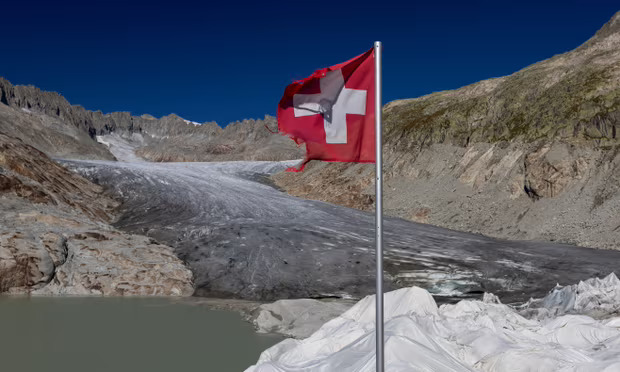
A Swiss flag at the Rhône glacier in Obergoms, Switzerland. Photograph: Denis Balibouse/Reuters
Swiss glaciers have lost 10% of their volume in just two years, a report has found.
Scientists have said climate breakdown caused by the burning of fossil fuels is the cause of unusually hot summers and winters with very low snow volume, which have caused the accelerating melts. The volume lost during the hot summers of 2022 and 2023 is the same as that lost between 1960 and 1990.
The analysis by the Swiss Academy of Sciences found 4% of Switzerland’s total glacier volume vanished this year, the second-biggest annual decline on record. The largest decline was in 2022, when there was a 6% drop, the biggest thaw since measurements began.
Experts have stopped measuring the ice on some glaciers as there is essentially none left. Glacier Monitoring in Switzerland (Glamos), which monitors 176 glaciers, recently halted measurements at the St Annafirn glacier in the central Swiss canton of Uri since it had mostly melted.
Timing, they say, is everything. Yesterday, the world’s energy watchdog, the International Energy Agency (IEA), published its latest report, the 2023 Net Zero Roadmap.
The IEA categorically stated that the time for no new oil and gas was over. If we are to keep temperatures to 1.5 degrees, then world leaders must not develop new oil, gas, or coal beyond existing fields.
If we want a liveable planet, we must shift from fossil fuels to renewables.
This is not the first time, either, that the IEA has confirmed that no new oil, gas, or coal fields are compatible with limiting global temperature rise to 1.5ºC.
“Keeping alive the goal of limiting global warming to 1.5 °C requires the world to come together quickly. The good news is we know what we need to do – and how to do it,” said IEA Executive Director, Fatih Birol at the launch of the report. The IEA reiterated the way to do it is not to approve new oil and gas fields.
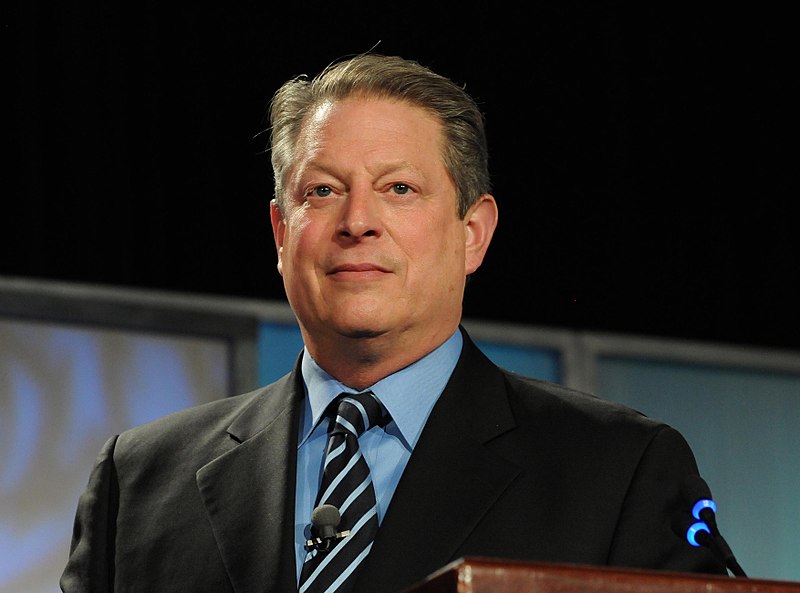
Image of Al Gore by JD Lasica Creative Commons Attribution 2.0 Generic license.
At an event coinciding with the U.N. General Assembly in New York, Gore said he used to believe the sector sincerely wanted to be part of the solution to the climate crisis, but now he thinks it’s clear they are not.
Former U.S. Vice President Al Gore, a long-time climate activist, had harsh words for the fossil fuel industry on Thursday.
“Many of the largest companies have engaged in massive fraud,” he said at The New York Times’ Climate Forward event, as the Independent reported. “For some decades now, they’ve followed the playbook of the tobacco industry, using these very sophisticated, lavishly financed strategies for deceiving people.”
Gore, who won the Nobel Peace Prize in 2007, criticized the industry for using their influence to lobby against effective climate action.
“The climate crisis is a fossil fuel crisis.”
“The fossil fuel companies, given their record today, are far more effective at capturing politicians than they are at capturing emissions,” he said.
Now, he warned, the sector had set its sights on the United Nations COP28 climate change conference in the United Arab Emirates with the appointment of the UAE’s state oil company CEO Sultan Ahmed Al Jaber to lead the talks.
“That’s just, like, taking the disguise off,” Gore said, as The New York Times reported. “They’ve been trying to capture this process for a long time.”
Gore’s remarks reflect a recent shift in the tone of his climate advocacy. In a TED Talk filmed in July and released in August, Gore made many of the same arguments about fossil fuel lobbying and Al Jaber’s appointment.
“The climate crisis is a fossil fuel crisis,” he said. “The solutions are going to come from a discussion and collaboration about phasing out fossil fuels.”
After listening to the talk, journalist Emily Atkin wrote in her newsletter Heated:
With this new talk, it’s become clear that the man who made An Inconvenient Truth famous is no longer primarily focused on convincing people that the climate crisis is real or dangerous. He’s turned a corner, and is now focused on convincing people that if they truly care about solving the climate crisis, they must turn their ire toward the fossil fuel industry—and boot them from the negotiating table before it’s too late.
Gore acknowledged the shift in his thinking himself on Thursday.
“I was one of many who felt for a long time that the fossil fuel companies, or at least many of them, were sincere in saying that they wanted to be a meaningful part of bringing solutions to this crisis,” Gore said, as The Independent reported. “But I think that it’s now clear they are not. Fossil fuel industry speaks with forked tongue.”
While he acknowledged that it was not fair to expect the industry to solve a crisis its business model encouraged it to perpetuate, “it’s more than fair to ask them to get out of the way, and stop blocking the efforts of everybody else to solve this crisis,” he said. “I think it’s time to call them out.”
Gore’s remarks came as world leaders and climate activists and experts gathered in New York for the U.N. General Assembly and Secretary-General António Guterres’ Climate Ambition Summit, held the day before.
He is also not the only prominent mainstream climate voice to have turned on the fossil fuel sector.
Former Executive Secretary of the U.N. Framework Convention on Climate Change Christiana Figueres, who helped negotiate the Paris agreement, said that she did not think the industry should be invited to COP28.
“If they are going to be there only to be obstructors, and only to put spanners into the system, they should not be there,” she said at a conference Thursday organized by Covering Climate Now, as The Guardian reported.
Her remarks echoed an opinion piece she wrote for Al Jazeera in July, in which she said she was wrong to believe that the sector could be part of the solution.
“My patience ran out, and I say this with sadness,” she said Thursday.
Heatwaves around Mediterranean have damaged harvests and forced producers to import from South America
Olive oil groves by Birding In Spain, CC BY-SA 4.0 <https://creativecommons.org/licenses/by-sa/4.0>, via Wikimedia Commons
Europe has almost run out of local olive oil supplies and is set for more shortages, after extreme weather damaged harvests for a second year.
The world’s largest producer has said it is having to import supplies from South America to keep up with demand.
“Today it is almost physically impossible to buy olive oil. It is sold out,” Walter Zanre, the chief executive of the UK arm of Filippo Berio, said.
Olive trees have been cultivated around the Mediterranean for thousands of years, with Spain alone producing half of the world’s supply of olive oil, but wildfires and soaring summer temperatures mean the future of this ancient industry is looking increasingly uncertain.
Global production is expected to fall to 2.4m tonnes according to the International Olive Council, less than last year’s harvest and well short of global demand of about 3m tonnes, after drought and heatwaves of more than 40 degrees hit production in Spain.
Extreme weather in other important growing regions including Greece, Italy and Portugal as well as Turkey and Morocco has added to the crisis.