Met police confirm protesters held on suspicion of public order offences, including one related to placard
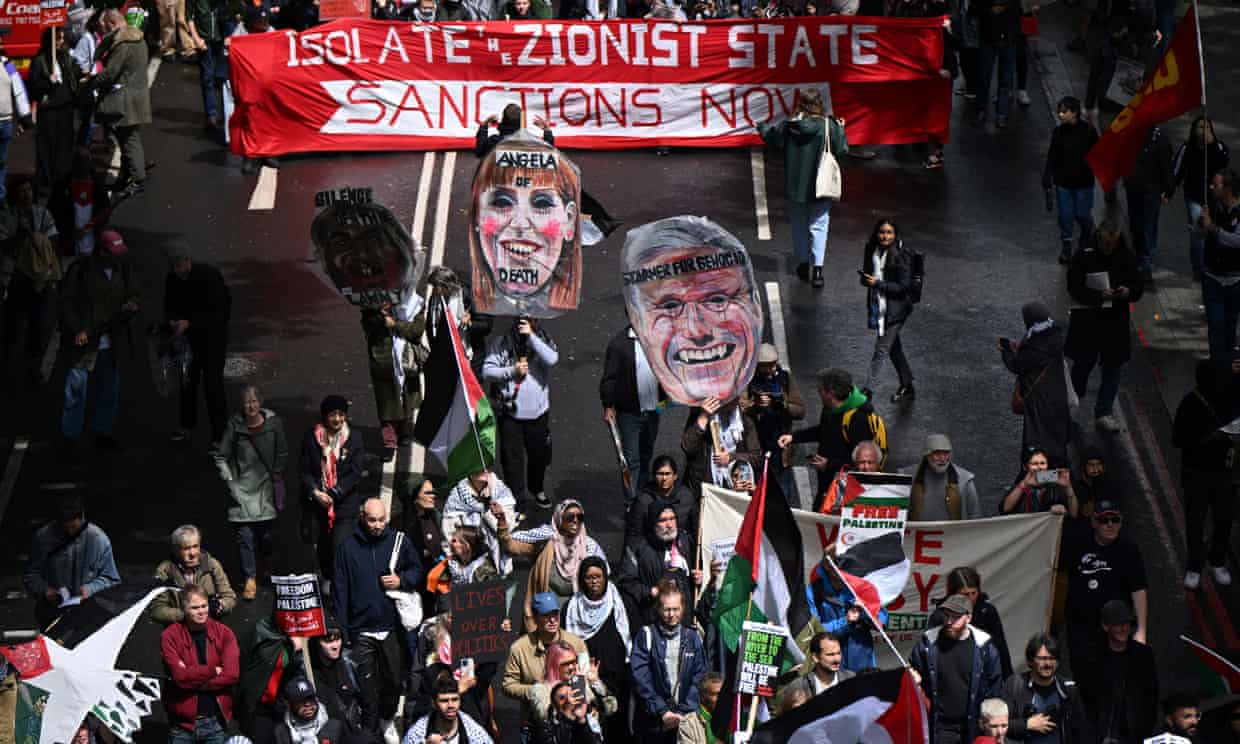
Four people were arrested on Saturday on suspicion of public order offences while attending a pro-Palestinian march in central London, including one relating to a placard.
The Metropolitan police confirmed on X that three people were held on suspicion of breaching Public Order Act conditions imposed on the march, with a fourth man detained on suspicion of a racially aggravated public order offence relating to a placard.
Organised by the Palestine Solidarity Campaign, tens of thousands of protesters took to the streets on the first day of a new Labour government to call for an immediate ceasefire in Gaza.
…
This latest protest comes after the health ministry in Gaza confirmed that at least 38,098 Palestinians have been killed and 87,705 others injured since Israel’s military offensive in Gaza began on 7 October.
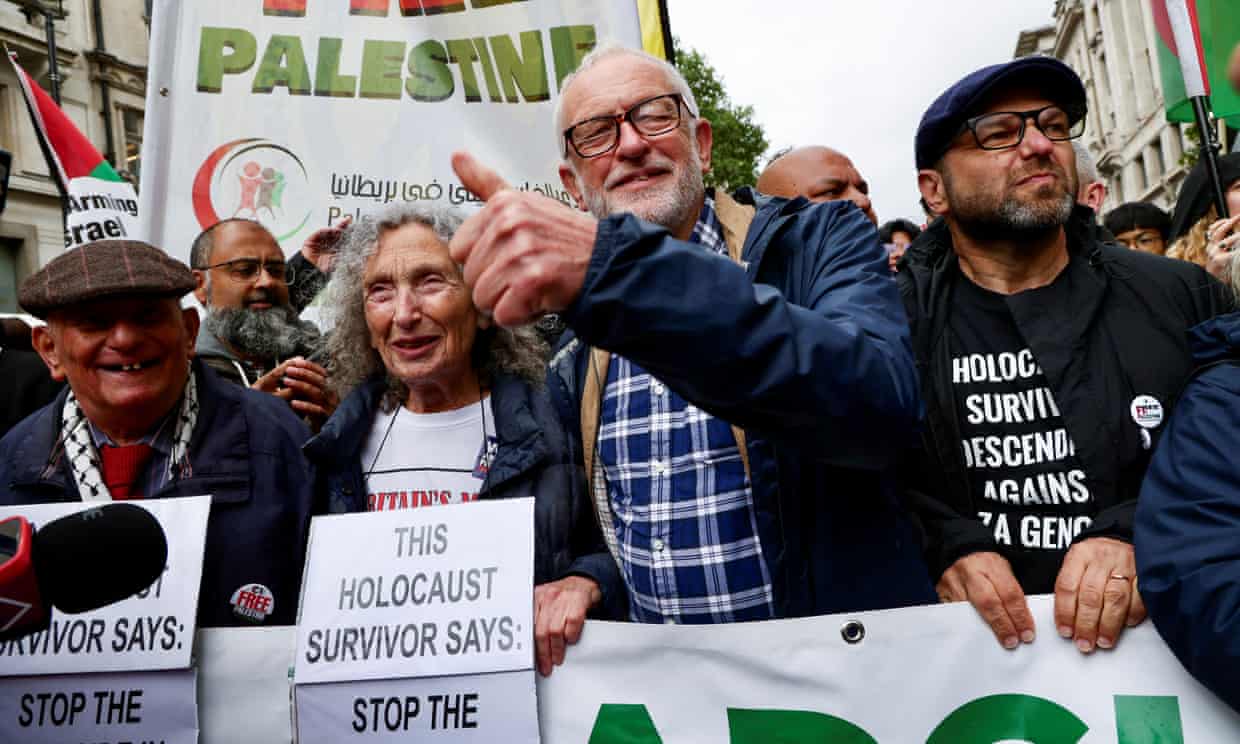
Jeremy Corbyn, the independent MP for Islington North, joined pro-Palestine march in London. Photograph: Yann Tessier/Reuters [Jeremy Corbyn 2nd from right is joined by Andrew Feinstein, far right, former ANC Member of the National Assembly of South Africa who stood as an independent candidate against Starmer because of Starmer’s support for Israel’s Gaza genocide.]
In attendance was the re-elected independent MP for Islington North, Jeremy Corbyn, who told protesters that “a change in government doesn’t change the facts that the people of Gaza are still being murdered in their sleep”.
“We said it to the Tories, and now we will say it to Labour: a government that sells arms to Israel is a government that is complicit in crimes against humanity.”
Zionist Keir Starmer is quoted “I support Zionism without qualification.” He’s asked whether that means that he supports Zionism under all circumstances, whatever Zionists do.
Labour secures landslide victory in UK general election, but triumph marred by centrist program and stance on Gaza
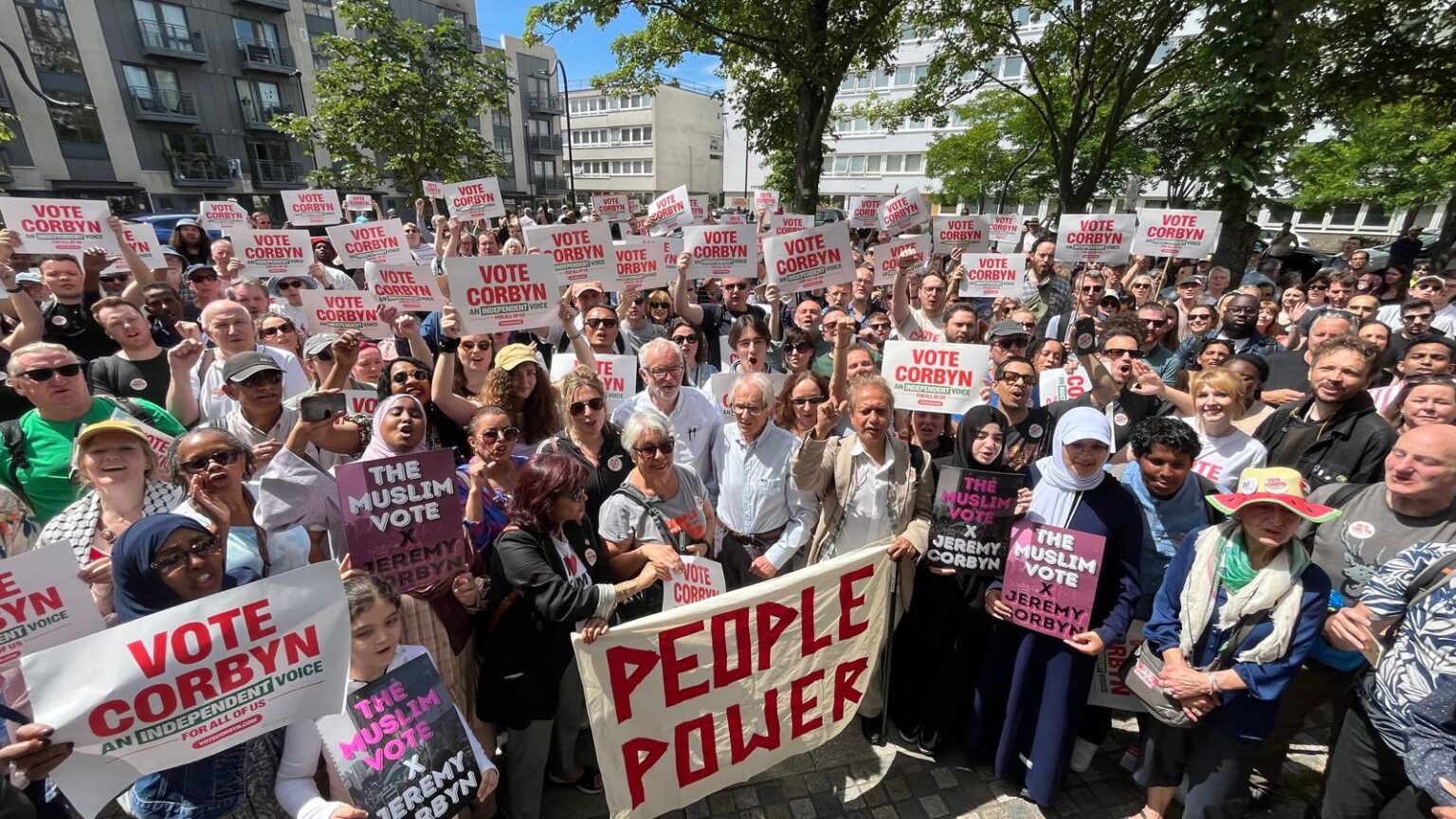
Jeremy Corbyn has been re-elected to the British Parliament, this time as an independent candidate. Corbyn won in his long-standing constituency of Islington North with a margin of over 7,000 votes over Labour candidate Praful Nargund. According to Corbyn, the result in Islington North is “a warning to the incoming government that dissent cannot be crushed without consequences. That ideas of equality, justice, and peace are eternal.”
Labour leadership blocked Corbyn from standing as a party candidate in this election following years of a campaign against him within party structures and in corporate media. Like other Labour members leaning explicitly towards the left, Corbyn faced extreme pressure and attacks against his policies, even during his tenure as Labour leader, despite receiving widespread support among the public.
The incoming government Corbyn referred to will be a Labour one. Keir Starmer is set to become the next prime minister after the party secured one of its biggest electoral victories in history, winning 412 seats. In comparison, the Conservatives, who held power for almost 15 years, struggled to reach 121 seats. These results align with pre-election polls, which predicted that former prime minister Rishi Sunak and his party would be punished for failing to address crucial issues such as the cost of living crisis, struggling public services, including the National Health Service (NHS), and more.
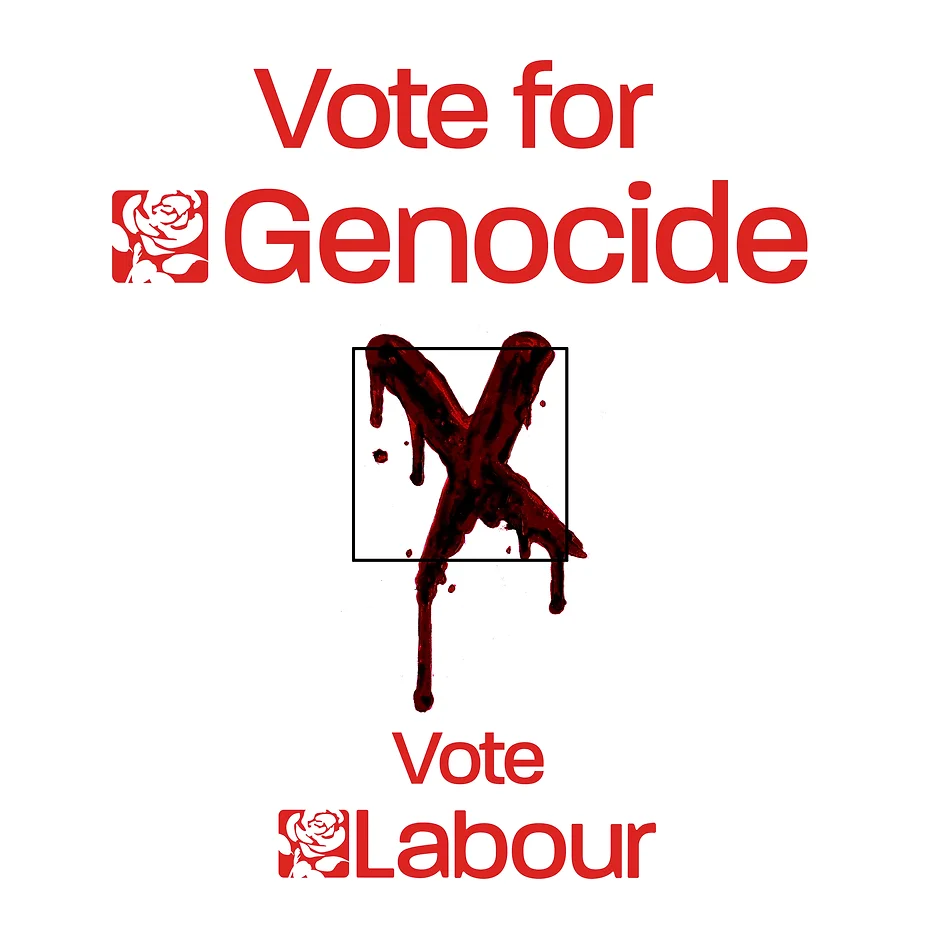
Election night brought some surprises, even for the triumphant Labour. The party lost to independent candidates running on an explicitly pro-Palestine platform in several constituencies in addition to Islington North. Starmer’s stance on Israel’s attacks on the Gaza Strip since October last year, as well as Labour’s unwillingness to adopt a decisive call for a ceasefire early in the war on Gaza, alienated a significant part of the Labour voting base. Despite their eagerness to oust the Tories, thousands of voters made clear that the next government would be held accountable for its international alliances, including support for Israel.
Gains were recorded by the Green Party, which secured four seats in Parliament, and Nigel Farage’s right-wing Reform UK, which obtained the same number of representatives despite joining the campaign at the last minute. The Liberal Democrats increased their representation to over 70 seats, while the Scottish National Party (SNP) suffered a major blow, keeping only 9 seats, down by 37 from the last election.
Despite widespread relief being reported at the Tories being ousted from power, many voters remain uncertain about what to expect from Starmer’s new cabinet. Labour’s campaign manifesto was described by many on the left as insufficient to represent a decisive break from the path set by the Tories, including the continued commodification of essential services such as healthcare. Speaking after the announcement of election results, Corbyn described the Labour manifesto as “thin, to put it mildly,” and emphasized that public demands for improvements will be huge.
Although the measures currently proposed by Labour are far from enough to get the UK on the right track, the presence of Corbyn and other progressive voices like Diane Abbott, who is likely to be re-elected as a Labour MP, will ensure the new administration is held accountable for its decisions.
“Tonight’s results in Islington North give us a glimpse of a different future, which puts the interests of the many ahead of those of the few,” Corbyn said in his post-election statement. “Tonight, we celebrate. Tomorrow, we organize. The energy we have unleashed will not go to waste.”
Additional comments by dizzy dissident: I regard Keir Starmer as a thoroughly dishonest politician of the Tony Blair and Boris Johnson tradition. He has claimed to be a Socialist while intending to pursue a thoroughly conventional NeoLiberal and Zionist agenda. Despite campaigning on the inane slogan of “change” the reality is no change. Diss ent cannot be crushed without consequences.
This month brought yet another record-breaking spate of flash floods and deadly heatwaves across the US. Yet, as a new study by Heated (6/27/24) reveals, despite ample reporting on these events, a majority of news outlets still did not link these events to their cause: climate change.
Emily Atkin and Arielle Samuelson, writers for the climate-focused, Substack-based outlet, analyzed 133 digital breaking news articles from national, international and regional outlets reporting on this month’s extreme weather. Just 44% mentioned the climate crisis or global warming. Broken down by weather event: 52% of stories that covered heatwaves, and only 25% of stories that covered extreme rainfall, mentioned climate change.
As Atkin and Samuelson write, by now we know that climate change is the main cause of both extreme heat and extreme flooding. And we know the biggest contributor of climate-disrupting greenhouse gasses: fossil fuels, which account for about 75% of global emissions annually.
Still, the study’s authors found, only 11% of the articles they studied mentioned fossil fuels. Only one piece (BBC, 6/24/24) mentioned deforestation, which scientists say contributes about 20% of annual greenhouse gas emissions. None mentioned animal agriculture, which the FAO estimates contributes about 12% of global emissions.
Stark omissions
The omissions were laughably stark: A New York Post piece (6/21/24) ended with a New Yorker and former Marine who said he’d been in “way hotter conditions”—in Kuwait and Iraq. An AP article (6/4/24) quoted the “explanation” offered by a spokesperson for the Arizona Department of Forestry and Fire Management: “It does seem like Mother Nature is turning up the heat on us a little sooner than usual.”
Heated recognized some outlets that consistently mentioned climate change in their breaking coverage of heat and floods this month. That list included NPR, Vox, Axios, BBC and Agence France-Presse (AFP).
Then there were the outlets whose breaking coverage never mentioned it: ABC News, USA Today, The Hill, the New York Post and Fox Weather. When questioned, many of these outlets pointed the study’s authors to other climate coverage they had done, but this study’s focus on breaking news stories was deliberate:
Our analysis focused only on breaking stories because climate change is not a follow-up story; it is the story of the lethal and economically devastating extreme weather playing out across the country. To not mention climate change in a breaking news story about record heat in June 2024 is like not mentioning Covid-19 in a breaking news article about record hospitalizations in March 2020. It’s an abdication of journalistic responsibility to inform.
Explaining isn’t hard
A crucial takeaway for journalists and editors in this piece is that explaining the cause of these weather events isn’t hard. It’s often a matter of adding a sentence at most, Atkin and Samuelson write. They provide examples of stories that successfully made this connection, as with BBC (6/24/24):
Scientists say extreme weather events are becoming more frequent and intense as a result of human-caused climate change, fueled by activities like burning fossil fuels and cutting down forests.
Heatwaves are becoming more severe and prolonged due to the global climate crisis, caused primarily by the burning of fossil fuels.
Notably, the Guardian piece was a reprint of an AParticle that did not originally include that sentence; Heated confirmed that it was added by a Guardian editor.
AP, however, was sometimes able to provide appropriate context, as in a June 21 piece:
This month’s sizzling daytime temperatures were 35 times more likely and 2.5 degrees F hotter (1.4 degrees C) because of the warming from the burning of coal, oil and natural gas—in other words, human-caused climate change.
More denial than acknowledgment
During last summer’s apocalyptic orange haze on the East Coast, caused by record Canadian wildfires, I conducted a similar study (FAIR.org, 7/18/23) on US TV news’s coverage. Out of 115 segments, only 38% mentioned climate change’s role. Of those 115, 10 mentioned it in passing, 10 engaged in climate denial and 12 gave a brief explanation without alluding to the reality that climate change is human-caused. Only five segments acknowledged that climate change was human caused, and just seven fully fleshed out the fact that the main cause of the climate crisis is fossil fuels.
When there are more segments denying climate change than acknowledging fossil fuels’ role in it, you know there’s a problem.
This year, I noticed coverage of worldwide coral bleaching that did make the appropriate connections (FAIR.org, 5/17/24). As Atkin and Samuelson emphasized, the difference between careless and responsible reporting on this issue is often just a few words.
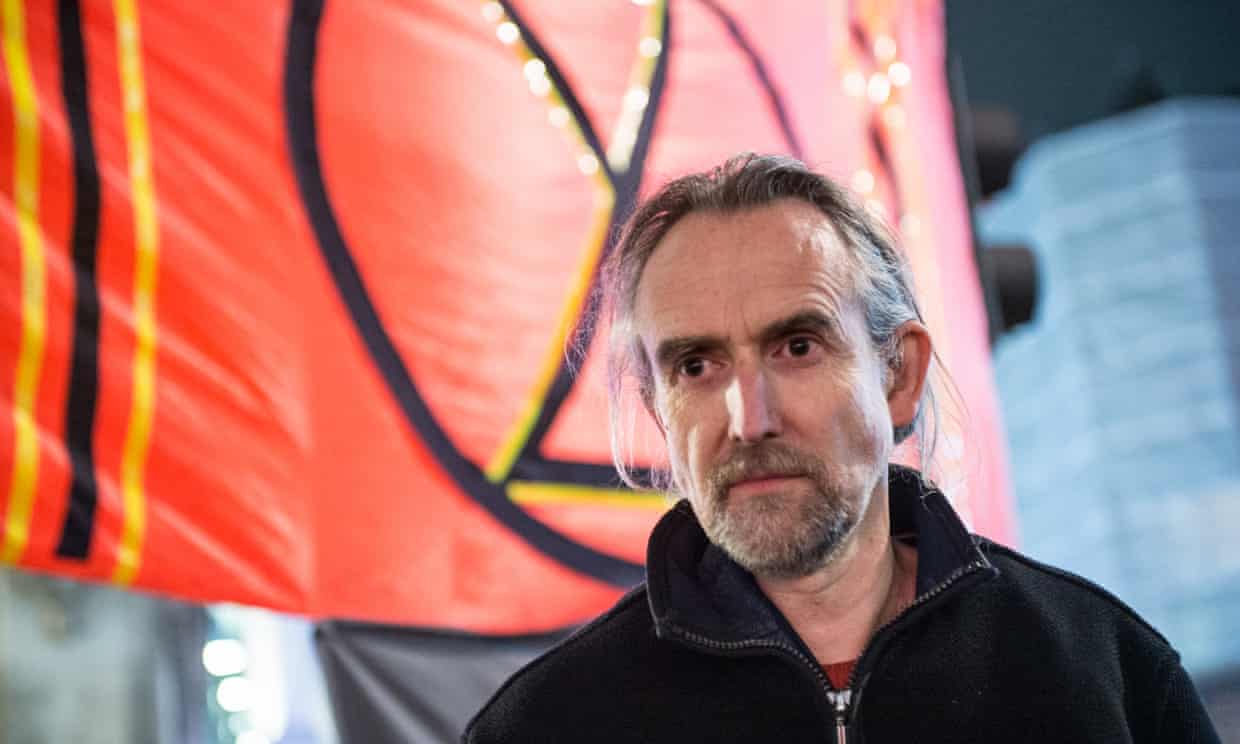
Roger Hallam, on trial for conspiring to block traffic on the M25 in 2022, said he wanted to ‘speak the whole truth’. Photograph: Ollie Millington/Getty
Accused speak out of turn about climate threat and challenge judge who orders jury to leave
There was chaos in the courtroom at a climate protest trial when two defendants stood and made statements defying the authority of the court.
At separate points during the trial on Thursday, Roger Hallam and Daniel Shaw, charged along with three others with conspiring to block traffic on the M25 in 2022, stood up in front of the jury and spoke out of turn.
Hallam, whose evidence was discontinued on Wednesday, stood up just as court got under way on Thursday and said: “I wish to communicate to the jury and the court that I was forcibly removed from the court yesterday for refusing to break my oath and speak the whole truth.”
Later on, while Louise Lancaster, a co-defendant, was in the witness box, Shaw, whose evidence was also discontinued on Wednesday, stood up from his place in the court and directly challenged the judge.
He said: “Climate change represents an existential threat to humanity. The court agrees with that. Why are you not trying the people causing this crisis?”
Each time the defendants continued speaking as the judge, Christopher Hehir, ordered the jury to leave the court.
Lancaster refused to submit to cross-examination by the prosecution, as Shaw and Hallam had done the previous day, prompting Hehir to discontinue her evidence.
Hehir told jurors: “Members of the jury, in your absence I had a discussion in open court with Miss Lancaster. In frank and straightforward terms she has told me she is not prepared to submit to cross-examination. In those circumstances her evidence is at an end.”
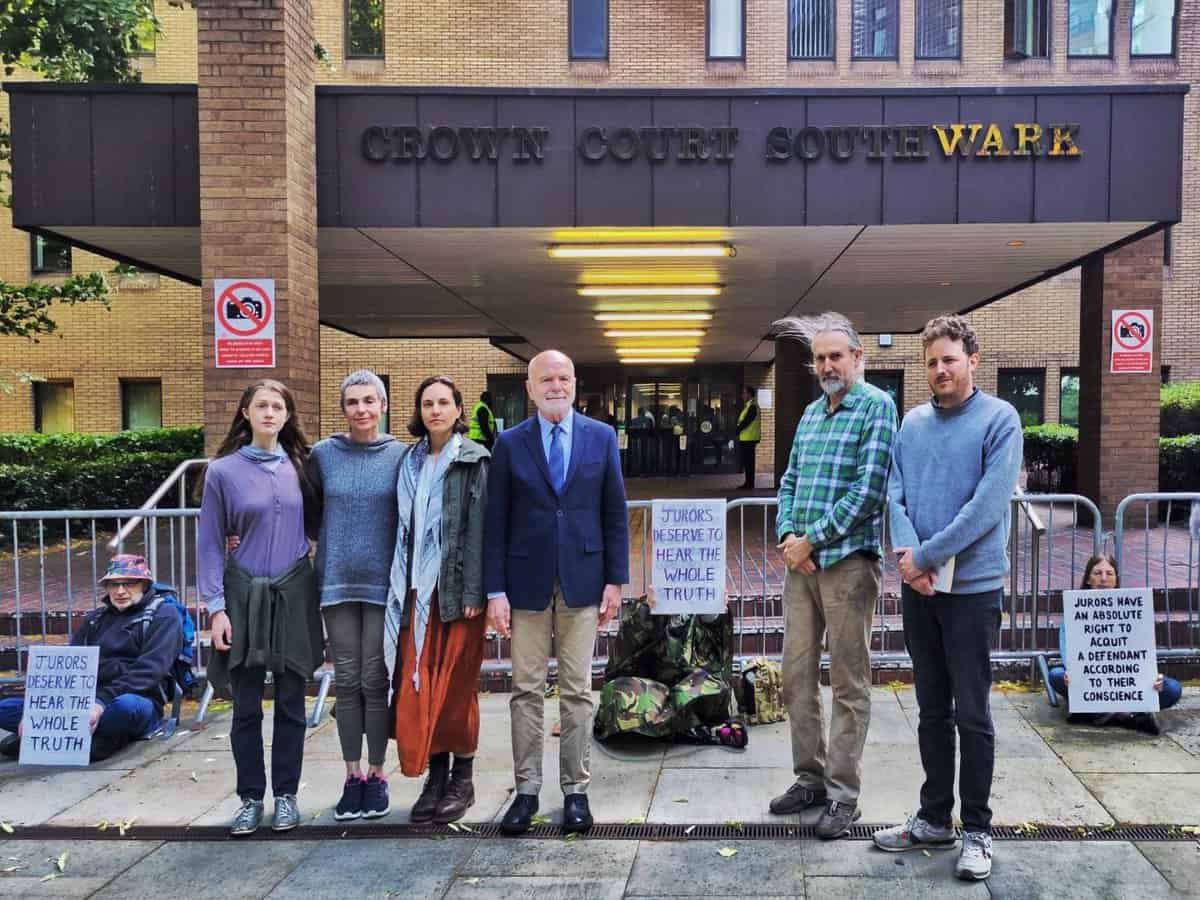
UN Special Rapporteur on Environmental Defenders under the Aarhus Convention and former UN Special Rapporteur on Human Rights Defenders Michel Forst is attending the ongoing trial of five Just Stop Oil supporters at Southwark Crown Court today. He is attending as an observer because of his serious concerns.
The special rapporteur’s office released a statement on 24th June detailing his views regarding the criminal prosecution of Daniel Shaw in this trial. The statement can be read here.
The Aarhus Convention, to which the UK is a signatory, aims to promote environmental democracy by ensuring public access to information, participation in decision-making, and access to justice in environmental matters. The Special Rapporteur monitors the implementation of the convention’s provisions by its parties, ensuring compliance with obligations related to access to justice. Additionally, the Special Rapporteur investigates complaints from individuals or groups alleging violations of their rights under the Aarhus Convention, assesses specific cases, and makes recommendations to ensure compliance.
Daniel Shaw, Cressie Gethin, Lucia De-Abreu-Whittaker, Louise Lancaster and Roger Hallam are currently on trial at Southwark Crown Court, charged with conspiracy to cause a public nuisance in connection with the M25 gantry actions in November 2022. They were arrested either pre-emptively in police raids at their homes after attending a Zoom call in which a Sun journalist was present, or arrested travelling near the M25 respectively. The Sun alleged it had ‘infiltrated’ the meeting and boasted of tipping off the police and enabling National Highways to secure a public injunction.
Some of these five were imprisoned for up to 113 days without trial. They were released subject to stringent conditions including a 10 pm to 7 am house curfew, not to be within a one-mile radius of the M25, no contact with other defendants and not to participate in any climate change demonstration.
In another trial involving Just Stop Oil supporters, which was the first under the new Public Order Act 2023 for a Section 7 offence, Judge Hehir who is overseeing the current proceedings barred all legal defences from the defendants and prohibited any mention of the climate crisis to the jury. This trial concluded with a conviction, and Judge Hehir is expected to sentence the defendants at a future date.