I’m writing about someone without naming him or her. It might be worth using these metrics with anyone, see if they’re capable and adjusted?
She is easily manipulated because: She is not able to appreciate anyone else’s perspective and is therefore incapable of empathy. She can’t distinguish her own interests from the interests and responsibilities of her office or position.
The second issue may derive from the first: if you haven’t progressed from – or regressed to – infantile self-interest then there are no responsibilities and interests other than your own. Rich people are taught to only be concerned for themselves.
…
12 Feb 2025
Since writing this yesterday I’ve realised that this might also apply to myself [edit: i.e. “… can’t distinguish her own interests from the interests and responsibilities of her office or position.”] I was appointed to a position without my knowledge or consent in the early 90s. Some would say that I wasn’t appointed and that it was instead a recognition. Soon later I went off grid and disappeared. My attitude is that since I didn’t have an option in it, FU you’re stuck with me and I’ll do as I like which in practice means I had chosen my path and I continue. Seniority appears to apply to this position and to me. I’m surprised that some people respect this position while many others seem to rebel against it and me, use their positions to try to entrap and persecute me. [14/2/25 Not so much now, used to happen so much when Bliar was PM and into late 00s.] Life is interesting and strange and then you die.
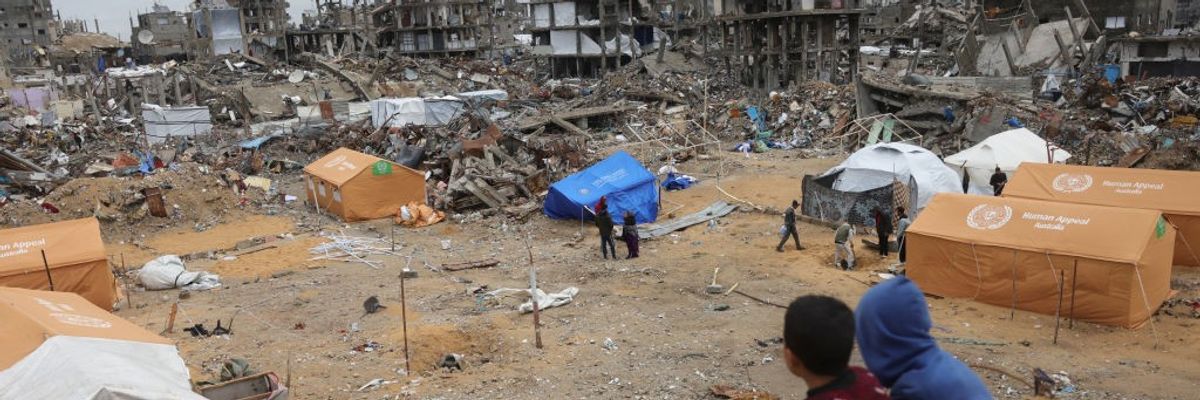
Displaced Palestinian children sit on a sand mound overlooking tents set up amid destroyed buildings in Jabalia in the northern Gaza Strip on February 6, 2025. (Photo: Bashar Taleb/AFP via Getty Images)
“Palestine is not just an idea—it is a place. It is a homeland to the Palestinian people,” the coalition wrote.
A coalition of over 100 organizations on Monday forcefully denounced U.S. President Donald Trump’s plan to ethnically cleanse the Gaza Strip of Palestinians and take over the coastal enclave recently decimated by an Israeli military campaign conducted with American weapons.
Led by A New Policy—a group founded by Biden administration officials who resigned in protest—and the Quaker organization Friends Committee on National Legislation, the coalition said that “we are deeply alarmed by President Trump’s recent statements, tracing them back to January 25, just days after the Republican returned to power.
“We, the undersigned organizations, decry and oppose any effort or initiative, and any calls for, the forcible displacement of Palestinians from Gaza, and support the joint statement of Egypt, Jordan, Saudi Arabia, the United Arab Emirates, Qatar, the Palestinian Authority, and the Arab League that similarly rejected any such steps, the coalition wrote, citing the Fourth Geneva Convention.
The letter highlights the ethnic cleansing of Palestine in the 1940s during the formation of the modern state of Israel, which Palestinians call the Nakba, Arabic for catastrophe; that since 2006, Gaza “has been in a state of siege,” with residents enduring repeated bombardment and restrictions on necessities; and that since the Hamas-led October 7, 2023 attack on Israel, they have faced what various experts have found to be a plausible case of genocide, with over 48,000 people killed.
“Through this all, the Palestinians in Gaza have stood with remarkable dignity and perseverance, insisting throughout the immense suffering and loss that they will never abandon their homeland,” the letter continues, echoing recent remarks from residents. “We are deeply concerned by clear statements of intent from Israeli government officials over the past year concerning the creation of new Israeli settlements within the Gaza Strip, which further reinforce the intent of ethnic cleansing.”
“The United States has no right to dictate to the Palestinian people in Gaza to leave, and direct other countries to participate in their displacement. We are also aware that even a temporary external displacement could be used by Israel to enact permanent exile,” the letter says. “While we agree that the short and medium-term humanitarian needs of the people of Gaza may be difficult to meet given the nearly complete destruction that Israel has wrought, if the necessary services cannot be provided in Gaza, the people of Gaza must be able to access them elsewhere within the historic borders of Palestine and must be able to return.”
The coalition also expressed alarm over “an uptick in settler violence” and deadly Israel Defense Forces operations in the illegally occupied West Bank, writing that “these actions are part and parcel of a strategy that seeks to make not just Gaza, but all Palestinian areas across historic Palestine, unlivable for the Palestinian people, and are thus contributory to a process of ethnic cleansing.”
“Palestine is not just an idea—it is a place. It is a homeland to the Palestinian people,” the groups stressed. “To participate in, facilitate, or endorse their removal from it would violate every precept of international law, devastate the rules-based international order that protects us all, do irreversible harm to America’s global influence, and be an act of unconscionable immorality.”
The letter concludes with a poem from Palestinian Mahmoud Darwish, who wrote:
My country is not a suitcase I am not a traveler I am the lover and the land is the beloved. The archaeologist is busy analyzing stones. In the rubble of legends he searches for his own eyes to show that I am a sightless vagrant on the road with not one letter in civilization’s alphabet. Meanwhile in my own time I plant my trees. I sing of my love.
In addition to the coalition leaders, signatories to the letter include ActionAid USA, CodePink, Democracy for the Arab World Now, Demand Progress Education Fund, Democratic Socialists of America, IfNotNow Movement, Just Foreign Policy, Madre, National Iranian American Council, Oil Change International, Peace Action, Progressive Democrats of America, and September 11 Families for Peaceful Tomorrows, and U.S. Campaign for Palestinian Rights.
The letter came amid a fresh wave of alarm over Trump’s latest comments about Gaza and Palestinians, which aired Monday morning on “Fox & Friends.” He said: “We’ll build safe communities a little bit away from where they are, where all of this danger is. In the meantime, I would own this—think of it as a real estate development for the future. It would be a beautiful piece of land.”
Asked by Fox News‘ Bret Baier whether Palestinians would have the right to return to Gaza, the president said, “No, they wouldn’t.”
The letter also came as Hamas on Monday suspended its next planned release of hostages taken in October 2023, citing Israel’s deadly violations of a fragile cease-fire deal that took effect last month.
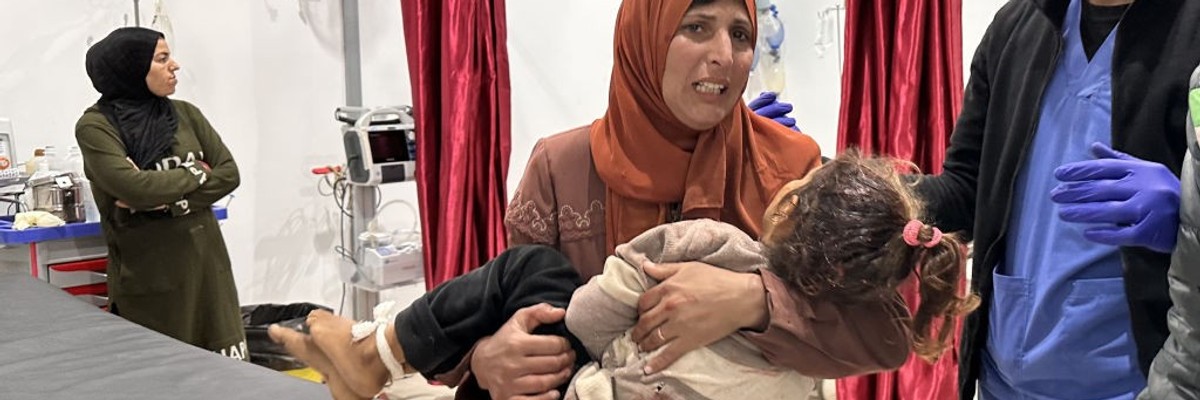
The mother of 5-year-old Neda Muhammed al-Amudi, who was killed in the Israeli army’s January 27, 2025 attack on a horse carriage in the Nuseirat Refugee Camp—a violation of the cease-fire with Hamas—mourns over her body at Awda Hospital in Gaza City, Palestine. (Photo: Fadel A. A. Almaghari/Anadolu via Getty Images.
One group says that Israeli forces have killed at least 110 Palestinians since the cease-fire took effect last month. Among the victims are multiple children, including a 5-year-old girl.
Hamas on Monday announced the suspension of its next planned release of hostages kidnapped during the October 7, 2023 attack on Israel, accusing that country of violating the fragile cease-fire agreement it signed last month.
Abu Obeida, the spokesperson for the Qassam Brigades—Hamas’ armed wing— said in a statement that hostages will “remain in place until the occupying entity complies with past obligations and compensates retroactively.”
“Over the past three weeks, the resistance leadership monitored the enemy’s violations and their noncompliance with the terms of the agreement,” Obeida explained. “These violations include delaying the return of displaced persons to northern Gaza, targeting them with shelling and gunfire in various areas of the Gaza Strip, and failing to allow the entry of relief materials in all forms as agreed upon. Meanwhile, the resistance has fulfilled all its obligations.”
Since the cease-fire took effect on January 19, Israeli forces have bombed and shot civilians in Gaza, killing at least 110 Palestinians, according to the Geneva-based Euro-Mediterranean Human Rights Monitor. Palestinian civilians killed over the past few weeks reportedly include multiple children—one of them a 5-year-old girl—and an elderly woman.
“Israel continues to commit genocide in the Gaza Strip by denying Palestinians the basic necessities for survival and imposing conditions of life calculated to bring about their physical destruction,” the group alleged on Friday.
Euro-Mediterranean Human Rights Monitor continued:
Since the cease-fire, only a handful of injured and ill Palestinians from Gaza have been permitted to travel abroad for treatment, leaving thousands at risk of death due to Israel’s ongoing denial of their right to receive treatment. In addition to ensuring a severe shortage of specialized medical personnel, generators, fuel, and oxygen stations, Israel has obstructed the rehabilitation of destroyed hospitals and blocked the entry of medical supplies, medications, and equipment.
Further, in addition to blocking equipment needed for maintenance and restoration, the ongoing and illegal restrictions by Israel are preventing the entry of temporary shelters, tents, and basic supplies for the hundreds of thousands of Palestinians whose homes it has destroyed…
Israel is deliberately obstructing the restoration of essential infrastructure, including water and sewage systems, endangering civilian lives and worsening environmental and health crises.
This, after over 15 months of Israeli bombardment and invasion of Gaza left more than 170,000 Palestinians dead, wounded, or missing in Gaza and around 2 million others forcibly displaced, starved, or sickened, according to the Gaza Health Ministry and international humanitarian agencies.
U.S. President Donald Trump—whose proposal for an American takeover and redevelopment of the Gaza Strip into the “Riviera of the Middle East” has sparked international condemnation—said Monday that the cease-fire should end, letting “all hell break loose,” if all the remaining 40 or so Israeli and international hostages are not released by noon on Saturday.
The Qassam Brigades on Monday reaffirmed Hamas’ “commitment to the terms of the agreement as long as the occupation adheres to them.”
The UK chancellor, Rachel Reeves, has described so-called sustainable aviation fuel (SAF) as a “game changer”. As she announced government support for a series of airport expansions, she said that the fuel “can reduce carbon emissions from flying by 70%”.
This number is misleading. Optimistic estimates do suggest that fully replacing fossil jet fuel with its sustainable alternative could lead to total savings of around 70%. But it will be hard to produce enough SAF to make a difference on that sort of scale. Even if the UK meets its ambitious targets, an annual saving of 7% by 2030 is more plausible.
SAF is synthetic liquid fuel derived from something other than fossil fuels. These inputs have to be processed into a liquid that can be burned safely while also storing a lot of energy for its weight, since minimising weight is crucial. This is why long-haul electric battery-powered planes are unlikely to take off any time soon.
The UK classifies three major pathways for creating sustainable aviation fuel. It can be derived from oils or fats, including used cooking oil or tallow. It can come from other sorts of material, such as municipal solid waste, agricultural residues, or sewage. Or it can be made from hydrogen and captured carbon using renewable electricity.
SAF can also be produced from bioenergy crops, and products such as palm oil. However the UK won’t certify it as sustainable, due to concerns about land use and impacts on wildlife.
Emissions that would have occurred anyway
Burning SAF actually emits a similar amount of CO₂ to fossil jet fuel. Instead, most savings come from how we account for the waste and renewable energy that is used to produce it.
Waste emits greenhouse gases anyway, sustainable fuel supporters argue. So why not have those emissions do something useful, like power a plane? Jenya Smyk/shutterstock
SAF fundamentally relies on assumptions that if waste or energy crops were not used to make this fuel, they would be incinerated, would degrade, or would in some way release their embodied carbon anyway. In the case of fuel derived from renewable energy and captured carbon, it assumes that carbon came from the atmosphere in the first place. This allows these emissions to be deducted from the total impact of SAF, leading to lower emissions than conventional aviation fuel.
Is sustainable aviation fuel even sustainable?
Estimates of how much greenhouse gas SAF could cut vary greatly due to the many different ways it can be produced, and the complexities of accounting for emissions across the entire life cycle from waste, to fuel production, to plane engine. A 2023 review by the Royal Society illustrates this nicely. It found SAF could at best produce effectively negative emissions (a 111% reduction), while at worst it could be more carbon intensive than fossil kerosene jet fuel (a 69% increase).
While policy incentives are likely to encourage increased production, there remain serious concerns that will need to be addressed before SAF can become a serious competitor for conventional jet fuel. There are hard limits to the amount of used cooking oil available for instance, and the use of other feedstocks is still in its infancy.
Meanwhile any renewable energy used to make the fuel will have to compete with growing demand from electric vehicles, AI data centres and more. And there are big worries the industry simply won’t be profitable enough to attract initial capital investment, let alone take on its well-established rival.
UK SAF production
Coming into effect in January, the UK’s SAF mandate sets legal obligations for aviation fuel suppliers in the UK to progressively increase proportions of sustainable fuel, from 2% of total jet fuel in 2025 to 10% in 2030, and 22% in 2040.
As of 2023, 97% of the UK’s supply is derived from used cooking oil, with the rest from food waste. Only 8% of this cooking oil is sourced from the UK, with most being imported from China and Malaysia. The UK also comprises 16% of the global SAF market, despite representing only 1% of total passengers.
Let us assume that Rachel Reeves’ 70% saving is deliverable if fossil jet fuel was fully replaced with SAF. That’s optimistic in itself, but not beyond the realms of possibility.
Getting hold of that much sustainable fuel is less plausible, however – the total demand for jet fuel in the UK is more than ten times the current global production of SAF. But let’s assume that the rocky global market can deliver the UK’s ambitious demand of 10% SAF use by 2030.
Reeves’ figure then becomes an optimistic value of 7% savings across the UK industry. If we then correct for anticipated growth of passenger numbers, assuming plans for airport expansion, those savings are likely to vanish.
While SAF has a role to play in decarbonisation, growth sits in clear opposition to its impacts and potential. If the UK has any hope of meeting its climate targets, it should instead be seeking alternatives to flying where possible.
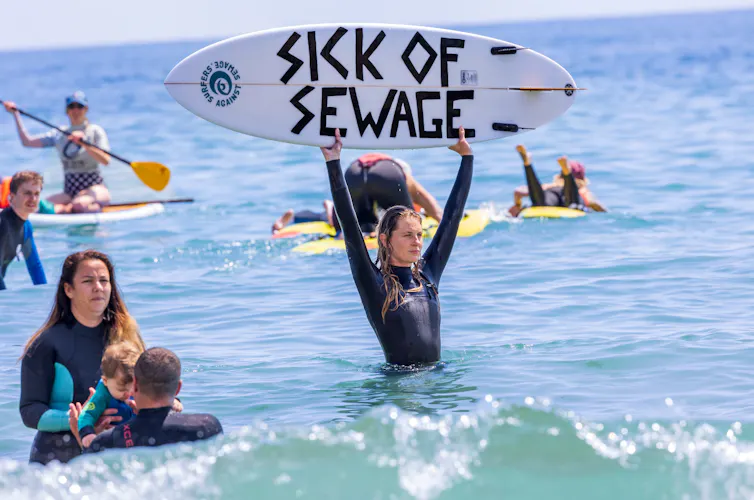
Water bills are going up in England and Wales, even after the series of scandals around water companies. Last year water firms paid £158 million in fines following a record-breaking number of sewage dumps in rivers and seas.
Severn Trent Water and United Utilities alone reportedly made 1,374 illegal sewage spills over two years. (Both companies took issue with the analysis that led to this figure but acknowledged concerns about sewage discharges.)
There have been other notable incidents. Whistleblowers have told of water companies that fail to treat legally required amounts of sewage and divert that sewage to public waterways. To add to the disgrace, water companies have generally failed to invest enough in the UK’s water infrastructure.
Research suggests that governments have been pressured to become more “business-like”. This has given rise to the use of public-private partnerships (PPPs) to run important public services, such as water, transport and even prisons. Water companies in England and Wales are private companies that bid for their contracts, while in Scotland, the water provider is a public organisation.
While other findings show that PPPs can support important public service needs, such as public health, research by my colleagues and I examines a consistent pattern in UK PPP scandals and wrongdoing. Over the past decade and a half, billions of pounds of taxpayers’ funds are unaccounted for. This appears to be largely because private interests have been prioritised over public needs.
As a researcher of PPP wrongdoing, the reasons for many of the scandals seem obvious. My colleagues and I studied parliamentary inquiries and reports that have scrutinised PPP wrongdoing. This research can tell us a great deal about the UK’s predicament with regard to the failings in the water industry.
The first lesson is that, in general, many PPPs are motivated actually to reduce the quality of the services they deliver. One parliamentary inquiry found that contracting services out from the public to the private sector had become a “transactional process” where cost-cutting is favoured and the “knock-on cost” to users results in a lower-quality public service.
Other findings showed that companies regularly reduced the quality of a service to maximise profits. One way was to bid for a public service at a low price. A Public Accounts Committee member observed that companies coming in with low quotes for contracts can end up damaging services by under-investing in them.
Another example is Sodexo – a private prison management provider. It cut employee numbers by around 200 and a subsequent BBC Panorama documentary detailed escapes and widespread drug use in the prisons they managed and also criticised a lack of safety for both prisoners and prison officers. Sodexo acknowledged the programme had highlighted problems and said it would investigate, but added that there had been “positive actions and improvements” already.
Similar practices were observed at a children’s prison run by security firm G4S, where an officer was left with brain damage after an attack by inmates. G4S admitted liability for the officer’s injuries and agreed a settlement with him.
Pay the fine, it’s cheaper
The second lesson is it can be cost-effective to breach contracts and pay fines. Companies sometimes breach the terms of their public-private contracts because it’s in their economic interest. This even has a name – economists call it “efficiency breach”.
When observing the fines in comparison to the profitable contracts, it’s easy to posit what the motivations of many in the UK’s public service system are. In 2017, despite previous indictments of wrongdoing, G4S won £25 million of government contracts.
In 2020 the firm won another £300 million contract to run Wellingborough “mega-prison” in England. Despite some raised eyebrows, G4S said at the time it aimed to make the site a blueprint for “innovation, rehabilitation and modernisation” in the prison service.
Pay the shareholders, invest later
The third lesson is that shareholders are more important than long-term investments in a service. This is perhaps the most notable feature of the UK’s public service system, where a vast array of shareholders benefit from the profits made by PPPs. In one of the parliamentary reports we analysed, which details the collapse of the facilities management firm Carillion, it was clear that shareholders’ interests trumped good management and long-term investment.
As was noted in the report, despite Carillion’s collapse, the firm paid out £333 million more to shareholders than it generated in cash between 2012 and 2017. Often, this shareholder primacy can even go against a firm’s own employees rather than just the state and taxpayers. One MP noted that despite its pension scheme being in deficit, shareholders were still receiving dividends.
Often, shareholders are prioritised because of short-term thinking. These processes can lead to firms passing these bad practices down their supply chains.
The behaviour of water companies is suggestive of these dynamics. Since water companies have been privatised, they have loaded themselves up with debt (£64 billion) but paid out £78 billion to shareholders. Some 70% of these shareholders are “foreign investment firms, private equity, pension funds and businesses lodged in tax havens”.
So what should be done? There are plenty of ways to enhance and improve the UK’s PPP problems. The most obvious may be to renationalise public services and renew the quality of public services through New Deal-style investments. After all, this is what what most of the UK electorate wants.
There are other options. An innovative and exciting frontier is opening for businesses to recognise their environmental responsibilities – initiatives in New Zealand, India and Ecuador are giving the status of personhood to rivers and ecosystems, for example.
Outdoor fashion brand Patagonia has “the Earth” as its only shareholder, and hair and skincare brand Faith in Nature has appointed nature to its board. Imagine if the UK’s water companies had the rivers and seas represented.
In the end, only time will tell how water companies will be held accountable. But for the moment it’s the UK taxpayer and consumer paying the price.
G4S was approached about this article but declined to comment.