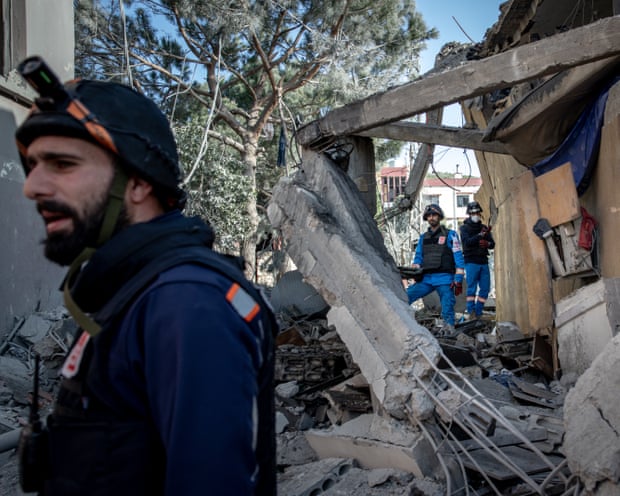
Paramedics search a building for survivors in Nabatieh on Monday, shortly after an Israeli airstrike. Photograph: Chris McGrath/Getty Images
Lebanese health ministry says killing of 91 healthcare workers shows ‘total disregard’ for international law
When they received the call to respond to an Israeli airstrike in the city of Mayfadoun, in southern Lebanon, most of the paramedics held back, having previously seen colleagues killed by double-tap attacks targeting rescuers. But the medics from the Islamic Health Association (IHA) rushed to the scene.
By the time the other emergency workers arrived at the site, they found the IHA medics had indeed been caught in a second strike. They started evacuating their wounded colleagues, only for their ambulances to be hit in two further attacks.
One of the paramedics covered his ears and screamed, convulsing in pain as shrapnel shattered the back window of the ambulance.
The rescue mission on Wednesday afternoon had turned into a nightmare as Israel carried out three consecutive strikes on three sets of ambulances and medical workers.
In total, the attacks killed four medics and wounded six more, from three different ambulance corps, according to medical sources. Three of the medics were from the Hezbollah-affiliated IHA and Amal-affiliated medical corps, while one was from the Nabatieh emergency services organisation. Under international law, all medics are protected and are considered non-combatants, regardless of political affiliation.
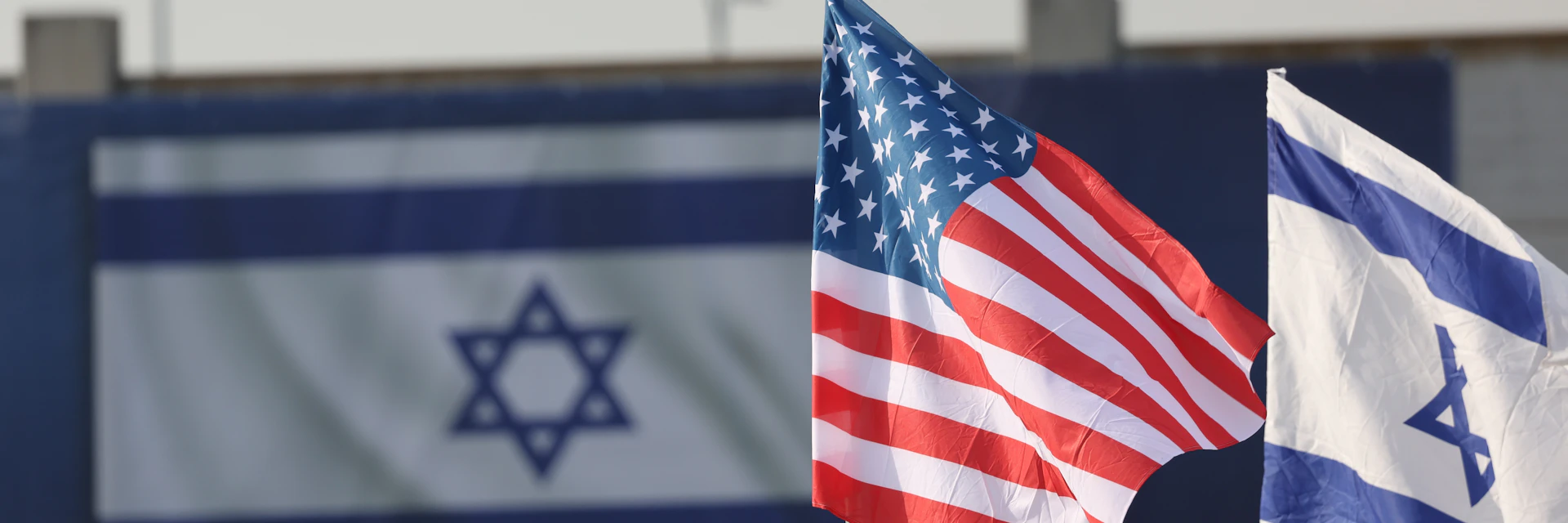
Israeli and US flags hang at Ben Gurion Airport ahead of the arrival of the US president, Donald Trump, to Israel in October 2025. Abir Sultan / EPA
Israel and the US have maintained a close alliance for decades. Their recent joint air campaign in Iran has once again underscored the depth of this partnership. Yet while the strength of their relationship is widely acknowledged, the reasons behind it remain contested.
At the centre of this debate lies the question of whether US support for Israel is driven primarily by domestic political forces, particularly lobbying organisations such as the American Israel Public Affairs Committee (Aipac), or whether it reflects broader strategic imperatives within US foreign policy.
Aipac’s historical influence is well documented. It emerged in the 1950s from the American Zionist Committee for Public Affairs and developed into a powerful lobbying organisation. By the 1970s it had become instrumental in securing substantial US military and economic aid, as well as favourable legislative outcomes, for Israel.
US aid to Israel now includes approximately US$3.3 billion (£2.4 billion) annually in military financing and an additional US$500 million for missile defence. Aipac, which has embedded itself across Democratic and Republican political networks, has played a central role in maintaining this flow of support.
But the claim that Aipac drives US policy, which former US counterterrorism official Joe Kent suggested in March when resigning from the Trump administration in opposition to the Iran war, misreads how power operates in Washington.
As scholars of American power, we argue that the US-Israeli alliance has been driven primarily by Israel’s demonstrated value as a strategic asset for the US, rather than solely by the influence of lobbying. Aipac has become effective because it aligns with this existing strategic consensus, not because it created it.
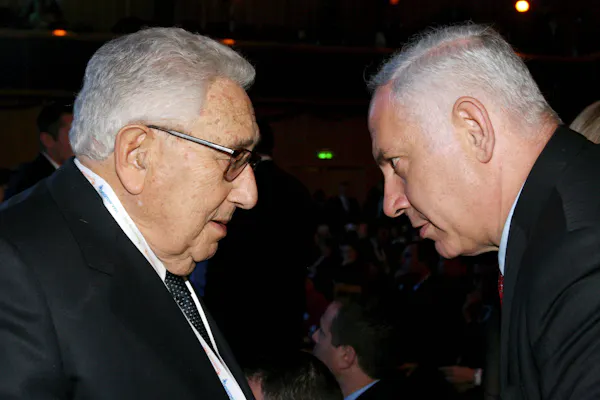
The former US national security advisor and secretary of state, Henry Kissinger, meets with Benjamin Netanyahu in Jerusalem in 2008. Anna Kaplan / EPA
Strategic US asset
This strategic consensus can be traced to the cold war. Israel’s decisive victory in the 1967 six-day war over a coalition of Arab states supported by and aligned with the Soviet Union revealed its utility as a regional proxy capable of advancing US interests in the Middle East.
From that point onward, US policymakers framed Israel as a pillar of their Middle East strategy – part of a broader effort to contain the influence of rival powers, project US power overseas and stabilise a region that is central to global energy supplies.
This framing became institutionalised in US policy in the late 1960s. Washington sharply increased arms transfers, supplying Israel with advanced aircraft such as F-4 Phantoms under President Lyndon B. Johnson. Intelligence-sharing arrangements were also expanded between the two countries.
The US perception of Israel as a strategic regional asset grew further in 1970. That year, the US requested that Israel prepare to intervene in Jordan on behalf of the government in its conflict with the Palestine Liberation Organization. Israel responded by moving troops to the border, with the presence of Israeli planes overhead often credited as having deterred invasion by Syrian forces.
Then, during the 1973 Yom Kippur war (again fought between Israel and Soviet-aligned Arab states), the US launched a large-scale airlift of military supplies into Israel. The operation signalled that Israel’s security was now directly tied to American strategy.
From the late 1970s, Israel was incorporated into a wider US-led regional security architecture alongside countries such as Egypt and Jordan. This followed the 1978 Camp David accords and 1979 Egypt-Israel peace treaty, which brought Egypt into a US-backed regional order. The US subsequently expanded joint military exercises, positioned military equipment in Israel and deepened defence coordination across these states.
Further evidence underscores the primacy of strategy in the US-Israeli relationship. President Ronald Reagan’s 1981 decision to sell surveillance aircraft to Saudi Arabia, for example, proceeded despite intense opposition from pro-Israel lobby groups. When core US strategic interests have been at stake, US policy has overridden lobbying pressure.
Formal agreements have reinforced the depth of the US-Israeli alliance. A 2016 memorandum of understanding committed US$38 billion in military aid over a decade. The US is also Israel’s largest trading partner, with bilateral trade approaching US$50 billion annually.
Cooperation extends across scientific, technological and industrial sectors, while both states are deeply integrated within international organisations. This dense web of ties cannot be reduced to lobbying influence alone.
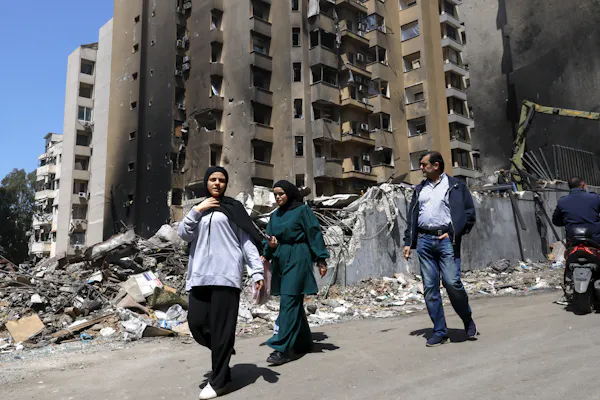
People walk past damaged buildings in Corniche el-Mazraa, one of the areas of Beirut that were hit during a wave of Israeli airstrikes on April 8. Wael Hamzeh / EPA
Israel has played a significant role in destabilising the Middle East in recent years through its actions in Gaza, Lebanon and Iran. It has also effectively undermined the current ceasefire between the US and Iran by continuing to bomb Hezbollah targets in Lebanon.
In light of these developments, does the core premise of the US-Israeli alliance – that Israel helps underpin regional stability in line with US interests – still hold? Or are the foundations of US support for Israel beginning to strain under the pressures of a more volatile Middle East?
We argue that, instead of undermining the alliance, Israel’s continued attacks on Lebanon expose the underlying structure of the US-Israeli relationship. Israel said Lebanon was not included in the ceasefire, a stance that was reinforced by US officials including President Donald Trump and Vice-President J.D. Vance.
They backed Israel’s right to act against Hezbollah, with Trump calling the conflict in Lebanon a “separate skirmish”. This alignment suggests not divergence, but coordination within an asymmetric relationship in which the US provides the overarching strategic framework and Israel executes within it.
Rather than adding strain to the alliance, these developments illustrate its durability. Even where Israeli actions risk escalation or complicate diplomacy, US support remains intact – rooted in a broader convergence of interests centred on maintaining regional dominance.
Keir Starmer explains that UK is actively supporting Israel’s genocidal expansion and repeats his previous quotation that he supports Zionism “without qualification”. Keir Starmer said “I said it loud and clear – and meant it – that I support Zionism without qualification.” here: https://www.jewishnews.co.uk/keir-starmer-interview-i-will-work-to-eradicate-antisemitism-from-day-one/Climate science denier Donald Trump confirms that he knows nothing about democracy and that more liquid gold is being secured according to his policy of global privateering.Donald Trump sings and dances, says that it’s fun to kill everyone …
This work by Middle East Monitor is licensed under a Creative Commons Attribution-NonCommercial-ShareAlike 4.0 International License.
A charity distributes meals to displaced Palestinians in the Rimal Neighborhood as food shortages persist due to the Israeli policy on aid entering the Gaza City, Palestine, on April 15, 2026. [Ahmed Jihad Ibrahim Al-arini – Anadolu Agency]
The Islamic Resistance Movement, Hamas condemned statements by the US Vice President J.D. Vance claiming that aid entering Gaza is at its highest level in five years, describing the remarks as “misleading and far removed from reality.”
In a statement issued Wednesday, Hamas said the claims represent an attempt to distort facts and obscure the ongoing humanitarian crisis in the Gaza Strip.
The movement stated that conditions on the ground contradict such assertions, pointing to Israel’s ongoing policies of “engineering starvation,” alongside strict restrictions on the entry of aid and disruption of essential supplies.
It added that Israeli authorities have not implemented the terms of the first phase of the ceasefire agreement, maintaining a blockade that leaves residents in “life under duress.”
Hamas said the situation has led to severe shortages of basic goods, including food, medicine, and fuel, citing reports by human rights organizations and international bodies.
The statement also noted that continued targeting of infrastructure is further worsening humanitarian conditions, contributing to what it described as an unprecedented level of crisis in the Gaza Strip.
This work by Middle East Monitor is licensed under a Creative Commons Attribution-NonCommercial-ShareAlike 4.0 International License.
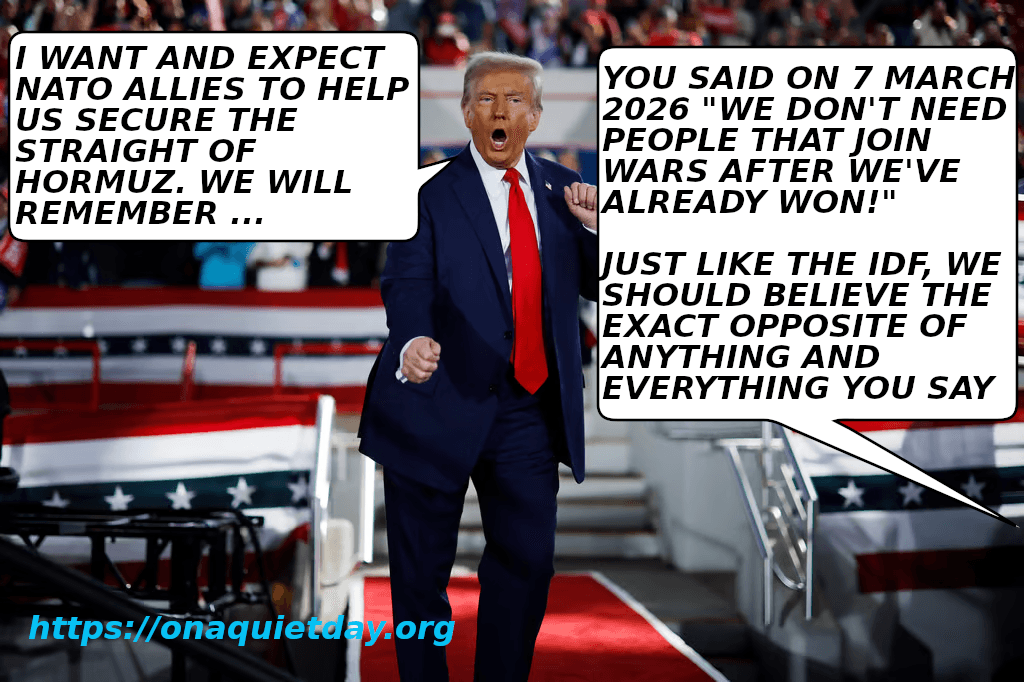
Keir Starmer explains that UK is actively supporting Israel’s genocidal expansion and repeats his previous quotation that he supports Zionism “without qualification”. Keir Starmer said “I said it loud and clear – and meant it – that I support Zionism without qualification.” here: https://www.jewishnews.co.uk/keir-starmer-interview-i-will-work-to-eradicate-antisemitism-from-day-one/Donald Trump calls for help from NATO allies in securing the Straight of Hormuz despite saying on 7 March 2026 that they don’t need people to join wars after they’ve already won. He’s challenged with the claim that he lies as much as the IDF.
This work by Middle East Monitor is licensed under a Creative Commons Attribution-NonCommercial-ShareAlike 4.0 International License.
In this episode, we examine why the first round of Iran-US talks broke down, how Lebanon has moved to the centre of ceasefire negotiations and why Trump appears to be retreating from his earlier endorsement of Iran’s 10-point plan.
In this episode, we examine why the first round of Iran-US talks broke down, how Lebanon has moved to the centre of ceasefire negotiations and why Trump appears to be retreating from his earlier endorsement of Iran’s 10-point plan.
We also ask whether the war on Iran now amounts to a historic strategic defeat for both Washington and Tel Aviv, before looking at the build-up to war and Netanyahu’s role in shaping it. The discussion then turns to the growing rift between Pope Leo and Trump, the dangerous normalisation of political assassination and the rise in US soldiers refusing to fight with Iran. We close by considering why Israel is more dangerous than ever and what Viktor Orban’s defeat could mean for Israel and the global far right.
This work by Middle East Monitor is licensed under a Creative Commons Attribution-NonCommercial-ShareAlike 4.0 International License.
Keir Starmer explains that UK is actively supporting Israel’s genocidal expansion and repeats his previous quotation that he supports Zionism “without qualification”. Keir Starmer said “I said it loud and clear – and meant it – that I support Zionism without qualification.” here: https://www.jewishnews.co.uk/keir-starmer-interview-i-will-work-to-eradicate-antisemitism-from-day-one/Donald Trump calls for help from NATO allies in securing the Straight of Hormuz despite saying on 7 March 2026 that they don’t need people to join wars after they’ve already won. He’s challenged with the claim that he lies as much as the IDF.
This work by Middle East Monitor is licensed under a Creative Commons Attribution-NonCommercial-ShareAlike 4.0 International License.
Iranian military personnel take part in an exercise titled “Smart Control of the Strait of Hormuz”, launched by the Naval Forces of the Islamic Revolutionary Guard Corps, is being carried out in the Persian Gulf and the Strait of Hormuz on February 16, 2026. [Islamic Revolutionary Guard Corps – Anadolu Agency]
A military adviser to Iran’s Supreme Leader has warned that Iranian forces would sink US ships in the Strait of Hormuz if Washington acts as a “policeman” in the strategic waterway.
The warning was made on Wednesday amid ongoing tensions in the region, where the United States has imposed a military blockade on Iranian ports after Iran disrupted maritime navigation in the strait during more than six weeks of fighting, now paused under a fragile two-week ceasefire.
Mohsen Rezaei, a former commander-in-chief of Iran’s Revolutionary Guards who was appointed as a military adviser by Khamenei last month, criticised the US President in remarks broadcast on state television, according to AFP, saying: “Mr Trump wants to become the police of the Strait of Hormuz. Is this really your job? Is this the job of a powerful army like the US?”
Speaking in military uniform, he added: “These ships of yours will be sunk by our first missiles and have created a great danger for the US military. They can definitely be exposed to our missiles and we can destroy them.”
Rezaei, long considered a hardliner even within the Revolutionary Guard, also said that it would be “great” if the US launched a ground invasion of Iran, as “we would take thousands of hostages and then for each hostage we would get a billion dollars,” according to AFP.
He added: “I am not in favour of extending the ceasefire at all, and this is a personal view,” without giving further details.
Rezaei is a veteran figure in Iran’s political and military establishment and led the Revolutionary Guard between 1981 and 1997.
This work by Middle East Monitor is licensed under a Creative Commons Attribution-NonCommercial-ShareAlike 4.0 International License.
Keir Starmer explains that UK is actively supporting Israel’s genocidal expansion and repeats his previous quotation that he supports Zionism “without qualification”. Keir Starmer said “I said it loud and clear – and meant it – that I support Zionism without qualification.” here: https://www.jewishnews.co.uk/keir-starmer-interview-i-will-work-to-eradicate-antisemitism-from-day-one/Donald Trump calls for help from NATO allies in securing the Straight of Hormuz despite saying on 7 March 2026 that they don’t need people to join wars after they’ve already won. He’s challenged with the claim that he lies as much as the IDF.