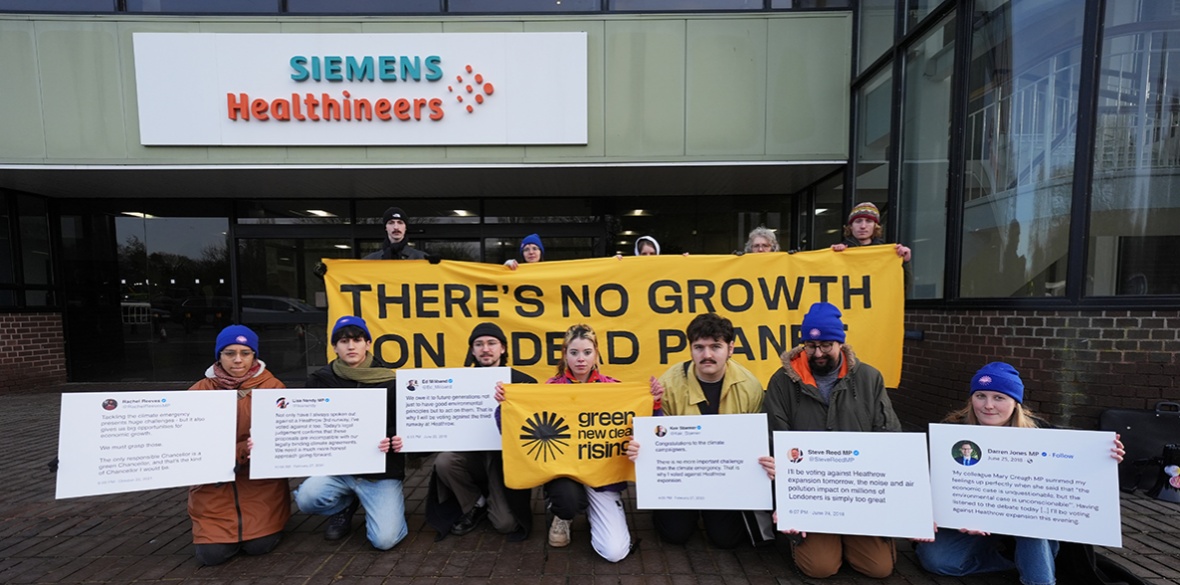
Activists from Fossil Free London and Green New Deal Rising take part in a protest against a third runway at Heathrow, and expansion at Gatwick and Luton, outside Siemens Healthineers in Eynsham, Oxfordshire, January 29, 2025
HEATHROW expansion cannot be the quick fix to the economy, campaigners warned today after the government backed a new multibillion-pound investment programme.
The airport’s chief executive Thomas Woldbye announced funding for upgrades and expansion ahead of its proposal for a third runway, expected to be submitted to the government this summer.
The government said that the investment programme will secure thousands of steel jobs by increasing the demand for British-made steel.
But polling by climate charities suggests a majority of the public believes expansion is the “wrong priority,” with 67 per cent of respondents also saying they did not see much, if any, benefit to taxpayers.
No Third Runway Coalition chairman Paul McGuinness called the announcement “almost Orwellian,” arguing that the government had relied on a Heathrow-commissioned report to promote the project rather than its own Treasury assessment.
…
Greenpeace UK’s chief scientist Dr Doug Parr said that the “real winners” will be Mr Woldbye and “the rest of the polluting aviation industry.”
“The only ‘perks’ for most people will be noise, air pollution and climate emissions,” he said.
Dr Parr said a third runway is “bad economics,” saying: “Instead of picking up any old polluting project from the discard pile, the Chancellor should focus on green industries that can attract investment and bring economic and social benefits for years to come, like secure jobs, affordable energy bills and cheaper, better transport.”
Emissions from the Drax plant near Selby on a winter’s day
ACIVISTS occupied the London offices of a lobbyist for Drax power plant today, protesting against the government’s decision to bankroll Britain’s top carbon emitter.
Labour announced yesterday that it will provide subsidies to the wood-burning power plant for at least four more years.
The plant has received billions from taxpayers because it is classed as a source of renewable energy, a claim long disputed by campaigners as it emits the largest amount of carbon in Britain.
Drax has also been fined £25 million by Ofgem for misreporting where its wood is sourced from after a BBC investigation found that it had used wood from environmentally important forests in Canada.
This morning, 20 activists from Axe Drax occupied the offices of 5654 & Company, a corporate affairs consultancy they say lobbies for the power station, with staff forced to leave for the day as a result, according to the campaign group.
Rosie, who only shared her first name, from Axe Drax said: “The decision to back Drax is a disaster for the climate and our energy bills.
“Funding the biggest carbon emitter in the UK in the name of green energy is insane.
“It is time for Labour to dump Drax and their lobbyists, not double down support.
“We are sick of their unaccountable power, while millions of us have our bills hiked.”
The UK chancellor, Rachel Reeves, has described so-called sustainable aviation fuel (SAF) as a “game changer”. As she announced government support for a series of airport expansions, she said that the fuel “can reduce carbon emissions from flying by 70%”.
This number is misleading. Optimistic estimates do suggest that fully replacing fossil jet fuel with its sustainable alternative could lead to total savings of around 70%. But it will be hard to produce enough SAF to make a difference on that sort of scale. Even if the UK meets its ambitious targets, an annual saving of 7% by 2030 is more plausible.
SAF is synthetic liquid fuel derived from something other than fossil fuels. These inputs have to be processed into a liquid that can be burned safely while also storing a lot of energy for its weight, since minimising weight is crucial. This is why long-haul electric battery-powered planes are unlikely to take off any time soon.
The UK classifies three major pathways for creating sustainable aviation fuel. It can be derived from oils or fats, including used cooking oil or tallow. It can come from other sorts of material, such as municipal solid waste, agricultural residues, or sewage. Or it can be made from hydrogen and captured carbon using renewable electricity.
SAF can also be produced from bioenergy crops, and products such as palm oil. However the UK won’t certify it as sustainable, due to concerns about land use and impacts on wildlife.
Emissions that would have occurred anyway
Burning SAF actually emits a similar amount of CO₂ to fossil jet fuel. Instead, most savings come from how we account for the waste and renewable energy that is used to produce it.
Waste emits greenhouse gases anyway, sustainable fuel supporters argue. So why not have those emissions do something useful, like power a plane? Jenya Smyk/shutterstock
SAF fundamentally relies on assumptions that if waste or energy crops were not used to make this fuel, they would be incinerated, would degrade, or would in some way release their embodied carbon anyway. In the case of fuel derived from renewable energy and captured carbon, it assumes that carbon came from the atmosphere in the first place. This allows these emissions to be deducted from the total impact of SAF, leading to lower emissions than conventional aviation fuel.
Is sustainable aviation fuel even sustainable?
Estimates of how much greenhouse gas SAF could cut vary greatly due to the many different ways it can be produced, and the complexities of accounting for emissions across the entire life cycle from waste, to fuel production, to plane engine. A 2023 review by the Royal Society illustrates this nicely. It found SAF could at best produce effectively negative emissions (a 111% reduction), while at worst it could be more carbon intensive than fossil kerosene jet fuel (a 69% increase).
While policy incentives are likely to encourage increased production, there remain serious concerns that will need to be addressed before SAF can become a serious competitor for conventional jet fuel. There are hard limits to the amount of used cooking oil available for instance, and the use of other feedstocks is still in its infancy.
Meanwhile any renewable energy used to make the fuel will have to compete with growing demand from electric vehicles, AI data centres and more. And there are big worries the industry simply won’t be profitable enough to attract initial capital investment, let alone take on its well-established rival.
UK SAF production
Coming into effect in January, the UK’s SAF mandate sets legal obligations for aviation fuel suppliers in the UK to progressively increase proportions of sustainable fuel, from 2% of total jet fuel in 2025 to 10% in 2030, and 22% in 2040.
As of 2023, 97% of the UK’s supply is derived from used cooking oil, with the rest from food waste. Only 8% of this cooking oil is sourced from the UK, with most being imported from China and Malaysia. The UK also comprises 16% of the global SAF market, despite representing only 1% of total passengers.
Let us assume that Rachel Reeves’ 70% saving is deliverable if fossil jet fuel was fully replaced with SAF. That’s optimistic in itself, but not beyond the realms of possibility.
Getting hold of that much sustainable fuel is less plausible, however – the total demand for jet fuel in the UK is more than ten times the current global production of SAF. But let’s assume that the rocky global market can deliver the UK’s ambitious demand of 10% SAF use by 2030.
Reeves’ figure then becomes an optimistic value of 7% savings across the UK industry. If we then correct for anticipated growth of passenger numbers, assuming plans for airport expansion, those savings are likely to vanish.
While SAF has a role to play in decarbonisation, growth sits in clear opposition to its impacts and potential. If the UK has any hope of meeting its climate targets, it should instead be seeking alternatives to flying where possible.
British chancellor Rachel Reeves has backed ‘catastrophic’ plans to build a third runway at Heathrow | Ian Forsyth/Getty Images
Rachel Reeves and Keir Starmer appear happy to pursue growth at any cost – including the destruction of the planet
Last weekend the temperature at the North Pole was 20℃ above average, taking it above ice’s melting point in what was described as “a very extreme winter warming event” by Mika Rantanen of the Finnish Meteorological Institute.
Four days later, things got worse still. The Copernicus Climate Change Service reported that last month was the warmest January ever recorded at 1.75℃ hotter than pre-industrial times. This is especially worrying since scientists expected temperatures to fall this year as La Nina took over from the previous year’s El Nino. We now face the worrying possibility that the impact of cooling La Ninas might be declining.
Amid these developments, British chancellor Rachel Reeves has backed plans to build a third runway at Heathrow, which climate campaigners warn would be “catastrophic”, and reports have emerged that she is also poised to support the opening of the giant Rosebank oilfield in the North Sea, which energy secretary Ed Miliband has described as “climate vandalism”.
Reeves’ drive for economic growth at the expense of the planet is a far cry from the strong green agenda that the Labour Party seemed to favour ahead of last year’s general election.
Labour’s apparent change of heart unfortunately coincides with Donald Trump taking office in the US. The climate science community is now braced for the impact of Trump’s newly appointed Department of Government Efficiency, led by billionaire Elon Musk, running a coach and horses through the US foreign aid programme.
Trump’s administration has also already started removing or downgrading mentions of climate change from federal government web pages – a sign that we are in a worse position than a decade ago after the 2015 Paris climate summit, when there were indications that the dangers of climate breakdown were at last being appreciated at higher political levels.
Now, one of the world’s leading climate specialists, professor James Hansen of Columbia University, says that the international target agreed upon at the Paris summit of limiting global temperature rises to 2℃ is “dead”. The pace of global heating had been “significantly underestimated”, he explained.
The fossil carbon states and corporations with their coal, oil and gas markets, meanwhile, are more certain about their prospects and happy to promote their wares with enthusiasm. There were 2,500 oil, gas and coal lobbyists at the 2023 Dubai COP28 climate summit, four times as many as attended the previous year in Egypt.
If forced onto the defensive, fossil fuel giants have several options. One is to move the focus away from mitigation to adaptation, another is to boost the potential of carbon capture and storage, and yet another is geoengineering.
Then, if all else fails they can fall back on direct air capture; removing carbon from the air once it is dispersed in the atmosphere, rather than as it is emitted. In other words, we should accept the likelihood of an “overshoot” of carbon emissions and hope that future technologies can save the day!
None of these scenarios has any current relevance as none can be developed in anything remotely like the time available given the speed of climate breakdown. There has to be urgent political change at the highest level to engage in emergency decarbonisation.
At a lower level, there is some good news at least. The cost of producing electricity from renewable sources is continuing to fall and the whole process of embracing renewables could accelerate if just one or two countries demonstrated just how quickly change can come.
The UK is in a hugely favoured position to do so, having huge scope to expand land-based wind and solar power as well as offshore wind. That should be one of the British government’s two absolute priorities, the other being a rapid programme of home and workplace insulation.
Further moves would be an immediate tightening up of house building regulations requiring much higher levels of insulation together with grants and loans for home environmental improvements. Transition to electrical vehicles should be accelerated along with much expansion of public transport.
Changes in agriculture must be brought in to cut down on greenhouse gas emissions, with methane emission control frequently being overlooked. Air and marine transport must also be subject to far greater emissions control. Any plans to expand existing airports must be abandoned as nonsensical, and subsidies for oil and gas production should be transferred to renewables.
All this, and much more, would cost money, and a lot of it, but there is plenty of that around, readily available from many sources including rigorous control of tax evasion and avoidance, together with new wealth taxes. If climate breakdown is recognised for what it is, the greatest threat to UK security, then the entire ‘defence’ budget should be rethought in this light. More than this, any government that recognises the challenge facing every one of us would see the need to borrow to help fund the response.
So, what of Labour so far? Regrettably, there is little to applaud despite the efforts of a rather isolated few on the front benches and a handful of backbenchers such as Clive Lewis. The party’s brave words of a year ago are difficult to find and Labour is now about growth at almost any cost – destruction of the planet included. The lobby brigade is winning.
Even carbon capture and nuclear power are now hailed by the Labour government as part of the answer even though the first is unproven and the second will take decades to bring in while we only have years, not decades, to make the change.
Perhaps Labour will come to its senses as climate disasters accelerate but it is now a party that has lost any sense of mission. It has forgotten its history, how a Labour government of the late 1940s took on seemingly impossible tasks and succeeded in many respects against the odds. Can the party change now? Perhaps, but don’t hold your breath.
Keir Starmer, Angela Rayner and Rachel Reeves wear the uniform of the rich and powerful. They have all had clothes bought for them by multi-millionaire Labour donor Lord Alli. CORRECTION: It appears that Rachel Reeves clothing was provided by Juliet Rosenfeld.
Green Party Co-leader Adrian Ramsay. Wikipedia CC.
Green MP and party co-leader Adrian Ramsay has urged the government to divert planned new subsidies for the privately owned wood-burning Drax power station to a national home insulation scheme.
Adrian Ramsay said “Drax is a green energy scam, burning trees – some imported from ancient forests from as far away as Canada – subsidised by the taxpayer.
“The billions of pounds worth of subsidies run out in 2027, but the government is expected to try to renew them next week, turning taxpayer money into profits for a private company, instead of using the money to fuel a green energy revolution.
“Drax has benefitted from over £6 billion in subsidies since 2012 and neither taxpayers nor the environment can afford a penny more.
“The money should be used to help fund a national scheme of home insulation that would cut people’s energy bills and help to reduce energy use.
“Green MPs and Peers will be pressing the government to end this subsidy scandal and invest people’s money where it will make a real difference to them.”