Left activists in the country blame the government’s reluctance to act against big polluters despite its impact on the most of the people who are risking their health to pursue their livelihoods.
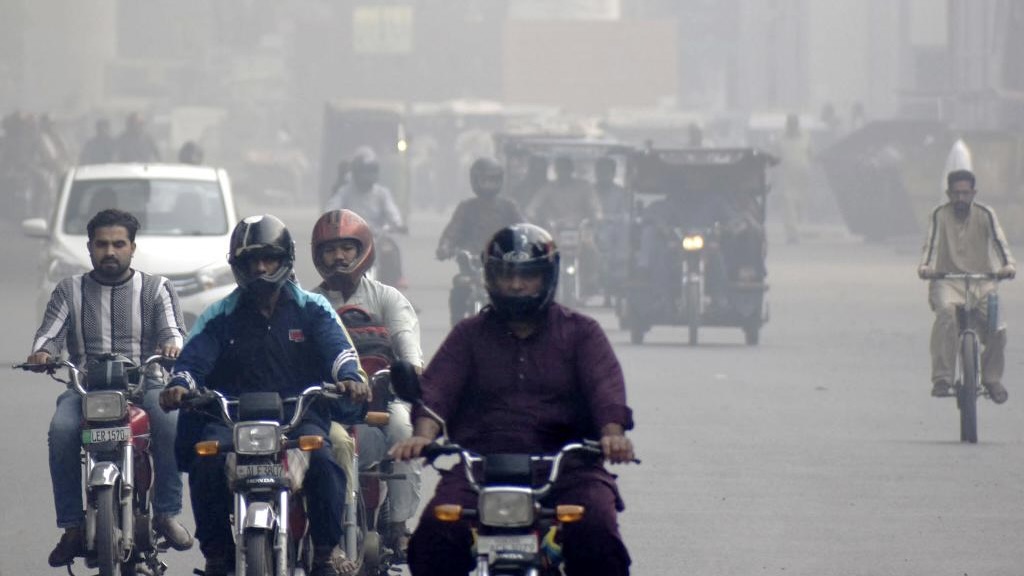
A thick layer of toxic smog has covered the atmosphere of Pakistan’s Punjab province for the last two weeks, making its air hazardous for millions of people in cities such as Lahore and Multan.
Lahore, the capital of Punjab and the second largest city of Pakistan has emerged as the world’s most polluted city with its AQI hitting above 1,000 for several days this week. The AQI on Wednesday was recorded at 815. Other cities in the Punjab province, such as Multan, Bahawalpur and Faisalabad too recorded an average AQI above 400 in the same period.
An AQI above 300 is considered hazardous for human living.
The high level of pollutants (PM 2.5) in the air has forced the Pakistani authorities to shut down schools and colleges until November 17 and public parks until November 18. It has also issued orders to shut the shops and commercial activities early asking citizens to minimize venturing out and to wear masks.
The number of people reporting respiratory issues have reached nearly 70,000 daily in the province according to theAssociated Press.
Prolonged exposure to smog leads to a large number of health problems such as irritation in the eyes, respiratory issues among others. Every year millions of people die due to air pollution.
According to the World Health Organization (WHO) “fine particles matter (PM 2.5) can penetrate [the human body] through the lungs” and blood streams causing major damages to human organs and can cause lung cancer, asthma, stroke and other diseases. Such exposure among children can affect their growth both physically and psychologically and can have lifelong effects.
Smog has become a regular feature in Pakistan’s Punjab province in recent years due to rising pollution caused by the high number of vehicles, increasing urbanization with a high density population, and an increase in polluting industries and agricultural activities.
According to Marriyum Aurangzeb, a senior minister in the Punjab government, Lahore endured 275 days of unhealthy AQI levels over the past one year with average temperature rising by 2.3 degree celsius.
Failure of the state
Punjab is Pakistan’s largest province with over 117 million people. The government led by Mariyum Nawaz of Pakistan Muslim League (PML) has been accused of taking inadequate measures to control the situation. In the name of fighting against polluters it has only targeted farmers and brick kilns and has been reluctant to hold larger and more powerful polluters such as big industries and the transport sector, Dawn reported.
According to the Punjab government’s own study, unfit vehicles apparently are the primary polluters (around 43%) in the province but the government has failed to curb their movement.
Ammar Ali Jan, head of the Haqooq-e-Khalq Party (HKP) has been consistently raising the issue of smog which makes the atmosphere “unfit for human survival.” Noting that in this inhuman condition only the rich who can afford to buy air purifiers can survive terming the government’s inactivity to provide relief to the people as a “criminal and insane” policy of “privatization of clean air.”
High pollution disrupts normal life for all sections of the population. However, it disproportionately affects the working class population as they are unable to follow the protection measures such as staying at home and wearing masks given the nature of their livelihoods.
In a recent tweet he also said that “climate catastrophe in Punjab is a result of a development model that turned our cities into concrete jungles.” He accused the Maryum Nawaz government for remaining “hopelessly non serious about confronting the challenge” and instead favoring big polluters such as “land mafia,” and “car/oil companies” in the state.
In light of the government’s lack of response, various left and progressive student organizations in the country called for a protest in front of the Punjab provincial assembly on Thursday, November 14. They demanded urgent action to fight climate change and the smog problem in the country.
Activists protesting against fossil fuel lobbyists in attendance at COP29 hold a demonstration on November 15, 2024 in Baku, Azerbaijan. (Photo: Sean Gallup/Getty Images)
“It is now clear that the COP is no longer fit for purpose,” a coalition of scientists and advocates wrote as more than 1,700 fossil fuel lobbyists swarmed COP29 in Azerbaijan.
The crushing influence of petrostates and fossil fuel industry lobbyists has rendered the annual United Nations climate conference unfit to deliver the kinds of sweeping changes needed to avert catastrophic warming, a coalition of leading scientists, advocates, and policy experts warned in an open letter released Friday as the first week of the COP29 summit in Baku, Azerbaijan came to a close.
Acknowledging that the COP process has achieved “important diplomatic milestones” and “a remarkable consensus” on climate targets over nearly three decades of international negotiations, the coalition wrote that the policy framework produced by dozens of U.N. summits is not sufficient to solve the pressing crises facing humanity in an age of runaway warming and large-scale climate devastation.
“Science tells us that global greenhouse gas emissions must be reduced by 7.5% annually to have any chance of staying within the 1.5°C threshold, a prerequisite for the stability of our planet and a livable future for much of humanity. In 2024, the task is unequivocal: Global greenhouse gas emissions must be reduced by 4 billion tonnes,” reads the letter, whose signatories include former U.N. Secretary-General Ban Ki-moon, former U.N. Framework Convention on Climate Change executive secretary Christiana Figueres, Club of Rome global ambassador Sandrine Dixson-Declève, and Potsdam Institute for Climate Action Research director Johan Rockström.
“Twenty-eight COPs have delivered us with the policy framework to achieve this, but it is now clear that the COP is no longer fit for purpose,” the letter continues. “Its current structure simply cannot deliver the change at exponential speed and scale, which is essential to ensure a safe climate landing for humanity.”
The letter calls not for a complete abandonment of COP but rather “a fundamental overhaul” that would enable the U.N.-led summit “to deliver on agreed commitments and ensure the urgent energy transition and phase-out of fossil energy.”
The coalition of experts and advocates recommended a number of reforms for future COP summits, including “strict eligibility criteria to exclude countries who do not support the phase-out/transition away from fossil energy,” new “mechanisms to hold countries accountable for their climate targets and commitments,” and changes to limit the influence of fossil fuel lobbyists and ensure equitable representation.
“At the last COP, fossil fuel lobbyists outnumbered representatives of scientific institutions, Indigenous communities, and vulnerable nations,” Figueres said in a statement Friday. “We cannot hope to achieve a just transition without significant reforms to the COP process that ensure fair representation of those most affected.”
Rockström added that “there is still a window of opportunity for a safe landing for humanity, but this requires a global climate policy process that can deliver change at exponential speed and scale.”
“Planet Earth is in critical condition,” he said. “We have already crossed six planetary boundaries.”
“2024 marks yet another year at COP where we see those fighting the climate crisis outnumbered by those that have contributed to it the most—the fossil fuel industry.”
The open letter was released in the wake of a new analysis from the Kick Big Polluters Out coalition showing that at least 1,773 fossil fuel lobbyists have been granted access to the COP29 summit—giving the industry primarily responsible for the global climate emergency more representation than nearly every country present at the talks in Baku.
According to the Kick Big Polluters Out coalition, the fossil fuel industry has more representation at COP29 than the 10 most climate-vulnerable nations combined.
Additionally, The Guardian reported Friday that “at least 132 oil and gas company bosses and staff were invited” to COP29 as “guests” by Azerbaijan’s government and “given host country badges.”
“2024 marks yet another year at COP where we see those fighting the climate crisis outnumbered by those that have contributed to it the most—the fossil fuel industry,” said Joseph Sikulu of 350.org. “How can we achieve the ambition that is needed to save our homes when these negotiations are continually flooded with fossil fuel lobbyists? There is a ban on tobacco lobbyists from attending the World Health Organization’s summit, why is that not the case for the fossil fuel industry at COP?”
“We demand that the upcoming COP presidencies set clear rules against the presence of fossil fuel interests at the negotiating table,” Sikulu added. “Our lives depend on it.”
Al Gore, the former U.S. vice president, joined climate advocates on Friday in decrying Big Oil’s capture of the U.N. climate summit.
“It’s unfortunate that the fossil fuel industry and the petrostates have seized control of the COP process to an unhealthy degree,” said Gore.
Lamenting that the follow-through on COP28 commitments to transition away from fossil fuels has been “very weak,” Gore said he believes “one of the reasons for that is that the petrostates have too much control over the process.”
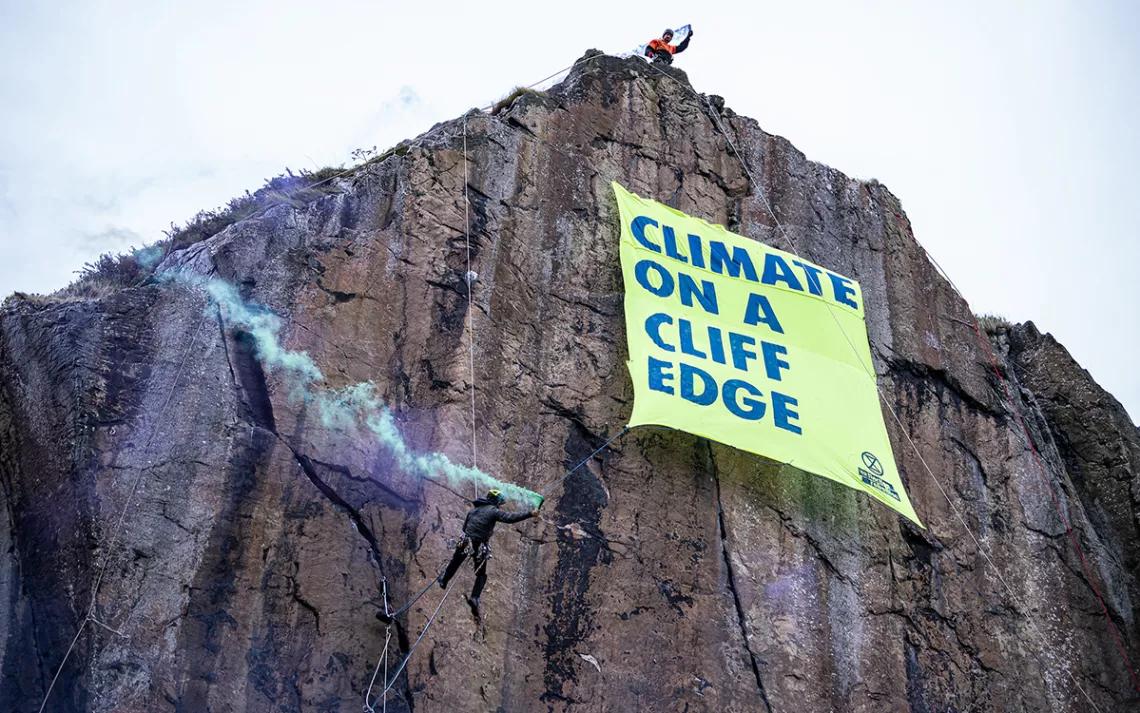
Experienced climbers scale a rock face near the historic Dumbarton castle in Glasgow, releasing a banner that reads “Climate on a Cliff Edge.” One activist, dressed as a globe, symbolically looms near the edge, while another plays the bagpipes on the shores below. | Photo courtesy of Extinction Rebellion and Mark Richards
Scientists and campaigners are calling on governments and tech companies to tackle climate disinformation. Credit: MauriceNorbert via Alamy
An open letter from climate scientists and campaigners warns of the dangers associated with false climate claims.
Governments around the world must take “immediate and decisive action” to tackle climate disinformation, scientists and campaign groups have urged as talks at the COP29 climate summit in Baku, Azerbaijan enter their fourth day.
A coalition of 55 climate information integrity groups and 42 leading climate scientists and experts have signed an open letter urging countries to counter the risk of false and misleading claims that are wrecking efforts to slow climate change.
It comes two days after UK Prime Minister Keir Starmer spoke at COP29 arguing that “there is no national security without climate security” – and a week after the election in the United States of Donald Trump, who has previously called climate change a “hoax”.
The letter published today – signatories to which include Friends of the Earth, the Institute of Strategic Dialogue, and regional branches of Greenpeace and WWF – lists steps governments could take.
These include adopting a universal definition of climate disinformation, such as the working definition proposed by the Climate Action Against Disinformation (CAAD) coalition, another signatory.
According to the letter, the definition should cover anything that misrepresents scientific data or “falsely publicises” supposed solutions to climate change which in fact contribute to global warming, often referred to as “greenwashing”.
Such a definition should cover “deceptive or misleading online behaviour” that undermines public understanding of climate change, the fact it is caused by human activity, and the need for urgent mitigation and adaptation action, the letter said.
Signatories also urged governments to take action against organisations which give a platform to climate disinformation – including social media outlets, advertising technology providers, broadcasters, and publishing companies.
“The spread of disinformation continues to undermine and delay our collective ability to act, jeopardising progress at crucial negotiations and the upcoming G20 Summit in Brazil”, the letter said.
“Climate disinformation, waged by vested interests, undermines climate action and puts our collective future at risk. Our information ecosystem is being damaged, and those responsible must be held accountable.”
The letter ends by arguing that “by adopting these principles, governments can foster a healthier and safer online environment that supports informed decision-making and enables effective climate action.”
The world’s leading climate science group, the UN’s Intergovernmental Panel on Climate Change (IPCC), has warned that efforts to tackle climate change were being delayed by “rhetoric and misinformation that undermines climate science and disregards risk and urgency”.
“As disinformation continues to be an obstacle to vital climate action, the message from this open letter to decision makers globally is clear: protecting truth in the climate conversation is critical if we are to secure meaningful change”, said Max MacBride, Head of Counter-Disinformation at Roots Greenpeace, the NGO’s grassroots campaign initiative.
“At Roots, we see every day how climate disinformation stifles youth advocacy, and we join this call to hold governments and platforms accountable for enabling informed, equitable climate action”, he said.
Climate Disinformation Threats
A CAAD report published earlier this week found that climate disinformation is widespread online, and is hobbling efforts to address climate change.
The report said that social media platforms bear responsibility for allowing “super spreaders” to “pollute their platforms with debunked claims attacking renewable energy and electric vehicles”.
CAAD also found that fossil fuel companies were allowed to use digital advertising across Meta platforms to greenwash their reputations, by promoting false solutions or presenting fossil fuels as essential to the energy transition.
A study published in February found that 14 percent of Americans don’t believe climate change is real – even as growing numbers of Americans say they are concerned about the climate.
“In the US, we’ve painfully experienced the role disinformation has played in thwarting disaster response and threats to the lives of responders”, Kate Cell, Senior Climate Campaign Manager at the Union of Concerned Scientists, told DeSmog.
“As climate-fueled disasters become more common around the world, governments can protect their residents by addressing the problem of climate disinformation systemically.”
Another report released this week by the scrutiny NGO InfluenceMap found 2.500 cases of fossil fuel companies pushing arguments which contradict IPCC recommendations since COP28 last year.
Thais Lazzeri, founder of educational group FALA, a signatory to the letter, told DeSmog: “The letter comes at a unique time for Brazil, which is hosting the G20 and the incoming COP30 Presidency. The alliance of so many Brazilian institutes and professionals shows the urgency for answers and the intersectoral power of this Brazilian network, willing to work together.”
She added: “At the opening of the Brazil space at CO29, Environment Minister, Marina Silva, said that denialism doesn’t fit. The Brazilian government can lead by example and guarantee information integrity policies and strategic, connected actions to change the game.”
DeSmog has previously reported on news media spreading false climate claims, with The Telegraph newspaper in the UK attacking climate solutions – a trend that has increasing since July’s general election. As revealed by DeSmog in 2023, one in three presenters on the right-wing broadcaster GB News had spread climate disinformation during the previous year.
“It is much easier to pollute the waters of public discussion on climate change causes and consequences than it is to keep them clean and productive,” said Max Boykoff, signatory to the letter and professor of Environmental Studies at Boulder University in Colorado and founder of the Media Climate Change Observatory, a project which analyses mentions of climate change in news media.
“Therefore, more proactive, clear, accurate and effective communication efforts are consistently and repeatedly needed. That motivates this call for government action to curb disinformation about climate change.”
A protester holds a sign with a Shell logo during a demonstration on March 11, 2023 in The Hague, Netherlands. (Photo: Michel Porro/Getty Images)
“This setback will only help us grow stronger,” said the Dutch climate group that originally brought the case. “Large polluters are powerful. But united, we as people have the power to change them.”
Climate campaigners didn’t sugarcoat their reactions to a Dutch court decision on Tuesday that overturned a landmark 2021 ruling ordering the oil behemoth Shell to cut its planet-warming emissions nearly in half by the end of this decade.
“We are shocked by today’s judgment,” said Donald Pols, director of Milieudefensie, the Netherlands-based environmental group that originally filed suit against Shell in 2018.
“It is a setback for us, for the climate movement, and for millions of people around the world who worry about their future,” Pols said of Tuesday’s ruling by the Hague Court of Appeal. “But if there’s one thing to know about us, it’s that we don’t give up. This setback will only help us grow stronger. Large polluters are powerful. But united, we as people have the power to change them.”
The original 2021 ruling, as CNBC noted, marked “the first time in history that a company was found to have been legally obliged to align its policies with the Paris Agreement” and “sparked a wave of lawsuits against other fossil fuel companies.”
Despite acknowledging that Shell has “an obligation toward citizens to reduce CO2 emissions,” the appeals court on Tuesday scrapped a legal mandate compelling the company to slash its emissions by 45% by 2030 compared with 2019 levels, saying it was “unable to establish that the social standard of care entails an obligation for Shell to reduce its CO2 emissions by 45%, or some other percentage.”
“It is primarily up to the government to ensure the protection of human rights,” the court added.
Laurie van der Burg of Oil Change Internationalsaid in response that “while we mourn today’s setback, the ruling establishes a responsibility for Big Oil and Gas to act that future litigation can build on.”
“The court ruled protection against climate change is a human right, and corporations have a responsibility to reduce their emissions,” she added. “As far as we know, this is the first case where a court has acknowledged that new investments in oil and gas are incompatible with international climate goals.”
“Today’s ruling underscores the importance of world leaders now negotiating at the U.N. Climate Summit in Baku taking responsibility.”
Shell, which is responsible for just over 2% of global CO2 emissions, said in a statement that it was “pleased” with the court’s ruling and claimed to be “making good progress in our strategy to deliver more value with less emissions.”
But research by the human rights organization Global Witness has found that Shell has consistently overstated the scale of its investments in green energy—including by characterizing fossil fuels as “renewable.”
“Even as Shell claims to be reducing its oil production, it is planning to grow its gas business by more than 20% over the next few years, leading to significant additional emissions,” Global Witness wrote in a complaint to the U.S. Securities and Exchange Commission last year.
Andy Palmen, the director of Greenpeace Netherlands, said Tuesday that while campaigners working toward a just phaseout of fossil fuel emissions are “disappointed that Shell is being allowed to continue polluting,” they “will not give up the fight.”
“This only motivates us more to take action against major polluters,” said Palmen. “It really gives hope that the court finds that Shell must respect human rights and has a duty to reduce its CO2 emissions.”
“Today’s ruling underscores the importance of world leaders now negotiating at the U.N. Climate Summit in Baku taking responsibility,” Palmen added, referring to the COP29 gathering that kicked off on Monday in Azerbaijan’s capital city. “The summit in Dubai last year marked the end of coal, oil, and gas, now governments must come up with concrete plans to move away from fossil fuels.”
The Dutch appeals court’s ruling came in the wake of new research showing that oil and gas production surged to an all-time high in 2023—the hottest year on record.
“The oil and gas industry is not transitioning,” the environmental group Urgewald and dozens of other NGOs found. “In fact, 95% of the upstream companies on [the Global Oil and Gas Exit List] are still exploring or developing new oil and gas resources. This includes the oil and gas producers TotalEnergies, Shell, BP, Eni, Equinor, OXY, OMV, and Ecopetrol, which all claim to be targeting net zero emissions by 2050.”
Nils Bartsch, head of oil and gas research at Urgewald, said Tuesday that the 2023 oil and gas production record is “deeply concerning.”
“If we do not end fossil fuel expansion and move towards a managed decline of oil and gas production,” said Bartsch, “the 1.5°C goal will be out of reach.”
This year is now virtually certain to beat 2023 as the hottest year on record, Carbon Brief analysis shows.
It will also be the first full year to surpass 1.5C above pre-industrial levels across the majority of observational records.
In this latest “state of the climate” quarterly update, Carbon Brief finds:
The year 2024 has seen record warm temperatures for seven of the nine months of the year where data is so far available.
The world, as a whole, has warmed approximately 1C since 1970 – and 1.2C to 1.4C since the mid-1800s.
A strong El Niño event contributed to exceptionally high global temperatures early in the year, but record or near-record temperatures persisted despite the fading of El Niño in recent months.
Record global temperatures have been seen across many regions of the planet over the first nine months of the year.
Global temperatures are closely aligned with the projections from climate models.
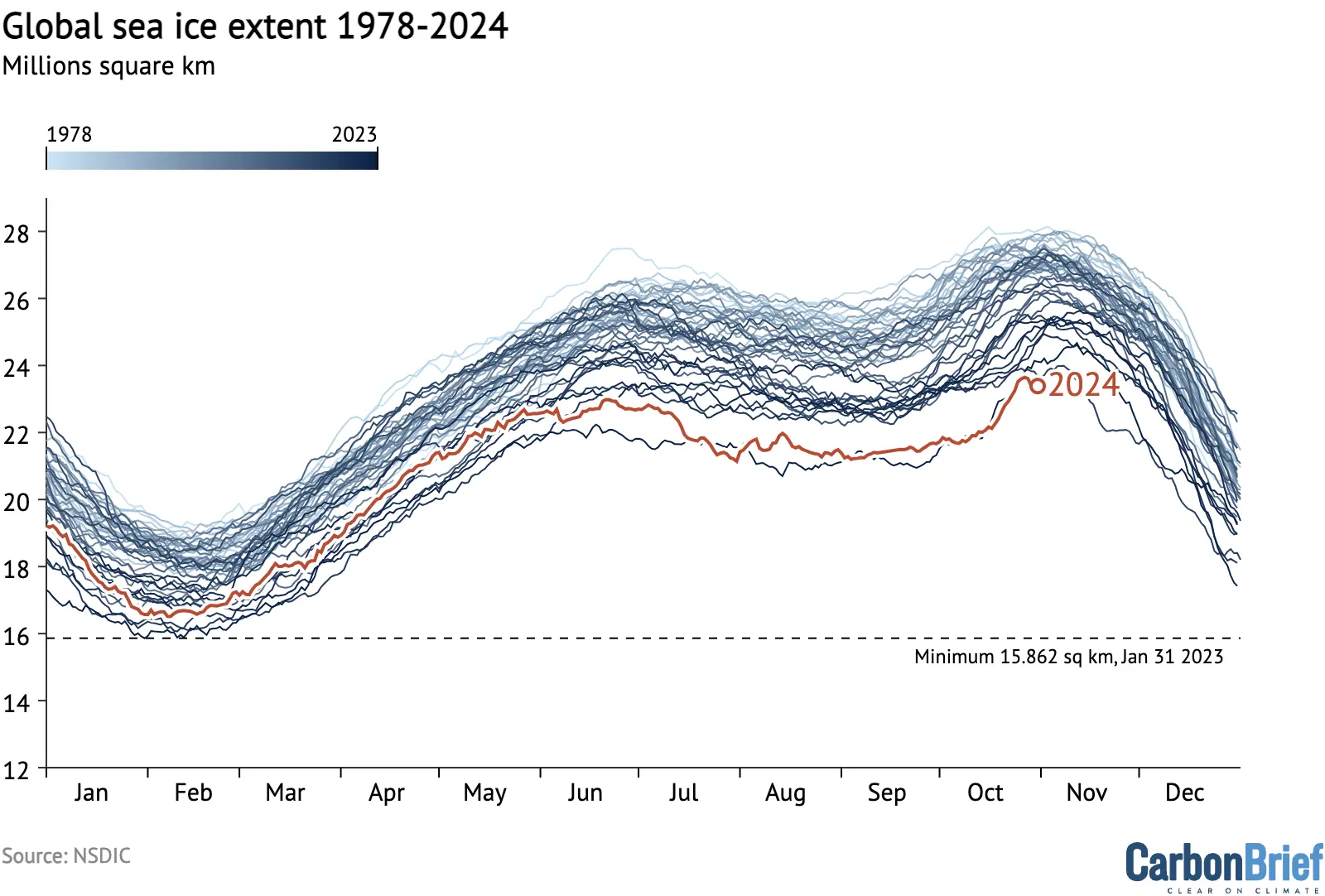
Global sea ice extent is currently at record lows and Antarctic sea ice has spent much of the year at near-record lows – second only to those seen in 2023.
The figure below shows Carbon Brief’s estimate of where 2024 temperatures will end up in each of the groups, based on the year to date and expected El Niño-Southern Oscillation (ENSO) conditions in the tropical Pacific for the remainder of the year.
The dots reflect the best estimate, while the whiskers show the two sigma (95%) confidence interval of the projections. The prior record year (2023 in all groups) is shown by the coloured square. https://interactive.carbonbrief.org/state-of-the-climate/24-Q3/projections.htmlCarbon Brief’s project of 2024 annual global average surface temperatures for each group, along with 95% confidence intervals and prior record (2023) values. 1.5C above pre-industrial (1850-1900) levels is shown by a dashed line. The average projection represents a composite of all five records following the WMO approach. Chart by Carbon Brief.
In all cases, the projected global average temperature for 2024 is virtually certain to exceed the prior record set in 2023.
Three of the five groups (Hadley, Berkeley and Copernicus/ECMWF) are very likely to show annual temperatures exceeding 1.5C above pre-industrial levels (defined here as the 1850-1900 period), while the NASA record has a roughly 40% chance of exceeding 1.5C. Only NOAA’s record is unlikely to show global temperatures above 1.5C this year.
These differences in warming since pre-industrial across different datasets primarily result from choice of ocean records used, as well as differences in approaches to filling in gaps between observations in the early part of the records (e.g. pre-1900s). It reflects the uncertainty in the degree of warming since the mid-1800s, with projected 2024 temperatures ranging from 1.44C (NOAA) to 1.61C (Berkeley Earth).
The figure also provides a composite average of the five different datasets, following the approach used in the sixth assessment report (AR6) from the Intergovernmental Panel on Climate Change (IPCC) and by the WMO. Carbon Brief’s analysis finds that 2024 will be the first year above 1.5C in the composite average.
This provides a way to determine the first year where we can reasonably say that the world has passed that warming level – even though 2023 exceeded 1.5C in the Berkeley Earth dataset and 2024 will not exceed 1.5C in the NOAA dataset.
(It is important to note that exceeding 1.5C in a single year is not equivalent to breaching the Paris Agreement limit. The goal is generally considered to refer to long-term warming – typically over two or three decades – rather than annual temperatures that include the short-term influence of natural fluctuations in the climate, such as El Niño.)
The figure below shows the annual temperatures from each of these groups between 1970 and present, with the year-to-date 2024 temperatures for each record shown as individual points. https://interactive.carbonbrief.org/state-of-the-climate/24-Q3/records_2024_to_date.htmlAnnual global average surface temperatures from NASA GISTEMP, NOAA GlobalTemp, Hadley/UEA HadCRUT5, Berkeley Earth and Copernicus/ECMWF (lines), along with 2024 temperatures to date (January-September, coloured shapes). Each series is aligned by using a 1981-2010 baseline, with warming since pre-industrial based on the IPCC AR6 estimate of warming between pre-industrial and the 1981-2010 period. Chart by Carbon Brief.
There is strong agreement between the different temperature records, with all of them showing approximately 1C warming between 1970 and present. Global temperatures have been around 1.3 above pre-industrial levels in recent years (with a range of 1.2C to 1.4C across the different temperature datasets, reflecting that the differences between them are larger in the 1800s and early 1900s).
As the chart below shows, 2024 (purple line) started out remarkably warm as a result of a strong El Niño event that built in 2023 (red) and peaked near the beginning of the year.
However, global temperatures have remained quite elevated despite the fading of El Niño conditions, setting records through June and remaining quite close to 2023’s exceptional highs in recent months.
Overall, 2024 has set or tied all-time records for seven of the 10 months available to-date in the ERA5 record. (This record uses weather model-based reanalysis to combine lots of different data sources over time.)https://interactive.carbonbrief.org/state-of-the-climate/24-Q3/monthly_global_temperature_anomalies_Q3_2024.htmlTemperatures for each month from 1940 to 2024 from Copernicus/ECMWF ERA5. Anomalies plotted with respect to a 1850-1900 baseline. Chart by Carbon Brief.
While human emissions of CO2 and other greenhouse gases are responsible for effectively all of the Earth’s long-term warming, temperatures in any given year are strongly influenced by short-term variations in the Earth’s climate that are typically associated with El Niño and La Niña events.
These fluctuations in temperature between the ocean and atmosphere in the tropical Pacific help make some individual years warmer and some cooler.
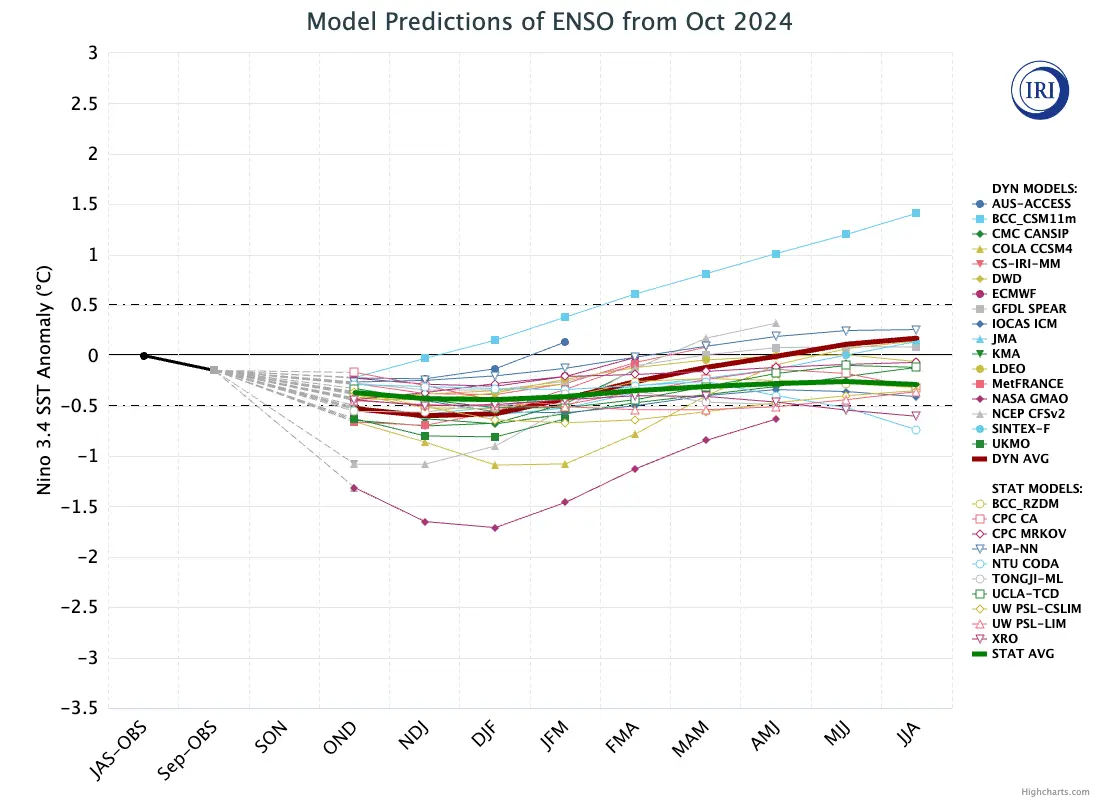
The figure below shows a range of different ENSO forecast models produced by different scientific groups. The values shown are sea surface temperature variations in the tropical Pacific – the El Niño 3.4 region – for three-month periods.
El Niño Southern Oscillation (ENSO) forecast models for overlapping three-month periods in the Niño3.4 region (July, August, September – JAS – and so on) for the remainder of 2024 and then into the spring and summer of 2025. Credit: CPC/IRI ENSO forecast.
Most models expect neutral conditions in the tropical Pacific, with only a few crossing the -0.5C Niño 3.4 sea surface temperature (SST) anomaly that represents the development of a formal La Niña event.
This should result in relatively cooler temperatures in 2025, though it is possible that the year ends up warmer than anticipated given the continuation of high temperatures in recent months – despite the absence of El Niño conditions.
Large areas of record warmth
While global average temperatures are an important indicator of changes to the broader climate system over time as a result of human activities, these impacts will differ as some regions experience more rapid warming or extreme heat events than is reflected in the global average.
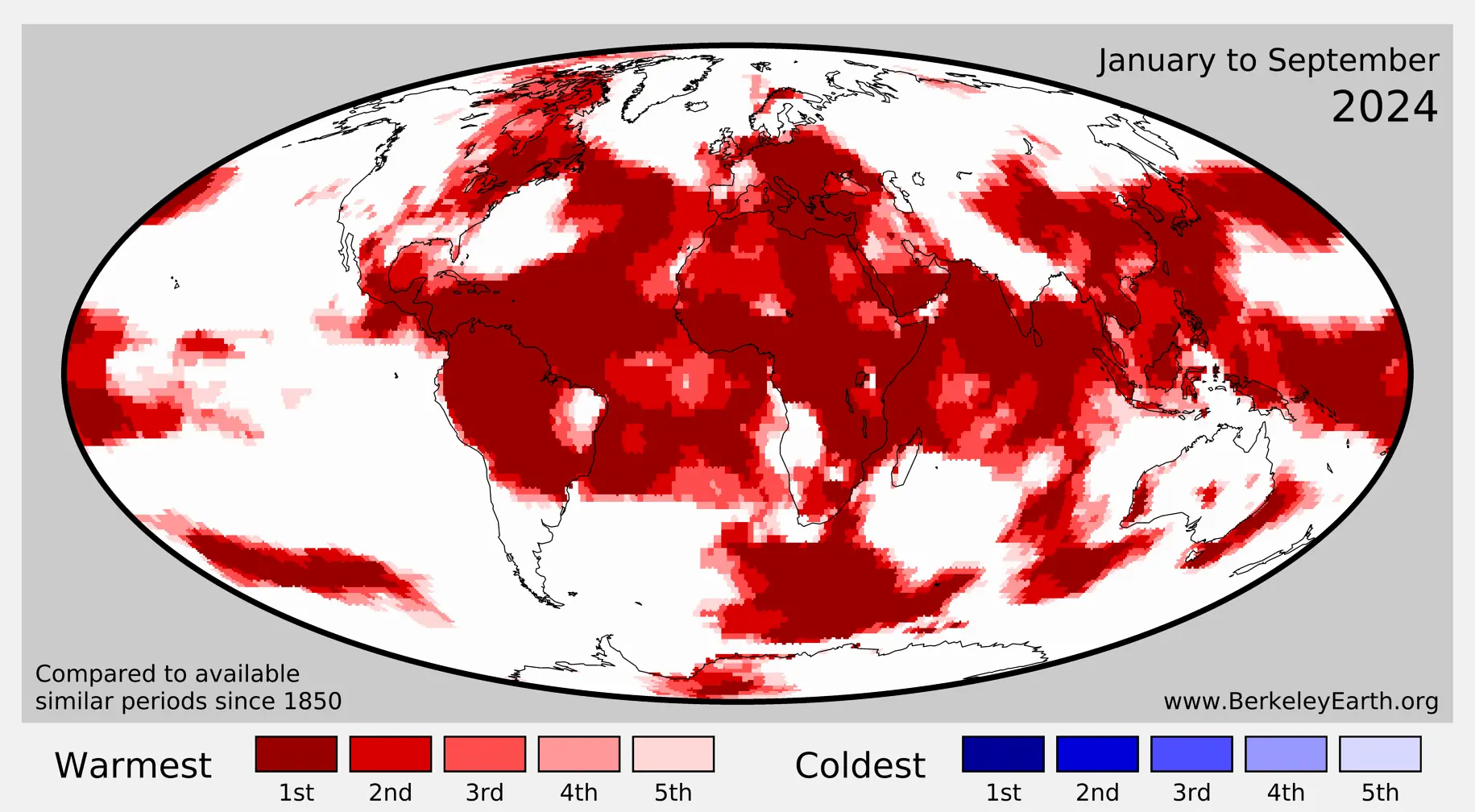
The figure below shows the parts of the world that saw record warm or cold temperatures over the first three quarters of 2024 (January through to September) in the Berkeley Earth dataset compared to all prior years since global temperature record began in 1850.
Map of year-to-date (January-September) regions that set new records (warmest through to fifth warmest). Note that no regions set cold records for the year-to-date in 2024. Credit: Berkeley Earth
Notably, no area on Earth saw record cold (or even the second, third, fourth or fifth coldest temperatures on record). Nearly all of Central America and large parts of South America saw their warmest year to date on record, as did much of eastern Europe, Africa, China, south-east Asia, and Korea.
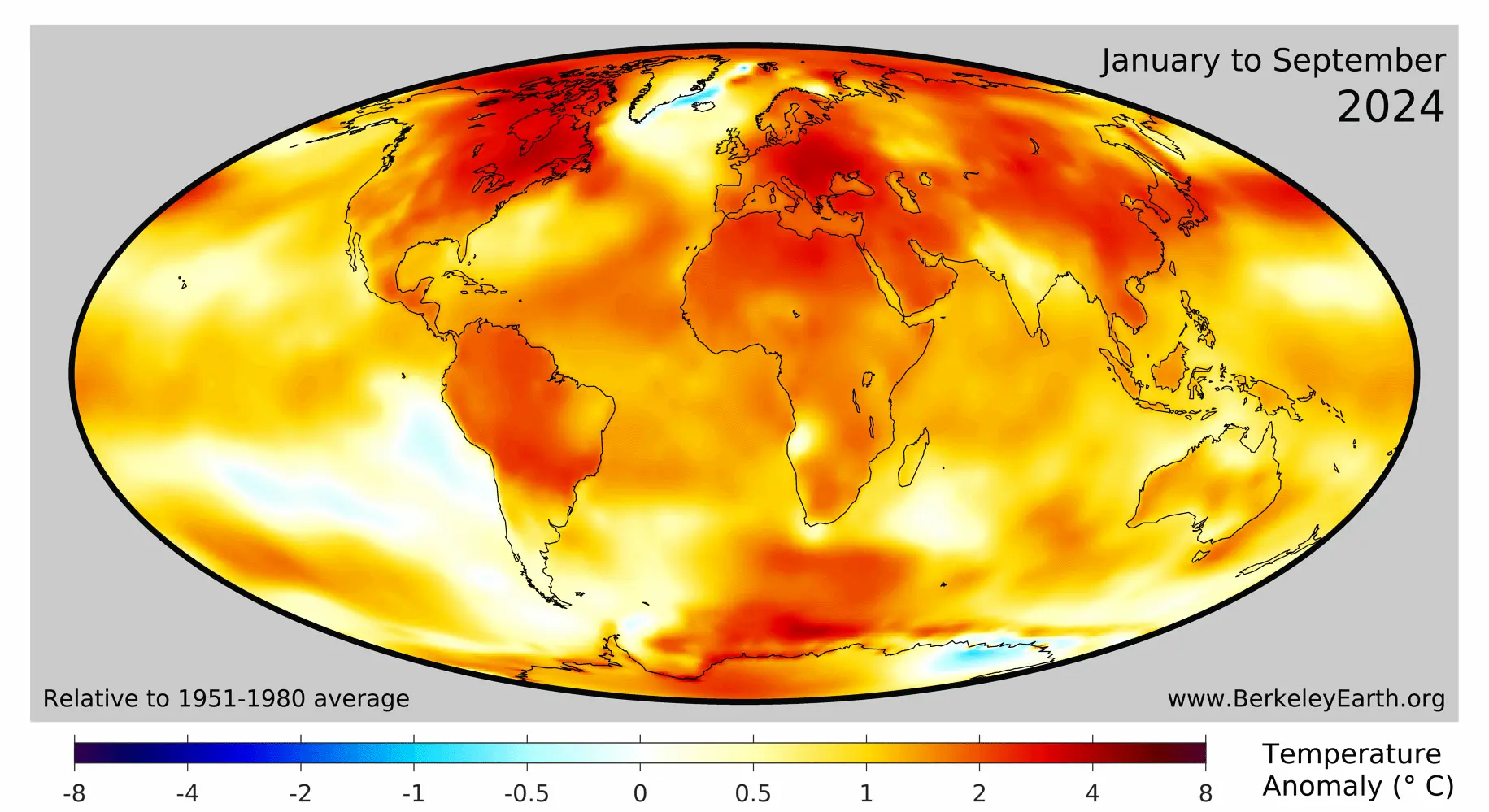
The figure below shows the temperature anomaly over the first nine months of the year compared to the 1951-80 baseline period used by Berkeley Earth. Warming was particularly pronounced over land regions, with many areas already showing warming of 1.5C or 2C above that baseline.
Map of year-to-date (January-September) global surface temperatures. Anomalies are shown relative to the 1951-80 period following the convention used by Berkeley Earth. Credit: Berkeley Earth
Temperatures are tracking climate model projections
Climate models provide physics-based estimates of future warming given different assumptions about future emissions, greenhouse gas concentrations and other climate-influencing factors.
The figure below shows the range of individual models forecasts featured in AR6 – known collectively as the CMIP6 models – between 1970 and 2030, with grey shading and the average projection across all the models shown in black. Individual observational temperature records are represented by coloured lines.https://interactive.carbonbrief.org/state-of-the-climate/24-Q3/model_obs_comps_Q3_2024.htmlTwelve-month average global average surface temperatures from CMIP6 models and observations between 1970 and 2024. Models use SSP2-4.5 forcings after 2015.Anomalies plotted with respect to a 1981-2010 baseline. Chart by Carbon Brief.
While global temperatures were running below the pace of warming projected by climate models for much of the period between 2008 and 2022, the past two years have been closer to the model average.
However, the CMIP6 models may be biassed a bit too warm, with a subset of “hot” models pushing up the average. The IPCC used an approach that weighted models based on how well they reproduced historical temperatures, rather than simply averaging all the models together.
Excluding these hotter models from the analysis results in observations over recent years much closer to the multi-model average and near the centre of the uncertainty range across all models. It also reveals that the past two years – 2023 and 2024 – have been near the upper end of the model range.https://interactive.carbonbrief.org/state-of-the-climate/24-Q3/model%20_obs_comps_filtered_Q3_2024.htmlTwelve-month average global average surface temperatures from CMIP5 models and observations between 1970 and 2024. Models use SSP2-4.5 forcings after 2015. Anomalies plotted with respect to a 1981-2010 baseline. Chart by Carbon Brief.
Record low global sea ice extent
Highly accurate observations of Arctic and Antarctic sea ice have been available since polar-observing satellites became available in the late 1970s.
Arctic sea ice extent during the first three-quarters of 2024 has been below or at the low end of the historical 1979-2010 range, but has not seen any record daily lows.
Antarctic sea ice, on the other hand, set new all-time low records for a few days in July and September, and has generally been the second lowest on record (after 2023) from June onwards.
The figure below shows both Arctic (red) and Antarctic (blue) sea ice extent in 2024, the historical range in the record between 1979 and 2010 (shaded areas) and the record lows (dotted black line).
Unlike global temperature records (which only report monthly averages), sea ice data is collected and updated on a daily basis, allowing sea ice extent to be viewed through to the present day.https://interactive.carbonbrief.org/state-of-the-climate/24-Q3/sea_ice.htmlArctic and Antarctic daily sea ice extent from the US National Snow and Ice Data Center. The bold lines show daily 2024 values, the shaded area indicates the two standard deviation range in historical values between 1979 and 2010. The dotted black lines show the record lows for each pole. Chart by Carbon Brief.
Global sea ice extent is estimated by combining both Arctic and Antarctic sea ice extent. The figure below shows global sea ice extent in each year, with 2024 shown in red. Currently global sea ice extent is at record-low levels, below the prior record for this date set in 2023.
Methodological note
A statistical multivariate regression model was used to estimate the range of likely 2024 annual temperatures for each group that provides a temperature record. This model used the average temperature over the first six months of the year, the average ENSO 3.4 region value during the first nine months of the year and the average predicted ENSO 3.4 value during the last three months of the year to estimate the annual temperatures.
The model was trained on the relationship between these variables and annual temperatures over the period of 1950-2023. The model then uses this fit to predict both the most likely 2024 annual value for each group, as well as the 95% confidence interval. The predicted ENSO 3.4 region values for the last three months of 2024 are taken from the IRI plume forecast.
The percent likelihood of different year ranks for 2024 is estimated by using the output of the regression model, assuming a normal distribution of results. This allows Carbon Brief to estimate what percent of possible 2024 annual values fall above and below the temperatures of prior years for each group, as well as the likelihood of the year exceeding 1.5C in each record.