Image of InBedWithBigOil by Not Here To Be Liked + Hex Prints from Just Stop Oil’s You May Find Yourself… art auction. Featuring Rishi Sunak, Fossil Fuels and Rupert Murdoch.
… UK political parties’ plans for climate and the environment have been jointly assessed by Greenpeace and Friends of the Earth in a new election scorecard published today, which ranks Labour far ahead of the Conservatives across all key green policy categories.
Published just 10 days before voters head to the polls on July 4th, the scorecard assesses the Labour, Conservative, Liberal Democrat and Green Party manifestos released in the past fortnight against 40 policy recommendations set out by the two environmental campaign groups.
Overall, the Green Party topped the league table with a near-perfect 39 score out of a possible 40 recommended policies, ahead of the Liberal Democrats in second place with 31.5.
Labour, meanwhile, scored 20.5 against the 40 green policy recommendations, over four times higher than the Conservatives’ which scored only five points.
Rishi Sunak on stopping Rosebank says that any chancellor can stop his huge 91% subsidy to build Rosebank, that Keir Starmer is as bad as him for sucking up to Murdoch and other plutocrats and that we (the plebs) need to get organised to elect MPs that will stop Rosebank.
Thousands of people marched through central London to urge political leaders to take more decisive action in tackling the UK’s wildlife crisis.
…
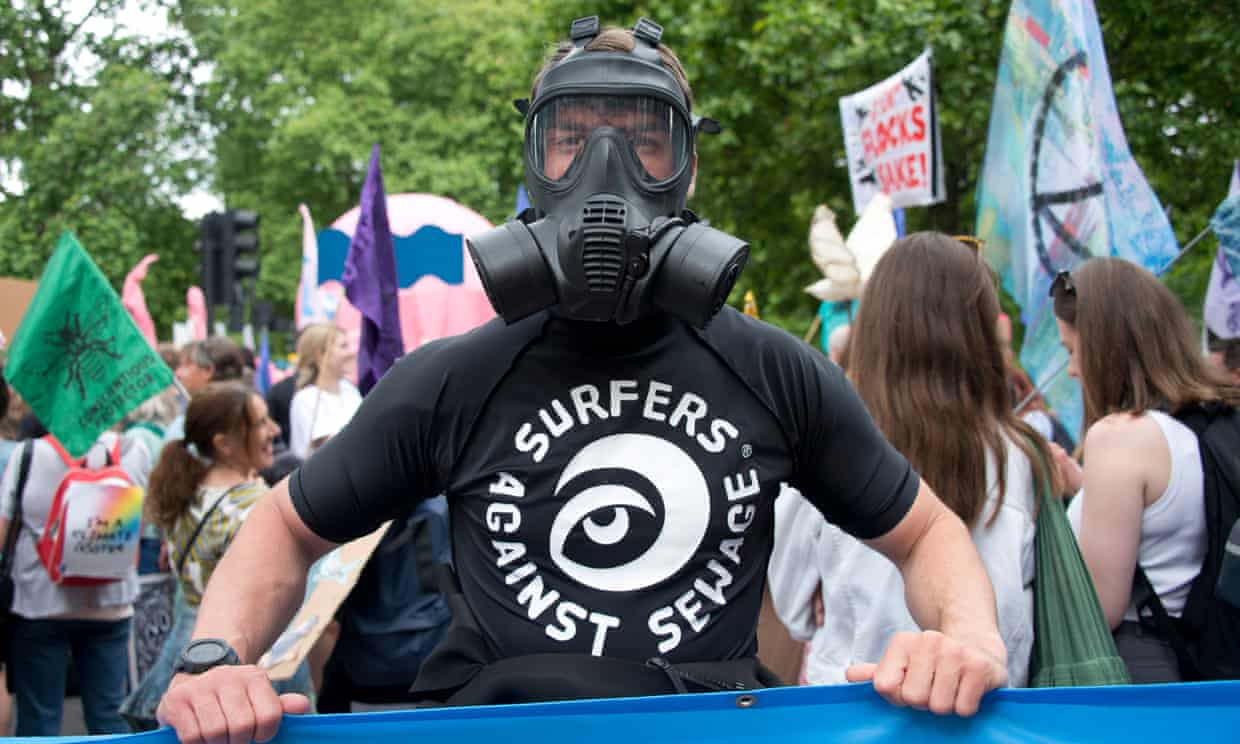
Demonstrators descended on the capital wearing glittery outfits, elaborate animal costumes and intricate face paint. Protesters were calm but the placards they held up revealed an undercurrent of frustration and anger. One read: “We have been swimming in shit.” There were also chants of “less faeces more species”.
A total of 350 environmental groups came together to pressure the government to act more robustly and decisively against the biodiversity crisis. Charities including the National Trust, the Wildlife Trusts, the RSPB and Friends of the Earth stood side by side with direct action groups such as Just Stop Oil, Extinction Rebellion and Animal Rising.
Henry Swithinbank from Surfers Against Sewage. Photograph: Sophia Evans/The Observer
Climate activists Just Stop Oil launched a protest at Stonehenge, the 5,000-year-old stone monument in southern England, a day before thousands of people planned to gather there to celebrate the summer solstice.
Two members of the group sprayed three of the standing stones with an orange powder made from cornflour to draw attention to their campaign and its demands: that the UK government commit to ending the extraction and burning of oil, gas and coal by 2030.
Much like other protests by Just Stop Oil, which have included throwing paint – and sometimes tomato soup – at protected paintings in galleries, the Stonehenge action has been lambasted for threatening that which people hold dear: cultural heritage and national identity.
Politicians, archaeologists and heritage enthusiasts have condemned Just Stop Oil for supposedly endangering the stones. Some have even called for prison sentences – which could happen, as the Unesco World Heritage Site is protected by the Ancient Monuments and Archaeological Areas Act (1979). Lichen species growing on the stones are also protected under the Sites of Special Scientific Interest (SSSI).
The backlash demonstrates how heritage sites such as Stonehenge hold a sacred place for many and generate an almost desperate desire for rigid preservation. But Stonehenge and its landscape are dynamic features that forever shift and change. They have been beset by wars, roadworks and countless solstice gatherings. The stones were touched by thousands of hands before a barrier was installed and still bear the footfall of millions of visitors. They have withstood several interventions by archaeologists, who have hoisted the stones upright and replaced the lintels. In fact, all of the stones painted by Just Stop Oil – 21, 22 and 23 – have been re-erected or consolidated during the 20th century.
This is also not the first time the stones have been vandalised. As well as graffiti carved into some of them, the stones have often been the stage for political protests. The slogan “ban the bomb”, referring to the call for nuclear disarmament, was sprayed across nine stones in 1961. The Stonehenge landscape will survive this protest by Just Stop Oil.
The real threat to Stonehenge
What Stonehenge may not withstand is climate change. The UK is set to experience warmer, wetter winters and hotter, drier summers, as well as an increase in the occurrence and severity of extreme weather which will include high winds and flooding. This will have an impact on the stones and their landscape, exacerbating erosion of the faces of the stones caused by freezing and thawing while much wetter or much drier soil undermines their stability.
There are 70 species of lichen growing on the stones, some of which are rare for the surrounding Salisbury plain. But drier summers brought about by climate change may deteriorate the environment required for these species to thrive.
While Just Stop Oil’s protest at Stonehenge has generated outrage, there is silence over the cumulative and ongoing effects of climate change upon this and other heritage sites. There is little to no public uproar about climate change posing one of the biggest challenges to cultural landscapes, buried archaeology and the built environment. Without immediate and drastic reductions in greenhouse gas emissions, we will witness the loss and change of beloved heritage sites which will in turn affect our economy, way of life and sense of place.
Heritage and climate change have a complex relationship. Climate change affects, and will continue to affect, heritage – but the reverse is also true. Heritage can encourage climate action. My research has demonstrated that greater awareness of heritage loss can raise consciousness of the climate crisis and prompt action.
This is in part due to the emotional attachment people have to local and national heritage sites, and even those in other countries. When climate change and heritage meet during these protests, it is incredibly emotive. The visceral response to the protest at Stonehenge reveals our fear of loss and change, but this can act as a catalyst for climate action too. Just Stop Oil’s protest appears to have highlighted a collective fear of losing revered heritage, yet the conversation about it has overlooked the main instigator.
The orange cornflour has been washed away by the charity English Heritage, which reports no visible damage. But climate change will continue to threaten Stonehenge, its wider landscape and the rare lichen living on the stones. We must channel our concern over potential damage to Stonehenge towards the real threats facing heritage sites.
However, in a ruling on Monday, Mr Justice Holgate largely dismissed their claim, finding most parts of their case were “unarguable”.
SSWHS previously said the approved scheme would “destroy” around seven hectares of the world heritage site, and mark “the first step” towards being de-listed by Unesco.
…
Then-transport secretary Grant Shapps first gave the green light to the project in November 2020, despite advice from Planning Inspectorate officials that it would cause “permanent, irreversible harm” to the area.
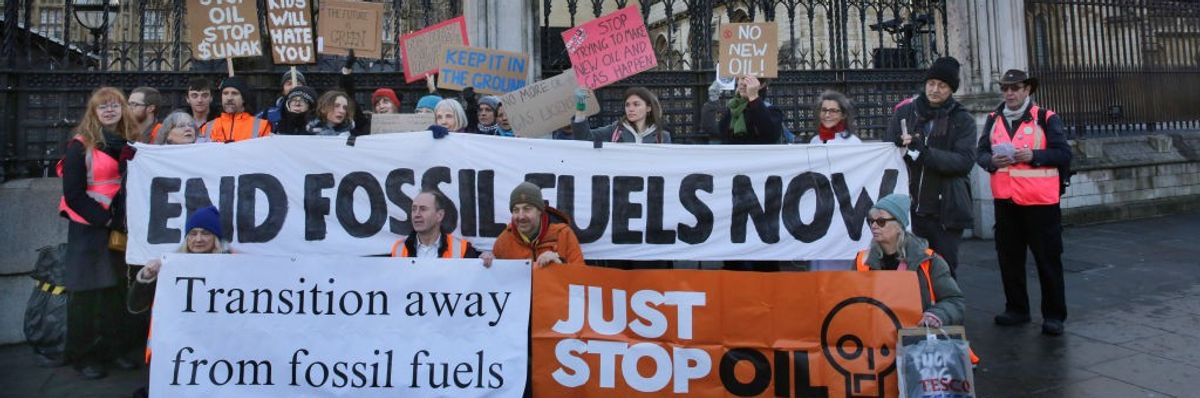
Campaigners gathered outside the Houses of Parliament in London, United Kingdom, in January 2024 to protest the issuance of North Sea oil and gas licenses. (Photo: Martin Pope/SOPA Images/LightRocket via Getty Images)
“There can be no doubt that citizens across the world are saying to their leaders, you have to act and, above all, have to act faster,” a U.N. official said. “This is an issue that almost everyone, everywhere, can agree on.”
A large majority of the global population, including people who live in oil, gas, and coal producing countries, supports a fast transition to clean energy and a phaseout of fossil fuels, a poll released Thursday showed.
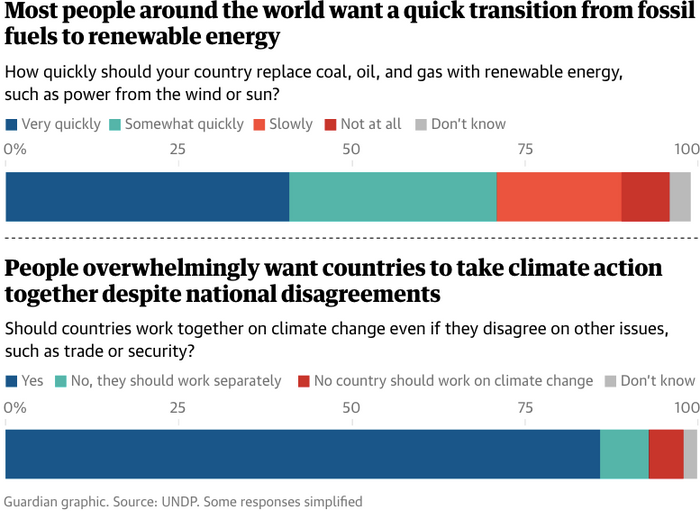
Across 77 countries, 72% of those surveyed supported a quick fossil fuel phaseout, while an even higher percentage, 80%, supported stronger climate action in general, according to the poll, called Peoples’ Climate Vote and conducted for the United Nations Development Program (UNDP) with the University of Oxford and GeoPoll.
“There can be no doubt that citizens across the world are saying to their leaders, you have to act and, above all, have to act faster,” UNDP Administrator Achim Steiner told The Guardian. “This is an issue that almost everyone, everywhere, can agree on.”
People in most major fossil fuel producing nations support a quick energy transition in their own countries, the poll showed. In the United States, the world’s largest oil and gas producer, 53% supported either a “very” or “somewhat” quick phaseout; in Saudi Arabia, the second largest, 75% did so; and in China and India, the leading coal producers, the figures were 80% and 76%, respectively.
The poll also showed overwhelming support for transnational cooperation, even if it requires setting aside other differences: 86% of those surveyed said want countries to tackle climate change together. Steiner called this a “stunning” level of consensus.
Steiner noted that fossil fuel subsidies distort the market and subvert the public will for change.
“There are very narrow, self-interested agendas that maintain artificially inflated [profits] for fossil fuel-based industries that ultimately are coming at the cost of everyone,” he said.
The poll—the largest standalone public opinion survey on climate change to date, building on a first edition that was run in 2021—clarifies the will of the global public and strengthens the moral case for climate action, commentators said.
“Brilliant to see clear, credible evidence that the overwhelming majority of people across the world—oil rentier economy or not—want to see transition from fossil fuels to renewable energy ‘quickly,’” X user Dave Drabble wrote. “Let’s not let oil and gas interests determine our fate.”
Similarly rejecting the influence of fossil fuel interests, Steiner said, “It is so important we let the people speak for themselves.”
A new report shows oil majors fall short of meeting Paris Agreement targets while fueling global military conflicts.
Oil majors are not on track to hit Paris Agreement climate targets that limit global temperature rise to 1.5°C, a new report reveals.
Eight fossil fuel giants – Chevron, ExxonMobil, Shell, TotalEnergies, BP, Eni, Equinor, and ConocoPhillips – are on course to use 30 percent of the world’s remaining carbon budget for that 1.5°C goal, according to the Big Oil Reality Check report by nonprofit Oil Change International (OCI).
Combined, the oil and gas companies’ extraction plans are consistent with a temperature rise of over 2.4°C, the report found.That level of warming, according to the Intergovernmental Panel on Climate Change, will reduce food security, risk irreversible loss of ecosystems, and increase heat waves, rainfall, and extreme weather events.
“We analyzed the climate promises and plans of the largest eight international oil and gas companies that are owned in North America and Europe. What would it take for an oil and gas producer to align their production with limiting warming to 1.5?” David Tong, global industry campaign manager at OCI and co-author of the report, told DeSmog.
“If an oil and gas company were serious about transitioning its business model, the first step would be ending all new production and then setting a Paris-aligned phaseout plan,” he added.
‘No New Fossil’ Standard
A recent paper by academics at University College London and the International Institute for Sustainable Development, published in Science in May, calls for stopping fossil fuel expansion and building a “No New Fossil” global norm. According to the authors, this would make it “easier to phase down fossil fuels” and achieve the Paris Agreement climate goals.
No new fossil fuel projects would be needed in a 1.5°C world, they wrote, because the “existing fossil fuel capital stock” is sufficient to meet energy demand. The authors also note that preventing new fossil fuel projects is, in general, more feasible than closing existing projects from an economic, political, and legal viewpoint.
In the face of continuing global pressure to stop fossil fuel expansion, Chevron, ConocoPhillips, Equinor, Eni, ExxonMobil, and TotalEnergies have goals to increase oil and gas production within the next three years or beyond, the OCI report finds. While Shell does not quantify a target, the company plans to keep oil production steady while growing gas production in the near future, OCI said.
#BigOil has, in recent years, made splashy climate pledges to cut their greenhouse gas emissions & take on the climate crisis, but those plans don't stand up to scrutiny.
— Center for International Environmental Law (@ciel_tweets) May 27, 2024
“None of those companies came anywhere close to alignment [with climate goals],” said Tong. “Six of the eight companies we analyzed have explicit plans to increase their oil and gas production in this critical decade when we need to be cutting our reliance on fossil fuels, cutting oil, gas, and oil production.”
Plateauing oil and expanding gas production, like some of these companies plan to do, is “grossly insufficient” compared with the action that’s needed, Tong added. Even commitments to make businesses more efficient aren’t going to cut it alone, he said.
“It’s like a cigarette company claiming that it will solve lung cancer by producing cigarettes more efficiently,” he noted. “That’s not just not a credible claim. It’s a promise to become a more efficient climate breaker.”
Big Oil and War
According to the OCI report, all the oil majors fail to meet basic criteria for just transition plans for workers and communities where they operate.
“A number of these companies also face significant ongoing, unresolved allegations of human rights … and Indigenous people’s rights violations,” Tong told me.
A March 2024 investigation, commissioned by OCI and conducted by DataDesk, revealed that ExxonMobil, Chevron, TotalEnergies, BP, Shell, and Eni are “complicit in facilitating the supply of crude oil to Israel.” These findings are particularly noteworthy in the context of “Israel’s mounting evidence of war crimes” against Palestinians in Gaza, the OCI states in its new report.
Diesel and gasoline for tanks and other military vehicles are supplied by Israel’s refineries, which rely on regular imports of crude oil by these companies and, since October 2023, supplies mainly from Azerbaijan, Kazakhstan/Russia, Gabon, and Brazil, the research has found.
The fossil fuel industry is “fueling war and military conflicts” in many regions of the world, said Svitlana Romanko, a prominent Ukrainian activist and founder and director of Razom We Stand, a Ukrainian organization campaigning to ban all imports of fossil fuels from Russia.
According to Romanko, the OCI Big Oil Reality Check report “reinforces the importance of moving away from fossil fuels and investing into distributed renewable energy.”
A new analysis by a group of climate experts estimates that the first two years of Russia’s war on Ukraine resulted in greenhouse gas emissions equivalent to around 175 million tonnes of carbon dioxide. The estimated global cost of this warming in extreme weather impacts: $32 billion.
After Russia launched its full-scale invasion of Ukraine in February 2022, Russia earned over 681 billion euros in revenue from fossil fuel exports. European Union countries purchased fossil fuels from Russia for more than 195 billion euros.
Big Oil, as well as Russia, is profiting from the war, Romanko said. After the invasion, BP, Chevron, Equinor, ExxonMobil, Shell, and TotalEnergies raked in $219 billion, more than double their profits compared to the previous year.
“Most [governments] subsidize fossil fuels, and these subsidies are accounting for trillions of U.S. dollars annually,” Romanko said. “This is a big part of fossil fuel profits, and the more fossil fuels are subsidized, [the] less investments are made available for renewable energies.”
She pointed out that the partnership between TotalEnergies and Russia’s largest private gas producer, Novatek, was also “instrumental” in helping Russia get access to technologies and engineering services to launch Novatek’s Yamal LNG and Arctic LNG 2 projects.
Romanko notes that fossil fuel infrastructure can also constitute a liability for military attacks and quickly become a target.
“Centralized infrastructure endangers energy supply and overall safety of the supply,” she said. In Ukraine, a massive effort to install solar power plants in schools and hospitals helped decentralize this key resource, Romanko explained. “Decentralized energy supply is essential to building true energy independence,” she added. “And this is the future.”
Pressure for Accountability
Some of the eight oil majors in OCI’s report have faced more international and national scrutiny than others. Such pressure can facilitate accountability, but that’s less likely when the fossil fuel company is closely intertwined with the institutional, political, and economic life of its country.
“We need to look at what has succeeded in putting so much pressure on companies like Shell and BP,” OCI’s Tong said.
One factor: when communities in a company’s home country work closely in partnership with communities in fossil fuel-producing countries. Tong said that positive results also happen when campaigners use a range of strategies to expose producers, from nonviolent direct action to op-eds, research, and court action.
“This is particularly challenging with Eni, TotalEnergies, and Equinor in different ways because of the close interactions that each of the companies have with their home states,” he added.
Public, political, and legal pressure for accountability must also be coupled with industry regulation, according to Tong.
“We concluded that there is no evidence that the oil and gas sector will voluntarily transition to renewable energy, or voluntarily act to align their production with what’s needed for the Paris Agreement,” Tong said. Instead, governments must no longer license new production sites.
The strong right-wing result in the latest EU Parliament elections could also affect Big Oil’s energy transition.
“The more the links between the state and big polluters are overt, the more people get out in the streets and protest,” Tong said.
What is safe to say is that Big Oil’s business as usual will increase climate change effects.
“Floods, hurricanes, extreme weather events, and the millions of human lives affected and lost – this damage to nature, to human lives and to life on earth will only mount,” Romanko said. “What will be lost in a few more years will also mount if fossil fuel companies are allowed to continue with business as usual.”