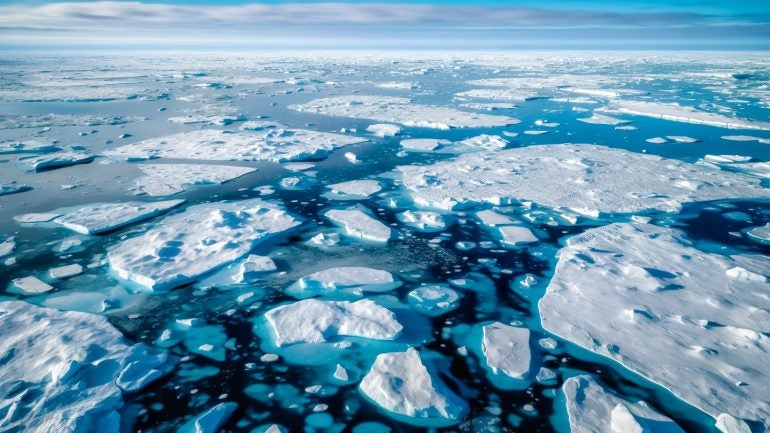
Landscape of the North Pole where climate change has caused melting ice caps. Photo: Mongkolchon Akesin/Shutterstock.
A paper by the National Bureau of Economic Research suggests that each degree of global heating could reduce global GDP by 12%.
A new paper written for the National Bureau of Economic Research (NBER) suggests that the global economic cost of climate change could be around six times higher than previous estimations.
The paper, written by Northwestern economics professor Diego Känzig and Harvard economics professor Adrien Bilal, suggests that every one degree of atmospheric warming reduces global GDP by 12%.
It uses global heating data cross-referenced against aggregated national GDPs to come to a higher figure. The authors believe that this model provides a more complete picture, as many of the shocks, including extreme wind and precipitation, are affected by global conditions rather than localised heating.
It also places the social cost of carbon (SCC) at over $1,000/tCO2. This global measure estimates the economic damage caused by every tonne of carbon emitted and has historically been set far lower. According to the authors, their own calculations would only place the SCC at $151/tCO2 if evaluating local rather than global temperature shocks.
What does this mean for global economies?
The findings of this paper are clearly worrying as they suggest the threat to markets posed by climate change is significantly higher than previously quantifiable. The authors of the paper describe the impacts of a 1°C as “of the same magnitude as the growth impacts that typically occur after severe banking or financial crises,” and the long-term impacts of climate change as “comparable to the economic damage caused by fighting a war domestically and permanently [italics theirs].”
Shell is suing Greenpeace – threatening a multi million dollar lawsuit and a protest ban. We need your help to fight in court.
Earlier this year, six Greenpeace International activists managed to board and occupy a moving Shell oil platform. The platform was making its way towards the North Sea to unlock new oil wells.
Our demand was clear: Shell must stop drilling for new oil and gas, and start paying up for causing decades of climate damage.
The protest continued for 13 days and almost 4,000km. During this time, Shell reported record annual profits of nearly $40bn. But they won’t pay a penny towards fixing the climate chaos they’ve caused.
Like so many of us, the activists who occupied Shells’ platform all experience the climate crisis in different ways – from rising energy bills and flooding to heatwaves and typhoons. This protest took the fight for climate justice straight to Shell, in a way they couldn’t ignore. Standing with millions of people worldwide, who are losing their lives, loved ones and homes to climate breakdown caused by fossil fuel giants.
Well, we got Shell’s attention. Now they’re suing Greenpeace UK and Greenpeace International, threatening a multi million dollar lawsuit and a protest ban.
These bullying tactics threaten the global fight for climate justice. Will you help us stand up to Shell and donate today to the Stop Shell Appeal?
A glowing quartz rod at the end of an experiment in absorbing solar radiation, in which it reached a temperature of 1,050°C. Solar process heat above 1,000°C can decarbonize industrial applications such as cement manufacturing and metallurgical extraction. Emiliano Casati, Leo Allgoewer and Aldo Steinfeld
Industrial processes like smelting metals or manufacturing cement can be carbon-intensive, as they typically rely on fossil fuels to generate enough energy to produce high temperatures. But researchers have found a way to use solar thermal trapping, rather than fossil fuels, to reduce the emissions of some industrial processes.
“To tackle climate change, we need to decarbonize energy in general,” said corresponding author Emiliano Casati, of ETH Zurich, Switzerland, as reported by Science Daily. “People tend to only think about electricity as energy, but in fact, about half of the energy is used in the form of heat.”
Scientists used semitransparent materials, including synthetic quartz, to capture sunlight with a thermal trapping effect. The team connected a synthetic quartz rod, partially lined with platinum, to an opaque silicon carbide disk, which would absorb the sunlight, and exposed one end of the quartz rod to concentrated solar radiation.
After exposing one end of the rod to the concentrated solar radiation, the silicon carbide disk reached 1,050 degrees Celsius (1,922 degrees Fahrenheit), hot enough for smelting metal or cooking cement, among other industrial processes. While that end reached over 1,000 degrees Celsius, the other end of the quartz rod stayed at a temperature of 600 degrees Celsius (1,112 degrees Fahrenheit). The researchers published their findings in the journal Device.
NOAA (4/15/24) found temperature levels in every ocean high enough to cause coral bleaching.
Record levels of heat in the ocean are causing once-colorful coral reefs around the world to bleach a ghostly white. In April, the National Oceanic and Atmospheric Administration (NOAA) announced the planet’s fourth mass coral-bleaching event on record—the second in the last decade.
While they might look like plants, corals are actually invertebrate animals related to jellyfish. They get their vibrant colors from tiny algae that live on them and provide them with food. But when ocean temperatures become too hot, corals get stressed and expel the algae, losing their food source and color. Starving coral can recover if their environments improve, but the International Panel on Climate Change (IPCC) predicts that even with the Paris Agreement’s allotted warming of 1.5°C over pre-industrial levels, 70–90% of the world’s coral reefs will still die.
Because coral reefs provide such vibrant ecosystems for sea life, mass coral death will impact economies and food security for humans as well. By protecting coasts, sustaining fisheries, generating tourism and creating jobs, it is estimated that coral reefs provide ecosystem services worth trillions of dollars each year (MIT Science Policy Review, 8/20/20; GCRMN, 10/5/21).
ABC News (7/25/23) reported last year that “ocean temperatures have a strong connection to climate change”—but didn’t mention what climate change is connected to.
In the past year alone, we’ve seen staggering and unprecedented ocean temperatures amid widespread heatwaves. Last summer, water temperatures of more than 100°F were recorded off the coast of Florida (ABC, 7/25/23). Scientists say the El Niño weather phenomenon, solar activity and a massive underwater volcanic eruption have played a role in recent supercharged ocean temperatures, but the biggest cause of this coral crisis is undisputed: climate change. The IPCC reports that it’s “virtually certain” ocean temperatures have risen unabated since 1970, absorbing more than 90% of excess heat from the climate system. We also know that the burning of fossil fuels changes the climate more than any other human activity does.
Therefore, in order to give the public the most complete understanding of what’s going on—and how we can fix it—reporting on coral bleaching should not only link the phenomenon to climate change, but link climate change to its main culprit: the fossil fuel industry. While much reporting deserves credit for clearly making this connection, some reports from major outlets were still behind, implying the climate crisis might be some sort of act of God, rather than something humans have caused—and have the power to mitigate.
Good news about bad news
Coral bleaching is bad news, but I’d like to take a rare moment to highlight the good news, too: A lot of reporting on this crisis was thorough, setting a solid example of how the increasing number of climate change-related phenomena should be reported on.
Vox (4/26/24) spells it out: “Ultimately, the only real solution is reducing carbon emissions. Period.”
Vox (4/26/24) dedicated a whole piece to climate change’s effects on coral, making that fossil fuel connection. Senior environmental reporter Benji Jones wrote:
Ultimately, the only real solution is reducing carbon emissions. Period. Pretty much every marine scientist I’ve talked to agrees. “Without international cooperation to break our dependence on fossil fuels, coral bleaching events are only going to continue to increase in severity and frequency,” [NOAA marine scientist Derek] Manzello said.
The New York Times (4/15/24) made the fossil fuel connection, too, in an article by Catrin Einhorn: “Despite decades of warnings from scientists and pledges from leaders, nations are burning more fossil fuels than ever and greenhouse gas emissions continue to rise.”
NPR dedicated an episode of All Things Considered (4/17/24) to scientists’ work to breed heat-tolerant corals and algae, in hopes that they can help restore reefs. The piece, by Lauren Sommer and Ryan Kellman, outlined this work’s promise—and its limitations. Heat-tolerant algae may not share as many nutrients with the coral, potentially causing the coral to grow more slowly and reproduce later. Regulators will need to assess whether these lab-grown corals are safe for wild populations and their ecosystems as a whole. Logistically, the sheer amount of heat-tolerant coral needed to replace affected reefs is vast, and it’s only a temporary solution.
“It’s not our ‘get out of jail free’ card,” said Australian coral biologist Kate Quigley:
Maybe that gets us to 2030, 2050, for a very few number of species that we can work with. If we don’t have an ocean to put them back in that’s healthy, no amount of incredible technology or money is worth it.
The episode ended with an acknowledgment that these scientific mitigations are meant only to buy time while humans work to halt climate change, which will require “cutting heat-trapping emissions from the largest source—burning fossil fuels—and switching to alternative energy sources like solar and wind.”
All Things Considered’s coverage of the scientists’ work was impactful because it took time to explain that creating these heat-tolerant corals was an important mitigation, but that the ultimate solution is to cut fossil fuels. Without the latter, the former would be in vain.
Capable of accountability
As a media critic for an organization that’s been at this since 1986, to me it’s heartening when news outlets’ work actually improves. It’s definitely not yet time to pop the champagne—there’s still a chronic lack of clear reporting linking climate disasters to fossil fuels, as FAIR has noted in coverage of last year’s wildfires (7/18/23, 8/25/23), climate protests (9/29/23), the potential breakdown of a crucial Atlantic current (7/31/23), overstating the potential of new carbon-capture technology (1/4/24) and more. But these few coral-focused pieces offer hope that some outlets might be improving their climate reporting practices to include accountability. At the very least, it proves they are certainly capable.
Aside from the effects of the climate crisis becoming harder and harder to ignore each year, there is a commendable movement to train journalists on how best to report on climate through a number of initiatives and organizations. There’s a lot of work to do, but these stories indicate progress since Big Media was applauding Big Oil’s efforts to clean up the Exxon Valdez oil spill in 1989 (Extra!, 3–4/90) and giving platforms to “scientists” on Big Oil’s payroll who asserted climate change was not occurring (Extra!, 11–12/04, 5–6/07).
The new denial
CNN (5/9/24) waited until the the 24th paragraph (out of 24) to tell readers that we “need to curb climate-warming carbon emissions.”
Climate denial today is more nefarious. Due to the unanimity and widespread knowledge of the scientific consensus, respectable outlets can no longer parrot views that the Earth isn’t warming. What they can do is bury or gloss over information on its primary cause, who profits off of it, and what needs to be done to prevent it from getting much worse.
In a piece on the potential of artificial reefs to mitigate this crisis that linked coral bleaching to climate change, CNN‘s Michelle Cohan (5/9/24) waited until the very last paragraph to mention the need to “curb climate-warming carbon emissions.” There’s nothing untrue about that statement, but it doesn’t tell you where those emissions come from, and leaves open the interpretation that “curbing” emissions can come from carbon capture and storage—a strategy that is largely industry greenwashing (FAIR.org, 1/4/24).
Despite likely short-form word limits, a solutions-oriented piece like this does a disservice to readers—and the scientists working on saving corals—by giving such an incomplete sketch of the necessary long-term change. It would benefit from a clear explanation that a) we need to phase out fossil fuels and b) alternative energy sources already exist, are reliable, and are more affordable than fossil fuels already. It’s not arduous or wordy to do so. All Things Considered did most of it in one sentence.
An ABC piece (4/15/24) by Leah Sarnoff and Daniel Manzo covered the coral-bleaching event, but only mentioned climate change in passing toward the end. Otherwise, “warming oceans” were just depicted as something that happened, with no clear connection or cause.
In an article expressing the dire condition of the reefs, the Washington Post‘s Rachel Pannett (4/18/24) likewise made the link to climate change only once: “Climate change is the greatest threat to the Great Barrier Reef, and coral reefs globally,” said Roger Beeden, the chief scientist of the Great Barrier Reef Marine Park Authority. There was another quote from a research director with the Australian nonprofit Climate Council, who merely noted that the bleaching of the Great Barrier Reef is “a disaster at our doorstep.”
It’s important to express the dire condition the reefs are in, and the devastating risks it poses to ocean and human life. But by only mentioning “climate change” in passing, and not discussing its causes, it comes across as a natural but unfortunate phenomenon. Not highlighting its causes means not highlighting its solutions, either. The result is a potentially paralyzing doomsday narrative that is more likely to dampen than galvanize necessary climate action—especially against fossil fuels.
‘Heat stress’
The word “climate” never appears in this Washington Post piece (4/15/24).
Another Washington Post piece (4/15/24), by Amudalat Ajasa, mentioned the “heat stress” on corals, but not even climate change, let alone the culpability of fossil fuels. This piece quoted NOAA’s Manzello, saying that this global event should be a wake-up call, but didn’t elaborate on what that wake-up call would be for. Wake up to do what? This piece didn’t explain.
The piece also took a grave tone, describing the ghastly reefs off the coast of Florida, Australia and the Caribbean island of Bonaire. It quoted Francesca Virdis, a chief operating officer at Reef Renewal Bonaire: “It’s hard to find a silver lining or a positive note with everything happening.”
The article explained the role of El Niño—a naturally occurring climate pattern that warms areas of the Pacific every 2–7 years—and the hope that it will soon let up and give way to La Niña, its cooler counterpart, but did not explain that the phenomenon plays a smaller role than ongoing, human-caused warming. The aforementioned Vox piece also discussed the role of El Niño, but was sure to specify that reefs have been collapsing long before this current crisis.
The feeling of alarm is justified, but journalists should remind readers that the coral bleaching crisis—and climate change as a whole—are not totally uncontrollable acts of nature. We know what is to blame. While it may be too late to avoid breaching the 1.5°C limit even if we cut emissions tomorrow, the sooner we cease burning fossil fuels, the more catastrophic impacts we’ll avoid.
The message is urgent and dire, but there’s plenty that humans—especially those in power—can do, and there’s plenty journalists can do to make the public aware.
FEATURED IMAGE: NOAA photos of a coral before and after bleaching. (This particular coral recovered from the event.)
FAIR’s work is sustained by our generous contributors, who allow us to remain independent. Donate today to be a part of this important mission.
Brussel sprout crops have been hit by the wet weather. Joe Gidden/PA
Climate change is a major reason the UK suffered such a waterlogged winter, scientists have confirmed.
It was the country’s second wettest October to March period on record and a disaster for farmers, who faced flooded fields during a key planting period.
Global warming due to humans burning fossil fuels made this level of rainfall at least four times more likely, according to the World Weather Attribution group.
One farmer in Lincolnshire told the BBC that a third of his farm could not be planted in time this year.
Colin Chappell, a fourth generation farmer on the banks of the River Ancholme in Lincolnshire, who produces food including peas, oil and wheat, says he will only produce half what he would usually expect.
“There are some farms in the valley that will not see a harvest at all this year. That hasn’t happened here since 1948,” he says.