The government has been defeated in court – for a second time – for not doing enough to meet its targets for cutting greenhouse gas emissions.
Environmental campaigners argued that the energy minister signed off the government’s climate plan without evidence it could be achieved.
The High Court ruled on Friday that the government will now be required to redraft the plan again.
In response the government defended its record on climate action.
A Department for Energy Security and Net Zero spokesperson said: “The UK can be hugely proud of its record on climate change. We do not believe a court case about process represents the best way of driving progress towards our shared goal of reaching net zero.”
The legal challenge was brought by environmental groups Friends of the Earth, ClientEarth and The Good Law Project.
Tony Bosworth, lead campaigner at Friends of the Earth, said it was “an embarrassing day for the government”.
Speaking outside the court to BBC News he said: “What we now need to see is a climate plan which is robust, which is comprehensive and which is fair, which makes sure we meet all our climate targets, and which does that in a way which doesn’t leave anybody behind.”
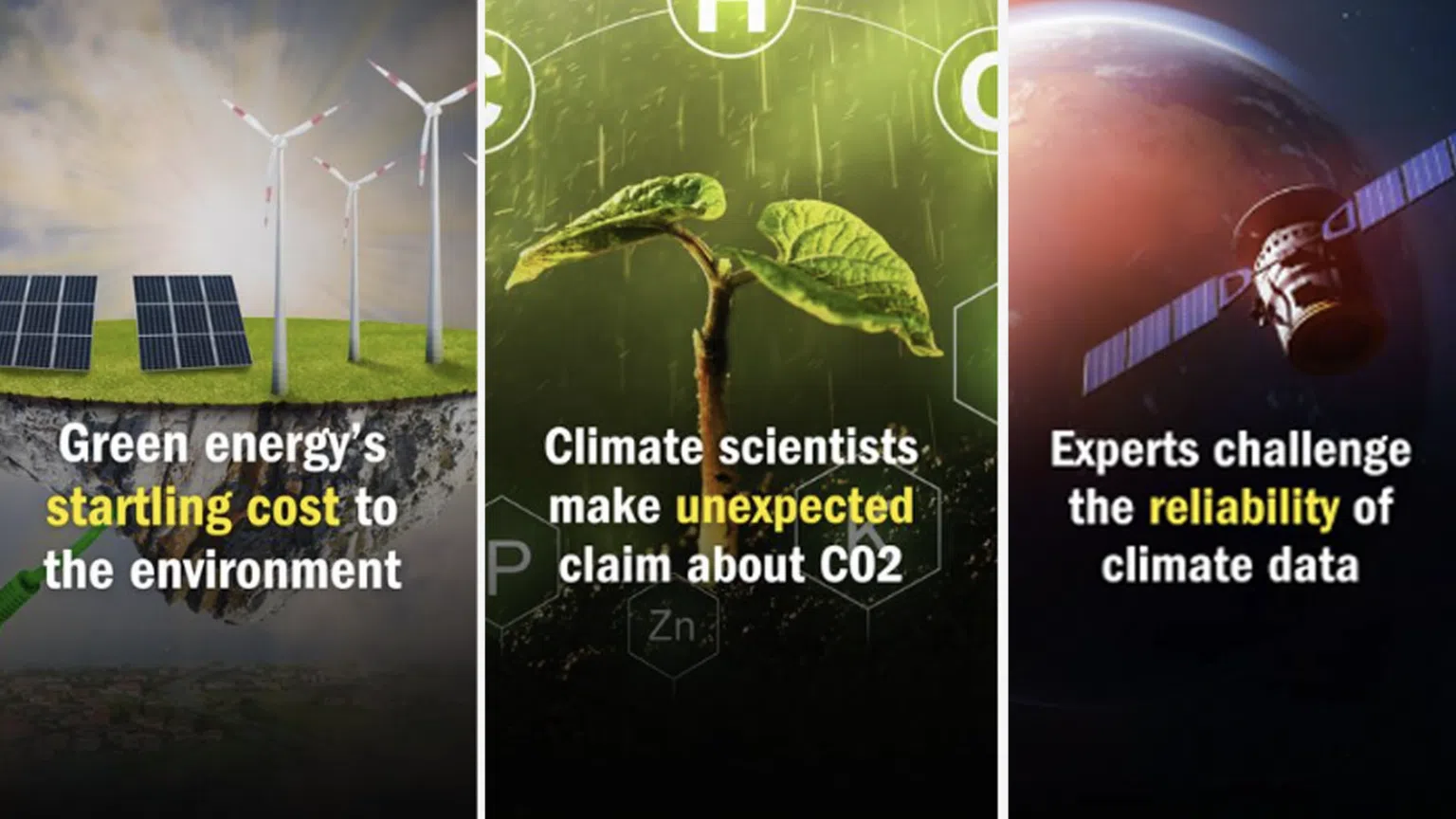
A mashup of three Epoch Times adverts posted on Meta. Credit: The Epoch Times / Meta
Campaigners have referred the Epoch Times to the UK advertising regulator for “stoking the climate culture war” on social media.
The pro-Trump Epoch Times has run hundreds of anti-climate social media adverts in Europe since the beginning of 2024 that have been seen millions of times, DeSmog can reveal.
Epoch Times accounts in Europe have run 425 adverts on Facebook, Instagram, and X (formerly Twitter) that have attacked or undermined climate science, green energy, or climate action since the start of the year. These adverts have been run in the UK, Germany, Slovakia, and Bulgaria, appearing on social media feeds at least 2.3 million times across Facebook and Instagram, and 3.1 million times on X.
These anti-climate ads were active for 22 days on average on Meta platforms (Facebook and Instagram), while they were displayed for 9.5 days on average on X.
Four of the adverts posted by Epoch Times on Meta have now been referred to the Advertising Standards Agency (ASA), a UK watchdog, by the campaign group Global Witness. The group is calling for the ASA to open an investigation into whether the Epoch Times breached the Committee of Advertising Practice (CAP) Code and, if so, to ban these adverts.
The Epoch Times claims to be the fastest growing independent news outlet in the United States. It claims to host websites across 22 languages in 35 countries, publishing online and in print. The publication has gained a substantial online following in recent years, amassing more than 10 million followers across its various Facebook accounts.
Based in New York, the Epoch Times is affiliated with the Falun Gong new religious movement in China and is staunchly anti-communist. Though the source of its income isn’t publicly declared, former employees told the New York Times that the publication was financed “by a combination of subscriptions, ads and donations from wealthy Falun Gong practitioners.”
The publication has propelled itself on Facebook by filling its feeds with viral, feel-good videos alongside its often partisan news coverage.
According to NewsGuard, an independent company that rates the credibility of news sites, Epoch Times articles “frequently include distorted, misleading, or unsubstantiated claims.” The Epoch Times claims on its website that its reporters are “guided by the highest code of conduct and ethics”.
The Epoch Times spent at least $1.5 million on adverts in support of then Republican President Donald Trump from 2018 to 2019 – more than any group other than the Trump campaign.
The publication was banned from advertising by Meta following these revelations, and the social media company told DeSmog that it ”continues to enforce this ban”. However, a number of Epoch Times offshoots have been allowed to promote climate science denial across Europe this year.
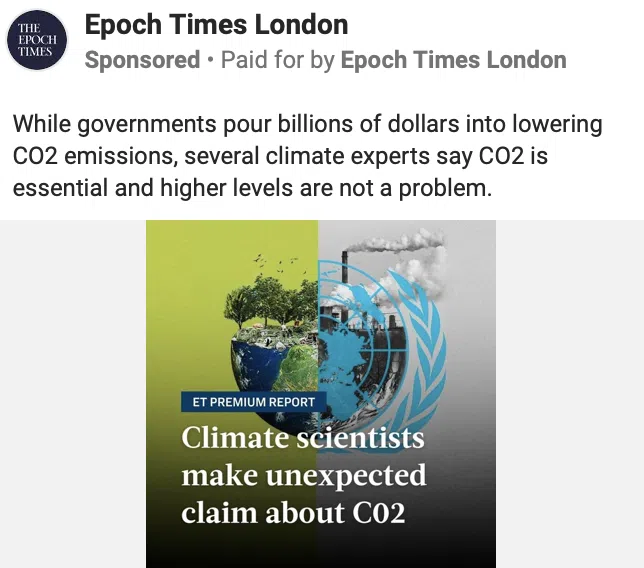
Many of these adverts have explicitly questioned the contribution of carbon dioxide (CO2) to climate change. The adverts have featured statements including “Several climate scientists say CO2 is essential and higher levels are not a problem”, and “What if more CO2 is actually good for the environment?”
The UN’s Intergovernmental Panel on Climate Change (IPCC), the world’s foremost climate science body, has stated that carbon dioxide “is responsible for most of global warming” since the late 19th century, which has increased the “severity and frequency of weather and climate extremes, like heat waves, heavy rains, and drought”.
The adverts ran for months, and reached millions of people, despite Meta’s pledge to tackle climate misinformation. Ten were removed prior to DeSmog contacting Meta, of which six were removed over a failure to include an appropriate advertising disclaimer.
“After sowing division and disinformation in the U.S., everyone in the UK should be alarmed that the Epoch Times is using the same playbook here,” said Nienke Palstra, campaign strategy lead at Global Witness. “We have already seen politicians trying to stoke a climate culture war and the Epoch Times is spending big to tap into this sentiment. We cannot allow the future of our planet to be put at threat for the political gain of extremists and populists.”
A spokesperson for the Epoch Times told Global Witness that scientists have always differed in their opinion on climate change and that “To ban different opinions does not help a civilised open society and erodes freedom of speech.”
Climate Denial Content
The bulk of the anti-climate adverts seen by DeSmog were posted by Epoch Times London, a Facebook page created in October 2023 that has fewer than 600 followers.
Many of the adverts posted by Epoch Times London questioned climate science, for example claiming that “the greenhouse effect is real but irrelevant”, and that “new studies undercut the ‘scientifically empty’ global warming narrative.”
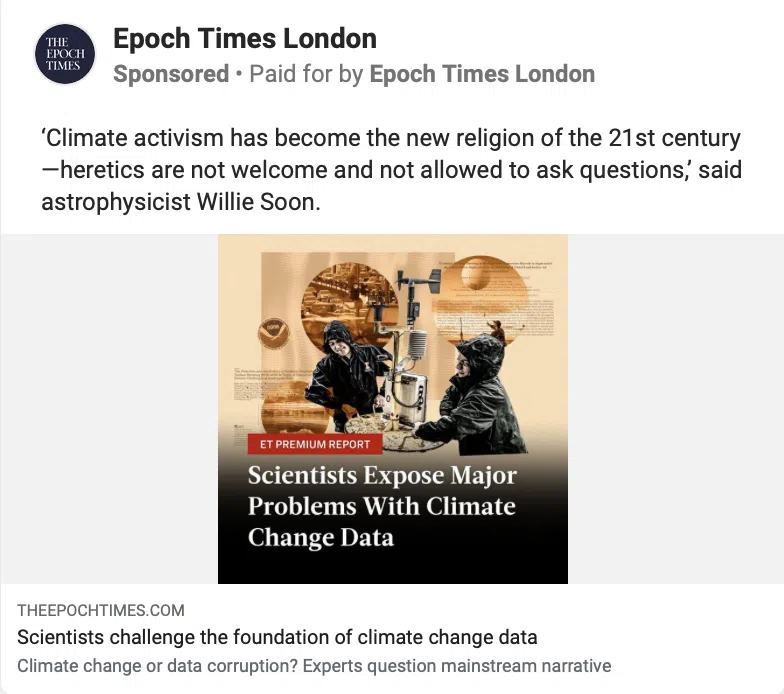
One advert entitled “Scientists Expose Major Problems With Climate Change Data” was linked to an Epoch Times article that claimed climate change can be best explained by “natural variation”. The article also said that attempts to create a scientific consensus around human-caused climate change are the product of “deliberate fraud” according to “some experts.”
The same article quoted Willie Soon, a scientist who has cast doubt on climate science and who has openly admitted accepting research funding from fossil fuel interests.
A number of the Epoch Times London adverts suggested that the consensus on climate change is based on a wilful misinterpretation of evidence by the scientific community, asking questions such as “Climate change or data corruption? Experts question mainstream narrative.”
DeSmog’s analysis found that Epoch Times London ran at least 392 unique adverts on Meta since the start of the year that attacked or attempted to undermine climate science, green energy, or climate action.
Of those adverts, 146 were still active prior to DeSmog contacting Meta. According to an analysis of Meta’s ad archive, Epoch Times London has spent between £12,600 and £51,715 on its anti-climate advertising since the start of the year, with those adverts having been seen between 1.9 million and 2.5 million times. Meta has now blocked Epoch Times London’s ability to post adverts.
According to Companies House, Epoch Times London was incorporated in 2014. The publication drew criticism in the UK in 2020 for posting free editions of its paper to Brighton and Hove residents, the front page of which included claims that the Chinese Communist Party had deliberately covered up evidence of COVID-19’s existence.
Following complaints from constituents, Lloyd Russell-Moyle, the Labour MP for Kemptown in Brighton, publicly criticised the Epoch Times in the House of Commons and called on Royal Mail to stop posting its print edition.
Epoch’s European Operations
Elsewhere in Europe, DeSmog has seen evidence of anti-climate advertising from Epoch Times-affiliated accounts.
The most prolific source of these adverts has been the German Epoch Times account on X, which has run 61 anti-climate adverts since the beginning of the year, reaching at least 1.5 million people and appearing 3.2 million times on X feeds across the German-speaking world.
Of the adverts that made a funding declaration, all stated that they were paid for Epoch Times Europe Gmbh, a company that has existed in Germany since at least 2009 according to the country’s company register.
A number of these adverts directly questioned the role of CO2 on climate change, saying that “CO2, especially anthropogenic emissions, hardly play a role”, “Climate change: CO2 not to blame”, “Climate change is too complex to blame on CO2”, and “CO2 is the most expensive fraud in history.”
While there were fewer ads run on Meta in Germany than in the UK, they still generated at least 100,000 impressions, representing an ad spend of between €1,500 and €3,777.
An account run by German Epoch Times journalist Erik Rusch has also run at least 24 anti-climate adverts since its creation in January – though the adverts state that they were paid for by Rusch.
Some of the adverts run by Epoch Times Germany suggested that wind turbines produce nefarious health effects, including claims such as, “Don’t ignore the health effects: Doctor warns against wind turbines”, and “Wind energy under scrutiny: Dr Bellut-Staeck on the low-frequency risks to humans and animals.”
One of the German adverts quoted Fritz Vahrenholt, who is a scientific advisor to the UK’s leading climate science denial group, the Global Warming Policy Foundation (GWPF).
Other adverts promoted by the German Epoch Times, as well as Epoch Times London, quoted fellow GWPF advisor Richard Lindzen. In one of these adverts, Lindzen was quoted as saying: “If we could get rid of 60 percent of CO2, we would all be dead.”
Germany Epoch Times adverts also linked back to articles on its website, directing readers to the claim by climate science denier John F. Clauser that the perceived climate threat is a “dangerous corruption of science.”
Another advert quoted Lindzen as asking, “Is climate change the existential threat we’ve been led to believe?” and linked to an Epoch Times interview with Lindzen on its YouTube series “American Thought Leaders”.
Former UK Prime Minister Liz Truss was recently interviewed on this series, while a parallel series, “British Thought Leaders”, has interviewed a number of climate science deniers. Since the beginning of March, this series has featured Martin Durkin, Rupert Darwall, and GWPF advisor Gwythian Prins. These interviews were headlined: “The Science Simply Does Not Support the Ridiculous Hysteria Around Climate At All”, “This Obsession With Carbon Dioxide Emissions Has Led to Tragedy”, and “The World Is at War – The West’s Green Policies Are Playing Into Our Enemy’s Hands”.
Epoch Times Bulgaria has posted three anti-climate ads since the beginning of the year, one of which was entitled “scientists alarmed that there is no real evidence that CO2 is causing climate change”.
Meta has pledged to take action against false narratives on climate change, and the platform has committing to using a “suite of tools, such as fact checking and labels, to help combat climate misinformation.”
In May 2021, Facebook said that it would begin attaching informational labels to posts about climate change, directing users to the platform’s new “Climate Science Information Center”.
However, research conducted in 2022 by the Center for Countering Digital Hate found that Facebook is failing to flag at least half of climate misinformation content.
“Despite claiming to take climate misinformation seriously, Meta has a history of allowing climate disinformation posts with high-engagement to go unchecked,” said Ilana Berger, senior climate and energy disinformation researcher at the misinformation watchdog Media Matters. “If Meta is committed to combating climate disinformation on its platform, it must at the very least consistently enforce its existing policies.”
Meanwhile, following his takeover of Twitter in 2022, Elon Musk has slashed the number of staff who identify harmful content and misinformation. X did not respond to DeSmog’s request for comment.
“Climate misinformation threatens all of our futures – and with elections pending across Europe, the stakes could not be higher,” said Richard Wilson, director of the campaign group Stop Funding Heat. “But the same money that is fuelling this problem could also be the key to a solution. If enough advertisers speak out, and urge Facebook and Twitter to stop climate lies being promoted through their platforms, they will have to clean up their act.”
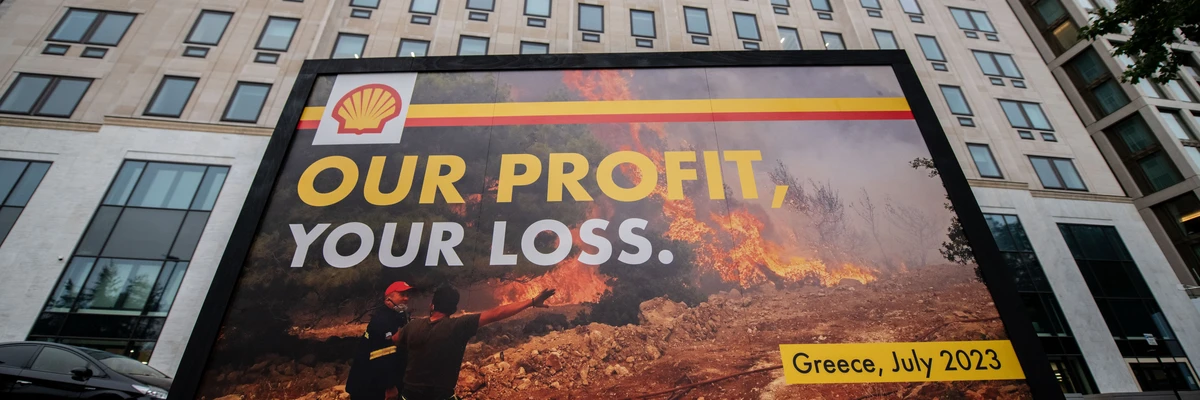
Greenpeace activists display a billboard during a protest outside Shell headquarters on July 27, 2023 in London. (Photo: Handout/Chris J. Ratcliffe for Greenpeace via Getty Images)
“The grotesque wealth that this Earth-wrecking company continues to accumulate is something we cannot allow ourselves to accept as normal,” one campaigner said.
Oil major Shell announced $7.7 billion in profits during the first quarter of 2024 on Thursday, as well as a $3.5 billion share buyback program.
The news comes as every month covered by the period was the hottest of its kind on record. The three-month period also saw the second-largest wildfire in Texas history, extreme heat in West Africa and the Sahel, and the beginning of the Great Barrier Reef’s fifth mass bleaching event in eight years. Scientists have clearly linked global heating, and the weather disasters it exacerbates, to the climate crisis driven primarily by the burning of fossil fuels.
“As extreme weather accelerates and the cost-of-living crisis rumbles on, Shell’s latest billion-pound profits are an affront to the world,” Izzie McIntosh, climate campaign manager at Global Justice Now, said in a statement. “The grotesque wealth that this Earth-wrecking company continues to accumulate is something we cannot allow ourselves to accept as normal.”
“This is the sad irony of the global energy system in which those causing chaos are the ones getting rich.”
Shell’s profits for the first three months of 2024 were around 20% lower than for the same time in 2023, CNBC reported. However, the company brought in $1.2 billion more than analysts had predicted. The world’s largest oil firms, including Shell, saw record profits in 2022 following Russia’s invasion of Ukraine and the energy crisis that followed.
“Shell has beaten expectations by a reasonable margin, despite the impact of lower gas prices during the first quarter,” Stuart Lamont, an investment manager at RBC Brewin Dolphin, said in a statement shared by CNBC.
Global Witness pointed out that Shell’s earnings to date amounted to over $58,000 a minute, more than the average U.K. nurse makes in a year.
“Shell continuing to rake in huge sums of money shows us that huge polluter profits were not a one-off but are the twisted reality of an energy system that benefits climate-wrecking companies to the cost of everyone else,” Global Witness fossil fuel campaigner Alexander Kirk said in a statement.
Shell announced its profits one day after the U.S. Senate held a hearing on how large oil and gas companies, including Shell, have continued to deceive the public about the dangers of their products, moving from outright climate denial into making commitments they don’t intend to keep or touting false solutions like carbon capture and storage that they then fail to develop. Shell, according to the testimony of Rep. Jamie Raskin (D-Md.), spent only 11% of its capital on low-carbon technologies between 2009 and 2023.
The hearing sparked calls for accountability from the fossil fuel industry—such as mechanisms to make climate polluters pay for the transition to renewable energy—and the news of Shell’s profits generated more.
In the U.K., Labor Shadow Energy and Climate Minister Ed Miliband proposed increasing the tax on energy company profits. Shell paid the U.K. government around $1.4 billion in taxes in 2023, of which around $300 million went to the Energy Profits Levy, according toThe Guardian. Also last year, it paid its shareholders $23 billion, nine times more than it invested in its “Renewables and Energy Solutions” program.
“These results show yet again why it is so damning [that Prime Minister] Rishi Sunak refuses to bring in a proper windfall tax on the oil and gas giants,” Miliband said. “These are companies that have made record profits at the expense of working people. Labor says tax these companies fairly so we can invest in clean homegrown energy that will end the cost of living crisis and make Britain energy independent.”
Greenpeace U.K. called Shell’s latest profits “shameless.”
“Their reckless hunt for profits needs to end,” the environmental advocacy group wrote on social media. “When will world leaders find their backbone and make polluters pay?”
When one commenter suggested governments held back out of desire to keep collecting Big Oil’s taxes, Greenpeace fired back, “What taxes?” and noted that Shell avoided paying U.K. taxes for years.
“At the end of the day we want clean, cheap renewable energy not to face the worst impacts of climate change,” Greenpeace continued. “Solutions exist, we just need the political and industrial will to get them in place.”
Global Witness and Global Justice Now also took the opportunity to call for an energy transition.
“This is the sad irony of the global energy system in which those causing chaos are the ones getting rich,” Kirk said. “This spiral won’t stop until we make the urgent switch to a fairer renewable energy system that puts both people and planet first.”
McIntosh concluded: “We urgently need to bring a fair and organised end to the fossil fuel era, and that means companies like Shell must stop trying to extract new oil and gas, and start paying what they owe for the loss and damage they’ve caused. Profit announcements like this for a corporate dinosaur like Shell need to become a thing of the past.”
Marine biologist Anne Hoggett records bleached and dead coral around Lizard Island on the Great Barrier Reef in Australia on April 5. Credit: David Gray/AFP via Getty Images
Heat waves recently extended across nearly 30 percent of the world’s oceans, an expanse equivalent to the surface area of North America, Asia, Europe and Africa.
Over the past several years, the temperature of the Earth’s oceans have been spiking high enough to trigger numerous die-offs of marine species, killing millions of corals, fish, mammals, birds and plants. Those mass die-offs also have sent a wave of emotional trauma washing over some researchers watching their life’s work vanish before their eyes.
“We talk a lot about eco grief, that sense of being overwhelmed and feeling loss,” said Jennifer Lavers, who has been tracking how thousands of seabirds have starved to death during recent ocean heat waves off the coast of western Australia as coordinator of the nonprofit marine research Adrift Lab.
Right now the extreme ocean heat in her region is waning, but globally, marine heat wave conditions extend across nearly 30 percent of the planet’s oceans, a surface area equivalent to all of North America, Europe, Asia and Africa. The harms of long-term gradual ocean warming are well documented, but Lavers said the most recent studies show that increasingly frequent pulses of extreme heat are doing the most damage to marine ecosystems.
With even more mass die-offs of ocean species projected, “scientists are leaving in droves from the field,” she said. “Incredibly skilled, talented, qualified, very passionate people are leaving because no matter what they say, what they do, how many papers they publish … It doesn’t matter.”
The creatures many scientists hoped to help with their research are still in decline and often they are worse off than they were when they started their work, including the flesh-footed shearwaters that she studies, she said.
“That’s the case for me,” she said. “I have to literally say to people that my job is to describe the extinction of a species.”
Exxon’s Richard Werthamer (right) and Edward Garvey (left) are aboard the company’s Esso Atlantic tanker working on a project to measure the carbon dioxide levels in the ocean and atmosphere. The project ran from 1979 to 1982. Credit: Courtesy of Richard Werthamer
Top executives were warned of possible catastrophe from greenhouse effect, then led efforts to block solutions.
…
At a meeting in Exxon Corporation’s headquarters, a senior company scientist named James F. Black addressed an audience of powerful oilmen. Speaking without a text as he flipped through detailed slides, Black delivered a sobering message: carbon dioxide from the world’s use of fossil fuels would warm the planet and could eventually endanger humanity.
“In the first place, there is general scientific agreement that the most likely manner in which mankind is influencing the global climate is through carbon dioxide release from the burning of fossil fuels,” Black told Exxon’s Management Committee, according to a written version he recorded later.
It was July 1977 when Exxon’s leaders received this blunt assessment, well before most of the world had heard of the looming climate crisis.
A year later, Black, a top technical expert in Exxon’s Research & Engineering division, took an updated version of his presentation to a broader audience. He warned Exxon scientists and managers that independent researchers estimated a doubling of the carbon dioxide (CO2) concentration in the atmosphere would increase average global temperatures by 2 to 3 degrees Celsius (4 to 5 degrees Fahrenheit), and as much as 10 degrees Celsius (18 degrees Fahrenheit) at the poles. Rainfall might get heavier in some regions, and other places might turn to desert.