Category: Climate Crisis

  • ‘In Even the Best Coverage There Is No Accountability for the Fossil Fuel Industry’

    Spread the love

    Original article by JANINE JACKSON republished from FAIR under a Creative Commons Attribution-NonCommercial-NoDerivs 3.0 Unported License.

    CounterSpin interview with Evlondo Cooper on climate coverage

    Janine Jackson interviewed Media Matters’ Evlondo Cooper about climate coverage for the March 22, 2024, episode of CounterSpin. This is a lightly edited transcript.

    Audio Player

    00:00

    00:00

    Use Up/Down Arrow keys to increase or decrease volume. [Available at the original article]

    Media Matters (3/14/24)

    Janine Jackson: Climate disruption is, of course, one of the most disastrous phenomena of today’s life, affecting every corner of the globe. It’s also one of the most addressable. We know what causes it, we know what meaningful intervention would entail. So it’s a human-made tragedy unfolding in real time before our eyes.

    To understate wildly, we need to be talking about it, learning about it, hearing about it urgently, which is why the results of our next guest’s research are so alarming. I’ll just spoil it: Broadcast news coverage of the climate crisis is going down.

    Evlondo Cooper is a senior writer with the Climate and Energy Program at Media Matters for America. He joins us now by phone from Washington state. Welcome to CounterSpin, Evlondo Cooper.

    Evlondo Cooper: Thank you for having me. I’m excited about our conversation today.

    JJ: We’re talking about the latest of Media Matters’ annual studies of climate crisis coverage. First of all, just tell us briefly what media you are looking at in these studies.

    EC: So we’re looking at corporate broadcast network coverage. That’s ABC, CBS and NBC. And for the Sunday morning shows, we also include Fox Broadcasting—Fox News Sunday.

    JJ: All right. And then, for context, this decline in coverage that you found in the most recent study, that’s down from very little to even less.
    Media Matters (3/14/24)

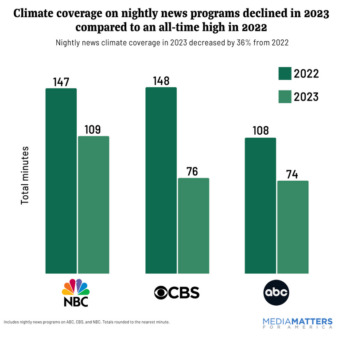
    EC: Yeah, so a little context: 2021 and 2022 were both record years for climate coverage, and that coverage was a little bit more than 1%. This year, we saw a 25% decrease from 2022, which brought coverage to a little bit less than 1%. We want to encourage more coverage, but even in the years where they were doing phenomenal, it was only about 1% of total coverage. And so this retrenchment by approximately 25% in 2023 is not a welcome sign, especially in a year where we saw record catastrophic extreme weather events, and scientists are predicting that 2024 might be even worse than ’23.

    JJ: Let’s break out some of the things that you found. We’re talking about such small numbers—when you say 1%, that’s 1% of all of the broadcast coverage; of their stories, 1% were devoted to the climate crisis. But we’ve seen, there’s little things within it. For example, we are hearing more from actual climate scientists?

    EC: That was a very encouraging sign, where this year we saw 41 climate scientists appeared, which was 10% of the featured guests in 2023, and that’s up from 4% in 2022. So in terms of quality of coverage, I think we’re seeing improvements. We’re seeing a lot of the work being done by dedicated climate correspondents, and meteorologists who are including climate coverage as part of their weather reports and their own correspondents’ segments, a bigger part of their reporting.

    So there are some encouraging signs. I think what concerns us is that these improvements, while important and necessary and appreciated, are not keeping up with the escalating scale of climate change.

    Media Matters (3/14/24)

    JJ: It’s just not appropriate to the seriousness of the topic. And then another thing is, you could say the dominance of white men in the conversation, which I know is another finding, that’s just kind of par for the elite media course; when folks are talked to, they are overwhelmingly white men. But it might bear some relation to what you’re seeing as an underrepresentation of climate-impacted populations, looking at folks at the sharp end of climate disruption. That’s something you also consider.

    EC: Yeah, we look at coverage of, broadly, climate justice. I think a lot of people believe it’s representation for representation’s sake, but I think when people most impacted by climate change—and we’re talking about communities of color, we’re talking about low-income communities, we’re talking about low-wealth rural communities—when these folks are left out of the conversation, you’re missing important context about how climate change is impacting them, in many cases, first and worse. And you’re missing important context about the solutions that these communities are trying to employ to deal with it. And I think you’re missing an opportunity to humanize and broaden support for climate solutions at the public policy level.

    So these aren’t communities where these random acts of God are occurring; these are policy decisions, or indecisions, that have created an environment where these communities are being most harmed, but least talked about, and they’re receiving the least redress to their challenges. And so those voices are necessary to tell those stories to a broad audience on the corporate broadcast networks.

    JJ: Yes, absolutely.

    CBS (7/17/23)

    Another finding that I thought was very interesting was that extreme weather seemed to be the biggest driver of climate coverage, and that, to me, suggests that the way corporate broadcast media are coming at climate disruption is reactive: “Look at what happened.”

    EC: Totally.

    JJ:  And even when they say, “Look at what’s happening,” and you know what, folks pretty much agree that this is due to climate disruption, these houses sliding into the river, it’s still not saying, “While you look at this disaster, know that this is preventable, and here is who is keeping us from acting on it and why.”

    EC: Yeah, that is so insightful, because that’s a core critique of even the best coverage we see, that there is no accountability for the fossil fuel industry and other industries that are driving the crisis. And then there’s no real—solutions are mentioned in about 20% of climate segments this year. But the solutions are siloed, like there are solution “segments.”

    But to your point, when we’re talking about extreme weather, when you have the most eyeballs hearing about climate change, to me, it would be very impactful to connect what’s happening in that moment—these wildfires, these droughts, these heat waves, these hurricanes and storms and flooding—to connect that to a key driver, fossil fuel industry, and talk about some potential solutions to mitigate these impacts while people are actually paying the most attention.

    CNN (3/3/23)

    JJ: And then take it to your next story about Congress, or your next story about funding, and connect those dots.

    EC: Exactly. I mean, climate is too often siloed. So you could see a really great segment, for instance, on the Willow Project, at the top of the hour—and this is on cable, but the example remains—and then later in the hour, you saw a story about an extreme weather event. But those things aren’t connected, they’re siloed.

    And so a key to improving coverage in an immediate way would be to understand that the climate crisis is the background for a range of issues, socioeconomic, political. Begin incorporating climate coverage in a much broader swath of stories that, whether you know it or not, indirectly or directly, are being impacted by global warming.

    JJ: It’s almost as though corporate media have decided that another horrible disaster due to climate change, while it’s a story, it’s basically now like a dog-bites-man story. And if they aren’t going to explore these other angles, well, then there really isn’t anything to report until the next drought or the next mudslide. And that’s just a world away from what appropriate, fearless, future-believing journalism would be doing right now.

    Evlondo Cooper: “It doesn’t have to be about just showing the destruction and carnage. There are ways that you can empower people to take action.”

    EC: It’s out of step, right? Pull up the poll showing bipartisan support for government climate action, because, whether people know it or not, as far as the science, —and there’s some deniers out there, but anecdotally, people know something is happening, something is changing in their lives. We’re seeing record-breaking things that no one’s ever experienced, and they want the government to do something about it.

    And so it’s important to cover extreme weather and to cover these catastrophes. And I know there’s a range of thought out there that says if you’re just focusing on devastating impacts, it could dampen public action. But to me, to your point, report on it and connect it to solutions, empower people to call their congressperson, their representative, their senator, to vote in ways that have local impacts to deal with the local climate impacts.

    It doesn’t have to be about just showing the destruction and carnage. There are ways that you can empower people to take action in their own lives, and to galvanize public support.

    And the public wants it. The public is asking for this. So I think just being responsive to what these polls are showing would be a way to immediately improve the way that they cover climate change right now.

    JJ: All right, then. We’ve been speaking with Evlondo Cooper of Media Matters for America. You can find this work and much else at MediaMatters.org. Evlondo Cooper, thank you so much for joining us this week on CounterSpin.

    EC: Thank you for having me.

    Original article by JANINE JACKSON republished from FAIR under a Creative Commons Attribution-NonCommercial-NoDerivs 3.0 Unported License.
  • School’s out: how climate change is already badly affecting children’s education

    Spread the love
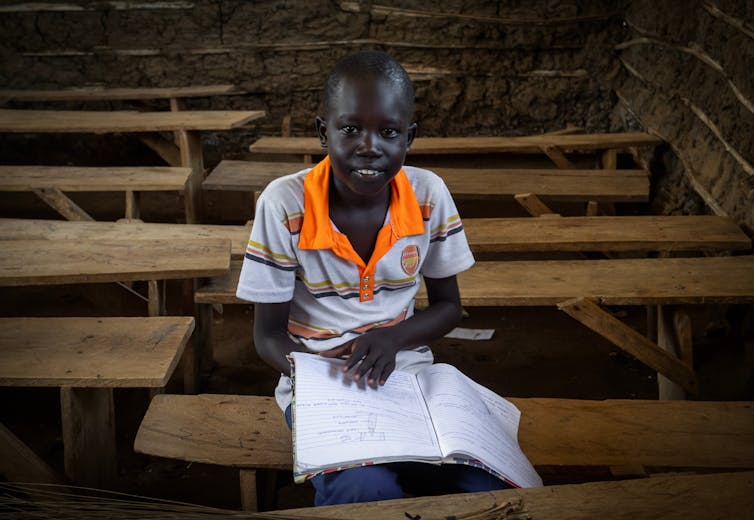
    The education of students in countries like Sudan is already being negatively affected by the extremes of climate change.
    Richard Juilliart/Shutterstock

    Caitlin M Prentice, University of Oslo; Francis Vergunst, University of Oslo; Helen Louise Berry, Macquarie University, and Kelton Minor, Columbia University

    Schools across South Sudan have been ordered to close as a heat wave of 45°C sweeps across the country. In recent years, severe flooding has already caused major disruptions to schooling in South Sudan where, on average, children complete less than five years of formal education across their lives.

    As researchers interested in both climate change and learning, we’ve been surprised that most public debate in this area concerns how best to teach children about climate change as part of the curriculum. Recently, we examined a less discussed, but arguably much more consequential, question: How is climate change impacting children’s education worldwide?

    In a recent paper published in Nature Climate Change, we reviewed studies linking climate change-related events or “climate stressors” to education outcomes. One of the clearest connections was between heat exposure and reduced academic performance.

    A study in the US found that adolescents’ maths scores decreased significantly on days above 26°C. In China, hotter day-of-test temperatures were associated with a drop in exam performance equal to losing a quarter of a year – or several months – of schooling.

    But it’s not just test days that matter. Studies show that raised temperatures also affect learning over longer time periods. For example, pupils’ test scores suffered when there were more hot days across the school year and even when the hotter weather occurred three to four years before exam day.

    Our review also highlights how climate-related regional disasters like wildfires, storms, droughts and floods are keeping many children out of school entirely. Floods can prevent children from travelling to school and cause damage to school buildings and materials, which disrupts learning and lowers test scores.

    In developing countries, storms and droughts commonly cause children to leave school permanently to join the workforce and support their families. Children in higher-income countries are not immune. They miss school days due to hurricanes and wildfires and these absences have measurable effects on education outcomes.

    The impacts of climate disasters can also affect children before they are born with consequences that reverberate across their lives. For example, children whose mothers were pregnant during Hurricane Sandy were more likely to be diagnosed with attention-deficit hyperactivity disorder (ADHD), a condition that can make schooling more challenging.

    In India, researchers found that raised temperatures lead to lower test scores due to crop failure and malnutrition, highlighting the importance of indirect links between climate stressors and subsequent school participation and learning.

    Educational injustice

    Our analysis suggests that climate change will exacerbate existing inequalities in global education access and attainment, with already disadvantaged groups facing the largest learning setbacks. In the US, heat had worse effects on exam scores for racial and ethnic minorities and children living in lower-income school districts.

    Following a super typhoon in the Philippines, children whose families had fewer financial resources and smaller social networks were more likely to drop out of school than their better-resourced neighbours. In contexts where girls’ education is less prioritised than boys’, their school attendance and exam scores have suffered more following climate change stressors such as droughts and storms.

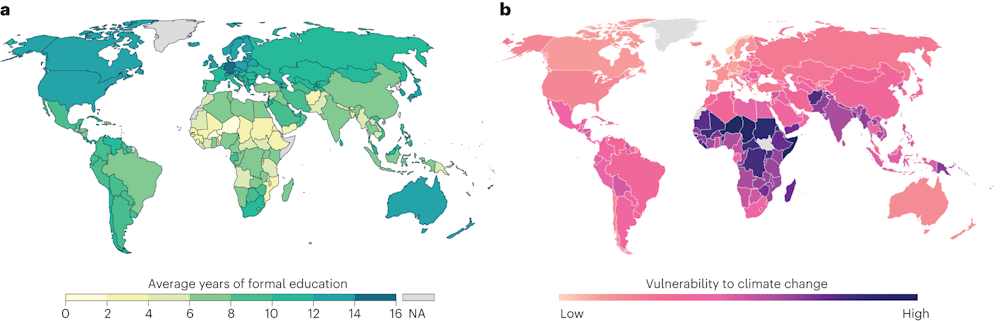
    Globally, regions where people are more vulnerable to the effects of climate change – in terms of risk of harmful stressors occurring and resources available to adapt – are also regions where children already receive fewer years of schooling.

    World map in green on left side, another in pink on right with shaded areas to indicate average years of formal education compared to vulnerability to climate change in each country
    These maps show the average years of formal education (left) and vulnerability to climate change by country (right).
    CC BY

    The impacts of climate change on education are already widely visible. While the scale of the problem is daunting, there are many ways to take action. Most critically, global heating urgently needs to be limited by reducing emissions of greenhouse gases.

    At the same time, children’s education must be protected from climate change stressors that are already occurring. Possible measures include installing cooling technologies, effective disaster response planning, building stressor-resilient schools and addressing systemic global inequalities related to socioeconomic, gender and racial discrimination.

    Preventing harm to children’s education is a worthy goal in itself. But improving education can also contribute to greater awareness and climate literacy, while mitigating climate change and making children more resilient in the face of climate stressors.

    Education can help fight climate change. But we must also fight climate change to prevent harm to education. Without action, the future of young people around the world hangs in the balance. The Conversation

    Caitlin M Prentice, Postdoctoral Fellow, Department of Psychology, University of Oslo; Francis Vergunst, Associate Professor, Psychosocial Difficulties, University of Oslo; Helen Louise Berry, Honorary Professor, Centre for Health Systems and Safety Research, Macquarie University, and Kelton Minor, Postdoctoral Research Scientist, Computational Social and Behavioural Science, Columbia University

    This article is republished from The Conversation under a Creative Commons license. Read the original article.

  • Food prices will climb everywhere as temperatures rise due to climate change – new research

    Spread the love
    A food market in Ghana, where many already don’t have access to a healthy and varied diet.
    Lauren Huddleston / shutterstock

    Jessica Boxall, University of Southampton and Michael Head, University of Southampton

    Climate change, and specifically rising temperatures, may cause food prices to increase by 3.2% per year, according to a new study by researchers in Germany. As climate change continues to worsen, this price inflation will mean more and more people around the world don’t have a varied and healthy diet, or simply don’t have enough food.

    The new analysis shows that global warming could cause food price inflation to increase by between 0.9 and 3.2 percentage points per year by 2035. The same warming will cause a smaller rise in overall inflation (between 0.3 and 1.2 percentage points), so a greater proportion of household income would need to be spent on buying food.

    This effect will be felt worldwide, by high and low-income countries alike, but nowhere more so than in the global south. As with various other consequences of climate change, Africa will be worst affected despite contributing little to its causes.

    Our own research on food security in Ghana, west Africa, gives a sense of what price inflation might mean in practice. The The Intergovernmental Panel on Climate Change describes west Africa as a “hotspot” of climate change, with models predicting extreme rising temperatures and reduced rainfall. With more than half of the population being directly dependent on rain-fed agriculture, Ghana is particularly vulnerable to climate change.

    We recently carried out a study in Mion, a rural district in the north of the country. We spoke to almost 400 people, and very single one of them told us they had experienced some level of food insecurity in the previous 12 months. Some 99% said climate change was at least partly to blame.

    Additionally, 62% were moderately or severely food insecure, with 26% experiencing severe food insecurity (going without food for an entire day). These percentages are much worse than Ghana’s national averages (39% and 6% respectively), but similar to some of the poorest countries in west Africa such as Togo, Burkina Faso and Benin.

    We also carried out a similar study among refugees from neighbouring Burkina Faso who fled across the border to the upper east region of Ghana. Again, 100% had experienced food insecurity.

    Mion isn’t suffering from a sudden famine, and nothing particularly unusual has happened to cause this food insecurity. This situation is considered to be a “normal phenomenon” due to the effects of climate change.

    Climate-related food inflation can be broken down into two interlinked problems.

    Shifting seasons, pests and diseases

    The first is that the same climate change effects that are causing the inflation are already making food harder to get hold of. For instance, higher temperatures can cause long-established and predictable farming seasons to shift and so may hinder crop production.

    Other consequences can include more pest and disease outbreaks that deplete livestock and food reserves, and heat stress to already-poor roads which makes it harder to access rural communities.

    All of these factors push prices higher and reduce the purchasing power of affected households. The drivers of food inflation are already worsening food insecurity.

    The second part of this problem is the rise in inflation itself. A 3% annual price increase would mean households are less able to purchase what they need.

    They would likely need to compromise on quality or perhaps even culturally important foods. This in turn makes people more vulnerable to disease and other health issues. Malnutrition is the leading cause of immunodeficiency globally.

    In Ghana, we found that those who reported more knowledge of climate change were more likely to be food secure. This is despite few people having any formal education. This is evidence that affected populations are very aware of the changing temperatures and unpredictability of the climate, and are perhaps engaging in proactive mitigation practices.

    Those without any schooling are more likely to engage in a climate-sensitive occupations such as farming, and so would be more immediately exposed. Teaching people about climate change might provide some capacity to adapt to it, and therefore increase food security.

    Alterations in the climate are a hunger-risk multiplier for those populations with entrenched vulnerability. In light of this, 134 countries at COP28 signed a declaration to incorporate food systems into their climate action, to ensure everyone has enough to eat in light of climate change.

    The researchers behind the new study suggest that reducing greenhouse gas emissions could limit any impacts on the global economy. We also suggest that diversifying economies would serve as some protection for those communities reliant on agriculture for both their food and income.

    Government intervention could also ensure financial protection and nutritional aid for those vulnerable to becoming trapped in the poverty cycle by inflation and diminished accessibility to food. The Conversation

    Jessica Boxall, Public Health & Nutrition Research Fellow, University of Southampton and Michael Head, Senior Research Fellow in Global Health, University of Southampton

    This article is republished from The Conversation under a Creative Commons license. Read the original article.

  • Green Groups Protest ‘Nuclear Fairy Tale’ in Brussels

    Spread the love

    Original article by OLIVIA ROSANE republished from Common Dreams under Creative Commons (CC BY-NC-ND 3.0).

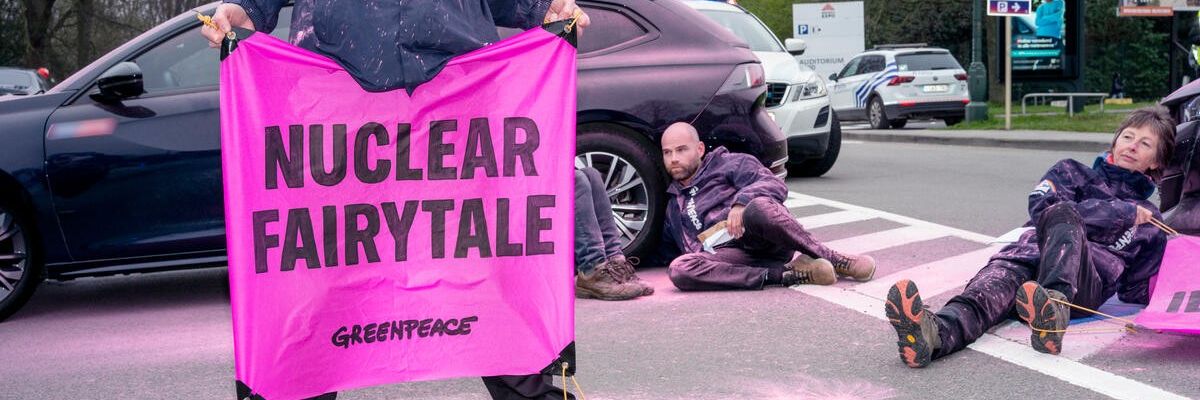
    Greenpeace activists disrupt a pro-nuclear summit in Brussels on March 21, 2024.  (Photo: Guillaume Chauvin/Greenpeace

    “All the evidence shows that nuclear power is too slow to build, too expensive, and it remains highly polluting and dangerous,” one activist said.

    An international coalition of environmental groups dropped banners and blockaded roads to protest the International Nuclear Energy Summit in Brussels on Thursday.

    While the summit, hosted by the Belgian government and the International Atomic Energy Agency (IAEA), pushes nuclear energy as a replacement for fossil fuels, more than 600 climate action groups launched a declaration calling nuclear power plants a “distraction which slows down the energy transition.”

    “We are in a climate emergency, so time is precious, and the governments here today are wasting it with nuclear energy fairy tales,” Greenpeace E.U. senior campaigner Lorelei Limousin said in a statement. “All the evidence shows that nuclear power is too slow to build, too expensive, and it remains highly polluting and dangerous.”

    “The nuclear lobby camouflages itself beneath a climate-friendly facade, hoping to divert massive sums of money away from real climate solutions, at the expense of people and the planet.”

    At the United Nations COP28 climate conference in the United Arab Emirates last year, more than 20 countries pledged to triple nuclear energy capacity by 2050. However, Greenpeace France calculated that achieving this would mean finishing 70 reactors each year between 2040 and 2050. This would be an unprecedented buildout in defiance of current trends: Between 2020 and 2023, 21 reactors were completed while 24 were shut down worldwide.

    In the European Union specifically, many countries turned away from nuclear after 2011 in response to the Fukushima accident in Japan, according to Reuters. Germany shuttered its last three reactors for good in April 2023 following a successful anti-nuclear campaign there. In general, the nuclear share of the E.U. power mix dropped from 32.8% in 2000 to 22.8% in 2023, Greenpeace said.

    Activists argue that nuclear still poses all the dangers the anti-nuclear movement has been warning about for decades and also cannot be ramped up quickly enough to prevent escalating climate extremes.

    To reinforce this message, members of Greenpeace France blockaded the main roads to the Brussels summit using cars and bicycles. They also lit pink flares and threw pink powder as a motorcade of officials en route to the summit approached. The action succeeded in delaying the arrival of several delegations, Greenpeace E.U. said.

    Other demonstrators dropped banners from the summit site at Brussels Expo reading, “Nuclear Fairy Tale,” while a group representing the 600 declaration signatories protested in front of an inflatable bouncy castle holding up a sign reading, “Nuclear fairy tales = climate crisis.”

    The declaration was drafted by Climate Action Network Europe and signed by groups from at least 56 different countries and territories including Climate Action Network Canada, the David Suzuki Foundation, the Sierra Club, Food and Water Watch, CodePink, International Physicians for the Prevention of Nuclear War, and several 350.org, Fridays for Future, and Friends of the Earth affiliates.

    “The nuclear lobby camouflages itself beneath a climate-friendly facade, hoping to divert massive sums of money away from real climate solutions, at the expense of people and the planet,” the declaration reads.

    The signatories pointed out that, while the world must dramatically reduce greenhouse gas emissions by 2030 in order to limit global temperature rise to 1.5°C above preindustrial levels, it would take longer than this for any new nuclear plant to come online.

    At the same time, it costs significantly more money to increase nuclear capacity than renewable options like wind and solar, they stressed. A new reactor requires almost four times the funds of a new wind power installation.

    “Governments need to invest in proven climate solutions, such as home insulation, public transport, and renewable energy, rather than expensive experiments, like small modular reactors, which have no guarantees of actually delivering,” the declaration says.

    It also points to safety risks across the nuclear lifecycle, from uranium mining to waste storage. And it adds that those dangers would only increase as temperatures rise.

    “The climate crisis also increases the risks involved in nuclear power, as increased heatwaves, droughts, storms, and flooding all pose significant threats to the plants themselves and to the systems that aim to prevent nuclear accidents,” the signatories argued.

    Instead, the declaration proposes that governments focus on achieving 100% renewable energy while also improving efficiency.

    “What we demand is a just transition toward a safe, renewable, and affordable energy system that secures jobs and protects life on our planet,” the declaration concludes.

    Original article by OLIVIA ROSANE republished from Common Dreams under Creative Commons (CC BY-NC-ND 3.0).

  • The disagreement between two climate scientists that will decide our future

    Spread the love

    Vladi333/Shutterstock

    Robert Chris, The Open University and Hugh Hunt, University of Cambridge

    Getting to net zero emissions by mid-century is conventionally understood as humanity’s best hope for keeping Earth’s surface temperature (already 1.2°C above its pre-industrial level) from increasing well beyond 1.5°C – potentially reaching a point at which it could cause widespread societal breakdown.

    At least one prominent climate scientist, however, disagrees.

    James Hansen of Columbia University in the US published a paper with colleagues in November which claims temperatures are set to rise further and faster than the predictions of the Intergovernmental Panel on Climate Change (IPCC). In his view, the 1.5°C target is dead.

    He also claims net zero is no longer sufficient to prevent warming of more than 2°C. To regain some control over Earth’s rising temperature, Hansen supports accelerating the retirement of fossil fuels, greater cooperation between major polluters that accommodates the needs of the developing world and, controversially, intervening in Earth’s “radiation balance” (the difference between incoming and outgoing light and heat) to cool the planet’s surface.


    You can listen to more articles from The Conversation narrated by Noa.


    There would probably be wide support for the first two prescriptions. But Hansen’s support for what amounts to the deliberate reduction of sunlight reaching Earth’s surface has brought into the open an idea that makes many uncomfortable.

    Michael Mann from the University of Pennsylvania in the US and another titan of climate science, spoke for many when he dismissed solar radiation management as “potentially very dangerous” and a “desperate action” motivated by the “fallacy … that large-scale warming will be substantially greater than current-generation models project”.

    Their positions are irreconcilable. So who is right – Hansen or Mann?

    Earth’s radiation balance

    First, an explanation.

    There are only two ways to reduce global warming. One is to increase the amount of heat radiated from Earth’s surface that escapes to space. The other is to increase the amount of sunlight reflected back to space before it lands on something – whether a particle in the atmosphere or something on Earth’s surface – and is converted to heat.

    There are many ways to do both. Anything that reduces the amount of greenhouse gas in the atmosphere will let more heat escape to space (replacing fossil fuels with renewables, eating less meat and tilling the soil less for example). Anything that makes the planet brighter will reflect more sunlight to space (such as refreezing the Arctic, making clouds whiter or putting more reflective particles in the atmosphere).

    But the key difference between the two, in terms of their impact on global warming, is their response time. That is, the time it takes for a change in the factors that allow more heat to escape or sunlight to be reflected to appear as a change in Earth’s surface temperature.

    Intervening to speed up the loss of heat from Earth’s surface cools the planet slowly, over decades and longer. Intervening to increase the sunlight Earth reflects back to space cools the planet more or less immediately.

    The essence of the dispute between Mann and Hansen is whether reducing greenhouse gases, by a combination of reducing new emissions and permanently removing past emissions from the atmosphere, is now enough on its own to prevent warming from reaching levels that threaten economic and social stability.

    Mann says it is. Hansen says that, while doing these things remains essential, it is no longer sufficient and we must also make Earth more reflective.

    When will warming end?

    Mann aligns with IPCC orthodoxy when he says that emissions reaching net zero will result, within a decade or two, in Earth’s surface temperature stabilising at the level it has then reached.

    In effect, there is no significant warming in the pipeline from past emissions. All future warming will be due to future emissions. This is the basis for the global policy imperative to get to net zero.

    In his new paper, Hansen argues that if the atmospheric concentration of greenhouse gases remains close to its current level, the surface temperature will stabilise after several hundred years between 8°C and 10°C above the pre-industrial level.

    Of this, at least 2°C will emerge by mid-century, and probably a further 3°C a century from now. A temperature increase of this magnitude would be catastrophic for life on Earth. Hansen adds that to avoid such an outcome, brightening Earth is now necessary to halt the warming in the pipeline from past emissions.

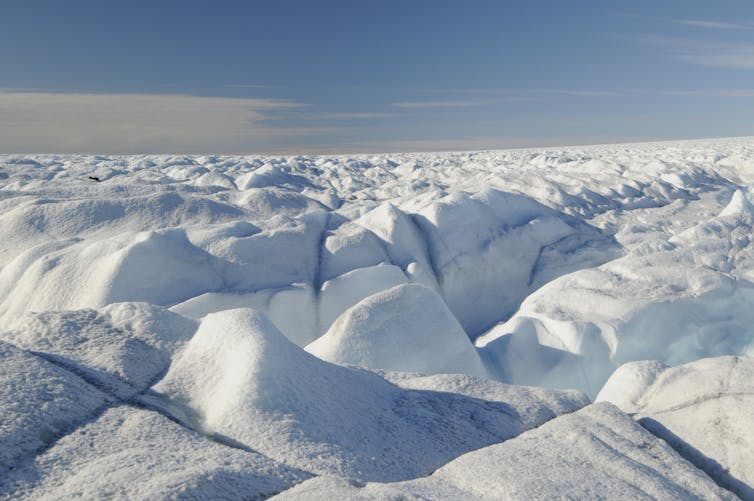
    Crevices in an ice sheet.
    Bright surfaces, like ice sheets, reflect light to space.
    Tobetv/Shutterstock

    But at the same time, we must also largely eliminate emissions if we are to stop recreating this problem in the future.

    Still getting hotter…

    We are scientists who study the feasibility and effectiveness of alternative responses to climate change, addressing both the engineering and political realities of enabling change at the scale and speed necessary.

    We find Mann’s rebuttal of Hansen’s claims unconvincing. Crucially, Mann does not engage directly with Hansen’s analysis of new data covering the last 65 million years.

    Hansen explains how the models used by IPCC scientists to assess future climate scenarios have significantly underestimated the warming effect of increased greenhouse gas emissions, the cooling effect of aerosols and how long the climate takes to respond to these changes.

    Besides greenhouse gases, humanity also emits aerosols. These are tiny particles comprising a wide range of chemicals. Some, such as the sulphur dioxide emitted when coal and oil are burned, offset the warming from greenhouse gases by reflecting sunlight back to space.

    Others, such as soot, have the opposite effect and add to warming. The cooling aerosols dominate by a large margin.

    Hansen projects that in coming months, lower levels of aerosol pollution from shipping will cause warming of as much as 0.5°C more than IPCC models have predicted. This will take global warming close to 2°C as early as next year, although it is likely then to fall slightly as the present El Niño wanes.

    Underpinning Hansen’s argument is his conviction that the climate is more sensitive to greenhouse gases than previously reported. The IPCC estimates that doubling atmospheric CO₂ raises Earth’s temperature by 3°C. Hansen calculates it to be 4.8°C.

    This, and the much longer climate response time that Hansen calculates from the historical record, would have a significant impact on climate model projections.

    Time for reflection

    The differences between Mann and Hansen are significant for the global response to climate change.

    Mann says that allowing emissions to reach net zero by mid-century is sufficient, while Hansen maintains that on its own it would be disastrous and that steps must now be taken in addition to brighten the planet.

    Brightening Earth could also reverse the reductions in reflectivity already caused by climate change. Data indicates that from 1998 to 2017, Earth dimmed by about 0.5 watts per square metre, largely due to the loss of ice.

    Given what’s at stake, we hope Mann and Hansen resolve these differences quickly to help the public and policymakers understand what it will take to minimise the likelihood of imminent massive and widespread ecosystem destruction and its disastrous effects on humanity.

    While 1.5°C may be dead, there may still be time to prevent cascading system failures. But not if we continue to squabble over the nature and extent of the risks.


    Imagine weekly climate newsletter

    Don’t have time to read about climate change as much as you’d like?

    Get a weekly roundup in your inbox instead. Every Wednesday, The Conversation’s environment editor writes Imagine, a short email that goes a little deeper into just one climate issue. Join the 20,000+ readers who’ve subscribed so far. The Conversation


    Robert Chris, Honorary Associate, Geography, The Open University and Hugh Hunt, Professor of Engineering Dynamics and Vibration, University of Cambridge

    This article is republished from The Conversation under a Creative Commons license. Read the original article.

    Roger Hallam was involved in starting the climate activism groups Extinction Rebellion and Just Stop Oil. He is still involved with Just Stop Oil and often gets arrested and imprisoned. [22/3 Apologies had a typo calling Roger Roget]

    https://rogerhallam.com/starmers-treason/

    …

    I used to be a social science researcher at King’s College, London. The name of the game in that trade is to look at everything in context. So I will provide some context. There is overwhelming evidence that the climate science industry is structurally underestimating the realities we face. “Worst than expected” is the standard phrase of just about every article as new stats are published. A few years ago we were going to pass 1.5C around 2050 – now it is already happening. I remember reading reports that the Arctic will melt in the summer around 2100. Papers now predict 2035, if not before. AMOC – the ocean current that stops the 60 million people on these islands from starving to death – was going to collapse at some point next century. Now a recent paper tells us the odds are it will collapse by 2050. If you have not been paying attention, this will create a collapse of temperatures overnight of 3-8C across Europe. So don’t be surprised if it happens before your pension comes due. 

    I’m like you. I don’t like to believe things are true if they conflict with my baseline beliefs – like “we will muddle through”. But then it becomes more difficult when it actually comes true. Scientists have been telling us privately and then publicly for years that staying under 1.5C was bollocks – and now here we are. For two decades or more the best kept secret of the climate space has been that aerosols (pollution from burning fossil fuel emissions) have been holding down temperatures by .5C-1C. As we passed 1.8C last September the pretence started to collapse as scientists raged about each other on a dark corner of Twitter. It’s the start of the exposure of the world’s biggest cover up. That they knew we were fucked a decade or more ago. Not that the media is interested. Everyone is still in on the pretence, it seems.

    …

    Roger Hallam https://rogerhallam.com/starmers-treason/ An interesting article. [22/3 Apologies had a typo calling Roger Roget]