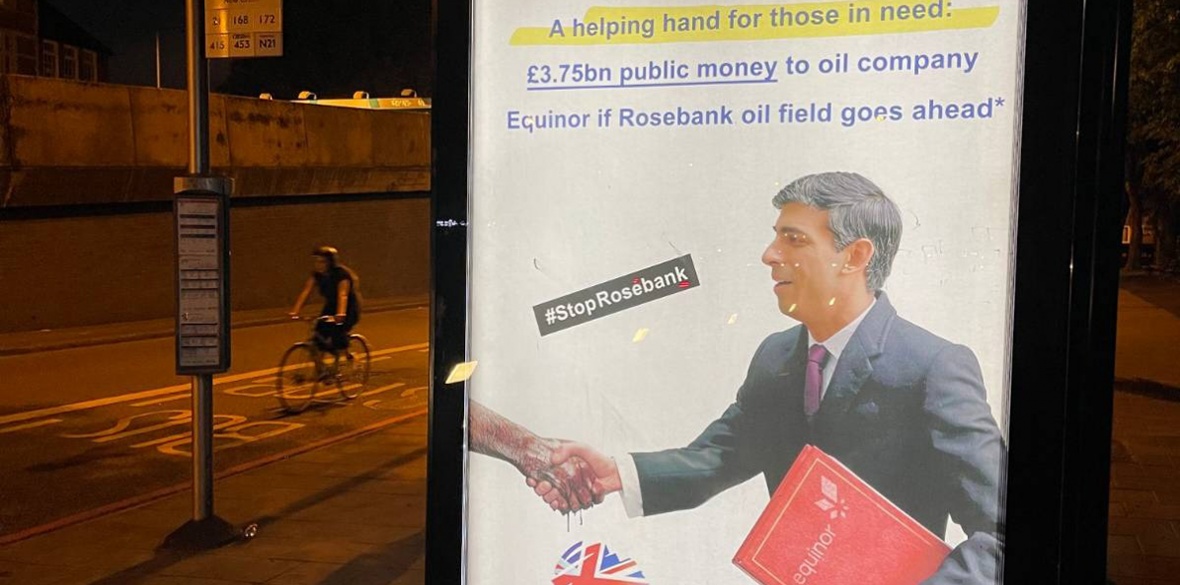
A spoof ad of Sunak shaking oil-soaked handPhoto: Fossil Free London
PARODY adverts mocking Rishi Sunak for giving public money to oil giants have appeared across London’s bus stops.
The Prime Minister is shown shaking an oil-soaked hand next to a Conservative logo with the words: “A helping hand for those in need: £3.75 billion public money to oil company Equinor if Rosebank oil field goes ahead.”
The spoof ads have been spotted in Hackney, Southwark and Tower Hamlets so far, and come after Fossil Free London campaigners last week delivered giant gifts to the Norwegian embassy to represent the £3.75bn tax breaks developers of the North Sea’s Rosebank field could receive.
Norway’s state-backed oil and gas giant Equinor would be among the firms set to profit while the taxpayer picks up almost all the costs of the development.
Earlier this month Mr Sunak claimed a planned expansion of oil and gas drilling in the North Sea was “entirely consistent” with the government’s goal to reach net zero by 2050.
“As fires rage in the West, fueled by fossil fuel pollution, today’s ruling in Montana is a game-changer that marks a turning point in this generation’s efforts to save the planet,” said one attorney representing 16 young plaintiffs.
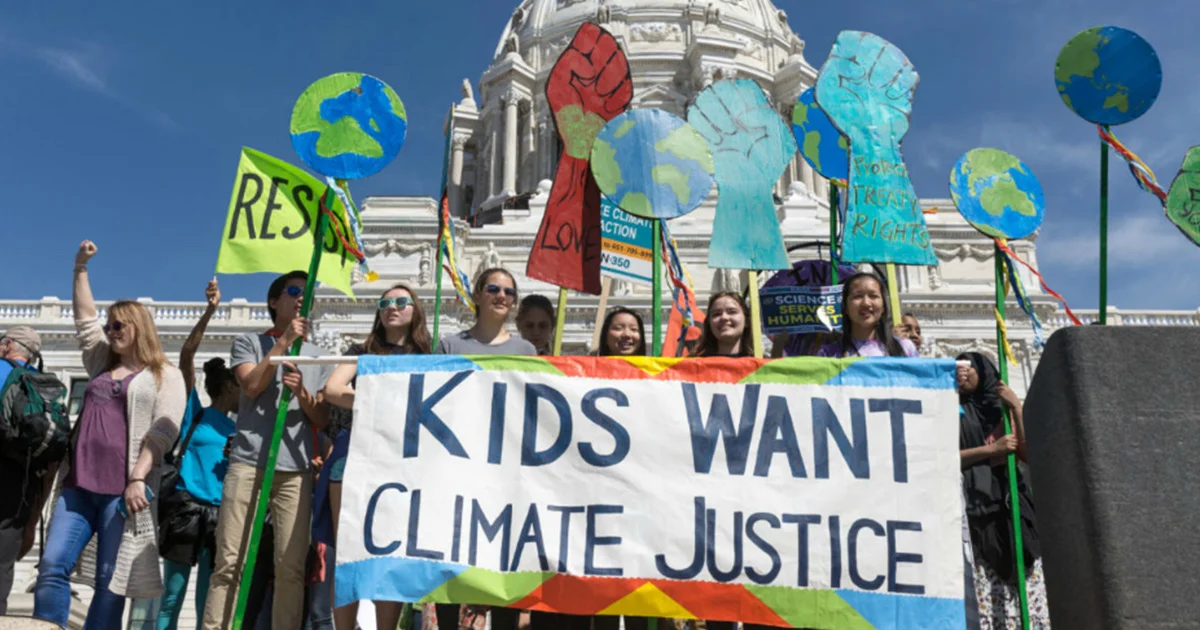
Climate advocates on Monday expressed hope that an unprecedented ruling by a state judge in Montana, siding with 16 young residents who argued the state violated their constitutional rights by promoting fossil fuel extraction, will mark a sea change in the outcomes of climate lawsuits.
In Held v. State of Montana, District Court Judge Kathy Seeley ruled that rights of the plaintiffs—who range in age from 5 to 22— have been violated by the Montana Environmental Policy Act because the law has prevented the state from assessing the climate impacts of mining projects.
Fossil fuel emissions including Montana’s “have been proven to be a substantial factor” in heating the planet and causing pollution, Seeley said in the nation’s first ruling on a constitutional, youth-led lawsuit regarding the climate.
Because the Montana Constitution guarantees residents a “clean and healthful environment,” the state’s environmental policy law violates the document, said Seeley.
“This is a landmark decision establishing enforceable principles of intergenerational justice.”
Julia Olson, founder of Our Children’s Trust, the non-profit law firm that helped represent the plaintiffs, called the victory a “sweeping win” that could have reverberating effects on the hundreds of lawsuits that have been filed in the U.S. arguing against the continued extraction of fossil fuels.
“As fires rage in the West, fueled by fossil fuel pollution, today’s ruling in Montana is a game-changer that marks a turning point in this generation’s efforts to save the planet from the devastating effects of human-caused climate chaos,” said Olson in a statement.
In their defense, state attorneys argued that Montana’s fossil fuel emissions are insignificant compared to global emissions, but Seeley said in her ruling that the state’s per capita emissions are “disproportionately large” and rank in the top six per capita emissions in the United States.
The state also ultimately rested its case on the argument that the state legislature should take up the issue of the environmental law rather than the judiciary—an admission, said Michael Gerrard of the Sabin Center for Climate Change Law at Columbia University, that the climate science underpinning the plaintiffs’ case was indisputable.
“Everyone expected them to put on a more vigorous defense,” Gerrard told The Washington Post Monday. “And they may have concluded that the underlying science of climate change was so strong that they didn’t want to contest it.”
During the trial, the plaintiffs testified about their own suffering due to pollution and extreme weather, while climate experts explained the connection between the state’s fossil fuel activities and planetary heating, the wildfires and scorching heat that have overwhelmed parts of the West, and other extreme weather.
“Judge Seeley’s decision comes at a time when we’re seeing the impacts of climate change accelerate—from low streamflows and lake levels to unprecedented heat waves, floods, and wildfires,” said Melissa Hornbein, senior attorney at the Western Environmental Law Center, which along with McGarvey Law also represented the plaintiffs. “These are the climate realities the youth plaintiffs and expert witnesses told us about on the stand, while the state disclaimed any responsibility and dismissed them.”
“We’re relieved that the court recognized that these youth plaintiffs are already feeling the impacts of the climate crisis, as well as the dangers threatening their future if the state doesn’t take meaningful action to address it,” Hornbein added. “We’re also delighted that Judge Seeley recognized Montana’s significant role as an emitter on the global stage, as well as its ability—constrained only by a resistant government—to rectify its disproportionate contribution to the climate crisis.”
The Sunrise Movement, the youth-led climate action organization, said the ruling is “proof that our generation is unstoppable—we have the power to bring down the fossil fuel industry and win a Green New Deal.”
As Common Dreams reported last month, lawsuits around the world have emerged as a key driver of climate action as a wide range of plaintiffs—from children in the U.S. to senior citizens in Switzerland—have argued that their human rights have been violated by the companies and lawmakers that have promoted fossil fuel production despite scientific evidence of the danger it poses.
Out of approximately 2,200 worldwide climate cases, about three-quarters have been filed in the United States, according to the United Nations Environment Program and the Sabin Center, and the number of legal challenges has more than doubled since 2017.
The outcome of the Montana case could “open up the floodgates for more climate lawsuits,” said Jamie Henn, director of Fossil Free Media.
WOW! The young people suing Montana over the right to a livable climate just won their case!!!!!
This is absolutely HUGE and will open up the floodgates for more climate lawsuits.
The law has become a powerful tool in our fight against fossil fuels. https://t.co/nRGJHJM5pM
Sen. Bernie Sanders (I-Vt.) said that the next plaintiff to file a case against the fossil fuel industry should be the federal government, to hold companies accountable “for their role in the climate crisis.”
Thank you to these brave young people who today won an enormous victory against climate change in their home state of Montana. It's time for the fed gov to follow their example and file lawsuits to hold the fossil fuel industry accountable for their role in the climate crisis. https://t.co/2WN34EpBlB
“This is a landmark decision establishing enforceable principles of intergenerational justice,” said Roger Sullivan, an attorney at McGarvey Law. “Simply stated, the government elected by this generation must abide its obligation to pass on a stable climate system to future generations.”
Analysis of extent of UK food imports from Mediterranean region show scale of threat which increasingly severe climate impacts pose to UK food security.
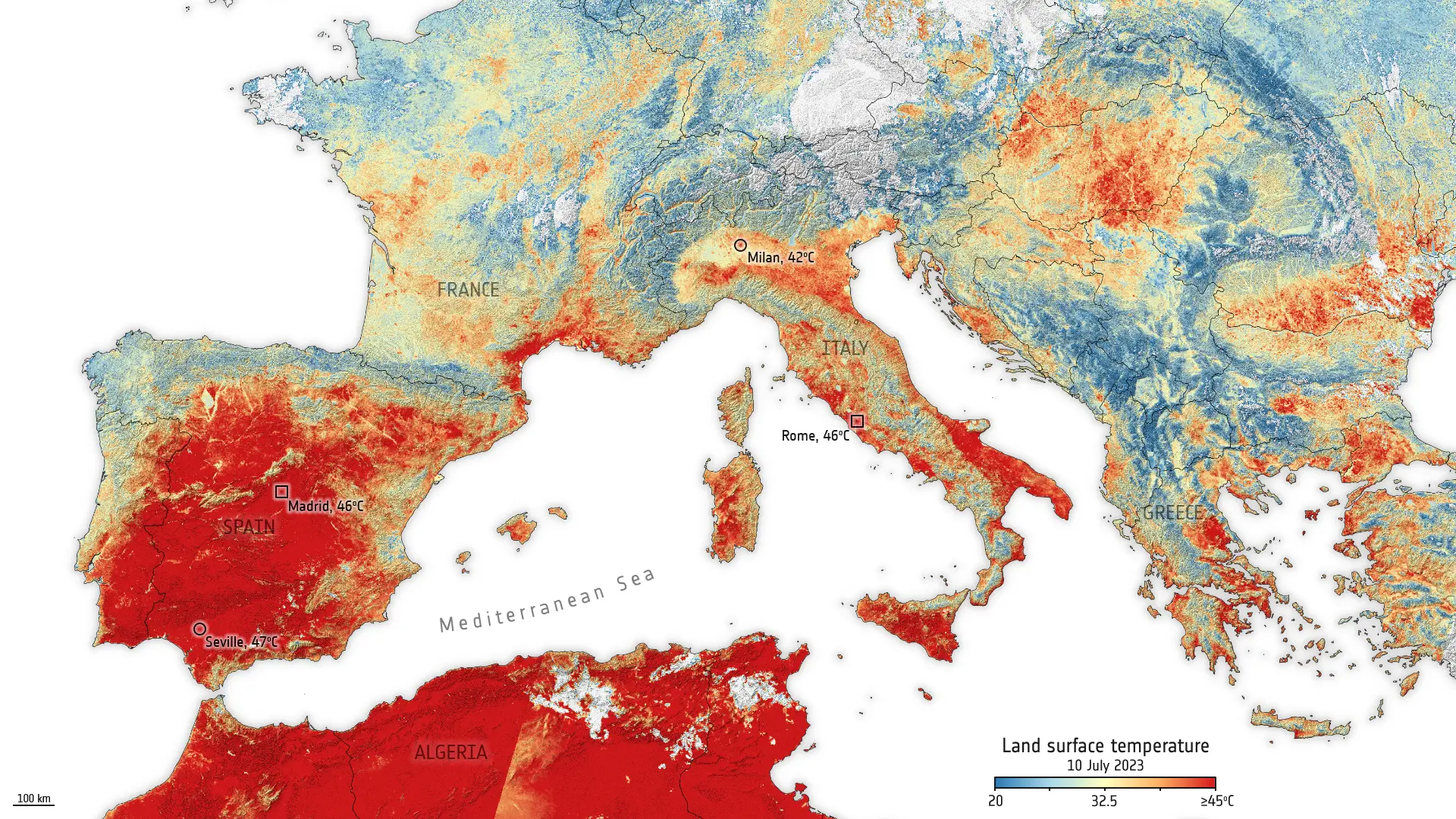
With parts of Europe and north Africa suffering extreme high temperatures and wildfires, analysis of the extent of UK food imports from the Mediterranean region show the scale of threat which increasingly severe climate impacts pose to UK food security.
The report, by the Energy and Climate Intelligence Unit (ECIU) shows that in 2022, just over a quarter of UK food imports – 9.8 billion kilograms, worth just over £16 billion – came from the Mediterranean region, most of which was staple fresh produce like fruit and vegetables. Spain alone, which is experiencing some of the worst climate impacts in the region, accounted for 7% of our food imports – worth £4 billion.
Europe has warmed at twice the rate of the global average over the last three decades, with the nations in southern Europe and northern Africa, around the Mediterranean experiencing some of the worst heat extremes ever in the last few years.
This has caused harm to food production as water shortages, extreme heat and fire damage crops, reduce quality and lower yields. Reduced yields mean less food in our shops and markets, and higher prices for the commodities affected. Previous ECIU analysis found that climate change and fossil fuel prices added more than £400 to household shopping bills in 2022, increasing the total annual UK food shopping bill by around £11.4 billion.
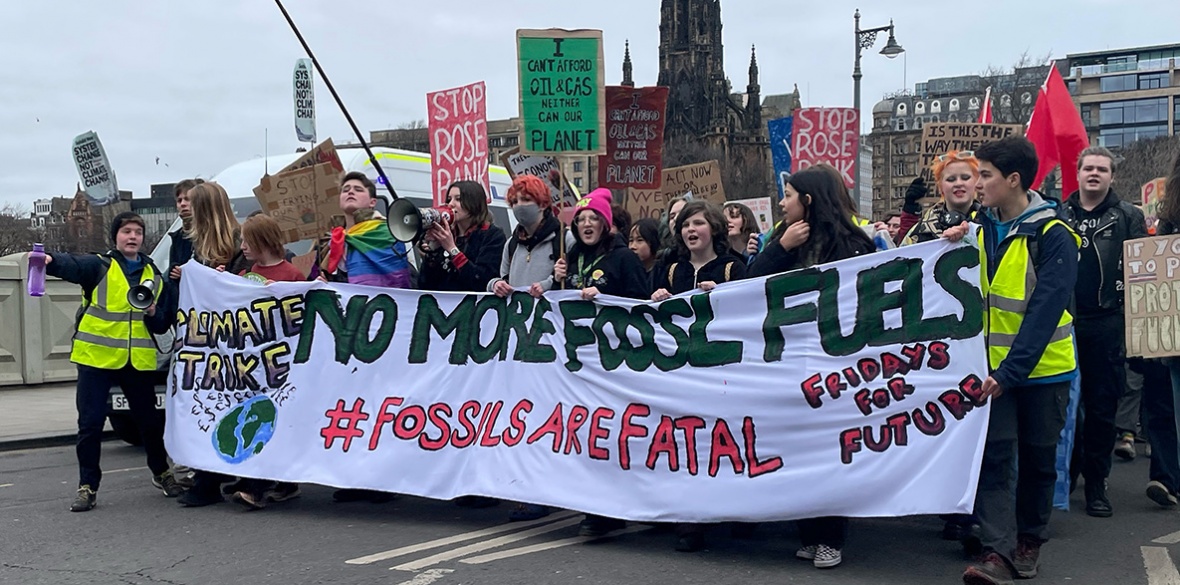
Climate protesters march through Edinburgh calling for an end to fossil fuel extraction, March 3, 2023
SCOTTISH leaders of all political parties have been challenged by a coalition of nature charities over their lack of urgency in tackling climate change.
Twenty-six groups have joined to write an open letter aimed at the leaders of the five parties represented at Holyrood — the SNP, Conservatives, Labour, Greens and Liberal Democrats.
…
In their letter they insisted that “without significant action” on the environment Scots could face “increasing disruption to our lives and face escalating impacts on food production and human health.”
The intervention comes as the organisations told how “extreme heat, dangerously warm seas, and out of control wildfires are causing havoc around the world.”
Amid these “unprecedented extreme global weather events,” the groups — who have more than 500,000 supporters between them — said they were “deeply concerned that our political leaders are not responding to the intertwined nature and climate crises with the urgency required.”
They added: “The status quo is not sustainable. Yet we have seen key environmental commitments shelved or delayed, and increasing signals that differing views on environmental policy will be exploited for electoral purposes or treated as disposable.”