Category: Climate Crisis

  • Study finds 2 billion people will struggle to survive in a warming world – and these parts of Australia are most vulnerable

    Spread the love

    This article is republished from The Conversation under a Creative Commons license. Read the original article.
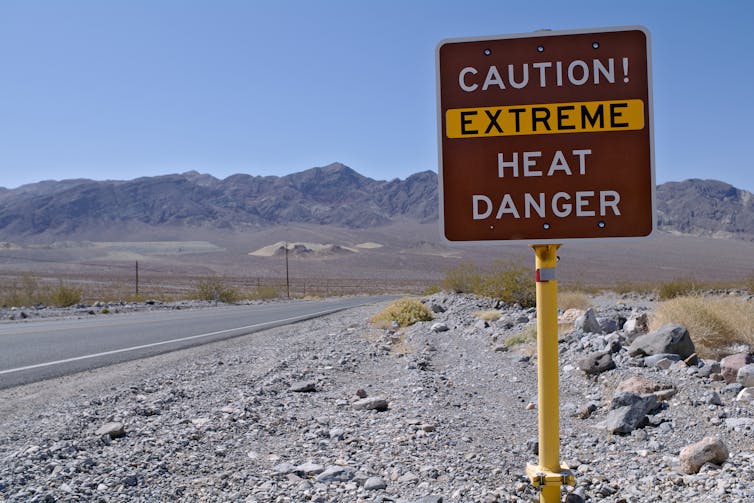
    Angel DiBilio, Shutterstock

    Annabelle Workman, The University of Melbourne and Kathryn Bowen, The University of Melbourne

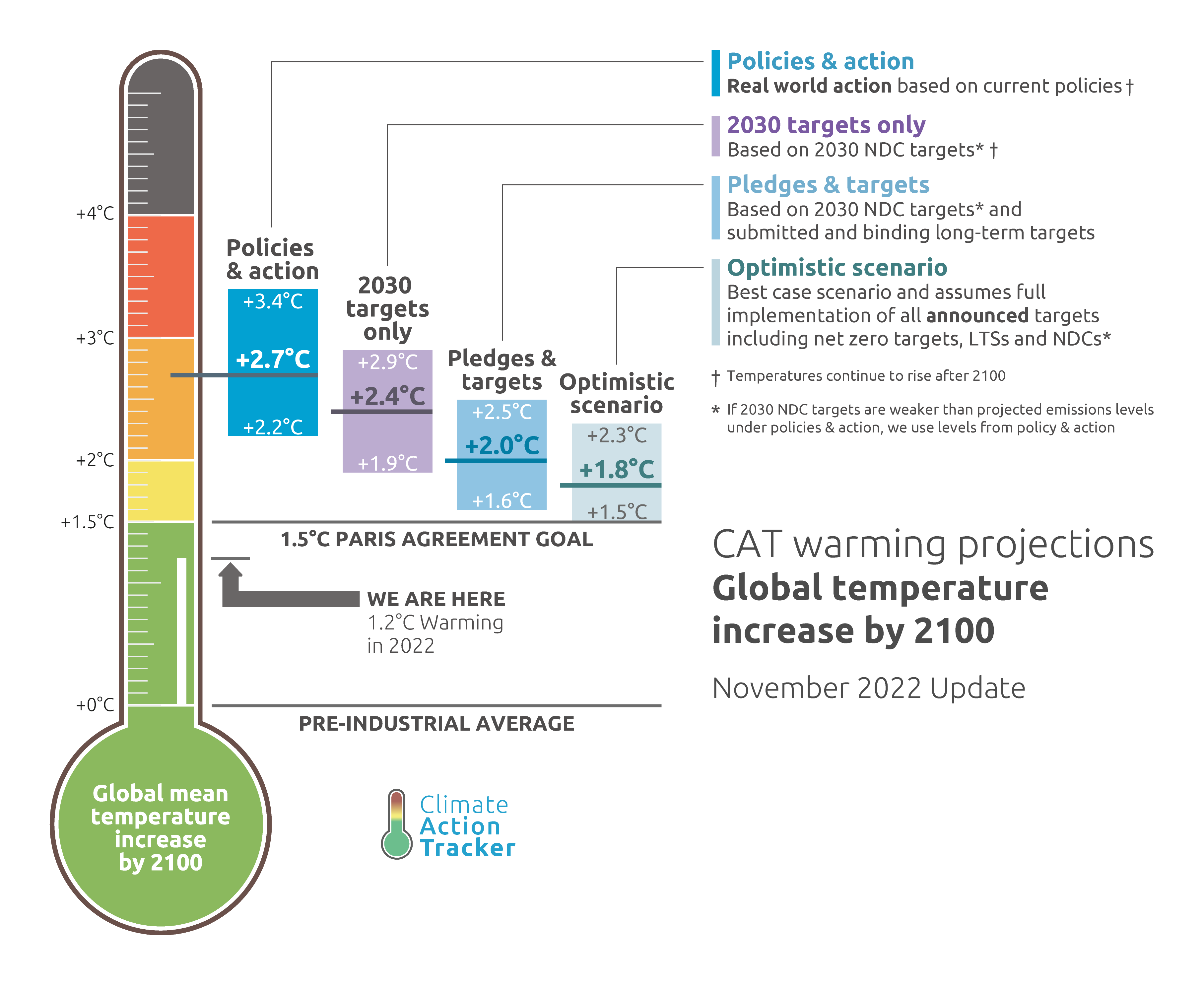
    Two billion people, including many Australians, will find themselves living in dangerously hot places this century if global warming reaches 2.7℃, research released today reveals.

    The authors calculated how many people would be left outside the “human climate niche” by 2100. The niche is defined as places with an average temperature of about 13℃, or about 27℃ in the tropics. Human population has historically peaked in these areas.

    The world is on track for 2.7℃ of warming by 2100. This would push a third of people on Earth outside the human climate niche. This includes people in parts of northwest Australia such as Darwin, Broome and Port Hedland. It also includes parts of Southeast Asia, India, Africa and South America.

    Limiting warming to 1.5℃ would substantially reduce the number of people exposed, including most of those affected in northwest Australia.

    We were not involved in the research, which was conducted by researchers in the United Kingdom, China, Europe and United States. We are Australian experts in the health implications of global warming. Below, we discuss the broader implications of these globally significant findings.

    What is the human cost of global warming?

    The research calculated the number of people outside the “human climate niche” under different demographic scenarios and levels of warming. Exposure to unprecedented heat was the main factor pushing people out of the niche.

    This includes an average temperature greater than or equal to 29℃, as well as a high number of days with a maximum temperature above 40℃ or in humid places, with a wet-bulb temperature greater than 28℃. The wet-bulb temperature (as opposed to the standard dry-bulb temperature) reflects humidity and is a method used to measure heat stress. That’s because it’s the point at which sweating is no longer effective as a means of cooling.

    The study says a wet-bulb temperature of 35 ℃ can be fatal, especially for vulnerable people, because the body can no longer cool itself.

    Above the present level of about 1.2 ℃ global warming, the authors found exposure to unprecedented average temperatures increased markedly, along with increased exposure to temperature extremes.

    But 2.7 ℃ of warming threatens a third of the world’s population. The below map shows where in the world people will suffer the worst heat. Almost the entire area of some countries, such as Burkina Faso and Mali in West Africa, would be exposed to unprecedented heat.
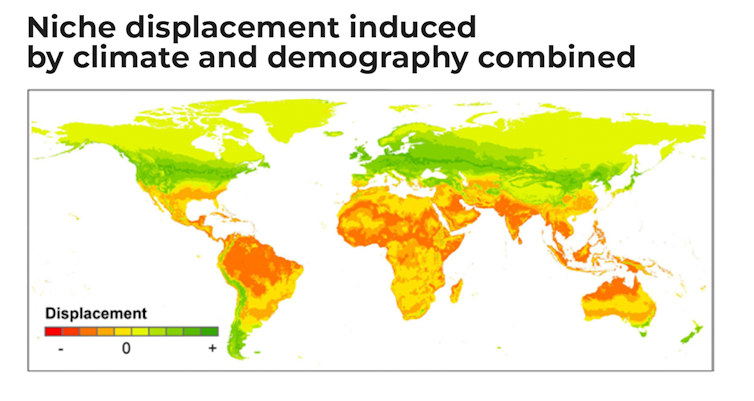


    Source: Nature Sustainability

    Why is warming a health hazard?

    Just last week, the World Meteorological Organization predicted global surface temperatures would rise to record levels within the next five years. The temperature is also likely to temporarily climb 1.5℃ above pre-industrial levels.

    This spells trouble for human health. Even incremental warming increases exposure to health hazards including potentially deadly heatwaves, infectious diseases and diet-related health issues.

    Let’s be clear. A 1.5℃ world will result in injury and death, particularly for people in Asia and Africa. Importantly, the people most at risk will be the least capable of protecting themselves: children, the elderly and those with existing health conditions.

    While populations closer to the equator are more likely to experience heat-related harm, Australians are by no means immune.

    For example, a 2019 study found heat-related health issues in Australia have been grossly underestimated. It found more than 36,000 deaths between 2006 and 2017 were attributable to heat.

    And experts predict Darwin could experience an average 265 days a year above 35℃ in a 3℃ warmer world.


    The risks to Australia of a 3℃ warmer world (Australian Academy of Science)

    As in other parts of world, primarily high-risk populations in Australia will experience some of the worst impacts from a changing climate. In essence, climate change creates and maintains health inequities.

    To date, the Earth’s average surface temperature has warmed 1.2℃ above pre-industrial levels. We must enact ambitious climate policies now if we are to change our dangerous trajectory.

    For too long, we have focused disproportionately on the economic costs of climate action for current – often wealthy – groups at the expense of considering the economic costs of inaction for all, including future generations.

    Historically health has rarely been included in these economic assessments, much less ethical considerations. Emissions reduction policies need to consider health and equity issues, and in doing so can provide governments with a strategic rationale to act.

    How can extreme heat harm health?

    There are multiple ways in which climate change can harm human health. Extreme heat can have direct effects, such as dehydration and heat stroke. Groups most at risk include the elderly and those already unwell.

    Extreme heat can also harm mental health, increasing rates of injury and death by aggravating existing mental illness. Beyond direct effects, heat can affect health by influencing, for example, agricultural productivity, water security and air quality.

    There are physiological limits to adaptation, particularly to heat. These limits can have negative consequences for labour productivity, especially for outdoor workers, and for health service demand, leading to increased hospital admissions, emergency department visits, and ambulance calls.

    Pursuing adaptation measures in an effort to reduce the harmful effects of existing climate change is vital, but to protect the health of all, it is critical that we pursue strong emissions reduction measures.
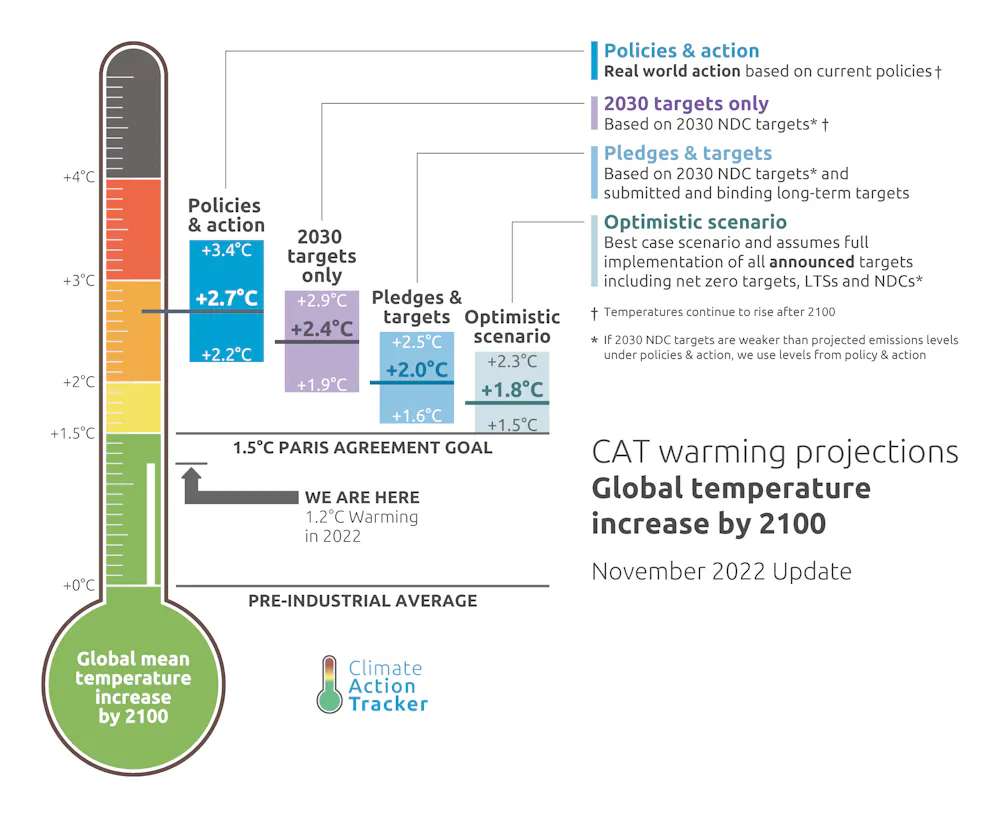
    An infographic tracking climate action against global warming projections


    The Climate Action Tracker charts policies and action against global mean temperature increase by 2100.
    Climate Action Tracker is an initiative of Climate Analytics and the NewClimate Institute

    Developing healthier climate policies

    Australian climate action targets have improved under the Albanese government, however they remain incompatible with keeping warming to 1.5℃.

    Approving additional coal projects is not helpful for reducing emissions or demonstrating climate leadership.

    A commitment to develop and implement a National Health and Climate Strategy and establish a National Sustainability and Climate Unit are promising initiatives. This will help to address our woeful performance in a recent assessment showing how national climate commitments don’t link with health.

    Last week, the Victorian Government committed to reducing emissions by 75-80% compared with 2005 levels by 2035. Their analysis indicates it will lead to A$5.7 billion in health benefits from improved air quality between 2035 and 2045.

    As today’s new research states, the findings highlight the need for “more decisive policy action to limit the human costs and inequities of climate change”. Australia, in particular, must protect children, the elderly and the broader population from the harms they face in a warmer world. The Conversation

    Annabelle Workman, Research Fellow, Melbourne Climate Futures and Melbourne School of Population and Global Health, The University of Melbourne and Kathryn Bowen, Professor – Environment, Climate and Global Health at Melbourne Climate Futures and Melbourne School of Population and Global Health, University of Melbourne, The University of Melbourne

    This article is republished from The Conversation under a Creative Commons license. Read the original article.
  • Diminshed service likely

    Spread the love
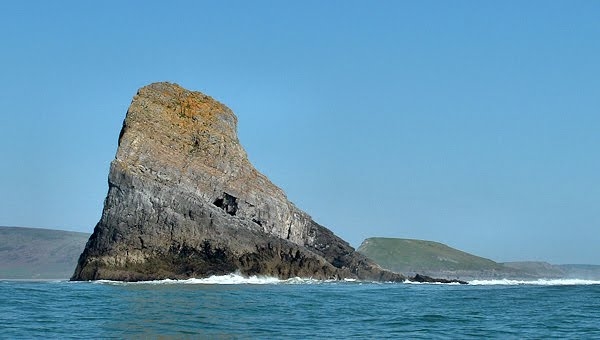
    Image of Worm's Head
    Worm’s Head

    It’s likely that there will be a diminished service over the next few months because I’m hoping to travel to remote locations with poor connectivity ;) I think that I largely repeat myself and that you’ve probably got the message anyway – assert yourselves, protest, Tories are scum, Starmer’s lot are Tories, Just Stop Oil, it’s the rich that are destroying our beautiful World, etc.

    Carry on

  • Climate activists disrupt Europe’s biggest private jet fair

    Spread the love

    https://www.theguardian.com/business/2023/may/23/climate-activists-private-jet-fair-greenpeace-stay-grounded-extinction-rebellion

    Protesters from Greenpeace, Stay Grounded, Extinction Rebellion and others chain themselves to aircraft in Geneva

    Dozens of climate activists have disrupted Europe’s largest private jet trade fair by chaining themselves to aircraft to protest against the sector’s carbon emissions.

    The demonstrators on behalf of Greenpeace, Stay Grounded, Extinction Rebellion and Scientist Rebellion also attached themselves to the entrance gates of the event at Geneva airport in the hope of preventing prospective buyers from entering the annual show.

    The activists, who were calling for a global ban on the use of private jets because of their carbon footprint, stuck tobacco-style health warning labels on some of the jets at the European Business Aviation Convention and Exhibition (EBACE) saying private jets “burn our future”, “kill our planet”, and “fuel inequality”.

    …

    https://www.theguardian.com/business/2023/may/23/climate-activists-private-jet-fair-greenpeace-stay-grounded-extinction-rebellion

  • Shell AGM disrupted by climate activists

    Spread the love

    Activists from Fossil Free London and Extinction Rebellion disrupted Shell’s AGM today.

    https://www.thenational.scot/news/23541141.shells-annual-meeting-disrupted-protesters-london/

    … In a tense moment during the meeting, which had already been delayed for nearly an hour, security stepped in to prevent a protester from reaching chairman Sir Andrew Mackenzie and other board members on the stage.

    Dozens of protesters were escorted out by members of the security team at London’s Excel conference centre.

    “Obviously that last incident went a stage further than we experienced in the first part of today,” Mackenzie said, after protesters had been escorted out.

    …

    Early in the meeting, a group of protesters sang, “Go to hell Shell and don’t you come back no more, no more, no more, no more,” to the tune of the Ray Charles song Hit the Road Jack.

    The first protester to get up shouted: “Welcome to Shell… complicit in the destruction of people’s homes, livelihoods and lives. Welcome to hell.”

    …

    https://www.thenational.scot/news/23541141.shells-annual-meeting-disrupted-protesters-london/

    Rishi Sunak’s Family Profiting from Ties to Oil Giant Shell

    Shell accused of ‘profiteering bonanza’ after record first-quarter profits of $9.6bn

  • ‘A Death Sentence’: Green Groups Decry G7 Support for More Gas Investments

    Spread the love

    Original article by Jessica Corbett republished from Common Dreams under Creative Commons (CC BY-NC-ND 3.0).

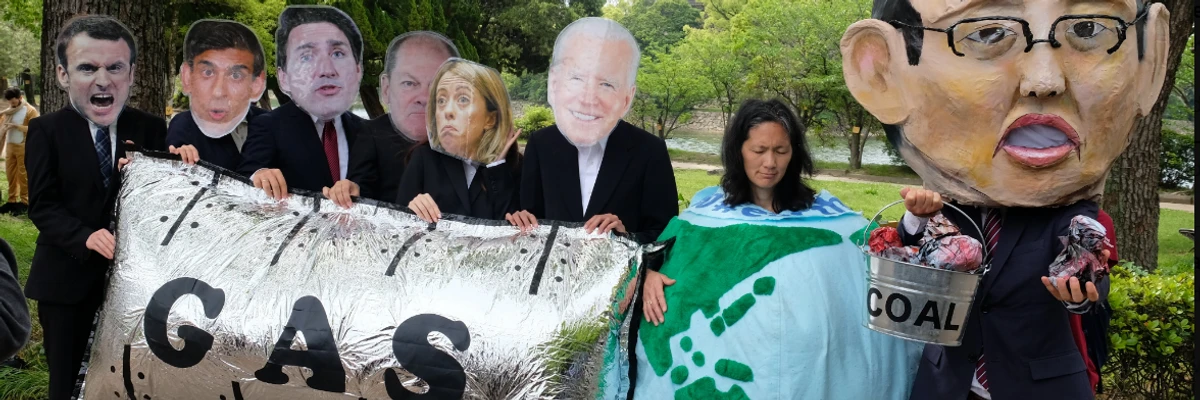
    Activists with masks of Group of Seven leaders protest fossil fuels. (Photo: 350.org Japan/Friends of the Earth Japan/Oil Change International)

    “Energy security can only be achieved by rapidly and equitably phasing out fossil fuels and transitioning to renewable energy, not locking in deadly fossil fuels and lining the pockets of oil and gas executives,” said one critic.

    Since Group of Seven leaders on Saturday put out a wide-ranging communiqué from a Japan-hosted summit in Hiroshima, climate action advocates from G7 countries and beyond have blasted the statement’s support for future investments in planet-heating gas.

    The statement comes after G7 climate, energy, and environment ministers were criticized for their communiqué from a meeting in Sapporo last month as well as protests around the world this week pressuring the summit’s attendees to ditch fossil fuels and “deliver a clear and just renewable energy agenda for a peaceful world.”

    To meet the 1.5°C goal of the Paris climate agreement, the new statement commits to “accelerate the phaseout of unabated fossil fuels so as to achieve net-zero in energy systems by 2050 at the latest” along with “the elimination of inefficient fossil fuel subsidies by 2025 or sooner.”

    “The G7 must stop using fossil fuels immediately—the planet is on fire.”

    The statement also highlights that last year, G7 nations—Canada, France, Germany, Italy, Japan, the United Kingdom, and the United States—pledged to end “new direct public support for the international unabated fossil fuel energy sector, except in limited circumstances,” though as recent analysis shows, some are breaking that promise.

    The communiqué then endorses liquefied natural gas (LNG) as a solution to “the global impact of Russia’s war on energy supplies, gas prices and inflation, and people’s lives,” referencing the invasion of Ukraine:

    In this context, we stress the important role that increased deliveries of LNG can play, and acknowledge that investment in the sector can be appropriate in response to the current crisis and to address potential gas market shortfalls provoked by the crisis. In the exceptional circumstance of accelerating the phaseout of our dependency on Russian energy, publicly supported investment in the gas sector can be appropriate as a temporary response, subject to clearly defined national circumstances, if implemented in a manner consistent with our climate objectives without creating lock-in effects, for example by ensuring that projects are integrated into national strategies for the development of low-carbon and renewable hydrogen.

    “The G7 energy outcome correctly diagnoses a short-term need for energy security, then promotes a dangerous and inappropriate lock-in of fossil gas that would do nothing to address this need,” responded Collin Rees, United States program manager at Oil Change International (OCI). “Energy security can only be achieved by rapidly and equitably phasing out fossil fuels and transitioning to renewable energy, not locking in deadly fossil fuels and lining the pockets of oil and gas executives.”

    After accusing the summit’s attendees of “using the war as an excuse,” deflecting blame for current conditions, and neglecting Global South countries disproportionately suffering from the climate crisis, Max Lawson, head of inequality policy at Oxfam, declared that “the G7 must stop using fossil fuels immediately—the planet is on fire.”

    Greenpeace International global climate politics expert Tracy Carty also demanded a swift end to fossil fuels, charging that “G7 leaders’ endorsement of new fossil gas is a blunt denial of the climate emergency” which dooms “current and future generations.”

    Gerry Arances, executive director of the Philippine Center for Energy, Ecology, and Development, similarly argued that “the endorsement of increased LNG deliveries and investment in gas in the G7 communiqué is no mere backsliding—it is a death sentence being dealt by the G7 to the 1.5°C limit and, in consequence, to the climate survival of vulnerable peoples in the Philippines, Southeast Asia, and across the world.”

    “Unless they genuinely put forward the phaseout of all fossil fuels, Japan and all G7 nations spout nothing but lies when they say they have aligned to 1.5°C,” he continued. “They cannot claim to be promoting development while subjecting our people to decades more of pollution and soaring energy prices. We reject this notion of a development powered by fossil fuels.”

    Looking to the United Nations Climate Change Conference (COP28) planned for later this year, Arances added that “Japan and G7 leaders should already be warned that civic movements will not tire in pushing back against fossil fuels and false solutions and in demanding a renewable energy transition.”

    “Civic movements will not tire in pushing back against fossil fuels and false solutions and in demanding a renewable energy transition.”

    Other campaigners also specifically called out the Hiroshima summit’s host—including Ayumi Fukakusa, deputy executive director at Friends of the Earth Japan, who asserted that the country “has used the G7 presidency to derail the global energy transition.”

    “Japan has been driving the push to increase gas investments and has been promoting its so-called ‘green transformation’ strategy,” Fukakusa said of a “greenwashing scheme” featuring hydrogen, ammonia, nuclear, and carbon capture and storage technologies.

    OCI Asia program manager Susanne Wong agreed that given the nation’s promotion of gas expansion and technologies to prolong the use of coal, “this year’s G7 is revealing Japan’s failure of climate leadership at a global level.”

    “Activists mobilized 50 actions across 22 countries this week to demand that Japan end its fossil fuel finance and stop driving the expansion of gas and other fossil-based technologies,” Wong added. “Japan will continue to face intense international scrutiny until it stops fueling the climate crisis.”

    Groups from other G7 countries also called out their political leaders. Petter Lydén, head of international climate policy at Germanwatch, said, “Most likely, the German chancellor, Olaf Scholz, has been a driving force behind the weak language on gas, which is a serious blow to Germany’s international credibility on climate.”

    Citing sources familiar with summit negotiations, The New York Timesreported Saturday that “Britain and France fought the German effort” while U.S. President Joe Biden was caught between defending his climate agenda and “aiding other United States allies intent on increasing their access to fossil fuels.”

    OCI’s Rees said the that “this betrayal continues a disturbing turn by President Biden and Chancellor Scholz from rhetorically committing to climate leadership to openly boosting fossil fuel expansion. History will not look kindly on world leaders who accelerate the pace of fossil fuel buildout in the face of worsening climate crisis.”

    Original article by Jessica Corbett republished from Common Dreams under Creative Commons (CC BY-NC-ND 3.0).