Category: Climate Crisis

  • Roger Hallam: Makerfield and the Myth of the Moderate Left

    Spread the love

    While liberals hesitate, the clock doesn’t.

    I am republishing this article by Roger Hallam. I’ve not asked and hope that he doesn’t mind. I’ll pull it down – of course – if he objects. There is a brief comment of my own at the end.

    Going to Work, L.S Lowry

    The real division in western politics is between the pathological centre and challenge on the so-called “far” left and right — meaning political forces reasonably enough challenging the centre’s mass death project. Of course, the far right is based upon a con — its core spaces are dominated by the same billionaire-funded mass death agenda as the centre’s, but the sentiment on the ground is very similar to that on the left.

    The point is the level of maturation — whether these forces are confident enough to separate themselves from the hegemony of the “centre” so that a credible and coherent message can be presented to the electorate that they really are “not them”. As usual, the far right has a big head start.

    This requires that the leadership of Left spaces actually believe in themselves. When this happens — as in the case of Mamdani and Polanski — then the voter response is dramatic. The Green Party has risen from around 6% to nearly 20% in a year. Of course, this is helped by local factors — the collapse of Your Party and the tactical incompetence of Labour. But the structural factor is the key determinant — a political leader who directly addresses the decimation of the cultural and material means of life of the majority under monopoly finance capital. There is the conventional economic wave — the “internal contradictions of capital” — and then fusing with the new and final wave: the destruction of the biosphere.

    Inadequate maturation of a Left party that promises systemic change is again catastrophically on display in the Green Party’s weak response to the Makerfield by-election. If Zack had believed in his own rhetoric — that the party is taking over from Labour — then he would have shown charismatic and strategic leadership and been out there on the streets from day one, making the self-fulfilling prophecy that Labour can never look after the interests of working people, for all the reasons everyone knows.

    Instead, like docile peasants in the face of aristocratic charm (i.e. lies), the weight of tradition has again won the day. The myth held that the Left can only go through the motions of opposition to the centre, which has the divine (i.e. neo-liberal) right to rule.
    Join Me

    This failure is catastrophic because, as any realist worthy of the label knows, next year the world will hit 1.7°C, and this will signal the end of our civilisation, beginning with the collapse of insurance markets. Think of 2008, then multiply it by 100. Capital in the twenty-first century is the biggest Ponzi scheme in human history. It sells you prosperity while knowing it is destroying the very basis of life. This does not end well.

    The far right response will be to double down on denial and ever greater psychotic short-termism, as shown by the present Trump regime. In other words, the far right has only one agenda: treason — to bring mass death down onto the British people. After all, it only took Hitler twelve years to do this to Germany. It will take about a decade to do the same this time around, but with the truly appalling outcome of the permanent desolation of our country. You cannot “rebuild” without a functioning biosphere.

    Even the billionaire owned Daily Mail sees disaster ahead.

    What the Green Party has to do but won’t do is tell the people of Makerfield that they will die the slow way with Burnham and the fast way with Farage. Both are happy to have AMOC collapse locked in, for example. AMOC collapse means the end of the UK — no question about it. This is a physical, not a social, situation. You cannot grow potatoes in northern Norway, as one expert put it.

    Of course, telling the UK public this “blood, sweat and tears” reality is most likely to fail. Never underestimate the effects of forty years of neo-liberal programming. But that is not the point. The point is that there is an absolute time limit here. There is no more time. We are at 1.5°C and 2°C is locked in (0.5°C, for instance, will be added to global temperatures once the air pollution from stopping burning fossil fuels is removed).

    This means it’s now or never. You can jump over the fence and most likely get shot, or you can wait a little longer and be guaranteed to die in the gas chamber, which is the earth’s atmosphere with over 500ppm of CO₂ in it.

    Sometimes choices are limited.

    Let me finish on a rather British positive note. I recently spoke to a woman who was part of one of the many trials of people who have taken part in civil disobedience with Just Stop Oil. The convention now is that the judge will not allow any evidence relating to the criminality of the elites with regard to carbon emissions. Unsurprisingly, these show trials lead to guilty outcomes from juries. In one of those trials, I was given a five-year prison sentence. For some reason, in her trial, the judge allowed the presentation of evidence, including the “agreed fact” that at 3°C there will be at least 4 billion deaths — as predicted by a recent major report by the UK insurance industry. These people, we hopefully can all agree, deal in facts.

    The jury went out for less than an hour and came back with a not guilty verdict. After all, who wants their kids and grandkids subjected to the equivalent of 80 World Wars Twos in the next two generations? Maybe the good citizens of Makerfield don’t want that fate either. But first, they need Mr Polanski to tell them some of these “agreed facts”.

    There is a reason the “blood, sweat and tears” speech is the best-known of the twentieth century. Could it have something to do with being told the truth?


    If this political moment feels like a dead end, that’s because it is — my new book Suicide names it. From the structural failure of liberal democracy to the legal and moral case for resistance, this is the argument the mainstream won’t make.

    Order Suicide

    dizzy: I have estimated for myself when the World becomes uninhabitable. I don’t have any particular insight into this – I am not a climate scientist and know much less about climate than Roger Hallam – and have instead simply decided at what temperature life is unsustainable and considered likely warming to that point. In a sense that I’m not an expert is not that important because nobody really knows what’s going to happen, there are only theories, best guesses because it is yet to happen. Anyway, I agree with Roger that it is imminent, not long at all. The date I reached is 2060. It’s the rich who are driving climate destruction, the rich who are in charge of our governments and the solution is to do away with the rich. Tax them to extinction, use the money to address the climate. If we continue with Capitalism / Neo-Liberalism we have very little time.
  • Climate Coverage Plunges, Though Crisis More Dire Than Ever

    Spread the love

    Article by Olivia Riggio republished from FAIR under a Creative Commons Attribution-NonCommercial-NoDerivs 3.0 Unported License.

    The UN just released its 2025 Global Climate Report, and, predictably, the outlook for our earth is incredibly dire. The past 11 years were the 11 warmest on record, and Earth’s energy imbalance—the amount of solar energy absorbed versus the amount Earth radiates back into space—is also the highest on record. Greenhouse gas emissions continued to increase through 2025, despite the world crossing the 1.5°C threshold marked in the Paris Agreement above which the worst effects of global heating will take place.

    There is no shortage of urgent climate news right now. The scientific consensus that we need to phase out fossil fuels fast has not changed, despite President Donald Trump’s anti-climate policies rolling back environmental protections and clean energy growth. But data shows coverage about climate change in US news outlets has plunged.

    Downward trend

    FAIR’s research has found that online news coverage of climate change has been trending down. A search of the term “climate change” in Media Cloud’s US–National dataset, which indexes 248 online outlets, found that there was almost 32% less climate coverage in 2025 than 2024.

    This trend is similar in TV news. A recent Media Matters (3/4/26) study found that climate coverage on major US commercial broadcast TV networks was down 35% in 2025.

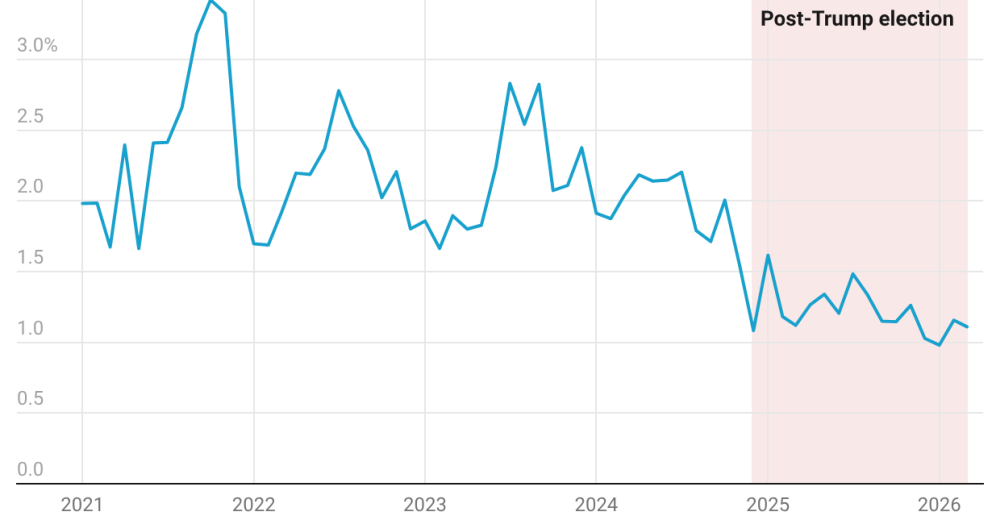
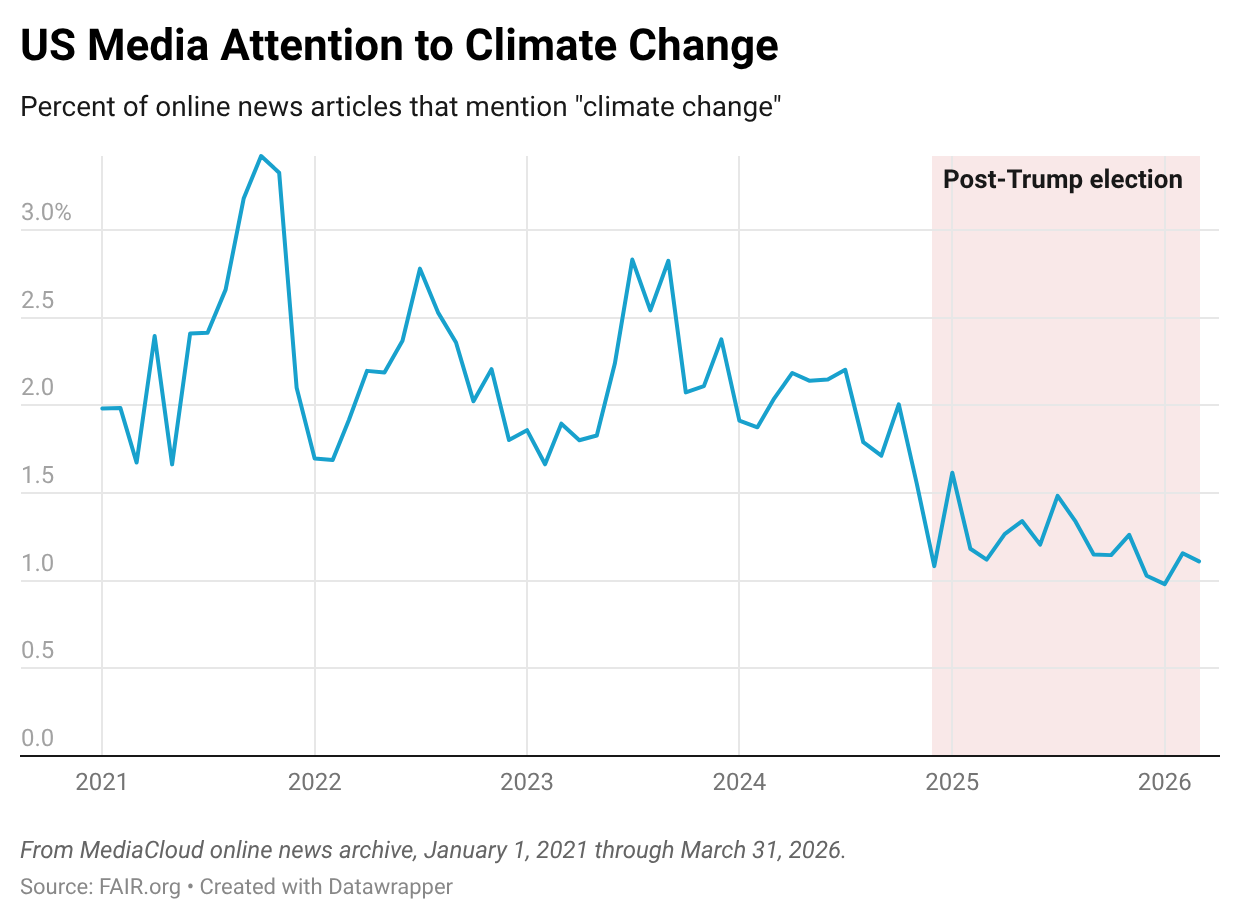
    Zooming out to the past five years to date, results show a steep downward trend. In 2021, 2.4% of US online news pieces in MediaCloud contained the phrase “climate change.” In 2025, that percentage was 1.3%, which is a nearly 46% decrease.

    This trend continues in 2026. Between January 1 and March 31 2026, climate stories made up 1.1% of total US news coverage. That’s a 42% decrease compared to the same period in 2021, when climate stories made up 1.9% of coverage.

    US Media Attention to Climate Change

    Coverage of climate change in MediaCloud’s US news database peaked at 3.4% of content in October 2021. This was in the runup to the COP26 climate conference in Glasgow (10/31/21–11/13/21), and was at the time the world’s fourth-warmest October on record, although now it’s only the seventh-warmest. Coverage reached its nadir in January 2026, at just under 1%, and as of March 31, 2026, sat at 1.1%.

    The unlabeled ‘crisis’

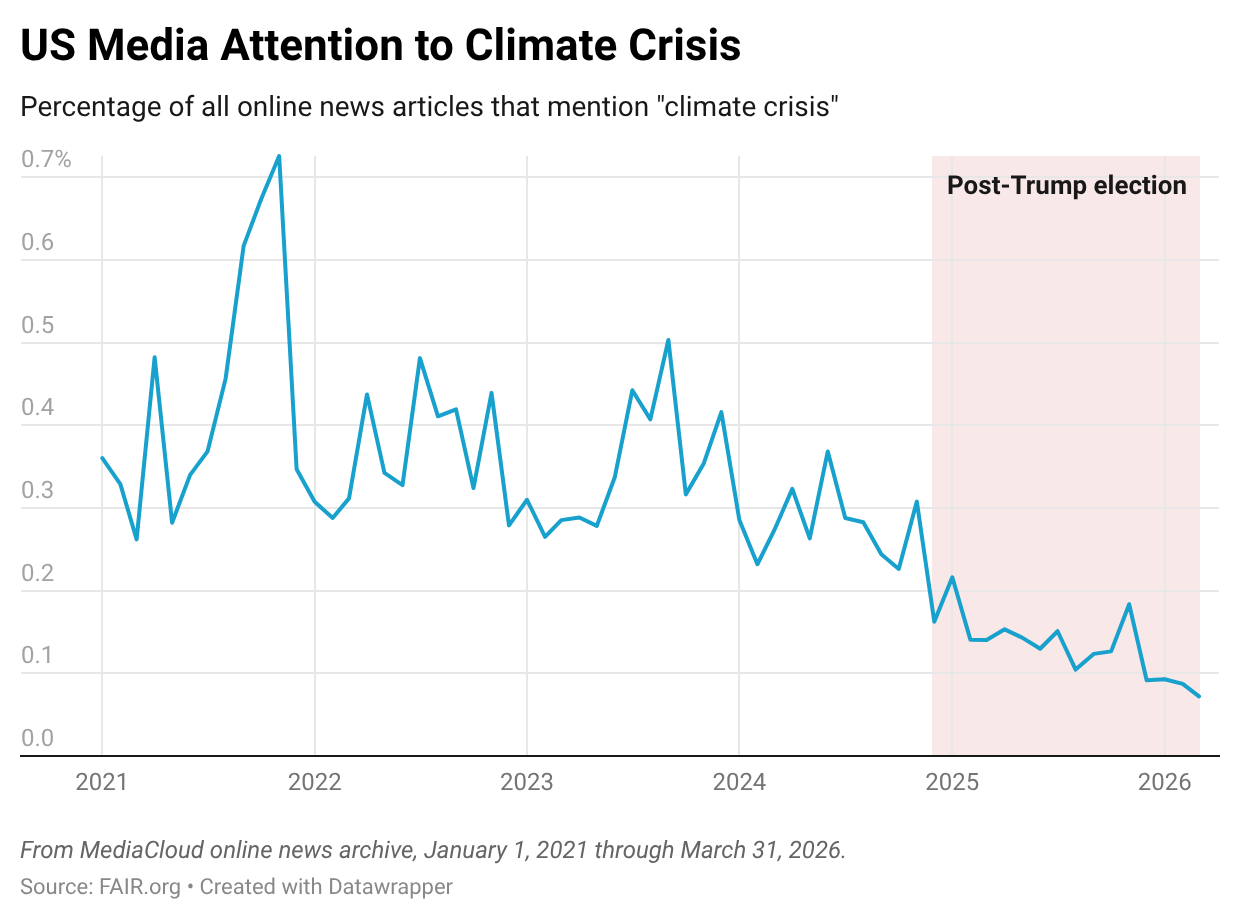
    The term “climate crisis,” which carries with it a more urgent connotation than the more familiar “climate change,” has nearly disappeared from media lexicon. The term, which averaged 0.4% of coverage in 2021, reaching its peak in November 2021 at 0.7%, has averaged 0.1% of content in the first quarter of 2026.

    US Media Attention to Climate Crisis

    Though it has never approached the usage of “climate change,” there was a time when the terms “crisis” or “emergency” to describe the heating planet were popularized in media and political lexicon (Public Citizen, 6/22/19). In 2019, activist Greta Thunberg (Twitter/X, 6/4/19) declared:

    It’s 2019. Can we all now please stop saying “climate change” and instead call it what it is: climate breakdown, climate crisis, climate emergency, ecological breakdown, ecological crisis and ecological emergency?

    Months later, the Guardian (10/16/19) changed its style guide to “introduce terms that more accurately describe the environmental crises facing the world.” The editors explained:

    Climate change is no longer considered to accurately reflect the seriousness of the overall situation; use climate emergency or climate crisis instead to describe the broader impact of climate change.

    In 2026, this terminology is arguably more applicable now than it has ever been. The years 2015–25 were the hottest on record. Yet while the Guardian continues its policy, it appears increasingly isolated.

    Trump and climate silence

    Under a president who called climate change a “con job” at the UN, and whose EPA edited its “Climate Change Science” page to blame global heating on debunked “natural causes” theories like changes in Earth’s orbit and volcanic activity, news media should be redoubling their efforts to tell climate change stories with accuracy.

    Instead, one cannot help but notice a correlation between Trump’s second presidency and dwindling media attention to the climate. From January 2021 through November 2024, climate pieces were an average of 2.2% of total news content per month. From December 2024, after Trump was elected, through March 2026, climate pieces averaged more than 46% lower, at 1.2%.

    The lack of recent coverage is not for lack of newsworthy climate stories. In addition to the release of the 2025 UN report, in March alone:

    • The University Corporation for Atmospheric Research filed a lawsuit charging that the Trump administration shut down the Colorado-based National Center for Atmospheric Research to get back at Colorado Gov. Jared Polis, whom Trump has clashed with (NCAR/UCAR, 3/16/26).
    • Scientists found that March’s record-shattering heatwave in the Western US would have been “virtually impossible” without the climate crisis. The heatwave included the hottest March days on record in the US, with two 112°F days in Arizona (NBC New York, 3/30/26).
    • The Trump administration paid a French energy giant $1 billion to cancel its offshore wind projects and invest in fossil fuels instead (Grist, 3/25/26).
    • More than 160 environmental and public health groups called for the firing of EPA administrator Lee Zeldin, who has rolled back national environmental regulations, including air quality standards, pollution limits for oil and gas drilling, and regulations on power plant and vehicle emissions (Earth.org, 3/26/26).
    • An oil spill in the Gulf of Mexico began in late March, killing wildlife and damaging reefs (Al Jazeera, 3/27/26).

    Iran War and climate

    The US and Israel’s unprovoked war on Iran is causing global oil and gas price shocks—and is being reported as the worst energy crisis in history, topping the crises of the 1970s and the Ukraine invasion of 2022 (Fortune, 3/23/26). With the war dominating headlines—the terms “Iran” and “war” made up 10.5% of US news coverage in March, per MediaCloud’s data—there were plenty of opportunities to discuss the war’s impact on climate.

    While 5,012 stories in MediaCloud’s US news database mentioned Iran and oil or gas prices during March 2026, only 219 (4.4%) mentioned those topics in relation to renewable energy or climate change.

    Simon Stiell, executive secretary of the UN Framework Convention on Climate Change, spoke at the 2026 Green Growth Summit in Brussels, explaining that a just transition from fossil fuels is not only an environmental imperative, but also an economic and national security one:

    Sunlight doesn’t depend on narrow and vulnerable shipping straits, wind blows without massive taxpayer-funded naval escorts [and] renewable energy allows countries to insulate themselves from global turmoil and to side-step might-is-right politics.

    Renewables like solar and wind are less beholden to geopolitics than fossil fuels, which are vulnerable to volatile shipping lanes and international relations in the specific regions of the world they are produced. Once solar panels and wind turbines are installed, they allow for energy to be produced locally and predictably. As a result, their prices remain stable over time (Global Witness, 4/2/26).

    Solar and wind have also been cheaper than fossil fuels for quite some time. A 2025 Lazard report found that utility-scale solar and wind have been the lowest-cost generation sources for 10 years, even without tax subsidies.

    This is not the first time in recent years the corporate press failed to make the connection between war-inflated gas prices and the need for renewable energy. In June 2022, after Russia invaded Ukraine, UN sanctions on Russian oil led to a global shortage, causing the national gas price average to top $5 a gallon. Out of 93 nightly news episodes in June 2022 that discussed gas prices, only 18 made even a passing climate connection, and only one made a pro-climate argument (FAIR.org, 7/29/22).

    Impacts of climate

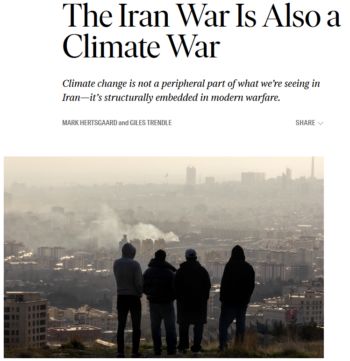
    Nation: The Iran War Is Also a Climate War

    The Nation (3/5/26): “The climate implications of this new war are not the center of attention at the moment, but they are essential context for understanding what’s at stake.”

    What’s more, as Mark Hertsgaard and Giles Trendle wrote for The Nation (3/5/26), “Modern warfare is inextricably linked with climate change.” Whether or not a war is fought over oil, the authors note, it cannot be fought without it. If the world’s militaries were a country, they would have the fourth-largest national carbon footprint.

    Modern warfare emits astronomical amounts of carbon, which cause extreme heat and other dangerous weather events that impact livelihoods and destabilize economies—conditions that lead to more war.

    And warfare also has immediate environmental and public health impacts, some directly linked to fossil fuels. After Israel attacked Iran’s oil facilities, black rain fell in Tehran. The heavy metals and toxic chemicals unleashed have the potential for major public health ramifications, leaching into food supplies and waterways in addition to air. Health risks from this pollution include lung problems, heart problems and cancer.

    Climate change does not occur in a vacuum. It is relevant to virtually everything that happens on Earth, from natural disasters to your weekly expenses. Studies show that 80–89% of people worldwide want to see stronger action on climate change from their governments.

    It is news media’s responsibility to reflect reality and to address the concerns of the communities they serve, regardless of the priorities of the administration in power. Failing to mention climate change where it is relevant will not stop it from occurring, but inattention will surely make it worse.


    This story is part of the 89 Percent Project, an initiative of the global journalism collaboration Covering Climate Now.

    FAIR’s work is sustained by our generous contributors, who allow us to remain independent. Donate today to be a part of this important mission.

    Article by Olivia Riggio republished from FAIR under a Creative Commons Attribution-NonCommercial-NoDerivs 3.0 Unported License.

    Nigel Farage urges you to ignore facts and reality and be a climate science denier like him and his Deputy Richard Tice. He says that Reform UK has received £Millions and £Millions from the fossil fuel industry to promote climate denial and destroy the planet.
    Nigel Farage urges you to ignore facts and reality and be a climate science denier like him and his Deputy Richard Tice. He says that Reform UK has received £Millions and £Millions from the fossil fuel industry to promote climate denial and destroy the planet.
    Donald Trump urges you to be a Climate Science denier like him. He says that he makes millions and millions for destroying the planet, Burn, Baby, Burn and Flood, Baby, Flood.
    Donald Trump urges you to be a Climate Science denier like him. He says that he makes millions and millions for destroying the planet, Burn, Baby, Burn and Flood, Baby, Flood.
    Elon Musk urges you to be a Fascist like him, says that you can ignore facts and reality then.
    Elon Musk urges you to be a Fascist like him, says that you can ignore facts and reality then.
  • Hottest May day for nearly 80 years as parts of UK hit heatwave threshold

    Spread the love

    https://www.theguardian.com/uk-news/2026/may/24/uk-heatwave-expected-as-temperatures-near-record-highs-for-may

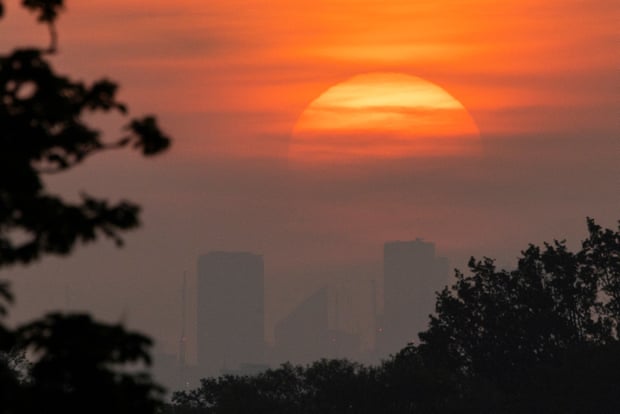
    The sun rising over London, seen from Richmond Park, on Sunday. Photograph: Brook Mitchell/AFP/Getty

    Highest temperatures of 2026 in England, Wales and Northern Ireland as Kew Gardens in London reaches 32.3C

    England, Wales and Northern Ireland recorded their highest temperatures of 2026 on Sunday, which was also the UK’s hottest May day for at least 79 years.

    Kew Gardens in west London recorded 32.3C (90.1F), Cardiff 27.4C and Armagh 23.4C.

    Scotland reached 23.5C in Edinburgh, just 0.1C below the record of 23.6C set in Aboyne on 1 May.

    The first area of the UK to hit the heatwave threshold was Santon Downham in Suffolk, which reached the criteria of recording temperatures of more than 27C for three consecutive days at 11.30am on Sunday.

    The other areas officially in heatwave conditions are Heathrow, Kew Gardens and Northolt in London, Benson in Oxfordshire, Brooms Barn in Suffolk, and High Beach and Writtle in Essex.

    Temperatures could rise again on Monday, with possible highs of between 33C and 34C.

    The climate crisis is increasing the likelihood of extreme heat. Large parts of western Europe are experiencing similar peaks, and the French national weather agency, Météo-France, said periods of exceptional heat are to be expected “more and more often and more and more prematurely, and to be more and more intense”.

    …

    https://www.theguardian.com/uk-news/2026/may/24/uk-heatwave-expected-as-temperatures-near-record-highs-for-may

    Nigel Farage urges you to ignore facts and reality and be a climate science denier like him and his Deputy Richard Tice. He says that Reform UK has received £Millions and £Millions from the fossil fuel industry to promote climate denial and destroy the planet.
    Nigel Farage urges you to ignore facts and reality and be a climate science denier like him and his Deputy Richard Tice. He says that Reform UK has received £Millions and £Millions from the fossil fuel industry to promote climate denial and destroy the planet.
    Donald Trump urges you to be a Climate Science denier like him. He says that he makes millions and millions for destroying the planet, Burn, Baby, Burn and Flood, Baby, Flood.
    Donald Trump urges you to be a Climate Science denier like him. He says that he makes millions and millions for destroying the planet, Burn, Baby, Burn and Flood, Baby, Flood.
    Elon Musk urges you to be a Fascist like him, says that you can ignore facts and reality then.
    Elon Musk urges you to be a Fascist like him, says that you can ignore facts and reality then.
  • Tuna has overtaken cod as the UK’s top‑selling seafood – here’s why

    Spread the love
    Atlantic bluefin tuna hunting garfish off the Devon coast in 2024. Rupert Kirwood

    Angus Atkinson, Plymouth Marine Laboratory and Simon Thomas, University of Plymouth

    Awesome, unexpected and unforgettable: a sudden bolt of silver as a tuna jumped clear of the sea. Nobody else saw it, and I (Angus Atkinson) almost thought I was hallucinating. But since I first saw one from a boat just off the south Devon coast ten years ago, Atlantic bluefin tuna have steadily increased in the southwest UK. Last year I even saw them from the shore, and tuna now supports a local fishery.

    Tuna is not the only species to make a rapid change in the southwest UK about a decade ago. Blue, thresher and porbeagle sharks suddenly increased dramatically. Spiny lobsters suddenly increased. Meanwhile basking sharks and many important fish species like cod and pollack declined. What is going on?

    Fortunately, in the southwest UK, help is at hand. Not only does this peninsula host some of the most complete long-term recordings of observations in the UK, we also have a burgeoning network of marine observers.

    This was the brainchild of marine consultant Bob Earll, who 15 years ago set up a network called South West Marine Ecosystems. This links scientists, marine charities, fishermen, conservation trusts, managers and citizen scientists many of whom have natural history skills to match the best. This network enables members to more easily share observations and recordings about marine life.

    Alongside established high-tech and long-term monitoring such as at the Western Channel Observatory (a set of sampling sites at sea within a 30-mile-radius from Plymouth), many pairs of eyes are looking at the sea along the entire coast of this peninsula. Each year we meet and put data together to report on the status of everything in the marine ecosystem, whether it swims, crawls or flies, and from nutrients right up to the numbers of stranded whales.

    South West Marine Ecosystems’ annual reports and annual conferences put the previous year’s observations into the context of all that has gone before. That includes strange new events such as the 2025 octopus outburst. This near-real time reporting, with everyone comparing notes, provided a lightbulb moment: these species shifts were not continuous but seemed to be concentrated into a short intense period of massive change around 2014 to 2016.

    In the southwest UK, tuna have increased to the extent that they support a tightly regulated fishery, with a UK catch quota of 230 tonnes for 2026-28. Fishing is always an emotive subject, and some people say we should be leaving these beautiful animals alone.

    Kayakers have a close encounter with tuna while photographing marine wildlife off the coast of Devon in 2024.

    A recent announcement by the Marine Stewardship Council (MSC) offers some hope that tuna fisheries worldwide are moving in the right direction.

    The MSC endorses those seafood sources that have been harvested sustainably, meaning that they abide by the rules of well-managed fisheries based on scientific advice, with minimal collateral ecological damage. This most recent announcement shows an important positive result: the proportion of tuna products available with an MSC endorsement has just risen to nearly 50%, compared to less than 20% only five years ago.

    Remarkably, tuna has just overtaken cod as the main seafood bought in the UK. This probably reflects the increasing availability of more sustainably-sourced tuna and sharply declining cod stocks.

    A state of flux

    Managing these fisheries involves treading that tightrope between allowing livelihoods for the fishing industry, but allowing the whole ecosystem to flourish. The challenges of climate change, shifting distributions and fishing pressure combine into a real headache to manage fisheries responsibly.

    Abrupt shifts in ecosystems, as we have witnessed in the southwest of the UK, are critical for fisheries management. In just a few years an ecosystem can lurch into a different operating space with different species and links.

    Computer simulation models of ecosystems can broadly project how food webs might respond to the average pace of climate change. Importantly, these models are notoriously poor for predicting abrupt shifts, often known as regime shifts, that punctuate the steadier pace of change.

    With these challenges, fisheries managers need all the help they can get to understand abrupt ecosystem shifts. The tuna increase was well documented by South West Marine Ecosystems. The success of this network means that similar programmes are spinning up around the other coasts of the UK.

    Similar initiatives are underway elsewhere. The Norwegian Institute of Marine Research provides a data network from public reporting of jellyfish increases, which are important for the management of Norwegian aquaculture.

    Joined-up science efforts like South West Marine Ecosystems, alongside long-term scientific monitoring studies and, of course, traditional fish stock assessments, will help us know better whether tuna should stay on the menu.

    Angus Atkinson, Professor of Marine Ecology, Plymouth Marine Laboratory and Simon Thomas, Visiting Fellow, Marine Ecology, University of Plymouth

    This article is republished from The Conversation under a Creative Commons license. Read the original article.

  • Climate Adam: Climate Scientists Were Wrong… That’s a good thing

    Spread the love

    Donald Trump urges you to be a Climate Science denier like him. He says that he makes millions and millions for destroying the planet, Burn, Baby, Burn and Flood, Baby, Flood.
    Donald Trump urges you to be a Climate Science denier like him. He says that he makes millions and millions for destroying the planet, Burn, Baby, Burn and Flood, Baby, Flood.
    Nigel Farage urges you to ignore facts and reality and be a climate science denier like him and his Deputy Richard Tice. He says that Reform UK has received £Millions and £Millions from the fossil fuel industry to promote climate denial and destroy the planet.
    Nigel Farage urges you to ignore facts and reality and be a climate science denier like him and his Deputy Richard Tice. He says that Reform UK has received £Millions and £Millions from the fossil fuel industry to promote climate denial and destroy the planet.
    Elon Musk urges you to be a Fascist like him, says that you can ignore facts and reality then.
    Elon Musk urges you to be a Fascist like him, says that you can ignore facts and reality then.