The Paris Agreement 2015 is the latest international treaty on climate change.

Quoted from wikipedia

...
The Paris Agreement's long-term temperature goal is to keep the rise in mean global temperature to well below 2 °C (3.6 °F) above pre-industrial levels, and preferably limit the increase to 1.5 °C (2.7 °F), recognizing that this would substantially reduce the effects of climate change. Emissions should be reduced as soon as possible and reach net-zero by the middle of the 21st century.[3] To stay below 1.5 °C of global warming, emissions need to be cut by roughly 50% by 2030. This is an aggregate of each country's nationally determined contributions.
...
According to the 2020 United Nations Environment Programme (UNEP), with the current climate commitments of the Paris Agreement, global mean temperatures will likely rise by more than 3 °C by the end of the 21st century.
...
Countries determine themselves what contributions they should make to achieve the aims of the treaty. As such, these plans are called nationally determined contributions (NDCs).
...
In 2021, a study using a probabilistic model concluded that the rates of emissions reductions would have to increase by 80% beyond NDCs to likely meet the 2 °C upper target of the Paris Agreement, that the probabilities of major emitters meeting their NDCs without such an increase is very low. It estimated that with current trends the probability of staying below 2 °C of warming is 5% – and 26% if NDCs were met and continued post-2030 by all signatories.
...

The message from the above quotations is
1. The Paris Agreement is an attempt to limit climate change effects by keeping global mean (average) temperatures below 1.5C or 2C.
2. We are likely looking at global temperature rises between 2C and over 3C by the end of the century.


We are currently at 1.1 or 1.2C global mean temperature above pre-industrial levels. There are extreme climate events now never mind at 1.5, 2 or over 3C.

2022 saw record-breaking heat in UK while there were heatwaves and vast wildfires in North America, record-breaking temperatures and huge wildfires across France and Western Europe, huge drought followed by severe flooding in Pakistan, repeated flooding in Eastern Australia and currently East Africa is suffering the worst drought in decades.

We are in a climate crisis at 1.2C. The crisis is now.

The main cause of global warming is the use of fossil fuels. The best response to the climate crisis is to stop the use of fossil fuels as much as we possibly can and to transition to renewable sources of energy instead. This would also involve a programme of insulation to reduce the use of fossil fuels.

Politicians worldwide are neglecting to address the climate crisis in any meaningful way. The protest group Just Stop Oil is calling for no new development of fossil fuels. Grant Shapps, UK's Secretary of State for Business, Energy and Industrial Strategy is so totally out of touch that he's not even familiar with Just Stop Oil's objectives: “I’ve no issue with people arguing for lower levels of petrol, gas or whatever other thing they want to campaign for usage, that is fine, that is one thing. But don’t go disrupting other people’s lives - it’s unacceptable, it’s illegal!”, the Business Secretary said.

Young people particularly should get active opposing climate destruction because it's fekking their futures and otherwise they're just going to keep on getting totally disregarded, shat on. Extreme weather events at 1.2C are so serious, 3C may well lead to extinction and next to nothing is being done to prevent it.

Some links - try searching for your own e.g. extreme weather events 2022
https://en.wikipedia.org/wiki/Paris_Agreement
Met Office: Unprecedented extreme heatwave (UK), July 2022
Analysis: Africa’s unreported extreme weather in 2022 and climate change
Over 20,000 died in western Europe’s summer heatwaves, figures show

16/12/22 Climate Reality Check 2021
Category: Climate Crisis
Climate Crisis Reality Check (2)
‘Deeply Depressing’ Study Shows Planet-Warming Emissions Continue to Rise

“If current emissions levels persist, there is now a 50% chance that global warming of 1.5°C will be exceeded in nine years.”
Republished from Common Dreams under Creative Commons (CC BY-NC-ND 3.0). Feel free to republish and share widely.
JAKE JOHNSONNovember 11, 2022
Rapid and drastic cuts to global greenhouse gas emissions are necessary to curb warming and prevent the most dire climate scenarios from becoming reality.
But a new study released Friday by the Global Carbon Project finds “no sign of the decrease that is urgently needed” as emissions remain at record levels this year, with fossil fuel giants and governments plowing ahead with new extraction efforts that could push critical climate targets out of reach.
Scientists with the Global Carbon Project estimate that total CO2 emissions will reach 40.6 billion tonnes this year—driven by rising pollution from fossil fuels—and will likely continue to rise in 2023 without bold action from policymakers worldwide.
“If current emissions levels persist, there is now a 50% chance that global warming of 1.5°C will be exceeded in nine years,” the researchers note. “Projected emissions from coal and oil are above their 2021 levels, with oil being the largest contributor to total emissions growth.”
“The 2022 picture among major emitters is mixed: emissions are projected to fall in China (0.9%) and the E.U. (0.8%), and increase in the USA (1.5%) and India (6%), with a 1.7% rise in the rest of the world combined,” the report finds.
Professor Pierre Friedlingstein of Exeter’s Global Systems Institute, the lead author of the new study, lamented in a statement that “we see yet another rise in global fossil CO2 emissions” in 2022 “when we need a rapid decline.”
“There are some positive signs,” Friedlingstein added, pointing to the slowing growth of fossil fuel emissions over the long term, “but leaders meeting at COP27 will have to take meaningful action if we are to have any chance of limiting global warming close to 1.5°C.”
That increasingly imperiled warming target remains a focus as world leaders gather in Sharm El-Sheikh, Egypt for the annual United Nations climate conference, a key opportunity for nations to commit to collective action against a climate emergency that is wreaking havoc worldwide.
Climate campaigners warn the opportunity is at risk of being squandered as Big Oil lobbyists swarm the conference and gas producers use the event to push their dirty energy source as a “transition fuel.”
Professor Corinne Le Quéré of the University of East Anglia, a co-author of the Global Carbon Project study, said that if governments respond to worsening climate chaos “by turbocharging clean energy investments and planting, not cutting, trees, global emissions could rapidly start to fall.”
“We are at a turning point and must not allow world events to distract us from the urgent and sustained need to cut our emissions to stabilize the global climate and reduce cascading risks,” Le Quéré warned.
Allowing planetary heating to exceed 1.5°C above preindustrial levels by the end of the century would spell disaster for large swaths of the planet as trends already seen around the world—from increasingly extreme weather events to species extinctions to rapidly melting sea ice—would accelerate, potentially locking in irreversible climate damage.
Professor Mark Maslin of University College London told The Guardian that the Global Carbon Project study is “deeply depressing.”
“It sends a clear message to the leaders at COP27—the world needs to have significant cuts in global emissions in 2023 if we are to have any chance to keep climate change to 1.5°C,” said Maslin.
Republished from Common Dreams under Creative Commons (CC BY-NC-ND 3.0). Feel free to republish and share widely.
Related
Analysis Exposes Big Oil’s Plot to Unleash Climate-Killing ‘Carbon Bombs’ Worldwide
Jake Johnson · May 11, 2022
Climate Crisis Pushing Up to 1 in 6 US Tree Species Toward Extinction: Study
Julia Conley · Aug 23, 2022
‘Abdication of Responsibility’: Fury as COP27 Draft Omits Oil and Gas Phase-Out
Julia Conley · Nov 17, 2022
‘We Must Wake Up!’ Study Says Climate Tipping Points Loom—But Some Are Avoidable
Brett Wilkins · Sep 8, 2022
After COP27, all signs point to world blowing past the 1.5 degrees global warming limit – here’s what we can still do about it
Young activists have been pushing to keep a 1.5-Celsius limit, knowing their future is at stake. AP Photo/Nariman El-Mofty Peter Schlosser, Arizona State University
The world could still, theoretically, meet its goal of keeping global warming under 1.5 degrees Celsius, a level many scientists consider a dangerous threshold. Realistically, that’s unlikely to happen.
Part of the problem was evident at COP27, the United Nations climate conference in Egypt.
While nations’ climate negotiators were successfully fighting to “keep 1.5 alive” as the global goal in the official agreement, reached Nov. 20, 2022, some of their countries were negotiating new fossil fuel deals, driven in part by the global energy crisis. Any expansion of fossil fuels – the primary driver of climate change – makes keeping warming under 1.5 C (2.7 Fahrenheit) compared to pre-industrial times much harder.
Attempts at the climate talks to get all countries to agree to phase out coal, oil, natural gas and all fossil fuel subsidies failed. And countries have done little to strengthen their commitments to cut greenhouse gas emissions in the past year.
There have been positive moves, including advances in technology, falling prices for renewable energy and countries committing to cut their methane emissions.
But all signs now point toward a scenario in which the world will overshoot the 1.5 C limit, likely by a large amount. The World Meteorological Organization estimates global temperatures have a 50-50 chance of reaching 1.5C of warming, at least temporarily, in the next five years.
That doesn’t mean humanity can just give up.
Why 1.5 degrees?
During the last quarter of the 20th century, climate change due to human activities became an issue of survival for the future of life on the planet. Since at least the 1980s, scientific evidence for global warming has been increasingly firm , and scientists have established limits of global warming that cannot be exceeded to avoid moving from a global climate crisis to a planetary-scale climate catastrophe.
There is consensus among climate scientists, myself included, that 1.5 C of global warming is a threshold beyond which humankind would dangerously interfere with the climate system. https://ourworldindata.org/grapher/temperature-anomaly?time=earliest..latest
We know from the reconstruction of historical climate records that, over the past 12,000 years, life was able to thrive on Earth at a global annual average temperature of around 14 C (57 F). As one would expect from the behavior of a complex system, the temperatures varied, but they never warmed by more than about 1.5 C during this relatively stable climate regime.
Today, with the world 1.2 C warmer than pre-industrial times, people are already experiencing the effects of climate change in more locations, more forms and at higher frequencies and amplitudes.
Climate model projections clearly show that warming beyond 1.5 C will dramatically increase the risk of extreme weather events, more frequent wildfires with higher intensity, sea level rise, and changes in flood and drought patterns with implications for food systems collapse, among other adverse impacts. And there can be abrupt transitions, the impacts of which will result in major challenges on local to global scales. https://www.youtube.com/embed/MR6-sgRqW0k?wmode=transparent&start=0 Tipping points: Warmer ocean water is contributing to the collapse of the Thwaites Glacier, a major contributor to sea level rise with global consequences.
Steep reductions and negative emissions
Meeting the 1.5 goal at this point will require steep reductions in carbon dioxide emissions, but that alone isn’t enough. It will also require “negative emissions” to reduce the concentration of carbon dioxide that human activities have already put into the atmosphere.
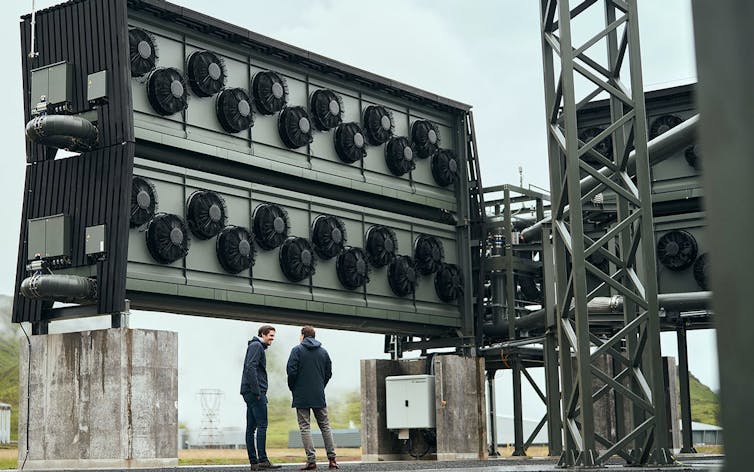
Carbon dioxide lingers in the atmosphere for decades to centuries, so just stopping emissions doesn’t stop its warming effect. Technology exists that can pull carbon dioxide out of the air and lock it away. It’s still only operating at a very small scale, but corporate agreements like Microsoft’s 10-year commitment to pay for carbon removed could help scale it up.
A report in 2018 by the Intergovernmental Panel on Climate Change determined that meeting the 1.5 C goal would require cutting carbon dioxide emissions by 50% globally by 2030 – plus significant negative emissions from both technology and natural sources by 2050 up to about half of present-day emissions.
A direct air capture project in Iceland stores captured carbon dioxide underground in basalt formations, where chemical reactions mineralize it. Climeworks Can we still hold warming to 1.5 C?
Since the Paris climate agreement was signed in 2015, countries have made some progress in their pledges to reduce emissions, but at a pace that is way too slow to keep warming below 1.5 C. Carbon dioxide emissions are still rising, as are carbon dioxide concentrations in the atmosphere.
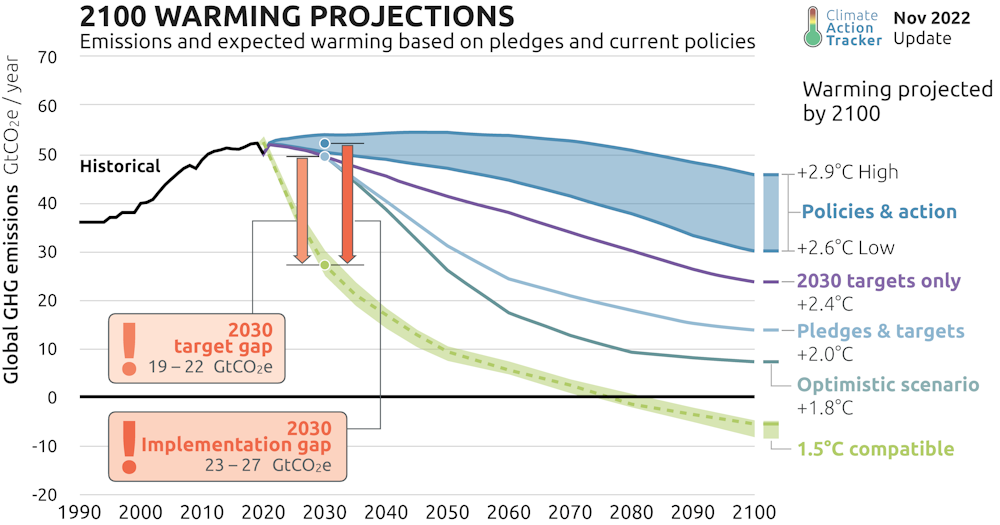
A recent report by the United Nations Environment Program highlights the shortfalls. The world is on track to produce 58 gigatons of carbon dioxide-equivalent greenhouse gas emissions in 2030 – more than twice where it should be for the path to 1.5 C. The result would be an average global temperature increase of 2.7 C (4.9 F) in this century, nearly double the 1.5 C target.
Given the gap between countries’ actual commitments and the emissions cuts required to keep temperatures to 1.5 C, it appears practically impossible to stay within the 1.5 C goal.
Global emissions aren’t close to plateauing, and with the amount of carbon dioxide already in the atmosphere, it is very likely that the world will reach the 1.5 C warming level within the next five to 10 years.
With current policies and pledges, the world will far exceed the 1.5 C goal. Climate Action Tracker How large the overshoot will be and for how long it will exist critically hinges on accelerating emissions cuts and scaling up negative emissions solutions, including carbon capture technology.
At this point, nothing short of an extraordinary and unprecedented effort to cut emissions will save the 1.5 C goal. We know what can be done – the question is whether people are ready for a radical and immediate change of the actions that lead to climate change, primarily a transformation away from a fossil fuel-based energy system.
Peter Schlosser, Vice President and Vice Provost of the Julie Ann Wrigley Global Futures Laboratory, Arizona State University
This article is republished from The Conversation under a Creative Commons license. Read the original article.
Climate change is relentless: Seemingly small shifts have big consequences
July 2021 was Earth’s hottest month on record and was marked by disasters, including extreme storms, floods and wildfires.
Thomas Lohnes via Getty ImagesKevin Trenberth, National Center for Atmospheric Research
Climate change has been accumulating slowly but relentlessly for decades. The changes might sound small when you hear about them – another tenth of a degree warmer, another centimeter of sea level rise – but seemingly small changes can have big effects on the world around us, especially regionally.
The problem is that while effects are small at any time, they accumulate. Those effects have now accumulated to the point where their influence is contributing to damaging heat waves, drought and rainfall extremes that can’t be ignored.
The most recent report from the United Nations’ Intergovernmental Panel on Climate Change is more emphatic than ever: Climate change, caused by human activities like burning fossil fuels, is having damaging effects on the climate as we know it, and those effects are rapidly getting worse.
Earth’s energy imbalance
An excellent example of how climate change accumulates is Earth’s energy imbalance. I am a climate scientist and have a new book on this about to be published by Cambridge University Press.
The Sun bombards Earth with a constant stream of about 173,600 terawatts (that is 12 zeros) of energy in the form of solar radiation. About 30% of that energy is reflected back into space by clouds and reflective surfaces, like ice and snow, leaving 122,100 terawatts to drive all the weather and climate systems around us, including the water cycle. Almost all of that energy cycles back to space – except for about 460 TW.
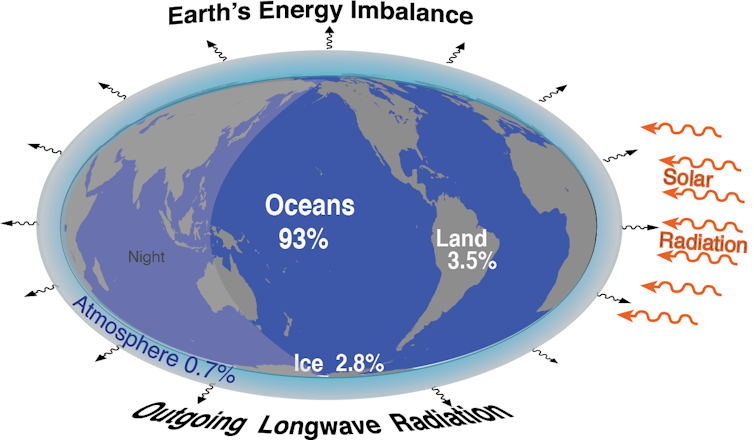
That remaining 460 TW is the problem we’re facing. That excess energy, trapped by greenhouse gases in the atmosphere, is heating up the planet. That is the Earth’s energy imbalance, or in other words, global warming.
Outgoing radiation is decreasing, owing to increasing greenhouse gases in the atmosphere, and leading to Earth’s energy imbalance of 460 terawatts. The percentage going into each domain is indicated.
Kevin Trenberth, CC BY-NDIn comparison with the natural flow of energy through the climate system, 460 TW seems small – it’s only a fraction of 1 percent. Consequently, we cannot go outside and feel the extra energy. But the heat accumulates, and it is now having consequences.
To put that in perspective, the total amount of electricity generated worldwide in 2018 was about 2.6 TW. If you look at all energy used around the world, including for heat, industry and vehicles, it’s about 19.5 TW. Earth’s energy imbalance is huge in comparison.
Interfering with the natural flow of energy through the climate system is where humans make their mark. By burning fossil fuels, cutting down forests and releasing greenhouse gases in other ways, humans are sending gases like carbon dioxide and methane into the atmosphere that trap more of that incoming energy rather than letting it radiate back out.
Before the first industries began burning large amounts of fossil fuels in the 1800s, the amount of carbon dioxide in the atmosphere was estimated at around 280 parts per million of volume. In 1958, when Dave Keeling began measuring atmospheric concentrations at Mauna Loa in Hawaii, that level was 310 parts per million. Today, those values have climbed to about 415 parts per million, a 48% increase.
Carbon dioxide is a greenhouse gas, and increased amounts cause heating. In this case, the human increment is not small.
Where does the extra energy go?
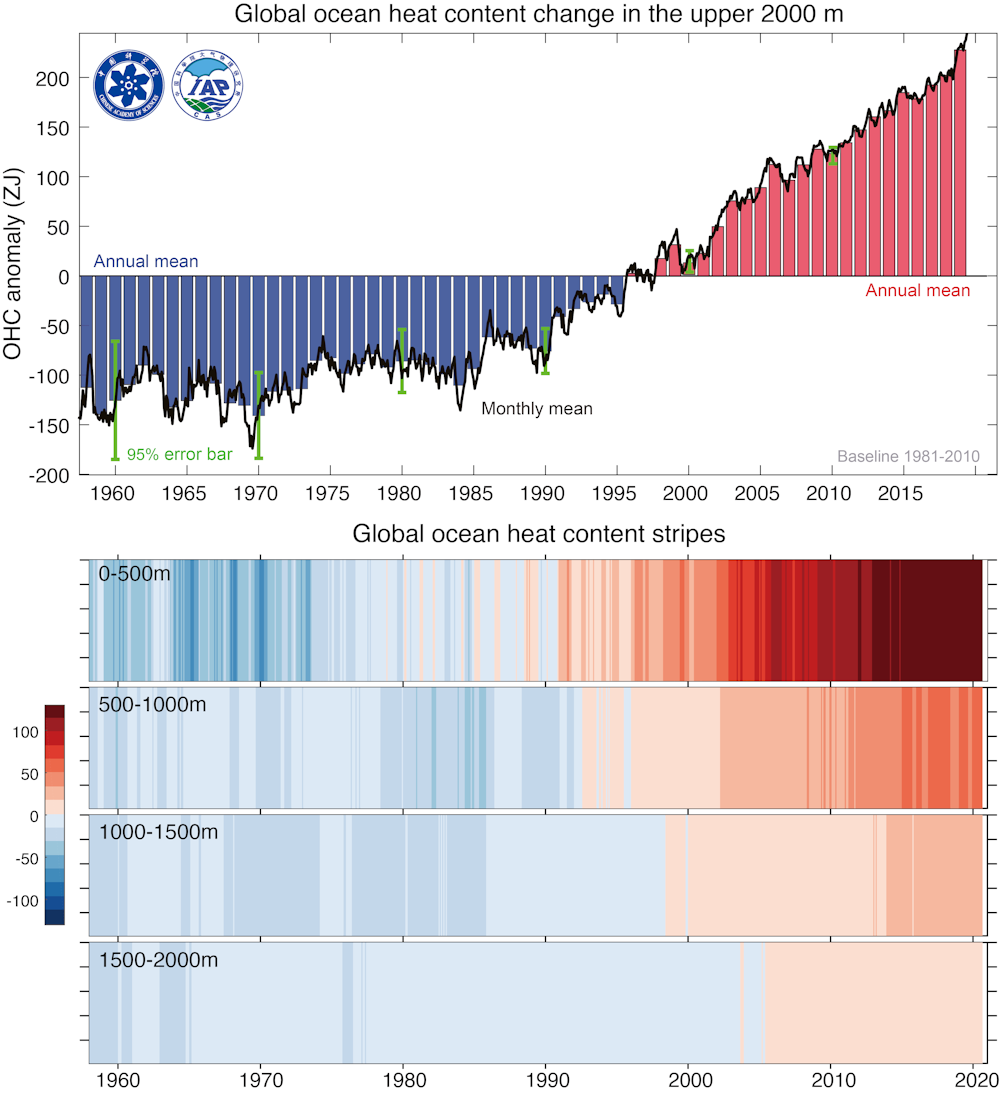
Measurements over time show that over 90% of this extra energy is going into the oceans, where it causes the water to expand and sea level to rise.
The upper layer of the oceans started warming around the 1970s. By the early 1990s, heat was reaching 500 to 1,000 meters (1,640 to 3,280 feet) deep. By 2005, it was heating the ocean below 1,500 meters (nearly 5,000 feet).
The average global temperature change at different ocean depths, in zetajoules, from 1958 to 2020. The top chart shows the upper 2,000 meters (6,561 feet) compared with the 1981-2010 average. The bottom shows the increase at different depths. Reds are warmer than average, blues are cooler.
Cheng et al, 2021, CC BY-NDGlobal sea level, measured by flights and satellites, was rising at a rate of about 3 millimeters per year from 1992 to 2012. Since then, it been increasing at about 4 millimeters a year. In 29 years, it has risen over 90 millimeters (3.5 inches).
If 3.5 inches doesn’t sound like much, talk to the coastal communities that exist a few feet above sea level. In some regions, these effects have led to chronic sunny day flooding during high tides, like Miami, San Francisco and Venice, Italy. Coastal storm surges are higher and much more destructive, especially from hurricanes. It’s an existential threat to some low-lying island nations and a growing expense for U.S. coastal cities.
Some of that extra energy, about 13 terawatts, goes into melting ice. Arctic sea ice in summer has decreased by over 40% since 1979. Some excess energy melts land ice, such as glaciers and permafrost on Greenland, Antarctica, which puts more water into the ocean and contributes to sea level rise.
Some energy penetrates into land, about 14 TW. But as long as land is wet, a lot of energy cycles into evapotranspiration – evaporation and transpiration in plants – which moistens the atmosphere and fuels weather systems. It is when there is a drought or during the dry season that effects accumulate on land, through drying and wilting of plants, raising temperatures and greatly increasing risk of heat waves and wildfire.
Consequences of more heat
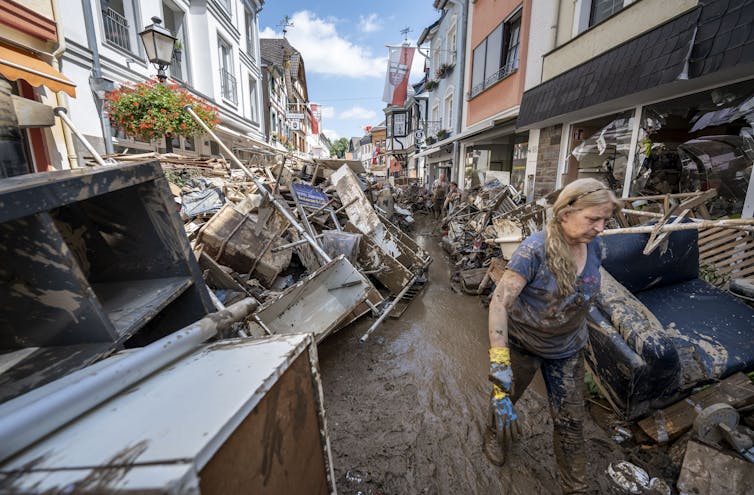
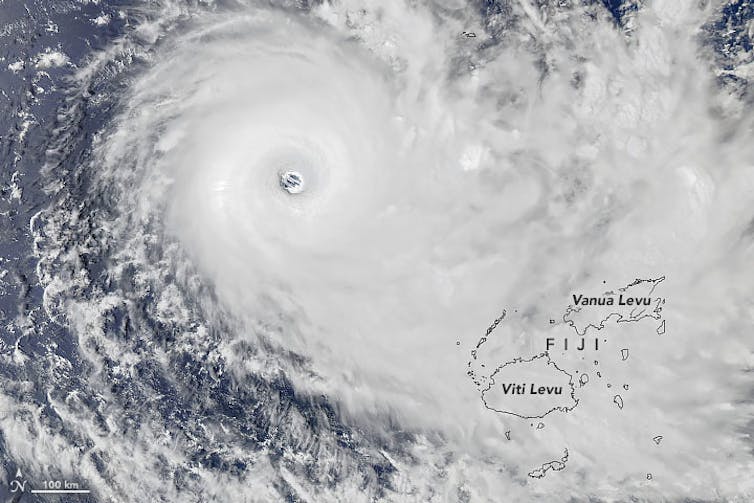
Over oceans, the extra heat provides a tremendous resource of moisture for the atmosphere. That becomes latent heat in storms that supersizes hurricanes and rainstorms, leading to flooding, as people in many parts of the world have experienced in recent months.
Air can contain about 4% more moisture for every 1 degree Fahrenheit (0.55 Celsius) increase in temperature, and air above the oceans is some 5% to 15% moister than it was prior to 1970. Hence, about a 10% increase in heavy rain results as storms gather the excess moisture.
Again, this may not sound like much, but that increase enlivens the updrafts and the storms, and then the storm lasts longer, so suddenly there is a 30% increase in the rainfall, as has been documented in several cases of major flooding.
Cyclone Yasa heads for Fiji in December 2020. It was the fourth most-intense tropical cyclone on record in the South Pacific.
NASA Earth ObservatoryIn Mediterranean climates, characterized by long, dry summers, such as in California, eastern Australia and around the Mediterranean, the wildfire risk grows, and fires can be readily triggered by natural sources, like dry lightning, or human causes.
Extreme events in weather have always occurred, but human influences are now pushing them outside their previous limits.
The straw that breaks the camel’s back syndrome
So, while all weather events are driven by natural influences, the impacts are greatly magnified by human-induced climate change. Hurricanes cross thresholds, levees break and floods run amok. Elsewhere, fires burn out of control, things break and people die.
I call it “The straw that breaks the camel’s back syndrome.” This is extreme nonlinearity, meaning the risks aren’t rising in a straight line – they’re rising much faster, and it confounds economists who have greatly underestimated the costs of human-induced climate change.
The result has been far too little action both in slowing and stopping the problems, and in planning for impacts and building resilience – despite years of warnings from scientists. The lack of adequate planning means we all suffer the consequences.
[The Conversation’s science, health and technology editors pick their favorite stories. Weekly on Wednesdays.]

Kevin Trenberth, Distinguished Scholar, National Center for Atmospheric Research
This article is republished from The Conversation under a Creative Commons license. Read the original article.
Just Stop Oil: Pair guilty of damaging Van Gogh painting’s frame
Image: sailko at https://commons.wikimedia.org, licensed under the Creative Commons Attribution-Share Alike 3.0 Unported https://www.bbc.com/news/uk-england-london-63717863
Two Just Stop Oil protesters have been found guilty of causing criminal damage to a Vincent Van Gogh painting’s frame after gluing themselves to it.
Louis McKechnie, 22, and Emily Brocklebank, 23, caused about £2,000 of damage to the frame of Peach Trees In Blossom at London’s Courtauld Gallery.
McKechnie was jailed for three weeks while Brocklebank received a suspended sentence.
She had said: “I didn’t think I would cause much damage. Glue comes off.”
…