Climate activists protest against US President Donald Trump’s state visit to Britain outside Windsor Castle, September 15, 2025 [Pic: Richard Bayfield]
‘A stain on our collective consciousness’
CLIMATE activists unfurled a banner calling US President Donald Trump a war criminal in the grounds of Windsor Castle ahead of a series of protests during his three-day state visit to Britain starting on Tuesday.
The sign showed a picture of President Trump with the words “Climate criminal. War criminal. The only place he’s welcome is The Hague.”
Campaigners from Fossil Free London chanted: “Climate criminal, war criminal, Trump’s not welcome here” as they drew attention to the “wannabe dictator’s” climate and foreign policy record today.
His second state visit to Britain has sparked calls for a large demonstration in London tomorrow, 2pm at Portland Place, organised by the Stop Trump Coalition.
Fossil Free London director Robin Wells said: “Genocide is unfolding. Seen on our phones through the faces of thousands of screaming children. Floods and fires across Europe get closer each day to our own front doors. But Trump claps and cheers for more.
Elon Musk urges you to be a Fascist like him, says that you can ignore facts and reality then.Donald Trump urges you to be a Climate Science denier like him. He says that he makes millions and millions for destroying the planet, Burn, Baby, Burn and Flood, Baby, Flood.
The price of eggs has more than doubled in the past eight years, which isn’t great, but at least you can eat eggs. The price of US government subsidies for the fossil-fuel industry has also more than doubled in that time, which is far, far less great. Welfare for an industry that makes billions of dollars in profits and pollutes the climate is worse than useless. It’s self-destructive.
The federal government gives oil, gas and coal producers at least $34.8 billion in subsidies each year, according to a new study by the research and advocacy nonprofit Oil Change International. In 2017, OCI estimated these gifts at $14.7 billion annually. This doubling in federal largesse has taken place under both Democratic and Republican political administrations, highlighting the difficulty of stopping its growth, much less reversing it.
In fact, some of the most recent extensions of federal aid have made it possible for these subsidies to explode in the future, threatening to reach trillions of dollars. When the world needs exponential growth in clean-energy investments to avoid the most catastrophic effects of global heating, the US government will be bankrolling fossil-fuel expansion and stoking the emergency.
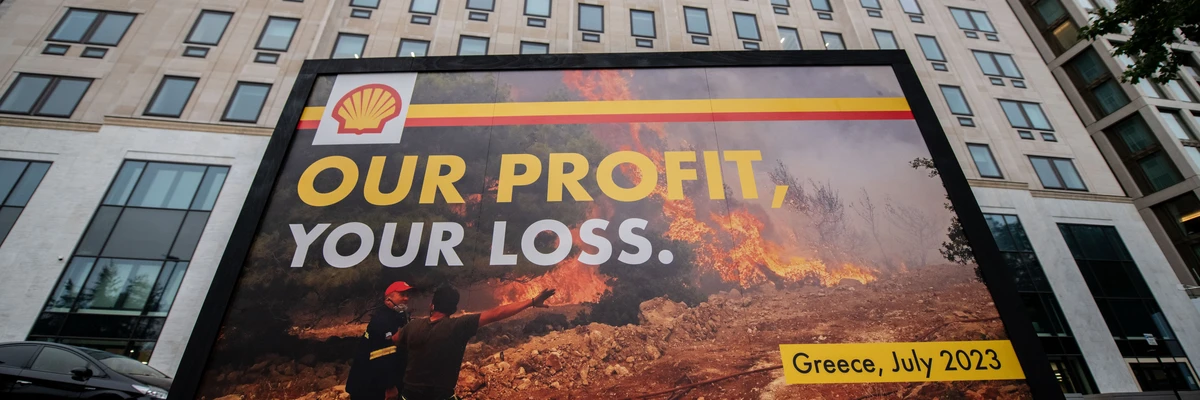
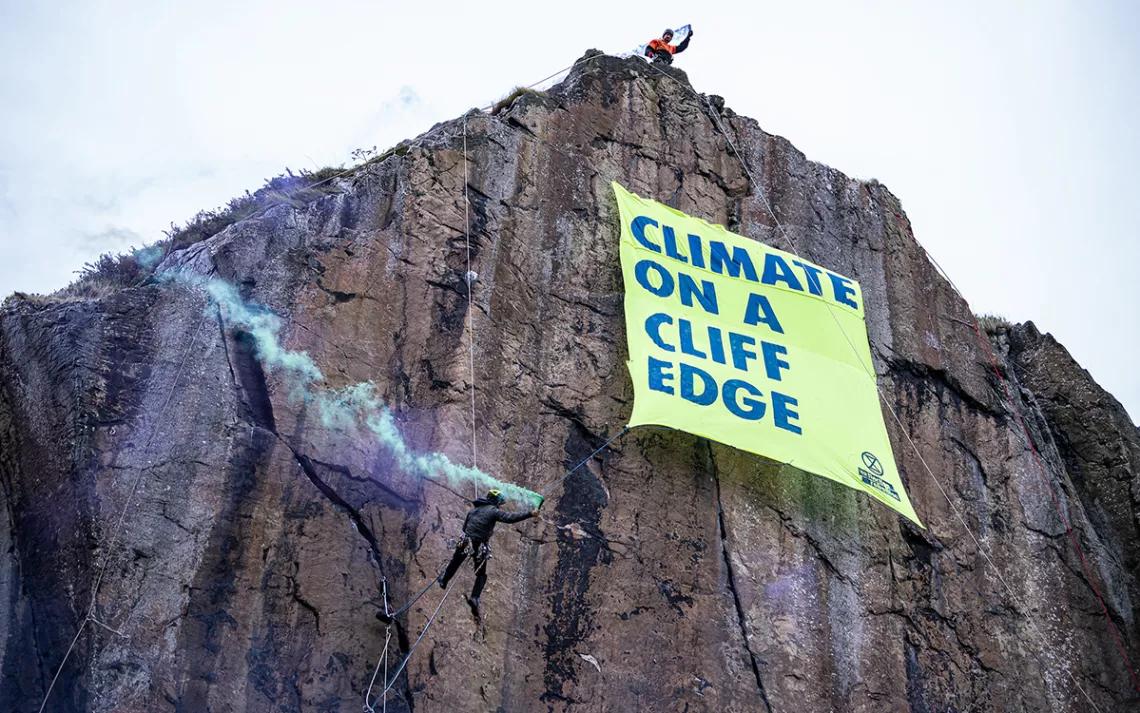
Donald Trump urges you to be a Climate Science denier like him. He says that he makes millions and millions for destroying the planet, Burn, Baby, Burn and Flood, Baby, Flood.Greenpeace activists display a billboard during a protest outside Shell headquarters on July 27, 2023 in London. (Photo: Handout/Chris J. Ratcliffe for Greenpeace via Getty Images)Experienced climbers scale a rock face near the historic Dumbarton castle in Glasgow, releasing a banner that reads “Climate on a Cliff Edge.” One activist, dressed as a globe, symbolically looms near the edge, while another plays the bagpipes on the shores below. | Photo courtesy of Extinction Rebellion and Mark Richards
Global warming linked to the world’s biggest oil and gas companies made all “major” 21st century heatwaves more intense and frequent.
This is according to new research, published in Nature, which uses “extreme event attribution” to assess the impact of climate change on all 21st-century heatwaves that were classified as “major disasters”.
The authors find one-quarter of the 213 heatwaves would have been “virtually impossible” without human-caused global warming.
They add that the effect of climate change on heatwave frequency and intensity is becoming more pronounced as the planet warms.
The study estimates the emissions stemming from the operations and production of more than 100 “carbon majors”, such as ExxonMobil, BP, Saudi Aramco and Shell.
The fossil fuels produced by these companies account for 60% of all human-caused CO2 emissions over 1850-2023, the study says.
The authors find that heatwaves recorded over 2000-23 were made, on average, 1.7C hotter due to climate change, with half of this increase due to the emissions originating from carbon majors.
This study “could be used to support future climate lawsuits and aid diplomatic negotiation”, according to a scientist not involved in the research.
The EM-DAT database catalogues all “major disasters” that have been reported since the year 1900 – defined as events that cause at least 10 fatalities, affect at least 100 people, or result in the declaration of state of emergency or a call for international assistance.
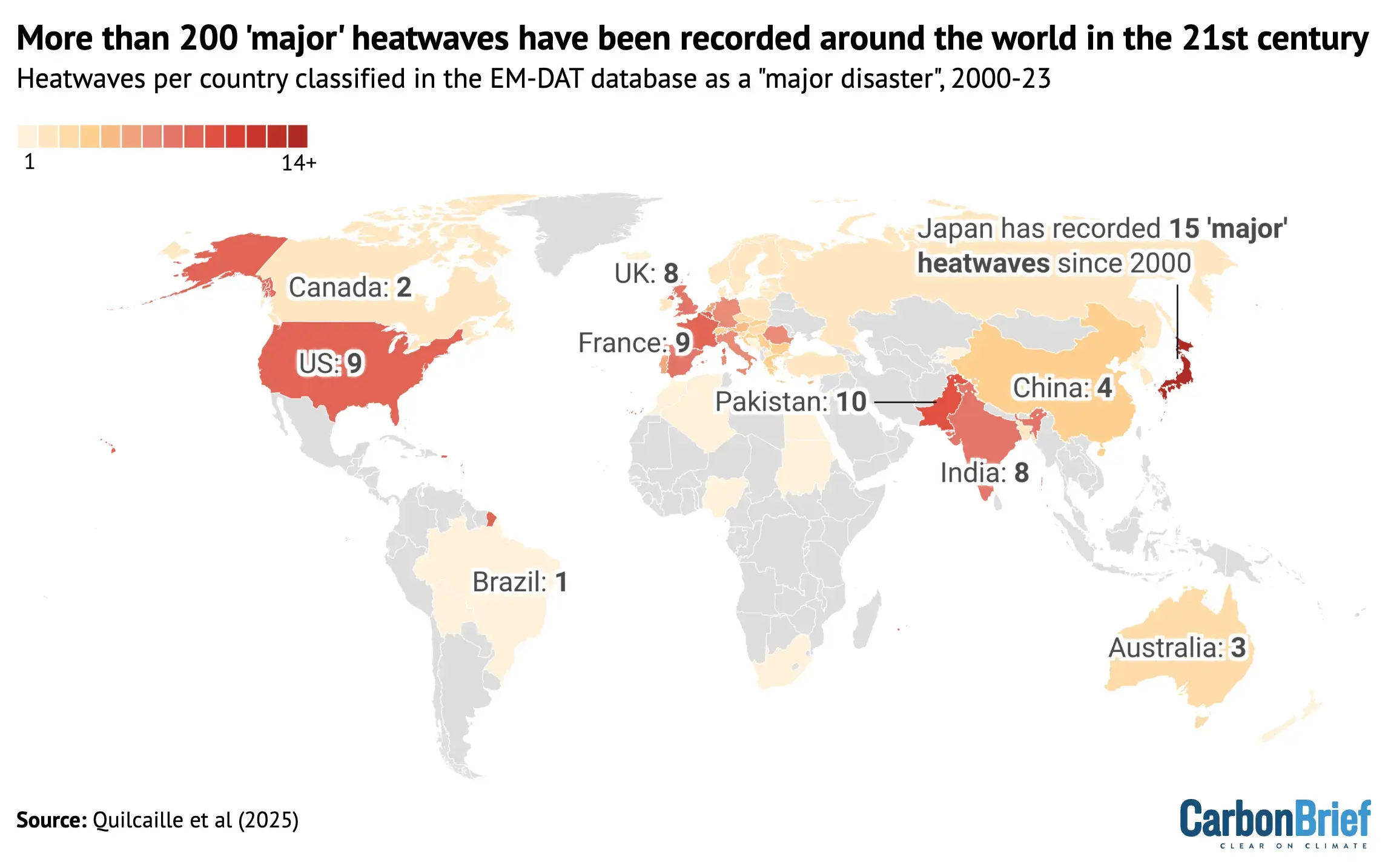
Between 2000 and 2023, the database lists more than 200 heatwaves. These are shown on the map below, where darker pink indicates a greater number of heatwaves. Countries with no reported heatwaves are shown in grey.
The map below shows the number of heatwaves per country recorded over 2000-23 on the EM-DAT database. Data: Quilcaille et al (2025).
The study authors acknowledge that heatwave reporting is “highly uneven”, with only nine of the heatwaves reported in the database since the year 2000 in Africa, Latin America or the Caribbean. (This is largely because extreme heat events in these regions are not routinely monitored.)
They then carried an attribution analysis on each heatwave to identify whether it was made more likely or intense due to human-caused climate change.
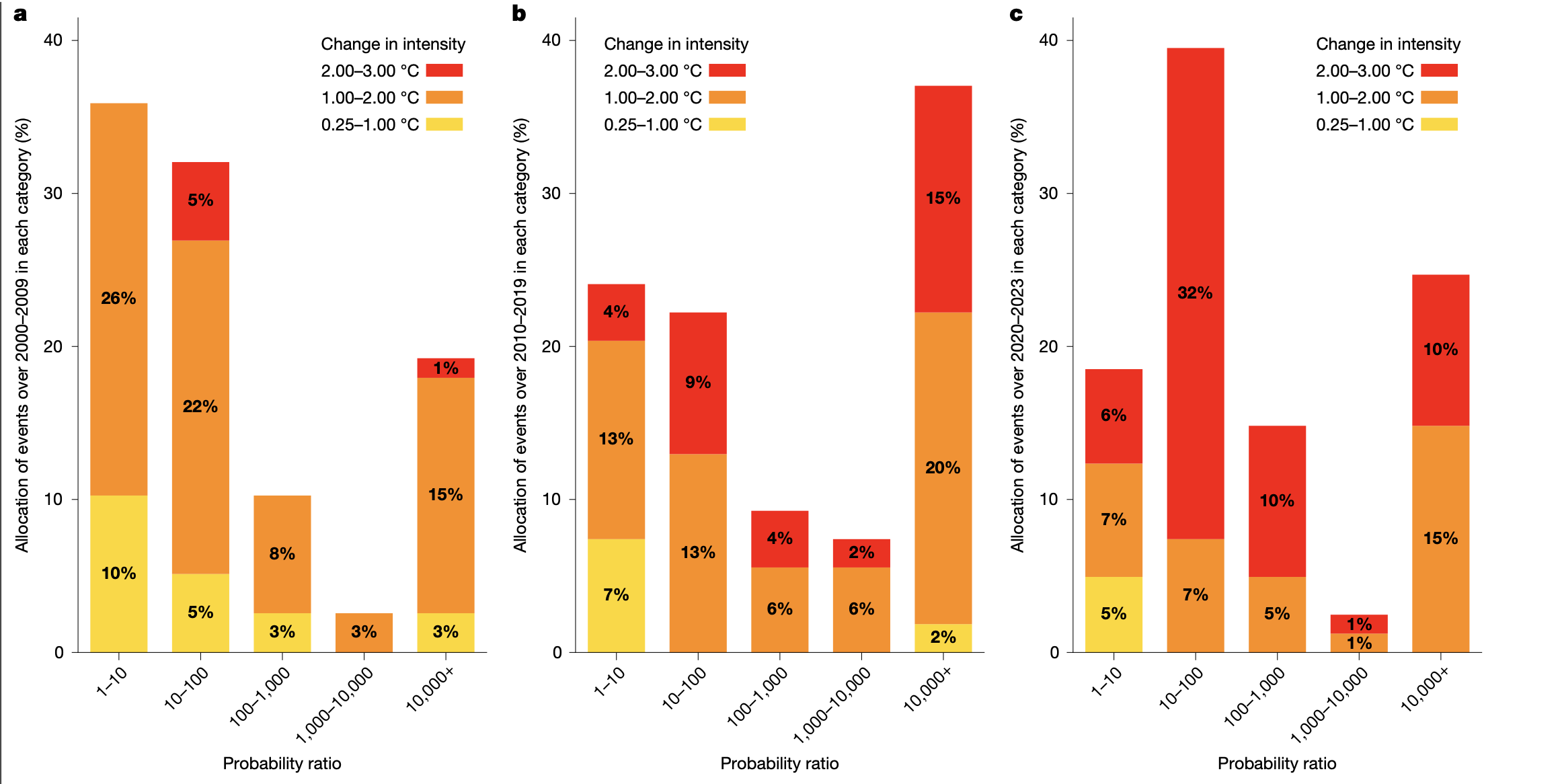
The chart below shows how climate changes increased the intensity and frequency of the 78 heatwaves assessed over 2000-09 (left), 54 heatwaves assessed over 2010-19 (middle) and 81 heatwaves assessed over 2020-23 (right).
The authors find that climate change increased the intensity and probability of all 213 heatwaves in the study. They add that the influence of climate change on heatwaves is strengthening over time.
In each panel, the bars show the percentage of heatwaves in that time period that were made 0.25-1.0C (yellow), 1.0-2.0C (orange) or 2.0-3.0C (red) hotter due to climate change.
The position of bars indicate the change in likelihood of the heatwaves. This ranges from those made 1-10 times more likely due to climate change (left-most bar in each panel) to those made more than 11,000 times more likely (right-most bar in each panel).
The extent to which climate changes increased the intensity and frequency of the 78 heatwaves assessed over 2000-09 (left), 54 heatwaves assessed over 2010-19 (middle) and 81 heatwaves assessed over 2020-23 (right). These are shown by colours and bar heights respectively. Source: Quilcaille et al (2025).
Heatwaves recorded over 2000-09 were, on average, 20 times more likely due to climate change, according to the authors. Meanwhile, those recorded over 2010-19 were about 200 times more likely.
Similarly, 2000-09 heatwaves were 1.4C hotter due to human-caused climate change on average, according to the study, while 2010-19 heatwaves were made 1.7C hotter.
The study finds that human-caused climate change made 55 heatwaves at least 10,000 times more likely. According to the authors, this is “equivalent to saying that they would have been virtually impossible” without the influence of human activity.
Carbon majors
To assess the contribution to heatwaves by oil and gas companies’ products, the authors use a database of carbon dioxide and methane emissions from 180 carbon majors over 1854-2023. This includes direct emissions from the companies, as well as the emissions released when the oil and gas they produced is used by others.
The 180 carbon majors in the database represent 60% of all human-caused CO2 emissions, including land use, over 1850-2023, according to the study. The paper adds that 14 companies, including ExxonMobil, BP, Saudi Aramco and Shell, are responsible for almost half of these emissions.
Using the Earth system model OSCAR, the authors estimate that global average surface temperatures increased by 1.3C between the 1850-1900 average and the year 2023.
They find that 0.7C of this increase was linked to the carbon majors, with 0.3C due to the emissions of the 14 largest.
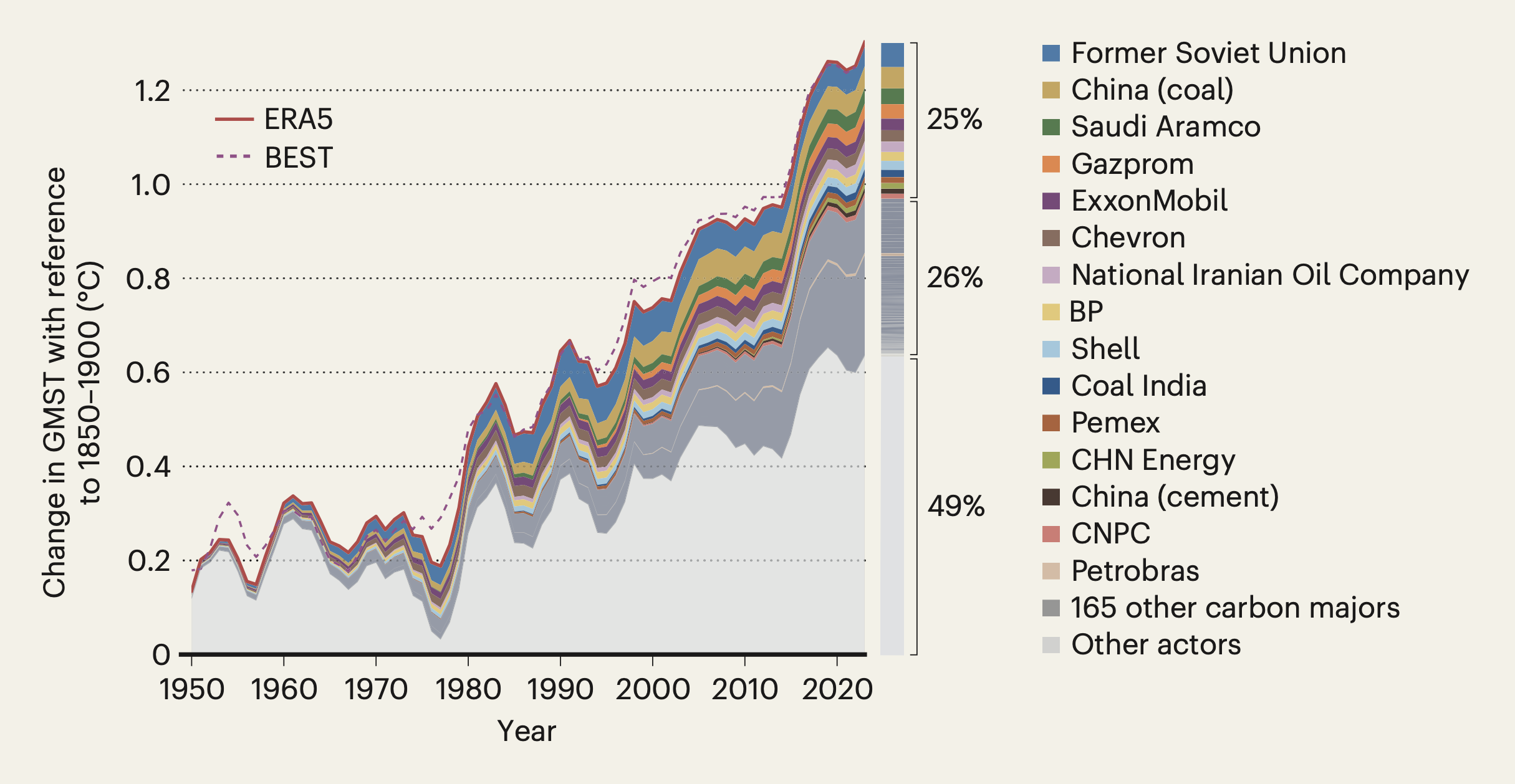
The chart below, taken from an accompanying Nature “news and views” article, shows the contribution of oil and gas companies’ products to increasing global average surface temperatures over 1950-2023, compared to the 1850-1900 average.
Each colour indicates a carbon major, while grey indicates other sources of temperature increase, such as land-use change.
The contribution of oil and gas companies to increasing global average surface temperatures over 1950-2023, compared to the 1850-1900 average. Each colour indicates a company, while grey indicates other sources of temperature increase. Source: Haustein (2025).
Heatwaves recorded over 2000-23 were, on average, 1.7C hotter due to climate change, according to the study. The authors find that emissions originating from carbon majors and their products contributed about half of the increase in intensity of heatwaves seen since pre-industrial times.
The authors then break down the contribution of emissions from each carbon major on each heatwave in their analysis.
For example, they find that the emissions linked to Saudi Aramco made 51 heatwaves at least 10,000 times more likely. They add that on average, emissions tied to the company made the 213 heatwaves 0.04C hotter.
Legal action
Attribution studies already play an important role in courts by providing evidence that helps judges to determine liability.
Dr Rupert Stuart-Smith is a research associate in climate science and the law at the University of Oxford’s Sustainable Law Programme. He was not involved in the study, but has published separate work showing that the emissions linked to each of the six largest corporate emitters cause one heat-related death in Zurich alone, every summer.
Stuart-Smith tells Carbon Brief that the new paper is a “high-quality analysis and a meaningful step forward for the field of climate change attribution”. He adds:
“With more and more lawsuits aiming to hold high-emitting companies responsible for their contributions to climate change impacts or compel state and corporate actors to reduce their emissions and prevent rising climate harms, work like this provides the basis for well-informed judicial decision-making.”
Dr Yann Quilcaille is a researcher at ETH Zürich and lead author of the study. He stresses the importance of attribution research for court cases, telling Carbon Brief that he hopes his work “can be used by legal practitioners”.
However, he also says that his role as a scientist is not to assign “responsibility” for climate change, but to “provide information to governments for decision making and to courts for litigation”.
Mankin tells Carbon Brief that the new paper is “very closely” linked to his research.
Callahan says the new paper is “an important contribution to an emerging literature that illustrates how individual emitters can be linked to the change risk of extreme climate conditions and human impacts”.
He explains that “this kind of evidence will be important in courtrooms – holding emitters legally accountable requires demonstrating a causal nexus between that emitter and a particularised harm suffered by a plaintiff”.
Attribution
The cutting-edge field of extreme weather attribution seeks to establish the role that human-caused warming played in these events. Attribution studies have been carried out on hundreds of heatwaves all around the world, as shown in Carbon Brief’s interactive map.
The new paper uses one of the earliest and most commonly used methods of attribution, called “probabilistic attribution”.
The authors first chose a temperature “threshold” to define their heatwave.
They then used a global climate model to simulate two worlds – one mirroring the world as it was during the heatwave and the other using the climate of 1850-1900. This second scenario is used to represent the climate in a world without human-caused climate change.
The authors run their models thousands of times in each scenario. As the world’s climate is inherently chaotic, each model “run” – individual simulations of how the climate progresses over many years – produces a slightly different progression of temperatures. This means that some runs simulate the heatwave, while others do not.
The authors count how many times the threshold temperature was in each model run. They then compared the likelihood of crossing the threshold temperature in the world with – and a world without – climate change.
For example, they find that the 2021 Pacific north-west heatwave was made 3.1C hotter due to human caused climate change and more than 10,000 times more likely.
(A study by the WWA at the time of the heatwave found that the heatwave was made 150 times more likely. The discrepancy is due to differences in the definition of the event, as well as its “very unlikely nature” according to the study authors.)
Dr Frederieke Otto is a professor at Imperial College London and founder of the WWA initiative. She tells Carbon Brief that the new study is “very similar to some other recent studies on impacts, based on the hazard attribution method used by WWA”, but says that “this is the most high profile and wide-reaching one”.
Otto adds:
“I do hope that many more impact attribution studies will follow, based on our or other extreme event attribution studies. We need more research on this.”
Donald Trump urges you to be a Climate Science denier like him. He says that he makes millions and millions for destroying the planet, Burn, Baby, Burn and Flood, Baby, Flood.Nigel Farage urges you to ignore facts and reality and be a climate science denier like him. He says that Reform UK has received millions and millions from the fossil fuel industry to promote climate denial and destroy the planet.Greenpeace activists display a billboard during a protest outside Shell headquarters on July 27, 2023 in London. (Photo: Handout/Chris J. Ratcliffe for Greenpeace via Getty Images)Experienced climbers scale a rock face near the historic Dumbarton castle in Glasgow, releasing a banner that reads “Climate on a Cliff Edge.” One activist, dressed as a globe, symbolically looms near the edge, while another plays the bagpipes on the shores below. | Photo courtesy of Extinction Rebellion and Mark Richards
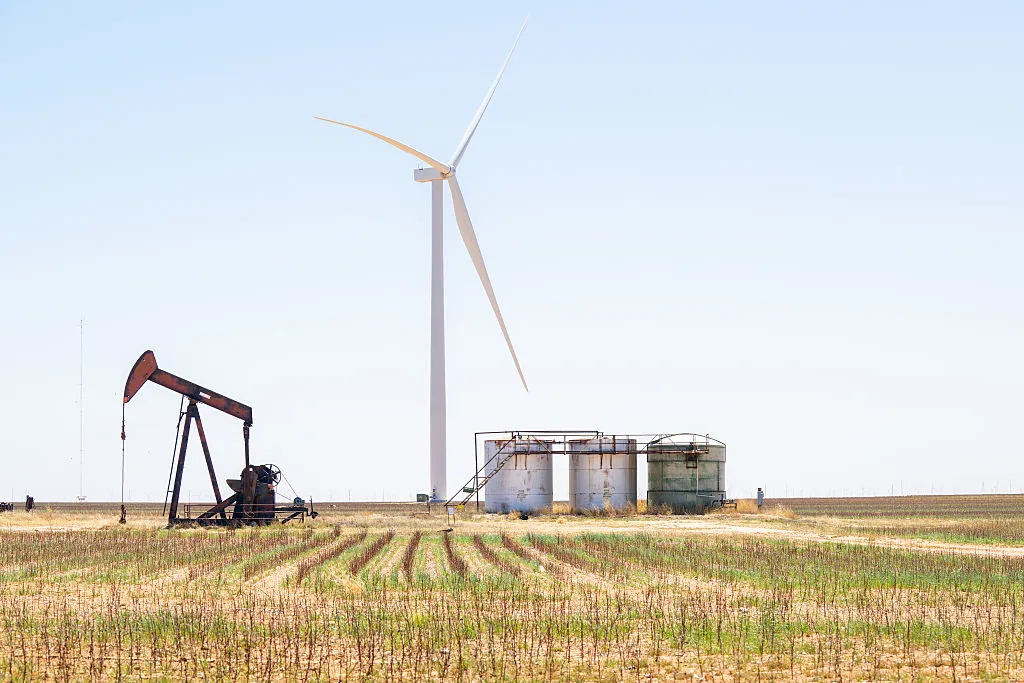
“We are going to get all our oil and gas out of the North Sea”, Conservative Party leader Kemi Badenoch said recently. Her promise to “maximise extraction” sets up a clash between political ambitions, economic reality and geological limits.
Reform UK has also said drilling for more oil and gas in the North Sea would be a “day one” priority. But even if the Conservatives or Reform were to be elected and lifted the current moratorium on new exploration licenses, there might not be the promised prizes of oil and gas under the seabed – or enough appetite from investors – to deliver on that promise.
BP, in those days British Petroleum, first extracted gas from under the North Sea in 1967. It marked the start of what was to become, for decades, one of the most valuable sectors of the UK economy, with more than 400 separate oil and gas fields developed to date.
But production peaked in 1999 and the North Sea now produces less than half as much as in its heyday.
It is now a “mature” basin: most of the biggest and easiest-to-develop fields have already been discovered and depleted. What remains are smaller, sometimes more remote, and often more technically challenging or expensive resources and reserves.
This is typical of ageing oil and gas provinces, where production declines even as operating costs rise. New projects must compete with oil and gas extracted from other parts of the world where it is easier and cheaper and more appealing to investors.
Finding oil and gas
Historically, only one in eight exploration wells in the North Sea led to a field producing oil and gas. That ratio has improved: between 2008 and 2017, a bit more than one in four wells led to a commercial success.
But far fewer wells are being drilled today. Even with the advances in technology, such as improved geophysical imaging which allows us to better define opportunities ahead of drilling, the big discoveries were probably made decades ago.
UK exploration wells vs offshore fields by year:
The number of exploration wells is down hugely from its peak in the 1980s and early 90s. Mark Ireland / NSTA
The UK government’s North Sea Transition Authority estimates there could still be around 3.5 billion barrels of oil equivalent in more than 400 undeveloped prospects. But most of these potential fields are small, isolated or technically complex. Developing them will require high oil and gas prices, fiscal stability, and a lot of investor confidence.
Politics vs geology
Even if a future government relaxes exploration licensing rules, geology will remain the bigger constraint. The North Sea is simply not as cheap as it was, and global fossil fuel giants have many other options. It is currently far cheaper to produce oil and gas in other regions, the Middle East or North Africa for example. Projects in these countries are all competing for the same capital.
Volatility in the energy sector will continue to make investors cautious. The 2015 oil price crash cut activity in the UK sector to its lowest level in decades, and it has never fully recovered. As fossil fuels are sold on the global market, political volatility, international and national, can lead to rapid shifts in investor confidence.
In the UK the introduction of a windfall tax in 2023 and changing requirements for environmental impact assessments are all making decision making on long-term projects riskier. And while the UK still needs considerable volumes of gas in future (and more modest amounts of oil) both are declining as our energy system evolves and renewable energy expand.
The UK’s mix of economic uncertainty, mature geology and smaller discoveries will make it harder to attract major international energy firms.
The future of the North Sea
That doesn’t mean the North Sea has finished as a source of oil and gas. For instance, undeveloped discoveries – where oil or gas has been confirmed but not yet produced – represent a lower-risk opportunity. But returns may be modest as many are relatively small and isolated from existing infrastructure.
New exploration licenses, if issued, might extend production modestly, but they are unlikely to deliver another game-changing discovery.
Some analysts argue that future licensing should be highly strategic, limited to projects with clear economic importance or climate compatibility. That approach could reduce reliance on imported gas, which tends to be more carbon-intensive than gas produced domestically. This would certainly make more sense than restarting fracking. But it would still not recreate the industry’s heyday.
Easy oil is over
The North Sea will still produce oil and gas for years to come, but its role will shrink. Even with friendlier policies, the era of big discoveries and rapid growth isn’t coming back.
Maximising extraction may sound appealing to politicians, but geology, economics and climate commitments all point to the North Sea’s best oil and gas days being behind it. The real challenge now is managing the investment during decline while investing in the cleaner solutions that will replace it.
UK Conservative Party leader Kemi ‘not a genocide’ Badenoch explains her reality that the Earth is flat, the Moon is made of cheese and that she was born from
Unicorn horn dust
German Chancellor Friedrich Merz, U.S. President Donald Trump, and French President Emmanuel Macron. DeSmog collage. Credit: Faces of the World / Flickr (Macron), Steffen Prößdorf (Merz), Gage Skidmore / Flickr (Trump)
European leaders are bending to the demands of U.S. climate science deniers.
“The CSDDD is the greatest threat to America’s sovereignty since the fall of the Soviet Union,” the Heartland Institute, a pro-Trump U.S. think tank, tweeted on 31 March.
The Heartland Institute is one of the world’s leading climate science denial groups. It has helped to draft Donald Trump’s anti-climate policies, which have seen the president pledge to “drill baby drill” for more fossil fuels and once again pull the U.S. out of the flagship 2015 Paris Agreement.
Over recent months – along with a host of other Trump allies – the Heartland Institute has set its sights on a new target: the EU’s Corporate Sustainability Due Diligence Directive (CSDDD).
This vague acronym belies the potentially transformative impact of the new law. In its original form, the CSDDD sought to require large companies – and those in “high risk” sectors – trading in the EU to address human rights and environmental issues in their own operations and in their supply chains. High turnover companies would also have been forced to adopt a plan to align with the Paris Agreement, including setting emissions reduction targets.
The Heartland Institute and its anti-climate, anti-regulation peers are vocal opponents of the law – and launched an aggressive campaign to water it down, or even to see it scrapped entirely.
These groups, which are all part of the ‘Make America Great Again’ (MAGA) ecosystem, view the CSDDD as symbolic of the way in which “woke” governments are attempting to force citizens and global corporations to conform to a pro-diversity, pro-environment agenda.
Following Trump’s election in November, these MAGA groups wasted no time in formulating their plans to oppose this perceived agenda.
They focused in particular on diversity, equity and inclusion (DEI) initiatives, which attempt to create workplaces free from bias – and environmental, social and governance (ESG) schemes, which try to ensure that organisations are guided by responsible and sustainable practices, not just profit.
In December, barely a month after Trump’s victory, the Heritage Foundation – the group that wrote the key ‘Project 2025’ blueprint for the president’s second term – published a report entitled: “ESG, DEI, and What to Do About Them”.
In the report, the Heritage Foundation described ESG and DEI as “pernicious”, and called the CSDDD “a serious problem”.
Two months later, the State Financial Officers Foundation – an influential network of Republican finance officials – wrote an open letter calling on the new administration to “investigate” the CSDDD, claiming that the EU’s directives are based on “unscientific assumptions about the nature of climate change impacts” and “will force companies to incriminate themselves”.
This quickly filtered through to Trump’s Cabinet. On 12 February, Howard Lutnick, the president’s pick for commerce secretary, told a Senate committee that the CSDDD threatened to place “significant burdens” on U.S. companies, and that the Trump administration was exploring the use of “commercial tools” to mount a counter-attack against the EU’s environmental regulations.
Soon this rhetoric made its way to the White House. In March, as part of the worldwide tariffs implemented by the Trump administration, the president called the EU “one of the most hostile and abusive taxing and tariffing authorities in the world”.
But the EU hasn’t stood firm in the face of Trump’s war of words.
The EU has already announced that it will be scaling back the CSDDD and delaying its implementation. The number of companies within scope has been reduced by 80 percent. The firms in question will only be required to file due diligence reports every five years, and won’t be required to investigate the ESG operations of their indirect business partners. The implementation of the law has also been postponed until 2028.
But Trump’s MAGA hardliners are still not satisfied. In April, the Heartland Institute released an open letter signed by 31 other groups, calling for Congress and the Trump administration to “take immediate steps to counter the CSDDD’s implementation”, including “if necessary, imposing retaliatory trade policies that punish EU nations for eroding America’s sovereignty, freedoms, and prosperity.”
This backlash is now influencing European leaders. In late May, French President Emmanuel Macron and German Chancellor Friedrich Merz called for the CSDDD to be scrapped entirely. They claim it must be abandoned in order to defend the “competitiveness” of European corporations, with Macron stating that Europe must “synchronise with the U.S. and the rest of the world.”
This judgement signifies the appeasement of anti-climate pressure groups that are ideologically opposed to clean energy and climate science.
The Heartland Institute has denied that humans are driving climate change, which it has called a “delusion”, while the Heritage Foundation’s Project 2025 document urged Trump to “dismantle the administrative state”, reverse policies on climate action, slash restrictions on fossil fuel extraction, scrap state investment in renewable energy, and gut the Environmental Protection Agency.
If the EU waters down its climate policies in response to Trump’s pressure, it will have helped to send Project 2025 global.
The ‘Climate Cartel’
It’s unclear whether these MAGA groups – and the Trump administration – will ease up on the EU if the CSDDD is ditched entirely. They may simply use it as evidence that European lawmakers will buckle under enough pressure.
Indeed, MAGA’s opposition to the CSDDD is part of a multi-pronged campaign that seeks to dismantle global climate initiatives pioneered by both governments and corporations.
Much of the original groundwork for this campaign was undertaken by the U.S. House Judiciary Committee and its chair Jim Jordan, a leading Trump supporter.
Last year, Jordan’s committee produced reports – and demanded evidence from major corporations – on a supposed “climate cartel” of “left-wing activists and major financial institutions”.
The committee alleged that some of the world’s biggest asset managers – that have questionable climate commitments – are conspiring to force American companies to decarbonise against their wishes.
As part of its “investigation”, the committee demanded information from more than 130 U.S.-based companies, retirement and pension programmes, as well as 60 U.S.-based asset managers.
In November, 11 Republican-led states sued BlackRock, Vanguard, and State Street – three of the world’s biggest asset managers – over their ESG policies. In West Virginia and Oklahoma, nearly two dozen banks have been barred from public contracts for trying to divest from fossil fuels.
These actions, along with the anti-climate rhetoric of Donald Trump, have had a chilling effect. In February last year, BlackRock, State Street, and JP Morgan Asset Management withdrew from Climate Action 100+, an investor-led initiative that works to ensure the world’s largest greenhouse gas emitters take action on climate change.
Fast forward a year, and a growing list of major U.S. corporations are either cancelling or delaying their sustainability reports – designed to show how they are meeting their climate commitments.
And a new story from the investigative outlet CORRECTIV today reports that German insurance giants and investment firms are withdrawing from climate agreements, while companies are quietly shelving their sustainability policies, amid the anti-ESG backlash orchestrated by Trump and his acolytes.
As one sustainability expert at a financial firm told CORRECTIV: “We have to be careful not to harm the cause by sticking our necks out and becoming a target in the U.S.”
This article was produced with support from the European Media and Information Fund, managed by the Calouste Gulbenkian Foundation. The sole responsibility for any content supported by the European Media and Information Fund lies with the author(s) and it may not necessarily reflect the positions of the EMIF and the Fund Partners, the Calouste Gulbenkian Foundation and the European University Institute.

 Climate activists protest against US President Donald Trump’s state visit to Britain outside Windsor Castle, September 15, 2025 [Pic: Richard Bayfield]