Kemi Badenoch is due to address the Scottish Tory conference in Edinburgh (Image: PA)
KEMI Badenoch’s call for an end to the windfall tax for fossil fuel firms and a ban on new oil and gas licences has been branded “out of touch”.
The Conservative leader is set to address her first Scottish branch office conference in Edinburgh on Friday and will speak about the oil and gas industry.
Scottish Tory leader Russell Findlay is set to address the party conference for the first time since taking over the role from Douglas Ross.
The energy profits levy, also known as the windfall tax, was brought in by the previous Tory government, and extended by Labour when they took power.
Badenoch is expected to tout the oil and gas sector during her conference speech, accusing the UK Government of “killing” it, claiming “renewing our party and our country means standing up for our oil and gas industry”.
UK Conservative Party leader Kemi ‘not a genocide’ Badenoch explains her reality that the Earth is flat, the Moon is made of cheese and that she was born from
Unicorn horn dust
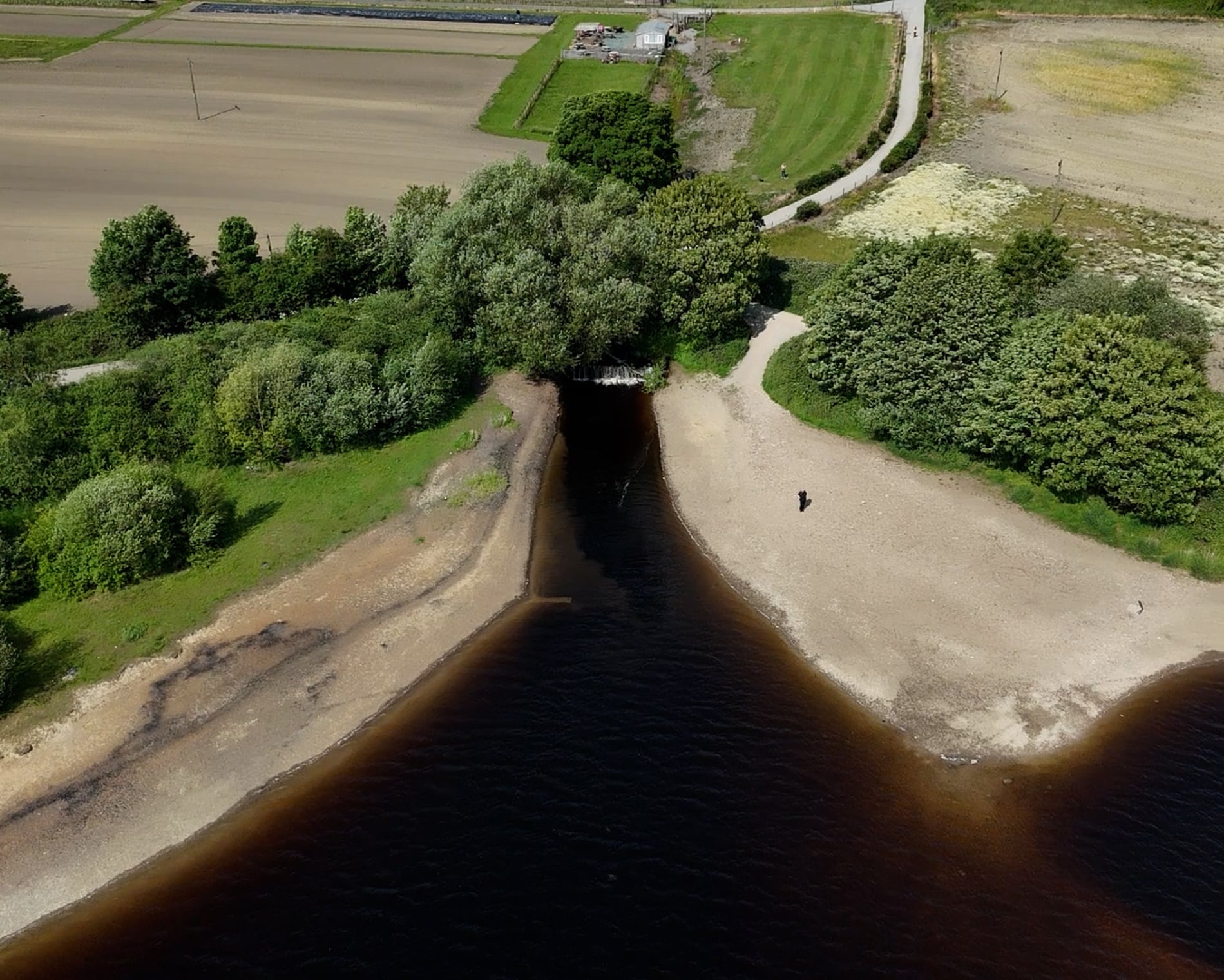
Ardsley reservoir near Wakefield, West Yorkshire. This year was Yorkshire’s warmest spring for mean temperature since records began in 1884. Photograph: Richard McCarthy/PA
Hosepipe bans possible as low reservoir levels make region second in England to enter drought status
Yorkshire has become the second area of England to enter drought after the country recorded its driest spring in 132 years.
Hosepipe bans could be possible if the region did not have significant rainfall in the coming weeks as, despite recent showers, reservoir stocks were continuing to dwindle. Yorkshire Water reservoir stocks dropped 0.51% over the last week to 62.3%, significantly below the average of 85.5% for this time of year.
Last month, north-west England entered drought status as reservoir levels fell to half their capacity. Much of the rest of the country is in prolonged dry status, which is the step before drought.
Warm and dry weather is forecast, and long-range forecasts suggest a greater-than-normal chance of a hot summer.
Met Office data shows Yorkshire recorded its warmest spring for mean temperature this year since records began in 1884.
…
Claire Barrow, the Environment Agency’s planning manager for Yorkshire, said: “Our climate is changing, and we had 22 days of almost no recorded rainfall in May.
“While we have had some rain at the start of June, it has not been enough to reverse the impacts of the prolonged dry weather.
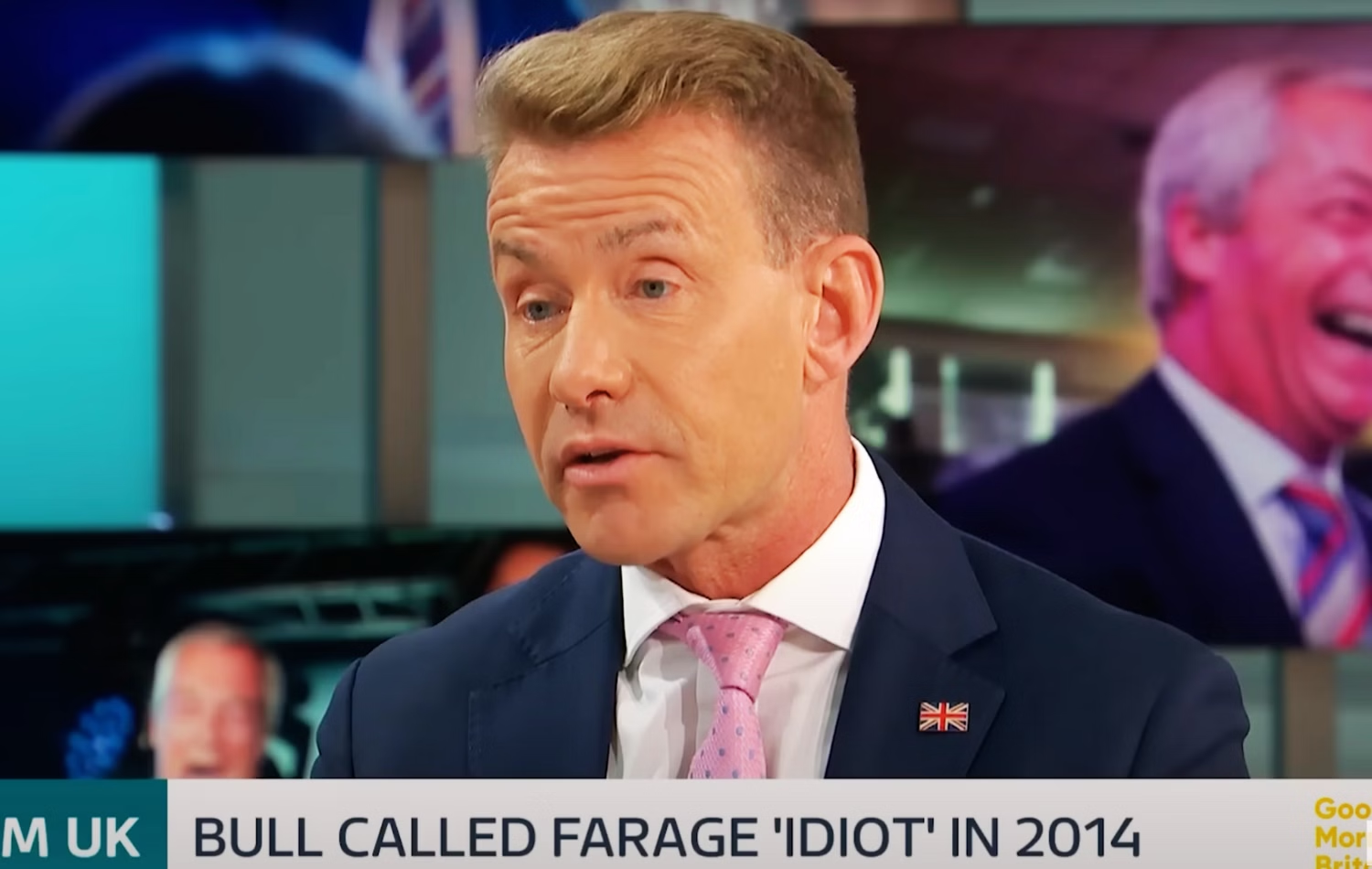
Reform UK chair David Bull[…]. Credit: Good Morning Britain / YouTube
Farage’s latest chairman is a TV presenter who has attacked climate “madness” and called for the ban on fracking to be lifted.
Reform UK’s new chairman has repeatedly attacked climate targets as “madness” and “a killer”, supported fracking, and falsely dismissed the role of carbon emissions on heatwaves.
David Bull, a TalkTV presenter and former doctor, was appointed as the chair of Nigel Farage’s right-wing populist party this week following the resignation of its previous chair Zia Yusuf.
Yusuf, a luxury lifestyle entrepreneur, said that working to achieve a Reform government was no longer a good use of his time, before returning two days later in a new role.
Bull is now loyal Farage supporter, despite having called the Reform leader a “dangerous, prejudiced idiot” in 2014. He was a member of the European Parliament in 2019 for the Brexit Party, the predecessor to Reform UK, and served as Reform’s deputy leader from March 2021 to July 2024.
In a series of social media posts, Bull has repeatedly attacked the UK’s target to cut carbon emissions to net zero by 2050, which climate scientists have said is needed to limit global warming to 1.5C.
On the eve of the 2024 general election, Bull posted on Elon Musk’s website X.com: “Net Zero is a killer. It’s killing British jobs, communities and the economy. Only Reform UK will scrap Net Zero.”
In reality, according to risk management experts the Institute and Faculty of Actuaries (IFoA), 50 percent could be wiped off the global economy between 2070 and 2090 if runaway temperature increases are not halted, while there could be more than 4 billion deaths.
In January of this year, he shared a Telegraph story about a lull in wind power and claimed that it made “a complete mockery” of Labour’s net zero chief Ed Miliband and his “religious obsession” with renewable energy.
As revealed by DeSmog, Reform’s constitution gives sweeping powers to its chairman, who cannot be formally sacked by the party leader.
Reform wants to scrap the UK’s net zero target entirely, stop subsidies for renewable energy, impose a “windfall tax” on wind and solar companies, approve new oil and gas extraction, and open new coal mines. The party’s leaders have also repeatedly made false statements about climate change.
As DeSmog has reported, Reform received £2.3 million between the 2019 and 2024 general elections from climate deniers, fossil fuel investors, and polluting interests. It is also openly seeking donations from oil executives.
David Bull’s Climate Stance
In May 2023, Bull hosted a TalkTV segment called “the madness of net zero”. He began by saying: “I think all of us feel that the climate is changing and that we want to go to net zero”. This is out of step with Reform’s position, and the title of his segment.
But he went on to claim, of the UK’s record heatwave the previous summer, “we don’t know whether that is a result of man-made emissions”.
In the same segment, Bull suggested net zero was “subjecting people in this country to become poorer”. In reality, according to the Confederation of British Industry (CBI), the UK’s net zero economy grew by 10 percent in 2024, employing almost a million people in full-time jobs with an average wage of £43,000 – £5,600 higher than the national average.
In October 2021, Bull endorsed a campaign by climate denial pressure group CAR26 for a Brexit-style referendum on net zero, and shared a poll commissioned by the group, adding: “We absolutely MUST have a referendum on the Government’s net zero policy. Retweet if you agree.”
CAR26 director Lois Perry now runs the UK-EU branch of the Heartland Institute, a notorious U.S. climate denial think tank. The UK-EU branch was launched in December by Reform’s leader Farage.
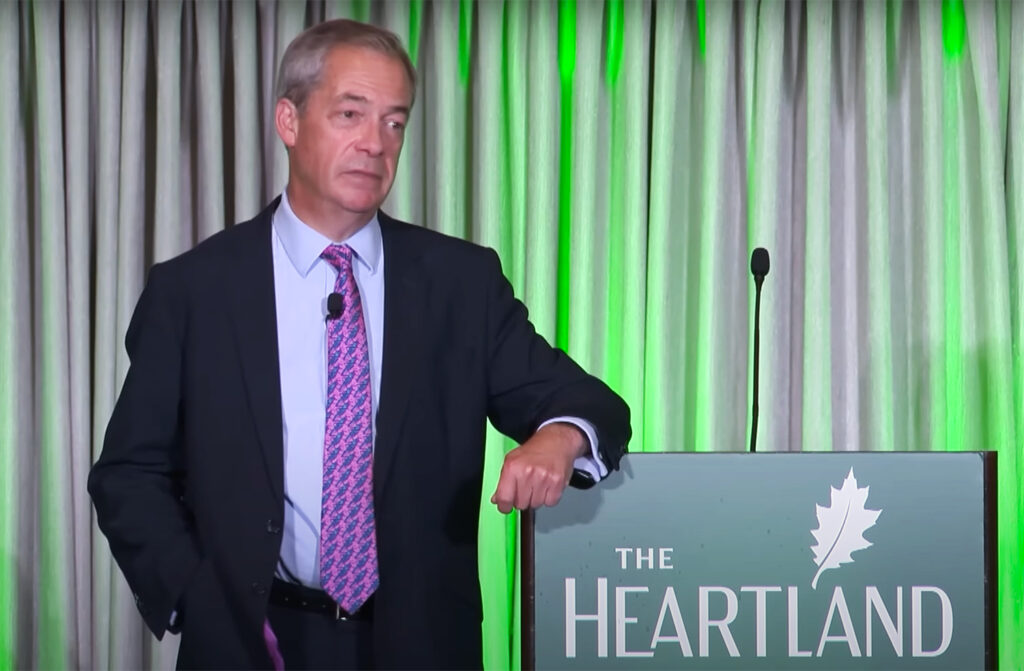
Reform UK leader Nigel Farage speaking at the Heartland Institute’s 40th anniversary fundraiser in September 2024. Credit: Heartland Institute / YouTube
In November 2021, while the UK hosted the flagship UN COP26 climate summit, Bull attacked what he called “the hypocrisy of COP26”. He told TalkTV: “It is obscene. The hypocrisy that they [world leaders] fly in on private jets. People are sick and tired of being told what to do.”
In April 2022, Bull posted on X.com predicting that “Net Zero will be the new Brexit. It will be the most defining issue at the next general election”. Despite Reform’s best efforts, the pro-net zero Labour Party won a historically large majority.
Bull has also supported overturning the UK’s ban on fracking for shale gas.
In October 2022, when prime minister Rishi Sunak reversed the decision by his predecessor Liz Truss to lift the ban, Bull posted: “MASSIVE MISTAKE. We need cheap energy NOW. Fracking has allowed the US to have 100-200 years of cheap energy.”
Aside from the pollution caused by burning shale gas, fracking is environmentally controversial due to its triggering of earth tremors, and the vast amount of water that it uses. The House of Commons Environmental Audit Committee – a body of MPs that advises the government on climate matters – concluded in 2019 that fracking was incompatible with the UK’s climate goals.
TalkTV was launched in 2022 by Rupert Murdoch’s News UK as a rival to GB News, but in 2024 it switched to an online streaming service.
As DeSmog has reported, TalkTV presenters have frequently attacked climate action. In the COP26 segment, Bull was interviewed by fellow TalkTV host Mike Graham, who has declared on social media that “climate change is a load of old bollocks”.
Bull has resigned as a TalkTV presenter, following his appointment as Reform’s chair.
Nigel Farage reminds you that he’s the man that brought you Brexit and asks what could possibly go wrong.Nigel Farage explains the politics of Reform UK: Racism, Fake anti-establishmentism, Deregulation, Corporatism, Climate Change Denial, Mysogyny and Transphobia.
Nigel Farage speaks during a press conference on May 27, 2025 in London, England. | Dan Kitwood / Getty Images
Nigel Farage says his party is a break from the political establishment. That claim doesn’t match up with its donors
Reform has received almost £5m from wealthy donors since 2023, including those with links to fossil fuels, the financial services industry and tax havens, openDemocracy can reveal.
Nigel Farage’s party received around £1.5m in large donations in the first quarter of this year – far less than the £3.3m given to the Conservatives and £2.3m to Labour – according to our analysis of Electoral Commission data published this week.
The figures are likely particularly disappointing for Reform’s leadership, which has boasted of a major fundraising drive this year, as they don’t include a further £1m that the Tories reportedly received in recent weeks from software and gaming entrepreneur Jeremy San.
But what does the £4.8m of donations tell us about Reform’s aims, especially if it were to win office at the next general election? openDemocracy analysed the past 18 months of donations data to shed light on who is donating to the party – and where their interests lie.
Our findings reveal that, despite claiming to represent a break with the current political establishment, Reform is largely funded by ex-Tory donors, who account for around a quarter of the £4.8m it has received in large donations (only those who give £11,180 or more in a year need to be declared to the Electoral Commission) since 2023.
We also found that Reform has an unusually high number of overseas backers with links to tax havens, which the party has publicly stated is part of its fundraising strategy.
While the party previously criticised Labour’s £4m donation from a Cayman Islands-controlled hedge fund, which openDemocracy revealed last year, more than 10% of its total donations are from sources with strong offshore ties.
How much has Reform raised?
Reform looks set to receive more money in large donations in 2025 than it did last year. The party took £1.5m in Q1, compared to £3m in all of 2024. (The latter figure has been misreported as £4.75m, due to double-counting of donations made during the election period, which are listed twice on the Electoral Commission’s website.)
Farage’s party has sought to frame itself as an alternative to the political status quo of the Conservatives and Labour, yet this is at odds with its wealthy funders, many of whom are longtime political donors and paid-up members of the elite.
Commercial interests in regulated sectors such as energy and financial services are overrepresented among both the established political donors and the first-time donors that Reform has attracted.
As well as this cash from rich donors, Reform has likely raised a significant amount of money through its membership, which party figures say has been the main source of funding over the last year or so.
While Reform declined to provide details of its funding through membership and small donations, its own website says it has more than 233,000 members at the time of writing. If accurate, this would generate between £2.3m and £5.8m a year for the party, whose annual membership costs £25 or £10 for under-25s.
It is important in understanding Reform to note this element of its support, particularly at a time when Labour and the Conservative memberships are thought to be dropping significantly.
The estimated figures suggest that Reform’s claims of being driven by a grassroots movement are true, though so are claims from the party’s opponents that it is taking millions of pounds from the ultra-rich.
Who has donated to Reform?
More than half the £4.8m given to Reform since 2023 comes from people in its inner circle.
The party’s biggest donor is Richard Tice MP, its deputy leader, who has put more than £1m into its coffers, while Zia Yusuf, who spectacularly quit as party chair last week in a row over a burqa ban only to rejoin two days later in a similar role, has chipped in £206,000.
Holly Vukadinovic, better known as Holly Valance, who is married to the party’s main fundraiser, Nick Candy, has also given £50,000.
After Tice, the party’s top donor is Fiona Cottrell, an aristocratic socialite who once reportedly dated the King, who has given £750,000. Though she isn’t directly tied to the party, her son George Cottrell – nicknamed ‘Posh George’ – is a longtime associate of Farage and ran fundraising for his previous political party, UKIP, as a teenager.
George is today understood to be a close aide to Farage and, despite having no official role in the party, was last spotted alongside the Reform leader at a press conference this week. He is believed to live between the UK and Montenegro, where he has a number of business interests, including in cryptoassets.
Following Sarah Pochin’s election in May, Reform now has five sitting MPs again. Rupert Lowe, originally elected as a Reform MP, now sits as an independent having lost the party whip | Carl Court / Getty Images
As openDemocracy has reported, George recently set up opaque corporate entities in the UK and the US, which his lawyers told us will be political consulting firms.
Although George has not given money directly to Reform, he has funded trips for Farage to Belgium and the US worth around £25,000. Electoral rules state that an individual must be registered to vote in the UK – including as an overseas voter – in order to donate directly to political parties, but anyone can pay the “reasonable costs of a visit outside the UK”.
As the party has grown in influence, it has attracted the backing of many donors with a history of financially backing right-wing political projects. The majority previously gave money to the Conservative Party, but some have funded Farage’s former parties and the hard-right Reclaim Party, which is fronted by actor Laurence Fox.
David Lilley, who gave £274,000 to Reform, is a veteran hedge fund boss who co-founded Redwood Kite Capital alongside Tory peer Lord Michael Farmer. Both Red Kite and his current firm, Drakewood Capital Management, focus on mining and metals trading.
First Corporate Consultants, a think tank that has given Reform £200,000, is owned by Terence Mordaunt, former chair of the opaque think tank Global Warming Policy Foundation (GWPF) which campaigns as Net Zero Watch. openDemocracy revealed in 2022 that the GWFP has been funded by an oil-rich foundation with huge investments in energy firms.
We have also previously uncovered significant interests in fossil fuels held by Jeremy Hosking, who has given Reform £140,000 and whose fund, Hosking Partners, has tens of millions invested in oil firms and the wider fossil fuel sector. Hosking has poured millions into the UK right in the last decade, including backing Vote Leave to the tune of millions and more recently funding the Reclaim Party and The Critic, a conservative political and cultural magazine.
Nick Candy, a property mogul and former Tory donor who is now in charge of leading Reform’s fundraising efforts, has publicly stated that his strategy is to court ultra-wealthy donors in low-tax jurisdictions around the world with ties to the UK.
This plan only got underway in earnest toward the start of this year and any donations made in recent months are yet to be published. But Reform already has several confirmed donors resident in Monaco, according to corporate filings.
All in all, around £600,000 came from individuals and organisations either resident in perceived tax havens, or controlled via them. They include Roger Nagioff (£100,000), a former Lehman Bros executive now resident in Monaco according to corporate filings, and Luxembourg-based brokerage firm JB Drax Honore (£50,000), which donated through its UK subsidiary.
Some of Reform’s biggest donors, including Malcolm Robinson (£160,000) and Duncan Mackay (£100,000), have not yet been publicly identified.
Political parties have no obligation to publish any information about their donors other than names and details of the donation, and an unavoidable quirk of these donor transparency rules is that individuals with uncommon names are subject to greater scrutiny than those with common names, because they are easier to identify.
Jeremy Hosking was a major funder of the Brexit campaign and has backed a number of right-wing causes in the years since | Jack Taylor / Getty Images
openDemocracy asked Reform to provide a brief biography for several donors who have given more than £50,000 but are yet to be publicly identified, including Robinson and Mackay, but the party did not respond.
However, openDemocracy can reveal that Simon William Smith, who has given the party £58,000, is an ‘angel investor’ with significant interests in cryptocurrency and related technologies. Reform has pledged to deregulate crypto and reduce tax on capital gains made on it.
Reform has also attracted many first-time donors to its cause, with around a quarter of large donations during this period coming from people or organisations with no apparent history of donating to political parties.
Among them are people with a varied range of commercial interests and professional backgrounds. They range from a former BlackRock executive to a company specialising in stage lighting electronics. Some of these donors control companies providing services to local authorities, including in the social care sector, while another donor has previously spoken out about the impact of small boat crossings on his haulage firm.
Overall, though the interests of the party’s wealthy backers are varied, there are common themes and a clear relationship between their political and commercial interests and Reform’s platform. Many stand to benefit significantly from an anti-net zero push, cutting back regulation in finance or energy, lower taxes on wealth and the liberalisation of cryptoassets.
Billionaire backing
While some of the funders from the UKIP and Brexit Party phases of Farage’s political life are now Reform donors, there is currently one notable absentee.
Christopher Harborne is a British billionaire with interests primarily in the fuel and aviation sectors and cryptocurrency. Though much was made of a potential massive donation from Elon Musk to Reform, in Harborne, the party already seemingly has the support of an eccentric tech billionaire who has form for seriously altering the course of British politics with huge donations.
Over a couple of years, Harborne gave Farage’s Brexit Party millions, becoming one of the largest British political donors in the modern era. He also gave Boris Johnson £1m around the time his government started talking up the crypto industry.
While Harborne has yet to put money directly into Reform in its current form, he has funded trips to the US for Farage. As he has active links to both the UK and Thailand (where he has adopted the name Chakrit Sakunkrit), it is not clear whether he is eligible to donate directly to the party, though he does control trading UK companies, which would be able to donate.
Reform also arguably receives significant backing from another major backer of right-wing UK causes: GB News. If payments that the television channel made to Reform MPs for TV gigs were classed as political donations rather than individual earnings, GB News would have been Reform’s second-largest external donor since the start of 2023, giving around £490k. Most of that cash went to Farage, but another of the party’s MPs, former Tory Lee Anderson, is paid £100,000 per year to host a regular show on the channel.
Nigel Farage reminds you that he’s the man that brought you Brexit and asks what could possibly go wrong.Nigel Farage explains the politics of Reform UK: Racism, Fake anti-establishmentism, Deregulation, Corporatism, Climate Change Denial, Mysogyny and Transphobia.
The UK government will soon face a momentous decision over whether to approve production in the Rosebank oilfield off the coast of Shetland.
Rosebank is the UK’s biggest undeveloped field. Its proponents – the largest of which is Norwegian state-owned petroleum company, Equinor – estimate that it will produce the equivalent of up to 500 million barrels of oil between 2026 and 2051. When burned, this oil will generate up to 200 million tonnes of carbon dioxide, which is more than the combined annual emissions of 28 low-income countries.
Thanks to recent courtcases, the climate effects of those “combustion emissions” will need to be taken into account by the government when it decides whether to approve production at Rosebank. In a new report, two colleagues and I reviewed the evidence concerning the implications of new oil and gas fields in the UK.
Get your news from actual experts, straight to your inbox.Sign up to our daily newsletter to receive all The Conversation UK’s latest coverage of news and research, from politics and business to the arts and sciences.
There is a rapidly dwindling global carbon budget for holding temperature increases to below 1.5°C of warming (the more conservative end of the Paris agreement’s temperature goal).
Globally, the emissions from burning the fossil fuels in oil and gas fields and coalmines that are already operating or under development far exceed that budget. In this context, Rosebank’s combustion emissions are highly significant, as they add considerably to that excess.
We also found that the projected production from existing fields is sufficient to meet or exceed global oil and gas demand in modelled economic scenarios in which climate warming is restrained to within 1.5°C. This is further evidence that new fields are not consistent with achieving globally agreed temperature goals.
However, it is often asserted by supporters of new fields that keeping UK oil in the ground won’t reduce global emissions, because another producer will supply the demand and reap the benefits. This is a gross and dangerous oversimplification which, according to the United Nations Environment Programme, “defies basic economics of supply and demand”.
Allowing a new field like Rosebank would increase the supply of oil globally, resulting in a fall in its price which, though small, would cause more oil to be consumed. As UK government advisers at the Climate Change Committee have acknowledged, new petroleum projects “support a larger global market overall” for petroleum. Stopping Rosebank would have the opposite effect, and lead to less oil consumed.
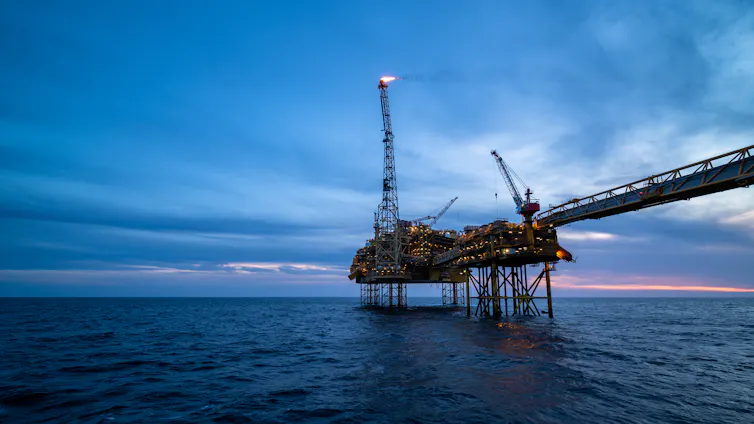
Rosebank is found about 80 miles west of Shetland and its puffins. Philippe Clement / shutterstock
The oil industry likes to trumpet the UK’s relatively low upstream emissions – that is, from the process of extracting oil – compared with those of competitors overseas. But this is a distraction from the bigger issue: the additional greenhouse gases emitted from consuming the extra oil that new fields produce.
A recent peer-reviewed study by economists and experts in the emissions-intensity of oil and gas production concluded that limiting oil supply will almost always lead to lower overall emissions, regardless of the intensity of upstream emissions from different fields. It is highly likely that leaving Rosebank’s oil in the ground will result in lower global greenhouse gases than would occur if the field were developed.
However, this focus on Rosebank’s aggregate emissions ignores two further reasons the field’s development consent should be refused on climate grounds.
A litmus test of climate leadership
First, exploiting new sources of oil supply like Rosebank locks in future oil and gas production, ultimately making it economically, politically and legally harder to wind the industry down.
Second, as the Climate Change Committee also stated, decisions by the UK government concerning petroleum production have an important “signalling effect” internationally and at home.
Internationally, the UK government has rightly acknowledged that climate action “must be accelerated drastically” to keep the average global temperature rise “below 1.5°C”.
The UK has a proud reputation for climate leadership. It was the first country to enact a legally binding framework to reduce greenhouse gas emissions, it rapidly phased out coal-fired power generation, and in 2019 it became the first country to adopt a net zero emissions target.
Building on this legacy, the foreign secretary David Lammy has vowed to “push for the ambition needed to keep 1.5 degrees alive”. But approving Rosebank would signal to the world that the UK government is not sincere about keeping the Paris agreement’s 1.5°C goal “alive”, after all.
Some might think that aspirations to climate leadership are futile given the Trump administration’s “drill, baby, drill” approach to fossil fuels. But Trump’s recklessness at a critical time for global climate efforts makes UK climate leadership more important than ever.
The UK already chairs a suite of international energy transition alliances focused on the international phase-out of coal-fired power, the scale-up of renewables, and the financing of these transitions. It could plug a gap in its influence by rejecting Rosebank and joining the Beyond Oil & Gas Alliance, a “club” of (currently) 25 national and sub-national governments that are working to phase-out oil and gas production and persuade other countries to follow suit.
And it could deepen cooperation with the EU to drive down oil and gas demand and scale up clean energy throughout the region, yielding benefits that will outlive the Trump administration.
Domestically, rejecting Rosebank would send a powerful signal to investors about the sincerity of the government’s commitment to achieve economic growth by becoming a “clean energy superpower”, as the governing Labour party pledged to do at the last election.
But the benefits of clean prosperity must extend to the people and communities caught up in the transition, too. The UK’s North Sea oil and gas reserves, along with the jobs their production supports, are in terminal decline.
Oil and gas workers and the communities in which they are based already face a volatile future. New fields like Rosebank would create some additional jobs in this declining industry. But they cannot arrest its long-term decline.
The government recognises that this transition is already taking place and will continue. With targeted regional and industrial investment, support for workers and their families, and careful planning that meaningfully involves affected communities, the UK has an opportunity to demonstrate to the world how to achieve a just transition away from oil and gas.