This year’s so-called “super El Niño” is entering into record-breaking territory.
Sea surface temperatures in the tropical Pacific now equal the previous daily record set in 2015 and will likely keep rising in the days ahead.
El Niño is a naturally occurring climate phenomenon in the Pacific that reshapes weather patterns around the world and temporarily boosts global temperatures.
The current El Niño event – which has been underway since June and is expected to last until next year – has been developing faster than any previous event on record.
The strength of an event is tracked using the “Niño 3.4 anomaly”, which measures how much warmer sea surface temperatures in a section of the central Pacific are than average.
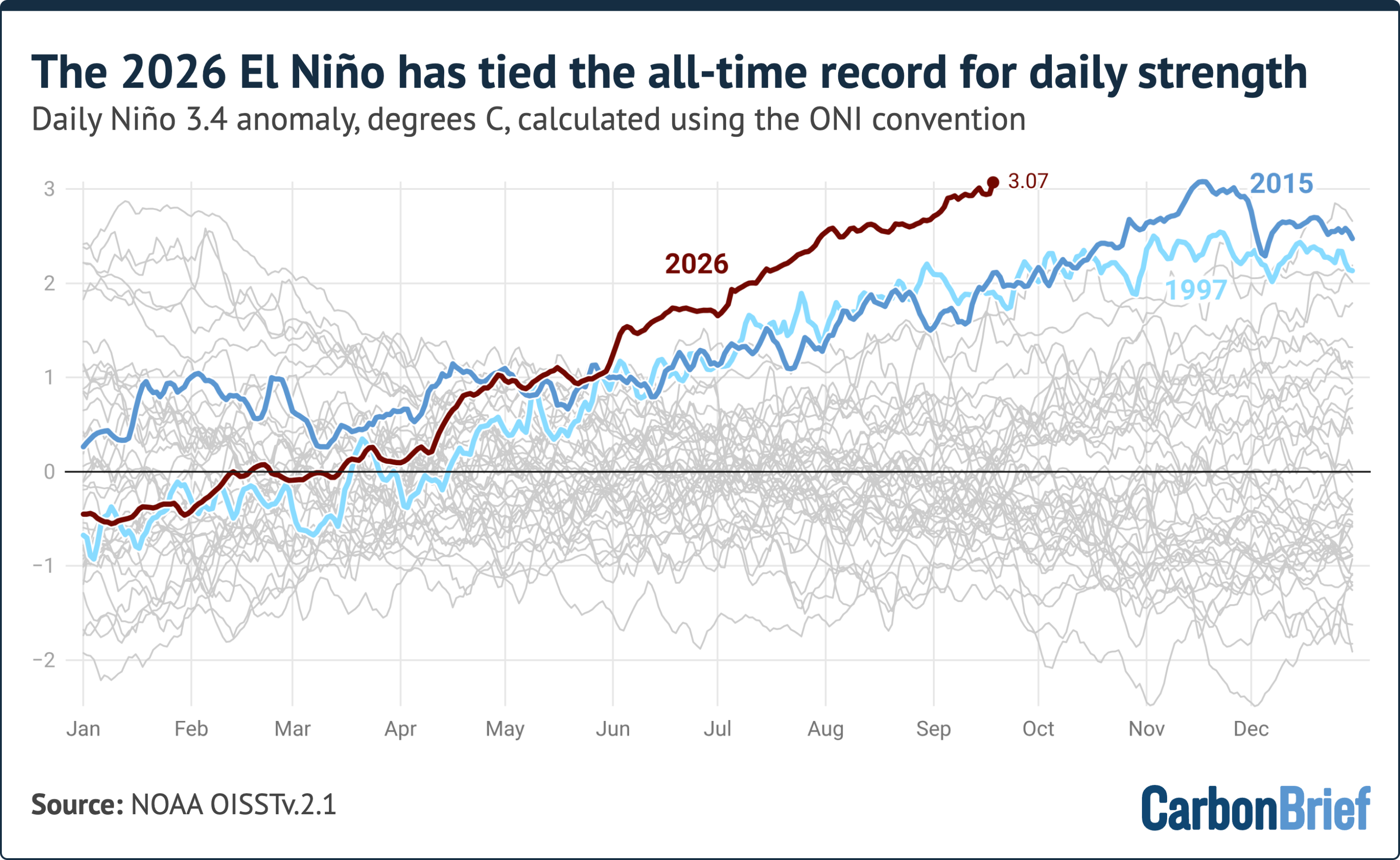
As of 19 September, the daily anomaly in the Niño 3.4 region stands at 3.07C, putting it in a statistical tie with the previous record of 3.08C.
Some scientists, using a different baseline for calculating the anomaly, have already called the new record.
Either way, this is remarkable, in part because of how early in the calendar year it is occurring. El Niño typically peaks in the winter months, most commonly in November or December.
Every strong El Niño on record has continued to strengthen after mid-September – and there is every reason to think that this one will as well.
El Niño events are typically classed as “weak” when the Niño 3.4 anomaly reaches 0.5C, “moderate” above 1C, “strong” above 1.5C and “very strong” above 2.0C.
For this year’s event, the Niño 3.4 anomaly has now reached 3.07C, which puts it in a statistical tie with the record set on 18 November 2015, set during a “very strong” El Nino event.
The chart below shows how the strength of the current El Niño (red line) is dramatically outpacing both 2015-16 (blue) and another “very strong” event in 1997-98 (light blue).
Daily Niño 3.4 sea surface temperature anomalies, 1982-2026, each relative to a centred 30-year climatology (ONI convention). Chart by Carbon Brief.
ONI is calculated by subtracting the latest 30-year average temperature in the Nino 3.4 region from daily sea surface temperatures. This approach allows for the most recent years to be compared against the most recent 30-year period. It removes much of the influence of longer-term, human-driven warming from the index.
(While meteorological organisations typically track changes to ONI on a three-month rolling average basis, Carbon Brief’s analysis looked at how the metric is changing on a daily basis.)
If ONI is calculated using a baseline of 1991-2020 then the current El Niño has already set a new record.
Since the start of June, El Niño’s strength has been greater than any other year. In early September in both 1997 and 2015, anomalies were around 1.9C – more than one degree below where they are this year.
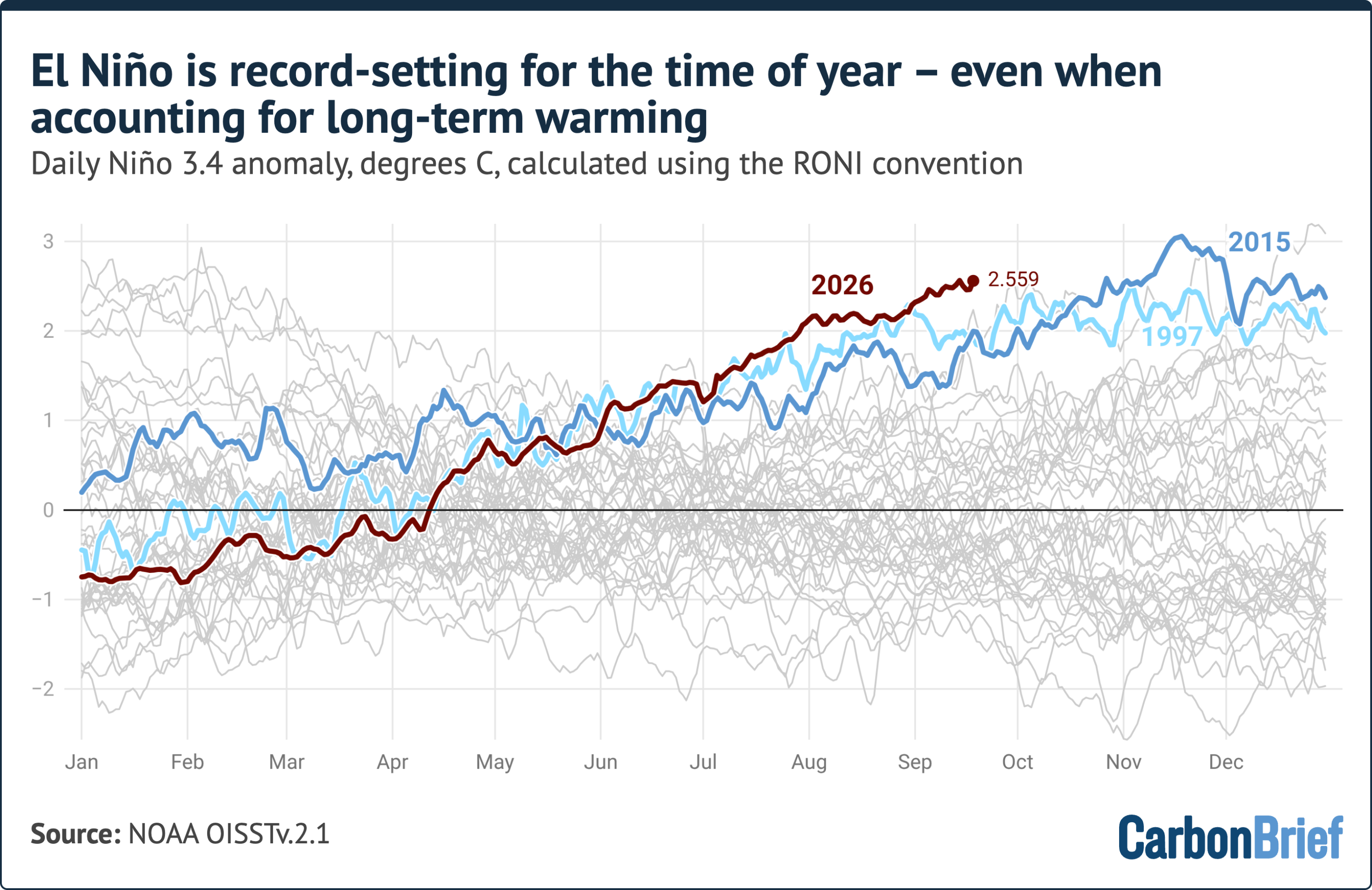
Introduced by NOAA in 2024, the RONI index adjusts for tropical ocean warming linked to human-caused climate change. To do this, it takes sea surface averages in the Nino 3.4 region and subtracts out temperature anomalies observed across the tropical oceans (between the latitudes of 20 degrees north and south).
This approach may better remove the influence of climate change in this specific region, but can also diminish the apparent strength of strong El Niño events, such as the current one, which extend well outside the Niño 3.4 region.
The chart below shows daily RONI values, which are record setting for this time of year, but remain below an all-time daily record set during the 1982-83 El Niño event.
Daily relative Niño 3.4 (RONI) anomalies for every year, 1982-2026. Chart by Carbon Brief.
RONI stood at around 2.5C in mid-September, some 0.7C below the 1982 record.
However, that record was set in late December, at the peak of the event.
The 1982-83, 1997-98 and 2015-16 events added between 0.5C and 1.9C to their RONI values between mid-September and their peaks.
On track to smash monthly and seasonal records
Because daily El Niño values are noisy, scientists typically turn to monthly or seasonal averages to compare El Niño events.
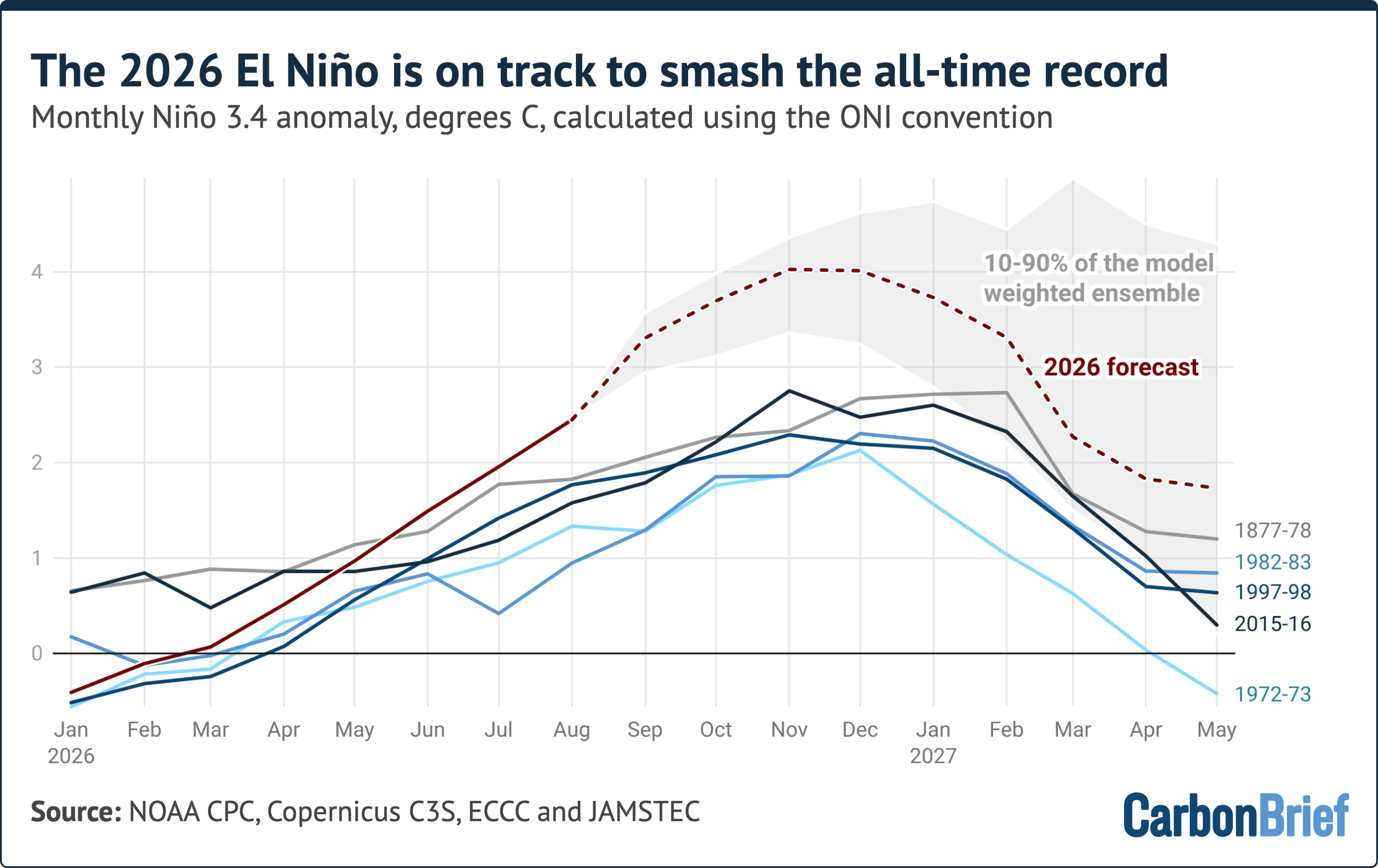
The latest full calendar month for which data is available – August 2026 – had a Niño 3.4 anomaly of around 2.45C. This is higher than the peak of every prior El Niño event on record except 2015-16 – where the anomaly reached 2.75C – and 1877-78, when the anomaly sat at around 2.7C, based on a reconstruction of sea surface temperatures using sparse ship data.
The figure below shows the monthly evolution of the five strongest El Niño events on record alongside 2026, as well the current forecast from 14 seasonal forecast models.
Monthly Niño 3.4 anomaly (degrees C) for the five strongest El Niño events on record, for 2026 through August and the 2026-27 forecast across 14 models, each relative to a centred 30-year climatology (ONI convention). Data from NOAA CPC, Copernicus C3S, ECCC and JAMSTEC. Chart by Carbon Brief.
Taken together, the models project a peak monthly anomaly later this year of around 4.1C, with 80% of the 674 individual model runs falling between 3.4C and 4.6C.
Every single model run peaks above the 2015-16 record. The projected margin over that record, some 1.3C, is larger than the entire gap between the strongest and fifth-strongest El Niño of the past 150 years.
Some caution here is warranted, however. No seasonal forecast system has ever been verified against an event of this size, because none has ever occurred. The models also predicted temperatures slightly warmer than observed this summer, with real-world observations for August coming in around 0.3C below forecasts.
However, all strong El Niño events on record have continued to strengthen well into the winter – and the models are in near-unanimous agreement that this one will, too. If the forecast holds, the current event will peak between November and January at a level far beyond any event previously observed in the instrumental record.
El Nino’s effect on global temperatures typically lags rising ocean temperatures in the Pacific by several months, so most of the impact will be felt in 2027 rather than 2026.
Carbon Brief’s most recent “state of the climate” quarterly analysis found 2026 on track to be the warmest or second-warmest year on record. The next update in early October will examine what a record El Niño means for 2027.
El Niño: Indonesia fire emissions in 2026 ‘on track’ to match record for this century
Explainer: How the ‘super El Niño’ will reshape the world’s weather
Analysis: What are the causes of recent record-high global temperatures?
State of the climate: First quarter of 2020 is second warmest on record
Donald Trump urges you to ignore facts and reality and be a Climate Science denier like him. He says that he makes millions and millions for destroying the planet, Burn, Baby, Burn and Flood, Baby, Flood.Nigel Farage urges you to ignore facts and reality and be a climate science denier like him and his Deputy Richard Tice. He says that Reform UK has received £Millions and £Millions from the fossil fuel industry to promote climate denial and destroy the planet.Elon Musk urges you to be a Fascist like him, says that you can ignore facts and reality then.
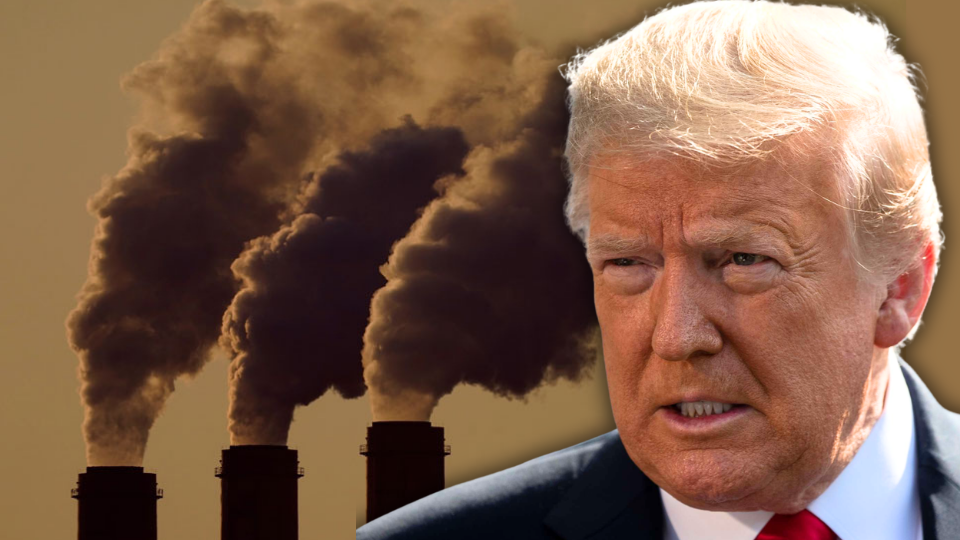
Donald Trump has gone on record calling climate change a “scam” and “con job.”| People’s World graphic
WASHINGTON—Just weeks after the United Nations Environment Programme released its grim report concerning climate change and the future of humanity, the Trump administration has repealed pollution limits on fossil fuel power plants. This rule change is happening despite the fact that power plants are the second-largest source of greenhouse gas emissions—the very same emissions scientists and climate activists say are the cause of global warming.
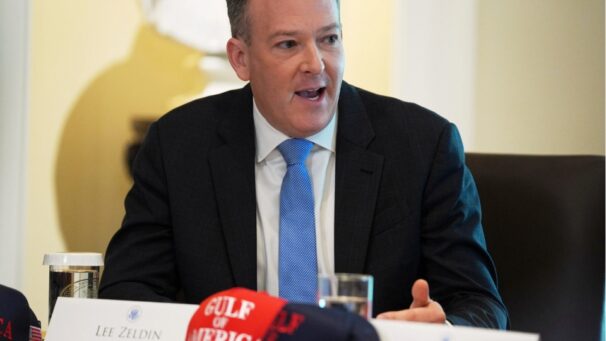
The reversal was announced by Environmental Protection Agency (EPA) Administrator Lee Zeldin at the G20 Energy Abundance Ministerial Meeting on Sept. 14 in Houston. He claimed the move “delivers reliable and affordable energy in the largest power sector deregulatory action in U.S. history,” and that it is “expected to unleash the full potential of America’s vast energy resources, including coal and natural gas.”
Zeldin alleged that former Presidents Joe Biden and Barack Obama implemented “a war on coal to destroy reliable and affordable energy” and boasted that the Trump administration “has come to protect American energy.”
The administrator’s comments continue a pattern where the EPA, under a president who said climate change is the “greatest con job ever perpetrated on the world,” has prioritized exalting the fossil fuel industry and thwarting the growth of clean energy initiatives such as solar, wind, and hydropower.
In February, Trump announced the official termination of the EPA’s 2009 landmark determination that greenhouse gases warm the planet and threaten the health and welfare of those who inhabit it. In 2025, the president referred to oil as “liquid gold” and created the National Energy Dominance Council as a means to expand U.S. fossil fuel and energy production.
Doug Burgum, who serves as secretary of the Department of the Interior (DOI) and chairs Trump’s National Energy Dominance Council, stood alongside Zeldin during the announcement on power plants. He claimed that the EPA’s repeal of pollution rules would save Americans “hundreds of millions of dollars” and put an end to “the Biden administration’s disastrous Green New Scam policies.”
The EPA’s lofty claim of delivering $300+ billion in savings to Americans might sound appealing in the middle of an affordability crisis, but independent researchers and advocates question whether Trump’s EPA is making false promises and ignoring the science.
Trump’s EPA administrator, Lee Zeldin, has fought to lift almost all controls on toxic chemicals that harm workers and the public. | AP
While Zeldin and his colleagues claim that during periods of peak electricity demand coal and natural gas continue to “keep the lights on,” recent reports show that coal is actually driving higher utility costs for consumers. The non-partisan think tank Energy Innovation noted that coal power was 28% more expensive in 2024 than in 2021 and that “coal’s already poor economics are getting worse as aging plants make coal power more expensive.” The organization also referred to another study that showed “coal plants were more expensive to continue operating compared to replacement with local wind or solar.”
In nearly every part of the United States, people are seeing a rapid rise in their energy costs lately. Electricity and home energy bills have risen faster than inflation—climbing an estimated 21% to 30% over a three to four year period. The quick jump for power bills has been attributed to a number of influences.
The top two reasons experts point to are, first, the high energy demand of AI data centers straining existing energy capacity (data centers which Trump champions) and, second, the extreme weather of hotter summers and freezing winters resulting from the climate change that the president doesn’t believe in.
In a press release announcing the power plant pollution rule elimination, the EPA maintained that “models” show greenhouse gas emissions from power plants have no “material impact on global climate change.” The claim provided no details on what models the agency was referring to or what science it relied on to make such an assessment.
Environmental advocates and scientists paint a different picture, one where continued pollution will impose detrimental costs for millions, both medically and financially.
Resources for the Future, an independent nonprofit research institution based in Washington, asserts that any savings made from the EPA’s continued deregulation of fossil fuels will be surpassed by the health damages many people will face as a result of increased emissions. The organization estimates that the free flow of power plant air pollution will increase health issues among the public, bringing additional health costs of up to $476 billion.
Advocates, political leaders, and medical professionals are also sounding the alarm on what they see as the immense danger the latest EPA move poses to working people.
“The administration is once again green-lighting massive corporate pollution with no regard to how it will harm our environment, climate, or Hoosiers struggling to afford their daily lives,” said Robyn Skuya-Boss, director of the Sierra Club Hoosier Chapter in Indiana. Last year, that state’s coal plants released more than 5.2 million metric tons of carbon dioxide.
“These protections have been essential guardrails to improving the health and safety of our communities from soot, smog, and toxic air pollutants. This dirty and dangerous rollback comes at the same time the administration is using illegal bailout orders to keep two of Indiana’s coal plants online at Hoosiers’ expense rather than close as planned in December 2025.
“Over and over again, the Trump administration demonstrates it cares more about forcing Indiana to burn coal than it does the health and welfare of Hoosiers,” Skuya-Boss asserted.
Sierra Club Chief Program Officer Holly Bender told the press that Trump’s EPA actions were a “full-throated climate denial while the climate crisis happens in real time.” The move is a “shocking betrayal of the American public,” she declared.
“While wildfires rage, floods devastate communities, and families struggle to afford skyrocketing electricity bills and insurance premiums, the Trump administration is handing the fossil fuel industry a license to keep polluting,” Bender said.
American Lung Association President and CEO Harold Wimmer noted in a statement that leaving the rules in place would have “resulted in other immediate health benefits,” such as reducing emissions of harmful oxides of nitrogen, sulfur dioxide, and particulate matter from coal-fired power plants, preventing “1,200 premature deaths in 2035.”
Massachusetts Gov. Maura Healey said, “American families and businesses will pay for President Trump’s reckless failure to regulate greenhouse gas emissions from power plants. By giving power plants a free pass to pump industrial carbon pollution into our communities, the EPA will saddle people with the bill for more expensive electricity, respiratory illnesses, and climate change-fueled disasters.”
The governor added, “Nobody wants this, and nobody can afford this,” saying the Trump administration has lost all credibility on energy and that the American public can’t afford more “endless wars driving up gas prices” and further reliance on “dirty coal plants.”
Rep. Adelita S. Grijalva, D-Ariz., asserted that the president and his administration is “once again prioritizing corporate profits over lower utility bills and the health of working families.”
Though the Trump administration is wasting no time in moving forward with its fossil fuel initiatives, the fight for clean air may not be over just yet. Just days after Zedlin’s announcement, a number of organizations have come forward to sue the administration to stop the rule elimination.
The Natural Resources Defense Council (NRDC), American Lung Association, American Public Health Association, Clean Air Council, Clean Wisconsin, and the Environmental Defense Fund filed suit, alleging that the EPA was failing in its “legal responsibility to protect health and the environment.”
The federal climate legal director at NRDC, Meredith Hankins, wrote in a statement: “The Clean Air Act and Supreme Court precedent demand that the EPA address climate pollution from the largest industrial source in the nation. The EPA’s legal reasoning is fatally flawed, so we are going to court.”
No paywalls at People’s World
We hope you appreciated this article. At People’s World, we believe news and information should be free and accessible to all, but we need your help. Our journalism is free of corporate influence and paywalls because we are totally reader-supported. Only you, our readers and supporters, make this possible. If you enjoy reading People’s World and the stories we bring you, please support our work by donating or becoming a monthly sustainer today. Thank you!
Donald Trump sings and dances, says that it’s fun to kill everyone … unless he gets distracted or falls asleep.Orcas discuss Donald Trump and the killer apes’ concept of democracy. Front Orca warns that Trump is crashing his country’s economy and that everything he does he does for the fantastically wealthy.Climate science denier Donald Trump confirms that he knows nothing about democracy and that more liquid gold is being secured according to his policy of global privateering.
Is net zero pushing up our bills? Ruining British industry? A worthless target? We weighed these claims up against the facts
“This is what climate change looks like, here and now,” Andy Burnham said last month, reflecting on a summer of catastrophic fires, drought and heatwave after heatwave. People were left without water, crops failed and emergency services had their busiest summer ever.
And yet with disaster on our doorsteps – and the government now recommending we stockpile in preparation for future extreme weather – there remains a sustained opposition to the UK’s plan to tackle it all: net zero.
In fact, many have doubled down on “ditching net zero” this summer. And in some fringes this is accompanied by claims that our changing climate has nothing to do with human activity. Let’s be clear: this goes against the overwhelming majority of scientists and scientific study.
We’ve already reported on how this sort of straight-up climate denial is creeping back into UK politics. But what about the softer arguments against net zero, those that appeal to people’s anxieties about the cost of living, job losses and the supposed need for pragmatism?
Many of these are also based on fallacies and falsehoods – some of them warping the scientific concept of net zero into something different altogether. Let’s dig into some of the most common myths out there.
‘Net zero is a made-up term’
The UK became one of the first major economies to bring net zero into national law in 2019, under Theresa May’s Conservative government. In a nutshell it means reducing greenhouse gas emissions by 100%, from 1990 levels, by 2050. The “net” part is that some emissions may still exist but are balanced out by removing emissions through carbon sinks, such as tree planting, or technology.
It’s a legal commitment enshrined in an amendment to the 2008 Climate Change Act, and it is based on rigorous climate science.
And yet one of the more common narratives online is that net zero is some arbitrary idea, a figure plucked out of thin air to make us poorer, colder, and plunder our economy. Reform MPs regularly refer to “net stupid zero” and Conservative leader Kemi Badenoch has called it “political fiction”. Conservative MP Andrew Bowie, who acted as May’s parliamentary private secretary when the target was brought in said in an interview with Politico last year: “What’s quite clear is that the setting of arbitrary targets with no clear plan on how to deliver them does not work for the country.”
Professor Myles Allen from Oxford University is one of the leading scientists on net zero, and has worked on the need for a finite carbon budget for over 20 years. “When I hear politicians saying, ‘I’m not a climate denier, I’m a net zero denier’, that doesn’t make any sense,” he told us. “The implication of that, obviously, is, ‘I’m comfortable with the world warming forever.’”
Key fact: Net zero by 2050 is a legal commitment, rooted in physics and atmospheric science, based on a finite carbon budget to stay within 2 degrees of warming.
‘Net zero is sending our energy bills through the roof’
Energy bills are extremely high, and set to rise further next month when the price cap increases. We are all feeling this. And many – including Reform in its election manifesto and Restore Britain’s energy policy paper – blame net zero for pushing up prices and “crippling our economy”.
But the main culprit has nothing to do with net zero.
Wholesale gas prices – the sums paid by our suppliers when they buy gas in bulk – have skyrocketed since the Iran war. In the last year, they have more than doubled. And our bills, which include a unit cost based on that wholesale price, have risen accordingly. Depending on where you live and the tariff you’re on, you’ll be paying around 7p per kilowatt-hour this September.
But what about electricity – surely that’s unaffected by price shocks in the gas industry?
This is where a concept called “marginal pricing” comes in. It’s a principle of all commodity markets, and it’s where the last available technology sets the price for what all energy suppliers receive. So if all of the UK’s energy demand is met by renewables suppliers (the cheapest option), it’s renewables setting the price. But if renewables aren’t being offered on the markets, or if demand is high, then it’s more expensive options – like gas – that set the wholesale electricity price. (Analysis from the Energy and Climate Intelligence Unit earlier this year found that wind power had reduced electricity prices by over 30%.)
The last part of the bill is the standing charge. This covers network operating costs, the maintenance of infrastructure, debt recovery and VAT. It also includes costs for some government policies such as social or environmental schemes – but this is a small percentage. So yes, our standing charges are helping pay for net zero. But they are mainly going towards upgrading pipelines and cables or claiming back unpaid bills. And they tend to make up between a fifth and a third of the total bill.
Adam Berman, policy director at Energy UK, the trade body for energy companies, explains that network costs have hugely increased because “successive governments have made the decision to finance our electricity infrastructure entirely through bills”. This is instead of “some balance between bills and general taxation which is what almost everyone else across the OECD does”. And it is this difference which makes our electricity bills more expensive than gas when you compare your two bills side by side.
However, he said: “If we hadn’t invested, in five or 10 years we would be close to the water sector, in that you’d have to be doing massive levels of investment”.
Key fact: Sky-rocketing energy bills are due to extremely high gas prices, which make both gas and electricity more expensive.
‘Net zero is destroying British industry’
Jobs are being lost in the UK’s oil and gas sector in the North Sea, and industries like steel have taken a hammering in recent decades. Reform and the Conservatives have put this down to net zero.
While it is true that the oil and gas industry reports staggering job losses – unions say 1,000 direct and indirect jobs are being lost each month – the reasons are complex. For a start, production in the North Sea has largely been in decline since 1999. Many of the wells and basins are reaching maturity, meaning that the fossil fuels are harder and more costly to extract. And as production has waned, so have jobs. (In fact, new research has shown that even in the small windows when production increased, jobs still declined.)
Losing your job can be a traumatic experience. But there is cause for hope: a recent government analysis found that oil and gas workers’ skills will be in high demand in critical sectors including clean power, construction, defence, advanced manufacturing and life sciences. It found that around 70% of oil and gas workers are already employed in occupations identified as a priority for these sectors. (For more on North Sea oil myths see Carbon Brief’s excellent analysis.)
On the other side, jobs in the UK’s renewable energy sector are growing – and have topped 145,000 for the first time according to a recent report.
Key fact: Oil and gas production in the North Sea has been in decline long before Net Zero, and jobs are declining too. However, renewables jobs are growing, and oil and gas skills are highly sought after in other industries.
‘The UK achieving net zero would make no difference anyway’
The UK’s carbon emissions have been in overall decline for decades and now account for less than 1% of the global total.
There are many variations on this myth: from “How will it make any difference?” to “Why should we make an effort when we aren’t as bad as other countries?” Rishi Sunak said it when he was prime minister in 2023. And Reform MP Lee Anderson last year asked in Parliament: “If the UK went net zero tomorrow, by how much would it reduce the Earth’s temperature by?”
Less than 1% does sound very low. However, we are also the 22nd highest emitter in the world; there are over 160 other countries with lower emissions than us.
And if you add together all the countries accounting for less than 2% of emissions, it comes to just under half the global total. If all of them took the “Why bother?” approach, it would write off our chances of a net zero world.
It’s also important to note that while China, the US and India make up the top three (with 26%, 11% and 8% respectively) this doesn’t tell the full story when it comes to emissions per person. China is the 35th highest country for emissions per capita, way behind the US and all the petrostates. The UK is 83rd, putting us roughly in the middle.
Nor does the 1% figure take into account historic emissions. England was among the first countries to industrialise. Our emissions have risen since the mid-1800s, while other countries’ did not until closer to the end of the century. When you look at historic cumulative emissions from 1750, the UK is the fifth worst offender.
A final caveat: when looking at global emissions the aviation and shipping industries are not included. They are grouped together like a separate country and according to 2024 data count for just over 3% of global emissions. So flights taken by British people don’t count towards the UK’s reported emissions. And British people take a relatively high number of flights.
If anything, the 1% figure is obscuring the fact that the UK is in fact an outsized contributor to global emissions. A net zero UK would make a huge difference to the world.
(None of this is to mention the simple argument that we have a moral duty to clean up after ourselves, regardless of the size of the mess – as summarised by this caller to LBC).
Key fact: The UK is a lower emitting country at less than 1% of global emissions. However there are over 160 low emitting countries and if everyone gave up on net zero that’s around 42% of global emissions.
‘Climate change is happening. Let’s just accept it’
Climate change is certainly happening. Forecasters warn of a “super” El Niño into 2027, with droughts, flash floods and extreme heat likely to get worse.
And yet some instruct us to simply look on the bright side and adapt to the changing world. “When it’s a bit warm, let’s enjoy it,” said Reform’s Richard Tice last month. “And if it means that English wine and sparkling wine gets better and better, fantastic.” A fortnight earlier, Sunday Telegraph editor Allister Heath had written a column titled: “Britain can’t stop climate change. Let’s just embrace a Mediterranean lifestyle.”
Pallavi Sethi, a researcher into climate misinformation at the LSE’s Grantham Institute, described the suggestion that we should simply accept climate change and scrap net zero as “dangerous and misleading”.
Reform’s Richard Tice told a press conference that there is ‘no evidence’ net zero would stop climate changeOli Scarff / AFP via Getty
At Jordan Peterson’s Alliance for Responsible Citizenship conference in London, and most recently Reform’s party conference in Birmingham, participants have raised the need to adopt more air conditioning, like the US.
It is true that we need more money to be spent on adaptation. The Climate Change Committee estimates that we need investments of around £11bn per year of both public and private investment to adapt homes, hospitals, infrastructure and many industries for a changing climate. A recent report states that “the UK was built for a climate that no longer exists today”.
Sethi told us: “Accepting that climate change is happening while giving up on efforts to limit further warming means accepting greater risks, more damage, as well as higher costs in the years ahead.”
However this is not an “either/or” scenario, and increasing temperatures lay bare the increased inequality in the UK. Some people can afford to adapt where they live, installing air con or heat pumps, or planting trees in their garden. Others cannot: they do not have the money, or the agency over Council property or a landlord’s private home. Enjoying England’s vineyards is not for the many.
Key fact: The fact that the climate crisis is already here doesn’t mean we can’t still mitigate it.
Reporter: Grace Murray Deputy Editor: Chrissie Giles Editor: Franz Wild Production Editor: Alex Hess Fact checker: Lydia Morrish
The Bureau has a number of funders, a full list of which can be found here. None of our funders have any influence over editorial decisions or output.
Donald Trump urges you to ignore facts and reality and be a Climate Science denier like him. He says that he makes millions and millions for destroying the planet, Burn, Baby, Burn and Flood, Baby, Flood.Nigel Farage urges you to ignore facts and reality and be a climate science denier like him. He says that Reform UK has received millions and millions from the fossil fuel industry to promote climate denial and destroy the planet.UK Prime Minister Andy Burnham says that he’s going to permit the Jackdaw and Rosebank North Sea fossil fuel projects. He urges you to ignore facts and reality and be a climate science denier like him. The proof is in the pudding.
Burnham: ‘I want Britain to believe in itself again.’ Photograph: Neil Hall/EPA
[Guardian] Exclusive: PM, who is facing pressure over whether to approve North Sea oil and gasfields, makes strongest comments yet on issue
The UK must fully commit to reaching net zero by 2050, Andy Burnham has argued in his strongest comments yet on the issue, saying it is no longer possible for Britons to believe they are not already affected by a changing climate.
Writing for the Guardian about new plans for a mass of community-led local green energy projects, the prime minister said the UK must “believe in itself”, and set out his determination to reach net zero targets, which have been rejected by the Conservatives and Reform UK.
The tone marks a contrast to the summer, when Burnham faced criticism for a seemingly muted response to the heatwaves, droughts and wildfires that affected the UK, with his main initiative being a ban on portable barbecues.
“I am determined that we meet the commitment on which Labour was elected and reach net zero by 2050,” Burnham said. “I want Britain to believe in itself again.”
Saying he wanted to connect local communities to green power projects – to reach net zero targets and make energy more affordable – Burnham said: “I am acutely aware that our changing climate is a major concern for many Britons, not least because we have just emerged from our hottest summer on record.”
Comment by dizzy: While this is very encouraging, it is unexpected and suggests a real change in direction. Burnham’s article seems far more restrained than the Guardian’s review leads us to believe, funding of £30m is nothing and it seems devolved rather than owned by his government. There’s a saying in UK and possibly elsewhere: The proof is in the pudding. It can be interpreted to mean wait and see what comes later.
[18/9/26 I think that this is probably BS. We’ve seen Burnham & Co do it before with this
UK Prime Minister Andy Burnham admits to blatently lying and engaging in deception to become leader of the UK Labour Party and Prime Minister.
where an announcement is made, it’s a delaying tactic and what happens months later falls hugely short of what we were led to believe.
Specifically, it may well be BS to mislead and misdirect for the forthcoming Holborn and St. Pancras by-election where the Green Party’s Zack Polanski is a candidate, to give the impression that he cares about the climate and may not wave through Jackdaw and Rosebank, only then to wave through Jackdaw and Rosebank. Burnham’s statement is big on talk, commitments even but the actuality is minimal.]
Donald Trump urges you to ignore facts and reality and be a Climate Science denier like him. He says that he makes millions and millions for destroying the planet, Burn, Baby, Burn and Flood, Baby, Flood.Nigel Farage urges you to ignore facts and reality and be a climate science denier like him and his Deputy Richard Tice. He says that Reform UK has received £Millions and £Millions from the fossil fuel industry to promote climate denial and destroy the planet.
Guests including Mark Zuckerberg, Lauren Sanchez, Jeff Bezos, Sundar Pichai and Elon Musk attend the Inauguration of Donald J. Trump in the US Capitol Rotunda on January 20, 2025 in Washington, DC. (Photo by Julia Demaree Nikhinson – Pool/Getty Images)
“With donor countries facing growing indebtedness and increasingly reallocating resources towards military spending, funding humanitarian assistance via the taxation of large fortunes was one of the most viable strategies.”
With international aid programs facing an unprecedented cash crunch thanks in large part to foreign aid cuts ordered by US President Donald Trump, a recent study published The Lancet suggests that taxing the ultrarich would be the simplest way to plug funding gaps faced by crucial life-saving programs.
Specifically, the peer-reviewed study found that a hitting the world’s billionaires with a 3% wealth tax would raise enough money to save up to 29.5 million lives in the world’s most vulnerable populations over the next four years leading into 2030.
Lucio Exposito, senior economist of the study and researcher at the ICESI School of Economics and University of East Anglia School of Global Development, told Euronews that a global wealth tax was the most plausible way to undo the damage done by international aid cuts, many of which were caused by billionaire SpaceX CEO Elon Musk’s dismantling of the United States Agency for International Development (USAID) in 2025 under the direct orders of Trump.
“With donor countries facing growing indebtedness and increasingly reallocating resources towards military spending,” Exposito explained, “funding humanitarian assistance via the taxation of large fortunes was one of the most viable strategies.”
The study’s introduction notes that wealth inequality has reached unprecedented heights in recent years, growing especially acute in the wake of the Covid-19pandemic.
“Today, the top 10% of the global population owns approximately 75% of global wealth, while the bottom 50% holds only 2%, with absolute income inequality steadily increasing over the past three decades,” the study explains. “Moreover, the wealthiest 0.002% of the global population… controls an estimated $37.1 trillion in global wealth, surpassing the gross domestic product of the world’s largest economy—the USA.”
Even as the world’s richest people have seen their wealth grow by bounds, official development assistance (ODA) to the Global South has been slashed significantly.
According to a study from the Organization for Economic Cooperation and Development (OECD) released earlier this year, ODA spending in 2025 fell by 23% compared to 2024, with the US responsible for 75% of the global decline.
A 2025 study published by The Lancet estimated that the elimination of USAID would lead to 14 million additional deaths worldwide by 2030.
dizzy: Tax the climate-destroying parasites out of existence. Why should anyone be so rich that they can donate £36M to Farage’s Reform Ltd company to destroy the planet?
Orcas discuss Donald Trump and the killer apes’ concept of democracy. Front Orca warns that Trump is crashing his country’s economy and that everything he does he does for the fantastically wealthy.Elon Musk urges you to be a Fascist like him, says that you can ignore facts and reality then.