Category: Climate Emergency

  • ‘What Betrayal Looks Like’: UN Report Says World on Track for 2.7°C of Warming by 2100

    Spread the love
    Dixie Fire in California

    A home burns as flames from the Dixie Fire tear through the Indian Falls neighborhood of unincorporated Plumas County, California on July 24, 2021. (Photo: Josh Edelson/AFP via Getty Images)

    https://www.commondreams.org/news/2021/09/17/what-betrayal-looks-un-report-says-world-track-27degc-warming-2100

    “Whatever our so-called ‘leaders’ are doing,” said Swedish climate activist Greta Thunberg, “they are doing it wrong.”

    JAKE JOHNSONSeptember 17, 2021

    The United Nations warned Friday that the planet is barreling toward 2.7°C of warming by the end of the century, a nightmare scenario that can be averted only if policymakers take immediate and sweeping action to slash greenhouse gas emissions.

    Even if the 191 parties to the Paris climate accord meet their current commitments, global greenhouse gas emissions will still rise 16% by 2030 compared to 2010 levels, according to a new report published by the U.N. Framework Convention on Climate Change (UNFCCC).

    “Failure to meet this goal will be measured in the massive loss of lives and livelihoods.”

    The goal of the 2015 Paris agreement is to limit global warming to below 2°C—and preferably to 1.5°C—above pre-industrial levels. An analysis released earlier this week found that the climate targets and actions of just one country—The Gambia—are in line with the critical 1.5° goal.

    “This is what betrayal looks like,” Swedish climate activist Greta Thunberg tweeted in response to the latest U.N. findings. “Whatever our so-called ‘leaders’ are doing, they are doing it wrong.”

    Patricia Espinosa, executive secretary of U.N. Climate Change,

    said in a statement that the international community must “peak emissions as soon as possible before 2030 and support developing countries in building up climate resilience.”

    “The 16% increase is a huge cause of concern,” said Espinosa. “It is in sharp contrast with the calls by science for rapid, sustained, and large-scale emission reductions to prevent the most severe climate consequences and suffering, especially of the most vulnerable, throughout the world.”

    The U.N. analysis came as U.S. President Joe Biden met with world leaders and announced that the United States is partnering with the European Union in an effort to cut methane emissions—a powerful driver of global warming—by nearly 30% by the end of the decade.

    In its landmark report last month, the Intergovernmental Panel on Climate Change (IPCC) emphasized that a “strong, rapid, and sustained” reduction in methane emissions is necessary to prevent the worst of the planetary crisis.

    The IPCC also estimated that keeping global warming to 1.5°C above pre-industrial levels would require a 45% reduction in carbon dioxide emissions by 2030—a mark that the international community is currently on track to miss badly, according to the new U.N. report.

    António Guterres, the secretary-general of the U.N., said in a statement Friday that 2.7°C of planetary heating would be “catastrophic” and that world leaders are “rapidly running out of time” to act.

    “This is breaking the promise made six years ago to pursue the 1.5°C goal of the Paris agreement,” said Guterres. “Failure to meet this goal will be measured in the massive loss of lives and livelihoods.”


    Our work [Common Dreams] is licensed under Creative Commons (CC BY-NC-ND 3.0). Feel free to republish and share widely.

  • Extinction Rebellion protesters break bail terms for City protest

    Spread the love

    https://www.theguardian.com/environment/2021/sep/02/extinction-rebellion-protesters-break-bail-terms-for-city-protest

    Dozens of Extinction Rebellion activists have carried out a mass act of non-violent civil disobedience by breaking bail conditions ordering them to stay away from the City of London financial district.

    The activists joined with hundreds of supporters in a low-key rally outside the Bank of England on Thursday afternoon, listening to speeches from a mobile sound system.

    XR said they had targeted the Bank because of its new remit to take environmental sustainability into account in its activities, and that protesters were willing to stay until its governor and the prime minister declared an end to all new fossil fuel funding.

    Those breaking bail advertised their civil disobedience with signs bearing messages such as “arrested for sitting in a road”, “arrested for conspiracy to commit climate justice” and “arrested for caring about my grandchildren”.

    Among them was Etienne Stott, who won gold in the canoe slalom for Britain in the 2012 London Olympics. He gave a speech publicly telling the crowd he was breaking the law by violating the conditions of his bail.

    He told the Guardian: “I’m fed up of being criminalised for acting for the future of all life on Earth in a peaceful, disobedient and responsible way, and it feels quite wrong that I’ve been criminalised for doing what’s so logically and obviously the right thing, given the emergency situation that we are in.

    “It seems to me completely sensible that our government stops its fossil fuel investments immediately, and yet I know they have got plans for a new oilfield in Shetland [and] a coalmine that’s in train.

    “It’s just so wrong. It’s the height of stupidity; it’s madness.”

    …

  • Atmospheric CO2 Levels Haven’t Been This High in 800,000 Years: NOAA

    Spread the love

    A major report on climate says both greenhouse gas concentrations and global sea levels hit record highs in 2020.

    Republished under a Creative Commons Licence. Original article at CommonDreams

    KENNY STANCILAugust 25, 2021

    Bolstering the case for meaningful climate action, a major report released Wednesday found that Earth’s atmospheric greenhouse gas concentrations and sea levels both hit record highs in 2020.

    “This situation is urgent, but it’s not hopeless. We have an opportunity to lead the global response in the fight against the climate crisis—we cannot afford to waste it.”
    —Rep. Eddie Bernice Johnson

    Based on the contributions of more than 530 scientists from over 60 countries and compiled by the U.S. National Oceanic and Atmospheric Administration (NOAA), State of the Climate in 2020 is the 31st installment of the leading annual evaluation of the global climate system.

    “The major indicators of climate change,” officials from NOAA’s National Centers for Environmental Information pointed out in a statement, “continued to reflect trends consistent with a warming planet. Several markers such as sea level, ocean heat content, and permafrost once again broke records set just one year prior.”

    “Annual global surface temperatures were 0.97°–1.12°F (0.54°–0.62°C) above the 1981–2010 average” in 2020, said NOAA, making last year one of the three warmest on record “even with a cooling La Niña influence in the second half of the year.”

    Last year was the warmest on record without an El Niño effect, and “new high-temperature records were set across the globe,” NOAA said. The agency added that the past seven years (2014-2020) had been the seven warmest on record.

    Although the coronavirus-driven economic slowdown resulted in an estimated 6% to 7% reduction of carbon dioxide (CO2) emissions in 2020, the global average atmospheric concentration of CO2 increased to a record high of 412.5 parts per million. The atmospheric concentrations of other major greenhouse gases (GHG), including methane and nitrous oxide, also continued to climb to record highs last year despite the pandemic.

    According to NOAA, last year’s CO2 concentration “was 2.5 parts per million greater than 2019 amounts and was the highest in the modern 62-year measurement record and in ice core records dating back as far as 800,000 years.” Moreover, “the year-over-year increase of methane (14.8 parts per billion) was the highest such increase since systematic measurements began.”

    In addition, global sea levels continued to rise, surpassing previous records.

    “For the ninth consecutive year,” said NOAA, “global average sea level rose to a new record high and was about 3.6 inches (91.3 millimeters) higher than the 1993 average,” which is when satellite measurements began. As a result of melting glaciers and ice sheets, warming oceans, and other expressions of the climate crisis, the “global sea level is rising at an average rate of 1.2 inches (3.0 centimeter) per decade.”

    Other notable findings of the new report include:

    • Upper atmospheric temperatures were record or near-record setting;
    • Oceans absorbed a record amount of CO2, global upper ocean heat content reached a record high, and the global average sea surface temperature was the third highest on record;
    • The Arctic continued to warm at a faster pace than lower latitudes—resulting in a spike in carbon-releasing fires—and minimum sea ice extent was the second smallest in the 42-year satellite record;
    • Antarctica witnessed extreme heat and a record-long ozone hole; and
    • There were 102 named tropical storms during the Northern and Southern Hemisphere storm seasons, well above the 1981–2010 average of 85.

    In contrast to the release less than three weeks ago of the latest assessment from the United Nations’ Intergovernmental Panel on Climate Change, which warned that fossil fuel emissions are intensifying extreme weather disasters—provoking a flurry of reactions and even garnering a short-lived uptick in corporate media’s coverage of the climate emergency—NOAA’s new report was met with less fanfare.

    In one of the few early statements issued by members of Congress in response to the report, Rep. Eddie Bernice Johnson (D-Texas) said that “scientists sounded the alarm on the climate crisis again.”

    “It is clear that without swift action, we can, unfortunately, expect to set new records like these every year,” said Johnson, chair of the House Committee on Science, Space, and Technology. “The consequences of climate change impact every American—especially disadvantaged communities—across the country; from the devastating floods in Tennessee a few days ago to the record-breaking wildfires in the West.”

    “Building a better future for all means acting on climate now,” the lawmaker added. “This situation is urgent, but it’s not hopeless. We have an opportunity to lead the global response in the fight against the climate crisis—we cannot afford to waste it.”

    Our work is licensed under Creative Commons (CC BY-NC-ND 3.0). Feel free to republish and share widely.

  • ‘Civil Disobedience Is Our Duty’: Swiss Climate Campaigners Occupy Zürich Financial Center

    Spread the love

    Republished from https://www.commondreams.org/ under a Creative Commons licence

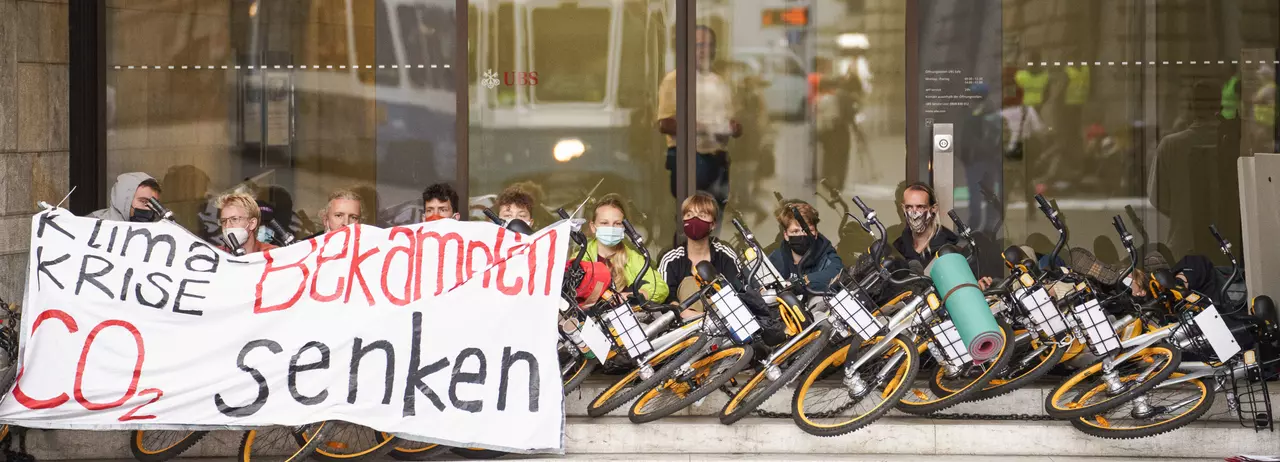
    Climate justice activists occupied the center of Zürich’s financial district on August 2, 2021 to demand that the two biggest banks in Switzerland divest from oil, gas, and coal. (Photo: Rise Up for Change/flickr/cc)

    “We have no other choice. Either phase out fossil fuels or face forest fires, famines, droughts, and floods.”

    KENNY STANCILAugust 2, 2021

    Climate justice campaigners occupied the center of Zürich’s financial district Monday to demand that the two biggest banks in Switzerland divest from oil, gas, and coal.

    Dozens of “singing and chanting activists” blocked entrances to the headquarters of Credit Suisse and a UBS office building on Paradeplatz square, Reuters reported. Police officers arrested about 30 people who refused to disperse during the peaceful demonstration.

    Frida Kohlmann, spokesperson for the Rise Up for Change group, said in a statement that Credit Suisse and UBS have failed to respond appropriately to the climate emergency. 

    “That is why the climate justice movement is occupying the Credit Suisse headquarters and the nearby UBS office today to draw attention to the consequences of the Swiss financial institutions’ inaction,” Kohlmann said.

    https://www.commondreams.org/news/2021/08/02/civil-disobedience-our-duty-swiss-climate-campaigners-occupy-zurich-financial-center?utm_term=AO&utm_campaign=Daily%20Newsletter&utm_content=email&utm_source=Daily%20Newsletter&utm_medium=Email

    “Civil disobedience is our duty,” tweeted Collectif BreakFree Suisse, part of the movement to stop financial actors from continuing to fund dirty energy projects that are fueling extreme weather-related disasters. “Either phase out fossil fuels or face forest fires, famines, droughts, and floods.”

    https://www.commondreams.org/news/2021/08/02/civil-disobedience-our-duty-swiss-climate-campaigners-occupy-zurich-financial-center?utm_term=AO&utm_campaign=Daily%20Newsletter&utm_content=email&utm_source=Daily%20Newsletter&utm_medium=Email

    In response to the protest, UBS said in a statement: “Climate protection is a top priority at UBS… We are committed to reducing greenhouse gas emissions across our business to net zero by 2050, with science-based interim targets for 2025, 2030, and 2035.”

    Despite having “decreased fossil fuel financing by 73%, from $7.7 billion in 2016 to $2.1 billion in 2020,” UBS continues to invest money in “thermal coal mining, oil refining, shale gas drilling,” and more, according to a recent analysis by CNBC.

    Credit Suisse asserted that it “is committed to climate protection and achieving the goals of the Paris Climate Agreement,” referring to the 2015 international treaty that seeks to reduce carbon pollution and limit global temperature rise to below 1.5°C.

    On its “DisCreditSuisse” campaign website, Collectif BreakFree Suisse said that while “Credit Suisse claims to align itself with the objectives of the Paris Agreement… it is one of the banks that is fueling the climate catastrophe the most.” According to a recent analysis (pdf) of the world’s largest asset managers, the bank ranks 72 out of 75 in terms of responsible investing.

    “Although Credit Suisse officially supports the objectives of the Paris climate agreement, it has been financing companies in the coal, oil, and gas sectors since 2015 with billions of dollars for the exploration, production, and processing of fossil fuels,” the group said. “Between 2016 and 2019, Credit Suisse invested (pdf) a total of $74.3 billion in fossil fuels. In particular, the bank provided almost $23 billion in financial support for global firms actively expanding their fossil fuels businesses.”

    “The existing instruments and guidelines do not appear to have led to any changes in the bank’s decision-making processes,” the group added. “The bank’s loan and investment portfolios are simply not being decarbonized at a pace commensurate with IPCC recommendations and the climate crisis. The bank is thus discrediting itself.”

    Republished from https://www.commondreams.org/ under a Creative Commons licence

    With Amazon Rainforest at ‘Tipping Point,’ Big Banks Told to End Fossil Fuel Financing

    1. Planet’s Vital Signs Are Reaching Dangerous ‘Tipping Points’ Amid Climate Crisis, Scientists Warn
    2. For First Time on Record, US Renewables Generated More Electricity Than Either Coal or Nuclear in 2020
    3. As Bipartisan Infrastructure Deal Reached, Sinema Comes Out Against $3.5 Trillion Package
    4. ‘Just Say That the Election Was Corrupt,’ Trump Told DOJ in December
    5. Progressives Threaten to Tank Bipartisan Infrastructure Deal If Their Demands Aren’t Met
    6. Science Museum Just Killed Its ‘Own Reputation,’ Says Greta Thunberg After Docs Reveal Gag Clause With Shell
    7. Bush, Pressley, and Omar Sleep Outside Capitol to Demand Extension of Eviction Moratorium
    8. Pelosi Under Fire for Parroting ‘Right-Wing Lies’ Against Student Loan Debt Cancellation
    9. Moving From Neglect to Dignity in the S.S.I. Program
    10. ‘Turn This Destruction Around’: 5 Months Left in 2021 But Humanity’s Used Up Earth’s Ecological Budget