
Article by Brett Wilkins republished from Common Dreams under Creative Commons (CC BY-NC-ND 3.0).
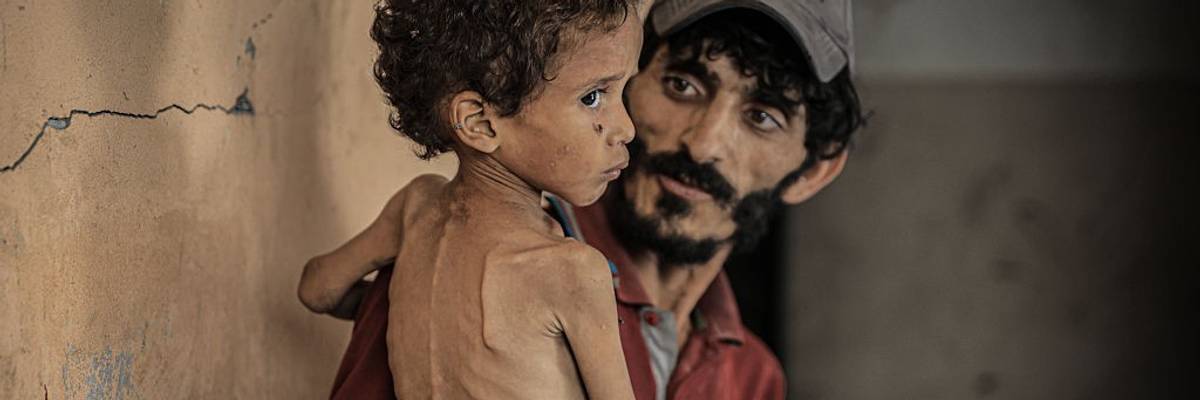
For nearly three years, Israeli officials and their US backers have denounced United Nations agencies reporting the facts of Israel’s genocidal assault on Gaza as lies, but now many of them are citing the latest global hunger study by the United Nations Children’s Fund as proof that last year’s famine that killed at least hundreds of Palestinians in the coastal exclave was a “hoax.”
The UNICEF-led State of Palestine Nutrition Cluster Coordination Meeting report, published on July 22, shows decreased hunger rates in areas of Gaza accessible to those conducting the survey. With Israeli forces controlling the majority of Gaza’s territory and much of the strip flattened and inaccessible, the report’s authors warned that “the survey findings should therefore be interpreted as representative.”
RECOMMENDED…
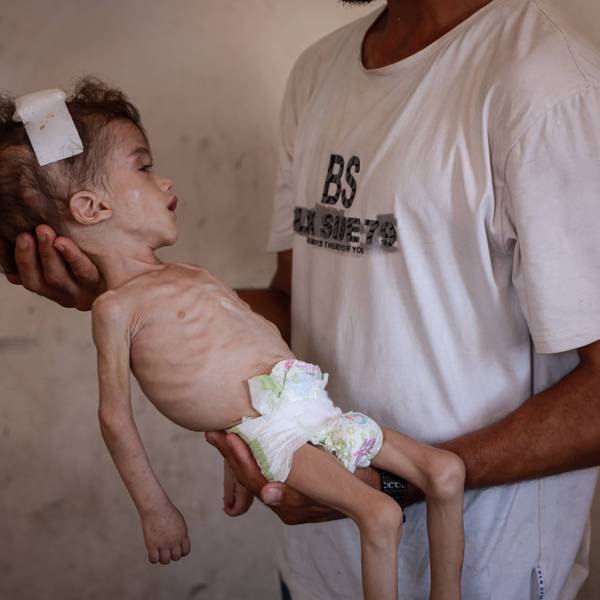
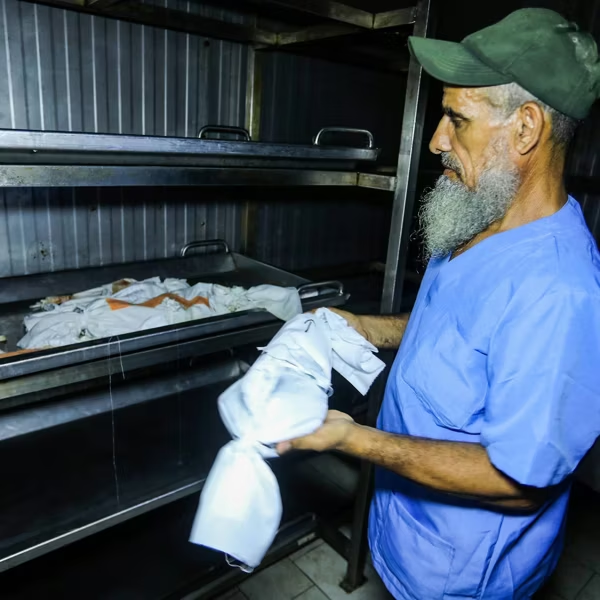
This did not stop the Israeli government and media, and Israel’s supporters and sympathetic media abroad, from citing UNICEF—which on Thursday said that Israel is killing about one child a day in Gaza despite a so-called ceasefire—and the broader UN, which they formerly accused of “lies,” “antisemitism,” “blood libels,” and “hoaxes” throughout a war that a UN commission of inquiry called a genocide.
“Once again, facts prevail over fiction,” Israeli Ambassador to the United Nations Danny Danon said. “UN bodies are acknowledging that the false narrative against Israel is falling apart.”
US Ambassador to Israel Mike Huckabee may have forgotten his acknowledgement last year—along with President Donald Trump and Vice President JD Vance—that Palestinians were “starving” in Gaza, aspersing the media for reporting on the starvation.
Eylon Levy—the British-Israeli former spokesperson for Israel known for purveying disinformation like the infamous October 7 “beheaded babies” lie—also ran with the narrative, posting on X that “the ‘Gaza Famine’ was always a hoax.”
Except it wasn’t.
UN agencies and other humanitarian groups started sounding the alarm on looming starvation in Gaza in the weeks after Israel began annihilating the strip in retaliation for the Hamas-led attack of October 7, 2023. By February 2024, UNICEF warned that “famine is imminent” in Gaza as the UN Office for the Coordination of Humanitarian Affairs cited the deaths of six infants from malnutrition and dehydration.
As Gaza’s hunger crisis worsened under Israel’s “complete siege,” UN agencies, including UNICEF, regularly warned about starvation in the strip. In February 2024, UN officials were accusing Israel of using starvation as a weapon of war—one of the alleged crimes against humanity and war crimes for which Israeli Prime Minister Benjamin Netanyahu and Yoav Gallant, his former defense minister, are wanted by the International Criminal Court in The Hague. Michael Fakhri, the top UN expert on the right to food, accused Israel of genocidal forced starvation of Gazans.
In August 2025, the Integrated Food Security Phase Classification (IPC)—the UN-aided top global authority on hunger crises—declared a Phase 5, or “catastrophic,” famine in Gaza as at least hundreds of Palestinians perished from malnutrition and related causes.
“Famine is now a grim reality for children in Gaza,” UNICEF executive director Catherine Russell said at the time. “As we have repeatedly warned, the signs were unmistakable: children with wasted bodies, too weak to cry or eat; babies dying from hunger and preventable disease; parents arriving at clinics with nothing left to feed their children.”
The IPC lifted Gaza’s famine designation in December 2025, citing improved—but still highly restricted—access of humanitarian aid into Gaza following a nominal ceasefire agreement reached two months earlier. However, last month the IPC published an analysis showing that from mid-April to the end of June, more than 1.2 million people, or 59% of Gaza’s population, were experiencing Phase 3 (crisis) or worse levels of food insecurity. This included about 212,000 people in Phase 4 (emergency).
“The situation remains fragile,” IPC warned.
Many of the people who deny that Israeli forces have killed or wounded a quarter million Palestinians in Gaza or that Israel is committing genocide there—a conclusion reached by numerous UN officials, scholars, jurists, rights groups, and the approximately 20 nations that formally joined South Africa’s pending genocide case against Israel at the International Court of Justice—are the same ones who have denied not only the Gaza famine, but that anyone was ever starving there.
They asked to see photos of starving Palestinians, and when shown them, they, and corporate media outlets including The New York Times, attempted to explain or even dismiss the evidence by claiming the emaciated—or often dead—children suffered from preexisting conditions, as if that somehow absolved Israel for their deaths. Others posted images of a Gaza market stocked with food or overweight Palestinians in a bid to debunk the fact of starvation in Gaza.
Still others dismissed images of starving Gazans as Hamas propaganda, with US media personality Megyn Kelly opining that Palestinians are “fine having their own children starve just as long as they can put them on camera.”
Article by Brett Wilkins republished from Common Dreams under Creative Commons (CC BY-NC-ND 3.0).

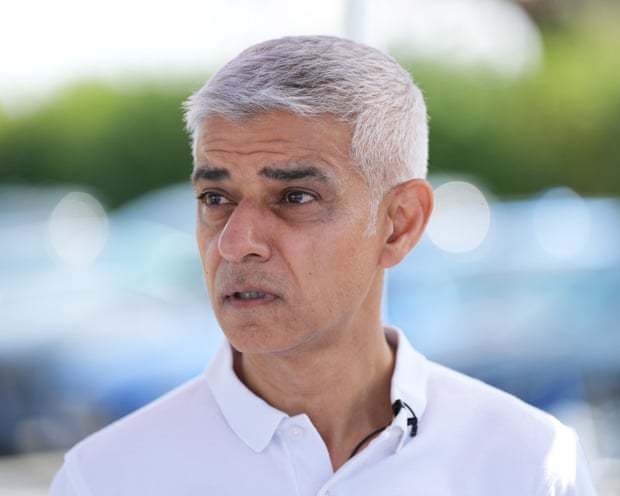
Sadiq Khan has called on the government to commit to revamped climate action and to reduce the UK’s reliance on oil and gas, as the UK endures a summer of drought, wildfires and heatwaves.
Writing in the Guardian, the mayor of London said that Andy Burnham’s administration must reaffirm its commitment to net zero and make clear it will continue to reduce the UK’s reliance on oil and gas “to get Britain back on track.”
There is growing concern among Labour MPs and climate experts that the new prime minister may support renewed drilling for oil and gas in the North Sea; since arriving in No 10, Burnham has remained largely tight-lipped on climate and environmental concerns despite speaking out about them during his time as mayor of Greater Manchester.
Last month, Burnham said he would be “pragmatic” about oil and gas and that decisions on new drilling would be made “in due course”. “The question isn’t whether Britain will still be using oil and gas, the question is where does it come from,” he said.
…


This work by Middle East Monitor is licensed under a Creative Commons Attribution-NonCommercial-ShareAlike 4.0 International License.

by Sayid Marcos Tenorio soupalestina
Throughout history, almost every national liberation struggle has been labelled “terrorism” by the powers exercising colonial rule or foreign occupation. This strategy is nothing new.
The British Empire branded IRA fighters in Ireland and EOKA guerrillas in Cyprus as terrorists. France portrayed Algeria’s National Liberation Front (FLN) as a criminal organisation. The same happened to the Mozambique Liberation Front (FRELIMO), the People’s Movement for the Liberation of Angola (MPLA), the South West Africa People’s Organisation (SWAPO) in Namibia, and even Nelson Mandela’s African National Congress (ANC).
History, however, vindicated these movements and condemned the colonial regimes that sought to perpetuate their domination.
This pattern reveals a constant: those who occupy a territory seek to strip the occupied people of any legitimacy to resist.
The dehumanisation of resistance is a colonial strategy. By labelling every resistance fighter a “terrorist”, attention is shifted away from illegal occupation, apartheid and the denial of self-determination, and redirected towards the reaction of the occupied people.
This narrative, however, encounters clear limits within international law itself.
From the United Nations Charter to Resolution 1514 (XV) on decolonisation and Resolution 2625 (XXV), which reaffirms the principle of peoples’ self-determination, the understanding has been consolidated that peoples subjected to colonial domination, foreign occupation or racist regimes have the right to struggle for their liberation.
Several subsequent resolutions of the United Nations General Assembly recognised the legitimacy of national liberation movements and acknowledged that such resistance may take the form of armed struggle, provided that it remains subject to the rules of international humanitarian law.
READ: Israel cancels entry permits for US activists supporting Palestinians in West Bank
This is precisely why the international community has never automatically equated national liberation movements with terrorist organisations.
International humanitarian law regulates the manner in which armed conflicts must be conducted and imposes obligations on all belligerents, including resistance movements.
However, it does not eliminate the political and legal right of a people to resist occupation. Confusing these two dimensions serves only the interests of occupying powers, because it transforms a conflict of a political and legal nature into a mere policing matter.
The history of the so-called “State of Israel” itself exposes this contradiction.
Before 1948, Irgun and Lehi were regarded as terrorist organisations by the British government because of attacks such as the bombing of the King David Hotel and the assassination of UN mediator Folke Bernadotte.
Years later, their leaders reached the highest levels of government, and Menachem Begin received the Nobel Peace Prize. This demonstrates that the label “terrorist” often reflects political circumstances more than any permanent legal definition.
In the contemporary context, this debate remains highly relevant. Palestine continues to be recognised by the United Nations as a territory under occupation, while Western Sahara remains on the UN list of Non-Self-Governing Territories, awaiting the fulfilment of its people’s right to self-determination.
In this context, the Islamic Resistance Movement (Hamas), which emerged during the First Intifada, and the Polisario Front, recognised by the United Nations as the representative of the Sahrawi people in the Western Sahara peace process, belong to the historical tradition of national liberation movements.
As with South Africa’s ANC, Algeria’s FLN, Namibia’s SWAPO, Mozambique’s FRELIMO and many other movements, both base their struggle on their peoples’ claim to the right of self-determination in the face of occupation or foreign domination.
This does not mean that every military action carried out by resistance organisations is automatically legitimate under international law.
The rules of international humanitarian law apply to all parties to a conflict and prohibit deliberate attacks against civilians, regardless of the cause being defended.
However, possible violations of these rules do not, in themselves, invalidate the legal legitimacy of the struggle for self-determination, nor do they automatically transform a national liberation movement into a terrorist organisation under international law. These are distinct questions, frequently conflated for political convenience.
There is no colonialism without resistance. There never has been.
The French Resistance against Nazi occupation, Vietnamese guerrillas, Algerian fighters, South Africans who confronted apartheid, African liberation movements, the Polisario Front and the Palestinian resistance all demonstrate that no people will indefinitely accept the loss of their land, sovereignty and dignity.
The real question, therefore, is not why resistance exists.
The question the world should be asking is why military occupations, colonial processes and regimes that deny entire peoples the right to determine their own destiny continue to exist.
As long as there is colonisation, apartheid, illegal annexation and denial of self-determination, there will be armed resistance movements.
And international law, despite political pressure and attempts to criminalise liberation movements, continues to uphold the fundamental principle that the freedom of peoples is not an act of terrorism, but a fundamental right of humanity.
OPINION: Trump says Hamas has agreed to disarm. The negotiations tell a different story
The views expressed in this article belong to the author and do not necessarily reflect the editorial policy of Middle East Monitor.
This work by Middle East Monitor is licensed under a Creative Commons Attribution-NonCommercial-ShareAlike 4.0 International License.
This work by Middle East Monitor is licensed under a Creative Commons Attribution-NonCommercial-ShareAlike 4.0 International License.

Demonstrators in Berlin staged a protest in support of Palestine on Saturday, Anadolu reports.
Protesters carried banners and Palestinian flags as they marched through the city and chanted slogans to express solidarity with Palestine.
Since Israel launched its genocidal war on the Gaza Strip in October 2023, the Israeli army and occupiers have intensified attacks across the occupied West Bank, killing at least 1,182 Palestinians, injuring around 13,000 and arresting nearly 25,000, according to official Palestinian figures.
This work by Middle East Monitor is licensed under a Creative Commons Attribution-NonCommercial-ShareAlike 4.0 International License.