Over 400 disrupt operations at BAE Systems site and call for ceasefire ahead of national march for Palestine 10 Nov 2023
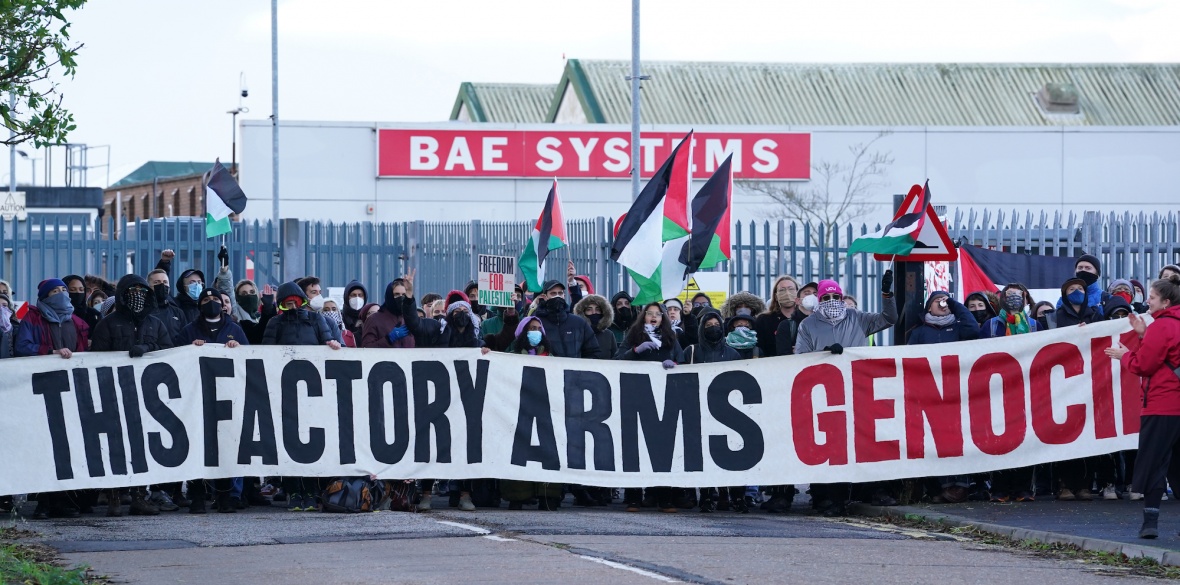
HUNDREDS of trade unionists disrupted operations at an arms factory in Kent today, blockading entrances and preventing workers and deliveries from entering the site.
More than 400 activists targeted a factory belonging to BAE Systems, a key weapons supplier to Israel, in protest over the country’s ongoing bombardment of Gaza.
United under the banner “Workers for a Free Palestine,” members of Unite, Unison, GMB, NEU, BMA, UCU, Bectu, and BFAWU, halted operations and called for an immediate ceasefire.
BAE Systems, the largest weapons firm in Britain, manufactures components for Israel’s F-35 stealth combat aircraft.
The fighter jets are currently being used in ongoing attacks against innocent civilians in Gaza, where the death toll has risen to more than 10,000.
Notably, the “active interceptor system,” which is used by pilots to direct and manoeuvre the aircraft, is also produced at the site in Kent.
Alexandra, a teacher and NEU member taking part in the blockade, said: “Seeing 185 schools and other educational institutions in Gaza bombed is utterly heartbreaking.
“If our government and the Labour opposition won’t support a ceasefire, as workers we will continue to take action to stop the slaughter of civilians in our name, funded by our taxes.
“The British arms industry, which is subsidised by public money, is involved in the mass killing of Palestinians.
“We’re here today to disrupt the Israeli war machine and take a stand against our government’s complicity and we urge workers across the UK to take similar action.”
LABOUR’S Gaza crisis has deepened after Imran Hussain became the party’s first front-bencher to resign over its backing for Israeli aggression, as Commons pressure mounted on the government to back a ceasefire.
Mr Hussain, who was shadow spokesman for a new deal for working people, told Labour leader Keir Starmer that he could no longer sit on the front bench in “good conscience.”
The Bradford East MP added: “Over recent weeks, it has become clear that my view on the ongoing humanitarian catastrophe in Gaza differs substantially from the position you have adopted.
“A ceasefire is essential to ending the bloodshed, to ensuring that enough aid can pass into Gaza and reach those most in need, and to help ensure the safe return of the Israeli hostages.”
His letter also condemned previous comments by Mr Starmer in a radio interview that Israel had the right to cut off water, food and power to the Gaza strip.
Sir Keir’s authority on the issue has suffered since, despite belated efforts to walk back his comments, with resignations taking place across the party.
The right to protest is a distinctive feature of democratic, liberal societies. Yet the way in which many leading British politicians are currently talking about Just Stop Oil might make you think otherwise. Far from engaging with the issues at stake in these protests, politicians appear to be encouraging the wider public to ignore them or even oppose them.
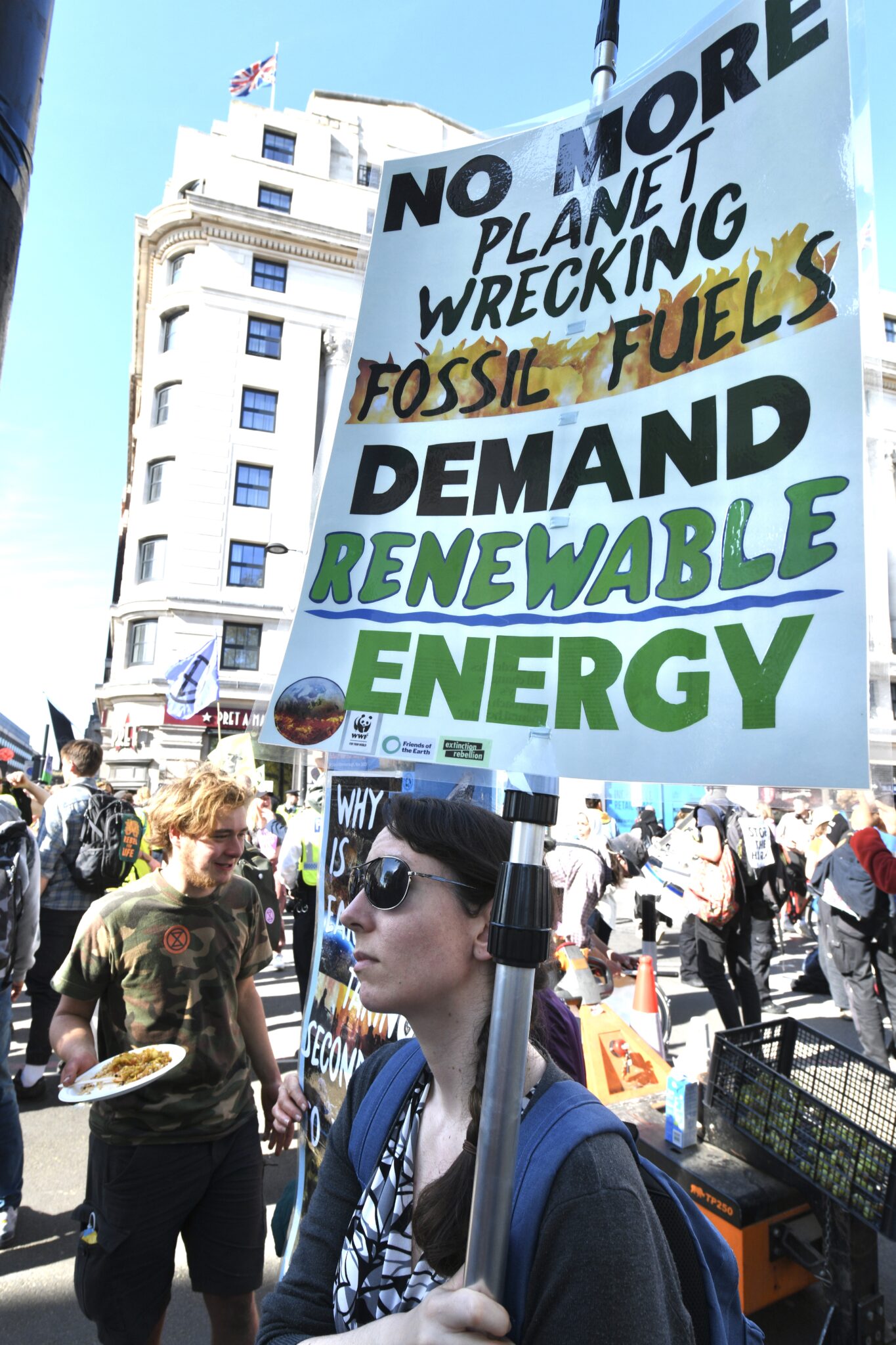
Extinction Rebellion protest, banner reads NO MORE PLANET WRECKING FOSSIL FUELS DEMAND RENEWABLE ENERGY
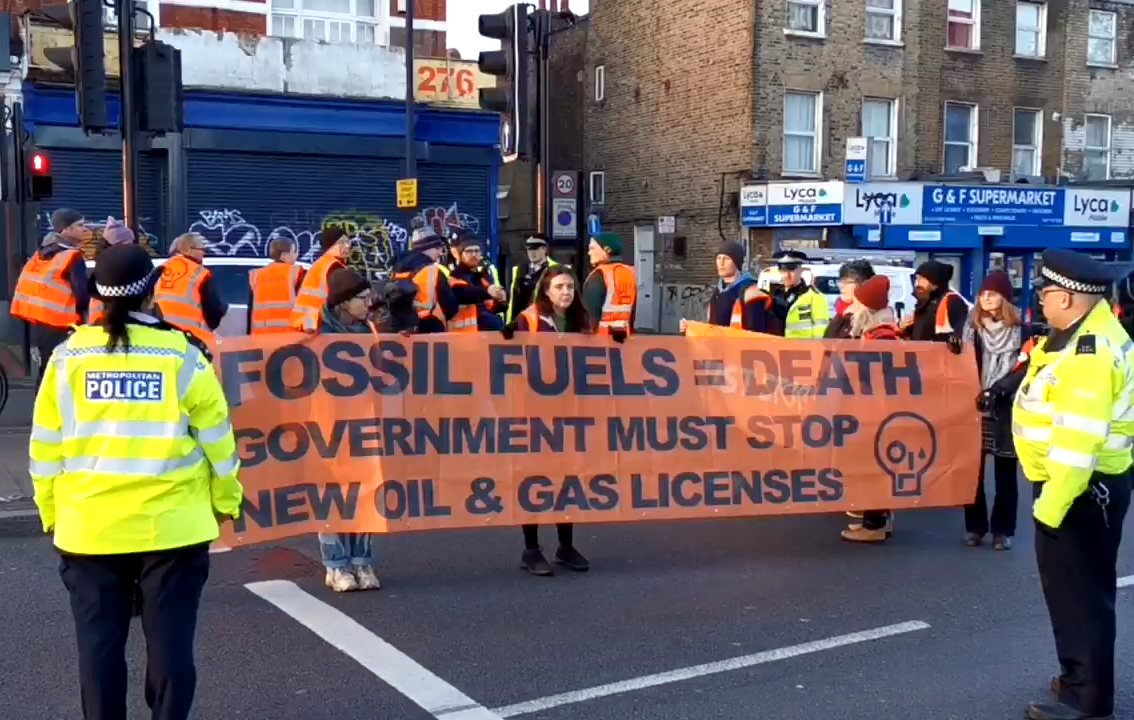
Having seen their initial protests largely ignored, Just Stop Oil members have been making more disruptive (but non-violent) protests lately. They’ve been present at high-profile sports events like Wimbledon and the World Snooker Championships.
Policing minister Chris Philp dismissed the temporary delays caused to such events as “completely unacceptable”. He argued that “the vast majority of the public are appalled by this very, very small, very selfish minority” and called on those not protesting to intervene.
With the UK government announcing new licences for oil and gas drilling in the North Sea, it’s clear that collective action that allows people to demonstrate their disagreement in peaceful ways is needed. In apparent contradiction to warnings about the climate crisis, Prime Minister Rishi Sunak’s commitment to the green agenda is wavering.
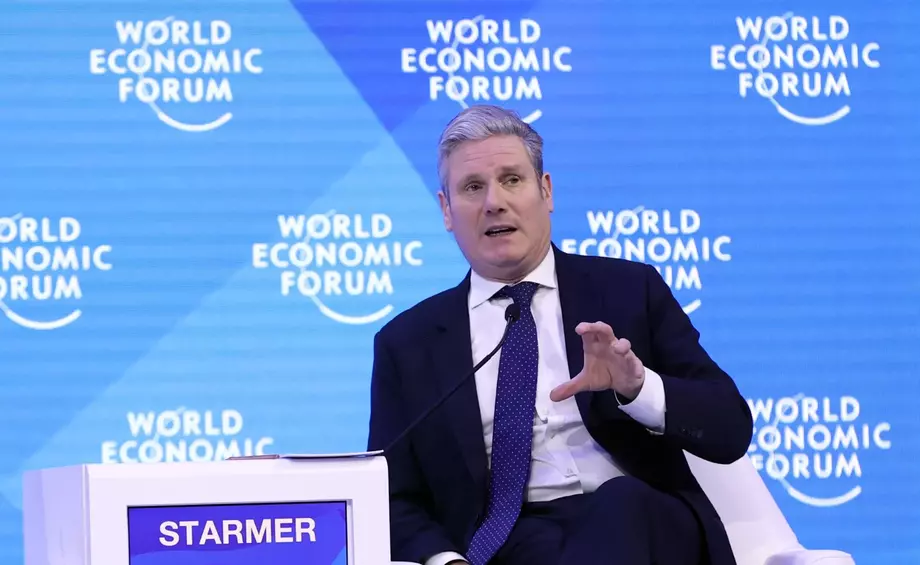
Meanwhile, Keir Starmer, the leader of the Labour party, has cancelled a plan to fund the transition from fossil fuels to green industries from the first day of government, should he win power. His response to criticism on this change was to turn on protesters.
He said: “The likes of Just Stop Oil want us to simply turn off the taps in the North Sea, creating the same chaos for working people that they do on our roads. It’s contemptible.”
Keir Starmer has deployed some divisive language about climate protestors of late. Prime Minister Rishi Sunak and Labour leader Keir Starmer. Credit: DeSmog via UK Parliament (CC BY 3.0)
Diverting the conversation
Referring to people defending the environment as a “minority” that acts against other citizens polarises society and marginalises protesters’ claims. It depicts people’s demands as somehow niche rather than amounting to a highly pressing threat to the majority.
One of the features of language is that when we talk, we only focus on one or, at most, a few aspects of a particular object or event. A lot will inevitably remain unsaid.
Still, when what remains unsaid is one of the most obvious elements of any given topic, what is missing becomes as informative as what was said. In this case, the focus on tactics instead of the substance of the protest betrays an unwillingness to engage with the climate crisis.
The government has put forward the home secretary Suella Braverman rather than the environment secretary to respond to the Just Stop Oil protests (itself a signal that they are seen as a public order issue more than anything else).
Braverman has referred to people protesting for environmental reasons as causing “havoc and misery”. Environment secretary Thérèse Coffey, meanwhile, doesn’t appear to have made any public statements regarding the matter.
To say that people are protesting and not mentioning the reason for the protest leaves the story incomplete. That’s something that rarely happens when UK politicians talk about protests in other countries.
But when talking about protests held in the UK, the debate looms over the disruption caused, as if the core message were secondary or even dispensable. It is only when the core message is ignored that politicians can refer to those acting in defence of human and nonhuman lives as “selfish”.
In the absence of meaningful political engagement, conversations about Just Stop Oil protests in the UK have strayed mainly into tactics and disruption at expense of their core message. However, politicians in democratic nations have a responsibility towards the electorate to engage properly with what citizens demand, not just with the way they make their claims heard.
Don’t have time to read about climate change as much as you’d like?
Shadow minister Imran Hussain quits Labour front bench over Starmer’s failure to call for a ceasefire in Gaza
“Over recent weeks, it has become clear that my view on the ongoing humanitarian catastrophe in Gaza differs substantially from the position you have adopted.”
…
Labour leader Keir Starmer has so far resisted calls for a ceasefire from within his own party, including from members of his shadow cabinet as well as from the Mayor of London Sadiq Khan, and Scottish Labour leader Anas Sarwar and the Mayor of Greater Manchester Andy Burnham. The Labour leader said that the terrorist group Hamas would be “emboldened” by a ceasefire, four weeks after it killed 1,400 people in Israel.
Announcing his resignation on X, formerly Twitter, Hussain wrote in his letter: “Over recent weeks, it has become clear that my view on the ongoing humanitarian catastrophe in Gaza differs substantially from the position you have adopted.
“A ceasefire is essential to ending the bloodshed, to ensuring that enough aid can pass into Gaza and reach those most in need, and to help ensure the safe return of the Israeli hostages.”
He added that the cutting of food, water, power, and medicine to Palestinians in Gaza is an act of collective punishment that violates international law and is a ‘clear war crime’.
Some 13 of the 31 members of Labour’s shadow cabinet have received donations from a prominent pro-Israel lobby group or individual funder, it can be revealed.
The list of recipients includes party leader Keir Starmer, his deputy Angela Rayner, shadow foreign secretary David Lammy, and even the former vice-chair of Labour Friends of Palestine, Lisa Nandy, who is now shadow international development minister.
These donations were provided by Labour Friends of Israel (LFI), a pro-Israel lobby group which takes MPs on “fact-finding” missions to the region, and Sir Trevor Chinn, a multi-millionaire business tycoon and long-time pro-Israel lobbyist.
More than half of Starmer’s shadow cabinet are listed as parliamentary supporters or officers of LFI.
…
Pro-Israel lobbying
Sir Trevor Chinn is a British multi-millionaire who has spent decades working in the motor industry, chairing such organisations as the AA, the RAC, and Kwikfit.
Chinn is also a longstanding pro-Israel lobbyist. Since the 1980s, he has funded LFI and Conservative Friends of Israel and played a leading role in groups such as Britain Israel Communications and Research Centre (BICOM) and the Jewish Leadership Council.
The Guardiandescribed BICOM in 2009 as “Britain’s most active pro-Israeli lobbying organisation – which flies journalists to Israel on fact-finding trips and organises access to senior government figures”.
It added that the organisation had “received nearly £1.4m in two years from a billionaire donor whose father made a fortune manufacturing arms in Israel”, referring to Poju Zabludowicz, a London-based business tycoon.
Starmer received a £50,000 donation from Chinn during his campaign for the Labour leadership in 2020 – and failed to declare this until after he’d won the election.
Declassified has found that Chinn has donated to eight other members of the shadow cabinet, including Rayner, Lammy, Reeves, Streeting, shadow education secretary Bridget Phillipson, shadow work and pensions secretary Liz Kendall, and shadow environment secretary Steve Reed.