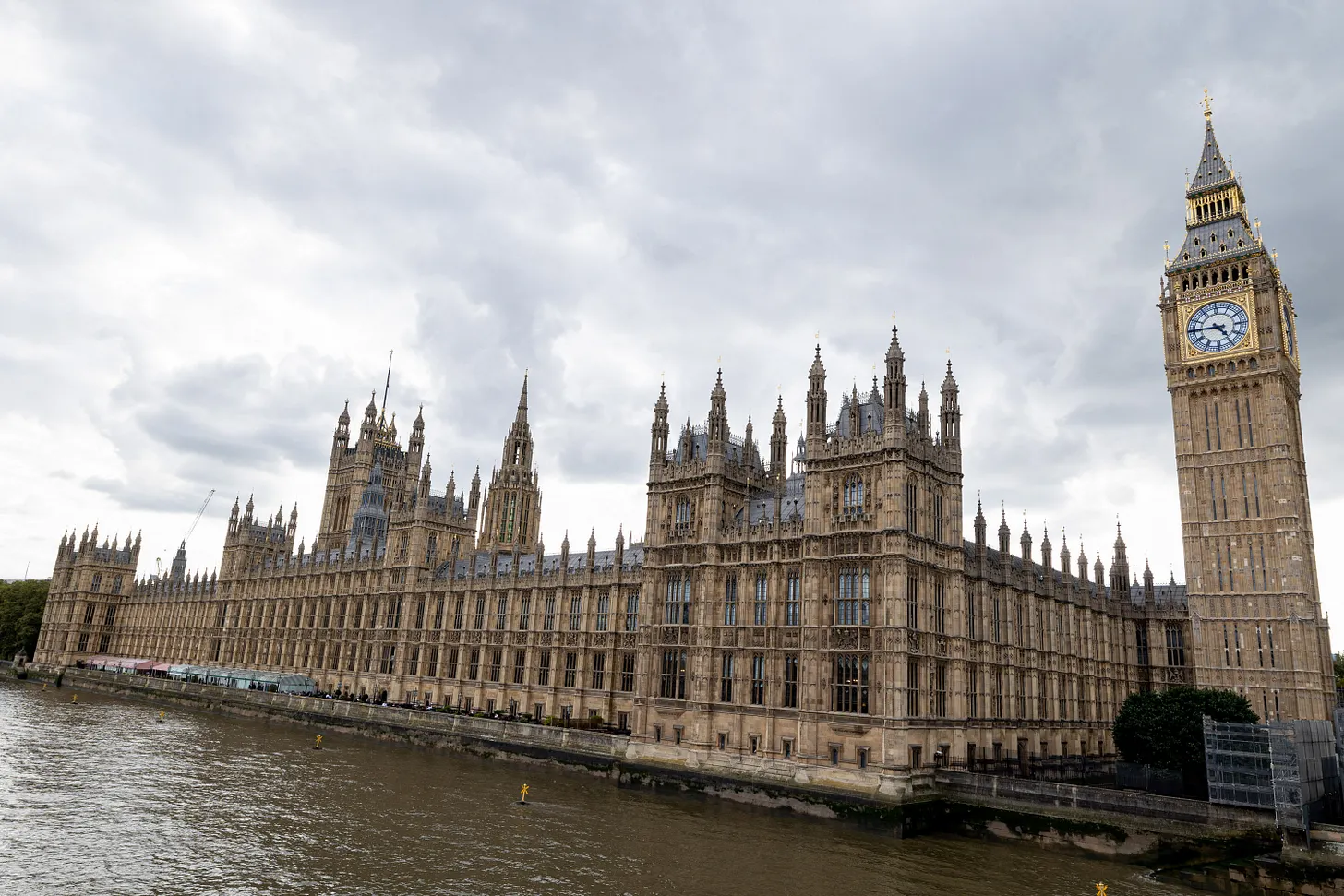
The UK Parliament, London. Photo by Hesther Ng/SOPA Images/Sipa USA via Reuters
Starmer is rushing legislation through parliament that experts say threatens free speech, public interest journalism and international humanitarian aid
Sir Keir Starmer’s historically unpopular and soon-to-be-replaced administration is using its last gasps to push through a new national security law that experts believe will pose serious threats to free speech, public interest journalism and the provision of international humanitarian aid.
The new legislation, called the national security (state threats) bill, is intended to update existing national security legislation. It has been introduced by the current home secretary, Shabana Mahmood. Mahmood is widely seen as a hardliner in Starmer’s government, responsible for introducing tougher restrictions on the settlement rights of asylum seekers and immigrants. The bill has been rushed through the Commons and is now being pushed at pace through the Lords. The government wants to have the law on the statute books within weeks.
…
Free speech and press freedom groups argue that the bill threatens public interest journalism – a view endorsed by two independent reviewers of terrorism legislation. David Anderson, the government’s former independent reviewer, has said that journalists would be “at risk of prosecution if they were to have contact of any kind with sources within designated bodies or their agents”. Any journalist who works with a source in a hostile foreign government, or simply approaches them for information, could face more than a decade in prison.
Jonathan Hall, the government’s current independent reviewer, has raised similar concerns. He has pushed for the law to include a “reasonable excuse” defence covering the exchange of information.
The practical implications of the bill for journalism are wide-ranging and devastating.
This work by Middle East Monitor is licensed under a Creative Commons Attribution-NonCommercial-ShareAlike 4.0 International License.
Iranian President Masoud Pezeshkian delivers a speech during the “Leader of Resistance: Imam Khomeini International Conference” in Tehran, Iran, on July 4, 2026. [Iranian Presidency / Handout – Anadolu Agency]
Iranian President Masoud Pezeshkian on Saturday criticised international institutions for what he described as their failure to stop Israeli actions in the region, saying global bodies have remained silent while Israel openly speaks of assassinations and targeted killings, Anadolu reports.
Speaking at a conference in Tehran’s Summit Hall held in commemoration of slain former Supreme Leader Ali Khamenei, Pezeshkian said international organisations and human rights advocates were expected to prevent such actions, but instead political and logistical support was being provided.
He said Israel attacked multiple countries in the region and was responsible for many of the crises and instability across the Middle East, adding that Muslim countries had not initiated such aggression.
Pezeshkian also referred to the beginning of a “new leadership” for the Islamic community, saying the current leadership bears a heavy responsibility and that his government would continue working toward the ideals of the revolution, strengthening Islamic unity and expanding solidarity among Muslim nations.
The remarks came as funeral ceremonies for Khamenei got underway in Tehran, where thousands of mourners gathered at the Imam Khomeini Mosalla Mosque.
Khamenei was killed in joint US-Israeli strikes on Iran on Feb. 28, which triggered weeks of war before a ceasefire was reached under Pakistan’s mediation in April, followed by an interim deal in June.
According to the official schedule, memorial ceremonies will continue in Tehran through the weekend with the participation of heads of state, senior officials and religious figures.
Public farewell ceremonies are scheduled for Saturday and Sunday, followed by the main funeral procession in Tehran on Monday. The funeral rites will then move to Qom on July 7.
On July 8, ceremonies are scheduled in Iraq, including in Baghdad, Najaf and Karbala, where the body will be received by religious and political figures before being transferred to major Shia shrines.
The final funeral and burial ceremony is scheduled for July 9 at the Imam Ali Reza Shrine in the northeastern city of Mashhad, one of Shia Islam’s holiest sites.
This work by Middle East Monitor is licensed under a Creative Commons Attribution-NonCommercial-ShareAlike 4.0 International License.
This work by Middle East Monitor is licensed under a Creative Commons Attribution-NonCommercial-ShareAlike 4.0 International License.
Iran’s UN ambassador Kazem Gharibabadi in Vienna, Austria on 10 July 2019 [Aşkın Kıyağan/Anadolu Agency]
Iran’s Deputy Foreign Minister Kazem Gharibabadi on Saturday said the Strait of Hormuz “is not a stage for extra-regional powers to display military force,” warning against “any military activity” in the key waterway, Anadolu reports.
“The Strait of Hormuz is not a stage for extra-regional powers to display military force.
“As a responsible power and the guarantor of security in the strait, Iran warns against any military activity in this sensitive waterway,” Gharibabadi wrote on US social media company X.
His remarks came in a post in which he shared a UK-France joint statement on the Strait of Hormuz, saying the two countries “stand ready to deploy the wider Multinational Military Mission to support freedom of navigation” in the waterway.
In response, Gharibabadi said the strait’s security “rests with the littoral states.”
“Those who create crises will bear responsibility for the consequences of their adventurism. This is a serious warning,” he added.
A memorandum of understanding between Iran and the US, brokered under Pakistani mediation, entered into force on June 18 after being electronically signed by Iranian President Masoud Pezeshkian and US President Donald Trump.
It provides a framework for ending the conflict and addressing outstanding issues between Tehran and Washington through negotiations, including a cessation of hostilities, sanctions relief, the nuclear issue, the reopening of the Strait of Hormuz, and broader regional security arrangements.
This work by Middle East Monitor is licensed under a Creative Commons Attribution-NonCommercial-ShareAlike 4.0 International License.
U.S. President Donald Trump (R) welcomes Israeli Prime Minister Benjamin Netanyahu (L) at his Mar-a-Lago residence in Florida, United States on December 29, 2025. [Amos Ben-Gershom (GPO)/Handout – Anadolu Agency]
Trump and Netanyahu need each other more than they trust each other — and that mutual need, not any shared conviction, is the only thing still holding the alliance together.
There is an old parable about two scorpions in a jar. Neither can leave. Neither trusts the other. And sooner or later, one strikes, not because it wants to kill the other, but because the jar has become unbearable.
Donald Trump and Benjamin Netanyahu are those scorpions now, and the jar is the wreckage of the Middle East they built together.
For the better part of a year, they marched in locked steps. One man’s appetite for spectacle matched by the other’s genius for making disaster look like deliverance. Netanyahu persuaded Trump that Iran could be shattered quickly, cleanly, at no real cost. Trump believed him because believing him was easier than doubting him, and doubt has never been a currency Trump trades in. The war came. But Iran did not break. And when the bill arrived, it was delivered to Trump’s door, not Netanyahu’s.
John Mearsheimer of the University of Chicago, who has spent a career mapping the architecture of American deference to Israeli interests, put the verdict as bluntly as a man of his discipline allows:
Netanyahu convinced Trump the war would be short and decisive, and Trump, in Mearsheimer’s words, was foolish enough to believe him.
Elsewhere, Mearsheimer has been blunter still, arguing flatly that Israel and its lobby own Trump,
and that the President has demonstrated, repeatedly, a willingness to dance to Jerusalem’s tune.
Then came Lebanon, and with it the profanity that told the truth polite diplomacy never does. Reports of a fifteen-minute call, confirmed by Trump himself, describe the President screaming at Netanyahu, demanding to know what the hell he was doing. He called Netanyahu “crazy,” reminded him that he would be sitting in prison were it not for American protection, and scolded him in the most excruciating language, that the world now despised him for it. This is not the language of alliance. It is the language of a landlord screaming at a tenant who has torched the building and still expects a reference letter.
Netanyahu absorbed the insult silently, the way he absorbs everything, with a statement insisting nothing had changed, that Israel’s “position remains the same,” even as his troops turned back from Beirut on Trump’s order. One American official described the call more crudely: Trump had steamrolled him, and all the great warrior-statesman could manage in reply was a chastened “OK, OK”. This isn’t how empires normally treat client states, but this was never a partnership of equals. It is, as Jeffrey Sachs of Columbia University observes, the latest chapter in a decades-long bid for regional dominance. In this script, Netanyahu and the architects of Greater Israel are the sole victors; everyone else is left with the ashes. Sachs does not flinch from naming the architecture. The war on Iran, he argues, was never separate from the older “Clean Break” doctrine first sketched in 1996, a blueprint for regime-change wars with Washington cast as the enforcement arm of Israeli strategy. In that reading, Trump is not a partner but an instrument, wielded by a prime minister facing indictment at home and a coalition that cannot survive a genuine peace.
Gideon Levy of Haaretz, writing from inside Israel’s collapsing consensus, sees the same rot from the other direction. He has warned that Israel follows Netanyahu mindlessly toward a reckoning it has not yet allowed itself to imagine, and that the U.S.-Israel relationship itself is nearing its breaking point. Even Thomas Friedman, hardly a radical, has confessed to being torn, rooting against the Iranian regime while dreading what its defeat would do for two men, he flatly calls terrible people, “alleged crooks” running “anti-democratic projects” in their own countries.
Phyllis Bennis of Institute for Policy Studies frames the arrangement in the coldest terms available: not statesmanship, but real-estate logic: a transactional partnership between a president with no re-election ahead of him but a legacy to launder, and a prime minister facing an October election and a courtroom he has spent years trying to outrun.
Both men need a win they cannot contrive through governance, so they manufacture it through war. Both are impeachable, indictable, and disposable to the very coalitions that elevated them.
AIPAC, the Israeli religious right, and the Republican Zionist bloc in the U.S. Senate are Netanyahu’s insurance policy. Miriam Adelson’s checkbook and the MAGA base are Trump’s. Each man is one betrayal away from being fed to those bases as a sacrifice, and each of them knows it.
This is why the scorpion metaphor holds. Two men who need each other to survive politically are also the two men most capable of mortally stinging each other. Trump has already shown he will humiliate Netanyahu the moment the war stops being useful to him. Netanyahu has already shown he will defy Trump’s orders the moment his coalition demands it. The sting, when it finally comes, will not be ideological. It will be self-preservation, dressed up as principle, in a jar built from the bones of Lebanon, Gaza, and Iran, while the region, and the truth, are left to rot in the glass along with them.
This work by Middle East Monitor is licensed under a Creative Commons Attribution-NonCommercial-ShareAlike 4.0 International License.
Palestinian Christians attend a Christmas Mass at the Holy Family Church with Latin Patriarch of Jerusalem Cardinal Pierbattista Pizzaballa taking part in the service amid Israel’s blockade, in Gaza City, Gaza, on December 21, 2025. [Khames Alrefi – Anadolu Agency]
This April to June saw 83 Israeli attacks on Christians in Israel or Israeli-occupied territories in 76 incidents, most of them in Jerusalem, according to a report released Friday, Anadolu reports.
The report was issued by Israel’s Religious Freedom Data Center (RFDC) and the its Hotline for Documenting Harassment against Christians in Israel, a nongovernmental center specializing in documenting attacks related to freedom of worship.
According to the report, 68 incidents took place inside Jerusalem, a city also revered by Christians. Two incidents were recorded in Haifa and the Galilee in northern Israel, one in the Sea of Galilee area, one in the West Bank, one in Beit Shemesh west of Jerusalem, and two in Mevaseret Zion west of Jerusalem. The report did not give the location of the remaining incident.
Of the 68 incidents recorded in Jerusalem, 46 took place in the Old City, 13 in West Jerusalem and nine on Mount Zion, a historic hill southwest of the Old City, the report said.
“As in previous reports, the high number of spitting incidents remains particularly striking. During this quarter, 47 incidents involved spitting, accounting for 56% of all recorded forms of harassment,” the RFDC said.
“In recent years, these acts have increasingly taken place openly, in broad daylight, and at times in a deliberately demonstrative manner. In several cases, perpetrators even explained to Hotline volunteers—and on camera—why they believed such behavior was justified,” it added.
The center said reported incidents included Israeli parents spitting and directing insults in front of their children, and encouraging them to do the same.
As in previous years, the report noted a sharp increase in incidents during Jerusalem Day and the Flag March (28 Iyar on the Hebrew calendar), an annual Israeli event marking the occupation of East Jerusalem.
“While some incidents involved individuals acting alone, moving in groups appeared to encourage spitting and similar acts,” the report says.
The report said harassment and attacks are increasingly taking place openly in public spaces, with little hesitation from perpetrators. It cited a violent assault on a nun on Mount Zion and verbal abuse directed at a monk in a store.
The center says on its website that the reality in the Christian Quarter and the Old City of Jerusalem has long been sensitive and full of challenges and complexities, but that the situation changed radically for the worse in early 2023 with a rise in harassment.
In April, Israeli police prevented Pierbattista Pizzaballa, the Latin patriarch of Jerusalem, from reaching the Church of the Holy Sepulchre in East Jerusalem during Christian holidays, and imposed restrictions on Christians taking part in Easter celebrations at the church.
In recent years, Israeli extremists have been involved in spitting incidents targeting churches and Christian clergy in Jerusalem, along with attacks on holy sites in Jerusalem and the West Bank and the targeting of churches in the Gaza Strip during Israel’s war that started in October 2023.
Churches around the world have also criticized Israel’s recent wars on Gaza, Lebanon, and Iran, warning of their humanitarian and religious consequences.
This work by Middle East Monitor is licensed under a Creative Commons Attribution-NonCommercial-ShareAlike 4.0 International License.