Category: fake manufactured terrorism

  • ‘Moral and Political Debacle’: Right-Wing Media, CEOs Urge Trump to Stop Deadly ICE Crackdown

    Spread the love

    Original article by Brett Wilkins republished from Common Dreams under Creative Commons (CC BY-NC-ND 3.0).
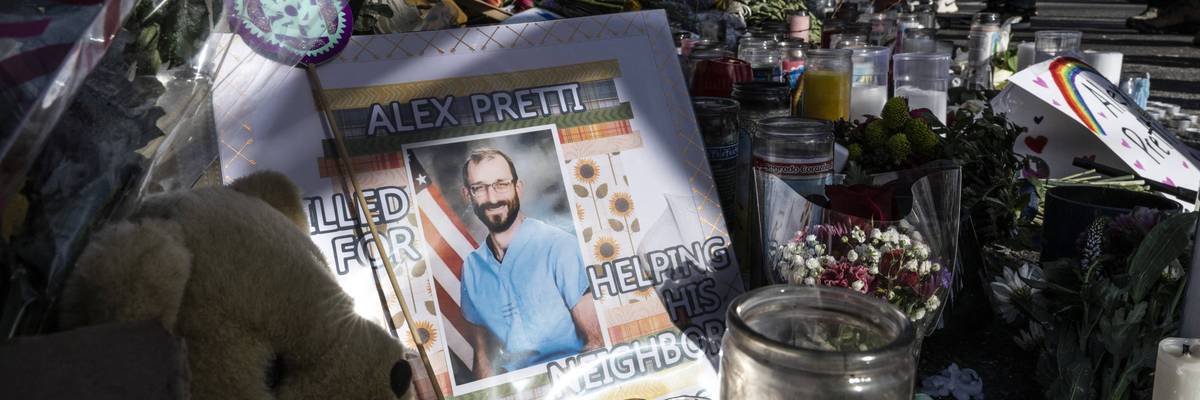
    An image of Alex Pretti is seen at a makeshift memorial in the area where he was shot dead by federal immigration agents in Minneapolis, Minnesota, on January 24, 2026. (Photo by Roberto Schmidt/AFP via Getty Images)

    “The American people didn’t vote for these scenes and you can’t continue to order them to not believe their lying eyes,” the New York Post editorial board wrote.

    “The Trump administration spin on this simply isn’t believable.”

    That’s what the editorial board of the right-wing Wall Street Journal wrote Sunday calling for a “pause” in Immigration and Customs Enforcement’s (ICE) anti-immigrant blitz following Saturday’s killing of 37-year-old intensive care nurse Alex Petti—who was disarmed before being shot by federal agents in Minneapolis—and top administration officials’ claims that the man who helped save US military veterans’ lives was a “domestic terrorist.”

    RECOMMENDED…
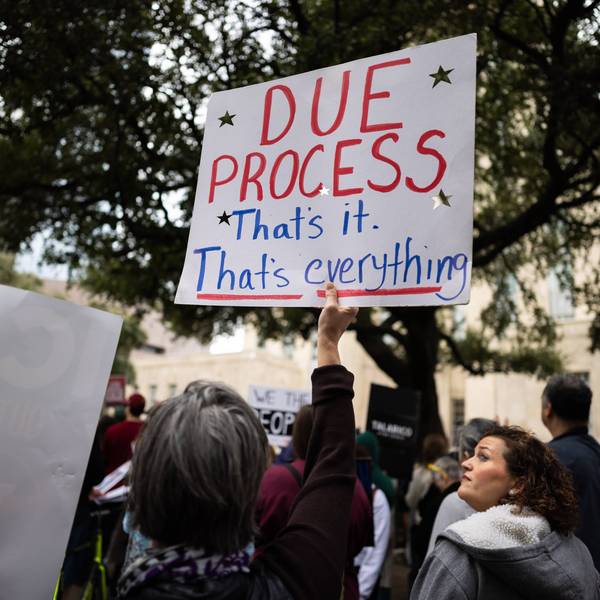
    Sign reads, ''Due process: That's it. That's everything.'' during an anti-ICE demonstration at Houston City Hall

    ‘Fucking Insane’: Journalist Finds at Least 2,300 Illegal ICE Detentions Since July
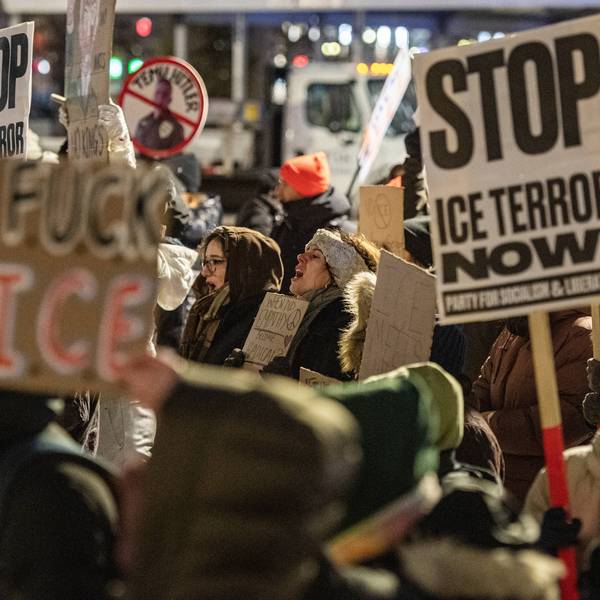
    US-POLITICS-PROTEST

    ‘A Surrender to Trump’s Lawlessness’: Democrats Warned Against Giving ICE More Money

    The Journal‘s editors called Pretti’s killing “the worst incident to date in what is becoming a moral and political debacle” for President Donald Trump and his administration.

    The Journal wasn’t alone. Other right-wing outlets owned by the Murdoch media empire, including the New York Post, published editorials calling for a suspension of Trump’s crackdown on undocumented immigrants, during which dozens of people have died in ICE custody and federal enforcers have killed two Americans. Even staunchly pro-Trump Fox News challenged administration officials over the shooting.

    “It’s time to de-escalate in Minneapolis, Mr. President,” the Post‘s editorial board wrote Sunday.

    “Not because you’re wrong to enforce immigration law, nor to go after fraudsters who’ve stolen billions in federal funds—but because these enforcement tactics won’t turn the tide, and instead are backfiring,” the editors clarified. “Swing voters—Hispanics and independents who turned to you at the last election—see US citizens dying at federal agents’ hands, and recoil in horror.”

    “The hasty and misleading rhetoric coming out of the administration needs to stop,” the Post said. “And while Pretti was horribly misguided, there is no evidence he was a ‘terrorist’ intent on a ‘massacre’ of law enforcement.”

    https://twitter.com/moorehn/status/2015811427995382054?ref_src=twsrc%5Etfw%7Ctwcamp%5Etweetembed%7Ctwterm%5E2015811427995382054%7Ctwgr%5Ec5a177b8db3675a50941784d0aa5dd1464c963c1%7Ctwcon%5Es1_c10&ref_url=https%3A%2F%2Fwww.commondreams.org%2Fnews%2Fconservative-pushback-alex-pretti

    As they did with Renee Good, the 37-year-old mother and poet who was shot dead by an ICE agent in Minneapolis earlier this month, Trump and some of his senior officials accused Pretti of being a “domestic terrorist”—a move in line with the administration’s designation of left-wing activism as terrorism.

    US Border Patrol Commander Gregory Bovino said that it looked like Pretti—who eyewitnesses said died while trying to help a woman who had been pepper-sprayed by ICE—“wanted to do maximum damage and massacre law enforcement.”

    White House Deputy Chief of Staff Stephen Miller attempted to smear Pretti as an “assassin” who “tried to murder federal agents.”

    Homeland Security Secretary Kristi Noem accused Pretti of “domestic terrorism.”

    As the Wall Street Journal‘s editors put it, “Alex Pretti made a mistake, but he wasn’t a ‘domestic terrorist.’”

    “Videos of an event aren’t always definitive, but this is how it looks to us,” they wrote. “Pretti attempted, foolishly, to assist a woman who had been pepper-sprayed by agents. Multiple agents then tackled Pretti, and he had a phone in one hand as he lay on the ground. An agent discovered a concealed gun on Pretti, and disarmed him. An agent then shot Pretti, and multiple shots followed.”

    The Post editors concluded, “Mr. President, the American people didn’t vote for these scenes, and you can’t continue to order them to not believe their lying eyes.”

    Meanwhile, more than 60 CEOs of Minnesota-based companies including Target, Best Buy, UnitedHealth, 3M, and General Mills published an open letter Sunday calling for “an immediate deescalation of tensions and for state, local, and federal officials to work together to find real solutions.”

    Gun rights groups including the National Rifle Association have called for a full investigation of Pretti’s killing. The NRA pushed back against arguments that Pretti should not have brought a gun—which he was legally carrying—to a protestcalling such assertions “dangerous and wrong.”

    “Responsible public voices should be awaiting a full investigation, not making generalizations and demonizing law-abiding citizens,” added the NRA, which was criticized for its initial silence following the killing of Philando Castile, a Black man who was legally carrying a gun when he was shot dead by police in front of his girlfriend and her 4-year-old daughter during a 2016 traffic stop in suburban Minneapolis.

    Even Republican lawmakers who support Trump have expressed their dismay over Pretti’s killing, with Sen. Bill Cassidy of Louisiana calling the incident “incredibly disturbing.”

    Chris Madel, an attorney who provided legal counsel to Jonathan Ross—the ICE agent who killed Good—was, until Monday, also a Republican candidate for Minnesota governor. However, Madel said that he dropped out of the race and implied that he would quit the GOP because he “cannot support the national Republicans’ stated retribution on the citizens of our state.”

    “Nor can I count myself a member of a party that would do so,” he said.

    “ United States citizens, particularly those of color, live in fear,” Madel continued. “United States citizens are carrying papers to prove their citizenship. That’s wrong.”

    “At the end of the day, I have to look my daughters in the eye and tell them I believe I did what is right,” he added. “I am doing that today.”

    Original article by Brett Wilkins republished from Common Dreams under Creative Commons (CC BY-NC-ND 3.0).

    Elon Musk urges you to be a Fascist like him, says that you can ignore facts and reality then.
    Elon Musk urges you to be a Fascist like him, says that you can ignore facts and reality then.
    Donald Fuhrump says that Amerikkka doesn't bother with crimes or charges anymore, not being 100% Amerikkkan and opposing his real estate intentions is enough.
    Donald Fuhrump says that Amerikkka doesn’t bother with crimes or charges anymore, not being 100% Amerikkkan and opposing his real estate intentions is enough.
    Orcas discuss how Trump was re-elected and him being an obviously insane, xenophobic Fascist.
    Orcas discuss how Trump was re-elected and him being an obviously insane, xenophobic Fascist.

  • Greta Thunberg arrested supporting Palestine Action hunger strikers in London

    Spread the love
    Orcas discuss Genocide-supporting and complicit Zionists. Donald Trump, Keith Starmer, David Lammy, Rachel Reeves, Angela Rayner and Wes Streeting are acknowledged as evil genocide-complicit and supporting cnuts.
    Orcas discuss Genocide-supporting and complicit Zionists. Donald Trump, Keith Starmer, David Lammy, Rachel Reeves, Angela Rayner and Wes Streeting are acknowledged as evil genocide-complicit and supporting cnuts.
    Keir Starmer objects to criticism of the IDF. He asks how could anyone object to them starving people to death, forced marches like the Nazis did, bombing Gaza's hospitals and universities, mass-murdering journalists, healthworkers and starving people queuing for food, killing and raping prisoners and murdering children. He calls for people to stop obstructing his genocide for Israel.
    Keir Starmer objects to criticism of the IDF. He asks how could anyone object to them starving people to death, forced marches like the Nazis did, bombing Gaza’s hospitals and universities, mass-murdering journalists, healthworkers and starving people queuing for food, killing and raping prisoners and murdering children. He calls for people to stop obstructing his genocide for Israel.
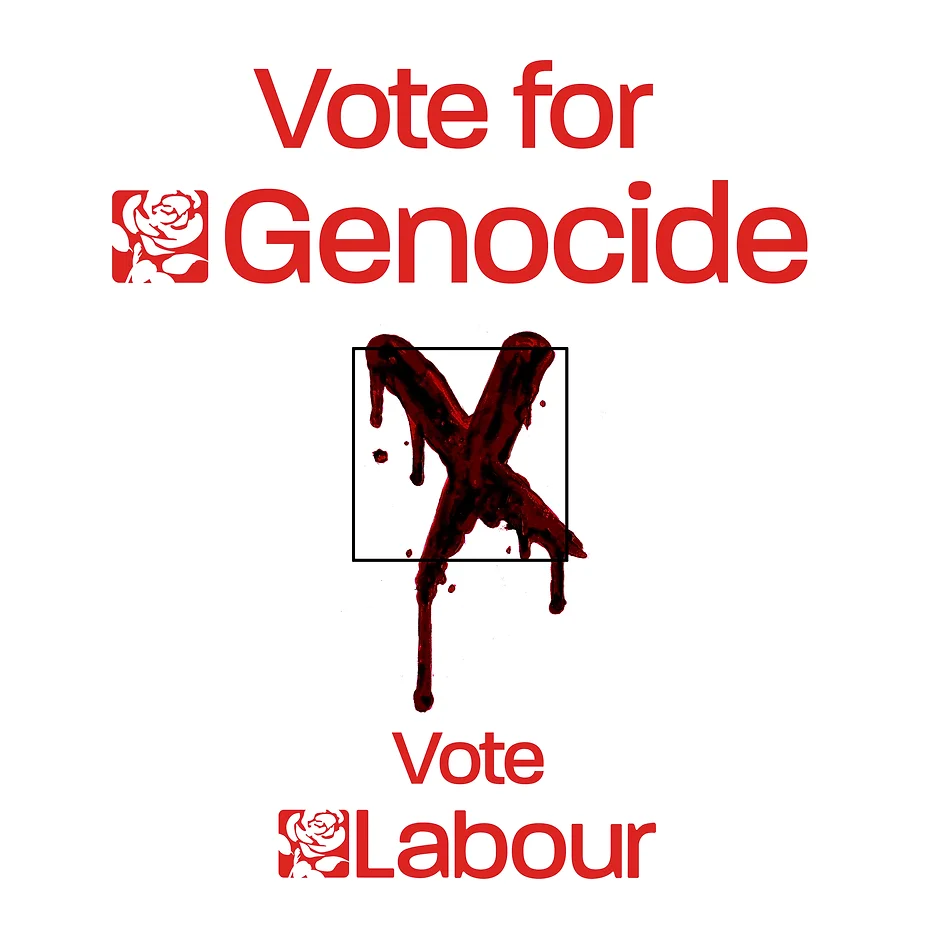
    Vote Labour for Genocide.
    Vote Labour for Genocide.

  • ‘Throwback to McCarthyism’: Trump DOJ Moves to Treat Leftist Dissent as Criminal

    Spread the love

    Original article by Stephen Prager republished from Common Dreams under Creative Commons (CC BY-NC-ND 3.0).

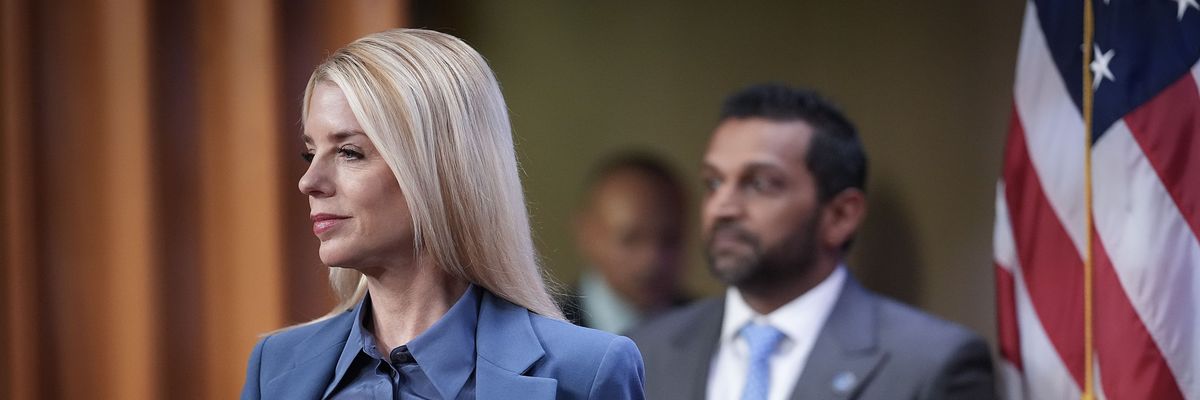
    Attorney General Pam Bondi and FBI Director Kash Patel arrive for a news conference at the Department of Justice on December 4, 2025, in Washington, DC. (Photo by Andrew Harnik/Getty Images)

    A former official from Trump’s first term said the FBI will be able to throw the full might of the surveillance state at “Americans whose primary ‘offense’ may be ideological dissent.”

    The Trump administration is about to embark on a massive crackdown on what it describes as a scourge of rampant left-wing “terrorism.”

    But the US Department of Justice (DOJ) memo ordering the crackdown has critics fearing it will go far beyond punishing those who plan criminal acts and will instead be used to criminalize anyone who expresses opposition to President Donald Trump and his agenda.

    RECOMMENDED…

    Dem Senator Raises Alarm About Trump Bringing 'Illegal and Dangerous Misuse of Lethal Force' to Domestic Foes

    Dem Senator Raises Alarm About Trump Bringing ‘Illegal and Dangerous Misuse of Lethal Force’ to Domestic Foes

    President Trump Returns To D.C. After Spending Thanksgiving Weekend In Florida

    Report Tracks Trump ‘War on Free Speech’ and Urges Systemic Resistance

    Earlier this month, independent journalist Ken Klippenstein reported that Attorney General Pam Bondi had sent out a memo ordering the FBI to “compile a list of groups or entities engaging in acts that may constitute domestic terrorism.”

    As part of this effort, Bondi set Thursday as a deadline for all law enforcement agencies to “coordinate delivery” of intelligence files related to “antifa” or “antifa-related activities” to the FBI.

    The memo identifies those who express “opposition to law and immigration enforcement; extreme views in favor of mass migration and open borders; adherence to radical gender ideology,” as well as “anti-Americanism,” “anti-capitalism,” and “anti-Christianity,” as potential targets for investigation.

    This language references National Security Presidential Memorandum-7, or NSPM-7, a memo issued by Trump in September, which identified this slate of left-wing beliefs as potential “indicators” of terrorism following the assassination of right-wing activist Charlie Kirk in September.

    In comments made before the alleged shooter’s identity was revealed, Trump attributed the murder to “those on the radical left [who] have compared wonderful Americans like Charlie to Nazis,” adding that “this kind of rhetoric is directly responsible for the terrorism that we’re seeing in our country and must stop right now.”

    Weeks after Kirk’s shooting, Trump designated “antifa” as a “domestic terrorism organization,” a move that alarmed critics because “antifa,” short for “anti-fascist,” is a loosely defined ideology rather than an organized political group.

    Senior Trump adviser Stephen Miller, meanwhile, promised that the Trump administration would use law enforcement to “dismantle” left-wing groups he said were “fomenting violence.” He suggested that merely using heated rhetoric—including calling Trump and his supporters “fascist” or “authoritarian”—“incites violence and terrorism.”

    Klippenstein said that “where NSPM-7 was a declaration of war on just about anyone who isn’t MAGA,” the memo that went into effect Thursday “is the war plan for how the government will wage it on a tactical level.”

    In comments to the Washington Post, former FBI agent Michael Feinberg, who is now a senior editor at Lawfare, said it was “a pretty damn dangerous document,” in part because “it is directed at a specific ideology, namely the left, without offering much evidence as to why that is necessary.”

    Studies have repeatedly shown that while all political factions contain violent actors, those who commit acts of political violence are vastly more likely to identify with right-wing causes.

    Miles Taylor, who served as chief of staff for the Department of Homeland Security under the first Trump administration, pointed out in a blog post the extraordinary surveillance capability that the FBI will have at its disposal to use against those it targets.

    He said it “includes the FBI’s ability to marshal facial recognition, phone-tracking databases, license-plate readers, financial records review, undercover operations, and intelligence-sharing tools against Americans whose primary ‘offense’ may be ideological dissent.”

    “Unfortunately, once you are fed into that system, there is no real ‘due process’ until charges are brought,” Taylor said. “It’s not like you get a text-message notification when the FBI begins investigating you for terrorism offenses, and there’s certainly no ‘opt-out’ feature. For this to happen, you don’t need to commit violence. You don’t even need to plan it. Under the administration’s new guidelines, you merely need to be flagged for association with the anti-fascist movement to become a potential target.”

    Sen. Ron Wyden (D-Wash.), a member of the Senate Intelligence Committee, told the Post, “It is a throwback to McCarthyism and the worst abuses of [Former FBI Director J. Edgar] Hoover’s FBI to use federal law enforcement against Americans purely because of their political beliefs or because they disagree with the current president’s politics.”

    Taylor argued: “He’s right, but it’s actually more dangerous than that. Joseph McCarthy had subpoenas and hearings and created his blacklists of ‘communist’ Americans from Capitol Hill. And while controversial FBI Director J. Edgar Hoover may have had old-school wiretaps and informants, Donald Trump’s team has algorithmic surveillance, bulk data collection, and a post-9/11 security state designed for permanent emergency. It’s like comparing a snowflake with a refrigerator.”

    Original article by Stephen Prager republished from Common Dreams under Creative Commons (CC BY-NC-ND 3.0).

    Keir Starmer warns against following the https://onaquietday.org blog.
    Keir Starmer warns against following the https://onaquietday.org blog.
    Elon Musk urges you to be a Fascist like him, says that you can ignore facts and reality then.
    Elon Musk urges you to be a Fascist like him, says that you can ignore facts and reality then.
    Donald Fuhrump says that Amerikkka doesn't bother with crimes or charges anymore, not being 100% Amerikkkan and opposing his real estate intentions is enough.
    Donald Fuhrump says that Amerikkka doesn’t bother with crimes or charges anymore, not being 100% Amerikkkan and opposing his real estate intentions is enough.
  • ‘Total Amateur Hour’: FBI Official Says Antifa Is #1 Threat in US—But Can’t Say Where, Who, or What It Is

    Spread the love

    Original article by Brad Reed republished from Common Dreams under Creative Commons (CC BY-NC-ND 3.0). 

    Operations Director of the National Security Branch at the Federal Bureau of Investigation Michael Glasheen testifies before the House Committee on Homeland Security on December 11, 2025 in Washington, DC. (Photo by Anna Moneymaker/Getty Images)

    “Just a complete admission here that the entire ‘antifa’ threat narrative is totally manufactured by this administration,” said one critic.

    A top FBI official struggled on Thursday to answer basic questions about antifa, a loosely organized collective of anti-fascist activists that he labeled the top terrorist threat facing the US.

    Michael Glasheen, operations director of the FBI’s National Security Branch, testified before the US House Committee on Homeland Security that antifa was “the most immediate violent threat” facing Americans today when it comes to domestic terrorism.

    RECOMMENDED…

    Leaked Memo Shows Pam Bondi Wants List of 'Domestic Terrorism' Groups Who Express 'Anti-American Sentiment'

    Leaked Memo Shows Pam Bondi Wants List of ‘Domestic Terrorism’ Groups Who Express ‘Anti-American Sentiment’

    Defiant Democrats Slam Trump 'Intimidation' After FBI Seeks Interviews Over 'Illegal Orders' Video

    Defiant Democrats Slam Trump ‘Intimidation’ After FBI Seeks Interviews Over ‘Illegal Orders’ Video

    But when Rep. Bennie Thompson (D-Miss.), ranking member of the Homeland Security Committee, asked Glasheen for specifics about this purportedly dire threat, he mostly came up empty.

    “So where is antifa headquarters?” Thompson asked him.

    Glasheen paused for several seconds and then said, “What we’re doing right now with the organization…” before Thompson interrupted him.

    “Where in the United States does antifa exist?” asked Thompson.

    “We are building out the infrastructure right now,” Glasheen replied.

    “So what does that mean?” asked a bewildered Thompson. “I’m just, we’re trying to get information. You said antifa is a terrorist organization. Tell us, as a committee, how did you come to that? Whether they exist, how many members do they have in the United States as of right now?”

    “Well, that’s very fluid,” Glasheen said. “It’s ongoing for us to understand that… no different from al-Qaeda and ISIS.”

    Thompson again interrupted and tried to make Glasheen answer his original question.

    “If you said antifa is the No. 1 domestic terrorist organization operating in the United States,” he said, “I just need to know where they are, how many people. I don’t want a name, I don’t want anything like that. Just, how many people have you identified, with the FBI, that antifa is made of?”

    “Well, the investigations are active…” Glasheen said.

    Thompson then became incredulous.

    “Sir, you wouldn’t come to this committee and say something you can’t prove,” he said. “I know you wouldn’t do that. But you did.”

    Many observers were stunned that Glasheen appeared to know so little about what he proclaimed to be the top domestic terrorist threat facing the US.

    “Total amateur hour in US law enforcement,” remarked Democracy Docket news editor Matthew Kupfer, “where the No. 1 terror threat is an organization that does not formally exist and a career FBI official is dancing around before a congressional committee trying to make the Trump strategy sound legit.”

    Zeteo editor-in-chief Mehdi Hasan argued that Glasheen’s testimony was proof that the administration was simply concocting domestic terrorism threats with zero basis in reality.

    “Wow,” Hasan marveled. “Just a complete admission here that the entire ‘antifa’ threat narrative is totally manufactured by this administration.”

    Fred Wellman, a Democratic congressional candidate in Missouri, wondered how many actual dangerous criminals are running free while the FBI focuses on taking down an organization that it apparently knows nothing about.

    “This would be comical if there wasn’t real world impact from this idiocy,” Wellman wrote. “We have real crimes and real threats and they are chasing a fake ‘organization’ for politics.”

    Democrats on the House Homeland Security Committee also piled on Glasheen, citing his testimony as evidence that the Trump administration is completely unserious about law enforcement.

    “If your ‘top threat’ has no headquarters, no organization, and no definition then it’s not a top threat,” they posted on social media. “The Trump administration is ignoring real threats, and the American people see right through it.”

    Original article by Brad Reed republished from Common Dreams under Creative Commons (CC BY-NC-ND 3.0). 

  • Ecuador: When legitimate protest becomes ‘terrorism’

    Spread the love

    Original article by Rose Barboza republished from Open Democracy under a Creative Commons Attribution-NonCommercial 4.0 International licence

    Indigenous demonstrators shout slogans during a demonstration at Parque Central Cayambe, Ecuador, as part of the national strike on October 1, 2025
     | Felipe Stanley/Agencia Press South/Getty Images

    Taking from Trump’s playbook and reviving colonial trope, President Noboa labelled Indigenous protesters ‘terrorists’

    Recent years have seen Western governments extoll their democratic values while leading increasingly harsh crackdowns on dissent, with activists arrested and accused of terrorism.

    Now, Ecuador has gone even further. President Daniel Noboa’s far-right government met recent nationwide anti-austerity protests with a brutality that has left two protesters dead, 473 injured, 12 missing, and 206 detained, according to the Alliance of Human Rights Organisations of Ecuador.

    A 31-day national strike erupted on 22 September, nine days after Noboa removed fuel subsidies, raising the price of diesel by 55% from $1.80 to $2.80 per gallon. The demonstrations, which disrupted the movement of goods and people across the country as protesters blocked main roads, were led by Ecuador’s largest Indigenous organisation, the Confederation of Indigenous Nationalities, which represents many of the people who will be the hardest hit by the price hikes.

    The government responded by imposing a state of emergency and deploying troops to break up protesters, leading to state-inflicted violence that drew criticism from civil rights groups in Ecuador and across the world.

    Human Rights Watch reported it had “verified 15 videos” of “soldiers or police officers forcibly dispersing peaceful demonstrations and using tear gas and other ‘less lethal’ weapons recklessly and indiscriminately”, while Amnesty International warned of “excessive use of force against protesters by the security forces, possible arbitrary arrests, as well as the opening of abusive criminal proceedings and freezing of bank accounts belonging to social leaders and protesters”.

    The unrest came as Ecuadorian voters prepare to vote on a series of referendums on 16 November. Perhaps the most controversial question they will answer is over whether to accept foreign military bases on Ecuador’s territory.

    The ballot does not explicitly refer to the United States, but it may as well do; this week, US homeland security secretary Kristi Noem made her second visit to the Latin American country in four months to scout out locations for new US military bases.

    Noboa’s government has long pushed for greater alignment with the US. While Ecuadorian opposition leaders warn that US military bases would threaten Ecuador’s sovereignty, both Noboa and Donald Trump’s administrations argue that they would help to stop transnational crime gangs from using the country to smuggle drugs from South America into the US.

    Although polls suggest a slight majority of voters are against the bases, many are still undecided. Regardless of how they vote, Trump’s influence over Noboa’s government is already clear from the reaction to the recent Indigenous-led demonstrations. Taking from the US president’s playbook, ministers accused protesters of carrying out “terrorist acts” – directly echoing language used against activists in the US – and at least 13 people have been charged with terrorism after allegedly attacking the offices of police in Otavalo, a city in northern Ecuador.

    This decision to cry terrorism is part of a strategy to turn social discontent into a security threat. Rather than answering the demands of protesters – the majority of whom were the poor people, transport workers and Indigenous peoples who will be hardest hit by fuel price increases – the government has chosen to criminalise dissent and militarise social conflict to protect its austerity measures from popular resistance.

    But protest is not terrorism. It is the democratic voice of those who suffer most from inequality.

    Unequal sacrifices

    In Ecuador, an oil-producing country, the dispute over fuel subsidies is a recurring issue.

    The subsidies have kept prices for petrol and diesel artificially low since the 1970s, but consecutive governments have argued they put too much strain on the national budget, costing the state billions, while international financial institutions have criticised them for “distorting” the economy. In 2022, the subsidies were equivalent to around 2% of Ecuador’s GDP, according to a report by the Ministry of Economy and Finance.

    But for farmers, truck drivers and informal workers, the subsidies provide indispensable respite from low incomes and rising living costs. Therein lies the clash: what governments see as an easy way to make savings on their balance sheet will mean hunger for many ordinary people.

    One key measure of the cost of living in Ecuador is the monthly price of the ‘basic family basket’, a government-defined set of goods needed to sustain a family of four, including food, clothing, medicine, household items and transport costs. In May this year, the price of that basic family basket reached $812, while the monthly minimum wage remained at $470. This disparity will only worsen with the removal of the diesel subsidy, which will make transport, food and the production of goods more expensive.

    Previous attempts to scrap the fuel subsidies have caused the social unrest that has marked Ecuadorian politics in recent years. Two previous governments tried to do so in 2019 and 2022. Both instances sparked huge demonstrations that forced ministers into U-turns.

    This time, Noboa’s government, which was elected in 2023, does not appear to be backing down. The Confederation of Indigenous Nationalities eventually called off their strike on 23 October in the wake of the state’s brutal repression, having been unable to secure any concessions.

    If the government does succeed in removing the subsidies, it will lead to rising costs that will not be borne equally across Ecuador, a plurinational and multi-ethnic country where wealth is concentrated in certain areas and among certain racial groups.

    The most recent data finds that 72% of the population self-identifies as mestizo, a term that refers to a person of mixed European and Indigenous American ancestry. The next largest demographic group is the Montubio people (7.4%), a rural ethnic group from coastal Ecuador; followed by Afro-Ecuadorians (7.2%), who also primarily live in the coastal provinces; then Indigenous people (7%) who largely live in the highlands and Amazon; and white people (6.1%), who have historically been based in larger cities.

    The Afro-Ecuadorians and Indigenous populations in the country’s Amazon and rural coastal provinces will suffer most from the increases in transport and labour costs. Many of the families who will be affected are already impoverished, with a 40% poverty rate in these areas, far above the national rate of 28%.

    Ecuador’s coast is dominated by export-oriented agribusiness and ports; the Andean highlands by public administration, services and manufacturing; while the oil extraction in the Amazonian east accounts for a large part of the country’s national income, without translating into local well-being.

    The paradox is evident: the territories that produce wealth also face the greatest inequalities and deficits in health, education and basic services.

    Women will also be hit harder by the removal of the fuel subsidies than men. The country’s 3.6% unemployment rate masks key gender inequalities; among women the rate is 4.6%, compared to 2.8% among men. Similarly, only 27% of women have access to adequate employment, with sufficient income and stability, compared to 41% of men, according to official figures.

    The greater job insecurity created by rising food and household goods prices will disproportionately affect women. They will be forced to work longer hours to survive, particularly where they are responsible for the care of children or elderly relatives – another burden that disproportionately falls on women.

    There is no neutrality in austerity: there is a regressive redistribution that privileges fiscal balance at the expense of the country’s most impoverished.

    ‘Terrorism’ and state coercion

    While protests started in the immediate aftermath of the announcement on 13 September that the subsidies would be scrapped, the coordinated national strike began on 22 September.

    Over the following 31 days, news broadcasts were full of images of this resistance across Ecuador: closed roads in Cuenca, pots and pans banging in Quito, women and children fleeing tear gas in San Rafael de la Laguna.

    President Noboa imposed a state of emergency in many provinces, a measure that suspends constitutional guarantees such as the freedom of assembly, the inviolability of the home and correspondence, and the freedom of movement due to curfews. Last year, the Constitutional Court issued a warning to the president over the repeated use of this tool, which it said should be applied only in “extraordinary” circumstances.

    By also condemning the protesters as “terrorists”, the government aims to delegitimise collective action, depoliticise the dispute over income and enable repression. Labelling Indigenous people as ‘offenders’ revives an old colonial trope of ‘internal enemies’, where racialised bodies are seen as a threat to order.

    Noboa’s discourse is also part of a well-known Latin American genealogy: during the years of counterinsurgency, the labels of ‘subversion’ and ‘terrorism’ justified massacres, states of siege and arbitrary detentions. Today, that same language is being revived to shield a neoliberal model that is based not on consensus but on coercion.

    For now, the question is not whether Ecuador can sustain fuel subsidies in the long term, but who gets to decide this. Removing subsidies without dialogue or progressive compensation mechanisms is governing against the majority.

    A truly democratic policy would require real dialogue with Indigenous, Afro-Ecuadorian and peasant organisations, and including their voices in defining policies on the prices of utilities, including fuel, water and energy.

    Wage and labour reform is also needed to link the minimum wage to the cost of the basic basket of goods and reduce gender and ethnic gaps, as well as territorial investment in the Amazon and rural areas to provide health, education and basic services. Finally, the demilitarisation of social conflict and the repeal of laws that criminalise protest.

    The Noboa government seems to be choosing another path: shielding austerity with repression. But labelling those who defend life and bread for their families as terrorists does not resolve the conflict: it deepens it.

    Protest is the language of those who refuse to be expelled from history by a model that promises order in exchange for inequality and silence.

    *Rose Barboza is a Brazilian researcher and doctoral candidate in Social Sciences at the Centre for Social Studies, University of Coimbra, Portugal. She specialises in transitional justice, feminist epistemologies and critical race theory. Her current work explores comparative cases of state repression and social movements across Latin America.

    Open Democracy free Daily Email

    Get one whole story, direct to your inbox every weekday. Sign up now

    Original article by Rose Barboza republished from Open Democracy under a Creative Commons Attribution-NonCommercial 4.0 International licence

    Crisis in Ecuador: Days of Mourning and Rage

    Ecuador has no winners – both sides will pay for peace

    The most dangerous ‘school’ in the UK: Army must end child recruitment

    Inside British Army’s child training college where violent abuse is the norm