Category: Hannah Spencer
What Hannah Spencer’s historic win means for the Green party’s future
Louise Thompson, University of Manchester
The byelection in Gorton and Denton this week has been huge for the Green party of England and Wales, with Hannah Spencer pushing Reform’s Matt Goodwin into second place, and Labour into third. Having one extra MP in parliament may not seem like a big milestone, but this byelection win is record-breaking for the Greens. I believe it shows their potential to be a credible alternative to Labour.
The Greens had never won a byelection before. They polled less than 7% of the vote (coming in fourth place) in the Runcorn and Helsby byelection in May 2025. And, unlike Reform UK in that byelection, the Greens didn’t just edge this victory – they took nearly 41% of the vote. That’s a whopping 28-point increase on their performance in the same constituency at the 2024 general election.
The victory has given party leader Zack Polanski the confidence that voters now see the Greens as a viable alternative to Labour, even in former Labour strongholds. He announced to supporters, “this is what replacing Labour looks like”.
Over the past few years the Greens have really professionalised their party. We saw the impact of this in the 2024 general election, when they quadrupled their number of MPs and finished second in 40 constituencies.
Under Polanski’s leadership, they’ve developed a more populist edge, focusing on issues such as the cost of living and moving away from being “just” a climate party. They’ve also had a more visible media presence and started to take their communication strategy more seriously.
Spencer’s win increases the size of the Green parliamentary group to five MPs. In the context of a 650-member House of Commons, this doesn’t seem like much.
The Greens certainly aren’t large enough to swing any votes, or cause the government many problems. And although they now have more MPs than ever before, they are still only the sixth-largest party group in the Commons. There are still over twice as many independent MPs as there are Greens.
The win will, however, give the Greens some breathing space. It’s a tough job being a small party in the Commons, and the existing group of four Green MPs have shared a heavy burden of responsibilities in the chamber since their arrival in 2024. As Spencer finds her feet, she will be able to take on some of these policy portfolio responsibilities.
Having a bigger parliamentary team doesn’t just alleviate some of the pressure to be in the chamber all the time. It also allows the party to be more strategic, and to insert Green voices into more conversations than before.
This could be through places on committees scrutinising legislation, trying to catch the speaker’s eye during high-profile government statements and question times, or holding backbench debates on more local issues. There is no place for passengers in any small party, so we can expect to see Spencer playing a very visible role for the rest of the parliament.
The battle ahead
When the next general election draws closer, the Greens may be grateful of this bigger team. They will want to capitalise on their success in Manchester and continue to professionalise their operations as a national party.
They are also likely to face more hostility at Westminster. Labour is now fighting a war on two fronts. The party’s embarrassing third-place result in Gorton and Denton – which Keir Starmer called “very disappointing” – will have hammered this home. We can expect to see more attacks on the Greens, including in the Commons chamber.
Until now, the prime minister has focused much more consistent attention on discrediting Reform. Now, he needs to worry much more about Polanski and the Greens, and will be directing some focus to winning back Labour voters who see the Greens as the stronger party of the left.

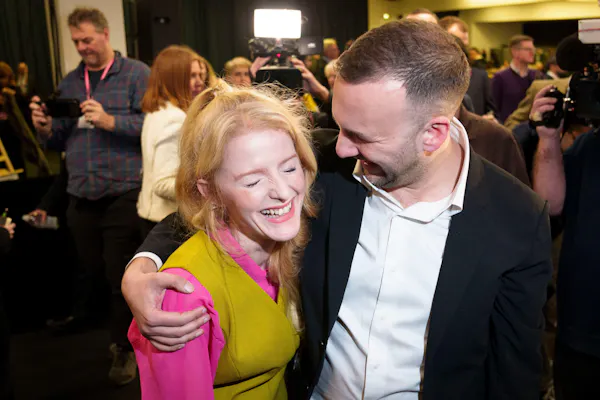
Hannah Spencer celebrates her byelection win in Gorton and Denton with Green Party leader Zack Polanski. Jon Super/Associated Press We had a glimpse of this in January, when North Herefordshire’s Ellie Chowns used her occasional opportunity to question the prime minister to ask about water pollution. Starmer turned it into a partisan attack on the unrelated topic of Polanski’s comments about Nato.
While the Reform UK leader, Nigel Farage, regularly berates Starmer in the Commons, the Greens rarely take such an overtly partisan approach. Reform MPs tend to participate more frequently in high-profile parliamentary occasions, where they can question the government. The Greens tend to have a more balanced, policy-focused approach, regularly popping up on committees to scrutinise legislation.
This is helped by Polanski’s position as a leader who sits outside the Commons (a member of the London Assembly). He can delegate the scrutiny of government policy to Chowns and her colleagues, while he takes broader comments about the government’s performance directly to the press.
This balance will be important as the Greens think about the upcoming local elections. Spencer told the press today that the party can now “win anywhere”, and Polanski predicted a “tidal wave” of Green MPs at the next election.
To do this, they need to maintain the momentum they’ve created this week. This means keeping a tight hold of the former Labour voters who chose them instead in Gorton and Denton.
It will be difficult for the party to carry out the same intensive campaign strategy on a more national level, but this sort of intensity is key to ensuring that the left vote goes to the Greens rather than to the other alternatives. Having more party members than ever before will help with this, but they will need to rely on their on-the-ground campaigners to feel secure.
Louise Thompson, Senior Lecturer in Politics, University of Manchester
This article is republished from The Conversation under a Creative Commons license. Read the original article.

Keir Starmer objects to criticism of the IDF. He asks how could anyone object to them starving people to death, forced marches like the Nazis did, bombing Gaza’s hospitals and universities, mass-murdering journalists, healthworkers and starving people queuing for food, killing and raping prisoners and murdering children. He calls for people to stop obstructing his genocide for Israel. 
Keir Starmer refuses to be outcnuted by Nigel Farage’s chasing the racist bigot vote. 
Keir Starmer says that the Labour Party under his leadership is intensely relaxed about assaulting those least able to defend themselves – the very poorest and most vulnerable. dizzy: I won hundreds of pounds by gambling on this election. I have a bet on the Green party at general election at 66/1.
Why isn’t the Greens’ growing success reflected in media coverage?
wellphoto/Shutterstock Maxwell Modell, Cardiff University; Matt Walsh, Cardiff University, and Stephen Cushion, Cardiff University
The victory of the Greens in the Gorton and Denton parliamentary byelection is a landmark for the party. But our new research reveals the Greens have received limited airtime over the last year despite almost doubling their support in the polls and in party membership.
While Reform UK has seen a spike in media coverage since it took a commanding lead in the polls, our research shows the Greens have not received more airtime in recognition of their growing popularity.
Broadcasters have to abide by due impartiality rules, but they have the editorial freedom to balance the airtime of political parties. They consider factors such as a party’s vote share at the last UK general election or a party’s electoral performance at the most recent devolved, regional and local election. Other factors to consider include the latest trends in opinion polls tracking voting intention, and whether what a party is saying the news organisation considers significant or, as the BBC says, whether they are “making the political weather” by setting the agenda.
After winning the byelection, this raises the question: should the Greens now be given more airtime?
Limited coverage of Greens
Our Impartiality project team has been tracking coverage of UK opposition parties on BBC News at Ten and ITV News at Ten, the UK’s most-watched nightly TV news bulletins.
In 2025, we found the Greens were the sixth most covered opposition party, being referenced in just 32 items, behind the Conservatives (375), Reform UK (213), the Liberal Democrats (116), the Scottish National Party or SNP (46) and ahead of Plaid Cymru (10).
Number of items led by an opposition party on BBC News at Ten and ITV News at Ten. Cardiff University, CC BY-NC-ND We also tracked how often a party was the leading focus of a broadcaster’s report. The Greens led four items – three on BBC and one on ITV. These stories related to the Greens’ May local election campaign, Zack Polanski winning the party leadership in September and the party conference in October. But neither BBC News at Ten and ITV News at Ten covered the announcement or build-up to the leadership contest.
In contrast, Reform UK led 69 items, Conservatives led 45 items, the Liberal Democrats led 14 items and the SNP led 13 items.
The Greens also appeared on only four episodes of BBC Question Time during 2025. That was about a third as often as the Liberal Democrats and Reform UK. Despite the leadership change, the subsequent surge in membership and the sustained rise in poll ratings (from 11% in August 2025 to 17% in December 2025), broadcast coverage of Greens did not increase at the end of 2025.
This shows a potential inequality in the treatment of the rising left and right parties. The BBC cited improvements in opinion polling as one of the factors behind the increased coverage of Reform UK, but the Green party’s popularity has not received anywhere near the same recognition.
In May 2025, news coverage of Reform UK increased substantially following its victories in local and mayoral elections, which broadcasters considered a sign that the party was now a major player in UK electoral politics. Our research even showed in September 2025 Reform UK was referenced on TV news more than the Conservatives, the party that is supposed to be the UK’s parliamentary official opposition.
Greens and Reform UK TV news coverage compared to opinion polls. Cardiff University, CC BY-NC-ND The question now is whether broadcasters will take the Green party’s victory in Gorton and Denton as a similar sign of its electoral significance and increase media coverage of the party.
While broadcasters have not broken any of the UK’s rules on due impartiality, our new research raises questions about how they have been interpreting impartiality in a new multi-party system.
Traditionally they have relied on allocating airtime according to parties with the largest number of MPs and total vote at the last general election. They have also factored in performances at the latest local, regional or devolved elections. But they now appear to making more subjective judgements about allocating airtime according to the opinion polls or the newsworthiness of parties.
Given the Greens’ growing popularity, their distinctive set of policies, charismatic leader and byelection victory, they might now look set to receive more media attention and scrutiny over the coming months.
Maxwell Modell, Research associate, Cardiff University; Matt Walsh, Head of the School of Journalism, Media and Culture, Cardiff University, and Stephen Cushion, Professor, Cardiff School of Journalism, Media and Culture, Cardiff University
This article is republished from The Conversation under a Creative Commons license. Read the original article.
Nigel Farage urges you to ignore facts and reality and be a climate science denier like him and his Deputy Richard Tice. He says that Reform UK has received £Millions and £Millions from the fossil fuel industry to promote climate denial and destroy the planet. Nigel Farage explains the politics of Reform UK: Racism, Fake anti-establishmentism, Deregulation, Corporatism, Climate Change Denial, Mysogyny and Transphobia. Nigel Farage reminds you that he’s the man that brought you Brexit and asks what could possibly go wrong. Historic by-election win indicates Green Party could win over a hundred seats at next General Election
The Greens are on track to win over a hundred seats at the next general election, if the historic swing achieved to win Gorton and Denton is replicated nationwide.
Local candidate Hannah Spencer delivered a stunning by-election victory that more than tripled the party’s vote.
In 2024 the Green Party secured just 13.2% of the vote in Gorton and Denton – one of Labour’s safest seats – but Hannah Spencer has achieved 40.7% of the vote, 14,980 votes, with a swing of 27.5%.
New Green Party MP Hannah Spencer said: “I’m grateful, and thrilled, that the people of Gorton and Denton chose hope over hate and elected me as their new Green Party MP.
“This is the beginning of something massive.”
Green Party leader Zack Polanski said: “If we see a swing like this at the next general election, there will be a tidal wave of new Green MPs. When I was elected Leader of the Greens I said we were here to replace Labour and I meant it. Hannah was a fantastic candidate and I know she’ll make a brilliant MP.”
Hannah Spencer MP added: “I’m proud to have run a positive, inclusive campaign focused on the issues that matter most to local people: bringing down the cost of rent and bills, protecting the NHS, properly funding our public services, and ending Britain’s complicity in genocide.
“I’d like to thank everyone who voted for me. They know they can trust me and the Green Party to deliver on our promises.
“I also want to thank the thousands of volunteers who gave their time, skills and energy to help us reach as many voters as possible with our message.
“The Greens are the only party with a real plan to improve everyday life for the people in Gorton and Denton and across the country.”
Zack Polanski added: “This used to be one of Labour’s safest seats. In this by-election almost half of their 2024 voters abandoned them and many switched to voting Green, meaning they finished 3rd. The Green Party saw a record-breaking swing in our direction and more than tripled our vote.
“Labour fought a shameful, dirty campaign – spreading lies about Green policies and even faking a tactical voting website. They knew they couldn’t win, but they risked splitting the vote and letting Reform in.
“People everywhere will now know that voting Green is the way to defeat Reform. Many ex-Labour voters told our canvassers that they will never go back to a party that supports genocide, fuels racism, and has failed to deliver on its promise to improve life for people across the country.”