Category: human rights violations
Witch memorials are quietly spreading across Europe

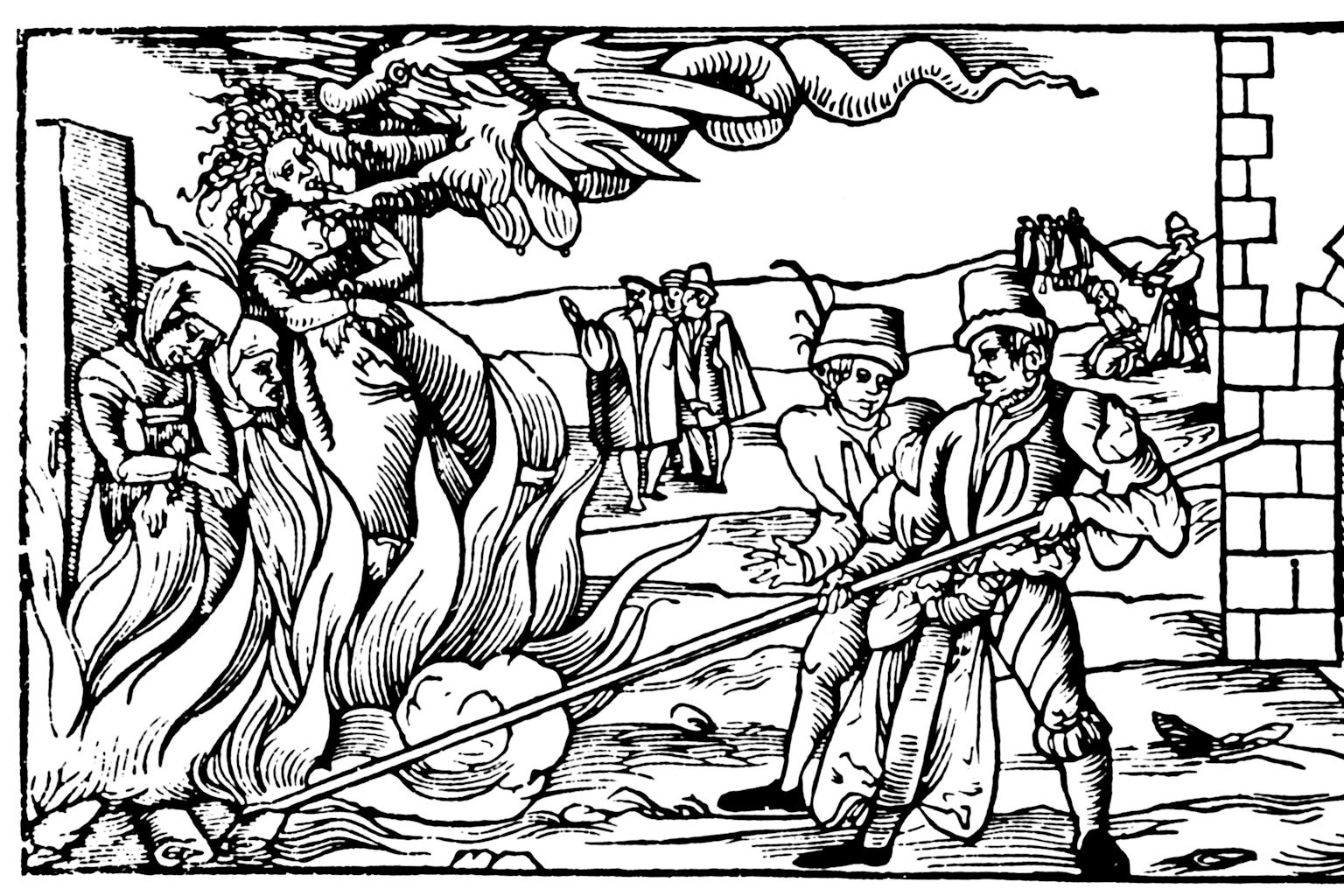
A 1555 depiction of women deemed to be witches being burned at the stake. Science History Images / Alamy Jan Machielsen, Cardiff University and Paul Webster, Cardiff University
Across Europe, campaigns for national witch memorials are gathering pace. In the Netherlands, a charity recently announced it had selected the design for a monument in Roermond, the site of the country’s worst witch-hunt.
In Scotland, campaigners Claire Mitchell and Zoe Venditozzi published a manifesto, How To Kill A Witch, to continue pressure on the Scottish government for a state-funded monument. Their Witches of Scotland campaign had won an early victory in 2022 when first minister Nicola Sturgeon issued an official apology.
Across early modern Europe (1450-1750), between 40,000 and 50,000 people were executed as witches. Though the age and gender of the accused varied from place to place, roughly 75% to 80% of all victims were women.
Within Britain and Ireland, Scotland saw some of the fiercest witch-hunting. Historians have identified more than 3,800 accusations (84% women), leading to perhaps as many as 2,500 executions.
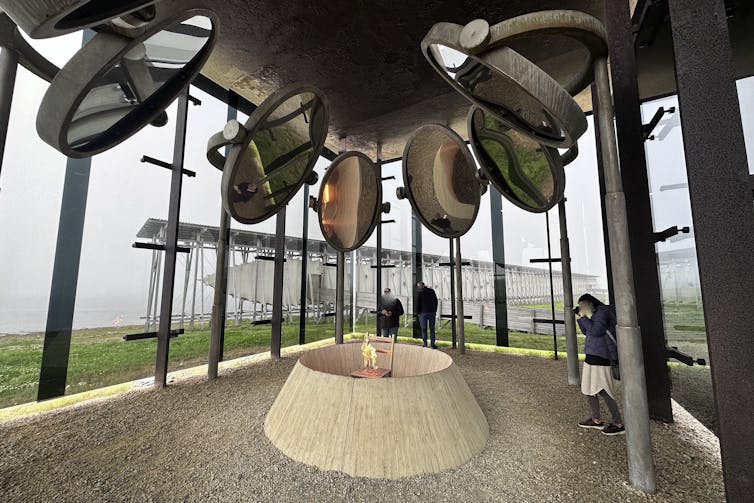
Despite these stark figures, there are still no official national witch memorials anywhere in Europe, although the Steilneset memorial in northern Norway, created in 2011, comes close.
The Damned, The Possessed and the Beloved, Louise Bourgeois’ memorial to the women burned for being witches, at Steilneset, near Vardo in Norway. Wolfmann / Wikipedia The lack of such national memorials does not mean the witch hunt has been forgotten. Its memory has long offered moral lessons for the present.
On the other side of the Atlantic, descendants of those caught up in the infamous 1692 Salem witch trials were among the earliest to commemorate the victims. A cenotaph erected in 1885 by descendants of Rebecca Nurse, one of the Salem accused, may well have been the first.
In Europe, there are similar local memorials. A witches’ well installed outside Edinburgh Castle in 1894 was probably the earliest such memorial in Europe, but most local attempts at memorialisation have been much more recent.
Our project – supported by Cardiff University’s On Campus student internship scheme – mapped memorials around the world and created an inventory of 134 plaques, memorials, sites and museums, which skews heavily towards the 21st century. Of the sites that can be securely dated, nearly half were unveiled during the past decade.
#MeToo, politics and wartime bears
This growth in grassroots interest has several origins. It partly stems from renewed concern at present-day violence, both against women in general but also against suspected witches in the global south. Our research threw up one memorial in the Indian state of Odisha to deter modern vigilantism.
It also coincides with the popularisation of witch-hunting as a political metaphor and the #MeToo movement. The latter not only encouraged women to call out misogyny, in the process it also highlighted how few statues of non-royal women exist.
It was the sight of a statue of Wojtek, a Polish bear and second world war mascot in Edinburgh’s Princes Street Gardens, that inspired one of the Witches of Scotland campaigners. If a bear could be commemorated, why not any of the thousands of women executed as witches?
Overlaying witch memorials with the geography of the early modern witch-hunt reveals further striking patterns. With 29 local memorials, Scotland accounts for the largest share, followed by Germany with 24 – both epicentres of the early modern witch-hunt.
By contrast, France is virtually absent from our data. There is no memorial in the former Duchy of Lorraine, another notable witch-hunting hotspot, nor any marker in Paris of the sensational and infamous “affair of the poisons” that shook Louis XIV’s court.
Whether to remember is also a political choice. Memorials in the Basque country present witch-hunting as foreign (French and Spanish) impositions, while glossing over the role played by local officials and folkloric beliefs.
Catalonia saw relatively few trials but its nationalist politicians have spearheaded motions labelling the witch-hunt “institutionalised femicide”. In this way, calls for a memorial have become something of a vehicle for progressive nationalism.
How to remember can be fraught. Accusations of kitsch, commercialism and profit haunt museums in particular. Salem’s Witch Museum was once named the world’s second biggest tourist trap.
Perhaps for this reason, many communities have settled for straightforward plaques listing those executed for alleged witchcraft. In a similar spirit, streets in Catalonia and Scotland have been renamed in their memory as well.
Going further raises thorny questions of artistic licence and historical representation. Visual depictions risk perpetuating stereotypes about warts, noses and pointy hats.
On the other hand, portraying witches as alluring ignores a substantial body of research linking witchcraft fears to young mothers’ anxieties about the postmenopausal body. For those reasons, a monument on a Belgian roundabout of a naked witch “flying to freedom” on her broomstick surrounded by traffic sparked much debate among our project team.
Acts of remembering inevitably entail acts of forgetting, and there are pitfalls here to be avoided. Stronger, more centralised states saw less witch-hunting, not more. State and church-issued pardons and apologies may thus downplay the role that communities played in witch persecutions, including other women.
Remembering is never simple. Yet, as one of history’s most infamous forms of demonisation, the early modern witch-hunt will always teach us how easy it is to blame, and how difficult it is to understand.
Looking for something good? Cut through the noise with a carefully curated selection of the latest releases, live events and exhibitions, straight to your inbox every fortnight, on Fridays. Sign up here.
Jan Machielsen, Senior Lecturer in Early Modern History, History, Archaeology and Religion, Cardiff University and Paul Webster, Lecturer in Medieval History and Co-Ordinator, Exploring the Past Pathway, Cardiff University
This article is republished from The Conversation under a Creative Commons license. Read the original article.
More than 50 child asylum seekers still missing after disappearing from Kent care
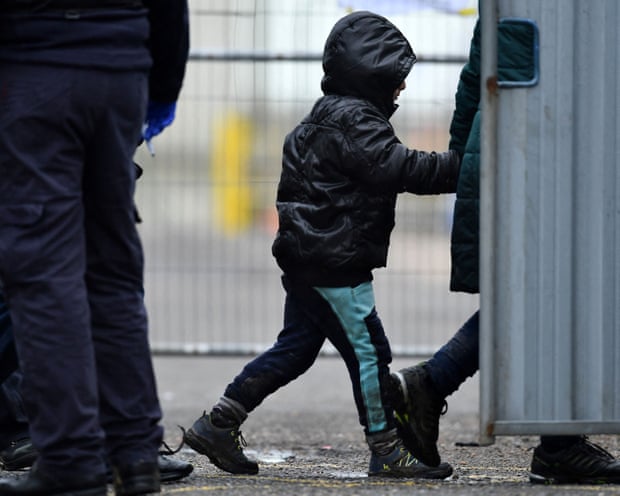
Border Force officers assisting a child. Photograph: Ben Stansall/AFP/Getty Images Council data obtained by the Guardian shows 345 children have gone missing in recent years, many probably taken by traffickers
More than 50 lone child asylum seekers who disappeared soon after arriving in the UK and while in the care of the authorities are still missing, according to data obtained by the Guardian.
Many of the missing children arrived in small boats or hidden in the backs of lorries and are thought to have been taken by traffickers. Kent is often the place where they arrive.
Freedom of information data from Kent county council (KCC), which is controlled by Reform UK, has documented 345 children going missing from their area, with 56 of those still missing.
Between 2021 and 2023, when the Home Office operated two hotels for children in Kent, along with hotels in other areas, 132 children went missing from those two hotels. Of these, 108 were later found but 24 are still missing. Between 2020 and August 2025, 213 children went missing from the council’s reception centres for this group of children, with 182 found and 32 still missing.
…
Esme Madill, of the Migrant and Refugee Children’s Legal Unit at Islington Law Centre, said: “These figures are shocking. Behind each number is a frightened child who will already have experienced egregious human rights abuses before arriving in the UK seeking safety. When we represent children who have escaped after being trafficked whilst ‘missing’ in the UK, we see how their mental and physical health is permanently harmed by the abuse they experience during this time.
“For one child to go missing represents an abject failure of the state to protect the most fragile and abused in their care. These numbers are in the hundreds.”
…
Original article at https://www.theguardian.com/uk-news/2025/nov/01/more-than-50-child-asylum-seekers-still-missing-after-disappearing-from-kent-care
US ‘heading towards fascist dictatorship’ say critics after arrest of British journalist Sami Hamdi
This work by Middle East Monitor is licensed under a Creative Commons Attribution-NonCommercial-ShareAlike 4.0 International License.
Sami Hamdi,the Editor-in-Chief of the International Interest during the speech at 17th Annual Convention for Palestine, in Tinley Park village of Illinois, United States on November 30, 2024. [Photo by Jacek Boczarski/Anadolu via Getty Images] The United States is “heading towards fascist dictatorship”, critics have warned, following the detention of British journalist Sami Hamdi by US Immigration and Customs Enforcement (ICE). Hamdi, a prominent political commentator and managing director of the London-based think tank The International Interest, was apprehended at San Francisco International Airport after addressing a Council on American-Islamic Relations (CAIR) gala in Sacramento.
ICE has confirmed that Hamdi is being held in custody pending removal, with a Homeland Security spokesperson citing revoked visa status. In a post on X, DHS official Tricia McLaughlin wrote: “Under President Trump, those who support terrorism and undermine American national security will not be allowed to work or visit this country.”
Critics, however, say Hamdi’s only “crime” was condemning Israel’s genocide in Gaza.
CAIR condemned his detention, describing it as a politically motivated abduction driven by pressure from far-right pro-Israel figures. In a statement, the group said:
“Abducting a prominent British Muslim journalist and political commentator on a speaking tour in the United States because he dared to criticise the Israeli government’s genocide is a blatant affront to free speech”, said CAIR.
“Our nation must stop abducting critics of the Israeli government at the behest of unhinged Israel First bigots. This is an Israel First policy, not an America First policy, and it must end.”
CAIR added that anti-Muslim provocateur Laura Loomer, who has previously espoused conspiracy theories and Islamophobic rhetoric, claimed credit for orchestrating Hamdi’s detention, posting that ICE responded to her demands.
READ: Immigrant students detained in US moved to remote detention centres flagged for rights concerns
The Muslim Council of Britain (MCB) has urged the UK government to intervene. “Press freedom cannot be selective,” it said. “The Government must defend British citizens and the right to speak truth to power.” It called for “urgent diplomatic action to secure British journalist Sami Hamdi’s release from US ICE detention.”
Hamdi’s father also issued a plea via X, writing: ” Anyone who truly wants to understand #Sami_Hamdi and how he thinks should start with these words” said Dr. Mohamed Elhachmi Hamdi sharing his son’s tweet from May calling out anti-Semitism and Islamophobia.
Dr Yasir Qadhi, a prominent American Muslim scholar, warned that the arrest reflects an alarming trend: “Our country is heading towards a fascist dictatorship in which any speech that goes against the official narrative is going to be criminalised,” he said. Qadhi described Hamdi’s arrest as part of a broader campaign of “anti-Muslim bigotry”, cautioning that this “inhumane evil will be directed against multiple minorities, not just Muslims.”
Hamdi had been on a US speaking tour, with scheduled events in Florida following his appearance in California. He has appeared on UK broadcasters including Sky News and Channel 4 as a commentator on Middle East affairs.
The incident forms part of a broader pattern of repression against Palestinian advocacy and criticism of Israel in the US. Universities have revoked student group charters, political donors have blacklisted dissenting voices, and social media platforms have throttled pro-Palestinian content.
Rights groups have warned that these actions represent a coordinated campaign to silence opposition to Israeli war crimes and shield its leaders from accountability.
READ: Detained student in US claims university laid groundwork for his ‘abduction’
This work by Middle East Monitor is licensed under a Creative Commons Attribution-NonCommercial-ShareAlike 4.0 International License.

Elon Musk urges you to be a Fascist like him, says that you can ignore facts and reality then. 
Donald Fuhrump says that Amerikkka doesn’t bother with crimes or charges anymore, not being 100% Amerikkkan and opposing his real estate intentions is enough. 
Keir Starmer objects to criticism of the IDF. He asks how could anyone object to them starving people to death, forced marches like the Nazis did, bombing Gaza’s hospitals and universities, mass-murdering journalists, healthworkers and starving people queuing for food, killing and raping prisoners and murdering children. He calls for people to stop obstructing his genocide for Israel. Gaza municipality warns of looming health and environmental disaster as waste piles up across the city
This work by Middle East Monitor is licensed under a Creative Commons Attribution-NonCommercial-ShareAlike 4.0 International License.
Palestinian children search for usable objects among piles of trash and rubble in Gaza City, Gaza on October 21, 2025. [Hamza Z. H. Qraiqea – Anadolu Agency] The Gaza Municipality warned on Monday of an imminent environmental and health disaster in the city, with more than a quarter of a million tonnes of waste accumulating in various areas. The crisis is worsened by a severe shortage of drinking water and the leakage of sewage, posing a threat to the lives of hundreds of thousands of residents.
The municipality’s spokesperson, Assem Al-Nabih, said in a recorded statement that “Gaza City is facing serious health and environmental crises, which are causing the spread of rodents and insects amid a shortage of water and massive piles of waste across different neighbourhoods.”
Al-Nabih explained that the municipality is unable to deal with the crisis, as more than 85 per cent of its heavy and medium machinery has been destroyed during the two-year-long Israeli war.
He also pointed out the lack of essential equipment and supplies needed to provide basic services.
Al-Nabih added that large amounts of sewage have leaked into city streets, worsening the health and environmental situation, and warned that epidemics could spread if the current conditions persist.
READ: Israel allows Red Cross, Egyptian teams into Gaza to search for hostage bodies
This work by Middle East Monitor is licensed under a Creative Commons Attribution-NonCommercial-ShareAlike 4.0 International License.
Genocide denier and Current UK Prime Minister Keir Starmer is quoted that he supports Zionism without qualification. He also confirms that UK air force support has been essential in Israel’s mass-murdering genocide. Includes URLs https://www.declassifieduk.org/keir-starmers-100-spy-flights-over-gaza-in-support-of-israel/ and https://youtu.be/O74hZCKKdpA Keir Starmer objects to criticism of the IDF. He asks how could anyone object to them starving people to death, forced marches like the Nazis did, bombing Gaza’s hospitals and universities, mass-murdering journalists, healthworkers and starving people queuing for food, killing and raping prisoners and murdering children. He calls for people to stop obstructing his genocide for Israel. 
Orcas discuss Genocide-supporting and complicit Zionists. Donald Trump, Keith Starmer, David Lammy, Rachel Reeves, Angela Rayner and Wes Streeting are acknowledged as evil genocide-complicit and supporting cnuts.