- Post author:dizzy
- Post published:26 September 2024
- Post category:Fascism/genocide/human rights violations/Israel/Palestine/politics/Zionism
- Post comments:0 Comments
Human rights lawyers renew calls for the release of 10,000 Palestinian prisoners
Original article by Ana Vračar republished from peoples dispatch under a Creative Commons Attribution-ShareAlike 4.0 (CC BY-SA) license.
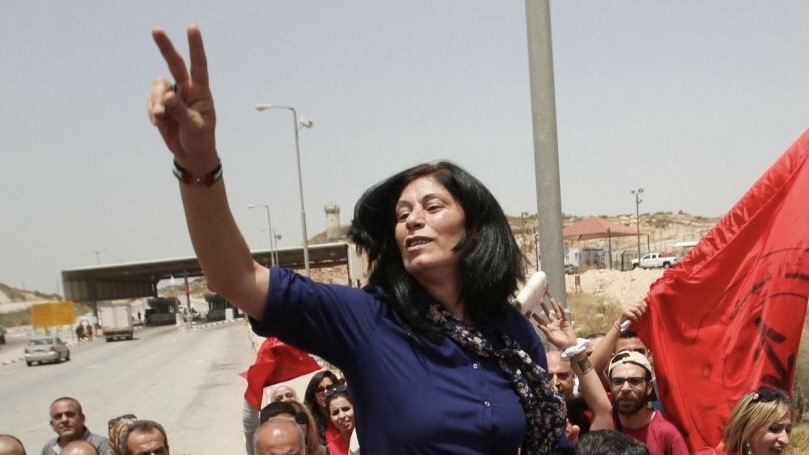
Legal experts and human rights advocates renew their call for solidarity with Palestinian prisoners detained by Israel since October 2023
Since October 7, 2023, approximately 10,000 Palestinians from across the West Bank and other occupied territories have been imprisoned by Israeli Occupation Forces (IOF) in what human rights lawyers describe as an unprecedented assault on all branches of the resistance movement. Thousands more have been forcibly disappeared from the Gaza Strip, with little information available about their whereabouts.
Amid the increased use of torture and detention of the Palestinian people by Israel, international solidarity movements have intensified campaigns calling for their release.
Among those recently detained from the occupied West Bank is Khalida Jarrar, a prominent human and women’s rights activist, who has faced persecution by Israel on multiple occasions, and is now being held in Neve Tirza prison.
Watch: 11 months in Israeli prison: Shatha Odeh’s struggle for basic rights
At a briefing on Palestinian political prisoners, organized by the International Peoples’ Assembly (IPA), Tala Nasir from Addameer Association for Prisoner Support and Human Rights, along with human rights lawyer Bilal Naammeh, highlighted the IOF’s violations of basic human rights among prisoners. Nasir pointed out that many arrests in the past year have targeted specific groups of professionals who play an important role in building the material basis of the community, including engineers and health workers. However, anyone can face arrest for something as minor as posting on social media, which occupation forces often manipulate into allegations of supporting resistance groups, including Hamas.
Israel is attempting to practically ban all political participation by Palestinians, Naammeh noted, a threat reinforced through military courts and remote trials designed to instill fear in the population. Since October 2023, these practices have become even more severe than before. Naammeh described how, in court, Israeli lawyers often accuse defendants of being involved in the resistance. When defense lawyers challenge these accusations due to insufficient evidence, they can be sanctioned or temporarily barred from representing clients.
As lawyers are currently the only point of contact between prisoners and the outside world, restricting their access—whether through sanctions or lengthy delays—has profound consequences.
Conditions inside Israeli prisons have also worsened significantly. Access to prisoners is limited, even for representatives of the International Committee of the Red Cross (ICRC). Prisoners face severe shortages of food and water, which has led to weight loss of up to 30 kilograms per person, and are allowed only one hour outside their cells each day, leaving them isolated for the rest of the time, according to Nasir.
Read more: Creating life from a life sentence: Sana’ Daqqah on the Palestinian prisoners’ movement
The lack of water and hygiene has led to mass outbreaks of disease and infection, including scabies. According to Naammeh, some prisoners with scabies have been tied to their beds to prevent them from scratching. Other reports indicate that the IOF moves prisoners with scabies between sections in order to purposely exacerbate the contagion. Despite the widespread health crisis, medical care remains out of reach for most. Naammeh highlighted that even the most pressing health issues can take up to two months to receive basic medical attention, leaving prisoners in prolonged suffering.
Conditions in the camps where Palestinians from Gaza are held are even worse, the two advocates suggested, but up-to-date information is nearly impossible to obtain. The only reports come from Israeli media or the testimonies of those who have been released. Nasir recounted stories of prisoners enduring extreme torture, including rape. Witnesses described prisoners being forced to bark for food and given only thin mattresses for six hours a day, making proper rest impossible. This treatment extends even to those who are supposed to enjoy specific protection under international law, such as health workers. Nasir explained that dozens of health workers abducted from Gaza are being held under the Unlawful Combatants Law, meaning they could remain imprisoned until the end of the conflict under such conditions.
In response to Israel’s blatant disregard for human rights and international law, Addameer and the IPA renewed their call for the immediate release of all political prisoners and urged international activists to escalate solidarity efforts, including by insisting on adherence to recent International Court of Justice rulings. The organizers reminded participants that even the simplest acts of solidarity can contribute meaningfully to the broader struggle for liberation.
Original article by Ana Vračar republished from peoples dispatch under a Creative Commons Attribution-ShareAlike 4.0 (CC BY-SA) license.
UNRWA: We are facing difficulties in bringing in the necessary winter supplies to the people of Gaza
Original article republished from Middle East Monitor is licensed under a Creative Commons Attribution-NonCommercial-ShareAlike 4.0 International License.

The United Nations Relief and Works Agency for Palestine Refugees (UNRWA) said that it is making every possible effort for the people of the Gaza Strip to urgently provide them with the necessary winter supplies, including plastic sheets, tents, mattresses, mats, blankets and other basic supplies.
UNRWA explained in a press statement on Monday that it, along with all humanitarian organisations are facing great difficulties in bringing these supplies into the Gaza Strip, noting that once they arrive, they will be immediately distributed to those in need.
UNRWA urgently appealed for an immediate halt to the destruction of homes and shelters, demanding the opening of more crossings to the Gaza Strip to enable humanitarian agencies to deliver basic supplies to thousands of families in need.
UNRWA also stressed the need for an immediate ceasefire to ensure the safe and sustainable delivery of aid, and to give families a chance to rebuild their lives safely.
Israel is waging a devastating war on Gaza, killing and wounding about 135,000 Palestinians, most of them children and women. More than 10,000 are missing amid massive destruction and famine that has claimed the lives of dozens, in one of the worst humanitarian crises in the world.
READ: Netanyahu admits Israel’s failure to distribute aid in Gaza through tribes
Original article republished from Middle East Monitor is licensed under a Creative Commons Attribution-NonCommercial-ShareAlike 4.0 International License.
Big Tech’s complicity in genocide: The unforgivable silence of online platforms
Original article by Ziyad Motala republished from Middle East Monitor under a Creative Commons Attribution-NonCommercial-ShareAlike 4.0 International License.

A damning report, “Palestinian Digital Rights, Genocide, and Big Tech Accountability”, by 7amleh, a Palestinian-led non-profit organisation that is focused on protecting the human rights of Palestinians, has laid bare the disturbing and active role that major online platforms and big tech companies play in perpetuating human rights abuses against Palestinians. While the world watches the horrors unfold in Gaza, the role of these digital accomplices cannot be ignored. The report highlights that platforms like Meta, X, YouTube and tech giants Google and Amazon have enabled, facilitated and even profited from these atrocities, effectively shielding war crimes under a digital smokescreen.
The findings are a harrowing indictment of how big tech companies, under the guise of neutrality, have become active participants in censorship, disinformation and incitement to violence. They have provided crucial infrastructure that underpins Israel’s military actions, allowing their platforms to be weaponised, silencing Palestinian voices while amplifying hate speech and calls for genocide. The complicity of these platforms is not a mere oversight; it is an entrenched system of deliberate decision-making that prioritises profits over human rights.
Systematic censorship of Palestinian voices
At the heart of the report’s findings is a shocking pattern of systematic censorship targeting Palestinian voices. Between October 2023 and July 2024, over 1,350 instances of censorship were documented on major platforms, including Facebook, Instagram, X and TikTok. These platforms disproportionately targeted Palestinian journalists, activists and human rights defenders, with Meta’s platforms being among the worst offenders. The censorship took many forms: accounts were suspended, content takedowns became routine and distribution of pro-Palestinian narratives was heavily restricted.
READ: Israel accused of using Google ads to undermine UN body
Meta’s manipulative algorithm changes played a key role in this censorship. The report reveals that during the ongoing war in Gaza, Meta altered its content moderation policies to lower the threshold for flagging Palestinian content, reducing the accuracy of its filters and triggering unnecessary takedowns. For Palestinian content, Meta’s filters operated with a mere 25 per cent certainty of a violation, compared to the usual 80 per cent applied elsewhere. These so-called “temporary risk response measures” were never lifted, allowing for an outsized level of scrutiny on Palestinian content creators. This is not an isolated incident – it’s a calculated, discriminatory policy that silences marginalised voices and hinders the free flow of information at a time when it’s needed the most.
As 7amleh’s report highlights, Meta’s broken promises to safeguard free speech, coupled with its biased content moderation, exacerbated the situation for Palestinians. Human Rights Watch had already condemned Meta for its systemic censorship of Palestinian voices during the war, with over 1,050 instances of content removal on Facebook and Instagram. In nearly all cases, this censorship targeted peaceful, pro-Palestinian content while allowing violent, anti-Palestinian content to flourish unchecked. Comments like “Free Palestine”, “Stop the Genocide” and “Ceasefire Now” were removed under Meta’s spam guidelines, reflecting a dangerous double standard that stifles legitimate political discourse.
Platforms as instruments of genocide
The report makes clear that online platforms are not simply neutral forums but have become instruments of incitement to genocide. Between October 2023 and July 2024, over 3,300 instances of harmful content – including incitement to genocide – were documented, the majority on X and Facebook. These platforms allowed high-level Israeli officials and other users to openly call for the extermination of Palestinians, dehumanising them as “sub-humans”, “animals” and worse. This genocidal rhetoric wasn’t limited to obscure corners of the internet. It was promoted, amplified and left unchallenged by the very platforms that claim to be committed to community standards and human rights.
For instance, on X, a December 2023 post by the deputy mayor of Jerusalem described blindfolded Palestinian detainees as “ants” and called for burying them alive. Although this specific post was eventually removed, countless others like it remain, fuelling a climate of violence and dehumanisation against Palestinians. This failure to combat hate speech directly contravenes international law, particularly in light of the International Court of Justice’s January 2024 order, which directed Israel to prevent and punish incitement to genocide.
These platforms are not just failing in their duty to protect free speech; they are actively facilitating the spread of genocidal propaganda. In the case of Meta, the report details how over 9,500 takedown requests from the Israeli government were sent to Meta between October and November 2023, with a shocking 94 per cent compliance rate. This high level of cooperation with a state actively committing war crimes raises serious concerns about the ethical boundaries of these companies. Meta’s decision to comply with such requests without transparency or accountability reveals a deeper issue: these platforms are willing to become tools of state oppression when the price is right.
READ: Israel using Meta’s WhatsApp to kill Palestinians in Gaza through AI system
The role of Big Tech: Project Nimbus and the automation of killing
Beyond the sphere of social media, Google and Amazon’s collaboration with the Israeli military under Project Nimbus casts an even darker shadow over the tech industry’s role in this conflict. The $1.2 billion cloud computing contract, as the report highlights, provides critical infrastructure to power Israel’s AI-driven Lavender and Gospel targeting systems – systems that are directly linked to the mass civilian casualties in Gaza.
The Lavender system, in particular, functions as a tool for automated killings, identifying targets based on massive data inputs and feeding them into the Israeli military’s bombing campaigns. The report describes how Lavender alone identified over 37,000 potential targets, contributing to the deaths of thousands of civilians, including women and children. By providing cloud services to facilitate this mass-scale targeting, Google and Amazon are directly implicated in these violations of international law. Despite mounting global pressure, both companies continue to support Israel’s military operations under Project Nimbus, even as the civilian death toll in Gaza rises.
Hate speech and disinformation: A coordinated assault on truth
The report goes on to document a deluge of hate speech and disinformation campaigns, often spearheaded by Israeli officials and amplified by online platforms. These campaigns, which include the systematic dissemination of dehumanising content on Telegram, X and YouTube, have targeted Palestinians both inside Gaza and across the diaspora. The report cites three million instances of violent content in Hebrew aimed at Palestinians on X alone, much of it coordinated by Israeli state actors.
Perhaps most troubling is the Israeli government’s influence operation known as STOIC, which ran a disinformation campaign targeting US and Canadian lawmakers to undermine the work of The United Nations Relief and Works Agency for Palestine Refugees in the Near East (UNRWA). This campaign, orchestrated with the help of AI, spread false narratives that led to the defunding of UNRWA, cutting off critical humanitarian aid to Palestinians. This is not merely a failure of moderation but an example of how platforms can be weaponised for state-driven disinformation, with devastating consequences for innocent civilians.
Profiting from genocide: Advertising amidst war crimes
As if censorship and disinformation weren’t enough, the report also exposes how platforms like Facebook have profited from harmful advertisements promoting violence against Palestinians. The investigation found that Facebook ran ads calling for the assassination of pro-Palestinian activists and the forced expulsion of Palestinians from the West Bank. Meta profited from these campaigns, further entrenching its complicity in the human rights violations unfolding in Gaza.
READ: Google, Amazon workers protest billion-dollar contract with Israel
Meanwhile, YouTube ran ads from the Israeli government that used graphic imagery to sway public opinion in favour of its military actions in Gaza. Despite YouTube’s policies against violent content, these ads flooded social media with incendiary narratives, particularly in Europe and the US, contributing to the normalisation of war crimes under the guise of counter-terrorism.
Time for accountability
The findings of this report should compel the international community to act. It is no longer acceptable for tech companies to hide behind vague policies and empty commitments to free speech while facilitating the mass killing and silencing of a besieged population. The complicity of Meta, X, YouTube, Google and Amazon in these atrocities must be brought into the spotlight and held accountable for their role in enabling these crimes.
These platforms are not neutral arbiters of truth – they are corporations driven by profit, willing to accommodate genocidal regimes and turn a blind eye to the suffering of millions if it serves their bottom line. As the report makes clear, it is time for the world to demand that these companies stop profiting from the destruction of Palestinian lives. The silence and complicity of big tech are unforgivable, and they must not be allowed to escape responsibility any longer.
The views expressed in this article belong to the author and do not necessarily reflect the editorial policy of Middle East Monitor.
Original article by Ziyad Motala republished from Middle East Monitor under a Creative Commons Attribution-NonCommercial-ShareAlike 4.0 International License.