Analysis Details How Israel’s Gaza Siege ‘Is Driving a Humanitarian Disaster’

Spread the love

Original article by Brett Wilkins republished from Common Dreams under Creative Commons (CC BY-NC-ND 3.0). 
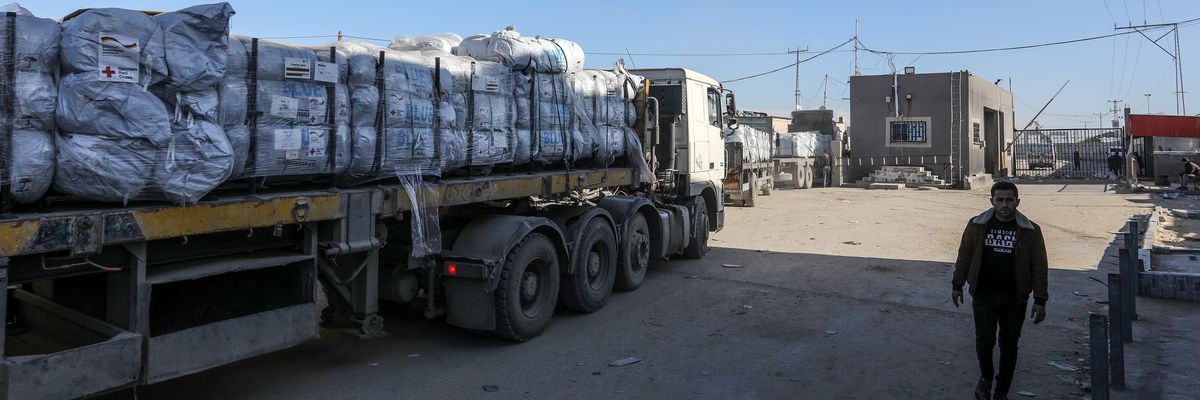
Trucks carrying aid supplies to Gaza are seen at the Karem Abu Salem border crossing on February 17, 2024. (Photo: Abed Rahim Khatib/Anadolu via Getty Images)

“Over 11 months, we have reached shocking levels of conflict, displacement, disease, and hunger,” said one campaigner.

Israel’s “complete siege” of the Gaza Strip “is driving a humanitarian disaster,” with 83% of required food aid failing to enter the embattled enclave, where the entire population is facing hunger and disease and almost half a million Palestinians are at risk of starvation, an analysis published Monday revealed.starvation,

The analysis by 15 international aid organizations noted that a record-low average of just 69 aid trucks are entering the Gaza Strip each day, compared with an already insufficient 500 daily truckloads a year ago. Additionally, the groups said that “only 17 out of Gaza’s 36 hospitals remain partially functional, and “critical infrastructure such as water networks, sanitation facilities, and bread mills” have been destroyed.

“While Israeli military attacks on Gaza intensify, lifesaving food, medicine, medical supplies, fuel, and tents have been systematically blocked from entering for almost a year,” the aid groups—which include ActionAid, American Friends Service Committee, CARE International, Christian Aid, Islamic Aid, Oxfam International, and Save the Children—said in a statement.

The publication highlights numerous ways that “lifesaving aid is systematically obstructed on a daily basis” in Gaza.

“These include the denial of safety, with more than 40,000 Palestinians and nearly 300 aid workers killed since last October; the sharp tightening of a 17-year blockade to a full siege, which prevents aid from entering Gaza; delays and denials which restrict the movement of aid around Gaza; tightly restrictive and unpredictable control of imports; the destruction of public infrastructure such as schools and hospitals; and the displacement of civilians and humanitarian workers,” the analysis’ authors wrote.

Zenab, a 33-year-old Palestinian woman pregnant with her second child, said that her pregnancy “has been the hardest time of my life.”

“It was also hard to get the medication I needed,” she continued. Sometimes I had to walk for hours to different pharmacies, hospitals, and health centers to see if anyone had my medication available. For me as a pregnant woman, there has been hardly any healthcare support, no proper hygiene and sanitation, and no suitable mattress to sleep on.”

“I was suffering from complications during my pregnancy,” Zenab added. “We didn’t have enough water to drink, and had hardly any food. The doctors again told me that my pregnancy was in danger.”

Among the report’s key findings:

  • 83% of required food aid doesn’t make it into Gaza, up from 34% in 2023;
  • An estimated 50,000 children aged between 6-59 months urgently require treatment for malnutrition by the end of the year;
  • 65% of the insulin required and half of the required blood supply are not available in Gaza;
  • Availability of hygiene items has dropped to 15% of the amount available in September 2023, with 1 million women now going without the hygiene supplies they need;
  • Only around 1,500 hospital beds in Gaza remain operational, compared to around 3,500 beds in 2023 which was already well below sufficient to meet the needs of a population of more than 2 million people; and
  • 1.87 million people are in need of shelter with at least 60% of homes destroyed or damaged as of January, yet tents for around just 25,000 people have entered Gaza since May 2024.

“There is a shortage of all humanitarian items. We are overwhelmed [with] these needs and [these] urgent requirements,” said Amjad Al Shawa, director of the Palestinian NGOs Network. “People [are] starving due to the shortage of aid. One hundred percent of the population depends on humanitarian aid.”

The authors of the analysis—which was released ahead of this week’s United Nations General Assembly in New York—are demanding that Israel secure an immediate and lasting cease-fire. They are also calling for an arms embargo on Israel and Israeli compliance with the recent International Court of Justice (ICJ) advisory opinion, which found that the occupation of Palestine is an illegal form of apartheid that must end immediately. Israel is on trial for genocide in a separate ICJ case.

“The situation was intolerable long before last October’s escalation and is beyond catastrophic now.”

“The situation was intolerable long before last October’s escalation and is beyond catastrophic now,” CARE International West Bank and Gaza country director Jolien Veldwijik said in a statement. “Over 11 months, we have reached shocking levels of conflict, displacement, disease, and hunger.”

That includes dozens of children who have died due to malnutrition, dehydration, and lack of adequate medical care.

“Aid is still not getting in, and humanitarian workers are risking their lives to do their jobs while attacks and violations of international law intensify,” Veldwijik added. “Aid, which is urgently required for 2.2 million people at risk of dying in the coming weeks and months, should never be politicized. We demand an immediate and sustained cease-fire, and the free flow of humanitarian aid into and throughout Gaza.”

Original article by Brett Wilkins republished from Common Dreams under Creative Commons (CC BY-NC-ND 3.0). 

Continue ReadingAnalysis Details How Israel’s Gaza Siege ‘Is Driving a Humanitarian Disaster’

UN Experts Warn Israel Risks ‘Pariah’ Status Over Gaza Genocide

Spread the love

Original article by Brett Wilkins republished from Common Dreams under Creative Commons (CC BY-NC-ND 3.0). 

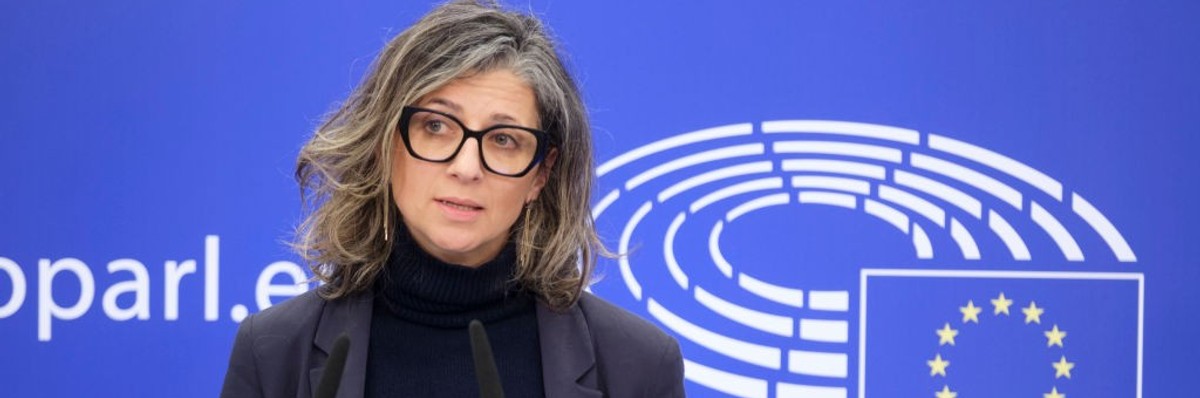
United Nations special rapporteur on the Occupied Palestinian Territories Francesca Albanese addresses the European Parliament in Brussels on April 10, 2024.
 (Photo: Thierry Monasse/Getty Images)

One expert even asked if Israel’s United Nations membership should be reconsidered given the country “seems to have zero respect” for the world body.

United Nations human rights experts warned Monday that Israel risks becoming an international “pariah” over its ongoing assault on Gaza—for which it is on trial for genocide at the world body’s International Court of Justice.

The special rapporteurs—who are appointed by the U.N. but do not speak on its behalf—condemned Israel’s human rights violations against Palestinians, as well as its blatant disregard for international law and multiple rulings from the ICJ.

These include an advisory opinion that the 57-year Israeli occupation of Palestine is an illegal form of apartheid that must immediately end, and orders for Israeli forces to avoid genocidal actions in Gaza and to immediately halt the Rafah offensive.

George Katrougalos, the U.N. special rapporteur on the promotion of democratic and equitable international order and a former Greek foreign minister, said during a press conference that the “first obligation” for harmonious relations between nations “is for everybody to respect the United Nations rules.”

“This is not happening in the case of Israel,” Katrougalos noted.

The United Nations agency for Palestinian relief says that around 200 of its staff members have been killed in more than 450 Israeli attacks on agency facilities since October. More than 500 Palestinians have been killed while seeking shelter under the U.N. flag.

Overall, more than 146,000 Palestinians have been killed or wounded by Israeli forces since October. Almost all of Gaza’s 2.3 million people have been forcibly displaced, and Israel’s “complete siege” has caused widespread starvation—sometimes deadly—and sickness throughout the coastal enclave.

Comparing the international community’s reaction to Russia’s ongoing invasion of Ukraine and Israel’s war on Gaza, Katrougalos stressed that “we cannot anymore stand this kind of double standards and hypocrisy.”

“I trust that the progressive and democratic citizens of Israel would not let their country become a pariah like South Africa [had] become during the times of apartheid,” he added. South Africa is leading the genocide case against Israel at the ICJ.

Francesca Albanese, the U.N. special rapporteur on the rights situation in the occupied Palestinian territory, said that “I think it’s unavoidable for Israel to become a pariah in the face of its continuous, relentless, vilifying assault of the United Nations, on top of millions of Palestinians.”

“Shockingly, in the face of the abyss reached in the OPT… most member states remained inactive at best, or [are] actively aiding and assisting Israel’s criminal conduct,” she continued.

“Should there be a consideration of its membership as part of this organization, which Israel seems to have zero respect for?” Albanese added.

Pedro Arrojo-Agudo, the U.N. special rapporteur on the rights to safe drinking water and sanitation, warned that “we are blowing up the United Nations if we don’t react” to Israel’s human rights violations.

Arrojo-Agudo added that, as with starvation, Israel is using deprivation of water as a “weapon” and disavowed Israel’s claim that Hamas—which led the October 7 attack on Israel—has “completely mismanaged water in Gaza.”

The special rapporteurs’ remarks came as representatives of U.N. member states gathered in New York for this year’s annual General Assembly. General debate sessions are set for next week.

Original article by Brett Wilkins republished from Common Dreams under Creative Commons (CC BY-NC-ND 3.0). 

Continue ReadingUN Experts Warn Israel Risks ‘Pariah’ Status Over Gaza Genocide

Coming Soon :: UK Labour Party Conference 2024

Spread the love
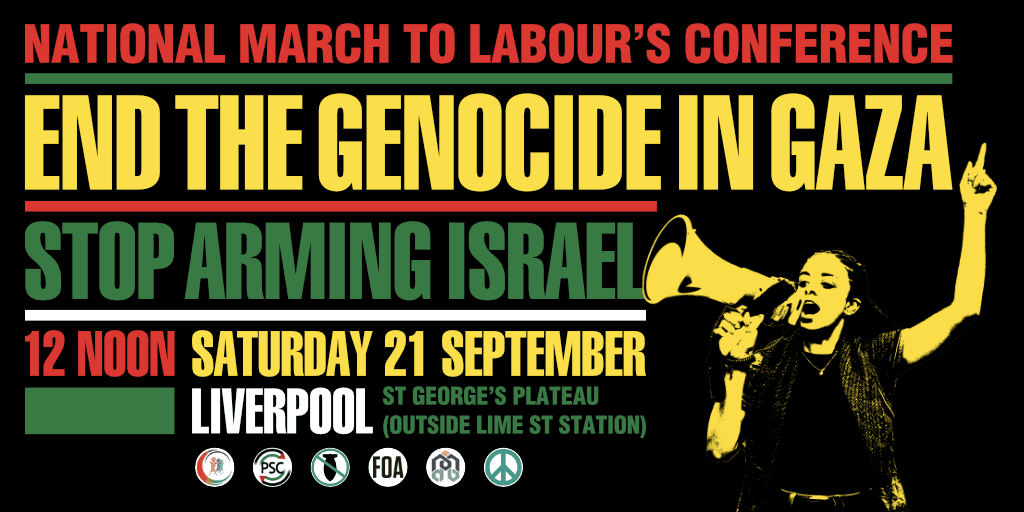
End the genocide in Gaza protest at Labour Party Conference, Liverpool 21 September 2024.

UK Labour Party Conference is starting on Sunday 22 September 2024. A protest has been announced on the 21st protesting the Labour party’s support for Israel’s genocide in Gaza.

I oppose Keir Starmer and the UK Labour Party for many reasons: their complicity in and support for Israel’s Zionist genocide in Gaza and the West Bank and attacks on the poor and disabled e.g. denying winter fuel payment benefits from poor and disabled pensioners likely to result in many deaths and the refusals to repeal the two-child benefit cap and the bedroom tax. Essentially the Labour Party are Zionist scum Blue Tories pretending to be Socialists. They are part of a global agenda to diminish international law to facilitate and support Israel’s racist, Fascist, genocide in Gaza and the West Bank.

I object to Labour Party Deputy Angela Rayner’s efforts to attack me while hiding – actually very typical of New Labour sihts in my experience.

Deputy Labour Party Leader Angela Rayner calls for police to kill and harass innocent people.

May be elaborated and extended.

Keir Starmer says pensioners can freeze to death and poor children can starve and be condemned to failure and misery all their lives.
Continue ReadingComing Soon :: UK Labour Party Conference 2024

Jury refuses to convict four Palestine Action activists

Spread the love

https://morningstaronline.co.uk/article/jury-refuses-to-convict-four-palestine-action-activists

Palestine Action activists outsite Bradford Crown Court

A CROWN Court jury has refused to convict four Palestine Action activists accused of causing more than £500,000 of damage at a factory supplying weaponry to Israel.

The four faced charges of criminal damage to a Teledyne Defence and Space factory at Shipley in West Yorkshire.

The activists were reported to have used sledgehammers to smash the roof, windows and the interior of the factory.

In closing speeches, the activists reminded jurors of their rights to acquit according to their conscience.

https://morningstaronline.co.uk/article/jury-refuses-to-convict-four-palestine-action-activists

Continue ReadingJury refuses to convict four Palestine Action activists

Gaza war: countries selling Israel weapons are violating international law – legal expert

Spread the love

[dizzy: This article was published  April 4, 2024 and refers to the United Kingdom’s previous Conservative government. Since then UK has a new Labour government under UK Prime Minister Keir Starmer. UK violating International law will not have changed since April 2024 and Keir Starmer should be well-aware of legal requirements since he is often referred to as a human rights legal expert.]

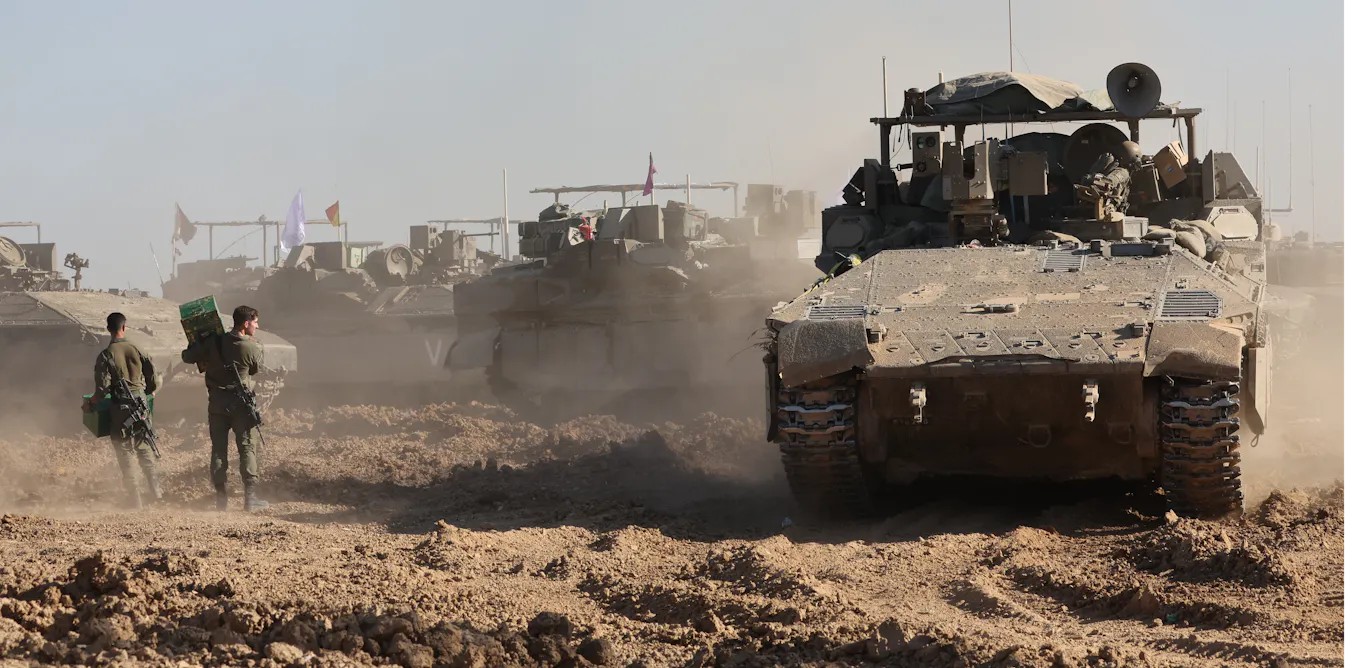
EPA-EFE/Abir Sultan

Lawrence Hill-Cawthorne, University of Bristol

The UK government has received internal legal advice that Israel has broken international humanitarian law in its current war on Gaza. The advice was revealed by Alicia Kearns, the Conservative chair of the House of Commons foreign affairs select committee, in a speech to a fundraising event on March 13 and leaked to the UK’s Observer newspaper.

The paper quoted British barrister and war crimes prosecutor Sir Geoffrey Nice as saying: “Countries supplying arms to Israel may now be complicit in criminal warfare. The public should be told what the advice says.”

The Guardian has now revealed that the prime minister, Rishi Sunak, has since received a letter signed by 600 lawyers and academics, including three former supreme court justices – among them Baroness Hale, the court’s former president – as well as former court of appeal judges and more than 60 KCs, warning that UK arms sales to Israel are also illegal under international law.

But what does international law actually say on this issue, and what are the UK’s (and other nations’) legal obligations in relation to the ongoing assault on Gaza?

In recent months, a number of countries have announced they are suspending arms exports to Israel. These include Canada, Belgium, Italy, Spain and the Netherlands, as well as the Japanese company Itochu Corporation. Germany and the US – by far the biggest suppliers of arms to Israel – have not as yet signalled intentions to follow suit.

Neither has the UK. But with arms exports amounting to £42 million in 2022, it is not one of Israel’s major suppliers.

Suspending arms exports to Israel indicates not only political concerns, but also fear over the legality of continuing to support Israel militarily in its assault on Gaza. The Netherlands court of appeal ruled in February that the Dutch government must discontinue its sales of F35 fighter jet parts on the basis of its obligations under the UN arms trade treaty. A similar lawsuit is currently pending in Denmark which exports F35 parts to the US, which then sells the finished jets to Israel.

In the UK, the high court dismissed an attempt to challenge the government’s continued licensing of arms exports to Israel. But this was because the particular procedural hurdle that applicants in such cases have to get over is notoriously high. The judgment said nothing definitive as to Israel’s (or the UK’s) compliance with international law.

Following this, 130 MPs and peers from across party lines recently signed a letter to the foreign secretary calling on the government to suspend arms exports to Israel.

Arms trade treaty

So what is the position under international law of countries, such as the UK, that support Israel militarily? There are many specific and general rules of international law that are relevant here.

The most obvious, and the one emphasised in the British MPs’ letter, is found in the UN arms trade treaty, to which the UK is a party. Article 7 requires a risk assessment for all weapons transfers, and prohibits exports where there is an overriding risk that the weapons could be used to commit serious violations of international humanitarian law (the law of armed conflict).

The only objective test we have for determining risk of future violations is to examine whether there is evidence of a pattern of past violations by Israel. UN reporting of past serious violations is one of the key considerations that the UK’s own policy points to in determining future risk. In 2019, the UK court of appeal suspended arms exports to Saudi Arabia based on the government’s failure to assess whether past violations of international law had likely been committed in Yemen.

The available evidence suggests there have been countless examples of Israeli actions in Gaza that appear, on their face, to be inconsistent with international humanitarian law. Among the most recent examples are the Israeli attack on an aid convoy on April 1, the destruction of Gaza’s hospitals, and the well-documented famine that now engulfs the territory.

The Hague court of appeal that ordered the Dutch government to suspend arms exports to Israel relied on reports from Amnesty International and the UN when it listed multiple examples of apparent violations of the law of armed conflict in Gaza.

And in the long-awaited UN security council resolution adopted on March 25, with the US abstaining, the security council condemned “all attacks against civilians and civilian objects, as well as all violence and hostilities against civilians”, and demanded the flow of humanitarian assistance into Gaza, in line with international humanitarian law.

This suggests a pattern of past serious violations and thus a clear risk of continuing violations. So, signatories to the arms trade treaty continuing to supply weapons to Israel likely do so in breach of article 7.

Geneva conventions

Yet all nations have other obligations that take on particular importance in relation to Gaza. One of these is the obligation to prevent genocide under article 1 of the Genocide convention (which was the focus of the letter to the prime minister referred to above).

This is especially relevant since the International Court of Justice (ICJ) determined in January that there is an imminent risk of irreparable harm to the rights of Palestinians in Gaza under the Genocide Convention.

But it also includes article 1 of the 1949 Geneva conventions, which requires states to “ensure respect” for international humanitarian law. There is overwhelming support for the view that this requires all states not only to avoid aiding or assisting violations (for example, through arms exports) but to take proactive steps to ensure warring parties comply with their obligations under international law. They can do so via diplomatic channels or by imposing sanctions.

On March 1, Nicaragua instituted proceedings before the ICJ against Germany (the second-biggest arms exporter to Israel), in part alleging that it is violating article 1 of the Geneva conventions due to its support for Israel.

In this way, all countries are legally obliged to ensure that others comply with international humanitarian law. If the catastrophic destruction, massive civilian death toll and immense suffering of those still alive in Gaza is not enough to pull Israel’s allies into line over their continuing arms sales, it is difficult to conceive of any situation that ever could.

Lawrence Hill-Cawthorne, Associate Professor of Law, University of Bristol

This article is republished from The Conversation under a Creative Commons license. Read the original article.

Continue ReadingGaza war: countries selling Israel weapons are violating international law – legal expert