Solidarity Marches Held Across Globe to Demand Cease-Fire in Gaza

Spread the love

Original article by JULIA CONLEY republished from Common Dreams under Creative Commons (CC BY-NC-ND 3.0). 

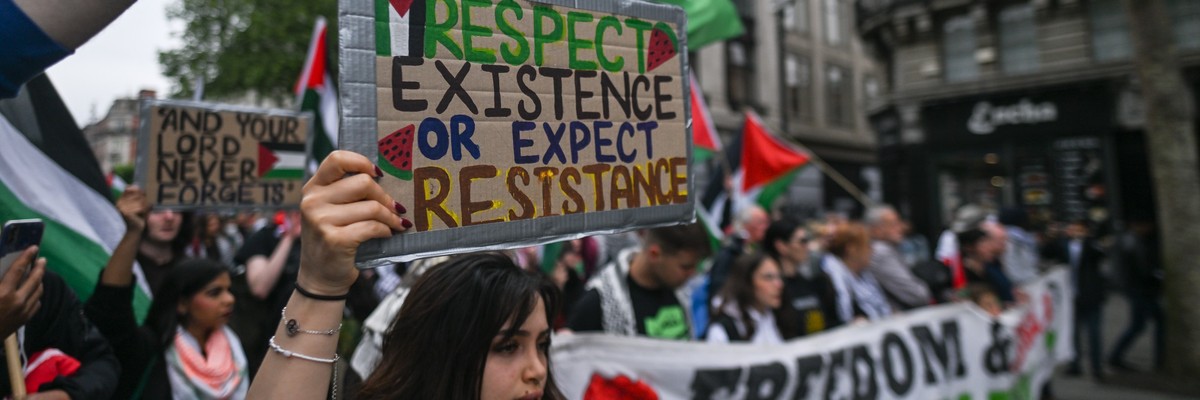
Pro-Palestinian activists from the Ireland Palestine Solidarity Campaign participate in the National March for Palestine on May 18, 2024, in Dublin, Ireland. 
(Photo: Artur Widak/NurPhoto via Getty Images)

Organizers held rallies in the U.S., Europe, and Asia to mark Nakba Day and condemn Israel’s bombing and starvation of Palestinian civilians.

As one United Nations official on Saturday said that “brand new words” are needed to adequately describe the devastation Israel has wrought across Gaza in its U.S.-backed military assault, tens of thousands of people across the globe marched in solidarity with Palestinians to demand an end to the “ongoing Nakba.”

The marches were held to honor Nakba Day, which was marked on May 15—the 76th anniversary of the mass displacement of 700,000 Palestinians who were forced from their homes when Israel declared statehood in 1948. The protesters demanded a cease-fire in Gaza, where Israeli forces have killed at least 35,456 people since October, the majority of them women and children.

Protesters in London carried signs reading, “Solidarity is a verb,” and “The Nakba never ended” as they marched through Whitehall, close to the home and office of Prime Minister Rishi Sunak.

Palestinian photojournalist Motaz Azaiza, who covered the first months of Israel’s bombardment and evacuated Gaza in January, joined the marchers and told the crowd that mass protests around the world have given Palestinians hope.

“I didn’t believe that I would stay alive to stand here in London today in front of the people, who saw me there under the bombing,” said Azaiza. “Occupation is using all the weapons against us, the bombs, the killing, the starvation, the apartheid in the West Bank, and now killing the people and forcing them to leave their lands… I did my best to show you, and I believe you will do more, we all together will do more to stop this genocide.”

In Dublin, Ireland, where politicians have harshly criticized Israel and its supporters for the assault on Gaza and the near-total blockade on humanitarian aid that has pushed parts of the enclave into famine, more than 100 civil society groups supported a march organized by the Ireland-Palestine Solidarity Campaign.

Irish Palestinian Zak Hania, a researcher and translator who was trapped in Gaza until earlier this month when he was finally granted permission by Egyptian and Israeli authorities to leave, thanked the crowd for choosing “to stand with justice and to stand with an oppressed people.”

“I am proud to be an Irish Palestinian,” said Hania. “I am proud to see all of you. It is part of my healing… We inherited a dream from our parents. We are trying for all our lives to fulfill our dreams and our parents’ dreams. My parents are dead, but I will work to fulfill their dreams. Their dream is to have a free Palestine.”

Other protests included a rally outside the German embassy in Bangkok, a march of about 400 people in Washington, D.C., and a demonstration in Brooklyn where police violently arrested at least 34 people, according to The New York Times.

Nerdeen Kiswani, founder of pro-Palestinian group Within Our Lifetime, told the Times she witnessed “police indiscriminately grabbing people off the street and the sidewalk. They were grabbing people at random.”

Independent journalists posted videos on social media of police officers punching and kicking protesters.

https://twitter.com/taliaotg/status/1791951178051326022?ref_src=twsrc%5Etfw%7Ctwcamp%5Etweetembed%7Ctwterm%5E1791951178051326022%7Ctwgr%5E53baf0a417323c159ec239a08e49260547eb26f5%7Ctwcon%5Es1_c10&ref_url=https%3A%2F%2Fwww.commondreams.org%2Fnews%2Fgaza-protest

The latest show of global outrage toward the Israeli government and the Western leaders who have supported its assault on Gaza came as U.N. humanitarian aid officer Yasmina Guerda told U.N. News about her latest deployment to Rafah, where 900,000 people have now been forced to flee following Israel’s incursion in the city.

“We would need to invent brand new words to adequately describe the situation that Palestinians in Gaza find themselves in today,” said Guerda. “No matter where you look, no matter where you go, there’s destruction, there’s devastation, there’s loss. There’s a lack of everything. There’s pain. There’s just incredible suffering. People are living on top of the rubble and the waste that used to be their lives. They’re hungry. Everything has become absolutely unaffordable. I heard the other day that some eggs were being sold for $3 each, which is unthinkable for someone who has no salary and has lost all access to their bank accounts.”

“Access to clean water is a daily battle,” she added. “Many people haven’t been able to change clothes in seven months because they just had to flee with whatever they were wearing. They were given 10 minutes notice and they had to run away. Many have been displaced six, seven, eight times, or more.

The daily reality described by Guerda is continuing to unfold as the Israeli forces have prevented 3,000 aid trucks from entering Gaza in the past two weeks, according to the Government Media Office in the enclave. The closure of the Rafah and Karem Abu Salem crossings for the past 13 days, since Israel launched its new offensive in Rafah, has also prevented nearly 700 injured and sick people from leaving Gaza for treatment.

“This constitutes a clear danger in light of the collapse of the health system,” said the office.

On Sunday, U.N. humanitarian chief Martin Griffiths warned that the blockade on aid is leading to “apocalyptic” consequences, with the famine that has taken hold in parts of northern Gaza close to spreading across the enclave.

“If fuel runs out, aid doesn’t get to the people where they need it, that famine, which we have talked about for so long, and which is looming, will not be looming any more,” said Griffiths. “It will be present.”

Original article by JULIA CONLEY republished from Common Dreams under Creative Commons (CC BY-NC-ND 3.0). 

Continue ReadingSolidarity Marches Held Across Globe to Demand Cease-Fire in Gaza

As US Aid Shipments Begin, Gaza Pier Denounced as ‘PR Move’

Spread the love

Original article by BRETT WILKINS republished from Common Dreams under Creative Commons (CC BY-NC-ND 3.0).

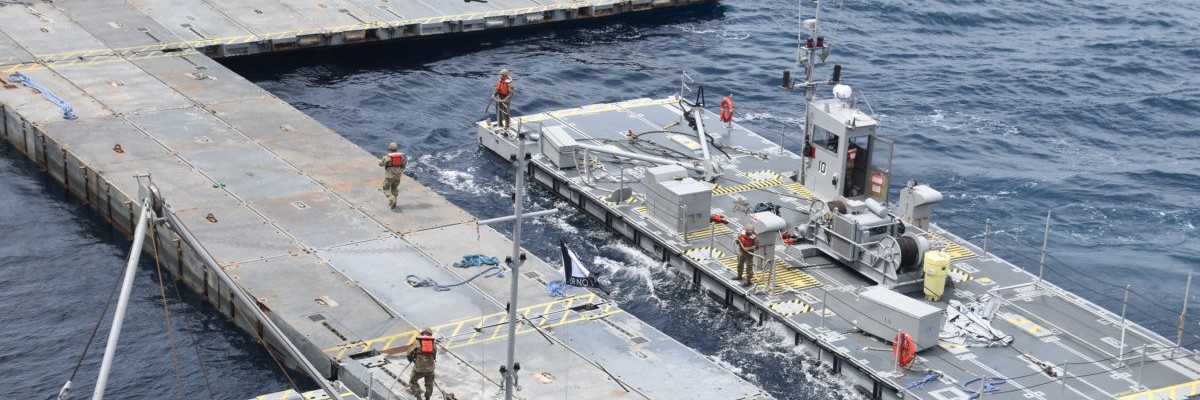
U.S. and Israeli troops assemble the Trident Pier off the shore of the northern Gaza Strip on April 26, 2024. 
(Photo: U.S. Army Central Command)

“It’s completely absurd,” said one humanitarian worker. “The solution to the problem here is obvious.”

As humanitarian shipments began trickling into Gaza via a U.S.-built temporary floating pier, Palestinians and aid workers on Friday renewed criticism of what they called an expensive and largely ineffectual publicity stunt that is no substitute for a cease-fire and opening of more land crossings into the besieged coastal enclave.

U.S. Army Central Command said that “trucks carrying humanitarian assistance began moving ashore” at around 9:00 am local time Friday as part of “an ongoing, multinational effort to deliver additional aid to Palestinian civilians in Gaza via a maritime corridor.”

The $320 million Trident Pier—which consists of a floating offshore barge and 1,800-foot causeway to the shore—is expected to eventually accommodate up to 150 trucks per day. According to United Nations agencies, an average of 200 trucks entered Gaza each day last month, far fewer than the prewar daily mean of more than 500 truckloads that U.S. and U.N. officials say are required to meet the needs of a population facing critical shortages of food, water, medicine, and other lifesaving supplies.

“We don’t want ships. We want the border crossing to open for people to come and go. We want safety.”

However, as famine grips northern Gaza—with malnutrition and dehydration killing dozens of people, mostly children—and at least hundreds of thousands of other Palestinians starve, Israel has been accused of blocking aid from those who desperately need it and using starvation as a weapon of war.

“We don’t want ships. We want the border crossing to open for people to come and go. We want safety. We want official borders,” Hassan Abu Al-Kass, a forcibly displaced Palestinian man, toldThe New York Times on Thursday.

Al-Kass compared the pier to the humanitarian aid airdropped by U.S. and other troops over Gaza, whose officials say that more than 20 people have been killed by the parachuting parcels, either by crushing or drowning while trying to reach offshore drops.

“Those planes, as well, that they bring here with the parachutes, and they throw food at us like dogs, like beggars, that does not work,” he said. “It falls on houses. It falls on people. It brings us problems.”

One unnamed humanitarian aid worker told U.S. investigative reporter Jeremy Scahill: “It’s completely absurd. The solution to the problem here is obvious and we need to end the occupation… Once the siege is lifted, humanitarian aid can roll in. A pier is a PR move.”

Farhan Haq, deputy spokesperson for U.N. Secretary-General António Guterres, said Thursday that “to stave off the horrors of famine, we must use the fastest and most obvious route to reach the people of Gaza—and for that, we need access by land now.”

Washington Post columnist Ishaan Tharoor noted on social media Thursday that “no major humanitarian organization has asked for this pier, and most see it as a costly distraction that will do little to make a dent in meeting Gaza’s overwhelming humanitarian needs.”

“For that,” he added, “you need a cease-fire and open border crossings and less military obstruction.”

According to a report published last month, officials at the United States Agency for International Development concluded in a confidential memo to Secretary of State Antony Blinken that Israel is violating a White House directive by blocking humanitarian aid from entering Gaza. Critics pointed to the leaked memo as more evidence that the Biden administration is breaking the law by supporting Israel’s assault on Gaza—which Palestinian and international officials say has killed, wounded, or left missing more than 125,000 people—with arms and diplomatic cover.

Parties to the South African-led genocide case against Israel at the International Court of Justice, as well as human rights groups, accuse Israel of flouting the ICJ’s January 26 preliminary ruling ordering the Israeli government to prevent genocidal acts in Gaza and ensure immediate delivery of humanitarian aid. Israel rejects charges of genocide and blocking aid.

Hundreds of U.N. and other aid workers—overwhelmingly Palestinians—have also been killed or wounded by Israeli forces in Gaza since October 7. Israeli troops have been accused of deliberately attacking both humanitarian workers and Palestinians trying to receive aid, including in the February 29 “Flour Massacre,” in which nearly 900 starving Gazans were killed or wounded while waiting for food distribution south of Gaza City.

Critics have slammed U.S. President Joe Biden for offering token aid to Gazans with one hand while lavishing Israel with billions of dollars of weaponry used to kill Palestinians with the other.

Earlier this month, Biden said he would stop sending bombs, artillery shells, and other arms to Israel in the event of a major invasion of Rafah, where more than a million Palestinians forcibly displaced from other parts of the embattled Gaza Strip are sheltering alongside around 280,000 local residents.

However, as Israeli air and ground attacks pound the southern city, killing civilians including 22 members of one family in a single strike, Biden—who previously implored Israel to stop its “indiscriminate bombing” of Palestinian noncombatants—informed Congress this week that his administration will soon send another $1 billion in arms and ammunition, including tank and mortar rounds, to the Israel Defense Forces.

This, despite the Biden administration last week acknowledging “reasonable” evidence that Israel is using U.S.-supplied weapons in the commission of war crimes in Gaza, with the caveat that “we are not able to reach definitive conclusions” on the matter.

Original article by BRETT WILKINS republished from Common Dreams under Creative Commons (CC BY-NC-ND 3.0).

Continue ReadingAs US Aid Shipments Begin, Gaza Pier Denounced as ‘PR Move’

Rights Groups Slam ‘Malicious Crackdown’ on Migrants and Civil Society in Tunisia

Spread the love

Original article by BRETT WILKINS republished from Common Dreams under Creative Commons (CC BY-NC-ND 3.0).

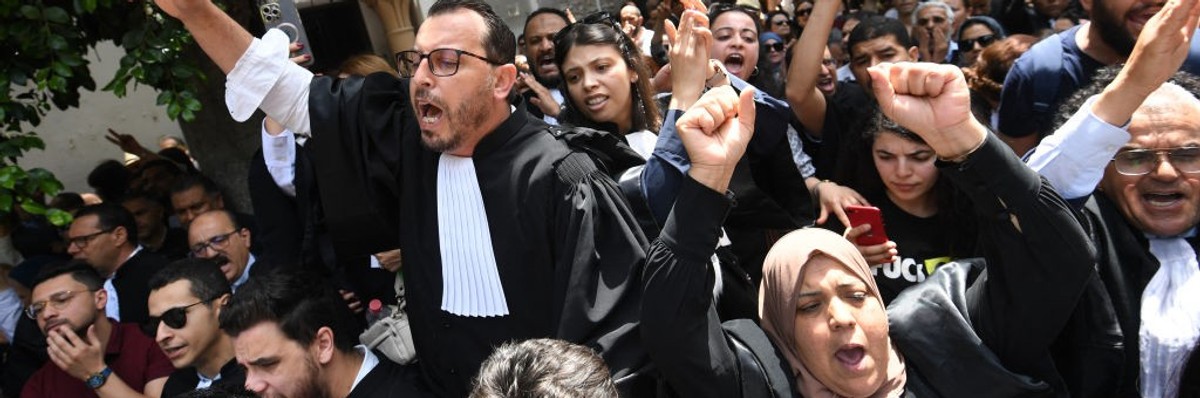
Lawyers shout slogans against Tunisian President Kais Saied during a May 16, 2024 protest in Tunis.
 (Photo: Fethi Belaid/AFP via Getty Images)

“The clampdown on migration-related work at the same time as the increasing arrest of government critics and journalists sends a chilling message,” said one campaigner.

Human rights defenders on Friday decried what Amnesty International called “an unprecedented repressive clampdown” by Tunisia’s increasingly authoritarian government on migrants, their civil society advocates, and journalists over the past two weeks.

Hundreds of Tunisian attorneys led a strike in the capital Tunis on Thursday to protest rising arrests of lawyers, one of whom, Mahdi Zagrouba, said he was tortured during interrogation—an allegation denied by Tunisian officials. Demonstrators chanted “No fear, no terror! Power belongs to the people!” as they marched on the Palace of Justice.

Sub-Saharan African migrants—recently described by Tunisian President Kais Saied as “hordes of illegal immigrants” who bring “violence, crime, and unacceptable practices” to Tunisia and threaten its “Arab and Islamic” character—have been particularly targeted, as have those who help them.

“On May 11, security officers stormed the Tunisian Bar Association’s headquarters during a live television broadcast, arresting a media commentator and lawyer, Sonia Dahmani, for sarcastic comments made on May 7 questioning the claim that Black African migrants were seeking to settle in Tunisia,” Human Rights Watch said Friday.

“Based on media reports, Dahmani’s arrest and subsequent detention was based on Decree-Law 54 on cybercrime, which imposes heavy prison sentences for spreading ‘fake news’ and ‘rumors’ online and in the media, after she refused to respond to a summons for questioning,” the group added.

Other recent arrestees include Saadia Mosbah, a Black Tunisian woman who heads the anti-racism group Mnemty (My Dream); and journalists Mourad Zeghidi and Borhen Bsaies

“The clampdown on migration-related work at the same time as the increasing arrest of government critics and journalists sends a chilling message that anyone who doesn’t fall in line may end up in the authorities’ crosshairs,” Lama Fakih, Middle East and North Africa director at Human Rights Watch, said in a statement. “By targeting these civil society groups, Tunisian authorities jeopardize the vital support they provide migrants, refugees, and asylum-seekers living in extremely vulnerable situations.”

According to Amnesty International:

Tunisian authorities have since May 3 arrested, summoned, and investigated the heads, former staff, or members of at least 12 organizations over unclear accusations including “financial crimes” for providing aid to migrants, including a Tunisian organization that works in partnership with the [United Nations] Refugee Agency, UNHCR, on supporting asylum-seekers through the refugee status determination process in the country. They have also arrested at least two journalists and referred them to trial for their independent reporting and comments in the media.

In parallel, security forces have escalated their collective unlawful deportations of refugees and migrants, as well as multiple forced evictions and have arrested and convicted landlords for renting apartments to migrants without permits.

“Tunisia’s authorities have stepped up their malicious crackdown against civil society organizations working on migrants and refugee rights using misleading claims about their work and harassing and prosecuting NGO workers, lawyers, and journalists,” said Heba Morayef, Amnesty’s regional director for Middle East and North Africa.

“A smear campaign online and in the media, supported by the Tunisian president himself, has put refugees and migrants in the country at risk,” she continued. “It also undermines the work of civil society groups and sends a chilling message to all critical voices.”

“Tunisia’s authorities must immediately end this vicious campaign and halt all reprisals against NGO workers providing essential support, including shelter, to migrants and refugees,” Morayef added. “The European Union should be urgently reviewing its cooperation agreements with Tunisia to ensure that it is not complicit in human rights violations against migrants and refugees nor in the clampdown on media, lawyers, migrants, and activists.”

Last July, the E.U. and Tunisia signed a memorandum of understanding that included up to €1 billion ($1.09 billion) in funding for the North African nation. Around 10% of that aid is meant to be spent on stopping migrants from reaching Europe.

“The European Union should be urgently reviewing its cooperation agreements with Tunisia to ensure that it is not complicit in human rights violations.”

Romdhane Ben Amor of the Tunisian League for the Defense of Human Rights toldAl Jazeera Friday that “the regime’s machinery is operating very efficiently, meaning it devours anyone who has a critical perspective on the situation… lawyers, journalists, bloggers, citizens, or associations.”

“So, of course, Kais Saied from now until the elections has a long list of individuals, associations, parties, and journalists whom he will gradually criminalize to always maintain the sympathy of his electoral base,” Ben Amor added, referring to this fall’s expected presidential contest.

Over the past three years, Saied—who was initially supported by both leftists and Islamists when elected on an anti-corruption platform in 2019—has dissolved Parliament and suspended most of Tunisia’s 2014 Constitution, allowing him to rule by decree. He has consolidated power by pushing through a new constitution, eroding the judiciary’s independence, repressing civil liberties, undermining workers’ rights, weakening democratic institutions, and other methods.

“Tunisian authorities must urgently reverse this significant backsliding on human rights,” Morayef asserted. “They must cease this judicial harassment and release all those detained solely for the exercise of their freedom of expression and freedom of association. People should have the freedom to express themselves without fear of reprisal.”

Original article by BRETT WILKINS republished from Common Dreams under Creative Commons (CC BY-NC-ND 3.0).

Continue ReadingRights Groups Slam ‘Malicious Crackdown’ on Migrants and Civil Society in Tunisia

Suella Braverman blanked by students at Gaza protest camp in excruciating video

Spread the love

https://leftfootforward.org/2024/05/suella-braverman-blanked-by-students-at-gaza-protest-camp-in-excruciating-video/

Suella Braverman has been ridiculed after an excruciating attempt to engage with students at a protest camp in support of Palestine outside the University of Cambridge. 

Visiting the camp on Thursday with GB News presenter Patrick Christys, the Tory MP was met with a wall of silence as she and the presenter attempted to talk with activists. 

The former Home Secretary tried a number of times to ask questions, but was met on all occasions with no response during the humiliating two and half minute encounter.

She introduced herself with, “Hi, I’m Suella I’m keen to find out your views and what you’re protesting about.” But protesters didn’t give them the response they were after, instead they just stood and stared back. 

Braverman persisted asking questions such as, “I’m interested in why you’re covering your faces. Is it a Covid or a health measure?” and “I’m really keen to hear what your message is to Israel.”

https://leftfootforward.org/2024/05/suella-braverman-blanked-by-students-at-gaza-protest-camp-in-excruciating-video/

Continue ReadingSuella Braverman blanked by students at Gaza protest camp in excruciating video

‘Enough Is Enough’: South Africa Urges ICJ to Halt Israeli Assault on Rafah

Spread the love

Original article by JULIA CONLEY republished from Common Dreams under Creative Commons (CC BY-NC-ND 3.0).
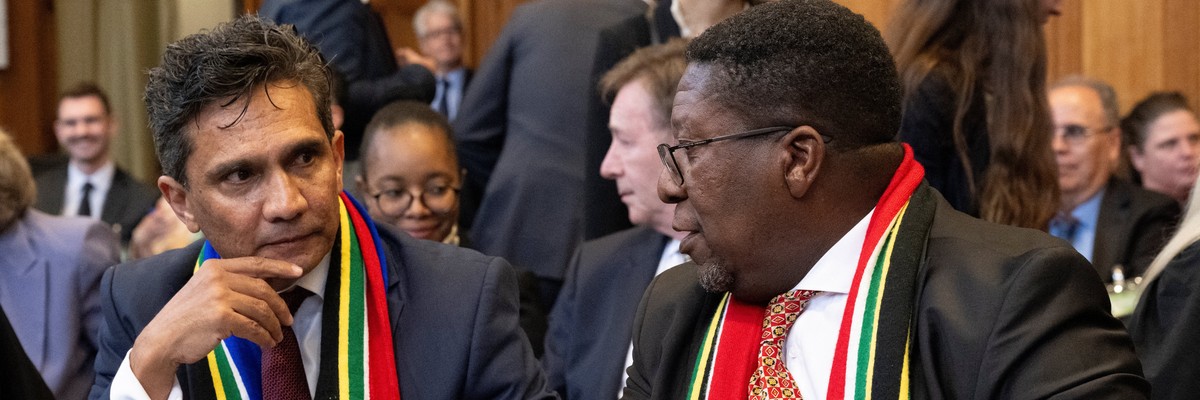
South African legal adviser Cornelius Scholtz (L) and South African Ambassador to the Netherlands Vusi Madonsela attend a hearing at the International Court of Justice (ICJ) on Israel’s incursion in Rafah, Gaza, in The Hague on May 16, 2024. (Photo: Lina Selg/ANP/AFP via Getty Images)

Israel’s assault on Rafah provides “evidence of the crime of genocide,” one legal expert said. “This attack is the final blow that is intended to destroy the Palestinian group in Gaza.”

South African officials on Thursday made their case before the International Court of Justice to stop Israel’s brutal invasion of Rafah, warning once again that Israeli officials have displayed clear “genocidal intent” and “genocidal conduct” in their military campaign in Gaza.

The case for the ICJ to stop the attack on Rafah was made by a number of lawyers, legal experts, and ambassadors, with the South African representatives outlining the bare facts of Israel’s military campaign, blocking of humanitarian aid, and statements of intent, just as they did when the court heard South Africa’s original claim that Israel is committing genocide.

That case, argued in January, resulted in a preliminary ruling in which the court said South Africa had made a “plausible” case and ordered Israel to prevent genocidal acts by the Israel Defense Forces (IDF).

On Thursday, South Africa urged the ICJ to see that Israel has not followed that order.

“It is difficult to imagine that the situation could get worse” than it was in January, international law professor John Dugard told the court. “But unfortunately, it has… Israel has now commenced its long-threatened assault on Rafah. It has ordered the evacuation of Palestinians in Rafah to the barren sand dunes of Al-Mawasi. It has closed critical border crossings to humanitarian aid, medical supplies, goods, and fuel, upon which the population depends.”

“Israel’s actions are in violation of fundamental international humanitarian law, but in addition, they provide evidence of the crime of genocide,” Dugard continued. “This attack is the final blow that is intended to destroy the Palestinian group in Gaza.”

Watch the livestream of the ICJ hearing below:

The South Africans made their case as the U.N. Relief and Works Agency for Palestinian Refugees in the Near East (UNRWA) said Thursday that an estimated 600,000 people have now been forcibly displaced from Rafah by Israel.

Despite tepid warnings from the U.S.—the biggest international funder of the IDF—for Israel to avoid attacking “population centers,” the IDF this week has moved into dense residential neighborhoods in central Rafah.

The U.S. has also called for Israel to allow humanitarian aid into Gaza, but the IDF’s seizure of the Rafah crossing between the enclave and Egypt last week led the World Food Program (WFP) on Thursday to warn that food and fuel rations “will run out in a matter of days.” Dozens of Palestinians have been starved to death so far by Israel’s blocking of relief shipments.

“The threat of famine in Gaza never loomed larger,” said the WFP as South Africa made its case in The Hague.

Three months after giving a 22-minute speech detailing the numerous statements of genocidal intent made by top Israeli officials since the Gaza assault began in October, South African lawyer Tembeka Ngcukaitobi during Thursday’s hearing, used the more recent words of Israeli Finance Minister Bezalel Smotrich, who publicly described the aim of the Rafah invasion as “total annihilation.”

In his presentation before the court, Ngcukaitobi invoked Smotrich’s language by arguing that the Rafah incursion “is the last stage of ‘total annihilation’ of Palestinian life.”

“For Palestinians to be able to continue to exist as a protected group under the Genocide Convention, they need a place from which to rebuild,” he continued. “Rafah is that place, the last stand… Without Rafah, the possibility to rebuild will be lost forever.”

In her speech, Irish lawyer Blinne Ni Ghralaigh outlined other developments in Gaza since the ICJ issued its preliminary ruling that illustrate the need for the court’s “invaluable intervention.”

Ni Ghralaigh detailed the destruction of hospitals like Al-Shifa, where mass graves have been found with the remains of women, children, and medical workers, and warned that “the same fate now awaits Rafah’s remaining hospitals, doctors, and medics.”

She also pointed to evidence that the IDF is treating evacuated areas as “extermination zones,” where soldiers are ordered to kill any remaining people, and its use of an error-prone AI system to target Palestinians.

The South African legal team said the court must order Israel “to immediately take all effective measures to ensure the access of persons able to investigate ongoing atrocities,” and called on the ICJ to “at least modify its provisional measures” from March, when it demanded that Israel allow humanitarian aid into Gaza.

“The court has the power to modify or make an explicit order for Israel to cease its military operations in Rafah, Gaza, and to withdraw from the Gaza Strip,” said Ni Ghralaigh, pointing out that the provisional measure from March could only take full effect if a cease-fire agreement was reached.

“No such resolution is in place. The court must itself, therefore, create the circumstances necessary for its provisional measures to take full effect. It must order Israel to cease its military operations system finally,” she said. “Enough is enough.”

Israel is expected to address the ICJ at a second day of hearings on Friday.

Original article by JULIA CONLEY republished from Common Dreams under Creative Commons (CC BY-NC-ND 3.0).
Continue Reading‘Enough Is Enough’: South Africa Urges ICJ to Halt Israeli Assault on Rafah