Israeli Assault Leaves Gaza’s Nasser Hospital ‘Not Functional’

Spread the love

Original article by JESSICA CORBETT republished from Common Dreams under Creative Commons (CC BY-NC-ND 3.0). 
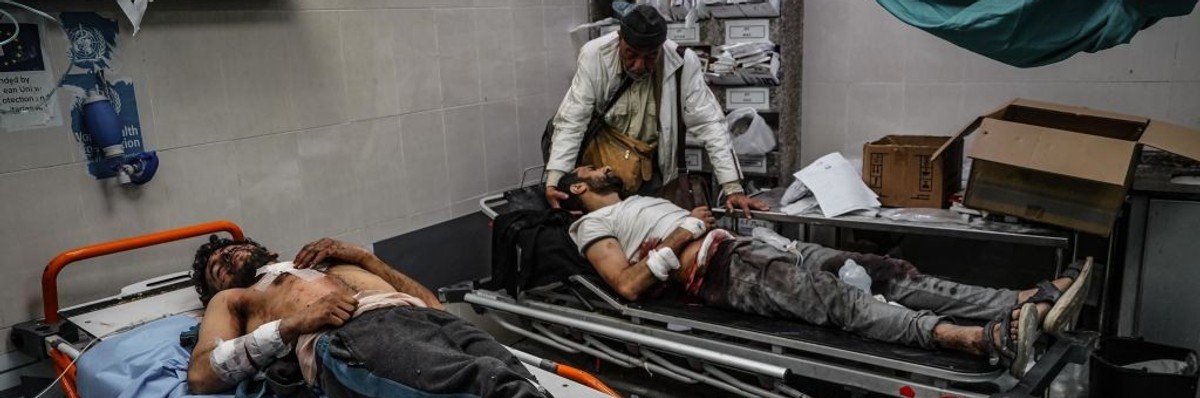
Injured Palestinians are brought to Nasser Hospital in Khan Yunis, Gaza on January 22, 2024.  (Photo: Belal Khaled/Anadolu via Getty Images)

The WHO “was not permitted to enter” the facility in recent days, said the agency chief, warning that “the cost of delays will be paid by patients’ lives.”

World Health Organization Director-General Tedros Adhanom Ghebreyesus announced Sunday that the largest hospital in the southern Gaza Strip “is not functional anymore, after a weeklong siege followed by the ongoing raid” by Israeli forces.

After claiming that Hamas was using Nasser Hospital in Khan Younis for “military activity” and some hostages’ bodies may be there, the Israel Defense Forces on Thursday began raiding the facility, where around 10,000 people had sought shelter. Sources there said the IDF bombed “a ward full of patients” and multiple people who were dependent on oxygen have died due to power outages.

Tedros highlighted on Sunday that the WHO team “was not permitted to enter” the facility in recent days “to assess the conditions of the patients and critical medical needs, despite reaching the hospital compound to deliver fuel alongside partners.”

“There are still about 200 patients in the hospital. At least 20 need to be urgently referred to other hospitals to receive healthcare; medical referral is every patient’s right,” he added. “The cost of delays will be paid by patients’ lives. Access to the patients and hospital should be facilitated.”

Later Sunday, the Palestinian Ministry of Health in Gaza said that “150 patients who cannot move are piled inside the rooms and corridors of the old building at Nasser Medical Complex without medical care after the arrest of 70 of the complex’s management and medical staff.”

“The occupation refuses to evacuate patients for treatment in other hospitals, which endangers their lives, including seven intensive care patients, five dialysis patients, [and] three newborns in the nursery, in addition to cases of burns, amputations, quadriplegia, childbirth, and others,” the ministry added.

The IDF said on Telegram that in its operations around the facility, Israeli troops apprehended “hundreds of terrorists and other terror suspects who were hiding in the hospital, some of whom had posed as medical staff,” including alleged participants in the October 7 Hamas-led attack that led to the war.

Noting IDF claims that soldiers aimed to recover the remains of hostages believed to be in the facility, The Washington Postreported that “Israeli forces have not yet found the bodies of any hostages but said on Sunday that they discovered medicine at the hospital bearing the names of Israelis who were abducted by Hamas.”

The Israeli assault on the Hamas-governed enclave has killed nearly 29,000 Palestinians, injured over 68,800 others, devastated civilian infrastructure—including hospitals—and left most of Gaza’s 2.3 million residents displaced, hungry, and at risk of disease. Global experts and critics have accused Israel of genocide, including in a South Africa-led case before the International Court of Justice (ICJ).

In response to IDF orders to leave northern Gaza, most residents are now crammed into the southern part of the strip. According toAl-Jazeera:

Al-Amal Hospital, the only other major medical facility still operational in Khan Younis, continues to be a target of Israeli attacks. The Palestine Red Crescent Society (PRCS) on Sunday said Israeli forces targeted the third floor of the hospital with artillery fire.

The Israeli military has expanded its siege on Khan Younis and its medical facilities as it pushed further south into Rafah on the border with Egypt.

Throughout the week, people around the world including humanitarian and United Nations leaders have pressured Israel to refrain from a full-scale attack on Rafah. The ICJ on Friday echoed U.N. Secretary-General António Guterres’ warning that it “would exponentially increase what is already a humanitarian nightmare with untold regional consequences.”

Original article by JESSICA CORBETT republished from Common Dreams under Creative Commons (CC BY-NC-ND 3.0). 

Continue ReadingIsraeli Assault Leaves Gaza’s Nasser Hospital ‘Not Functional’

‘Enough Is Enough’: Australia Says Free Assange

Spread the love

Original article by AMY GOODMAN DENIS MOYNIHAN republished from Common Dreams under Creative Commons (CC BY-NC-ND 3.0). 

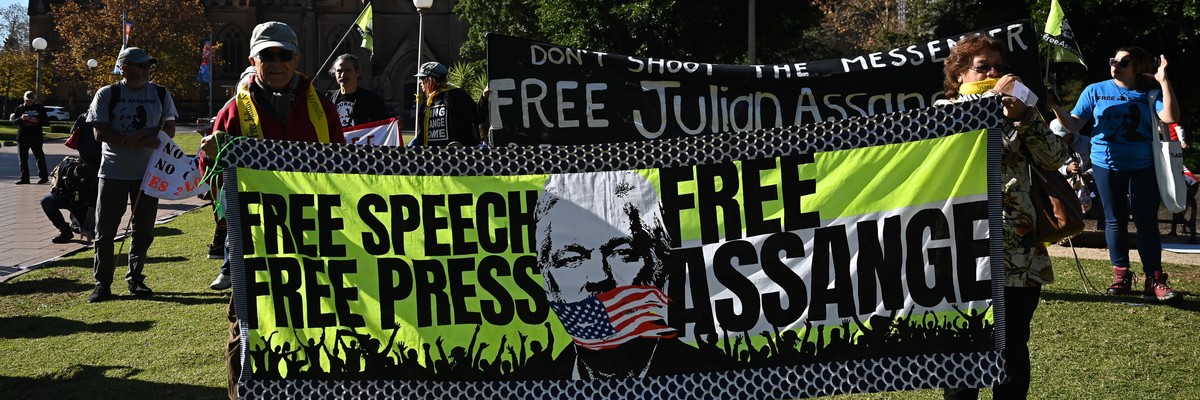
People participate in a rally demanding freedom for imprisoned WikiLeaks founder Julian Assange in Sydney, Australia, on May 24, 2023.  (Photo: Steven Saphore/Anadolu Agency via Getty Images)

U.S. and U.K. persecution of Assange has been continuous and severe.

Australian Prime Minister Anthony Albanese said during Prime Minister’s Questions on February 15, “This thing cannot just go on and on and on, indefinitely.”

The Prime Minister was addressing an action he took a day earlier, on Valentine’s Day. No, not his marriage proposal to his partner, Jodie Haydon (she said yes). He was explaining his support for a parliamentary motion that passed overwhelmingly, calling for the release of an Australian citizen, imprisoned WikiLeaks founder Julian Assange.

Albanese’s support builds on a growing demand from Australians across the political spectrum that the United Kingdom not extradite Assange to the United States, and for the U.S. to drop its espionage and hacking charges against him. Assange, who has been imprisoned in London’s notorious maximum-security Belmarsh Prison since 2019, has a court hearing in the UK.

Assange’s counsel, Jennifer Robinson, texted us on Thursday:

“The appeal next week could be Julian’s final appeal against U.S. extradition. If permission to appeal is denied, there are no further appeals available to us in the U.K.” If extradited, Assange faces up to 175 years in prison in the United States. Said Prime Minister Albanese, “Enough is enough.”

Prior to his imprisonment in Belmarsh, Julian Assange spent seven years cramped inside Ecuador’s small London embassy, where he’d been granted political asylum.

Assange founded WikiLeaks, a website that publishes leaked material while protecting the identity of the whistleblowers. While it launched in 2006, it wasn’t until 2010 that the U.S. government forcefully and publicly targeted Wikileaks and Assange, after Wikileaks made several massive disclosures of leaked documents related to the U.S. invasions and occupations of Iraq and Afghanistan.

On Monday, April 5, 2010, Julian Assange released a shocking video at the National Press Club in Washington, D.C. The video, which WikiLeaks titled “Collateral Murder,” was shot in 2007 from a U.S. military Apache helicopter flying over Baghdad, Iraq. The video shows in grainy black and white detail the gunship’s attack on a group of people on the ground. Twelve civilians, including two Reuters news employees, were mowed down by automatic fire from the helicopter. The voices of the crew were recorded, as they sought permission to “engage” with their targets, and as they laughed and cursed through the slaughter. It was a chilling video, documenting a war crime.

The video’s release was followed by the publication on Wikileaks.org of hundreds of thousands of digital records from the U.S. military, dubbed the Iraq War Logs and the Afghan War Diary. These documents provided further proof that the U.S. was committing war crimes. Some elected officials in the U.S. called for Assange to be assassinated. Then-Vice President Joe Biden called him a “high-tech terrorist.”

Not long after, the U.S. Justice Department convened a secret grand jury which issued a sealed indictment against Assange. Existence of that indictment itself was revealed on WikiLeaks, in a subsequent leak, in 2012. U.S. and U.K. persecution of Assange since then has been continuous and severe. In 2017, as revealed in 2021 by journalist Michael Isikoff and colleagues, the CIA hatched plans to either kidnap Assange from the Ecuadorian embassy or even to assassinate him.

Andrew Wilkie, an independent member of the Australian Parliament from Tasmania, introduced the resolution in support of Assange this week, saying, “This House notes that on 20 and 21 February 2024, the High Court of Justice in the United Kingdom will hold a hearing into whether Walkley Award-winning journalist Julian Assange can appeal against his extradition to the United States of America… both the Australian Government and Opposition have publicly stated that this matter has gone on for too long; and underlines the importance of the U.K. and USA bringing the matter to a close so that Mr Assange can return home to his family in Australia.”

The Australian government is not alone in calling for Assange’s release. In November, 2022, five major newspapers that collaborated with WikiLeaks—The New York TimesThe GuardianLe MondeEl Pais, and Der Spiegel—released a joint letter calling for an end to the prosecution. “Obtaining and disclosing sensitive information when necessary in the public interest is a core part of the daily work of journalists. If that work is criminalized, our public discourse and our democracies are made significantly weaker,” the letter read.

Assange’s attorney Jennifer Robinson will be in the London court for the hearing. She told us, “We have been saying for years: This is a political case which requires a political solution. The unprecedented showing of political support in the Australian Parliament overnight shows that Julian’s case is a priority for the Australian government, our parliament, and the people. The U.S. should listen to the concerns of its ally—and drop the case.”

Original article by AMY GOODMAN DENIS MOYNIHAN republished from Common Dreams under Creative Commons (CC BY-NC-ND 3.0). 

Continue Reading‘Enough Is Enough’: Australia Says Free Assange

75% of all journalists killed across the world in 2023 were killed in Israeli war on Gaza, says CPJ

Spread the love

Original article republished from peoples dispatch under a Creative Commons Attribution-ShareAlike 4.0 (CC BY-SA) license.

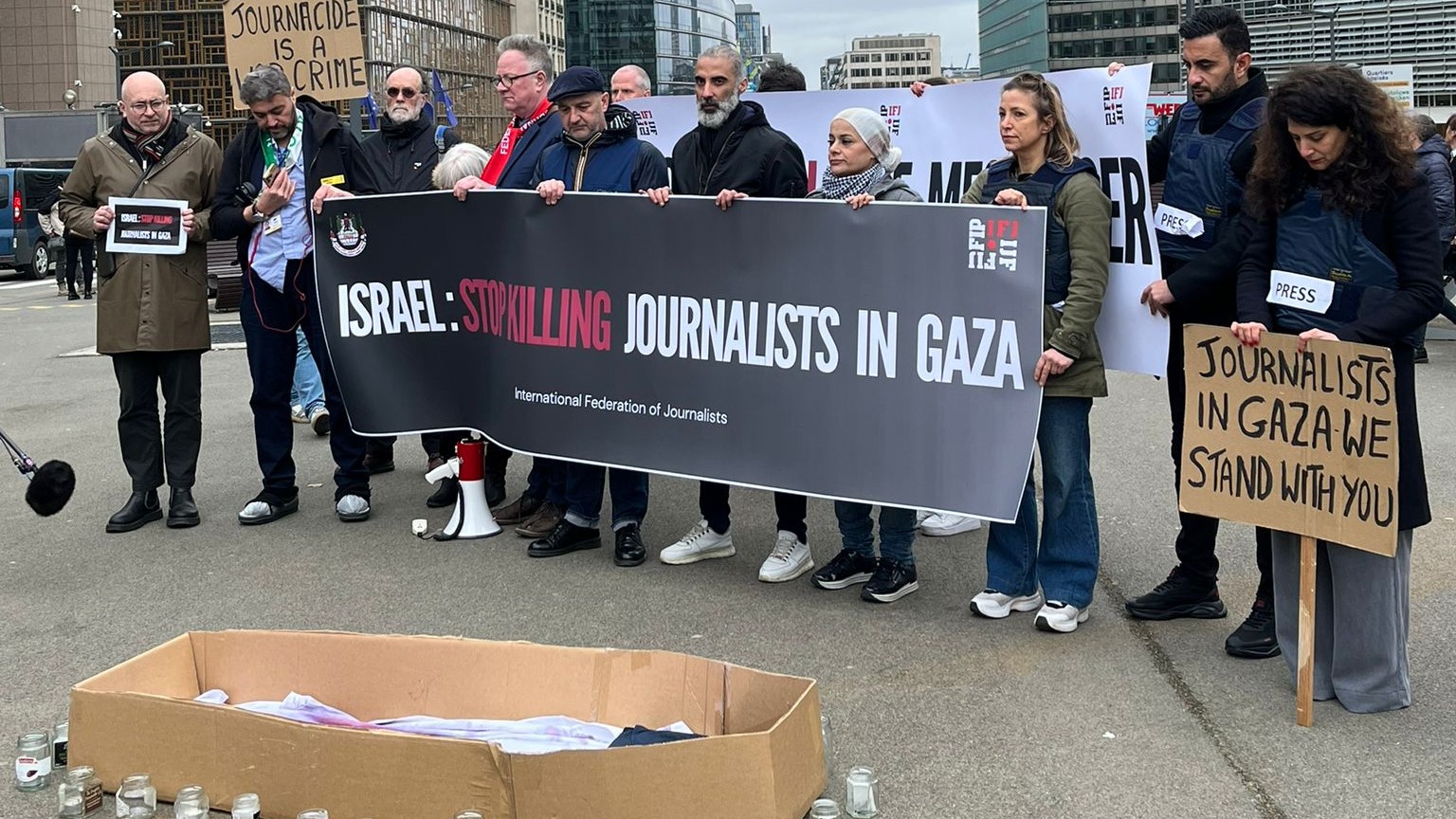
A protest against the killing of journalists in Gaza. Photo: International Federation of Journalists/X

A report by the Committee to Protect Journalists said that 78 journalists and media workers were killed in Gaza in the first three months of Israel’s war. The report added that the circumstances leading to the killing of these media professionals were difficult to ascertain due to Israel’s refusal to cooperate

Nearly three fourths of all journalists and media workers killed in 2023 were Palestinians who were killed in the first three months of the Israeli war in Gaza, said the annual report of Committee to Protect Journalists (CPJ) released on Thursday, February 15.

According to the CPJ, at least 99 journalists and media workers were killed in 2023. This is the highest number of journalists and media persons killed in a year since 2015 and was a 44% increase from last year when the figure was 69.

Among the 78 journalists and media workers killed in the Israeli war on Gaza, 72 were Palestinians, three were Lebanese and two were Israeli journalists.

The report stated that the details of the circumstances leading to the killing of most of the journalists and media workers in Gaza were difficult to obtain due to Israel’s refusal to cooperate. A large number of family members of those journalists and media workers were also killed in the Israeli bombings and ground offensive which made the task of investigating the circumstances of their killing difficult.

A total of more than  28,700 Palestinians have been killed and nearly 69,000 others have been wounded in the Israeli war in Gaza since October 7. Many journalists have lost their entire families in Israeli attacks.

CJP claimed that at least 78 of the journalists and thirteen media workers were killed on duty in 2023. It also claimed that there were eight more journalists killed last year but the investigation into the circumstances in which they were killed was still not complete.

CJP claimed that a large number of journalists in Palestine were killed deliberately and it has raised the issue with the Israelis.

Most of the Palestinian journalists killed on duty in Gaza were in full gear and easily identifiable when they were targeted in air strikes or during Israeli ground offensives.

Deliberately targeting and killing journalists on duty is a war crime as per international law. Israel often claims that journalists killed in Gaza were members of “terrorist groups” without providing any evidence.

The numbers are much higher, say other groups

Several more journalists and media workers have been killed in Gaza by Israeli forces since December, including Al-Jazeera journalist Hamza al-Dahdouh who was targeted and killed by a missile attack on the car in which he was traveling with another freelance journalist Mustafa Thuraya.

Hamza was the son of prominent journalist Wael Dahdouh, most of whose family members were killed in Israeli strikes earlier. Wael himself was injured in one of the attacks carried out by the Israelis while on duty.

According to estimates by other organizations, the number of Palestinian journalists killed is higher. The Palestinian Journalists Syndicate (PJS) claimed at least 95 journalists or around 8% of all registered journalists in Palestine have been killed by Israel between October 7 and December 19.

According to Palestinian Authority’s media office, the total number of media workers killed in Palestine since October 7 is 126.

PJS claims that most of the journalists killed in Gaza were deliberately targeted by Israeli forces with the intention of “assassination and murder.” Some of the journalists were also threatened by Israeli forces before they were actually killed for covering the Israeli genocide, PJS alleged.

In addition to killing Palestinian journalists, Israel has also resorted to other means of shutting down the spread of information, including media gags, denial of visas to foreign journalists, and repeated shutdowns of the internet and telecommunication services, sometimes for weeks.

“The war [Israeli war in Gaza] is unprecedented in terms of threats to journalists” Jodie Ginsberg, Chief Executive Officer of the CPJ, told Al-Jazeera.

Israel has a long history of targeting and killing journalists. In 2022, Al-Jazeera journalist Shireen Abu Akleh was killed when she was reporting the Israeli military raid on Jenin. CPJ claims there were at least 20 such cases before the current war in Gaza but no one has ever been charged or held responsible for these killings.

Original article republished from peoples dispatch under a Creative Commons Attribution-ShareAlike 4.0 (CC BY-SA) license.

Continue Reading75% of all journalists killed across the world in 2023 were killed in Israeli war on Gaza, says CPJ

‘We will not rest until we put an end to this monstrosity’

Spread the love

https://morningstaronline.co.uk/article/we-will-not-rest-until-we-put-an-end-to-this-monstrosity

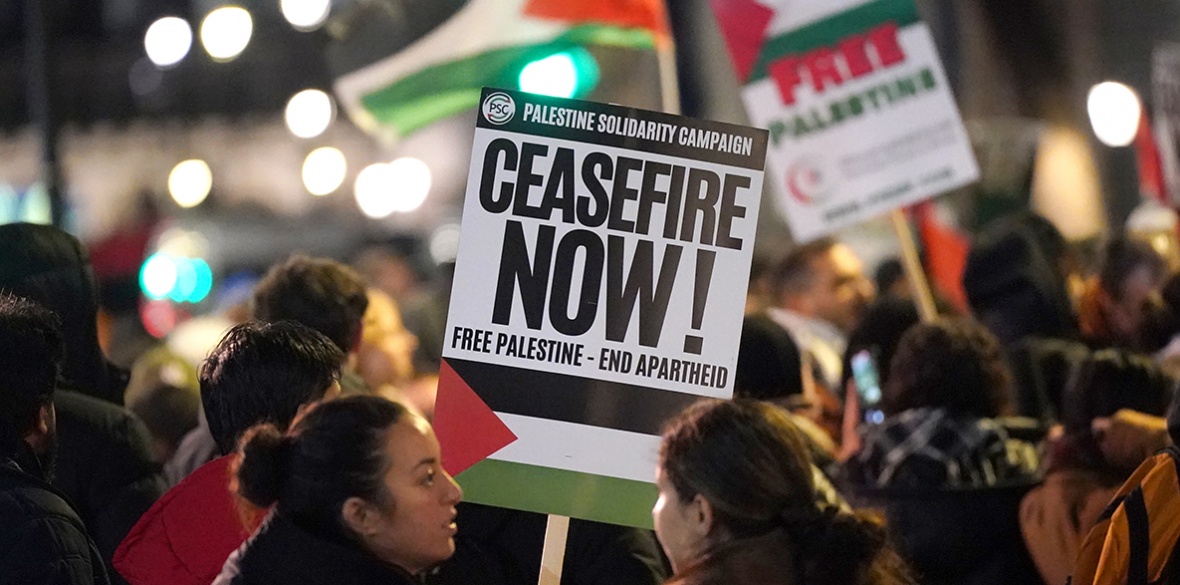
People during a pro-Palestine protest in Whitehall, central London, to call for a ceasefire in the conflict between Israel and Hamas, February 12, 2024

Palestine supporters to mobilise worldwide in call for a ceasefire as Israel mounts attack on Gaza’s last refuge

PALESTINE supporters in Britain and worldwide are expected to mobilise in huge numbers in a Global Day of Action on Saturday as Israel mounts its attack on the Gazan people’s last refuge, Rafah.

With 1.4 million people, mainly refugees, crammed into a city which is customarily home to less than 200,000, the feared effects of the Israeli onslaught have provoked mounting anger and increased calls for a ceasefire.

In Parliament next week, a Commons motion from the Scottish National Party calling for a ceasefire is expected to polarise MPs’ opinions and test Sir Keir Starmer’s authority over his own backbenchers.

Israel’s embassy in London will be among the targets for protests on Saturday for the first time since the weekly demonstrations began in October.

Thousands of people are expected to lobby Scottish Labour’s annual conference in Glasgow to demand that the party call for a ceasefire.

The SNP’s Commons motion calling for a ceasefire is expected to be heard on Wednesday, a week before the Rochdale by-election which has seen Labour dump its own candidate over his comments on Israel’s war on Gaza.

The motion “recognises that the only way to stop the slaughter of innocent civilians is to press for a ceasefire now.”

https://morningstaronline.co.uk/article/we-will-not-rest-until-we-put-an-end-to-this-monstrosity

Continue Reading‘We will not rest until we put an end to this monstrosity’

Australian lawmakers call for Julian Assange’s release ahead of extradition appeal

Spread the love

Original article by Tanupriya Singh republished from peoples dispatch under a Creative Commons Attribution-ShareAlike 4.0 (CC BY-SA) license.

The motion in parliament, which was supported by Prime Minister Anthony Albanese, has called for the return of imprisoned WikiLeaks founder Julian Assange to his family in Australia. Assange is days away from a final court hearing in the UK against his extradition to the US.

On February 14, lawmakers in Australia’s parliament voted 86-42 in support of a motion calling on the UK and the US to return arbitrarily imprisoned WikiLeaks founder and journalist, Julian Assange, to his home and family in Australia.

The move, which was also supported by Prime Minister Anthony Albanese, came just days before the High Court of Justice in London will decide if Assange can continue to contest his extradition to the US through the UK’s legal system.

The US has indicted Assange on 18 charges, 17 of which are under the notorious Espionage Act, in relation to the publication of confidential documents on WikiLeaks that exposed the war crimes and atrocities committed by US forces during the invasions of Iraq and Afghanistan. If convicted, Assange would face up to 175 years in a maximum security prison.

The 52-year-old journalist has already been held at the UK’s high security Belmarsh prison for nearly five years, without charge or conviction, amid serious concerns over his mental and physical health.

“Mr. Assange has been deliberately exposed, for a period of several years, to progressively severe forms of cruel, inhuman or degrading treatment or punishment, the cumulative effects of which can only be described as psychological torture.” Nils Melzer, the former UN Special Rapporteur on torture, had said of the journalist’s condition back in 2019.

Addressing a press conference on February 15, Assange’s partner, Stella, stated that his “life is at risk every single day he stays in prison– and if he is extradited he will die”, warning that Assange could be “on a plane within days”.

The public hearings on February 20 and 21 will mark the culmination of a protracted legal battle for Assange. A two-judge bench of the High Court will review a June 6, 2023 decision by Justice Jonathan Swift, in which he had rejected all eight grounds of appeal filed by Assange’s legal team.

If approved, the appeal will challenge the extradition order approved by the UK Home Office in June 2022.

Read more: Assange completes four years in UK jail, struggle against US extradition continues

On Wednesday, independent lawmaker Andrew Wilkie introduced a motion in the Australian parliament, calling on the US and the UK to bring “the matter to a close so that Mr. Assange can return home to his family in Australia”.

“This will be the time for all of us to take a stand, to stand up and to take a stand, and to stand with Julian Assange, stand for the principles of justice, stand for the principles of media freedom and the rights of journalists to do their job…This has gone on too long, that it must be brought to an end.”

Commenting directly on the matter in Parliament on February 15, PM Albanese stated that there was a “common view” that “enough is enough”. “People will have a range of views about Mr. Assange’s conduct… but regardless of where people stand, this thing cannot just go on and on indefinitely.”

He went on to state, “I hope it can be resolved amicably. It’s not up to Australia to interfere in the legal processes of other countries, but it is appropriate for us to put our very strong view that those countries need to take into account the need for this to be concluded.”

The Prime Minister’s ambiguous statements throughout the legal proceedings, including a refusal to outrightly call for a withdrawal of the extradition order, has been criticized by progressive, anti-imperialist forces, with the late renowned journalist John Pilger having called it a “betrayal” in March 2023.

Read more: The betrayers of Julian Assange 

Addressing reporters outside Parliament House on Thursday, Assange’s brother, Gabriel Shipton, warned that his extradition would mean that “all the ties to his family, his lifeline that are keeping him alive inside that prison will be cut off and he’ll be lost into a horrific prison system in the United States”.

He added that the vote in parliament had given the Australian government a “real mandate to advocate very, very strongly for a political solution” to bring Assange home.

“It’s not just about being extradited. Julian should never have been put in prison in the first place,” Stella Assange implored on Thursday, as journalists and activists across the world have warned of the impact Assange’s case could have on the press.

“We are seeing a critical attack on press freedom worldwide. It is like a disease, an anti-press pandemic, creeping up on us that has been incrementally taking shape over the years”, said WikiLeaks editor-in-chief Kristinn Hrafnsson, adding that Assange had been the “canary in the gold mine”.

Read more: Julian Assange case: 4 things that the media doesn’t tell you

Assurances about conditions in US prison are “dubious”, say advocates

This was reiterated by over 35 law professors in the US in a letter sent to the Department of Justice on February 14, stating that Assange’s prosecution posed an “existential threat” to the freedom of speech and press enshrined under the First Amendment.

These “constitutional implications” could “extend beyond the Espionage Act and beyond national security journalism [to] enable prosecution of routine newsgathering under any number of ambiguous laws and untested legal theories.”

Assange’s extradition to the US was approved on the basis of supposed “assurances” given by the US regarding his safety, including the avoidance of what are called “special administrative measures” (SAMs) — a horrific punitive measure that combines “the brutality and isolation of maximum-security units with additional restrictions that deny individuals almost any connection to the human world”.

However, human rights organizations and observers had immediately warned that these “assurances” were unreliable and could be arbitrarily revoked.

“The US assurances cannot be trusted. Dubious assurances that he will be treated well in a US prison ring hollow considering that Assange potentially faces dozens of years of incarceration in a system well known for its abuses, including prolonged solitary confinement and poor health services for inmates,” stated Julia Hall, the international expert on counter-terrorism and criminal justice in Europe at Amnesty International.

If the High Court of Justice in London does not rule in favor of Julian Assange next week, Stella Assange has stated that he will then approach the European Court of Human Rights (ECHR), seeking urgent measures to halt his extradition under Rule 39— granted when there is an “imminent risk of irreparable harm” — pending a full consideration of his case.

The present UN Special Rapporteur Dr. Alice Edwards, has also pointed out that outside of the legal process, the ultimate decision to actually proceed with the extradition will lie with the US Secretary of State. Antony Blinken, for his part, had rebuffed calls by the Australian government last year to drop the prosecution.

“The UK is a party to the UN convention against torture as well as the European convention on human rights, both of them have Article 3 which prohibits states from sending people to where they may face this type of treatment [torture],” Edwards said.

Original article by Tanupriya Singh republished from peoples dispatch under a Creative Commons Attribution-ShareAlike 4.0 (CC BY-SA) license.

Continue ReadingAustralian lawmakers call for Julian Assange’s release ahead of extradition appeal