Supreme court rules Rwanda plan unlawful: a legal expert explains the judgment, and what happens next

Spread the love
The Rwanda deal was signed when Priti Patel was home secretary. Rwanda visit April 14, 2022. Image: UK Home Office.

Before publishing this article unaltered, I draw your attention to these excerpts:

It is important to note that the supreme court’s decision is not a comment on the political viability of the Rwanda plan, or on the concept of offshoring asylum processes generally. The ruling focused only on the legal principle of non-refoulement, and determined that in this respect, Rwanda is not a “safe third country” to send asylum seekers.


This ruling is likely to revive discussion about the UK leaving the European convention on human rights (ECHR), which holds the UK to the non-refoulement obligation. Some Conservatives, including the former home secretary Suella Braverman, have argued that leaving the convention would make it easier to pass stronger immigration laws.

But while handing down the supreme court judgment, Lord Reed emphasised that there are obligations towards asylum seekers that go beyond the ECHR. The duty of non-refoulement is part of many other international conventions, and domestic law as well. In other words, exiting the ECHR would not automatically make the Rwanda plan lawful or easier to implement.

So it would appear that UK is not going to be sending refugees to Rwanda despite Rishi Sunak and Conservative claims that it will.

Supreme court rules Rwanda plan unlawful: a legal expert explains the judgment, and what happens next

Devyani Prabhat, University of Bristol

The UK supreme court has unanimously ruled that the government’s plan to send asylum seekers to Rwanda is unlawful.

Upholding an earlier decision by the court of appeal, the supreme court found that asylum seekers sent to Rwanda may be at risk of refoulement – being sent back to a country where they may be persecuted, tortured or killed.

The courts cited extensive evidence from the UN refugee agency (UNHCR) that Rwanda does not respect the principle of non-refoulement – a legal obligation. The UNHCR’s evidence questioned the ability of Rwandan authorities to fairly assess asylum claims. It also raised concerns about human rights violations by Rwandan authorities, including not respecting non-refoulement with other asylum seekers.

It is important to note that the supreme court’s decision is not a comment on the political viability of the Rwanda plan, or on the concept of offshoring asylum processes generally. The ruling focused only on the legal principle of non-refoulement, and determined that in this respect, Rwanda is not a “safe third country” to send asylum seekers.

The ruling is another blow to the government’s promise to “stop the boats”. And since the Rwanda plan is at the heart of its new Illegal Migration Act, the government will need to reconsider its asylum policies. This is further complicated by Conservative party infighting and the firing of home secretary Suella Braverman, just two days before the ruling.

How did we get here?

For years, the UK government has been seeking to reduce small boat arrivals to the UK. In April 2022, the UK and Rwanda signed an agreement making it possible for the UK to deport some people seeking asylum in Britain to Rwanda, without their cases being heard in the UK. Instead, they would have their cases decided by Rwandan authorities, to be granted (or rejected) asylum in Rwanda.

While the Rwanda plan specifically was found to be unlawful, the government could, in theory, replicate this in other countries so long as they are considered “safe” for asylum seekers.

The government has not yet sent anyone to Rwanda. The first flight was prevented from taking off by the European court of human rights in June 2022, which said that British courts needed to consider all human rights issues before starting deportations.

A UK high court then decided in December 2022 that the Rwanda plan was lawful.


Catch up on our other coverage of the Rwanda plan:

Why UK court ruled Rwanda isn’t a safe place to send refugees – and what this means for the government’s immigration plans

Rwanda deportations: what is the European Court of Human Rights, and why did it stop the UK flight from taking off?

Suella Braverman is wrong about the UN refugee convention being ‘not fit for purpose’ – here’s why

The government passed a major immigration law last year – so why is it trying to pass another one?

‘A toxic policy with little returns’ – lessons for the UK-Rwanda deal from Australia and the US


Ten asylum seekers from Syria, Iraq, Iran, Vietnam, Sudan and Albania challenged the high court ruling, with the support of the charity Asylum Aid. Their claim was about whether Rwanda meets the legal threshold for being a safe country for asylum seekers.

The court of appeal said it was not and that asylum seekers risked being sent back to their home countries (where they could face persecution), when in fact they may have a good claim for asylum.

The government has since passed the Illegal Migration Act. The law now states that all asylum seekers arriving irregularly (for example, in small boats) must be removed to a safe third country. But now that the Rwanda deal has been ruled unlawful, there are no other countries that have said they would take asylum seekers from the UK.

What happens next?
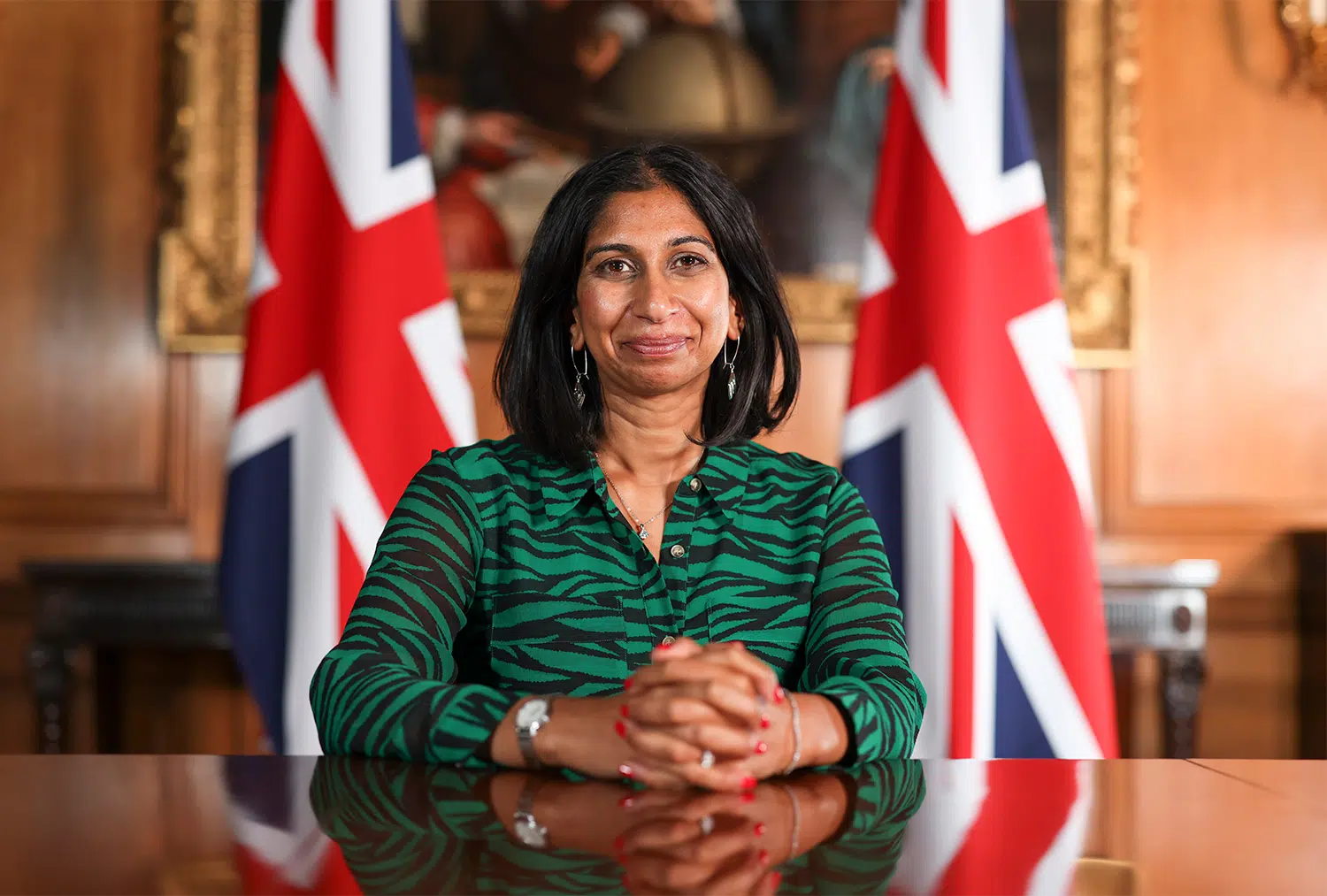
Former Home Secretary Suella 'Sue-Ellen' Braverman
Former Home Secretary Suella ‘Sue-Ellen’ Braverman continued with the Rwanda policy.

It is clear that the government’s asylum policies will need rethinking. Should another country now be designated as a safe country and different arrangements put in place, these will probably be subject to further legal challenges, including in the European court of human rights and in British courts.

This ruling is likely to revive discussion about the UK leaving the European convention on human rights (ECHR), which holds the UK to the non-refoulement obligation. Some Conservatives, including the former home secretary Suella Braverman, have argued that leaving the convention would make it easier to pass stronger immigration laws.

But while handing down the supreme court judgment, Lord Reed emphasised that there are obligations towards asylum seekers that go beyond the ECHR. The duty of non-refoulement is part of many other international conventions, and domestic law as well. In other words, exiting the ECHR would not automatically make the Rwanda plan lawful or easier to implement.

The prime minister, Rishi Sunak, has said that he is working on a new treaty with Rwanda and is prepared to change domestic laws to “do whatever it takes to stop the boats”.

The UK is not the only country to attempt to off-shore asylum processing. Germany and Italy have recently been considering finding new safe third countries to accept asylum seekers as well.

But ensuring these measures comply with human rights obligations is complicated. International law requires states to provide sanctuary to those fleeing persecution or risk to their lives. As this ruling shows, the UK is not going to find an easy way out of these obligations.The Conversation

Devyani Prabhat, Professor of Law, University of Bristol

This article is republished from The Conversation under a Creative Commons license. Read the original article.
Continue ReadingSupreme court rules Rwanda plan unlawful: a legal expert explains the judgment, and what happens next

Supreme court sinks shameful Rwanda scheme

Spread the love

https://www.morningstaronline.co.uk/article/b/supreme-court-sinks-shameful-rwanda-scheme

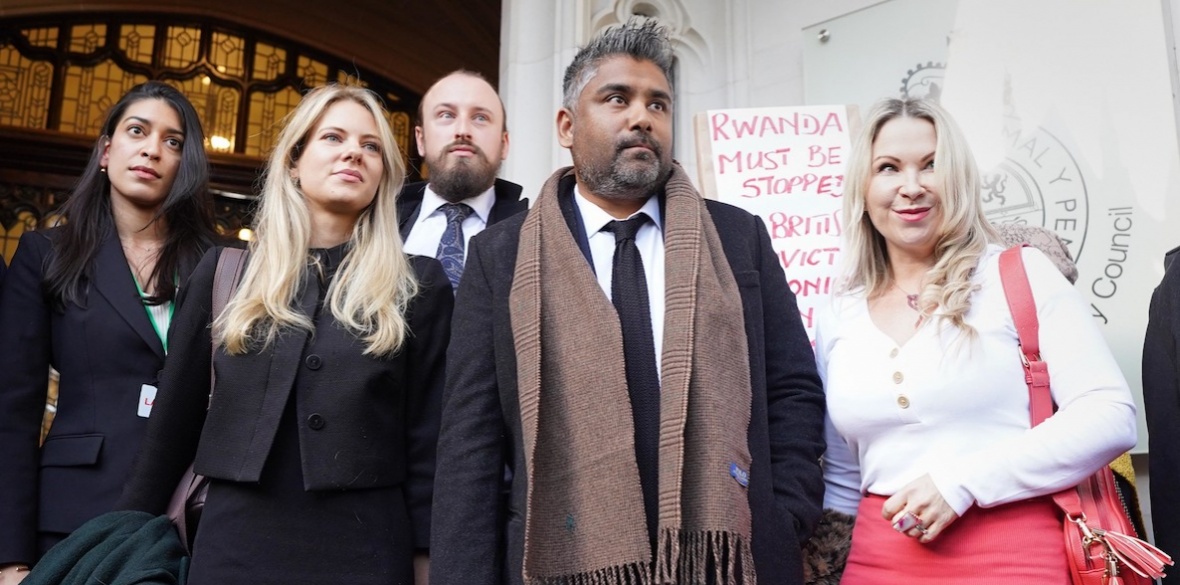
Toufique Hossain, director of public law and immigration at Duncan Lewis Solicitors, (centre) with his legal team outside the Supreme Court in London. Picture date: Wednesday November 15, 2023.

PITILESS Tory plans to deport refugees to Rwanda were ruled illegal by the Supreme Court today, plunging Rishi Sunak’s government deeper into chaos.

The court determined that Rwanda was not a safe destination for asylum-seekers and that there was a high risk of them being returned to their country of origin to be tortured or worse, thus torpedoing what is a flagship Tory policy.

The defiant Prime Minister pledged to fight on to stop destitute refugees crossing the Channel, responding to the judgement by asserting that “illegal migration destroys lives and costs British taxpayers millions of pounds a year. We need to end it and we will do whatever it takes to do so.”

He later claimed that the judges had agreed that the “principle of removing asylum-seekers to a safe third country is lawful” and told MPs he was ready to “revisit” UK laws to block migration if necessary and to seek a fresh treaty with Rwanda.

Labour ducked the moral issues raised by the policy, with leader Sir Keir Starmer and shadow home secretary Yvette Cooper focusing instead on the waste of money and time involved in the failed Rwanda policy.

The judges’ decision was, however, welcomed by a wide range of human rights campaigners.

Amnesty International’s Sacha Deshmukh said: “The government must now draw a line under a disgraceful chapter in the UK’s political history.

https://www.morningstaronline.co.uk/article/b/supreme-court-sinks-shameful-rwanda-scheme

Continue ReadingSupreme court sinks shameful Rwanda scheme

Greens welcome Supreme Court decision on deportations to Rwanda

Spread the love
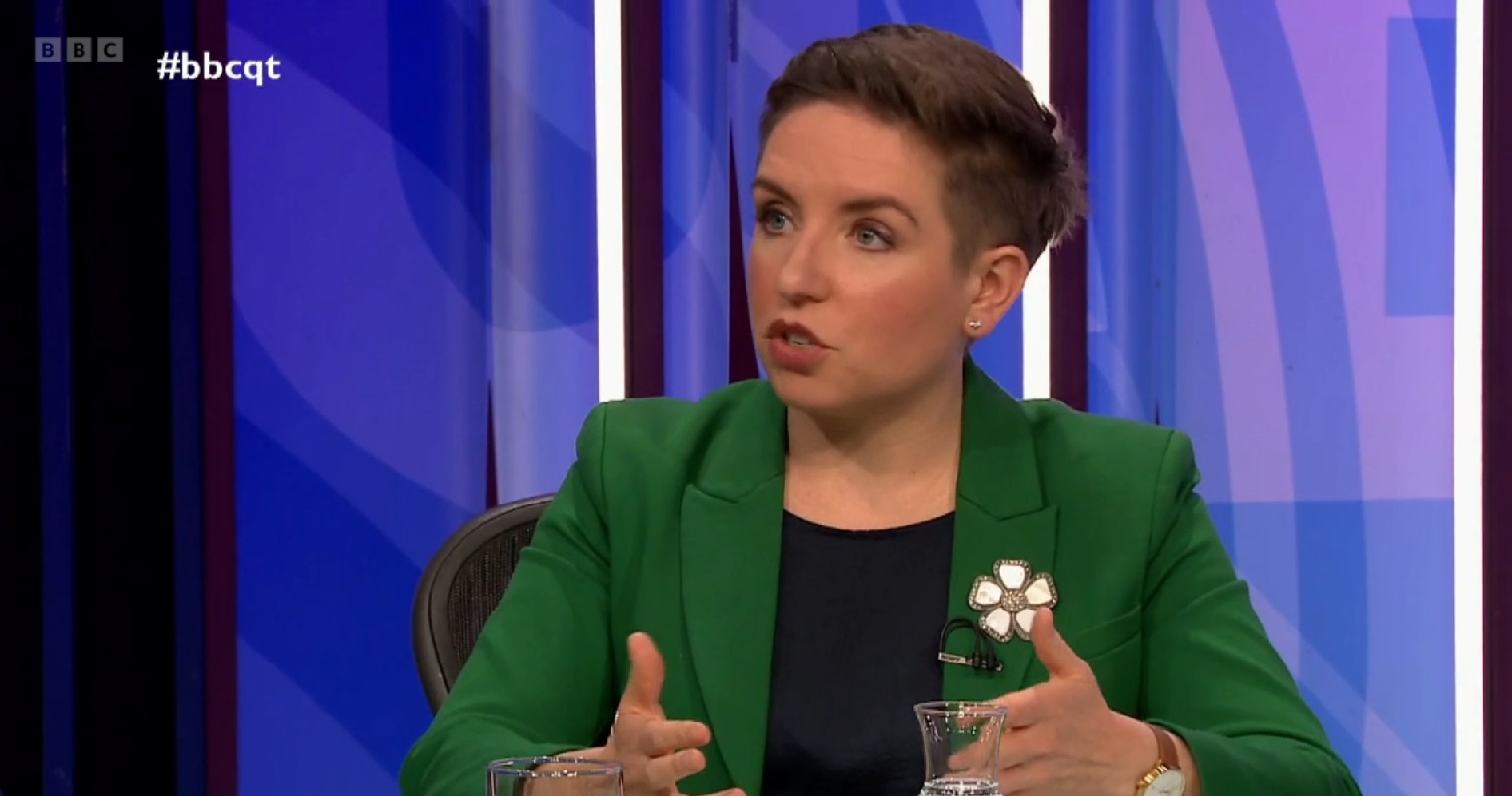
Image of the Green Party's Carla Denyer on BBC Question Time.
Image of the Green Party’s Carla Denyer on BBC Question Time.

Reacting to news that the Supreme Court has blocked government plans to send asylum seekers to Rwanda, Green Party co-leader Carla Denyer said: 

“This is welcome news. The government must now admit that its cruel and inhumane policy is finished and drop it.

“The new Home Secretary has the chance now to turn over a new leaf and make clear that there is no intention to quit the European Convention on Human Rights.  

‘He should pledge to create an asylum system that works. That is one with clear, open, safe and legal routes for applicants, quick and efficient determinations and support for resettlement into local communities with properly funded local services.” 

Continue ReadingGreens welcome Supreme Court decision on deportations to Rwanda

Over 50 Bodies Pulled From Rubble of Gaza School Bombed Amid Israeli Assault

Spread the love

Original article by BRETT WILKINS republished from Common Dreams under Creative Commons (CC BY-NC-ND 3.0).

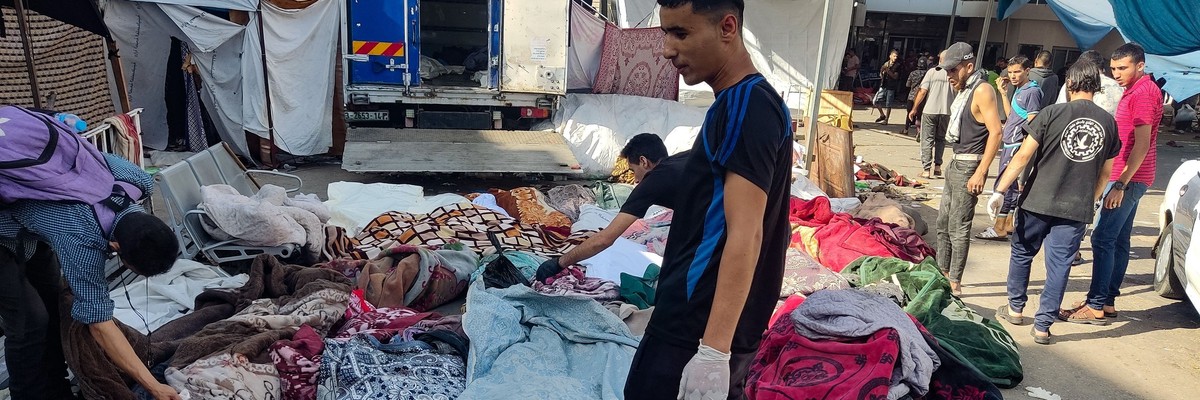
Men check the bodies of people killed in bombardment that hit a school housing displaced Palestinians, as they lie on the ground in the yard of al-Shifa hospital in Gaza City on November 10, 2023.  (Photo: Khoder al-Zaanoun/AFP via Getty Images)

As the death toll from Israel’s obliteration of Gaza topped 11,000, U.S. Secretary of State Antony Blinken said “far too many Palestinians have been killed”—while the United States’ armed aid to Israel continues.

Palestinian civil defense officials said Friday that more than 50 bodies were recovered from the rubble of a school in northern Gaza where civilians were sheltering when it was destroyed during overnight Israeli bombardment.

Palestine’s WAFA News Agency reported civil defense and ambulance rescue teams removed the blasted and crushed remains of victims of Thursday night’s missile and artillery strikes on the al-Buraq School in the al-Nasr neighborhood of Gaza City. The outlet said that most of those killed were women, children, and elders.

The Times of Israel reports that Israel Defense Forces (IDF) officials have not yet commented on the attack.

Injured survivors of the attack were rushed to al-Shifa Hospital, which was hit by Israeli airstrikes at least four times over the past 24 hours.

https://twitter.com/PalestineChron/status/1722988640320516470?ref_src=twsrc%5Etfw%7Ctwcamp%5Etweetembed%7Ctwterm%5E1722988640320516470%7Ctwgr%5Eb7a1a887a55b4dcb904301bcc9c73e5116d2a6e4%7Ctwcon%5Es1_c10&ref_url=https%3A%2F%2Fwww.commondreams.org%2Fnews%2Fisrael-bombing-schools-and-hospitals

As Common Dreams reported earlier Friday, Israeli strikes targeted the courtyard and obstetrics department of the hospital, where doctors have been forced to operate on patients without anesthesia after running out of critical supplies to treat an overwhelming number of wounded victims. Gaza officials said 13 people died in the attacks on al-Shifa.

In an interview with Al Jazeera, al-Shifa general director Muhammad Abu Salmiya called Friday “a day of war against hospitals.”

Israeli officials have made unsubstantiated claims of Hamas fighters operating from inside or under al-Shifa and other Gaza hospitals.

On Friday Israeli warplanes bombed in the vicinity of the Indonesian Hospital in Bait Lahia—where doctors announced a cessation of surgeries—while Mustafa al-Kahlout, director of the al-Nasr hospital and al-Rantisi Children’s Hospital in northern Gaza, told CNN that Israeli tanks had “surrounded” the complex.

Jens Laerke, spokesperson for the U.N. Office for the Coordination of Humanitarian Affairs, said Friday that northern Gaza resembles “hell on Earth” due to Israel’s bombardment and a lack of aid.

Nearly 200 health workers, over 100 United Nations personnel, and dozens of journalists have been killed by Israeli forces during the war.

The Gaza Health Ministry said Friday that at least 11,078 Palestinians—including more than 3,000 women and over 4,500 children—have been killed and upward of 27,000 injured by Israeli bombs and bullets since October 7, when Hamas-led attacks on Israel killed around 1,200 civilians and soldiers, with another 240 or so people taken hostage. Israeli officials on Friday revised down their death toll, which they previously said was higher than 1,400.

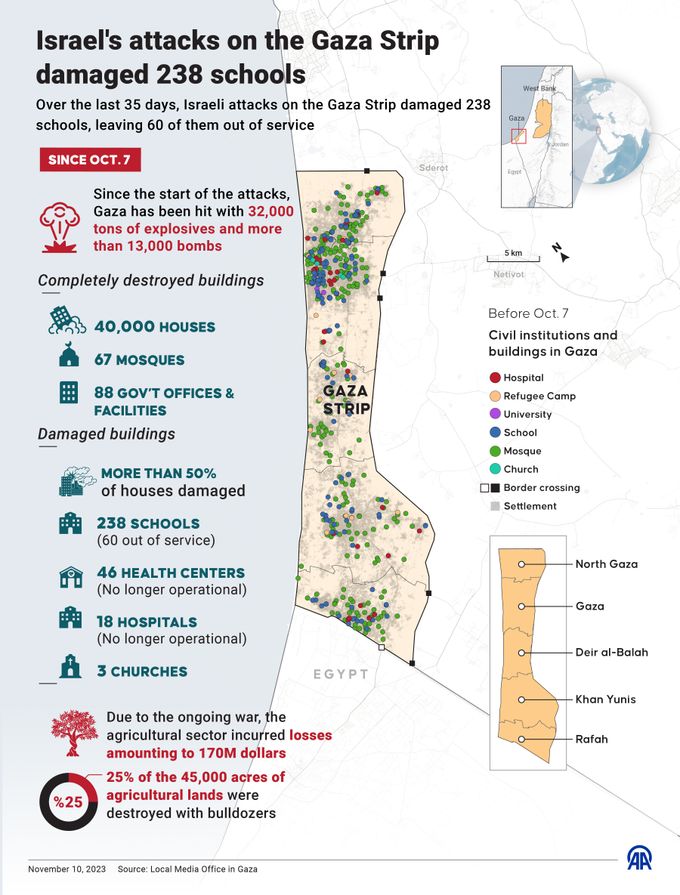
According to Gaza officials, around 70% of Gaza’s 2.3 million people have been forcibly displaced, while half the homes in the besieged strip have been destroyed. Officials also said 238 schools, 67 mosques, and 88 government buildings have been wiped out by Israeli attacks.

In the illegally occupied West Bank and East Jerusalem—whose residents were already suffering the deadliest year since the second intifada, or uprising, a generation ago—Israeli soldiers and settlers have killed at least 182 Palestinians while wounding thousands more since October 7.

A growing number of legal expertsactivists, and other observers are calling Israel’s war on Gaza “genocidal”—a characterization rejected by Israeli and U.S. leaders, with a handful of exceptions.

(Image: Andalou via Getty Images)

After 35 days of relentless and indiscriminate bombing—an IDF spokesperson acknowledged early in the war that “the emphasis is on damage and not on accuracy”—U.S. Secretary of State Antony Blinken said Friday during a visit to India that “far too many Palestinians have been killed.”

However, the U.S. continues to stand staunchly behind its number one Middle Eastern ally, with the Biden administration and Congress working on a $14.3 billion military aid package to Israel, atop the nearly $4 billion the country already receives from Washington annually. The U.S. also provides diplomatic cover for Israel, including a recent veto of a Brazil-led United Nations Security Council cease-fire resolution.

While Israel on Thursday agreed to daily four-hour humanitarian pauses for at least three days so that civilians have a chance to flee the constant bombardment and advancing IDF ground forces, Israeli officials—and U.S. President Joe Biden—stress that no cease-fire is imminent.

Israeli leaders have said a cease-fire is off the table until all hostages held by Gaza-based militants are freed. Abu Hamza, the military spokesperson of the al-Quds Brigades, the armed wing of Palestinian Islamic Jihad, said Thursday that the group was preparing to release an elderly woman and teenage boy in its custody.

United Nations Relief and Works Agency for Palestine Refugees in the Near East Commissioner-General Philippe Lazzarini wrote in an opinion piece published Thursday by The Washington Post that “the present course chosen by the Israeli authorities will not bring the peace and stability that both Israelis and Palestinians want and deserve.”

“Razing entire neighborhoods to the ground is not an answer for the egregious crimes committed by Hamas,” Lazzarini asserted. “To the contrary, it is creating a new generation of aggrieved Palestinians who are likely to continue the cycle of violence. The carnage simply must stop.”

Original article by BRETT WILKINS republished from Common Dreams under Creative Commons (CC BY-NC-ND 3.0).

Continue ReadingOver 50 Bodies Pulled From Rubble of Gaza School Bombed Amid Israeli Assault

Greens reject Home Secretary’s ‘dangerous’ comments and call for massive turn out for ceasefire in Gaza

Spread the love
Carla Denyer, Cost of Living Crisis protest, Bristol, 2 April 2022

Green Party co-leader Carla Denyer urged a massive turnout on tomorrow’s pro-ceasefire march, as “the strongest way to send a clear message that people want a ceasefire and have no time for Home Secretary Suella Braverman’s toxic rhetoric.”

She said

“This is a march to call for a ceasefire – an Armistice – that is urgently needed. The Green Party wants to see the unconditional release of hostages and the opening up of humanitarian aid to allow a dialogue about a long-term solution that ends the occupation and offers peace and security to Palestinians and Israelis alike.

“The Home Secretary’s comments are dangerous, inciting division at a time when we need to bring people together.

“Armistice Day and Remembrance Sunday are national moments of reflection and must be respected. The organisers of the pro-ceasefire march have been really clear that they have no intention of disrupting Armistice Day events. Indeed, I would say that Armistice Day is a very appropriate moment for people to be calling for a ceasefire – an armistice – so that civilians in Israel and Gaza can be protected.

“The Gaza ceasefire call has the backing of the United Nations, humanitarian aid agencies, three quarters of the British public, and growing numbers of countries, including Ireland and France. Hundreds of thousands have been out on the streets peacefully calling for an end to violence. 

“The Labour leadership needs to do more than stand on the sidelines. I invite them to throw their full support behind the growing call for a ceasefire.”

Continue ReadingGreens reject Home Secretary’s ‘dangerous’ comments and call for massive turn out for ceasefire in Gaza