Germany bans public grieving and solidarity with Palestine

Spread the love

Original article republished from peoples dispatch under a Creative Commons Attribution-ShareAlike 4.0 (CC BY-SA) license.

Demonstrators in Berlin take the streets in solidarity with Palestine (Photo: Montecruz Foto)

Germany is home to Europe’s largest Palestinian community, with roughly 80,000 Palestinians living in the country. For years, German authorities have tried to stifle Palestinian activism in the country, viewing it as a nuisance to its explicit policy of “unconditional support for Israel.” Demonstrations, such as one earlier this year to mark the 75th anniversary of the Nakba, have been sporadically banned in recent years and organizations, like the Palestinian prisoner solidarity network Samidoun, have also come under increasing scrutiny.

Yet the criminalization of solidarity with Palestine on a national level has taken on entirely new dimensions since October 7. After a small demonstration on Berlin’s busy Sonnenallee street on the evening of October 7, the German media and body politic have been up in arms about Palestinians supposedly celebrating terrorism and antisemitism on German streets.

Talking points that were two weeks ago only uttered by far-right AfD politicians are now being openly expressed by politicians from all parliamentary parties in Germany. Playing off the idea of “imported antisemitism,” the social democratic Chancellor Olaf Scholz is now arguing that “we must finally deport on a large scale” residents who do not hold German citizenship and openly protest against Israel. The Christian Democrats (CDU) are even demanding that the recognition of Israel’s right to exist must become a precondition for German citizenship.

Samidoun has been made into public enemy number one, as the media presents the group as a bastion for “sympathizers of terror” that poses “a particular danger, because as a secular organization, they are building bridges between Islamists and radical leftists.” In a speech before parliament on October 12, Chancellor Scholz personally announced a ban on Samidoun along with a ban on the activities of Hamas in Germany. 

In Berlin specifically, which is home to one of the largest Palestinian diaspora communities outside the Arab world, the authorities have been particularly hostile towards any signs of solidarity with Palestine. Since October 7, every demonstration explicitly or implicitly referring to Palestine has been banned, leaving the roughly 30,000 Palestinians living in Berlin with no means of expressing their anguish at the siege and bombardment of Gaza.

Solidarity groups have been trying to bypass this censorship by avoiding political statements and focusing on humanitarian campaigning, yet even demonstrations and slogans such as “Children in Gaza need help” and “Solidarity with the civilian population in the Gaza Strip” were banned. On October 13, the police went so far as to ban a demonstration registered by the group “Jewish Voice for a Just Peace in the Middle East” entitled “Jewish Berliners against violence in the Middle East.” 

Sonnenallee, a busy street in the district in which many Arab migrants live, has become a focal point of dissent against Israel’s attack on Gaza. The police patrol Sonnenallee every evening with tight controls on the public squares. Racial profiling and brutal arrests are commonplace and often recorded and posted to social media. One particular video shows police officers stomping out a candle-lit vigil with their boots.

In a letter to all Berlin schools, the city’s Department for Education, Youth and Family set out strict guidelines on how to discuss the situation in Palestine with students. “Any demonstrative action or expression of opinion that can be understood as advocating or approving of the attacks against Israel or support for the terrorist organizations carrying them out, such as Hamas or Hezbollah, constitutes a threat to school peace in the current situation and is prohibited.” According to the letter, these may include the following: “visibly wearing relevant clothing (for example, the kuffiyeh known as the Palestinian scarf), displaying stickers and patches with inscriptions such as ‘free Palestine’ or a map of Israel in the colors of Palestine (white, red, black, green), and shouting ‘free Palestine!’ and demonstrating verbal support for Hamas and its terrorism.”

At one high school on Sonnenallee, a 61-year-old teacher attempted to confiscate a Palestinian flag from a 14-year-old student and ended up in a physical altercation with a second 15-year-old student. The parents’ association of the school tried to organize a demonstration under the slogan “No place for racism, no place for violence” as a reaction to the incident, yet it was promptly banned by the police, ostensibly as a “a precautionary measure”. The Central Council of Palestinians in Germany has since sent a letter in response to Berlin’s Department for Education, expressing their “great concern about the psychological and educational development [of their children]” in Berlin schools.

As other European states are witnessing mass protests in solidarity with Palestine, the German state has been able to use force and violence to prevent such scenes on German streets. Yet it is unlikely that the government will be able to ban these sentiments of solidarity indefinitely, especially as the images of Israel’s brutal attack on Gaza continue to circulate around the world.

Original article republished from peoples dispatch under a Creative Commons Attribution-ShareAlike 4.0 (CC BY-SA) license.
Continue ReadingGermany bans public grieving and solidarity with Palestine

Israel kills over 400 Palestinians in a single day of airstrikes

Spread the love
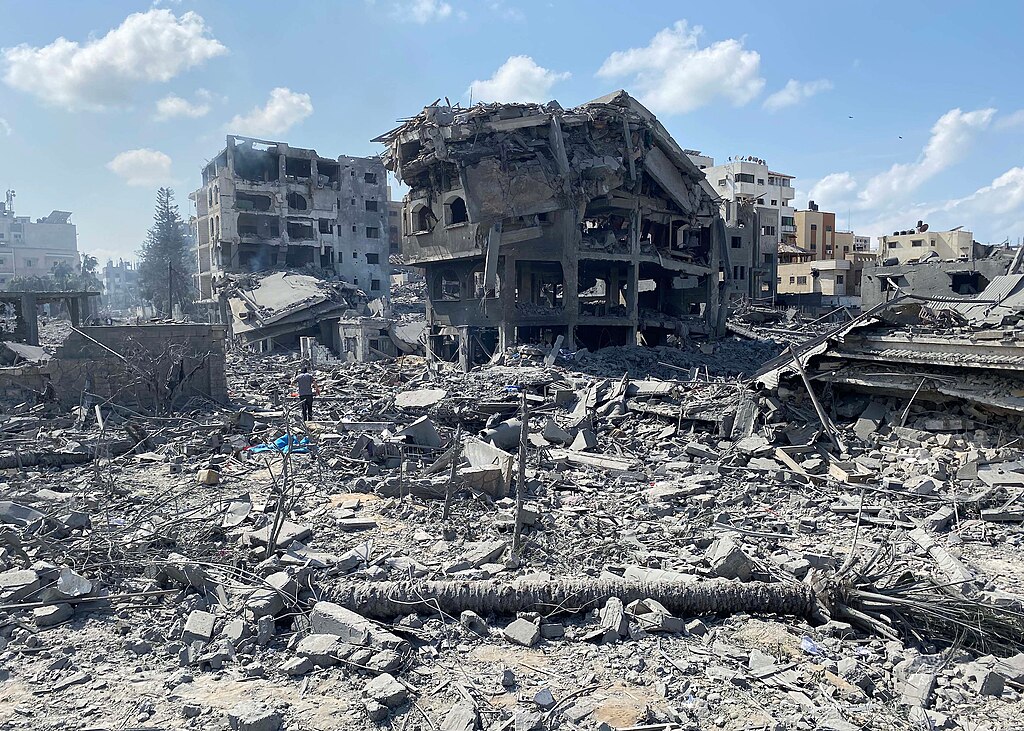
Palestinians inspect the damage following an Israeli airstrike on the El-Remal aera in Gaza City on October 9, 2023. Israel continued to battle Hamas fighters on October 10 and massed tens of thousands of troops and heavy armour around the Gaza Strip after vowing a massive blow over the Palestinian militants' surprise attack. Photo by Naaman Omar apaimages. licensed under the Creative Commons Attribution-Share Alike 3.0 Unported license.
Palestinians inspect the damage following an Israeli airstrike on the El-Remal aera in Gaza City on October 9, 2023. Israel continued to battle Hamas fighters on October 10 and massed tens of thousands of troops and heavy armour around the Gaza Strip after vowing a massive blow over the Palestinian militants’ surprise attack. Photo by Naaman Omar apaimages. licensed under the Creative Commons Attribution-Share Alike 3.0 Unported license.

Original article republished from Peoples Dispatch under a Creative Commons Attribution-ShareAlike 4.0 (CC BY-SA) license.
It has been 15 days since Israeli Occupation Forces started their continuous bombings of Gaza following Operation Al-Aqsa Flood, threatening a complete genocide of Palestinians living there

In what has been described as the most intensive bombing of the besieged Palestinian territory since October 7, at least 400 more people were killed in Israel’s indiscriminate strikes in Gaza strip on Sunday October 22.

Israel bombings inside Gaza continued on Monday as well with over 60 people killed in overnight attacks alone.

The Israeli military claimed on Monday that it bombed over 300 targets in Gaza on Sunday. Their aircrafts continued to target residential areas in Khan Younis, Al-Fallujah, and other localities killing civilians including children, on the 15th day since the Palestinian resistance movements launched Operation Al-Aqsa Flood.

Israeli warplanes targeted densely populated Jabalia refugee camp where at least 30 people were killed, as well as other localities close to the Al-Shifa and Al-Quds hospitals.

Footage released by the Palestinian Red Crescent Society (PRCS) on Monday clearly shows Israeli bombing in the vicinity of the Al-Quds hospital. 

These hospitals are overcrowded with wounded and in danger of being bombed like Al-Ahli Arab hospital last week. Close to 500 Palestinians were killed when Israel bombed it on October 17. 

According to the Gaza Ministry of Health more than 5,000 Gazans have been killed in the Israeli bombings so far, of those over 2,000 were children. More than 15,000 people have been wounded in these attacks and over a million have been displaced. 

Israel has also killed over 95 Palestinians in the occupied West Bank and wounded over 1,600 of them in the last 15 days. Israeli occupation forces arrested hundreds of Palestinians in different raids in the occupied West Bank on Sunday as well. 

The Israeli blockade on food, fuel and medicine supplies to Gaza continued on its 15th day and despite the small number of humanitarian aid trucks reaching the territory through Egypt’s Rafah border since Saturday there is an urgent need for the full resumption of the free transit of these supplies. 

Lack of fuel and medical supplies have made around 10 hospitals in Gaza go out of service, increasing pressures on the remaining hospitals and endangering hundreds of lives including newborn babies.

Philippe Lazzarini, head of United Nations Relief and Work Agency (UNRWA) warned on Monday that, “in three days UNRWA will run out of fuel, critical for our humanitarian response across the Gaza strip.” 

Lazzarini stated that without fuel it will be difficult to run the hospitals and supply basic amenities including food to the affected people. UNRWA runs several hospitals and also shelters over 500,000 Palestinians displaced due to Israeli bombings in Gaza.

51 health workers have also been killed in airstrikes since October 7 and over 87 others have been injured.

Meanwhile, China’s special envoy to the Middle East, who is currently touring the region, said on Monday that his country is willing to do whatever it takes to start a dialogue to explore an immediate ceasefire in Gaza. He stated that the situation in Gaza is very serious and if no steps were taken to achieve a ceasefire now there is a possibility of a region-wide escalation.

In the meanwhile, Israel is already bombing Lebanon targeting Hezbollah, which has supported the actions of the Palestinian resistance during Al-Aqsa Flood and targeted positions of the Israeli army near the Lebanese border. 

Original article republished from Peoples Dispatch under a Creative Commons Attribution-ShareAlike 4.0 (CC BY-SA) license.

Continue ReadingIsrael kills over 400 Palestinians in a single day of airstrikes

‘Totally Insufficient’: Groups Say Trickle of Gaza Aid No Match for Ongoing ‘Mass Atrocities’

Spread the love

Original article by Jon Queally republished from Common Dreams under Creative Commons (CC BY-NC-ND 3.0).

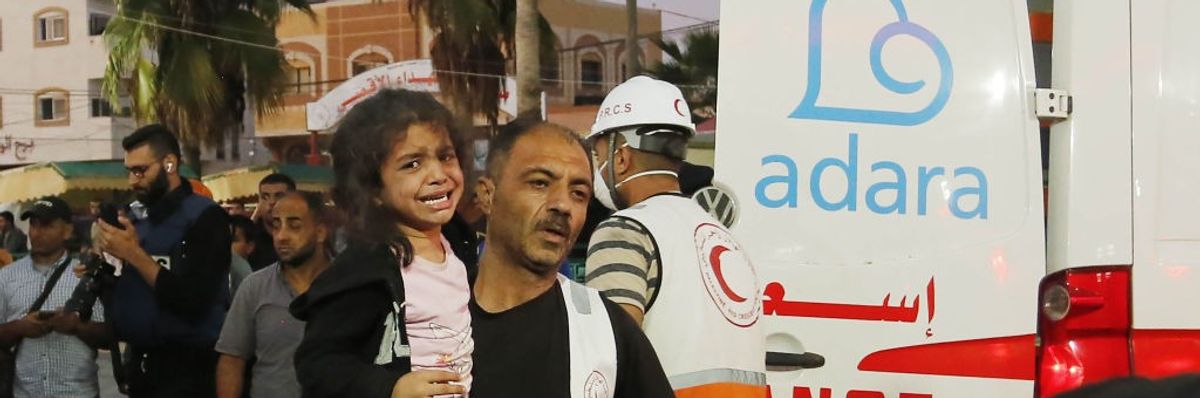
Injured child is taken to Suheda al-Aqsa Hospital (Al-Aqsa Martyrs Hospital) in Deir al-Balah, Gaza as Israeli attacks on Gaza continue on the 15th day on October 21, 2023. (Photo by Ashraf Amra/Anadolu via Getty Images)

“Collective punishment of two million people is a war crime and a moral outrage,” said one head of a medical relief group. “The siege must end, a ceasefire must be secured, and aid must be allowed to reach any who need it.”

Emergency aid groups and relief experts denounced the tiny “trickle” of humanitarian supplies that were finally allowed to pass through the Rafah crossing into Gaza on Saturday, especially as what was described by human rights watchdogs as a “loss of civilian life at a scale we have not seen in the modern history of Israel and Palestine” continues inside the besieged territory.

The 20 trucks authorized to deliver aid into Gaza through border with Egypt, said Médecins Sans Frontières/MSF in a statement, is “totally insufficient compared to the desperate needs of the people, who have been under complete siege and relentless bombing for two weeks.”

“Prior to the siege,” the group said, “hundreds of trucks with supplies entered Gaza every day as the Strip is crucially reliant on external aid. Food, water, and medicine are still desperately needed.”

“Gaza was a desperate humanitarian situation before the most recent hostilities. It is now catastrophic. The world must do more.” —UN Agencies

Guillemette Thomas, MSF’s medical coordinator for Gaza, said Saturday that inside Gaza “we have an extremely high number of injured people arriving in hospitals, very serious patients requiring complex care. According to our colleagues who still work at Shifa hospital, the hospital will soon run out of fuel and therefore electricity. This means that all the patients currently in intensive care units connected to ventilators and babies in incubators will die because of the lack of electricity. Operating theaters will no longer be able to function, patients will no longer be able to be operated on and the number of victims will increase significantly in the coming hours.”

Thomas warned that those in the intensive care were “just the tip of the iceberg,” warning that all injured and sick people Gaza remain at severe risk.

Human Rights Watch was among those who suggested that the refusal to allow fuel into Gaza—and the absence of efforts to restore or repair devastated the electricity grid or water systems—makes the paltry level stand out as intentionally inadequate.

“While aid agencies struggle to squeeze a few trucks of humanitarian aid into southern Gaza via Egypt, the Israeli authorities are keeping their crossings with Gaza closed and refusing to flick the switch for the water and electricity supply,” said Tirana Hassan, HRW’s executive director. “There is no excuse for denying water, food, and medicine to Gaza’s civilian population. It is cruel and contrary to international law.”

Melanie Ward, chief Eexecutive of the U.K.-based group Medical Aid for Palestinians said 20 trucks of supplies “does not even scratch the surface” of what’s needed in Gaza.

“It is appalling that fuel will not be allowed in, making the distribution of aid to the people who need it across Gaza impossible,” Ward said. “Without electricity, the lights will go out in hospitals, desalination and sewage plants will not function, and many more people will die.”

“Political leaders should remember that collective punishment of two million people is a war crime and a moral outrage,” she added. “The siege must end, a ceasefire must be secured, and aid must be allowed to reach any who need it.”

Ward’s group was also part of a Saturday effort to bring attention to 130 premature babies currently in hospitals throughout Gaza at risk of death if those facilities run out of power:

In a joint Saturday statement, UN agencies—namely the UNDP, UNFPA, UNICEF, WFP, and WHO—said while the “limited, shipment of life-saving humanitarian supplies” provided by the United Nations and Egyptian Red Crescent would “provide an urgently needed lifeline to some of the hundreds of thousands of civilians, mostly women and children, who have been cut off from water, food, medicine, and other essentials,” it was “only a small beginning and far from enough” to address the depth of the crisis.

Citing the overwhelmed hospitals and acute shortages of power, food, and water, the agencies’ statement included a slate of demands, including a pause of Israel’s bombing campaign:

We call for a humanitarian ceasefire, along with immediate, unrestricted humanitarian access throughout Gaza to allow humanitarian actors to reach civilians in need, save lives and prevent further human suffering. Flows of humanitarian aid must be at scale and sustained, and allow all Gazans to preserve their dignity.

We call for safe and sustained access to water, food, health – including sexual and reproductive health, and fuel, which is necessary to enable essential services. “We call for the protection of all civilians and civilian infrastructure in Gaza, including healthcare facilities.

We call for the protection of humanitarian workers in Gaza who are risking their lives for the service of others.
And we call for the utmost respect of international humanitarian law by all parties.

Gaza was a desperate humanitarian situation before the most recent hostilities. It is now catastrophic. The world must do more.

In a joint statement on Friday, top Human Rights Watch program directors—Omar Shakir, Yasmine Ahmed, and Akshaya Kumar—said that the world is “witnessing loss of civilian life at a scale we have not seen in the modern history of Israel and Palestine. With deadlock paralyzing international institutions, leaders should rise to the moment and act to prevent further mass atrocities before it’s far too late.”

HRW said Saturday that as the occupying power in Gaza it has the legal duty under international humanitarian law to “ensure that the basic needs of the civilian population are provided for” and that it is obligated to facilitate, not prevent, the flow of humanitarian aid.

“Israeli authorities need to act immediately,” said Hassan in her statement. “Lives are hanging in the balance.”

Original article by Jon Queally republished from Common Dreams under Creative Commons (CC BY-NC-ND 3.0).

Continue Reading‘Totally Insufficient’: Groups Say Trickle of Gaza Aid No Match for Ongoing ‘Mass Atrocities’

Government has ‘no plans’ to stop arms sales to Israel despite civilian deaths

Spread the love

Original article by Adam Bychawski republished from OpenDemocracy under a Creative Commons Attribution-NonCommercial 4.0 International licence.

Human rights groups say UK is ignoring its own rules on arms exports after hundreds of Palestinians killed

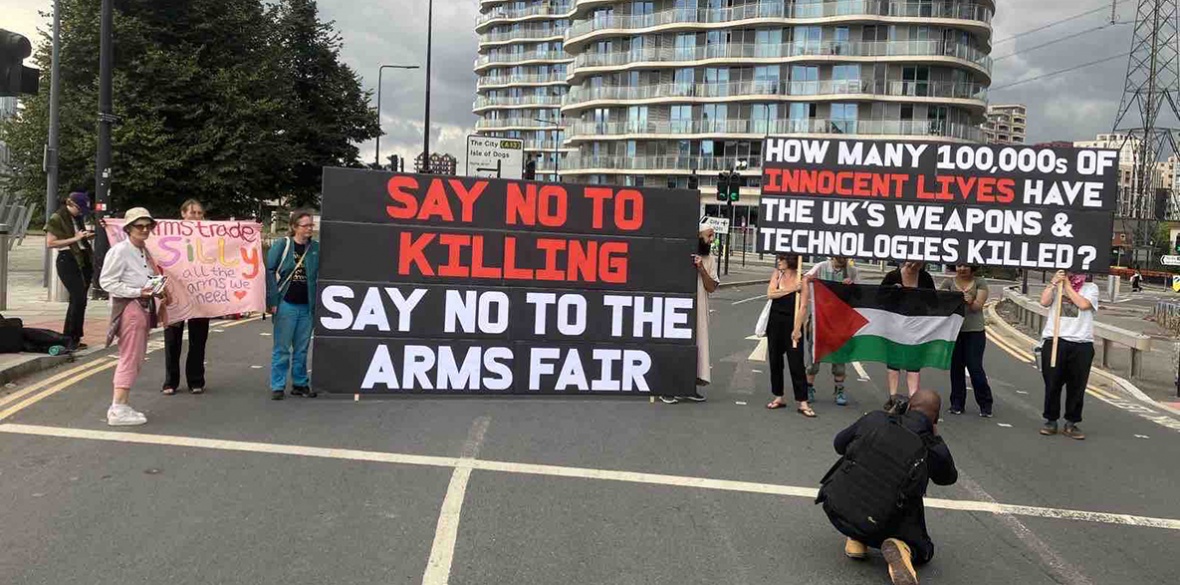
Campaigners block the road in East London outside the DSEI arms fair Photo: @CAATuk / Twitter

The UK government has no plans to suspend arms sales to Israel, despite human rights campaigners warning its exports have been used to kill civilians, openDemocracy has been told.

The UK has approved millions of pounds worth of licences for military equipment to Israeli forces since 2015. They include components for F-35 fighter jets, which can deliver ground strikes and have been recently pictured in social media posts from the Israeli Air Force.

In response to Hamas’ attack on Israel which killed hundreds of civilians, Israeli forces have fired thousands of bombs into Gaza since 7 October. As of yesterday, 2,750 Palestinians have been killed and 9,700 wounded in Israeli air strikes on the Gaza strip, according to the Palestinian health ministry. This figure was given before an attack on al-Ahli Arab hospital that reportedly killed 500 people.

Francesca Albanese, the UN’s special rapporteur on the situation of human rights in the Palestinian territories, warned last week that “Palestinians are in grave danger of mass ethnic cleansing”.

openDemocracy asked the Department of Business and Trade if it would suspend and review its export licences for arms to Israel in light of the reported civilian killings. In response, the department said the licences were “under continual review” but there were “no immediate plans to stop arms export licences to Israel”.

Emily Apple, media coordinator for the Campaign Against the Arm Trade, said: “It is disgusting that the Department for Business and Trade is refusing to suspend and review arms licences to Israel given the mounting evidence of war crimes committed by Israel in Gaza.

“UK industry is responsible for 15% of the components used in the F35 stealth combat aircraft that are being used in airstrikes, and the UK is therefore complicit in war crimes committed by the Israeli government.”

Any UK company wishing to export military goods to other nations must apply for a licence to do so. The government has a number of criteria that must be met before licences can be granted. 

One of the criteria is to “not grant a licence if [the department] determines there is a clear risk that the items might be used to commit or facilitate a serious violation of international humanitarian law”.

Officials are also told not to grant licences if there is a “likelihood that the items would be used in the territory of another country other than for legitimate purposes including national or collective self defence”.

The campaign group Palestine Action, which has taken direct action in the UK against Israeli arms company Elbit, said it was “no surprise” that the UK government is continuing to allow arms exports.

“Numerous weapons factories, including ones owned by Israel’s largest weapons firm, continue to operate on our doorsteps, who market their weapons as “battle-tested” on the captive population of Gaza,” a spokesperson for the group said.

The UK has in the past paused export licences in response to reports that its criteria may have been breached.

In 2019, the then foreign secretary Dominic Raab suspended arms exports to NATO ally Turkey after it invaded Syria, on the grounds that it risked worsening the humanitarian crisis in the country.

The UK revoked some arms licences to Israel in 2009 after hundreds of Palestinians were killed in airstrikes by Israeli forces. During the 2o14 conflict, the government warned it would suspend licences again if hostilities continued, but ultimately did not go-ahead with the decision.

The decision to continue supplying arms to Israel comes after MPs and campaign groups raised concerns about a growing lack of transparency from the government over exports licences.

In October, an enquiry led by MPs found that despite pledges from the government to improve transparency “progress has been limited” and that “there is a worrying lack of openness and data on compliance”.

The Campaign Against the Arms Trade told openDemocracy that there is a “disturbing lack of transparency over arms sales to Israel”.

“The UK government has hidden behind exemptions and refused to supply CAAT with data regarding recent exports by Elbit subsidiaries, and a large proportion of UK sales are hidden by open export licences where it is impossible to monitor the amount of weapons sold,” it said. 

Sacha Deshmukh, Amnesty International UK’s chief executive, urged the government to reverse its decision to continue supplying Israel with arms.

“The UK’s arms export system is based on the principle of avoiding a clear risk of British weapons being used to commit serious violations of international law. There’s mounting evidence that Israel’s military conduct in Gaza during the last week has included indiscriminate attacks which have killed and injured large numbers of Palestinian civilians.

“The government needs to follow its own rules and urgently suspend export licences for all arms transfers to Israel that risk being used to commit further unlawful attacks.”

Original article by Adam Bychawski republished from OpenDemocracy under a Creative Commons Attribution-NonCommercial 4.0 International licence.

Continue ReadingGovernment has ‘no plans’ to stop arms sales to Israel despite civilian deaths

Spanish Minister Says Netanyahu Should Be Brought Before ICC for War Crimes

Spread the love

Original article by JAKE JOHNSON republished from Common Dreams under Creative Commons (CC BY-NC-ND 3.0). 

Spanish Minister of Social Rights Ione Belarra delivers a statement on October 16, 2023. (Photo: Ione Belarra/Twitter.com)

“Using the horrific murders of Israeli civilians by Palestinian armed factions as an excuse to justify Israel’s crimes in general and the massacre in Gaza in particular is unacceptable,” said Spain’s minister of social rights.

Spain’s minister of social rights released a statement Monday calling on her country’s coalition government to petition the International Criminal Court to open a war crimes investigation into Israeli Prime Minister Benjamin Netanyahu, citing the ongoing aerial bombardment of the Gaza Strip and the devastating blockade that has prevented the free flow of desperately needed humanitarian aid.

“Using the horrific murders of Israeli civilians by Palestinian armed factions as an excuse to justify Israel’s crimes in general and the massacre in Gaza in particular is unacceptable,” Ione Belarra, the leader of Spain’s left-wing Podemos party, said in a video statement posted to social media.

“We ask our partner, the Socialist Party, to work together to present on behalf of the government of Spain a petition to the prosecutor’s office of the International Criminal Court to investigate the war crimes committed in Palestine by Netanyahu, as was done recently in the case of the Spanish aid worker murdered in the Ukrainian war, as well as those perpetrated by Hamas in Israel and occupied territories against the civilian population,” said Belarra, who also called for immediate efforts to protect civilians and negotiate an end to the violence.

Israel is not a member state of the ICC, but the top prosecutor for the Netherlands-based court toldReuters last week that war crimes carried out by Hamas and the Israeli government fall under the body’s jurisdiction.

“It’s horrendous what’s going on, what we’re seeing on our television screens. There has to be a legal process to determine criminal responsibility,” said Karim Khan. “Willful killing, hostage-taking are grave breaches of the Geneva Convention and one has to comply with the law.”

In the wake of Hamas’ deadly October 7 attack on Israel, the Netanyahu government began what international human rights groups and legal experts have described as a campaign of collective punishment, bombarding the densely populated Gaza Strip, devastating civilian infrastructure, and cutting off the enclave’s supply of food, electricity, fuel, and other critical supplies.

Israeli officials have admitted that the assault on Gaza is primarily geared toward inflicting massive damage, not on precisely targeting Hamas.

More than 2,600 people in Gaza have been killed since Israel’s bombing campaign began and more than a million have been displaced. The United Nations Relief and Works Agency for Palestine Refugees in the Near East (UNRWA) warned Sunday that the Israeli airstrikes and blockade have sparked “an unprecedented humanitarian catastrophe” as Gaza’s healthcare system nears total collapse.

On Friday, the Israeli government ordered the entire population of northern Gaza—more than a million people—to evacuate ahead of an expected ground invasion, a demand that prompted global outrage. Rights groups said the directive could amount to the war crime of forcible transfer, given that Gazans have been given no guarantee of safe passage or clear assurance that they will be able to return to their homes.

Israeli bombing on Monday reportedly dashed hopes of a temporary agreement to allow people to flee Gaza and let humanitarian aid enter through a border crossing between Egypt and the occupied territory.

In her remarks on Monday, Belarra decried the complicity of European governments and the United States—Israel’s primary supplier of weaponry—in the devastating attack on Gaza and urged the E.U. to “stop blindly following” the U.S.

“The United States and the European Union are not looking the other way or acting in a neutral manner, they are encouraging the state of Israel in its policy of apartheid and occupation that seriously violates human rights,” said Belarra. “Using Hamas as an excuse to murder thousands of Palestinian civilians, including children, is unspeakable hypocrisy on the part of both Israel and the countries that justify it.”

Original article by JAKE JOHNSON republished from Common Dreams under Creative Commons (CC BY-NC-ND 3.0). 

Continue ReadingSpanish Minister Says Netanyahu Should Be Brought Before ICC for War Crimes