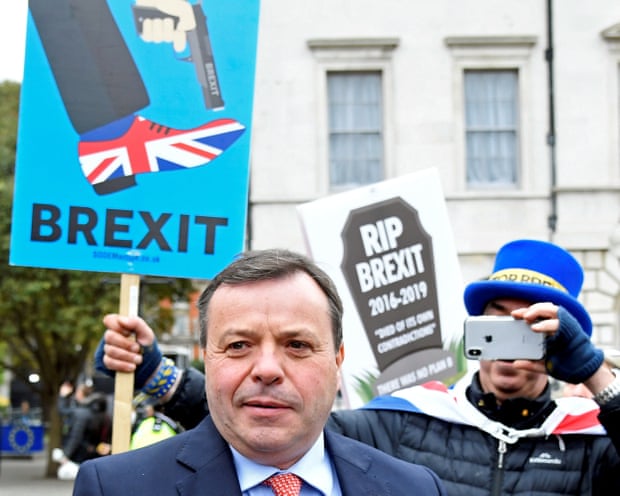
Arron Banks said he believed the Sunday Times used hacked information, an accusation the newspaper denied. Photograph: Toby Melville/Reuters
Asked whether he targeted reporter who investigated party finances, Brexit campaigner says: ‘When you live by the sword, you die by the sword’
The prominent Reform UK member and Brexit campaigner Arron Banks is said to have set private investigators on a Sunday Times journalist after he broke a series of stories about Nigel Farage.
Banks is alleged to have paid for the services of investigators to examine Gabriel Pogrund, editor of the paper’s Insight investigations team.
…
The Sunday Times and the Guardian have broken a series of stories in recent months revealing how cash has poured into Reform and Farage personally from donors and wealthy benefactors.
In response to the New Statesman report, Banks said: “We believe the Sunday Times used hacked information and that was an area of interest. We do have an investigative arm that’s got advanced capabilities.”
Asked directly whether he had paid investigators to look into Pogrund, he said: “When you live by the sword, you die by the sword.”
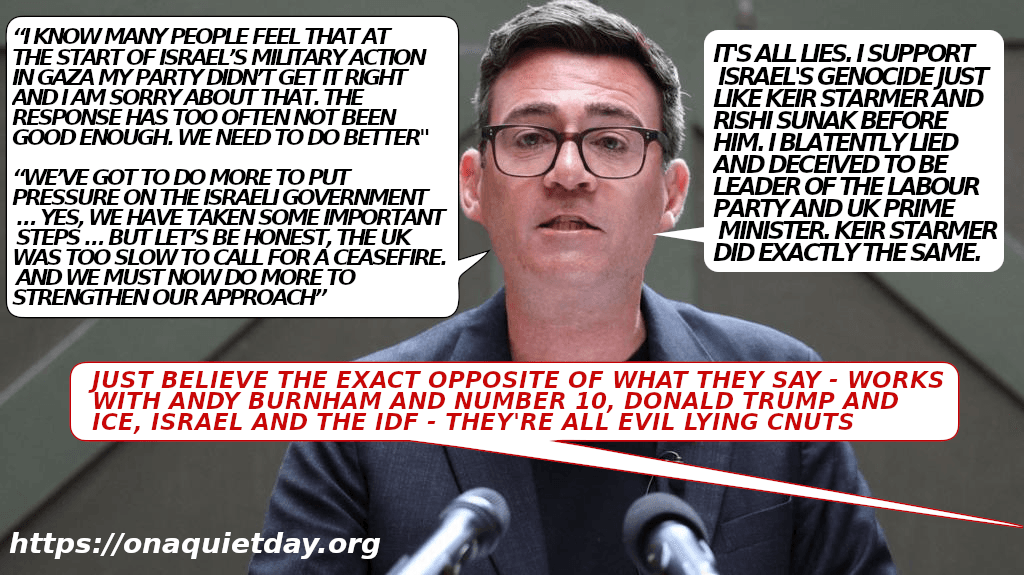
Nigel Farage urges you to ignore facts and reality and be a climate science denier like him and his Deputy Richard Tice. He says that Reform UK has received £Millions and £Millions from the fossil fuel industry to promote climate denial and destroy the planet.Power-mad orange gasbag Donald Trump says Burn, Baby, Burn.
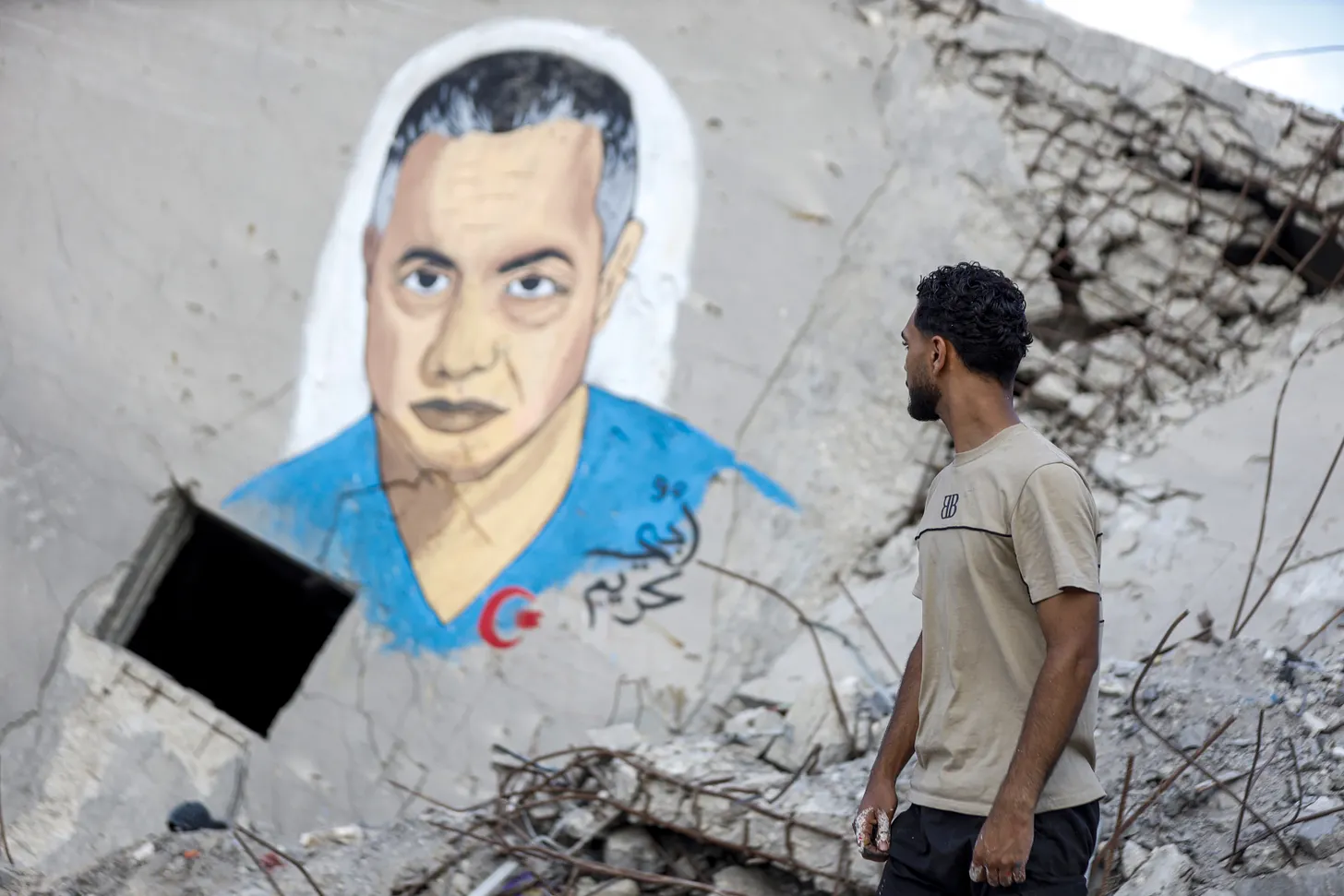
A Palestinian man walks past a portrait of imprisoned Kamal Adwan Hospital Director Dr. Hussam Abu Safiya, painted by Palestinian artist Abu Karsheli on the rubble of the Italian Tower, which was destroyed in Israeli attacks in Gaza City, Gaza, Palestine, on June 27, 2026. Photo by Ahmed Jihad Ibrahim Al-Arini/Anadolu via Getty Images.
The escalated abuse against Dr. Hussam Abu Safiya following a legal challenge to his detention has sent a chilling message to the families of detained medical workers in Gaza.
GAZA CITY—Dr. Hussam Abu Safiya, the former director of the Kamal Adwan Hospital in northern Gaza, suffered multiple injuries, including fractured ribs, after enduring severe beatings by Israeli prison authorities on July 27, according to the Palestinian Prisoners’ Media Office. The group described it as the “most difficult day” of his imprisonment since being detained without charge over a year and a half ago.
In a statement issued on Wednesday, the office said Abu Safiya, who suffers from heart disease and high blood pressure, has been subjected to “brutal torture” since June 24, when he was transferred to Rakevet—an underground detention facility within the Ramla prison complex in central Israel—including spending 21 days in solitary confinement.
Previously, Abu Safiya told his lawyer, Nasser Odeh, during a prison visit on July 2, that following an appeal filed with the Israeli Supreme Court at the end of April, the assaults and abuse against him escalated dramatically. Abu Safiya told Odeh that after a court hearing in June, where he appeared via a video link looking gaunt, several prison guards entered his cell and beat him with batons and a hammer.
Abu Safiya’s son, Elias, 27, told Drop Site News that Odeh found his father in extremely critical condition during the July 2 visit—unable to breathe normally and speaking with great difficulty, with marks of beatings and torture visible on his face and body.
According to Elias, Abu Safiya told Odeh that this might be the last time he would see him. For the family, it felt like “a farewell message from a human being who feels his life is nearing its end,” said Elias. “Since that moment, we have been living every day in genuine fear of receiving the news of his martyrdom at any moment.”
The apparent repercussions against Abu Safiya in prison following the legal challenge to his detention and similar cases involving detained medical workers have sent a chilling message to the families of Palestinian detainees—particularly doctors—that seeking justice, either through legal means or public campaigns, can have severe consequences.
Drop Site is a reader-funded, independent news outlet. Without your support, we can’t operate. Please consider becoming a paid subscriber or making a 501(c)(3) tax-deductible donation today.
Gaza health chief urges action to ‘save’ Dr Abu Safia before it’s too late
People lift placards bearing portraits of Palestinians detained by Israel, including Hussam Abu Safia, during a protest in solidarity with them in Ramallah, occupied West Bank [File: Zain Jaafar/AFP]
Fears mount for life of Hussam Abu Safia detained by Israel amid reports of torture and lack of medical care.
The director general of Gaza’s Ministry of Health has called for urgent action to “save” the life of detained Palestinian doctor Hussam Abu Safia before it is “too late”.
The paediatrician has been held by Israel since 2024 and “serious concerns are mounting” over his life and health, Dr Muneer al-Boursh posted on X on Saturday.
He noted reports that Abu Safia has been assaulted while in an Israeli detention facility and has sustained injuries to his eye, head and chest.
Abu Safia’s ongoing detention and lack of medical care have made his health condition a “source of extreme alarm that demands urgent action not postponed statements,” al-Boursh added.
Abu Safia was the director of Kamal Adwan Hospital who led the facility, one of the last functioning in northern Gaza, through an 85-day siege before Israeli forces raided it and detained him on December 27, 2024.
He has been held without charge under Israel’s unlawful combatant law, which permits indefinitely renewable detention; Israel’s supreme court rejected an appeal for his release in June. His lawyer, who visited him last month, reported new signs of beatings and torture. Rights groups, including Amnesty International and the United Nations Commission of Inquiry, have warned that his life is in imminent danger.d
This work by Middle East Monitor is licensed under a Creative Commons Attribution-NonCommercial-ShareAlike 4.0 International License.
Iranian President Masoud Pezeshkian delivers remarks during a meeting with officials from the Ministry of Roads and Urban Development in Tehran, Iran on July 26, 2026. [Iranian Presidency / Handout – Anadolu Agency]
Iranian President Masoud Pezeshkian on Saturday said that now is the “best time” to reach an agreement with the US, Anadolu reports.
“When people talk about reaching an agreement, I believe now is the best time, because there is cohesion, strength and unity in the country. As far as I know, Iran is regarded as having emerged from this war and this conflict victorious and strong,” Pezeshkian said at his second news conference since taking office.
He said the current situation provided an opportunity to pursue an agreement and resolve outstanding issues through dialogue.
According to the semi-official ISNA news agency, Pezeshkian said Iran could pursue its rights through dialogue and that it sought “nothing beyond the rights of the country and its people.”
He said wars alone could not resolve disputes and reaffirmed his government’s commitment to pursuing peace under the memorandum of understanding signed with the US in June.
“The issues cannot be resolved through war alone,” he said. “We are trying to move toward peace based on the provisions of the memorandum.”
“We are determined to make the memorandum the basis of our approach, provided the United States abandons the atmosphere of distrust it has created and trust can be rebuilt,” Pezeshkian said, adding that Washington remained “untrustworthy” in Tehran’s view.
In other remarks carried by the official IRNA news agency, Pezeshkian said dialogue had not altered Tehran’s long-standing position toward Washington.
“The US is colonialist, the US is criminal, and the Islamic Republic remains the Islamic Republic. There is no doubt about that,” he said.
Pezeshkian, however, argued that diplomacy had compelled Washington to negotiate with Tehran.
“The very fact that we held talks and pursued diplomacy forced the US to come to the table and reach an agreement and understanding with Iran,” he said.
He rejected criticism of the memorandum, saying it contained no provision requiring Iran to relinquish any of its interests or positions.
“You will not find a single clause in the memorandum in which we gave anything away,” he said, adding that Tehran “stands firmly” behind what it signed.
Pezeshkian accused Washington of violating the memorandum by pursuing alternative shipping arrangements in the Strait of Hormuz instead of adhering to procedures to be jointly agreed by Iran and Oman.
He said disputes over the alleged violations should be addressed through mechanisms established under the memorandum and expressed hope the implementation process would continue “with dignity and honor” for Iran.
Pezeshkian also defended Iran’s negotiating team, describing its members as “dedicated, expert and hardworking,” and said criticism directed at them was unfair.
He also said his administration was working with the heads of the three branches of government and the Supreme National Security Council to ease internet restrictions while taking security and infrastructure considerations into account.
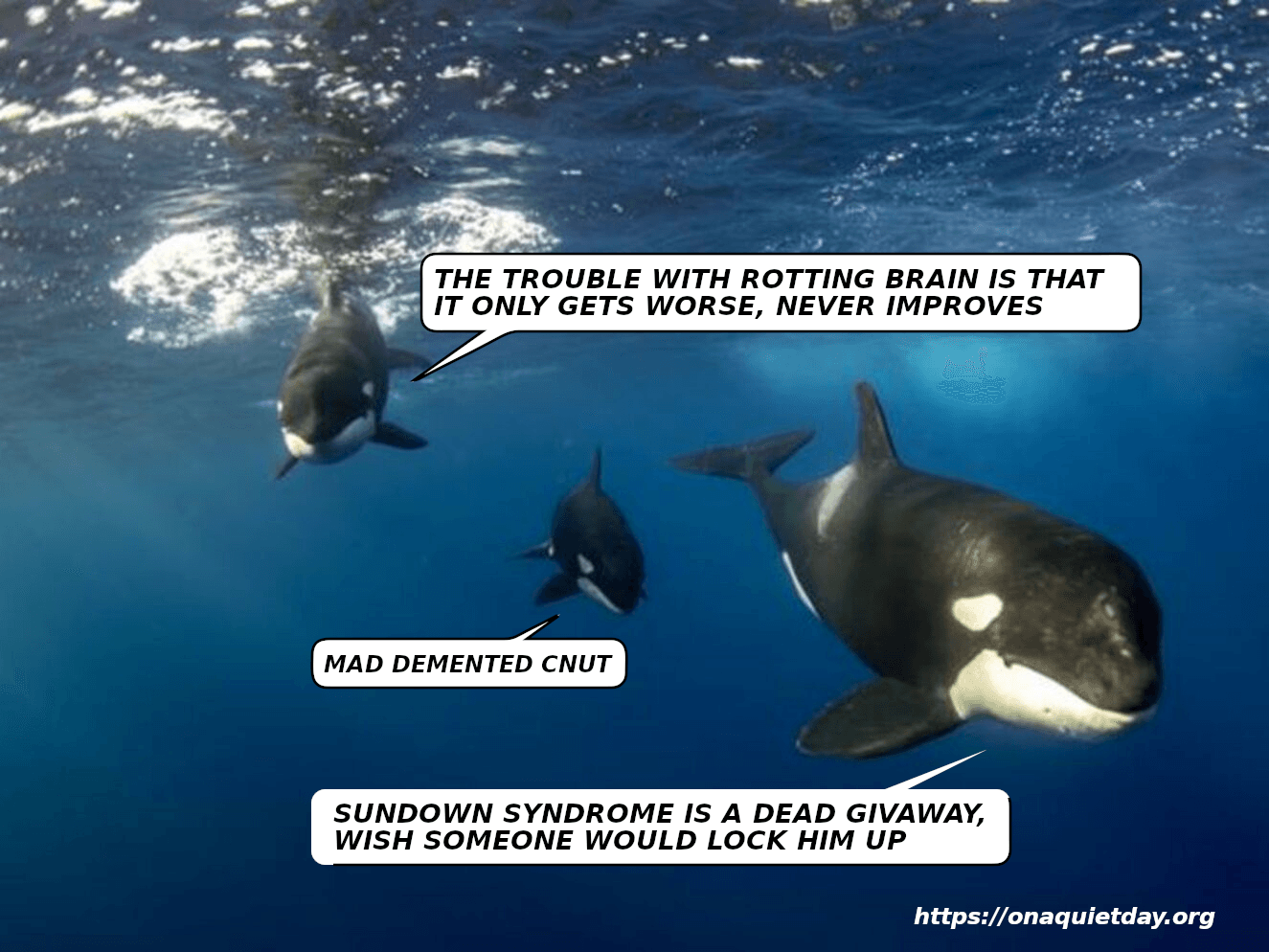
Donald Trump sings and dances, says that it’s fun to kill everyone … unless he gets distracted or falls asleep.Orcas discuss rotting brain, front Orca says Sundown Syndrome is a dead givaway and he wishes someone would Lock Him Up
Throughout history, almost every national liberation struggle has been labelled “terrorism” by the powers exercising colonial rule or foreign occupation. This strategy is nothing new.
The British Empire branded IRA fighters in Ireland and EOKA guerrillas in Cyprus as terrorists. France portrayed Algeria’s National Liberation Front (FLN) as a criminal organisation. The same happened to the Mozambique Liberation Front (FRELIMO), the People’s Movement for the Liberation of Angola (MPLA), the South West Africa People’s Organisation (SWAPO) in Namibia, and even Nelson Mandela’s African National Congress (ANC).
History, however, vindicated these movements and condemned the colonial regimes that sought to perpetuate their domination.
This pattern reveals a constant: those who occupy a territory seek to strip the occupied people of any legitimacy to resist.
The dehumanisation of resistance is a colonial strategy. By labelling every resistance fighter a “terrorist”, attention is shifted away from illegal occupation, apartheid and the denial of self-determination, and redirected towards the reaction of the occupied people.
This narrative, however, encounters clear limits within international law itself.
From the United Nations Charter to Resolution 1514 (XV) on decolonisation and Resolution 2625 (XXV), which reaffirms the principle of peoples’ self-determination, the understanding has been consolidated that peoples subjected to colonial domination, foreign occupation or racist regimes have the right to struggle for their liberation.
Several subsequent resolutions of the United Nations General Assembly recognised the legitimacy of national liberation movements and acknowledged that such resistance may take the form of armed struggle, provided that it remains subject to the rules of international humanitarian law.
This is precisely why the international community has never automatically equated national liberation movements with terrorist organisations.
International humanitarian law regulates the manner in which armed conflicts must be conducted and imposes obligations on all belligerents, including resistance movements.
However, it does not eliminate the political and legal right of a people to resist occupation. Confusing these two dimensions serves only the interests of occupying powers, because it transforms a conflict of a political and legal nature into a mere policing matter.
The history of the so-called “State of Israel” itself exposes this contradiction.
Before 1948, Irgun and Lehi were regarded as terrorist organisations by the British government because of attacks such as the bombing of the King David Hotel and the assassination of UN mediator Folke Bernadotte.
Years later, their leaders reached the highest levels of government, and Menachem Begin received the Nobel Peace Prize. This demonstrates that the label “terrorist” often reflects political circumstances more than any permanent legal definition.
In the contemporary context, this debate remains highly relevant. Palestine continues to be recognised by the United Nations as a territory under occupation, while Western Sahara remains on the UN list of Non-Self-Governing Territories, awaiting the fulfilment of its people’s right to self-determination.
In this context, the Islamic Resistance Movement (Hamas), which emerged during the First Intifada, and the Polisario Front, recognised by the United Nations as the representative of the Sahrawi people in the Western Sahara peace process, belong to the historical tradition of national liberation movements.
As with South Africa’s ANC, Algeria’s FLN, Namibia’s SWAPO, Mozambique’s FRELIMO and many other movements, both base their struggle on their peoples’ claim to the right of self-determination in the face of occupation or foreign domination.
This does not mean that every military action carried out by resistance organisations is automatically legitimate under international law.
The rules of international humanitarian law apply to all parties to a conflict and prohibit deliberate attacks against civilians, regardless of the cause being defended.
However, possible violations of these rules do not, in themselves, invalidate the legal legitimacy of the struggle for self-determination, nor do they automatically transform a national liberation movement into a terrorist organisation under international law. These are distinct questions, frequently conflated for political convenience.
There is no colonialism without resistance. There never has been.
The French Resistance against Nazi occupation, Vietnamese guerrillas, Algerian fighters, South Africans who confronted apartheid, African liberation movements, the Polisario Front and the Palestinian resistance all demonstrate that no people will indefinitely accept the loss of their land, sovereignty and dignity.
The real question, therefore, is not why resistance exists.
The question the world should be asking is why military occupations, colonial processes and regimes that deny entire peoples the right to determine their own destiny continue to exist.
As long as there is colonisation, apartheid, illegal annexation and denial of self-determination, there will be armed resistance movements.
And international law, despite political pressure and attempts to criminalise liberation movements, continues to uphold the fundamental principle that the freedom of peoples is not an act of terrorism, but a fundamental right of humanity.
Donald Trump sings and dances, says that it’s fun to kill everyone … unless he gets distracted or falls asleep.Orcas discuss rotting brain, front Orca says Sundown Syndrome is a dead givaway and he wishes someone would Lock Him Up
This work by Middle East Monitor is licensed under a Creative Commons Attribution-NonCommercial-ShareAlike 4.0 International License.
Senior international affairs adviser to Iran’s Supreme Leader, Ali Akbar Velayati. [Photo/AA]
Ali Akbar Velayati, Senior Adviser on international affairs to Iran’s Supreme Leader, said Saturday that “foreign forces” must leave the region, arguing that their presence is the main cause of insecurity, Anadolu reports.
“Recent developments reflect the resilience of the armed forces, the steadfastness of Iranians, and the courage of the Resistance Axis,” Velayati said on US social media platform X.
“The U.S. and Zionist regime’s defeat reinforced the belief that foreign forces — the main cause of insecurity — must leave the region,” he added.
Velayati also said that “growing cooperation among regional states can secure its security,” without providing further details.
Regional tensions escalated on Feb. 28, when Israel and the US launched coordinated attacks on Iran targeting military, nuclear and energy infrastructure. Tehran responded with missile and drone attacks against Israeli and US targets across the region.
On June 18, Iran and the US signed a memorandum of understanding through Pakistani and Qatari mediation, ending active hostilities and launching negotiations toward a final agreement. The talks later stalled over disputes related to maritime security and freedom of navigation through the Strait of Hormuz, a critical export route for Gulf oil and gas.
Donald Trump sings and dances, says that it’s fun to kill everyone … unless he gets distracted or falls asleep.Orcas discuss rotting brain, front Orca says Sundown Syndrome is a dead givaway and he wishes someone would Lock Him Up