Climate Activists Demand Justice for ‘Unjustly’ Arrested Ugandan Anti-EACOP Protesters

Spread the love

Original article by Brett Wilkins republished from Common Dreams under Creative Commons (CC BY-NC-ND 3.0).
“The arrests of these activists are a clear attempt to silence dissent and suppress opposition to the EACOP,” said one organizer.

Climate campaigners around the world on Wednesday urged Ugandan authorities to drop charges against four climate activists arrested and jailed overnight after peacefully protesting a highly controversial oil pipeline under construction in the region.

Bob Barigye, Mutesi Zarika, Naruwada Shamim, and Nalusiba Phionah were violently arrested Tuesday in the capital Kampala for protesting the environmental and social impacts of the East African Crude Oil Pipeline (EACOP). The activists—who were later released on bond—were charged with inciting violence.

However, the #StopEACOP coalition—which said the protesters were “unjustly” arrested and jailed—argued that photos and videos from the demonstration show that it was peaceful.

“The arrests of these activists are a clear attempt to silence dissent and suppress opposition to the EACOP,” the coalition’s campaign coordinator, Zaki Mamdoo, said in a statement. “We call upon the international community and civil society organizations to join us in condemning these arrests and demanding justice for those detained.”

Samuel Okulony, director of the Environment Governance Institute, said that “it is not a crime to voice opposition to the controversial EACOP project or to advocate for the government and project proponents to explore alternative, sustainable solutions.”

“Peaceful protest and dialogue are fundamental pillars of a democratic society, and these rights must be protected and upheld,” Okulony added.

Charity Migwi, the African regional campaigner for U.S.-based 350.org, condemned the arrests “in the strongest terms possible.”

“These activists were exercising their democratic right to peacefully protest against a project that they believe will have devastating consequences for the environment and the people of Uganda and beyond,” she said, urging the Ugandan government to “drop all charges against them.”

This isn’t the first time anti-EACOP activists have been arrested for peacefully protesting the pipeline. Last October, nine student leaders were arrested by police and subsequently charged with inciting violence for holding a Kampala demonstration in support of a European Parliament resolution condemning the project’s human rights and environmental violations. Four more anti-EACOP activists were arrested last December.

Barigye, a 34-year-old biology teacher and climate activist, was arrested in January for anti-EACOP organizing despite having police permission to protest. Barigye toldAfrican Arguments earlier this year that he was held for four days, during which time he was “psychologically tortured” by police.

“They threatened my life and family,” he said. “They dragged me into a filthy cell, made me starve… I could not sleep as they would interrogate me at any time of the night.”

“We are looked at us the enemies of the state,” Barigye said of the anti-EACOP activists. “The police now prefer psychological torture because physical torture will create bad publicity around the oil pipeline project, which could push away investors and insurers… The government doesn’t want to be in the international spotlight for the wrong reasons.”

If completed, the $3.5 billion, nearly 900-mile EACOP would transport up to 230,000 barrels of crude oil per day from fields in the Lake Albert region of western Uganda to the Tanzanian port city of Tanga on the Indian Ocean.

Earlier this week, Human Rights Watch published a report detailing how EACOP has devastated the lives and livelihoods of tens of thousands of people in its path while exacerbating the climate emergency.

Original article by Brett Wilkins republished from Common Dreams under Creative Commons (CC BY-NC-ND 3.0).

Continue ReadingClimate Activists Demand Justice for ‘Unjustly’ Arrested Ugandan Anti-EACOP Protesters

Morning Star: The anti-boycott Bill helps shield an ever-more extremist Israel from democratic pressure

Spread the love

https://morningstaronline.co.uk/article/e/anti-boycott-bill-helps-shield-ever-more-extremist-israel-democratic-pressure

The anti-boycott Bill targets the Boycott, Divestment and Sanctions (BDS) movement in solidarity with Palestine. It is openly a bid to enforce British foreign policy on all public bodies: Communities Secretary Michael Gove claims councils, universities or other institutions which seek to make ethical decisions on how to spend or invest funds are guilty of “pursuing their own foreign policy agenda.”

In banning public bodies from taking stances on international questions at odds with that of central government, the law is part of the creeping enforced conformity chilling democratic debate in Britain, reflected in Tory anti-protest legislation, Labour’s relentless search for heretics to expel and the online censorship of alternative and foreign media in the name of combating “disinformation.”

The cross-party consensus on stripping us of our democratic rights is evident here too. Though Labour proposed a “reasoned amendment,” setting out objections to the Bill without actually amending it, it instructed its MPs to abstain when that fell rather than oppose the legislation.

In an interview with Jewish News, shadow communities secretary Lisa Nandy stressed the party’s support for a ban on BDS, saying Labour’s only concerns were that the Bill might also stop councils boycotting other countries, namely China: suggesting Labour would police enforced alignment with British foreign policy even more closely than the Tories. Her concerns are misplaced, anyway: the Bill breaks new ground by explicitly referencing Israel, giving it a unique impunity from activist pressure under British law, as well as by specifying that it should also cover the occupied West Bank and Golan Heights, endorsing Israel’s illegal colonisation projects in practice while continuing to oppose them formally.

https://morningstaronline.co.uk/article/e/anti-boycott-bill-helps-shield-ever-more-extremist-israel-democratic-pressure

Continue ReadingMorning Star: The anti-boycott Bill helps shield an ever-more extremist Israel from democratic pressure

‘We’ve Run Out of Time’: Experts and Activists Urge Climate Action Amid Summer of Extremes

Spread the love
Canadian wildfires.

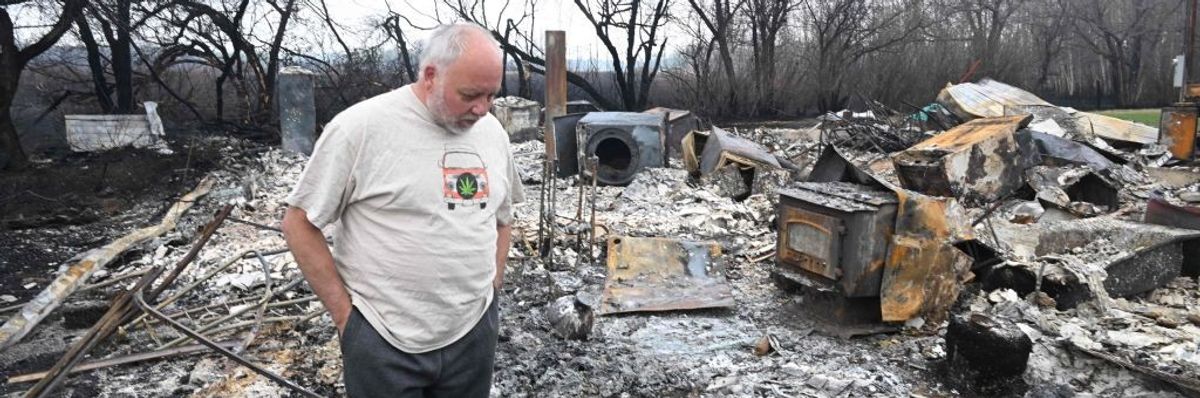
Property owner Adam Norris surveys the wildfire damage at his home in Drayton Valley, Alberta, Canada, on May 8, 2023.

 (Photo: Walter Tychnowicz/AFP via Getty Images)

Original article by OLIVIA ROSANE republished from Common Dreams under Creative Commons (CC BY-NC-ND 3.0).

“Still we are not acting with the urgency and determination that is required,” the U.N. High Commissioner for Human Rights said Monday.

As parts of the world from China to Texas bake under extreme heat, scientists and advocates are warning that world leaders are running out of time to take action on the climate crisis.

In a speech to a United Nations panel discussion on Monday,, U.N. High Commissioner for Human Rights Volker Türk cautioned that current policies put the planet on course for a “dystopian future.”

“Yet still we are not acting with the urgency and determination that is required. Leaders perform the choreography of deciding to act and promising to act and then… get stuck in the short term,” Türk said.

[Twitter refuses to embed.]

Türk’s remarks came after Reuters ran an article highlighting recent weather extremes and land- and sea-temperature records. Scientists warn that the clock is running out on the chance of limiting global warming to 1.5°C above preindustrial levels.

“We’ve run out of time because change takes time,” University of New South Wales climate scientist Sarah Perkins-Kirkpatrick told Reuters.

Early June 2023 was the hottest on record, with average temperatures even overshooting the 1.5°C mark for a few days. While this has happened before during the Northern Hemisphere winter, this was the first time it has happened during the Northern Hemisphere summer, according to Reuters.

At the same time, sea surface temperatures broke records in both April and May. Temperatures in the Indian and Pacific oceans could rise to 3°C warmer than normal by October, Australia’s weather agency said, according to Reuters.

“We know that our environment is burning. It’s melting. It’s flooding. It’s depleting. It’s drying. It’s dying.”

University of Leeds professor of climate physics Piers Forster told Reuters that the climate crisis was predominantly to blame, but that El Niño, a drop in dust from the Sahara blowing over the ocean, and a turn to low-sulfur shipping fuels that reduced atmospheric particulates also contributed.

“So in all, oceans are being hit by a quadruple whammy,” he said. “It’s a sign of things to come.”

Other signs of things to come include the wildfires burning in Canada, which is in the midst of its worst fire season on record, as AFP reported June 28. The fires have displaced more than 100,000 people, sent toxic smoke spewing south and east, and released a record almost 600 million tons of carbon dioxide into the atmosphere.

Places from India to the southern U.S. have sweltered through deadly heat waves. On Thursday, several states in the South and Midwest had reached the highest threat level for their wet bulb temperature—the temperature of a thermometer covered in a wet cloth which is meant to simulate how the human body would react to a combination of heat and humidity in full sun, as The Hill reported. Studies have shown that the human body cannot sweat to cool down when heat and humidity reach certain levels—the most recent research points to a threshold of 88°F at 100% humidity.

[Twitter refuses to embed.]

On Sunday, Chinese authorities said that the country had broken records for the number of hot days during the first six months of the year, with Beijing breaking its all-time temperature record to hit a high of 41.1°C on Thursday, as CNN reported.

When the capital finally saw relief Monday, flooding displaced more than 10,000 people in Hunan province, and Shaanxi province’s Zhenba county experienced its worst flooding in 50 years, according to the Independent.

“We know that our environment is burning. It’s melting. It’s flooding. It’s depleting. It’s drying. It’s dying,” Türk said during his remarks Monday.

Türk warned that conditions could get even more extreme if global temperatures rise to around 3°C, which current policies put them on track to do, according to the most recent report from the Intergovernmental Panel on Climate Change.

“Vast territories would disappear under rising oceans, or become effectively uninhabitable, due to heat and lack of water,” he said.

Türk’s speech was focused on the right to food specifically, and how the climate crisis would continue to interfere with it. Between 2000 and 2023, there had already been a 134% increase in climate and flood disasters, he said.

“More than 828 million people faced hunger in 2021,” he said. “And climate change is projected to place up to 80 million more people at risk of hunger by the middle of this century—creating a truly terrifying scale of desperation and need.”

Yet so far, political and corporate leaders are not responding to the situation with the urgency experts and advocates say it requires. The Bonn climate talks, which occurred amidst the record early June heat, ended with little progress.

“I am hoping that the sheer reality will help us change people’s moves and change the politics.”

“It was very detached from what was going on outside of the building in Bonn—I was very disappointed by that,” Li Shuo, Greenpeace’s senior climate adviser in Beijing, told Reuters.

The next major international climate conference—COP28—begins in the United Arab Emirates in late November, but campaigners are concerned by the fact that its president, Sultan Ahmed al-Jaber, is also the head of the UAE’s state oil company.

Meanwhile, Li and Türk still expressed hope for 11th-hour progress.

“We are really getting to the moment of truth,” Li told Reuters. “I am hoping that the sheer reality will help us change people’s moves and change the politics.”

Türk recommended a list of actions including an end to fossil fuel subsidies, a phaseout of fossil fuel use, and a “just transition to a green economy.”

He also said that COP28 needed to be a “decisive game-changer.”

“There is still time to act,” he said. “But that time is now. We must not leave this for our children to fix—no matter how inspiring their activism. The people who must act—who have the responsibility to act—are our leaders, today.”

Original article by OLIVIA ROSANE republished from Common Dreams under Creative Commons (CC BY-NC-ND 3.0).

Continue Reading‘We’ve Run Out of Time’: Experts and Activists Urge Climate Action Amid Summer of Extremes

Human Rights Watch reports new evidence of Ukrainian use of anti-personnel landmines

Spread the love

https://www.eureporter.co/world/human-rights-category/2023/07/03/human-rights-watch-reports-new-evidence-of-ukrainian-use-of-anti-personnel-landmines/

Human Rights Watch (HRW) said on Friday (30 June) that it uncovered new evidence of the indiscriminate use by Ukrainian forces of banned anti-personnel landmines against Russian troops who invaded Ukraine in 2022.

The group called on Ukraine’s government to follow through with a commitment made earlier this month not to employ such weapons, investigate their suspected use and hold accountable those responsible.

“The Ukrainian government’s pledge to investigate its military’s apparent use of banned anti-personnel mines is an important recognition of its duty to protect civilians,” Steve Goose, Human Rights Watch’s arms director, said in a statement.

HRW said it shared its findings with the Ukrainian government in a May letter to which it received no response.

https://www.eureporter.co/world/human-rights-category/2023/07/03/human-rights-watch-reports-new-evidence-of-ukrainian-use-of-anti-personnel-landmines/

Continue ReadingHuman Rights Watch reports new evidence of Ukrainian use of anti-personnel landmines

Human Rights Group Slams Israeli Occupation for Holding Over 1,100 Palestinians Without Trial

Spread the love

https://daysofpalestine.ps/human-rights-group-slams-israeli-occupation-for-holding-over-1100-palestinians-without-trial/

The Israeli use of administrative detention, a controversial practice that allows the Israeli occupation to hold suspects without trial for months or even years, has reached its highest level since 2003, according to a report by an Israeli human rights group, B’Tselem.

B’Tselem said that as of November 2021, there were 1,128 Palestinians in administrative detention, including 10 minors and two women. The group said this was the largest number of such detainees since the end of the second intifada, or Palestinian uprising, in 2003.

The group accused the Israeli occupation of using administrative detention as a “tool of oppression” and a “means of collective punishment” against Palestinians, especially those involved in political or social activism. It said that most of the detainees were held based on secret evidence that they and their lawyers could not challenge in court.

https://daysofpalestine.ps/human-rights-group-slams-israeli-occupation-for-holding-over-1100-palestinians-without-trial/

Continue ReadingHuman Rights Group Slams Israeli Occupation for Holding Over 1,100 Palestinians Without Trial