Category: human rights violations

  • UN Chief Invokes Article 99 to Spur Security Council Action on Gaza

    Spread the love
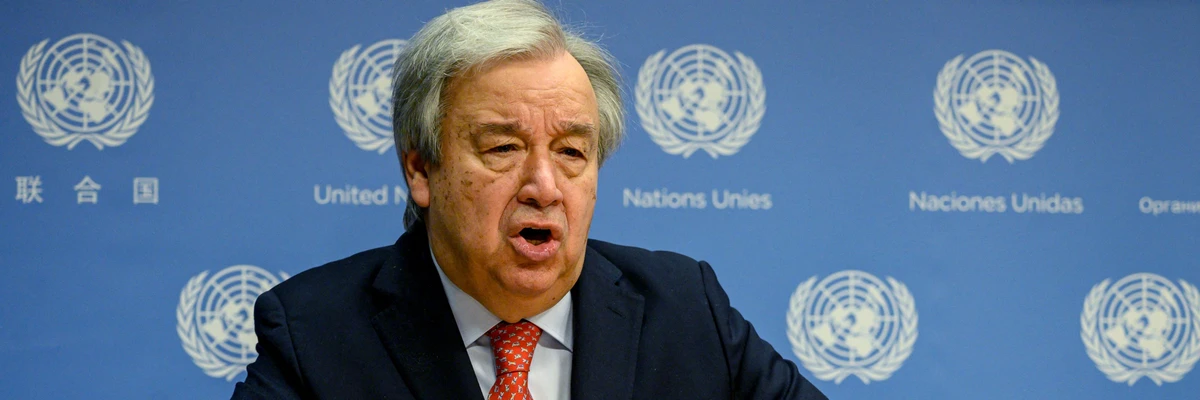
    United Nations Secretary-General António Guterres discusses climate change at U.N. headquarters in New York City on July 27, 2023.
    United Nations Secretary-General António Guterres discusses climate change at U.N. headquarters in New York City on July 27, 2023.

    “Facing a severe risk of collapse of the humanitarian system in Gaza, I urge the council to help avert a humanitarian catastrophe and appeal for a humanitarian cease-fire to be declared.”

    With over 16,000 Palestinians dead just two months into Israel’s war on the Gaza Strip, United Nations Secretary-General António Guterres on Wednesday demanded immediate action by the U.N. Security Council.

    For the first time since becoming secretary-general nearly seven years ago, Guterres invoked Article 99, a rarely used section of the U.N. Charter empowering him to bring to the attention of the council “any matter which in his opinion may threaten the maintenance of international peace and security.”

    U.N. spokesperson Stéphane Dujarric said that Guterres was invoking Article 99 “given the scale of the loss of human life in Gaza and Israel, in such a short amount of time.”

    “I think it’s arguably the most important invocation,” Dujarric told reporters at U.N. headquarters, “in my opinion, the most powerful tool that he has.”

    “The international community has a responsibility to use all its influence to prevent further escalation and end this crisis.”

    Guterres wrote to José Javier De la Gasca Lopez Domínguez, the Ecuadorian president of the Security Council, that “more than eight weeks of hostilities in Gaza and Israel have created appalling human suffering, physical destruction and collective trauma across Israel and the occupied Palestinian territory.”

    The U.N. chief reaffirmed his condemnation of the October 7 Hamas-led attack on Israel—in which around 1,200 people were killed and over 200 others were captured—that led to the war. He called accounts of sexual violence “appalling” and stressed that the remaining hostages “must be immediately and unconditionally released.”

    He also emphasized that “civilians throughout Gaza face grave danger,” with the Israeli airstrikes and raids damaging more than half of all homes and displacing about 80% of the 2.3 million residents. Over a million of them have sought shelter at U.N. facilities, “creating overcrowded, undignified, and unhygienic conditions,” while others “find themselves on the street.”

    “The healthcare system in Gaza is collapsing,” he noted, pointing out that only 14 of 36 hospitals are operating at all. “I expect public order to completely break down soon due to the desperate conditions, rendering even limited humanitarian assistance impossible. An even worse situation could unfold, including epidemic diseases and increased pressure for mass displacement into neighboring countries.”

    Already, conditions in Gaza are making “it impossible for meaningful humanitarian operations to be conducted,” Guterres added. “The capacity of the United Nations and its humanitarian partners has been decimated by supply shortages, lack of fuel, interrupted communications, and growing insecurity.”

    “The situation is fast deteriorating into a catastrophe with potentially irreversible implications for Palestinians as a whole and for peace and security in the region. Such an outcome must be avoided at all cost,” the U.N. leader warned. “The international community has a responsibility to use all its influence to prevent further escalation and end this crisis.”

    “I urge the members of the Security Council to press to avert a humanitarian catastrophe,” he wrote. “I reiterate my appeal for a humanitarian cease-fire to be declared. This is urgent. The civilian population must be spared from greater harm.”

    The United States—a supporter of Israel’s war and one of the U.N. Security Council’s five permanent members—vetoed a mid-October resolution condemning violence against civilians in Israel and Gaza and urging “humanitarian pauses” for aid delivery.

    Roughly a month later, the Security Council approved a Gaza resolution that calls on all parties to abide by their obligations under international law and advocates for “urgent and extended humanitarian pauses and corridors.”

    Dr. Christos Christou, international president of Médecins Sans Frontières, or Doctors Without Borders, said at the time that “the unacceptably jumbled and sluggish process finally led to the adoption of a text that does not come close to reflecting the severity of the humanitarian catastrophe in Gaza.”
  • Rwanda plans are an affront to democracy and human rights, say Greens  

    Spread the love
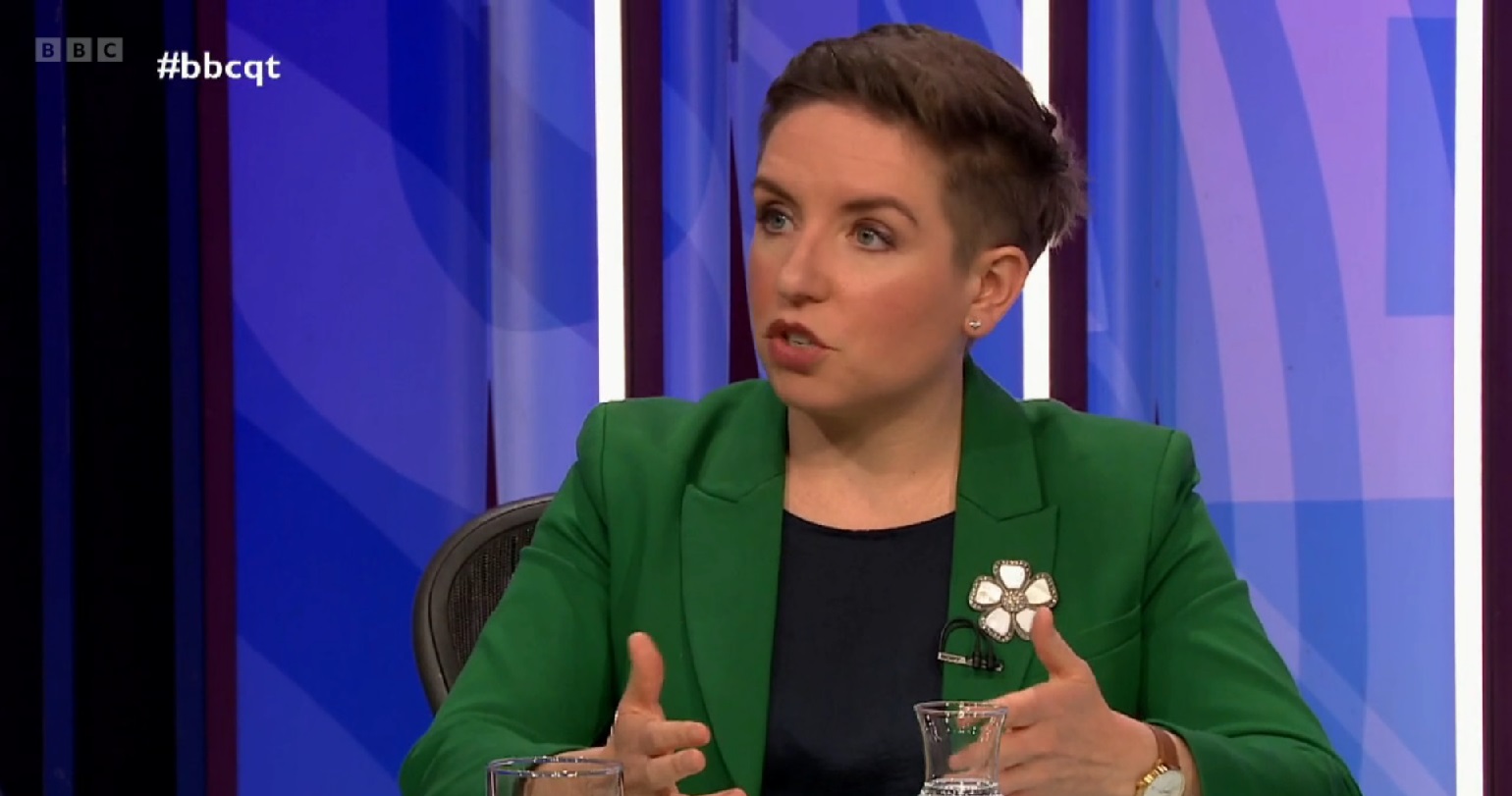
    Image of the Green Party's Carla Denyer on BBC Question Time.
    Image of the Green Party’s Carla Denyer on BBC Question Time.

    Responding to the government publishing plans to disapply sections of the Human Rights Act to get around a Supreme Court ruling banning the deportation of people seeking asylum to Rwanda for processing, Green Party co-leader Carla Denyer said: 

    “The fact that the government is going to try to use its parliamentary majority to over-ride established human rights protections is an affront to democracy. 

    “We need a system that welcomes refugees through clear, open, safe and legal routes, that offers quick and efficient determinations and support for resettlement into local communities with properly funded local services.” 

    “Instead of creating an asylum system that works, the government is deliberately making it chaotic and inaccessible to put people off using their right to seek asylum.  

    “It is the use of cruelty and inhumanity as a tool of public policy and cannot be allowed to go unchallenged. 

    “Everyone deserves to be treated in a way that is fair and humane. This new legislation will remove fundamental legal protections designed to protect us all from the arbitrary power of the state.”

  • Dutch Court Hears Case Accusing Government of Complicity in Israeli War Crimes

    Spread the love

    Original article by JULIA CONLEY republished from Common Dreams under Creative Commons (CC BY-NC-ND 3.0).

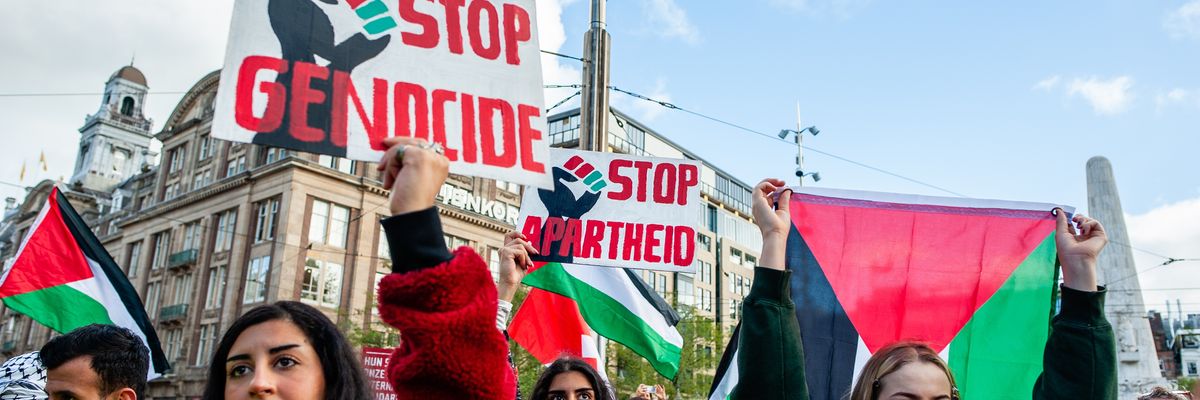
    Protesters hold signs denouncing genocide during a demonstration in solidarity with Palestine in Amsterdam on October 15, 2023. (Photo: Ana Fernandez/SOPA Images/LightRocket via Getty Images)

    “When military goods can contribute to human rights violations or international humanitarian law, that export is strictly prohibited,” said one campaigner. “It is incomprehensible that, despite clear warnings, the government has knowingly deviated from this.”

    A Dutch court on Monday heard opening arguments in a case brought by four human rights organizations that have accused the government of the Netherlands of being complicit in Israeli war crimes due to its export of military supplies as Israel kills thousands of civilians in Gaza.

    Supplying the Israel Defense Forces (IDF) with parts for F-35 fighter jets, which are stored in a warehouse in the Netherlands, puts the Dutch government at risk for “becoming complicit in violations of international humanitarian law,” the director of the Dutch branch of Amnesty International , one of the plaintiffs, said when the lawsuit was announced last month.

    Amnesty is joined by Oxfam Novib—the Dutch chapter of Oxfam International—The Rights Forum, and PAX in the case, which is expected to result in a judgement around December 15.

    The groups filed the lawsuit after government documents showed the Netherlands had allowed at least one shipment of reserve parts for F-35s since October 7, Al Jazeera reported .

    The Dutch Defense Ministry wrote in a letter to Parliament that “it cannot be established that the F-35s are involved in grave violations of the humanitarian laws of war,” but with nearly 16,000 people killed in Gaza in less than two months—including more than 6,600 children —the human rights groups aim to test that claim in court.

    “The state must immediately stop its deliveries of F-35 parts to Israel,” lawyer Liesbeth Zegveld said Monday at the Hague District Court. “That is its obligation under… Article 1 of the Geneva Conventions, it is its obligation under the Genocide Treaty to prevent genocide, and it is its obligation under export law.”

    Martje van Nes, PAX’s director of organization, pointed out last month that “the Netherlands has a very concrete assessment framework for arms exports.”

    “When military goods can contribute to human rights violations or international humanitarian law, that export is strictly prohibited,” said van Nes. “It is incomprehensible that, despite clear warnings, the government has knowingly deviated from this. This makes them responsible for the deployment of the equipment.”

    PAX noted on Monday that the call for the Netherlands to end shipments of any supplies that Israel could use to continue its massacre of Palestinian civilians—in retaliation for an attack by Hamas in October that killed 1,200 Israelis—”is all the more urgent” considering the end of a temporary cease-fire on Friday. More than 800 people have been killed since the pause in fighting ended last week, and Israel was stepping up its ground attacks on Monday.

    “As far as we are concerned, the government must take action now to protect citizens,” said PAX on social media. The group has demanded a permanent humanitarian cease-fire.

    Dagmar Oudshoorn, director of Amnesty International in the Netherlands, said that as the host country “of both the International Court of Justice and the International Criminal Court,” the Dutch government “likes to present itself as a champion of international law.”

    “Our government is losing all credibility right now,” she said. “Evident violations such as food, water, and fuel blockade, the forced displacement of the population, and the bombing of schools and hospitals, are not mentioned. And by supplying armies, the Netherlands runs the risk of becoming complicit in violations of international humanitarian law.”

    The Netherlands has maintained since October 7 that Israel “has the right to defend itself” and has called for Prime Minister Benjamin Netanyahu’s government to adhere to international law, but the groups said the IDF is clearly not doing so and should lose the support of the country.

    “This complicity must stop now,” said Gerard Jonkman, director of The Rights Forum.

    Original article by JULIA CONLEY republished from Common Dreams under Creative Commons (CC BY-NC-ND 3.0).

  • Report Details ‘Toxic’ Fossil Fuel Pollution in COP28 Host UAE

    Spread the love
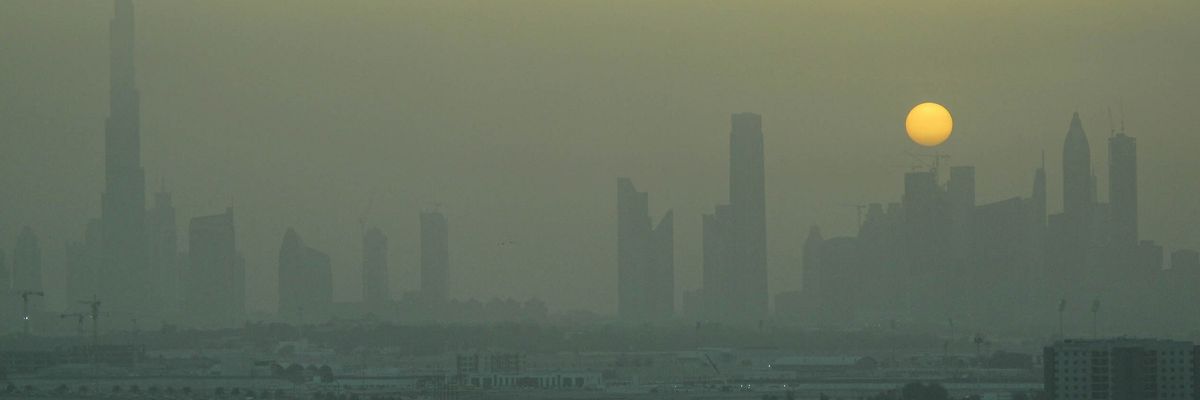
    The sun sets amid heavy air pollution in Dubai. (Photo: Forbes Johnston/flickr/cc)

    Original article by BRETT WILKINS republished from Common Dreams under Creative Commons (CC BY-NC-ND 3.0). 

    “Nobody will ever hold the government to account publicly,” said one climate campaigner. “We do not have the privilege of speaking out against the government.”

    Despite greenwashing efforts like hosting the ongoing United Nations Climate Change Conference, the United Arab Emirates—the world’s seventh-biggest oil producer and sixth-largest exporter—is contributing heavily to toxic air pollution, creating a “devastating impact on human health.”

    That’s according to a Monday report from Human Rights Watch (HRW) report—entitled ‘You Can Smell Petrol in the Air’: UAE Fossil Fuels Feed Toxic Pollution —which “documents alarmingly high air pollution levels in the UAE” and how toxic air caused by oil and gas production creates “major health risks” for the country’s 9.4 million people.

    As the report details:

    The UAE government says that the country has poor air quality but mainly ascribes this to natural dust from sandstorms. However, academic studies have shown that natural causes are not the single, or in some cases even the major, factor in air pollution. A 2022 academic study found that, in addition to the dust, emissions including from fossil fuels contribute significantly to the problem in the UAE. Air pollution and climate change are directly linked, as the extraction and use of fossil fuels are the sources of air pollution and greenhouse gas emissions.

    The report’s researchers analyzed levels of PM2.5 —fine particulate matter measuring 2.5 micrometers or smaller that can penetrate human lungs and blood—at 30 UAE government monitoring stations and found that they were, on average, three times higher than the World Health Organization’s (WHO) daily recommended exposure.

    According to the latest available data from the World Bank, the UAE’s mean annual PM2.5 exposure is over eight times higher than what the WHO says is safe .

    The WHO estimates that approximately 1,870 people die each year from outdoor air pollution in the UAE.

    “Fossil fuels pollute the air people breathe in the UAE,” HRW environment director Richard Pearshouse said in a statement . “But the obliteration of civil society by UAE’s government means that no one can publicly express concerns, let alone criticize the government’s failure to prevent this harm.”

    The report explains:

    Those in the UAE wanting to report on, or speak out about, the risks of fossil fuel expansion and its links to air pollution face risks of unlawful surveillance, arrest, detention, and ill-treatment. Over the last decade, authorities in the UAE have embarked on a sustained assault on human rights and freedoms, including targeting human rights activists, enacting repressive laws, and using the criminal justice system as a tool to eliminate the human rights movement. These policies have led to the complete closure of civic space, severe restrictions on freedom of expression, both online and offline, and the criminalization of peaceful dissent.

    “Nobody will ever hold the government to account publicly,” said one climate activist interviewed by HRW. “We do not have the privilege of speaking out against the government.”

    Pearshouse argued: “Air pollution is a dirty secret in the UAE. If the government doesn’t allow civil society to scrutinize and speak freely about the connection between air pollution and its fossil fuel industry, people will keep experiencing health conditions that are entirely preventable.”

    Most of those affected by air pollution in the UAE are migrant workers, who make up nearly 90% of the country’s population. In addition to enduring widespread serious labor abuses, these workers—many of whom hail from some of the world’s most climate-vulnerable countries—face deadly dangers from air pollution.

    Migrant workers interviewed by HRW said they breathe air that burns their lungs, are often short of breath at work, and suffer from skin and other ailments they believe could be caused by pollution. However, migrant workers told HRW that they were given no information about the risks of air pollution or how to protect themselves.

    One migrant worker told HRW: “Sometimes, the environment becomes dark and murky. We discuss among friends why it is that way… The conversation ends there. During such times friends also fall sick.”

    While the UAE government has submitted a recently revised domestic climate action plan as required by the 2015 Paris agreement, the plan has been criticized for its continued reliance upon fossil fuel production.

    “Sometimes, the environment becomes dark and murky. We discuss among friends why it is that way.”

    The choice of the UAE and the CEO of its national oil company— Sultan Ahmed Al Jaber —as host and president of the U.N. Climate Change Conference also stunned and angered many climate campaigners around the world. In the United States, climate activists were also outraged after U.S. climate envoy John Kerry glowingly endorsed Al Jaber as “a terrific choice” for the COP28 presidency.

    Late last month, internal records leaked by a whistleblower showed that Al Jaber used meetings about COP28 to push foreign governments for fossil fuel deals. In response to the allegation, former Marshallese President Hilda Heine resigned from COP28’s advisory board.

    Al Jaber stoked further controversy over the weekend when he insisted there is “no science” supporting the effort to rapidly phase out planet-heating fossil fuels.

    Original article by BRETT WILKINS republished from Common Dreams under Creative Commons (CC BY-NC-ND 3.0). 

  • Prem Sikka: How the Data Protection and Digital Information Bill is the government’s latest erosion of hard-won rights

    Spread the love

    https://leftfootforward.org/2023/12/prem-sikka-how-the-data-protection-and-digital-information-bill-is-the-governments-latest-erosion-of-hard-won-rights/

    ‘The Bill only targets the less well-off. There is no equivalent surveillance of legislators who accept payments to advance the interests of their corporate paymasters.’

    Prem Sikka is an Emeritus Professor of Accounting at the University of Essex and the University of Sheffield, a Labour member of the House of Lords, and Contributing Editor at Left Foot Forward.

    George Orwell’s iconic novel Nineteen Eighty-Four, published in 1949, warns of a dystopian world where The Party or the government undermines people’s rights, independence and autonomy through fear and propaganda. Constant surveillance is a key weapon for disciplining people and shaping their minds.

    That world has arrived in the UK, the self-proclaimed mother of parliaments. The new tyranny isn’t ushered in by some communist, socialist or military regime but by a right-wing elected government.

    The latest weapon is the Data Protection and Digital Information Bill which puts the bank accounts of 22.4m people under constant surveillance. In true Orwellian doublespeak, the government claims that the Bill allows “the country to realise new post-Brexit freedoms” and links surveillance to people’s fears about frauds.

    The Bill uses developments in electronic transactions and artificial intelligence to place the poor, disabled, sick, old and pregnant women under surveillance. It gives Ministers and government agencies powers to direct businesses, particularly banks, and financial institutions, to mass monitor individuals receiving welfare payments, even when there is no suspicion or any sign of fraudulent activity. No court order is needed and affected individuals will not be informed. The Bill enables Ministers to make any further regulations without a vote in parliament.

    …

    https://leftfootforward.org/2023/12/prem-sikka-how-the-data-protection-and-digital-information-bill-is-the-governments-latest-erosion-of-hard-won-rights/