This work by Middle East Monitor is licensed under a Creative Commons Attribution-NonCommercial-ShareAlike 4.0 International License.
Mahmoud Al-Habbash, advisor to the Palestinian President Mahmoud Abbas, speaks during the 19th International Muslim Forum at the Moscow Central Mosque in Moscow, Russia on December 12, 2023. [Sefa Karacan/Anadolu via Getty Images]
The Supreme Judge of Palestine and Presidential Adviser for Religious Affairs and Islamic Relations Mahmoud Al-Habbash said on Monday that an Israeli bill aimed at legalising restrictions on the Muslim call to prayer (adhan) amounts to a “declaration of religious war against Islamic holy sites and rituals” and a direct attack on freedom of worship.
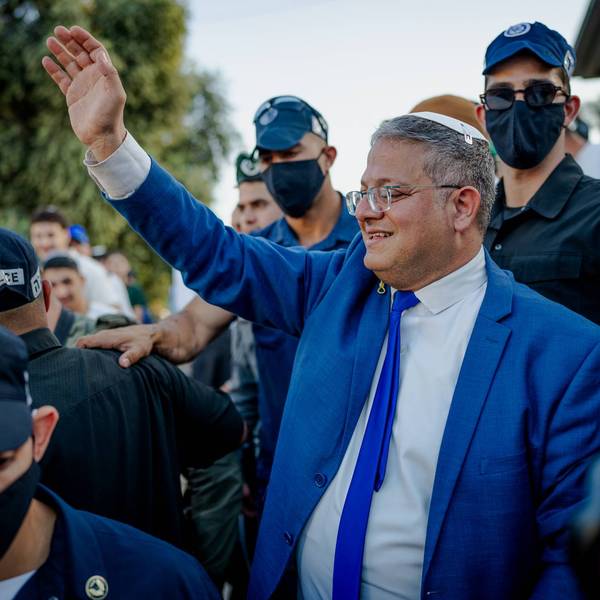
His remarks came in a statement responding to the approval on Sunday of a draft bill by Israel’s Ministerial Committee for Legislation. The bill was submitted by the far-right Otzma Yehudit party, led by National Security Minister Itamar Ben-Gvir.
Al-Habbash said Israeli attempts to restrict the call to prayer in Jerusalem and among Palestinian communities inside Israel were “a direct assault on Muslims, the Islamic faith and freedom of worship”, adding that they rise to the level of a declaration of religious war against Islamic holy sites and practices.
Under the proposed legislation, no sound system may be installed or operated in a mosque without a licence. Approval of a licence would be based on the level of “noise” and the mosque’s proximity to residential areas.
According to a statement issued by Otzma Yehudit on Sunday, Israeli police officers would be authorised to order the immediate suspension of the call to prayer if the rules are violated. Continued violations could result in the confiscation of loudspeakers and the imposition of financial penalties.
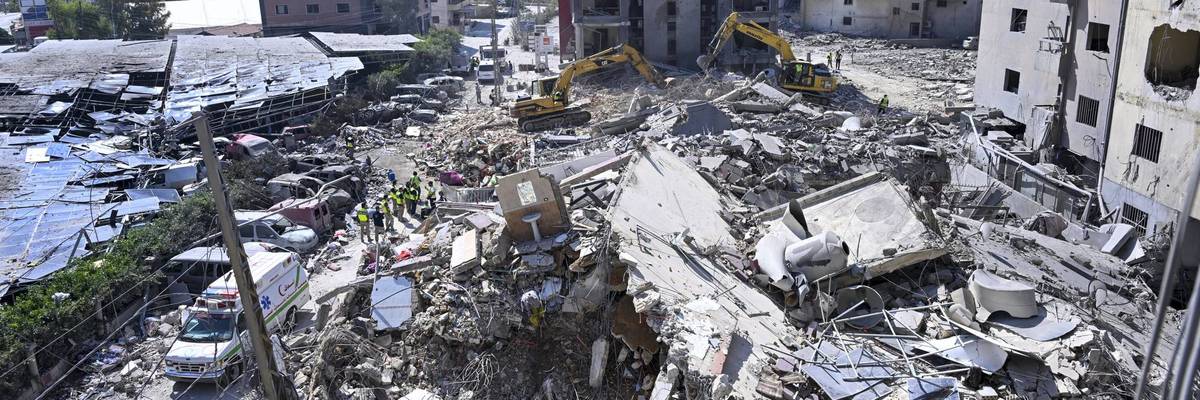
An aerial view of buildings and a parking area opposite the Jabal Amel Hospital, the largest hospital in the city of Tyre, Lebanon, on June 2, 2026, shows damage from an Israeli strike. (Photo by Houssam Shbaro/Anadolu via Getty Images)
“The more Netanyahu prevents the war with Iran from ending, the more obvious it becomes that he convinced Trump to start it.”
The death toll from Israel’s assault on Lebanon continued to rise on Tuesday despite President Donald Trump’s claims of de-escalation following Monday phone calls with Israeli Prime Minister Benjamin Netanyahu and an intermediary for Hezbollah.
The Lebanese Ministry of Public Healthsaid Tuesday that “the cumulative toll of the aggression from March 2 to June 2 has reached 3,468 dead and 10,577 injured,” even amid a ceasefire agreed to in April. The deal stemmed from Trump and Netanyahu’s illegal war on Iran, and Israel initially claimed it did not include Lebanon.
After Iran on Monday reportedly halted talks with the US over Israel’s attacks on Lebanon, Trump said on his Truth Social platform that due to his phone calls, Israeli troops “have already been turned back” from Beirut, and Hezbollah “agreed that all shooting will stop—That Israel will not attack them, and they will not attack Israel.”
However, Netanyahu said later Monday that “I spoke this evening with President Trump and told him that if Hezbollah does not stop attacking our cities and civilians, Israel will strike terrorist targets in Beirut. This position remains unchanged.”
According to Axios reporting contested by a senior Israeli official, one US source summarized Trump’s remarks to Netanyahu as follows: “You’re fucking crazy. You’d be in prison if it weren’t for me. I’m saving your ass. Everybody hates you now. Everybody hates Israel because of this.”
Another source said that Trump was “pissed” and at one point yelled at the prime minister, “What the fuck are you doing?”
While “the story has understandably been met with considerable skepticism,” wrote Trita Parsi, executive vice president of the Quincy Institute for Responsible Statecraft, there are “a few important counterexamples—particularly from Trump’s second term—that suggest the Axios story is not entirely implausible.”
“What is also plausible, however, is that Trump will once again fail to sustain the pressure and, by that, allow for Netanyahu’s potential retreat to prove temporary,” Parsi predicted.
Netanyahu’s stenographer says the @axios report that Trump scolded/swore at Netanyahu is bullshit. No idea which is accurate, but both Biden and now Trump often claim to be hard on Netanyahu in private while in practice giving him everything he wants and more. https://t.co/E904beSVhz
Republican Congressman Thomas Massie (Ky.), a libertarian who recently lost his reelection primary to a Trump-backed challenger, responded to the reporting on social media: “It’s all talk. Just withhold foreign aid to Israel for a month, and they’ll stop bombing their neighbors—instant peace, the Strait of Hormuz can be opened, and gas drops $2 a gallon. Israel has been, and continues to be, the biggest welfare recipient from American taxpayers.”
Massie also said that “the more Netanyahu prevents the war with Iran from ending, the more obvious it becomes that he convinced Trump to start it.”
Progressive Democratic Congresswoman Ilhan Omar (Minn.) similarly said late Monday: “The lesson Israel has learned, time and again, is that it can commit genocide and other atrocities with near-total impunity. Now it’s exporting the Gaza playbook to Lebanon. Israel’s war in Lebanon is killing thousands and displacing over a million. NO MORE US AID TO ISRAEL.”
Citing Lebanon’s National News Agency (NNA) on Tuesday, Al Jazeera cataloged Israel’s killings since Trump’s de-escalation claims:
Two Syrians were killed in an Israeli attack on a plant nursery where they were working in the town of Jebchit in the Nabatieh governorate, NNA said on Tuesday.
Israeli drone strikes hit a motorcycle on Martyr Sabra Street in Toul and a car in the Dhi’at al-Arab neighborhood of Ansar, killing two people, NNA said.
The third strike hit a car near the village of Harouf, killing one person.
Separately, an Israeli drone strike hit a car on the road linking the southern town of Marjayoun with the city of Nabatieh, killing James Karam, a dentist from the nearby Christian municipality of Qlayaa, along with his daughter and son, NNA reported.
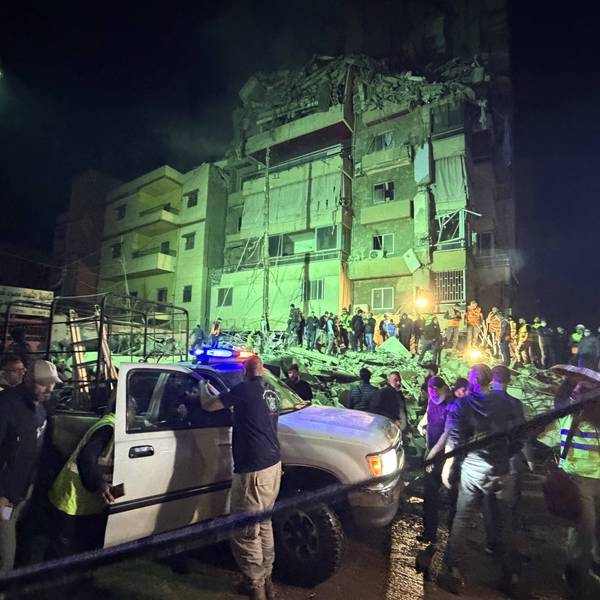
Those deaths followed Israel’s Monday airstrike in the southern village of Marwaniyeh, which killed six members of the Hassan Abdullah family, according to the Lebanese Civil Defense. Palestine Chronicle reported that “rescue teams worked throughout the night and into Tuesday morning to recover victims trapped beneath the rubble of the destroyed building. Three additional people were pulled from the debris during the operation.”
After Trump announced a fresh ceasefire in Lebanon, Israel carried out a massacre last night against the Hassan Abdullah family from the town of Marwaniyeh by targeting their home, killing the entire family.
Also on Monday, Israel attacked the Jabal Amel Hospital in Tyre, killing at least four people and injuring dozens more.
Dr. Abdinasir Abubakar, the World Health Organization (WHO) representative in Lebanon, said Tuesday that the hospital is one of the few operating in the country’s south, and the attack “caused significant damage… to the emergency department and intensive care unit.”
“Six hospitals have not yet resumed maternity delivery services and are currently providing only emergency room care,” he noted. “For pregnant women and newborns, delays in care can mean the difference between life and death.”
WHO has verified nearly 200 attacks on healthcare facilities and workers in Lebanon over the past three months. Calling for such attacks “to stop” and “active protection for healthcare,” Abubakar stressed that “these attacks kill and maim, they also deprive people of the health services they need.”
Israeli airstrikes hit near Jabel Amel hospital in Tyre, southern Lebanon causing extensive damage to the hospital, which was still crowded with people, including women and children.
The strikes are part of Israel’s escalating military offensive in Lebanon, which has also… pic.twitter.com/pUBtWoUPVv
Israel hit Jabal Amel Hospital after a strike near Hiram Hospital the previous day, according to Doctors Without Borders, which supports both facilities. Omar Ebeid, the organization’s project coordinator in southern Lebanon, said Tuesday that “these repeated attacks reflect a grave failure to protect the medical mission and underscore the urgent need to safeguard civilians, medical staff, health facilities, and continuous access to lifesaving care.”
Faced with a rising death toll and Israeli forces’ destruction of civilian infrastructure, The Associated Press reported, “another round of talks between Israel and Lebanon began Tuesday in Washington, where Lebanese negotiators are set to seek a full ceasefire that will prevent future attacks.”
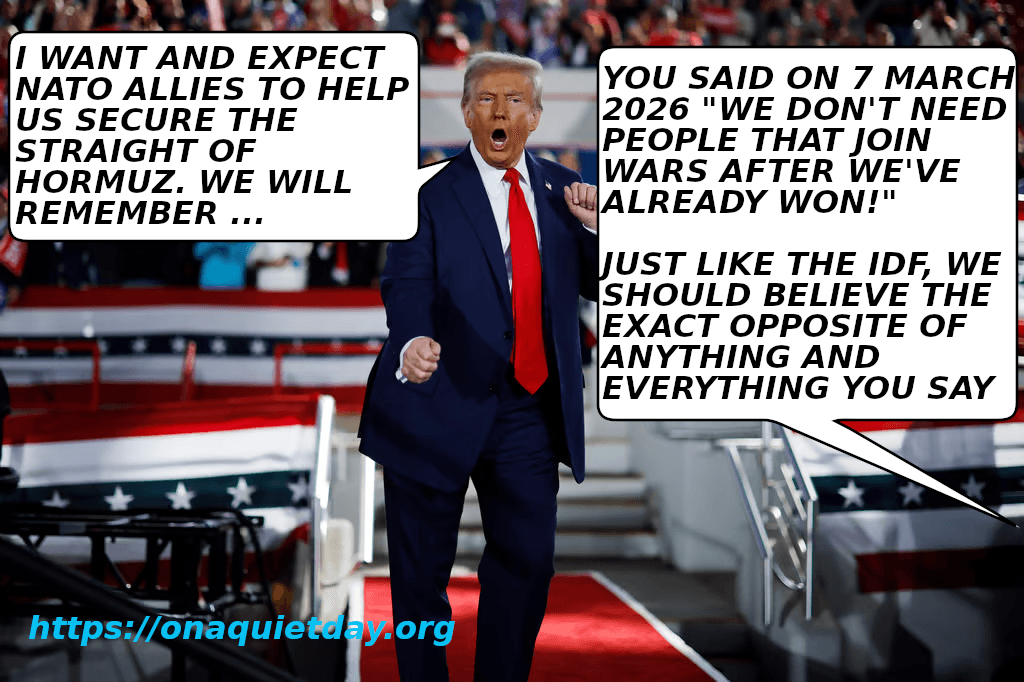
Donald Trump calls for help from NATO allies in securing the Strait of Hormuz despite saying on 7 March 2026 that they don’t need people to join wars after they’ve already won. He’s challenged with the claim that he lies as much as the IDF.Keir Starmer explains that UK is actively supporting Israel’s genocidal expansion and repeats his previous quotation that he supports Zionism “without qualification”. Keir Starmer said “I said it loud and clear – and meant it – that I support Zionism without qualification.” here: https://www.jewishnews.co.uk/keir-starmer-interview-i-will-work-to-eradicate-antisemitism-from-day-one/
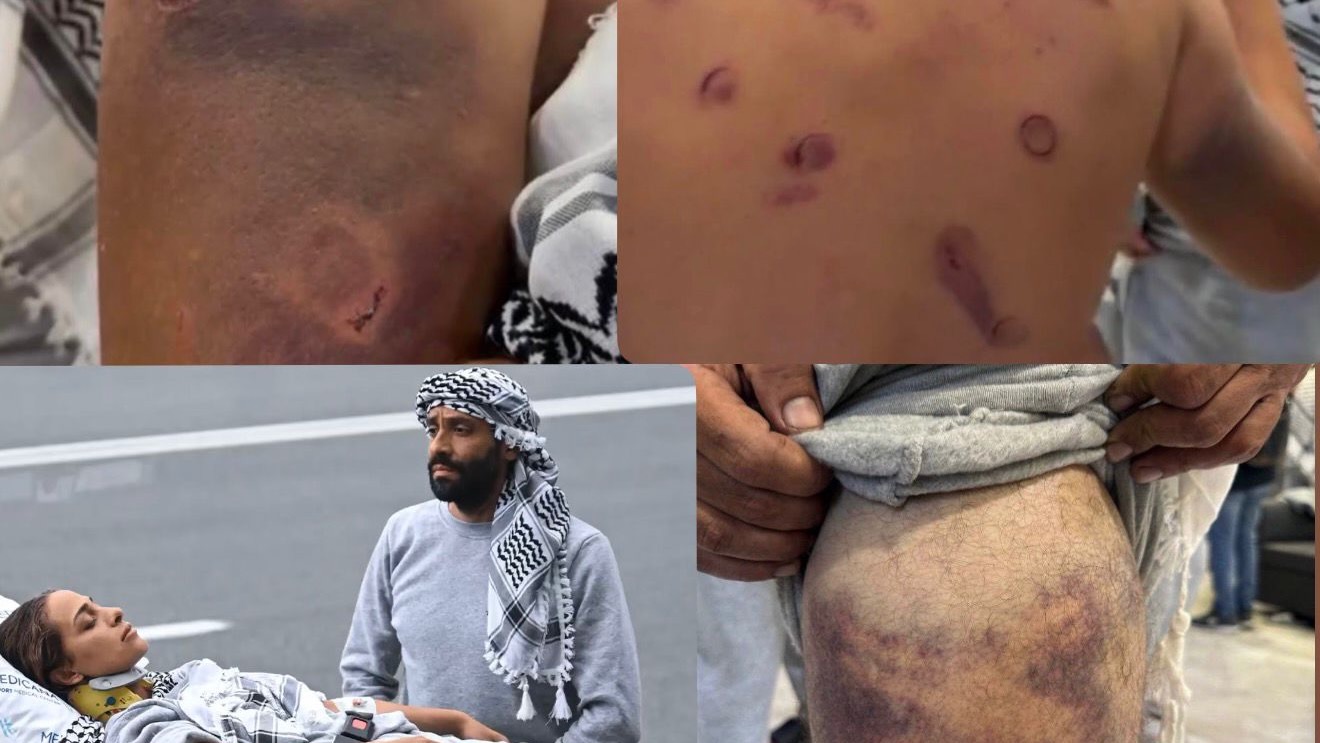
Gaza Global Sumud Flotilla activists arrived in Turkey in horrific condition after severe beatings in Israeli custody. Photo: State of Palestine
The global outrage over Gaza, the continued symbolic power of Palestinian prisoners, and the persistence of international solidarity movements all indicate that the Palestinian struggle remains profoundly alive.
The treatment of the flotilla activists by Israel’s National Security Minister Itamar Ben-Gvir was shocking only to those who continue to clothe colonial violence in the soft language of security. There is now a mountain of evidence before humanity: Gaza has become not merely a place under siege but a geography of calculated despair, where starvation and bombardment have been converted into instruments of political management. The activists aboard the flotilla were not armed combatants, nor were they soldiers threatening invasion. They were international volunteers, human rights advocates, doctors, parliamentarians, and organizers attempting to break the siege imposed on Gaza. Their journey was political, moral, and humanitarian. Yet the Israeli state met them with humiliation, detention, and theatrical violence.
Ben-Gvir understood precisely the symbolic function of his actions. The politics of the Israeli far right is not merely about security; it is about pedagogy. The violence must be seen and the humiliation must circulate publicly. Domination must constantly reproduce itself through spectacle. The public degradation of Palestinians and their allies is central to the ideological machinery of the Israeli far right. Every arrest becomes a lesson in obedience, every beating becomes a message, every detention becomes a declaration that resistance, even symbolic resistance, will be met with overwhelming force.
The flotilla activists entered a geography already transformed by blockade and devastation. Gaza today is not merely occupied territory; it is a laboratory of punishment. For years, Israel has controlled the movement of food, medicine, fuel, electricity, and people into the strip. The blockade has produced not security but social suffocation. International organizations have repeatedly warned about catastrophic humanitarian conditions. Yet the siege continues because it serves a political purpose: to fragment Palestinian life and break collective morale.
When activists attempted to challenge this order through the flotilla, Ben-Gvir and his allies responded as colonial powers often do when confronted by moral witness. The activists were presented not as human beings motivated by conscience but as enemies of the state. Their detention was accompanied by taunts and intimidation. The aim was not merely to stop the flotilla but to discourage future acts of solidarity. This pattern is older than the present crisis. Colonial systems survive not only through military superiority but through rituals of domination. The British Empire practiced it in India and Kenya, French colonial authorities employed it in Algeria, and South African apartheid institutionalized it with bureaucratic precision. Humiliation becomes part of governance.
Ben-Gvir’s rhetoric reveals the depth of this political culture. He speaks of Palestinians not as a people with rights but as a demographic threat to be controlled and contained. In this worldview, solidarity itself becomes criminal. Humanitarianism is recast as terrorism. International law becomes an inconvenience. The flotilla activists were therefore dangerous not because they carried weapons but because they carried testimony. They threatened to expose the architecture of siege before a global audience. Their mere presence undermined the carefully manufactured narrative that Gaza’s suffering is unavoidable collateral damage rather than a political choice. What Ben-Gvir fears most is not armed resistance alone. He fears political imagination and the possibility that ordinary people across the world may see Palestinians not through the language of security briefings but through the language of shared humanity. And so, the brutality directed at the flotilla activists was not an aberration. It was entirely consistent with the ideological world that Ben-Gvir inhabits: a world in which domination must constantly reproduce itself through force, humiliation, and fear.
The politics of erasure
Long before the flotilla activists were detained and brutalized, Ben-Gvir directed his fury toward one of the most important Palestinian political prisoners of the modern era: Marwan Barghouti (born 1959).
Marwan Barghouti occupies a singular place in Palestinian political life, not because he is untouched by political contradiction but because he embodies the continuity of a national struggle that many powerful actors wish to erase. To many Palestinians, he represents a figure capable of unifying fragmented political tendencies. Emerging from the ranks of Fatah during the First Intifada, Barghouti became associated with grassroots political mobilization and the demand for national liberation. Even among those who disagree with aspects of his political strategy, there is widespread recognition of his symbolic importance. Israel understands this symbolism well. That is why Barghouti’s imprisonment since 2002 has never been merely judicial. It is deeply political.
Ben-Gvir’s hostility toward Barghouti reflects a broader Israeli strategy: the systematic destruction of Palestinian political leadership. Colonial systems frequently attempt to criminalize leadership because organized political consciousness poses a threat greater than spontaneous unrest. A people without leadership can be fragmented. A people without political memory can be managed.
Barghouti’s imprisonment became a site through which the Israeli far right could perform its politics of vengeance. Ben-Gvir repeatedly advocated harsher prison conditions for Palestinian detainees. Under his political influence, there were intensified crackdowns on prisoners’ rights, restrictions on family visits, and punitive measures designed not simply to incarcerate but to degrade. Reports from Palestinian prisoners and human rights organizations have described conditions marked by isolation, overcrowding, physical abuse, and psychological pressure. Prison raids became spectacles of domination. Books were confiscated. Collective punishment intensified. The prison, in this system, is not only a place of detention; it is an instrument of colonial management.
Barghouti’s case reveals something essential about Ben-Gvir’s worldview. He does not merely oppose Palestinian armed groups, but he opposes Palestinian political existence itself. This is why figures like Barghouti are so threatening. Barghouti speaks the language of national liberation. He invokes anti-colonial traditions familiar across Asia, Africa, and Latin America. His political symbolism connects Palestine to a wider history of struggle against occupation and racial domination. For Ben-Gvir, such figures must be broken psychologically. Their dignity must be shattered publicly. Their image must be transformed from political leader into criminal inmate.
Yet history offers many examples of imprisoned leaders becoming more powerful symbols through incarceration. Nelson Mandela spent twenty-seven years in prison under apartheid South Africa. States imprison those they fear politically. Barghouti’s endurance has therefore become deeply symbolic. His imprisonment is not simply about one man. It represents the broader Palestinian condition under occupation: confinement, fragmentation, and the attempt to erase political agency.
In 2025, Ben-Gvir posted a 13-second video clip of him taunting a very gaunt Barghouti in a prison and said, “You won’t win. Whoever messes with the nation of Israel… we will wipe them out”. A dignified Barghouti tried to interject several times to hold his own. The clip showed the desperation of Ben-Gvir, trying to overcome the man who had helped draft the Prisoner’s Document in 2006 that called for the revitalization of Palestinian politics, and which continues to circulate today. The prison cell can become a school of resistance. The attempt to erase memory can instead strengthen it. Barghouti remains, despite years of imprisonment, a reminder that Palestinian political identity has survived every attempt at fragmentation.
The long history of Israeli fascistic politics
To understand Ben-Gvir, one must move beyond the comforting fiction that he is an aberration. He is not an interruption in Israeli political history, but is one of its logical outcomes. Ben-Gvir did not emerge from nowhere. He is the product of decades of radicalization within sections of Israeli society shaped by settler colonialism, militarization, and ethno-nationalist ideology.
As a young man, Ben-Gvir was associated with the banned Kach movement founded by Rabbi Meir Kahane. Kahanism openly advocated Jewish supremacy and the expulsion of Palestinians from historic Palestine. Even the Israeli state once regarded Kach as too extreme, banning it as a terrorist organisation. But ideas once considered fringe have steadily migrated into the political mainstream. Ben-Gvir built his career through provocation. He became known for inflammatory rhetoric, public incitement, and confrontational appearances in Palestinian neighborhoods. For years he cultivated the image of a militant street activist who viewed compromise as weakness.
One infamous episode occurred in 1995 when Ben-Gvir appeared on Israeli television holding the emblem from Prime Minister Yitzhak Rabin’s car. “We got to his car”, he declared, “and we’ll get to him too”. Weeks later Rabin was assassinated by a far-right Israeli extremist opposed to the Oslo Accords.
This history matters because it reveals the political atmosphere from which Ben-Gvir emerged: a culture in which hatred against Palestinians, and often against peace advocates themselves, became normalized. Over time, Israeli politics shifted steadily rightward. Settlement expansion accelerated. Military occupation hardened. The peace process collapsed into ritualized diplomacy disconnected from realities on the ground. Within this environment, figures like Ben-Gvir gained legitimacy. His rise also reflects deeper structural realities. Colonial systems frequently generate extremist political formations because domination requires ideological justification. Violence must be moralized and inequality must be rationalized. Ben-Gvir provides precisely this ideological function. He transforms structural violence into nationalist virtue. His political language relies heavily on fear. Palestinians are depicted not as a colonized population but as existential enemies. Human rights organizations are portrayed as traitorous. International criticism becomes evidence of conspiracy.
This is not unique to Israel. Similar political patterns can be observed globally. From Narendra Modi’s Hindutva nationalism in India to the authoritarian ethnonationalism visible in parts of Europe and the Americas, contemporary far-right movements rely on a politics of permanent fear. Minorities become scapegoats, and dissent becomes treason.
What makes Ben-Gvir especially dangerous is not merely his rhetoric but his access to state power. As National Security Minister, he has influence over policing, prison administration, and internal repression. The extremist street politics of previous decades have now entered the machinery of governance.
This transformation carries grave consequences. The treatment of the flotilla activists and of prisoners like Marwan Barghouti are not isolated incidents. They are symptoms of a broader political trajectory in which cruelty itself becomes policy. Yet history also reminds us that systems built upon permanent domination eventually confront crises of legitimacy. Colonial regimes often appear invincible until suddenly they do not. French Algeria seemed permanent. South African apartheid appeared deeply entrenched. Portuguese colonialism in Africa looked immovable. Repression contains contradictions, violence generates resistance, and humiliation produces solidarity.
The global outrage over Gaza, the continued symbolic power of Palestinian prisoners, and the persistence of international solidarity movements all indicate that the Palestinian struggle remains profoundly alive. Ben-Gvir represents the hardening edge of a political project attempting to preserve domination through fear. But fear alone cannot produce justice, legitimacy, or peace. And that is ultimately the tragedy of the present moment: a political class incapable of imagining coexistence except through the language of force. The flotilla activists understood this, and so does Marwan Barghouti. Millions across the world understand it as well. The question now is whether the international system will continue to normalize such brutality, or whether global public opinion will finally recognize that what is unfolding is not merely a conflict between two equal sides, but a struggle over the basic meaning of freedom, dignity, and humanity itself.
Vijay Prashad is an Indian historian and journalist. He is the author of forty books, including Washington Bullets, Red Star Over the Third World, The Darker Nations: A People’s History of the Third World, The Poorer Nations: A Possible History of the Global South, and How the International Monetary Fund Suffocates Africa, written with Grieve Chelwa. He is the executive director of Tricontinental: Institute for Social Research, the chief correspondent for Globetrotter, and the chief editor of LeftWord Books (New Delhi). He also appeared in the films Shadow World (2016) and Two Meetings (2017).
Keir Starmer explains that UK is actively supporting Israel’s genocidal expansion and repeats his previous quotation that he supports Zionism “without qualification”. Keir Starmer said “I said it loud and clear – and meant it – that I support Zionism without qualification.” here: https://www.jewishnews.co.uk/keir-starmer-interview-i-will-work-to-eradicate-antisemitism-from-day-one/Keir Starmer objects to criticism of the IDF. He asks how could anyone object to them starving people to death, forced marches like the Nazis did, bombing Gaza’s hospitals and universities, mass-murdering journalists, healthworkers and starving people queuing for food, killing and raping prisoners and murdering children. He calls for people to stop obstructing his genocide for Israel.
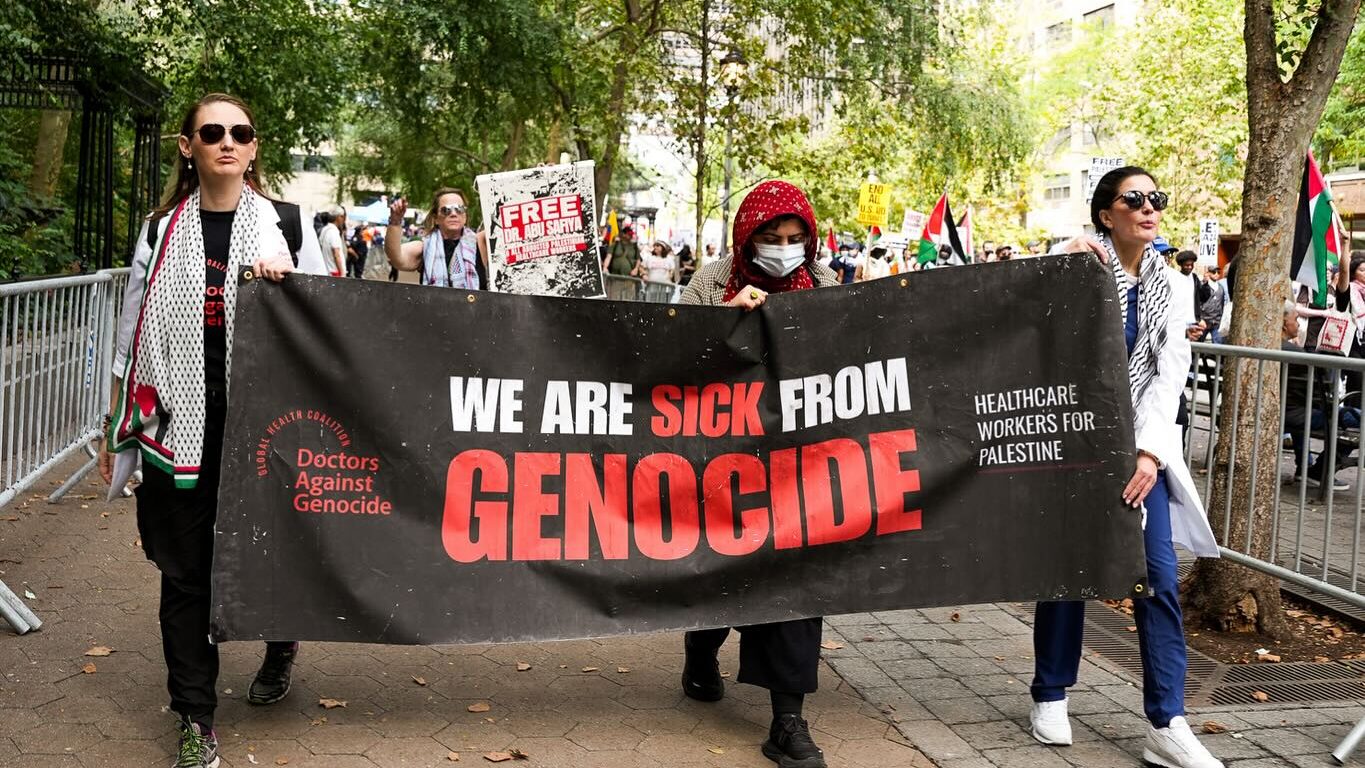
Health students from Gaza describe how transforming awareness into action has to remain a key part of solidarity movements worldwide.
As healthcare infrastructure and health workers were actively targeted throughout the genocide in Palestine, a group of Gaza students participated in an international virtual cross-cultural exchange. What began as an academic space quickly became something else. Health conversations could not remain theoretical – they were shaped by lived realities where access to care, electricity, clean water, and safety were not abstract determinants, but daily uncertainties.
In Gaza, two million people are trapped in a deepening hole of bombardment, darkness, and scarcity. Hospitals operate without electricity; medicines are blocked or nearly impossible to find. Access to clean water is a privilege. Children search for moments of joy among the rubble, while students try to learn wherever they can, often in whatever corners they can find. Families share what little they have, holding on to hope as much as survival, while the sound of drones and explosions defines daily life.
Our exchange brought together students from Gaza with those across different countries. Discussions around health moved beyond theory, reflecting realities where social determinants of health are not abstract concepts, but immediate conditions shaping survival. It became more and more apparent that true awareness should not simply mean knowing that war exists, but also questioning how oppression dismantles health, dignity, and any sense of normal life – and even the smallest act of living becomes resistance.
Even after building this kind of awareness, the question remained: what will people do with the information they receive?
The architecture of control
Key questions focused on international organizations: why did institutions built to protect people disappear when needed most?
In Gaza, aid trucks sat idle as hunger grew louder than bombs. On May 2, 2025, the International Committee of the Red Cross warned that after months of aid blockade, Gaza’s humanitarian system was collapsing. But the crisis did not begin there. According to the UN Office for the Coordination of Humanitarian Affairs, around 80% of Gaza’s population depended on humanitarian assistance even before May 2023. This is not chaos; it is structure. The blockade, inspections, and delays are not accidental. They are designed to control and exhaust.
Many watched from a distance, convinced the situation was too far, too complex, or too political to engage with. It became easier to assume someone else would speak up. But one thing became clear: silence is not neutral, it becomes part of the system that allows this to continue.
The birth of solidarity
As genocide continued in Gaza, discussions repeatedly returned to another central question: what does meaningful solidarity actually look like, beyond awareness?
Through our conversations, it became clear that awareness alone – no matter how empathetic – does not interrupt systems of harm; what matters is whether awareness translates into action that challenges those systems. The examples we discussed were part of a broader pattern of refusal.
Source: PHM student group
Ships crossed the Mediterranean carrying food, medicine, and determination. The Global Sumud Flotilla, made up of activists from more than forty countries, sailed toward Gaza knowing the risks. Israeli forces had intercepted missions before. Drones followed them, and one ship was struck while docked in Tunisia. Still, they sailed. They knew they might never reach the shore, but they also knew the world was watching. The boats did not dock, but the message did.
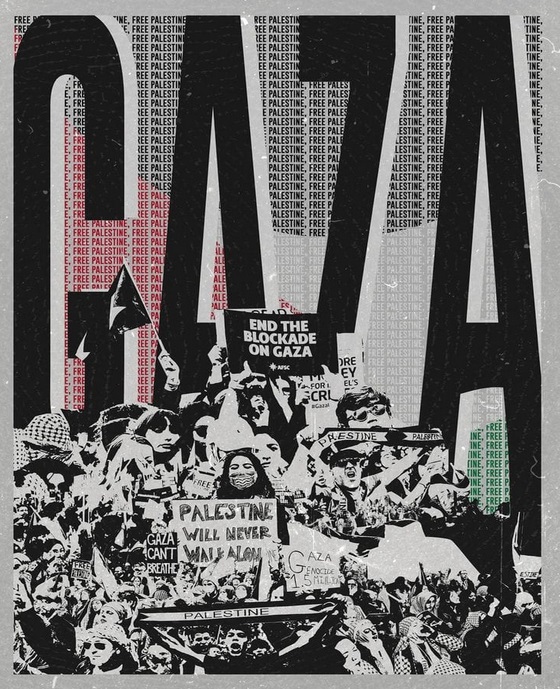
On land, resistance spread across continents. Students from Columbia to Cambridge, Cairo to Amsterdam, built encampments, marched, and blocked streets, demanding accountability and divestment. At UCLA, tents stood for weeks despite arrests. Donations of food, money, and time poured in. Boycotts emptied stores – not through slogans, but through conscience. Offices of arms manufacturers were blockaded. Pension funds were questioned. Complicity became visible.
Refusal as a practice
As the exchange continued, discussions began to highlight refusal as more than a reaction: it emerged as a form of active solidarity. This became clear in the actions we examined. Medical teams crossed borders through chaos. Doctors Without Borders and the Red Crescent worked in overcrowded hospitals under fire, performing surgeries with limited resources. Artists, writers, and musicians turned their platforms into protest, canceling shows, rejecting sponsorships, and donating their work. While these actions took different forms – ships, tents, scalpels, brushes – they carried the same spirit: a refusal to accept silence as safety and let distance turn into detachment.
This understanding was shared across different voices, from within Gaza and beyond. Again and again, the same realization surfaced: without action, awareness risks becoming another form of passive witnessing.
The imperative of action in the face of a false ceasefire
The ceasefire has not ended suffering in Gaza. While bombings may have slowed, destruction remains. Hospitals are still overwhelmed. Families continue searching for the missing. Basic needs go unmet. A ceasefire, in this context, is not peace – it is a pause without justice.
The ceasefire was not an end, but a test of what follows. If awareness reaches its peak during a crisis, what happens when the noise fades? Action did not disappear with the headlines. It shifted. Journalists who documented life under bombardment ensured that those affected were not reduced to numbers. Medical teams and humanitarian organizations continued working long after global attention began to drift.
Collective responses began to take different shapes. Petitions gathered support across borders, reflecting how individual concern can scale into global pressure. Students and academics questioned institutional ties and demanded accountability. Grassroots movements organized through boycotts and divestment, turning awareness into sustained pressure rather than a passing reaction.
These efforts point to a larger pattern: action is not a single moment, but a continuation. The ceasefire may have quieted the bombs, but it has not ended responsibility. If anything, it has made that responsibility harder to ignore. The question is no longer whether the world is aware. It is what will be done with that awareness – and how long it can remain just awareness.
This article was written by Alaa Abu-Esaid, Rima Altelbany, Abed Al Hakeem Shamali, Jasmina Atroshy, Mohammed Ismail, Hesham Al Amassi, and Seraj Al Amassi.
People’s Health Dispatch is a fortnightly bulletin published by thePeople’s Health Movement and Peoples Dispatch. For more articles and to subscribe to People’s Health Dispatch, clickhere.
This work by Middle East Monitor is licensed under a Creative Commons Attribution-NonCommercial-ShareAlike 4.0 International License.
A general view of the U.S. Capitol building as Democrats and their allies gather for “The People’s State of the Union” rally at the National Mall in Washington, D.C. United States, as U.S. President Donald Trump delivers his State of the Union address inside Congress on February 24, 2026. [Celal Güneş – Anadolu Agency]
The US Congress is quietly advancing a measure that would entrench Israel inside the American military-industrial complex, raising concerns that Washington is moving to lock itself into Tel Aviv’s future wars at a time when Israel is becoming a global pariah.
The House version of the 2027 National Defence Authorization Act (NDAA) includes a provision titled the “United States-Israel Defense Technology Cooperation Initiative”. Known as Section 224, it would require the US secretary of defence to designate an official responsible for coordinating defence technology cooperation between the US and Israel. The provision covers bilateral research, development, testing, evaluation, integration and industrial cooperation.
Responsible Statecraft reported that the clause would go far beyond the existing US-Israel military aid relationship. It would lay the groundwork for joint weapons development, co-production, licensing agreements, military-industrial joint ventures and deep cooperation in artificial intelligence, quantum technology, autonomous systems, directed energy, cyber, biotechnology and other advanced warfare sectors.
The report also warned that references to “network integration” and “data fusion” could mean US military data becoming increasingly accessible to Israel’s military establishment.
It’s claimed that in effect, Section 224 would shift US support for Israel from visible military aid into the far more opaque machinery of Pentagon procurement, weapons contracts, classified technology programmes and private defence industry partnerships.
Support for Israel would no longer be an annual aid package that can be debated, conditioned or cut. It would be dispersed across supply chains, research programmes, data systems, production lines and jobs in congressional districts.
The timing is seen as extremely significant. Israel’s genocide in Gaza and its widening wars across the Middle East have shattered the mythology of Israeli military self-sufficiency. For decades, Israel has presented itself as a regional superpower able to defeat its enemies alone. Yet the reality since October 2023 has shown the opposite: Israel cannot sustain major wars without US weapons, intelligence, air defence, diplomatic cover and emergency resupply.
The limits of Israeli military power were laid bare in a Washington Post report last week citing Pentagon assessments of US support for Israel during hostilities with Iran. The report found that the US military expended far more advanced missile-defence interceptors defending Israel than Israeli forces used themselves. One US administration official quoted in the report stated: “Israel is not capable of fighting and winning wars on its own, but nobody actually knows this, because they never see the back end.”
Israel’s global isolation has also intensified. The International Court of Justice is hearing South Africa’s genocide case against Israel, while the International Criminal Court has issued arrest warrants for Prime Minister Benjamin Netanyahu and former Defence Minister Yoav Gallant over alleged war crimes and crimes against humanity in Gaza. In much of the world, Israel is no longer seen as a normal ally, but as a pariah state accused of carrying out mass killing, forced displacement and starvation in Gaza.
This work by Middle East Monitor is licensed under a Creative Commons Attribution-NonCommercial-ShareAlike 4.0 International License.