I’ve only quoted a small part of this article. The UK government is an active participant in Israel’s genocide through more than providing Israel with “… military material and intelligence …”
Metropolitan Police officers remove a person at a protest in Parliament Square, central London, in support of Palestine Action, organised by Defend Our Juries who are campaigning to de-proscribe the organisation, July 19, 2025
…
[T]he biggest war crimes of all have been, and continue to be, the killing of innocent Palestinians, by bombs, rockets, bullets and now the weapon of starvation. The Palestinian Forum in Britain has reported that, after 650 days, there are in Gaza 67,880 dead and missing, of whom over 19,000 are children, and 650,000 children starving.
…
Killing Palestinians indiscriminately, causing serious bodily or mental harm to others, and deliberately inflicting conditions of life designed to eliminate Palestinians in Gaza as a group — these are all actions which fall clearly within the UN Convention on the Prevention and Punishment of the Crime of Genocide.
It is outrageous that, 80 years after the end of the second world war, which saw the genocide of Jewish, Roma and Sinti people in Europe, and the terrible massacres of Chinese people in occupied Manchuria, our own government is not only doing nothing about the genocide in Gaza, but is actively complicit in it, by continuing to provide Israel with military material and intelligence.
That is why the demonstrations on Saturday by hundreds of thousands of people, in London, Edinburgh and elsewhere, are so important. Pressure must be maintained and stepped up on the government, and in fact, all MPs.
Genocide denier and Current UK Prime Minister Keir Starmer is quoted that he supports Zionism without qualification. He also confirms that UK air force support has been essential in Israel’s mass-murdering genocide. Includes URLs https://www.declassifieduk.org/keir-starmers-100-spy-flights-over-gaza-in-support-of-israel/ and https://youtu.be/O74hZCKKdpAUK Labour Party government ministers Keir Starmer, Angela Rayner and Rachel Reeves explain that they are partners complicit in Israel’s Gaza genocide. The UK has provided Israel with arms, military and air force support. They explain that they don’t do gas chambers but do do forced marches, starvation, destroy hospitals, mass-murders of journalists and healthcare workers.Keir Starmer objects to criticism of the IDF. He asks how could anyone obect to them starving people to death, forced marches like the Nazis did, bombing Gaza’s hospitals and universities,mass-murdering journalists, healthworkers and starving people queuing for food, killing and raping prisoners and murdering children. He calls for people to stop obstructing his genocide for Israel.
Pro Palestine Action and counter-protesters during a protest in Parliament Square, central London, organised by Defend Our Juries who are campaigning to de-proscribe the organisation, July 19, 2025
Police arrest over 100 at protests supporting Palestine Action
CAMPAIGNERS urged police to redirect resources toward investigating Prime Minister Sir Keir Starmer for genocide offences, after more than 100 people were arrested for holding signs supporting Palestine Action on Saturday.
Demonstrators held placards reading: “I oppose genocide, I support Palestine Action” in London, Manchester, Edinburgh, Bristol and Truro at protests co-ordinated by Defend Our Juries.
In London, the Metropolitan Police arrested 55 people in Parliament Square.
The arrests were made under Section 13 of the Terrorism Act 2000, which prohibits wearing or displayingitems that could suggest support for a proscribed group.
One woman detained by police said: “Our government is not only arming a genocide, they are using terrorism laws to silence people who speak out.
“Palestine Action are campaigning for peace. They are dismantling weapons factories.”
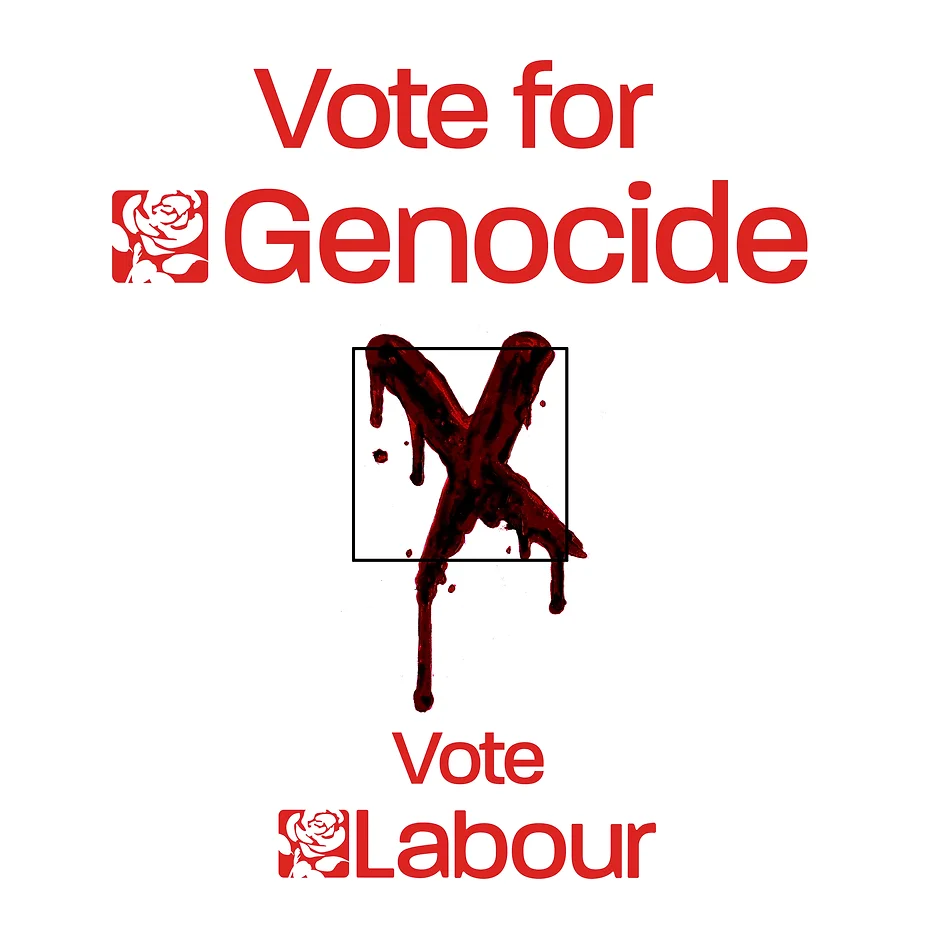
Vote Labour for Genocide.Keir Starmer objects to criticism of the IDF. He asks how could anyone obect to them starving people to death, forced marches like the Nazis did, bombing Gaza’s hospitals and universities,mass-murdering journalists, healthworkers and starving people queuing for food, killing and raping prisoners and murdering children. He calls for people to stop obstructing his genocide for Israel.UK Labour Party government ministers Keir Starmer, Angela Rayner and Rachel Reeves explain that they are partners complicit in Israel’s Gaza genocide. The UK has provided Israel with arms, military and air force support. They explain that they don’t do gas chambers but do do forced marches, starvation, destroy hospitals, mass-murders of journalists and healthcare workers.
This work by Middle East Monitor is licensed under a Creative Commons Attribution-NonCommercial-ShareAlike 4.0 International License.
Four-year-old Palestinian girl Razan Abu Zahir lost her life due to severe malnutrition and lack of baby food, on July 20, 2025 in Deir al Balah, Gaza. [Ashraf Amra – Anadolu Agency]
The UN agency for Palestinian refugees (UNRWA) on Sunday once again accused Israeli authorities of using starvation as a weapon of war against the civilian population of Gaza, Anadolu reports.
In a statement on X, UNRWA said: “The Israeli Authorities are starving civilians in Gaza. Among them are 1 million children.”
It renewed its urgent call for the lifting of Israel’s ongoing siege, saying: “Lift the siege: allow UNRWA to bring in food and medicines.”
Despite international legal obligations to protect civilians and allow the delivery of aid, Israel has maintained a total siege on Gaza since March 2, bombing convoys, blocking border crossings, and targeting aid distribution points, actions that have been widely condemned as collective punishment and potential war crimes.
According to Gaza’s Health Ministry, dozens of children have already died from starvation and dehydration, while hundreds of thousands more are at risk due to widespread food insecurity and the collapse of healthcare services.
The Health Ministry said on Sunday that 86 Palestinians, including 76 children, have died due to hunger and malnutrition since the start of the Israeli war, calling the situation “a silent massacre.”
The ministry reported 18 deaths from hunger in the last 24 hours alone, holding both Israel and the international community responsible for the growing humanitarian disaster in the enclave.
It called for the immediate opening of border crossings to allow the entry of food and medicine into the besieged territory.
On Saturday alone, Israeli strikes killed at least 136 Palestinians, including 38 people waiting for aid and three children who died from severe malnutrition, Palestinian official sources reported.
Israel has killed nearly 59,000 Palestinians, most of them women and children, in Gaza since October 2023. The relentless bombing has destroyed the enclave, almost collapsed the health system, and created famine-like conditions.
Last November, the International Criminal Court issued arrest warrants for Israeli Prime Minister Benjamin Netanyahu and his former Defense Minister Yoav Gallant for war crimes and crimes against humanity in Gaza.
Israel also faces a genocide case at the International Court of Justice for its war on the enclave.
This work by Middle East Monitor is licensed under a Creative Commons Attribution-NonCommercial-ShareAlike 4.0 International License.
A large crowd gather during a food distribution by a charity organization, as many Palestinians struggle to access food due to Israel’s ongoing attacks on the Gaza Strip, on July 18, 2025. [Abdalhkem Abu Riash – Anadolu Agency]
In Gaza, mornings no longer begin with the sound of explosions — but with the quiet, urgent cries of hunger.
Mothers wake to infants with no milk. Children search for scraps to ease empty stomachs before the bombs return to flatten what little hope remains.
This isn’t exaggeration. It’s a grim, documented reality. Gaza is not only under bombardment — it’s under siege. And the weapon now cutting deepest is starvation. Because hunger is silent, the world looks away, as if a slow death does not count.
For months, Gazans have faced a dual siege: daily airstrikes and international indifference. Border crossings remain closed. Those searching for food are shot. Humanitarian supply lines are systematically broken. Bread has become a fantasy. Water is a daily fight. Medicine, a rare miracle.
“Humanitarian catastrophe” no longer captures it. What’s unfolding now is a deliberate campaign of starvation — one that meets every definition, legal and moral, of genocide.
Footage smuggled out of Gaza shows children collapsing while queuing for bread, families surviving on weeds, mothers dividing a single loaf between four hungry children. It’s not the bombs killing them — it’s the slow wasting of malnourished bodies.
The people of Gaza are not asking for the impossible. They are asking for a shred of global conscience.
But what hurts even more than the hunger is the silence.
In the early days of the assault, Western leaders issued cautious statements: calls for restraint, reminders of international law, expressions of concern. But those voices have since faded. Forgotten. Buried in old press releases. No action followed. No policies changed.
Instead, support for Israel intensified. Some governments even suspended funding to the UN’s main relief agency, UNRWA — in the middle of Gaza’s collapse.
Have you ever heard of a government withdrawing aid from a humanitarian agency while children are starving?
It happened. And it happened quietly.
As Nelson Mandela once said:
“To deny people their human rights is to challenge their very humanity.”
Today, Gaza is being punished not only with bombs, but with hunger — a form of collective punishment enabled by an international consensus too timid to speak out. You won’t find this consensus in official statements, but you’ll see it in every sealed border, every empty bowl, and every child who cries from thirst.
According to UN agencies:
Food insecurity has reached catastrophic levels.
Over 90 per cent of children in Gaza are malnourished.
Infant deaths from starvation and dehydration are now a daily reality.
Yet the world remains still.
Worse still, some governments continue to justify Israel’s actions under the banner of “self-defence” — as if using starvation as a weapon were somehow legitimate.
But it isn’t just the West that bears responsibility.
Egypt too must answer for its role. The Rafah crossing — Gaza’s only exit not controlled by Israel — has been shut for months. Cairo waits for Tel Aviv’s permission to let aid in or patients out. When will we stop pretending this is neutrality? This is complicity.
And what of the Arab governments who have normalised ties with Israel? Some have remained silent. Others have gone further, publicly strengthening relations while Gaza starves. At least the West doesn’t claim kinship. But these regimes do — while doing nothing to stop the suffering of fellow Palestinians.
As former UN Secretary-General Kofi Annan once warned:
“When food becomes a weapon, humanity itself has collapsed.”
Gaza is facing that collapse — and the international system is allowing it to happen.
Yet despite everything, Gaza endures. Its people turn hunger into defiance. They resist, even when stripped of everything. In Gaza, dignity isn’t found in comfort — it’s found in survival.
But let’s be honest: Israel cannot sustain this alone. It relies on silence. On selective outrage. On diplomatic cover. And that is exactly what it gets from world powers who claim to care about human rights — but choose which victims matter.
So who is really standing with Gaza?
Not governments. Not institutions. But ordinary people. Protesters. Citizens. The ones who still have a conscience and refuse to look away.
Gaza doesn’t want pity. It wants justice. It demands an end to the genocide — and accountability for those who enable it.
The question is no longer: What is happening?
We know.
The question is: Who will act?
And when history is written — who will be remembered for their silence?
Because silence, in the face of starvation, is not neutrality.
It is complicity.
The views expressed in this article belong to the author and do not necessarily reflect the editorial policy of Middle East Monitor.
This work by Middle East Monitor is licensed under a Creative Commons Attribution-NonCommercial-ShareAlike 4.0 International License.
Keir Starmer objects to criticism of the IDF. He asks how could anyone obect to them starving people to death, forced marches like the Nazis did, bombing Gaza’s hospitals and universities,mass-murdering journalists, healthworkers and starving people queuing for food, killing and raping prisoners and murdering children. He calls for people to stop obstructing his genocide for Israel.
This work by Middle East Monitor is licensed under a Creative Commons Attribution-NonCommercial-ShareAlike 4.0 International License.
Fourteen-month-old Nur El Sarsak, one of hundreds of children diagnosed with malnutrition, fights for her life in Deir al-Balah in central Gaza, where she lives with her family, on July 19, 2025. [Ashraf Amra – Anadolu Agency]
The UN agency for Palestinian refugees (UNRWA) on Saturday called for the immediate lifting of restrictions preventing life-saving aid from reaching Gaza, saying it has food stockpiled to support the territory’s entire population for more than three months, Anadolu reports.
“UNRWA has enough food for the entire population of Gaza for over three months stockpiled in warehouses–including this one in Al Arish, Egypt–awaiting entry,” the agency said on X.
Despite having both supplies and logistical systems in place, the agency said access remains blocked.
It concluded with a direct appeal: “Open the gates, lift the siege, allow UNRWA to do its work and help people in need among them 1 million children.”
Israel has killed nearly 59,000 Palestinians so far, most of them women and children. It imposed a full humanitarian blockade of Gaza on March 2, cutting off food, medical supplies and other aid to the more than 2 million Palestinians in the territory.
After growing international pressure, it began allowing a trickle of aid in late May. The UN agencies have been bypassed and the controversial Gaza Humanitarian Foundation is operating distribution sites, leading to hundreds of deaths since then.

 Metropolitan Police officers remove a person at a protest in Parliament Square, central London, in support of Palestine Action, organised by Defend Our Juries who are campaigning to de-proscribe the organisation, July 19, 2025