“We must ask who these decisions would be made for and why. Whose advice is the Government listening to, when record-high wealth inequality is causing harm to the economy and society in many different ways, while frequent flying is the preserve of the super-rich?
“The aviation lobby is loud and well-funded, but the Government should instead be listening to scientists and its own Climate Change Committee, which has already urged a halt to overall airport expansion. The previous Labour government’s poor record on airport expansion doesn’t have to continue.
“If Ed Miliband is serious in his role as Net-Zero Minister, he will work to prevent the Chancellor and Transport Secretaries making a huge mistake, and advise the Chancellor to not make any dangerous new decisions until they have heard and listened to the new advice from the Climate Change Committee which is due in February.”
Orcas comment on killer apes destroying the planet by continuing to burn fossil fuels.
The UK banking industry has warned that government plans to crackdown on benefit fraud could leave banks at risk of breaking consumer protection rules.
A new law unveiled on Wednesday would allow the Department for Work and Pensions (DWP) to reclaim money from accounts without a court order.
Ministers argue this will speed up the debt recovery process and help contribute to a wider crackdown on benefits fraud.
But UK Finance, the biggest business group representing British banks, has told the BBC the plans could undermine the banks’ own efforts to protect vulnerable account holders.
The government’s announcement on Wednesday is the culmination of years of work by officials in DWP about how to more closely involve banks in benefit fraud crackdowns.
Similar plans drawn up by the previous Conservative government failed to make it through Parliament before last July’s general election.
The banking sector is understood to have been quietly lobbying against the plans for more than a year, but this is the first time they have raised concerns publicly.
The pesticide Cruiser SB has the potential to kill off populations of bees. Photograph: Creative Touch Imaging Ltd/NurPhoto/Rex/Shutterstock
Emergency use of Cruiser SB, a neonicotinoid pesticide highly toxic to bees, to be outlawed in UK in line with EU
Bee-killing pesticides have been banned for emergency use in the UK for the first time in five years after the government rejected an application from the National Farmers’ Union and British Sugar.
The neonicotinoid pesticide Cruiser SB, which is used on sugar beet, is highly toxic to bees and has the potential to kill off populations of the insect. It is banned in the EU but the UK has provisionally agreed to its emergency use every year since leaving the bloc. It combats a plant disease known as virus yellows by killing the aphid that spreads it.
Prof Dave Goulson, a bee expert at the University of Sussex, has warned that one teaspoon of the chemical is enough to kill 1.25bn honeybees. Even at non-fatal doses it can cause cognitive problems that make it hard for bees to forage for nectar and the chemicals can stay in the soil for years.
The previous Conservative government repeatedly agreed to its use against the advice of the Health and Safety Executive (HSE) and the Expert Committee on Pesticides.
This year, ministers say they are refusing the application based on “robust assessments of environmental, health and economic risks and benefits, and advice from Defra’s chief scientific adviser, its economists, the Health and Safety Executive and the UK Expert Committee on Pesticides”.
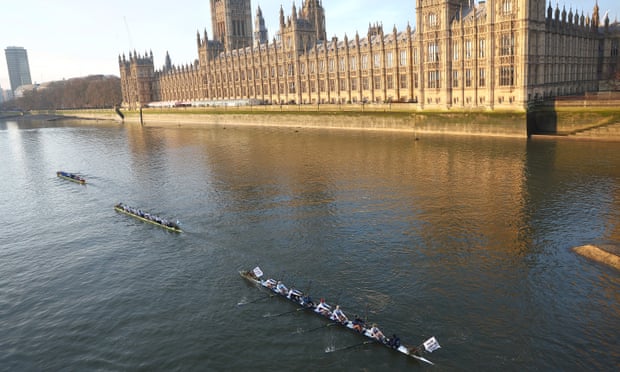
Climate campaigners, MPs, and ex-Olympians held a boat race along the Thames earlier this month to promote the bill. Photograph: Peter Nicholls/Getty Images
Guardian Exclusive: Supporters of bill say Labour has already insisted on removal of clauses requiring UK to meet targets agreed at Cop and other summits
A landmark bill that would make the UK’s climate and environment targets legally binding seems doomed after government whips ordered Labour MPs to oppose it following a breakdown in negotiations.
Supporters of the climate and nature bill, introduced by the Liberal Democrat MP Roz Savage, say Labour insisted on the removal of clauses that would require the UK to meet the targets it agreed to at Cop and other international summits.
Although it is a private member’s bill, more than 80 Labour MPs, including several ministers, had publicly signed up to support it.
Some Labour MPs have been ordered to attend the bill’s second reading on Friday morning and to prepare speeches, to deliberately make it run out of time and avoid a vote. Another possibility would be a three-line whip to vote against the bill, leaving any rebels at risk of disciplinary action, including losing the party whip.
Unpaid or under-paid internships persist in spite of law changes since 2018, making up 61% of those on offer. Photograph: OJO Images/Rex Features
UK charity calls for positions of four weeks or longer to be banned to help close social mobility gap
Young people from working-class or disadvantaged backgrounds are being “locked out” of careers by unpaid or low-paid internships that benefit middle-class graduates, according to a social mobility charity.
Research by the Sutton Trust found that middle-class graduates made more use of internships as stepping stones into sectors such as finance or IT, even in cases where the internships paid nothing or below the minimum wage as required by legislation.
Nick Harrison, the chief executive of the Sutton Trust, said: “Internships are an increasingly critical route into the best jobs, and it’s shocking that in this day and age, many employers still pay interns below the minimum wage, or worse, nothing at all. They should be ashamed.
“The government has pledged to ban unpaid internships, which is absolutely the right thing to do. Clearly not all young people can get support from the ‘bank of Mum and Dad’, so banning this outdated practice will help to level the playing field for these valuable opportunities. It’s a no-brainer and should be implemented without delay.”
A survey of 1,200 recent graduates commissioned by the trust revealed that 55% of middle-class young people had undertaken internships, compared with just 36% from working-class families – and that the gap between the two groups had widened “substantially” since its previous survey in 2018, from 12 to 19 percentage points.
Unpaid or underpaid internships had persisted in spite of law changes since 2018, making up 61% of those on offer and forcing interns to “subsidise themselves during their placements, which locks many of those who can’t afford it out of these vital opportunities”, the trust said.
A Downing Street spokesperson said the government’s position “will be set out at second reading”.
Nature and climate charities have urged ministers to adopt Savage’s bill, saying it would introduce vital concrete steps to tackle nature depletion and the climate crisis.