Category: Labour Party

  • From America with cash: Right-wing groups want to end abortion in the UK

    Spread the love

    Original article by Sian Norris republished from Open Democracy under a Creative Commons Attribution-NonCommercial 4.0 International licence.
    Emboldened by the overturning of Roe vs Wade, US anti-abortion groups have the UK in their sights
     | Future Publishing/GettyImages / Pexels / Composition by James Battershill

    A right-wing political and media ecosystem pushing a US-style anti-abortion agenda is gaining traction in the UK

    Conservative MPs, hard-right media personalities, and US-backed Christian anti-abortion charities are working to spread their anti-abortion agenda ahead of a parliamentary debate on legislation that would stop women being imprisoned for terminating a pregnancy after 24 weeks.

    Emboldened by their success in the United States with the Dobbs decision – the 2022 Supreme Court decision that overturned the right to safe and legal abortion in the US – groups such as the Alliance Defending Freedom and the Edmund Burke Foundation are now seeking to rollback progress on reproductive rights around the world.

    Their campaigns in the UK are based on strategies honed and perfected in the US. They use language shaped over decades to seed anti-abortion falsehoods that begin on social media before becoming talking points on conservative-friendly TV stations modelled on right-wing US news channels and far-right podcasts. Crucially, those behind the campaigns also invest millions of dollars to push their agenda in the UK.

    “As if the US anti-abortion movement didn’t already have sufficient momentum, the Dobbs’ decision turbo-charged their motivation and reach,” Gillian Kane, the director of policy and advocacy research at pro-abortion non-governmental organisation Ipas, told openDemocracy.

    “There are veteran organisations continuing their line of work, but also traditionally domestic-focused groups… see an opportunity to dip their toes in these crowded international waters.”

    In the UK, Labour MP Stella Creasy being viciously attacked on social media for backing an amendment to the Criminal Justice Bill that would end criminal sanctions for late-term abortions. These attacks were not started by a far-right activist or even an anti-abortion campaigner – but by her fellow MP Neil O’Brien, a former junior health minister in the Conservative Party-led government.

    O’Brien claimed Creasy was “arguing for people to be able to kill a baby before the day it is due to be born”, branding the amendment “an incredibly extreme and bad proposal”. Contrary to his allegation, the legislation would not increase the 24-week limit in which abortions must be carried out. Rather, it would mean women who self-administer late-term abortions will not be imprisoned, after Carla Foster, a mother-of-three from Staffordshire, was jailed last year for illegally procuring her own abortion at around 33 weeks pregnant.

    We shouldn’t send women to prison for decisions they make about their own bodiesLouise McCudden, MSI Reproductive Choices

    “On principle, we shouldn’t send women to prison for decisions they make about their own bodies,” said Louise McCudden, the UK head of external affairs at MSI Reproductive Choices, an NGO providing contraception and safe abortion services. “However, the solution has to be about more than prison and sentencing. We need to remove women who end their own pregnancies from criminal law altogether. That can be done without making any changes to the way abortion care is regulated or provided.”

    O’Brien’s message was provably wrong – but it was still shared by five of his Conservative colleagues. Soon, hard-right broadcasters began making similarly incendiary posts about the amendment, with GB News’ Darren Grimes and TalkTV’s Isabel Oakeshott branding Creasy’s proposal “infanticide” and “butchery” respectively.

    On social media, posts targeting Creasy started to quote far-right conspiracy theories and descended into misogyny and transphobia. It is no coincidence that such rhetoric directly echoes the far-right propaganda that led the US Supreme Court to overturn Roe vs Wade – openDemocracy has found that many of those making false claims about the amendment have links to the US anti-abortion movement, which sees an opportunity to make reproductive rights a new frontline of the UK’s culture wars.

    “Abortion isn’t divisive in this country like it is in the US,” said McCudden “Ninety percent of people [in Britain] are pro-choice, and many people are frankly shocked to discover that abortion sits within criminal law at all. That said, there’s a small but very vocal minority which does seem to be getting more aggressive.

    “There has been a worrying trend towards greater policing of women’s reproductive choices, with women’s bodies implicitly treated as national resource, especially in policy debates about the ageing population.”

    Funded by US cash

    The campaign against the UK amendment is reminiscent of the ‘partial-birth abortion’ propaganda successfully deployed by the US-anti-abortion movement since the mid-1990s.

    The term, which refers to late-stage abortions, is designed to make people think not of a fetus but “of a young child”, as conservative Robert Arnakis explained in 2017 at an event hosted by the anti-abortion, anti-LGBTQ+ think tank, Family Research Council.

    Such is its effectiveness, according to the Family Research Council’s president, Tony Perkins, that Donald Trump’s 2016 presidential election win can be traced back to the moment he referred to “partial birth abortions” during a candidate debate in Las Vegas.

    So-called ‘partial birth abortions’ had been banned nationwide in the US by 2003. When that ban was challenged by Planned Parenthood in 2007, a Christian legal charity successfully argued it was constitutional all the way up to the Supreme Court. That charity was Alliance Defending Freedom, which would go on to fund the lawyer who won a fight to implement an abortion ban in Texas in 2021 and was influential in the Dobbs ruling that revoked Roe vs Wade.

    But the ADF, which was founded in 1993, never intended to limit its influence over sexual and reproductive rights to the US. It has spent more than $31m on foreign activities since 2015, of which $27m has gone to Europe.

    The charity is now splashing more cash in the region than ever before; in 2015, its European spend was $1.4m – by 2022 that had risen to $5.2m. While US organisations must declare who they fund at home, for foreign spending they only need to name the region their money is going to. This means it is impossible to parse the details of where exactly ADF’s dollars flow overseas – though tax returns reveal much of it goes to its own international branches.

    The UK’s ADF branch, for example, has received more than £2m from its parent company since its first tax return in 2017. This has been spent on legal support for anti-abortion and anti-LGBTQ+ protesters and societies, as well as on growing its political influence in the UK – more than doubling its expenditure from £370,000 in 2018 to £770,000 today.

    ADF UK’s communications lead, Lois McLatchie-Miller, was among those amplifying opposition to Creasy’s amendment. The day after she tweeted Creasy’s plans were “barbaric”, she appeared on the far-right podcast Hearts of Oak, which claims to “bridge the transatlantic and cultural gap between the UK and the USA” and has platformed conspiracist voices.

    British anti-abortion groups have also increased their spending and activity in recent years. Right to Life UK, an anti-abortion charity with close ties to numerous UK MPs, spent £705,000 last year, up from £200,000 five years earlier. And the extremist anti-abortion group Centre for Bio-Ethical Research UK – which in 2019 erected a billboard featuring graphic abortion imagery outside Creasy’s office – is now targeting her constituency with leaflets and “education displays”. Although the group’s small size means it does not have to report full accounts, its staff numbers have risen from four in 2017 to 12 today, suggesting an uptick in its spending.

    US campaigns, UK MPs

    Money alone won’t help global anti-abortion actors to push their agenda in the UK. As the posts on X reveal, they are being aided and legitimised by Conservative Party politicians, media channels such as GB News, and events such as the annual National Conservatism Conference.

    In 2019, ADF International paid for flights and other travel expenses for anti-abortion MP Fiona Bruce to attend its youth conference – Areté Academy – in Vienna. The same year, she attempted to ban late-term abortions for specific fetal anomalies. Academy alumni have gone on to work at Bruce’s legal firm, and in September 2023, she took another donation to cover expenses from ADF International, this time worth £1,737.92.

    In Westminster, ADF UK also “engages with the members of the All-Party Parliamentary Group on Freedom of Religion or Belief”. It featured alongside a host of anti-abortion and pro-Brexit MPs – including then-home secretary Suella Braverman, Jacob Rees-Mogg, Danny Kruger and Miriam Cates – on the line-up of last year’s National Conservatism Conference, which was held in London.

    NatCon, as the conference is more commonly known, is run by the Washington DC-based Edmund Burke Foundation. The 2024 conference – which took place in Brussels this week – was marred by controversies after police shut down the event during a speech by British hard-right politician Nigel Farage, following an order from a local mayor who feared a threat to public order. A court later ruled the event could resume and the ADF – which was again present at the conference – is backing a legal challenge against the mayor’s order.

    On the bill for this year’s event were Hungarian prime minister Viktor Orban and French presidential hopeful Eric Zemmour, as well as British politicians including Braverman and Cates. The latter made a name for herself at the 2023 event, when she echoed the Great Replacement conspiracy theory, saying: “There is one critical outcome that liberal individualism had failed to deliver and that is babies.” The white nationalist theory accuses Black and Brown migrants of ‘colonising’ white Europeans and blames white women’s “selfish individualism” for low birth rates.

    Cates is now part of a number of MPs pushing anti-gender narratives, including attacks on trans rights, LGBTQ+ inclusive education, and abortion. Alongside Kruger, she is a co-chair of the New Conservatives, a group of Tory MPs that says it is fighting “a dangerous new culture that despises national sentiment…, welcomes mass migration, denigrates our nation’s history, and pursues a radical agenda on sex and gender which is directly harmful to children”.

    The Legatum Institute – a British think tank that openDemocracy previously revealed receives funding from the foundation of US billionaire Charles Koch, who donates to an array of anti-abortion causes – gave £50,000 to the New Conservatives in December 2023.

    Legatum is also behind the recently launched ARC Forum, where Cates and Kruger sit on the advisory board, and is a co-owner of GB News, a right-wing news channel that offers a platform to commentators promoting anti-gender disinformation and anti-trans and anti-drag conspiracies.

    While GB News and its presenters and guests maintain a veneer of respectability, the anti-abortion disinformation they amplify is picked up by far-right social media accounts that espouse conspiracies such as the Great Replacement.

    One such post attacked Creasy’s amendment and suggested that white women should be banned from having abortions, while black women should be encouraged to have them. Another, which came in reply to a post by Grimes warned the plan would mean “the native birth rate will further decline”.

    Despite the growing volume of attacks, and the increased spending on attempts to reverse abortion rights, the UK has seen progress in liberalising reproductive healthcare in recent years. Parliament voted to decriminalise abortion in Northern Ireland in 2019, and women have been able to access telemedicine for abortion since the pandemic. MPs also voted to introduce buffer zones around clinics, although the law has yet to be implemented.

    But such success is often met with increased backlash. While the attacks on Creasy’s amendments seem disparate, our analysis shows they are connected by a global anti-abortion movement funded by hard-right interests determined to shout louder and spend more to roll back women’s rights in the UK. Such forces have already succeeded in making trans rights part of their culture war. They want abortion to be next.

    openDemocracy approached ADF UK, O’Brien, Cates, Bruce, Clarke-Smith, Grimes and the Legatum Institute for comment, including clarification on what they believe the sanction should be for women who terminate their pregnancy after 24 weeks. We received no reply.

    Original article by Sian Norris republished from Open Democracy under a Creative Commons Attribution-NonCommercial 4.0 International licence. 

    A dying baby, a Trump tweet: Inside network setting global right-wing agenda
  • John McDonnell MP slams UK government’s record on sanctioning Israeli settlers in the West Bank

    Spread the love

    https://leftfootforward.org/2024/04/john-mcdonnell-mp-slams-uk-governments-record-on-sanctioning-israeli-settlers-in-the-west-bank/

    ‘What’s happening in the West Bank just as in Gaza are war crimes’

    Labour MP John McDonnell has questioned the UK government’s record on sanctioning Israeli settlers in the occupied West Bank, as violence in the region escalates. 

    Speaking in Parliament on Wednesday, McDonnell called on the UK government to publish a detailed report into the sanctions imposed by the government on Israeli settlers in the West Bank. 

    It comes after the UN human rights office has demanded that Israeli security forces immediately stop participating in and enabling attacks by Jewish settlers in the region, stating the, “escalating violence over the past few days is also a matter of grave concern”.

    This followed the killing of a 14 year-old Israeli from a settler family, which sparked the biggest settler rampage since the war in Gaza began, with seven Palestinians reported murdered and many others wounded.

    Speaking on Wednesday in Parliament McDonnell said: “At a meeting with Israeli colleagues this morning we heard that the Israeli government is arresting legal and peaceful observers in the West Bank.

    “Could the government now make it very clear to the Israeli government that observers should be allowed to operate within the West Bank, to ensure that peace is maintained, but also could we have a report in detail on the sanctions that the government is applying to Israeli settlements and Israeli settlers.”

    …

    https://leftfootforward.org/2024/04/john-mcdonnell-mp-slams-uk-governments-record-on-sanctioning-israeli-settlers-in-the-west-bank/

  • Corbyn documentary pulled from Glastonbury now available online

    Spread the love

    https://morningstaronline.co.uk/article/corbyn-documentary-pulled-glastonbury-now-available-online Many articles from Morning Star featured today.

    AFILM about how Jeremy Corbyn was targeted by a co-ordinated campaign to undermine his leadership of the Labour Party with false accusations of anti-semitism is now available online.

    Oh Jeremy Corbyn — The Big Lie was due to be screened at last year’s Glastonbury festival but was dropped by organisers after they were hit by an online smear campaign which accused the film itself of anti-semitism.

    …

    Oh Jeremy Corbyn — The Big Lie is available on https://youtu.be/PXvaWz4gpTc.

    https://morningstaronline.co.uk/article/corbyn-documentary-pulled-glastonbury-now-available-online Many articles from Morning Star featured today.

  • Labour in ‘cash for access’ scandal over meetings with £150k donor

    Spread the love

    Original article by Ethan Shone republished from OpenDemocracy under a Creative Commons Attribution-NonCommercial 4.0 International licence. 

    Keir Starmer and Rachel Reeves have engaged heavily with the financial services industry
     | Dan Kitwood/Getty Images

    Labour top brass including Keir Starmer gave Bloomberg ‘exclusive’ look at party’s financial plan at private meeting

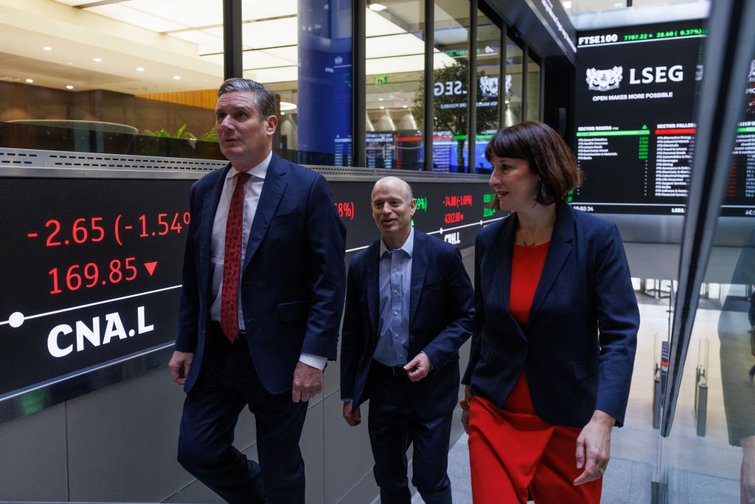
    Labour leader Keir Starmer, shadow chancellor Rachel Reeves, and four other senior party figures met with a major media and financial information conglomerate weeks after it donated £150,000 to the party – sparking concerns of “cash for access” from transparency campaigners.

    The meeting between Labour and the Bloomberg group, which took place in Edinburgh on 8 December last year, was described as “suspicious” and “highly unusual” by two Labour sources.

    The private roundtable event came shortly after the US business conglomerate, majority owned by American businessman and politician Michael Bloomberg, made its first donation to Labour in seven years. The donation was made by a Bloomberg subsidiary called Bloomberg Trading Facility Limited.

    The party used the meeting to offer Bloomberg and others in attendance “an exclusive dive” into its flagship financial services policy document, which was published the following month, according to a social media post by a person involved in coordinating the event.

    Labour did not deny that the meeting was connected to the donation, with a spokesperson telling openDemocracy: “It is standard practice for the Labour Party to meet with the private sector.” The party did not reply to openDemocracy’s query about whether Bloomberg was given exclusive access to the flagship financial services policy document. Bloomberg declined to comment for this story.

    The Edinburgh event was facilitated by Sovereign Strategy, a lobbying firm that has represented Bloomberg for almost two decades, which promises to get its clients’ “messages heard at the highest levels of government”, according to the firm’s website.

    Lobbyists often hold such events to introduce their clients to Labour frontbenchers so they can try to shape the party’s policy on issues relevant to their businesses.

    But two Labour sources, who spoke to openDemocracy on the condition of anonymity to avoid retaliation for appearing critical of the party’s leadership, said the Edinburgh meeting was “highly unusual” and “suspicious” due to the sheer number of senior politicians present.

    Starmer and Reeves were joined at the event by shadow business secretary Jonathan Reynolds, shadow City minister Tulip Siddiq, as well as Scottish Labour leader Anas Sarwar and Daniel Johnson MSP, the party’s business spokesperson in Holyrood.

    Other comparable meetings are typically attended by only one or two shadow ministers. openDemocracy has analysed more than 200 meetings attended by Labour frontbenchers in the past year based on publicly available data and triangulation through multiple sources, and found the Edinburgh meeting involved far more senior figures than any other.

    The meeting took place less than two weeks after Bloomberg Trading Facility Ltd, a subsidiary of Bloomberg LP, donated £150,000 to Labour – with the conglomerate becoming one of the party’s top corporate donors for all of 2023 in a single day, according to Electoral Commission records.

    A Bloomberg company last made a cash donation to the Labour Party in late 2016, when it gave the party £60,000. The firm has since handed the Conservatives £260,000, most recently donating £100,000 in June 2022.

    Simon Youel, the head of policy and advocacy at not-for-profit advocacy group Positive Money, told openDemocracy that voters should be worried by the timing of the meeting – which took place as Labour finalised a key document to set out its policy on the financial services sector.

    “What is most concerning is that weeks after this meeting, Labour published a plan for financial services that reads like a love letter to Big Finance, with much in there that could have been written by the industry itself,” Youel said.

    Labour spent months drafting its financial services report, bringing in a staffer from City consultancy Oliver Wyman to put it together. After its publication in January, Reeves and Siddiq threw a lavish, no-press-allowed reception in the City of London’s famed Guildhall to thank the industry for its contributions.

    In a since-deleted LinkedIn post, a Sovereign Strategy staffer said the roundtable discussion had a focus on the “outlook for the financial services industry and an exclusive dive into Labour’s launch of the financial services review”.

    Youel added: “Rachel Reeves herself has acknowledged New Labour’s errors in relying on an under-regulated financial sector to generate wealth, yet the party seems set on repeating the mistake of letting the City of London dictate policy-making, which inevitably the public will again be left paying the price for.”

    In a video from the event, Starmer can be heard telling the attendees: “What you now see is a Labour Party that is fundamentally different to the Labour Party that fought the last general election. Unrecognisably different. And very obviously pro-business.”

    The video, which Labour released on the day of the meeting, made no reference to who was at the event or what was discussed.

    Bloomberg holds a unique position within the financial sector, providing hardware, software, data and advisory services to all manner of financial services institutions.

    Its computer systems, Bloomberg Terminals, are used by banks, institutional investors and financial analysts all over the world to access high-level investment data and place financial transactions. The company also has a news division and TV channel that employ over 2700 journalists in 120 countries, according to its website. Its eponymous billionaire founder and majority owner, Michael Bloomberg, is a fixture in US politics and one of the richest people in the world. He was mayor of New York City for 12 years, before running for President as recently as 2020.

    Youel said that access to frontbench politicians could give Bloomberg a “value-add” for its clients, raising “serious concerns around cash for access in our democracy”.

    The roundtable was also attended by investment manager Baillie Gifford, Aegon Asset Management and NatWest Group. For several months in 2022, NatWest provided a member of staff to Jonathan Reynolds’ office, valued at £13,800.

    A Labour Party spokesperson said: “Donations from corporate entities are declared in line with Electoral Commission rules. Labour is proud to engage with the financial services sector as we develop policies to grow our economy after 14 years of Tory chaos and decline.”

    Scottish Labour refused to provide any additional details about the meeting, with a spokesperson saying only that the party “meets with a range of stakeholders to discuss a range of issues”.

    They added: “Boosting economic growth is at the heart of our plans to deliver a fairer and more prosperous Scotland, and we are working in partnership with both businesses and trade unions to deliver that.”

    Partnership with business
    Lobbyist Sovereign Strategy has in recent months strengthened its links to the Labour Party, which is widely expected to win this year’s general election.

    Keir Starmer is featured in a brochure published by the lobbying firm in September 2022. The Labour leader is pictured posing for a photo alongside Sovereign chairman Alan Donnelly, a former Labour MEP, in front of a display bearing Bloomberg’s branding.

    The brochure goes on to quote a senior Bloomberg executive as saying that the firm has “expanded our influence with key decision-makers”.

    Sovereign Strategy also donated £5,000 to deputy leader Angela Rayner “for campaigning activities” last month, according to the register of members’ financial interests. Just over a week after the donation from Sovereign to Rayner, Starmer met with Mike Bloomberg, the billionaire co-founder of Bloomberg, to discuss “Labour’s partnership with business”, .

    This donation appears to be a breach of the Public Affairs Code set out by the Public Relations and Communications Association (PRCA), a trade body representing UK lobbyists including Sovereign Strategy. A breach of the code could result in a member being reprimanded or their membership of the organisation being suspended.

    Section 8 of the code – a set of rules on the proper lobbying of governments – states that PRCA members must not “make any award of payment in money or in kind… to any MP”. There is no suggestion of wrongdoing on Rayner’s part.

    A spokesperson for Sovereign told openDemocracy the donation was made by the company’s chairman in a personal capacity, but was unwilling to provide any further details. A Labour source, however, confirmed the donation was from the company and made by its company bank account.

    The PRCA said it was reviewing the information openDemocracy provided.

    In January this year, a senior account manager at Sovereign who was involved in organising the Edinburgh roundtable joined the executive committee of Labour Business, an affiliate of the party that focuses on fostering links between Labour and the business community, in January.

    The Sovereign staffer in question previously worked for the Labour Party for a number of years in the business relations and endorsements team.

    They are one of a large number of former Labour staffers to have left their positions at the party to join Westminster consultancies and lobbying firms the past 18 months, as firms look to beef-up their Labour bona fides in anticipation of a Conservative wipeout at the next election.

    Steve Goodrich, the head of research and investigations at Transparency International UK, told openDemocracy: “Parties should scrupulously avoid the perception that they’re offering privileged political access in return for cash.

    “The next general election looks set to be the most expensive in modern times so it’s crucial that politicians of all stripes avoid stumbling into quid pro quos in the rush for funds.

    “Until we reduce the cost of politics, cases like these will continue to undermine public trust in our democracy, which is already perilously low.”

    Original article by Ethan Shone republished from OpenDemocracy under a Creative Commons Attribution-NonCommercial 4.0 International licence. 

    Academics call for transparency over university funding

    Jet-setters, partygoers and double-jobbers: Who’s given what to MPs in 2024

    Where Labour and the Tories got their money from in 2023

  • Revealed: UK ‘double counting’ £500m of aid for war-torn countries as climate finance

    Spread the love

    Original article by JOSH GABBATISS republished from Carbon Brief under a CC license.

    The UK government has reclassified nearly £500m of aid for war-torn and impoverished countries as “climate finance”, in a bid to meet its international commitments under the Paris Agreement.

    This follows reports that the UK’s pledge to spend £11.6bn on climate aid between 2021-22 and 2025-26 is slipping out of reach, due to government cuts.

    A freedom-of-information (FOI) request by Carbon Brief reveals how, after the reclassification, money for humanitarian work in nations including Afghanistan, Yemen and Somalia is now being double-counted as climate finance to help the UK hit its goal.  

    The projects being double-counted include work to provide food and basic necessities that have no explicit link to climate action, Carbon Brief’s analysis reveals. Some of their internal reports even state clearly that they are not climate-finance projects. 

    This is part of a wider revision of climate-finance accounting, introduced by the government in 2023 to ensure the UK achieves its £11.6bn target. 

    By redefining existing funds pegged for development banks, investment in foreign businesses and humanitarian aid as “climate finance”, the government expects to add £1.72bn to its total.

    Experts tell Carbon Brief it is “problematic” and “unjust” to relabel existing funds as climate finance rather than providing new money. One says the UK could meet its target, at least in part, by “double counting development and climate finance”.

    The chair of the Least Developed Countries (LDC) group at UN climate talks says the UK’s actions are a “clear deviation from the path to climate justice”.

    ‘Moving the goalposts’

    The UK government has committed to spending £11.6bn on international climate finance (ICF) between 2021-22 and 2025-26. This is the nation’s contribution to climate action in developing countries, which it is obliged to provide under the Paris Agreement. 

    Developed countries, such as the UK, have committed to sending “new and additional” climate finance to developing countries. This is generally interpreted as spending extra money on top of existing foreign aid.

    The UK government itself has described the £11.6bn goal as “dedicated ring-fenced funding that is distinguishable from non-climate [aid]”.

    However, reports began to emerge in 2023 that the government was not on track to meet its target.

    Experts attributed this to the government cutting its overall foreign aid budget. In November 2020, the government suspended a target to give 0.7% of national income as overseas aid – reducing it to 0.5% as a “temporary measure”. 

    The government is also spending more of the remaining funds on supporting refugees within the UK. The latest figures show that in 2023, the UK spent more of its aid budget on supporting asylum seekers and refugees in the country than on overseas projects.

    In order to remain on track for the £11.6bn goal, development minister Andrew Mitchell announced in October 2023 that the government was changing the way it calculated ICF spending.

    This immediately sparked concerns that the government was inflating its climate-finance figures without providing any new aid money for developing countries. Mitchell provided limited details of how the government was getting its target back on track.

    More information came in a report released in February by the Independent Commission for Aid Impact (ICAI). It concluded that, by “moving the goalposts”, the government had reclassified £1.72bn of spending as climate finance between 2021-22 and 2025-26.

    This figure includes four tranches of funding that had not previously been considered ICF:

    • £746m from assuming that a share of the “core” funding the UK gives to the World Bank and other multilateral development banks (MDBs) will be assigned to climate-related projects.
    • £497m from automatically labelling 30% of the humanitarian aid spent in the 10% of countries that are most vulnerable to climate change as ICF.
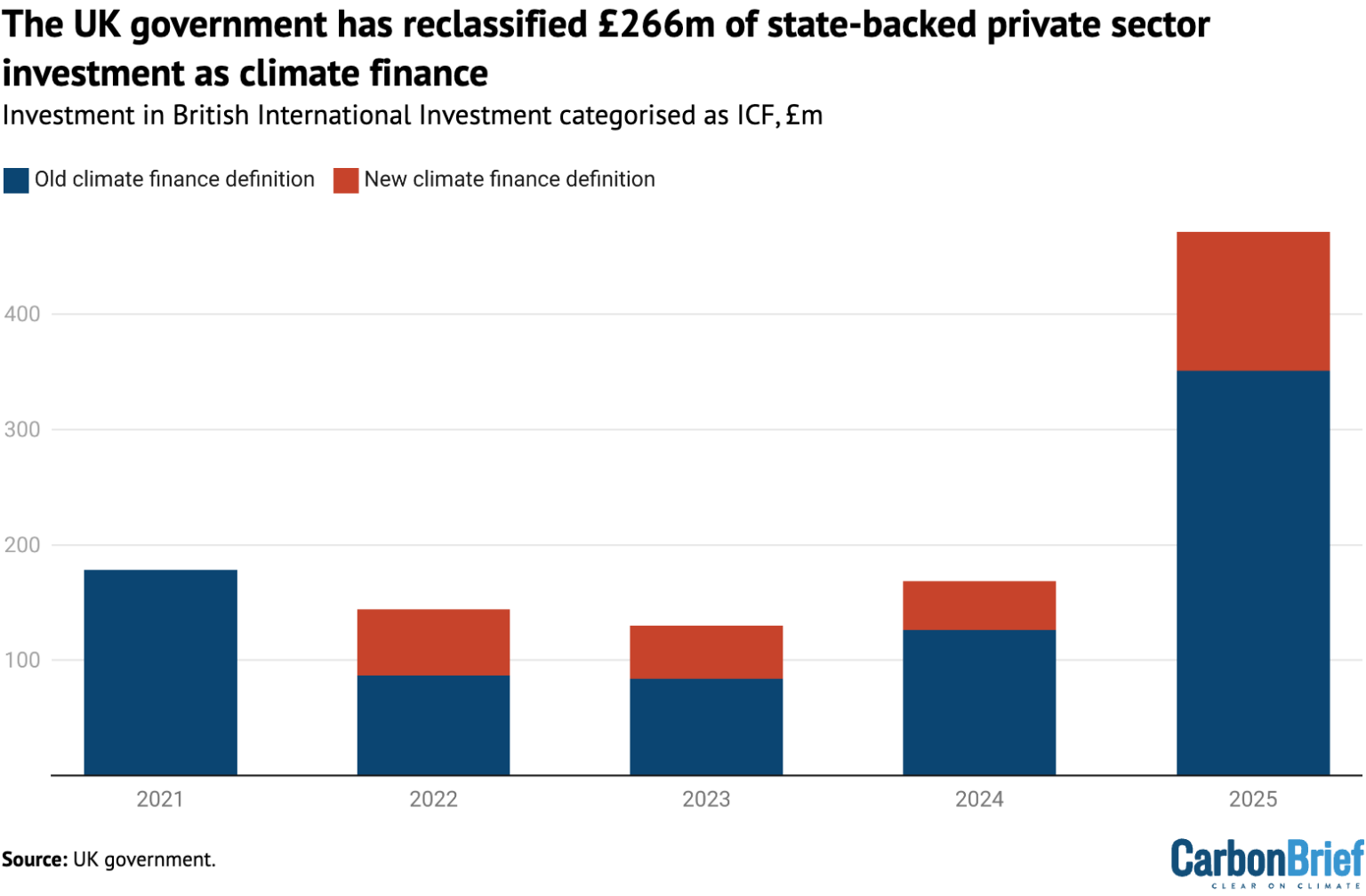
    • An estimated £266m from defining more payments into British International Investment (BII), the UK’s overseas development finance institution, as ICF.
    • £215m from civil servants “scrubbing” the aid portfolio – namely, going back over existing projects and adding any climate-relevant funding they had previously missed.

    The figures cited by ICAI are based on unpublished government analysis, which Carbon Brief has now obtained via FOI. 

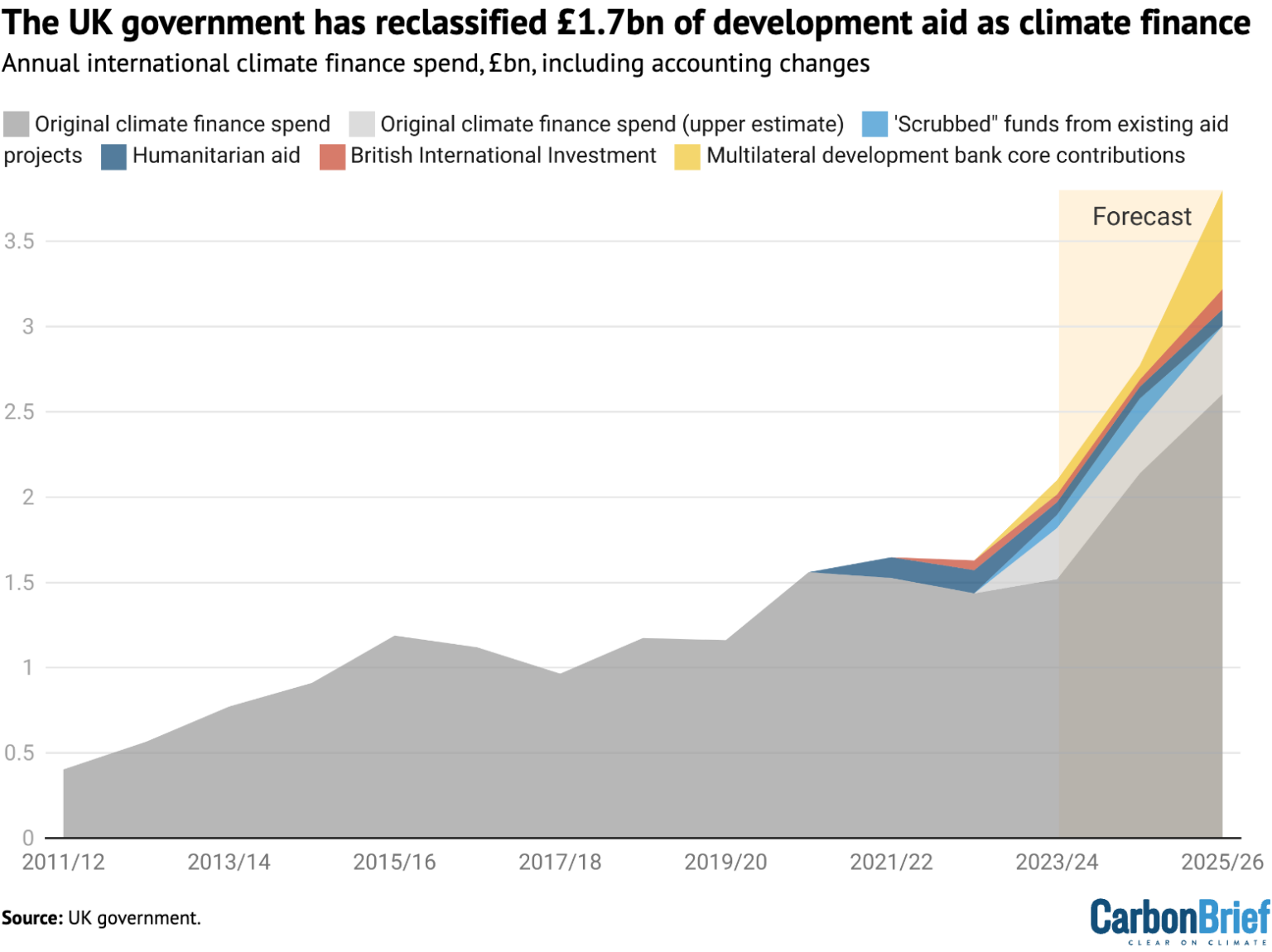
    The analysis includes the annual contributions each of these sources are expected to provide over the period from 2021-22 to 2025-26, which can be seen in the coloured sections of the chart below.

    Annual UK ICF spending, £bn, by financial year for the period 2011/12 to 2025/26. The grey area indicates ICF spending under the original accounting methodology used until October 2023. Beyond 2022/23 the figures are forecasts, with the light grey area indicating the upper bound and the darker grey indicating the lower bound. The coloured areas indicate the funding newly reclassified as counting towards ICF, following methodology changes introduced in October 2023. For multilateral development bank contributions, Carbon Brief understands that the UK will pledge £495m to the World Bank in 2025/26, and the remaining contributions that make up the £746m total are spread evenly across the 2011/12-2025/26 period. Source: UK government.

    As the chart indicates, even with the methodology changes, the £11.6bn target is still “backloaded”, with a significant uptick in ICF spending required beyond 2023-24 to meet it. 

    ICAI notes that, since the government cut its aid spending from the UN-backed benchmark of 0.7% to 0.5% of gross national income (GNI), “serious concerns remain over whether the heavily backloaded spending plan can be delivered”.

    Core funding

    The largest tranche of redefined ICF – some £740m – comes from the government starting to assume that a share of its “core” MDB funding counts as climate finance.

    This is money that the UK government already hands to these organisations to distribute according to their own priorities, primarily through loans. None of this money has previously been counted by the UK government as ICF, even though some went towards climate action.

    MDBs, including the World Bank, the African Development Bank (AfDB) and others have placed a growing emphasis on climate change in recent years. The World Bank, for example, has a target of spending 35% of its finance on climate-related projects.

    Following the reclassification, the UK government will simply assume that 35% of the money it gives to the World Bank – some £495m of £1.4bn total due in 2025/26 – counts as ICF.

    It will use a similar approach for its funding of other MDBs, with these changes adding a total of £740m to the amount of the UK’s aid spending that is classified as ICF.

    This move will not result in the UK providing any new funds for climate action, as it was already planning on distributing this money. In fact, the government has cut its spending on MDBs in recent years, due to the overall cut in the UK’s foreign aid budget.

    Humanitarian aid

    The second-largest tranche of newly reclassified climate finance is from projects in climate-vulnerable countries, an additional £497m of which is being counted as ICF.

    The government dataset obtained by Carbon Brief via FOI reveals the 28 humanitarian projects and five more general, country-specific funds that will contribute to this additional £497m. 

    The projects are based in some of the poorest and most war-torn countries in the world – Afghanistan, the Democratic Republic of the Congo (DRC), Somalia, Sudan, Uganda, Yemen and Zimbabwe.

    They largely focus on essential provisions, such as food and basic infrastructure.

    Prior to the recent changes, these programmes would have contributed just £47.5m to ICF, according to the government data released to Carbon Brief.

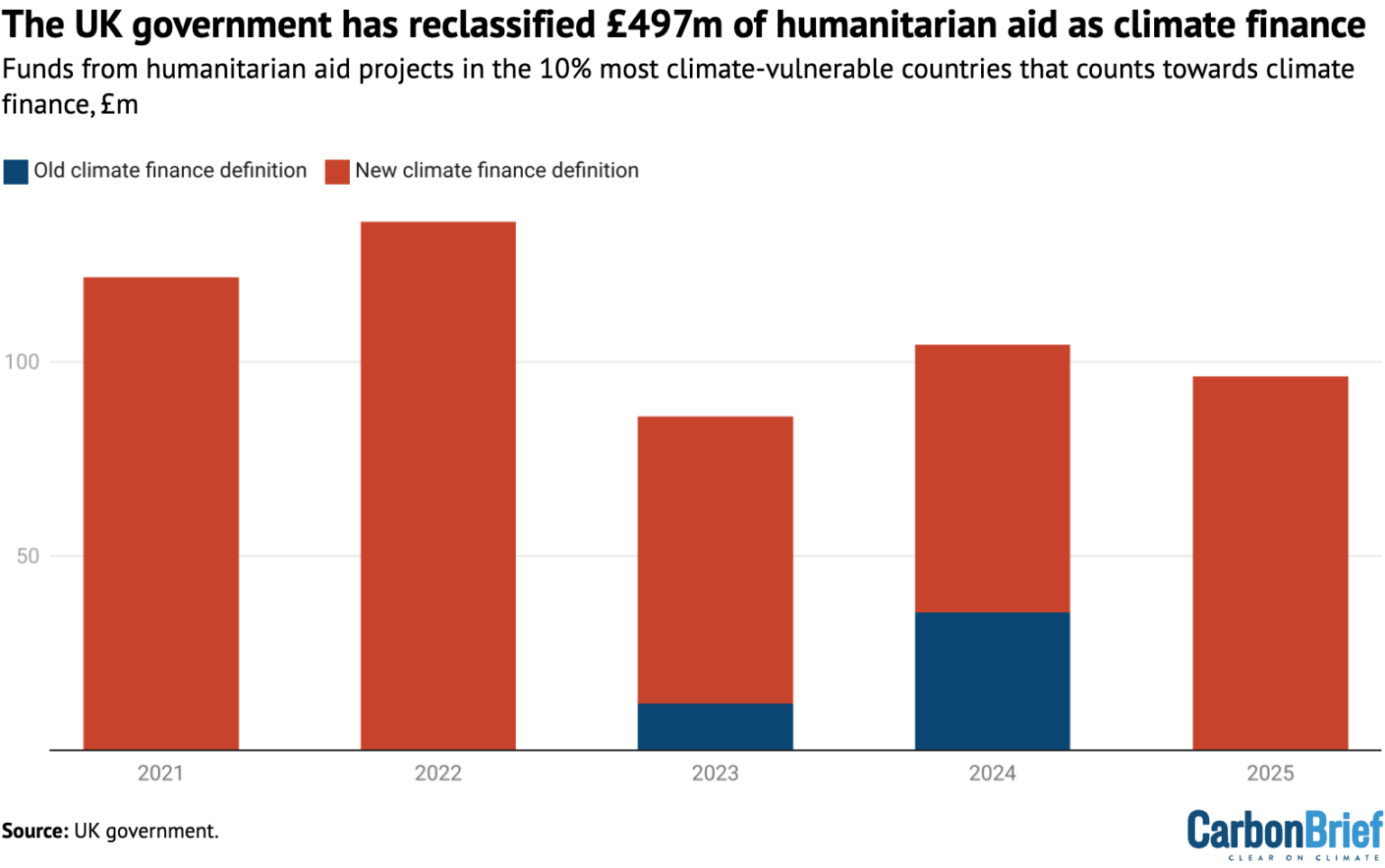
    By automatically counting 30% of their spend as ICF, this figure has now multiplied more than 10 times. The chart below shows, in red, these additional ICF funds.

    Annual UK ICF spending, £m, sourced from humanitarian aid projects for the 10% most climate-vulnerable countries, as defined by the Notre Dame Global Adaptation Initiative. Blue columns indicate the ICF spending that was expected from these projects prior to the methodology change, and red columns indicate ICF spending from these projects after the change. Source: UK government.

    For the 23 of the 28 projects with documentation available online, Carbon Brief assessed the relevant sections of their “business case and summary” documents for evidence that they were related to climate action.

    Many of the project documents reference climate change and say they will provide climate benefits. For example, all four projects in Somalia, a nation that has faced devastating drought and floods in recent years, mention the importance of climate resilience in their work.

    However, some of the projects explicitly state that they are not intended to provide climate-finance. 

    The summary document for the Assurance and Learning Programme (ALP) in Afghanistan, published in 2021, states: “The programme will not be eligible for ICF nor will it monitor ICF funded programmes.”

    Similarly, the Congo Humanitarian, Resilience and Protection (CHRESP) Programme summary document, also published in 2021, notes “we do not anticipate that any of our programming under this programme will be eligible as ICF”.

    Another project, titled Yemen: Access, Logistics, Liaison, and Accountability, will provide “few opportunities” to address climate change, according to the summary document. A further four project documents do not contain any reference to climate change. 

    Despite this, following the government’s reclassification, these seven projects will collectively contribute £166.9m of UK climate finance in the coming years.

    Euan Ritchie, a senior development finance policy advisor at the thinktank Development Initiatives, says blanket approaches to assigning climate finance are “problematic”. He tells Carbon Brief:

    “Just because humanitarian aid is going to a country that is vulnerable to climate change doesn’t mean it addresses that vulnerability. And these projects have already been screened for their climate focus.”

    He points to one of the projects, the Somalia Humanitarian and Resilience Programme, as an example. Ritchie says, based on International Aid Transparency Initiative data, that officials had already decided around 12% of this programme’s spending was ICF, and asks:

    “So what rationale is there for bumping it up to 30%? Were officials wrong the first time?”

    Fatuma Hussein, a programme manager at the thinktank Power Shift Africa, tells Carbon Brief such an approach is “unfair and unjust” as it “risks conflating” the “distinct needs” of climate aid and other humanitarian objectives.

    In its guidance for categorising what counts as climate finance, the Organisation for Economic Co-operation and Development’s Development Assistance Committee recommends scoring many humanitarian projects “zero”, indicating programmes that “generally do not qualify” as climate aid.

    More private investment

    The third-largest tranche of reclassified development aid relates to state-backed private sector investment under British International Investment (BII).

    The UK government will also now count more of its payments into BII as climate finance, amounting to around an extra £266m by 2025-26. Unlike aid spending, these are investments in the private sector and are expected to yield a financial return for the UK.

    Previously, the government counted a fixed 30% of BII spending as climate finance. It now intends to include a higher percentage to reflect a growing focus on climate investments.

    The new approach to BII investments assesses the share of each project that should count towards UK climate finance case-by-case, rather than using a blanket 30% share.

    It will record 100% of investments in a programme covering the Philippines, Indonesia and other parts of south-east Asia as ICF, as part of the government’s “Indo-Pacific tilt”. Investments in other regions also contribute a higher share of ICF – rising as high as 46% in 2022-23.

    The chart below shows the extra BII investment money (red) that now counts as ICF.

    Annual UK ICF spending, £m, from British International Investment (BII) contributions. Blue columns indicate the ICF spending that was expected from BII prior to the methodology change and red columns indicate ICF spending from BII after the change. Source: UK government.

    The figure above shows that the government expects private sector investment via BII to play an increasingly large role in its climate finance in the future.

    Many observers have expressed concerns about the government leaning more on private investment through BII to boost its ICF spending. 

    A report last year by the parliamentary international development committee criticised BII’s investment in, among other things, fossil fuels and “high-net-worth individuals”.

    BII prioritises loans and projects in middle-income nations where there is money to be made, rather than the nations that are most in need of climate finance. 

    ICAI highlighted this in its review of the UK’s climate finance commitments earlier this year, stating that private investment “is not always the most appropriate, realistic or preferred form of climate finance in the poorest and most fragile contexts”.

    Not new, not additional

    Developing countries will require trillions of dollars of investment in the coming years to meet their climate goals. 

    To help achieve this, developed countries, such as the UK, are expected to provide finance under the UN climate system that is “new and additional”. Discussions around a new climate finance goal will take centre stage this year at the COP29 climate summit in Baku.

    Experts tell Carbon Brief that the UK government’s changes to its ICF undermine the notion that it is providing new, “ring-fenced” funding. Regarding the “arbitrary” labelling of humanitarian funds as ICF, Ritchie says:

    “If the UK is counting a fixed share of projects as ICF it can no longer claim that ICF is distinguishable from non-climate [aid].” 

    Gideon Rabinowitz, director of policy and advocacy at the international development network Bond, tells Carbon Brief:

    “The change of definition means they will be able to reach the target by spending less money than they would have done otherwise through double counting development and climate finance.”

    Development NGOs say the best way for the UK to scale up its climate finance would be to return its foreign aid budget to 0.7% of GNI. However, with an election looming, neither the ruling Conservatives nor their Labour challengers have indicated a willingness to do this.

    There will be considerable pressure on developed countries in the coming months to commit to providing plentiful, high-quality climate finance in the run up to COP29. 

    Evans Njewa, the chair of the LDC group, to which nearly all of the UK’s humanitarian aid ICF recipients belong, tells Carbon Brief:

    “Reclassifying existing donor aid as climate finance is a clear deviation from the path to climate justice, and closing the finance gap cannot be achieved this way.” 

    Climate-finance reporting has been described as a “wild west”, with countries announcing figures based on vastly different definitions. This has led to nations counting money for coal, hotels and films in their totals, as there is no binding international standard to guide them.

    The UK government noted last year that its changes are in line with other countries’ methods. But experts point out that the UK was previously viewed as setting a high standard for other countries to reach. 

    In contrast, the new approach “risks breeding cynicism and mistrust because you are going to find programmes that have very little to do with climate change, but end up being reported in the pot as climate finance”, Rabinowitz says.

    Hussein agrees, telling Carbon Brief:

    “This not only highlights the disparity between western countries’ rhetoric on climate finance and their actual financial commitments to developing countries but also risks undermining trust that underpins global climate action.”

    She argues that nations should agree on common definitions and accounting methodologies for climate finance to ensure that governments cannot backslide as the UK has.

    Responding to Carbon Brief’s questions about the government’s methodology changes, a spokesperson from the Foreign, Commonwealth and Development Office (FCDO) said:

    “Since 2011, UK funding has helped more than 100 million people cope with the effects of climate change, given 70 million people access to clean energy and reduced or avoided over 86m tonnes of greenhouse gas emissions.

    “The UK remains on track to meet the £11.6bn international climate finance commitment.”

    Original article by JOSH GABBATISS republished from Carbon Brief under a CC license.