Category: Labour Party

  • Where Labour and the Tories got their money from in 2023

    Spread the love

    Original article by Ethan Shone republished from Open Democracy under a Creative Commons Attribution-NonCommercial 4.0 International licence.
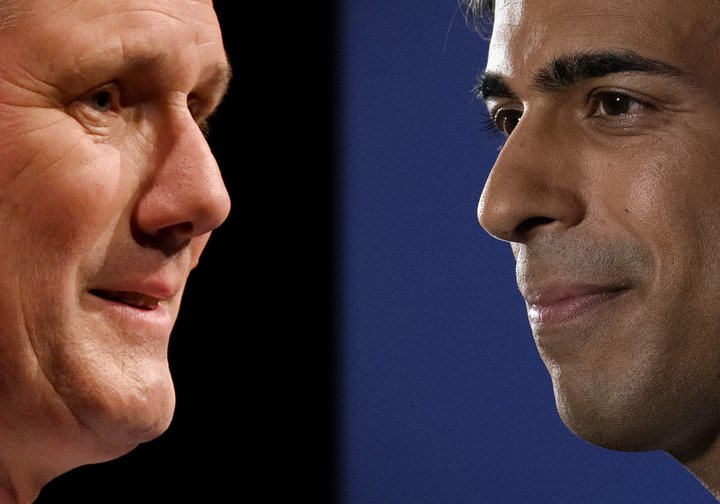
    Keir Starmer and Rishi Sunak saw donations to their respective parties increase significantly last year
     | Leon Neal & Carl Court/Getty Images

    Labour’s cash from private donors now dwarfs donations from unions, while the Tories got their biggest bung ever

    Britain suffered a bleak economic landscape in 2023, with wages stagnant and costs rising across the board, but political donors and the parties they give to seem to have been unimpacted. All parties declared more than £93m in total compared with £52m in the previous year. And the cash looks set to keep pouring in ahead of the general election, which could take place as soon as May – although our money is on a November poll.

    The Conservatives received the most donations by far, raking in £44.5m in cash, compared with Labour’s total of £21.6m, £6m for the Liberal Democrats, £610,000 for the Green Party and £255,000 for Reform – who now have their first MP in the form of ‘Red Wall Rottweiler’ Lee Anderson. The SNP registered only £76,000 cash donations in 2023, with £50,000 from the estate of a donor who passed away some years prior.

    In addition to this, parties received non-cash donations – for things like premises, staff costs, sponsorship, consultancy services and more – worth £4.2m in total. Other regulated recipients like Labour Together, The New Conservatives, Labour First, and the Carlton Club Political Committee, took in £2.5m – these are campaigning organisations affiliated to political parties but legally separate from them, and often provide financial support to a particular faction within a party.

    We’ve had a closer look at some of the underlying trends behind the numbers and picked out a few key points to look out for in the months ahead, based on what these donations tell us about the state of play in the two main parties.

    Labour’s reliance on companies and individuals over trade unions

    Much has been made of Labour’s increasingly close relationship with big business and the wealthy under Keir Starmer. Supporters of the party leadership argue that Labour has to be able to compete with the spending power of the Conservatives in the general election, and so has to look beyond the traditional funding source of the trade union movement toward people and businesses with deep pockets. Critics, however, might suggest that the interests of the trade union movement and the interests of those with the deepest pockets may not accord.

    The concern among those of the latter view is that, as donations from the wealthy come to represent a larger proportion of the party’s war chest, there could be a shift in policy in that direction. Dark Arts has already reported on the access and influence enjoyed by corporate lobbying firms who employ Labour candidates to connect their clients with senior party figures. I’ve also written for openDemocracy about the millions that have poured into the party from bankers and financiers under Starmer. And our analysis of donations data for 2023 shows another potentially concerning trend for those worried about a corporate takeover of the party.

    Of the £21.5m in cash received by the party in 2023, just £5.9m came from the trade union movement, compared with £14.5m from companies and individuals – a huge increase on the previous year, and indeed more than in the three previous years of Keir Starmer’s leadership combined. As trade union contributions have dipped slightly, from around £6.9m in 2020 and 2021 to £5.3m in 2022, donations from businesses and individuals have soared: they totalled £2.3m in 2020 and rose to £3m in 2021 and £7.6m in 2022 before nearly doubling last year.

    Around £10m of this total comes from just four sources: Gary Lubner (£4.6m), David Sainsbury (£3.1m), Fran Perrin (£1m) and Ecotricity (£1m), the green energy firm owned by prominent eco-activist Dale Vince. This means that just two individuals gave the Labour Party more money last year than all the trade unions combined.

    Lubner is the former CEO of Belron, a global firm specialising in vehicle glass repair. He has been donating to the party since meeting shadow chancellor Rachel Reeves at a dinner hosted by the big-four consultancy firm PwC in 2021. Sainsbury – of supermarket fame – has been an on-off Labour donor for decades, forging a close relationship with the party during the New Labour years when he got a seat in the Lords and served as a science minister. His daughter, Fran Perrin, was an adviser in Tony Blair’s Downing Street.

    Including trade unions, there were 114 donors who gave £25,000 or more last year, while the overall average sum donated over the year was £111,499.

    Tories in need of new funding sources ahead of GE

    It is perhaps an indictment of the British political system that two of the largest individual donors to political parties last year were both men with the last name Sainsbury. David Sainsbury’s contribution to Labour was dwarfed by the £10m left by his cousin, Tory peer John Sainsbury, to the Conservatives in his will – the largest single donation ever received by the party.

    Of the £44.5m in cash received by the Conservatives last year, more than £20m came from two sources: John Sainsbury and Frank Hester, an IT entrepreneur from Leeds who has given £5m personally and another £5m through his firm, The Phoenix Partnership. Hester’s firm has profited from public sector contracts and his ties with the party are under heightened scrutiny following the publication of an investigation by the Guardian that revealed he had said former Labour MP Diane Abbott made him “want to hate all black women” and should be shot.

    A further £11.3m came from five individuals:

    • Mohamed Mansour, Egyptian-born billionaire who controls the behemoth conglomerate Mansour Group, which has interests in real estate, finance, retail and tech: £5m
    • Graham Edwards, co-founder of one of the largest private companies in the UK, Telereal Trillium, which owns thousands of properties and approximately 60 million square feet of land: £2m
    • Amit Lohia, son of billionaire petrochemical and fertiliser tycoon Sri Prakash Lohia, chair of Indorama: £2m
    • Christopher Barry Wood, founder of biotech firm Medannex: £1.3m
    • Alan Howard, hedge fund manager who co-founded Jersey-based Brevan Howard and has significant interests in crypto-currency: £1m

    Even without the mega-donation from John Sainsbury, the party comfortably brought in more than Labour last year, and plans pushed through recently by the government raising the amount that political parties can spend at a general election have been widely seen as a sign the party still believes it can leverage its financial pull to good effect against Starmer’s Labour.

    However, when the one-off £10m donation is discounted, the party’s fundraising efforts slowed down significantly in the latter half of last year. In the first six months of 2023 the party received £20.6m, compared with just £12m in the second half of the year. Without the £10m from Lord Sainsbury, the party would have taken in just £3m in the third quarter, a huge drop from Q2 (£9.2m) and Q1 (£11.4m).

    This might suggest that, at least into the latter portion of last year, the Conservatives were not planning on holding an election in the early portion of 2024, as we would expect to see an uptick in fundraising in anticipation of that.

    Overall, there were 286 donors who gave the Conservative Party £25,000 or more last year. The average Tory donor gave £90,811 over the course of the year.

    If you’re concerned about the influence of money in politics and want to support our reporting in this area, sign up to our newly-launched newsletter, The Dark Arts, on Substack.

    Original article by Ethan Shone republished from Open Democracy under a Creative Commons Attribution-NonCommercial 4.0 International licence.

  • Labour’s public-private plans are just a return to the dreaded PFI era

    Spread the love

    https://morningstaronline.co.uk/article/labours-public-private-plans-are-just-return-dreaded-pfi-era

    Shadow Chancellor Rachel Reeves in the shadow of Tony Bliar.

    SOLOMON HUGHES warns Reeves’s proposed national wealth fund hands City financiers control over billions in public money for big business — and we get… to pay!

    HOW will Keir Starmer’s Labour try to “grow the economy?” The short answer is it is going to try to use public money to persuade international investors to put cash into “growth” industries.

    It’s the return of the public-private partnership. The big danger is that, like Labour’s last public-private partnership, the private corporations will get all the growth, while the public sector gets ripped off.

    The main economy-grower Starmer is promoting is Rachel Reeves’s proposed national wealth fund. It will invest in key industries like “green energy” and other modern manufacturing sectors.

    There is a strong Labour case to run a national bank investing in key industries: the 1945 Labour government set up two such banks, the Industrial and Commercial Finance Corporation and the Finance Corporation for Industry, which lent growth capital to small- and medium-sized industries or larger manufacturing firms respectively.

    Labour argued that the City avoided investing in these crucial sectors, exacerbating the 1930s Depression. Both government-founded investment funds were very successful. Jeremy Corbyn’s Labour proposed similar publicly owned national investment banks.

    But Reeves’s plan makes public money subordinate to private investment. She told the last Labour conference: “For every pound of investment we put in, we will leverage in three times as much private investment.”

    Labour plans to invest £7.3 billion in the fund, and so attract around £22bn private “co-investment.” Reeves says private money will be attracted because the government cash will be “encouraging and derisking investment” from international finance: investors will assume that if the government has a stake in, say, a car battery factory, that it is a “sure thing” and won’t be allowed to go bust or lose money for shareholders.

    But what happens if the publicly backed investments hit trouble? Say the car batteries come out too expensive, reducing profits, or need extra investment to fix production problems — will the private investors insist that the public investor take the losses? And if the profits are bigger than expected, will both parties benefit equally?

    There are some major signs Reeves’s deals will favour the big private investors. First, because it is putting in more of the money, they can call more of the shots. This is not really a national wealth fund because most of the money will not be national.

    …

    https://morningstaronline.co.uk/article/labours-public-private-plans-are-just-return-dreaded-pfi-era

  • Morning Star: Politicians can’t be trusted on racism: we must build from the bottom up

    Spread the love

    https://morningstaronline.co.uk/article/editorial-politicians-cant-be-trusted-racism-we-must-build-bottom

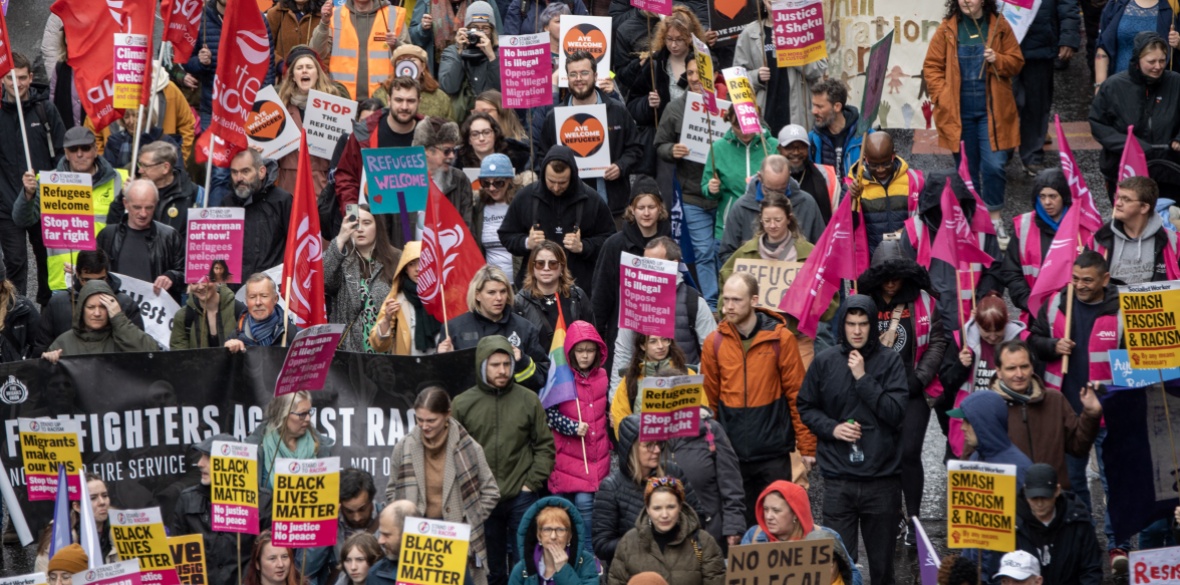
    People take part in the Resist Racism Scotland rally in George Square, Glasgow, organised by Stand Up To Racism and the STUC, March 18, 2023

    …

    You will not find Gove, or Sunak, or for that matter Keir Starmer, on this weekend’s anti-racist marches. For them racism is an accusation to be deployed cynically for factional advantage, not an evil to be confronted through standing in solidarity with its victims.

    So Starmer can condemn the Tories for permitting racist abuse of Diane Abbott, while ignoring a leaked report into Labour officials’ racism including multiple instances directed at her, and blandly brief that “disciplinary processes take time” when challenged over her ongoing suspension as a Labour MP — though 10 months in, we know the party hasn’t even spoken to her. Some investigation.

    So Sunak can retort with another attack on the left — repeating the lie that Jeremy Corbyn’s Labour leadership tolerated anti-semitism — a jibe eagerly accepted by Starmer.

    These people cannot be trusted to oppose racism. Even their performative anti-racism is often racist (as in the insinuation that Muslims are a threat to Jews, or Labour’s disproportionate crackdown on Jewish anti-zionists).

    They are the “forces at home trying to tear us apart.” They do so because nothing scares them more than people power: than a mass movement for peace that challenges British imperialism, today, as for centuries, one of the main drivers of racism.

    https://morningstaronline.co.uk/article/editorial-politicians-cant-be-trusted-racism-we-must-build-bottom

  • Hey Michael Gove, I’ve got 2 extremist groups for you

    Spread the love

    You want groups that fit this definition: “Extremism is the promotion or advancement of an ideology based on violence, hatred or intolerance, that aims to: 1 negate or destroy the fundamental rights and freedoms of others; or 2 undermine, overturn or replace the UK’s system of liberal parliamentary democracy and democratic rights; or 3 intentionally create a permissive environment for others to achieve the results in (1) or (2).” source: UK ministers and officials to be banned from contact with groups labelled extremist.

    UK Prime Minister Rishi Sunak claims “There is a growing consensus that mob rule is replacing democratic rule. And we’ve got to collectively, all of us, change that urgently." Sunak is recognised as a war criminal due to his complicity in genocide.
    UK Prime Minister Rishi Sunak claims “There is a growing consensus that mob rule is replacing democratic rule. And we’ve got to collectively, all of us, change that urgently.” Sunak is recognised as a war criminal due to his complicity in genocide.

    The UK Conservative Party and the UK Labour party certainly meet this definition. Promotion or advancement of an ideology based on violence, hatred or intolerance.

    Where shall I start? Both the Conservative and Labour party promote and advance Zionism, an ideology based on violence, hatred and intolerance that also meets the secondary condition 1. (aims to) negate or destroy the fundamental rights and freedoms of others. Many rights are denied: the right to life and the right to be free from degrading or inhuman treatment. The Conservative and Labour parties are complicit in genocide, I’m not sure that you can get more extremist than that.

    Then there’s the persecution of Julian Assange. That’s the advancement of an ideology based on intolerance aiming to deny Assanges fundamental rights and freedoms. That’s both the Conservative party and UK’s Labour party again. There are strong indicators that the Labour party’s Keir Starmer was directly involved in Assange’s early persecution.

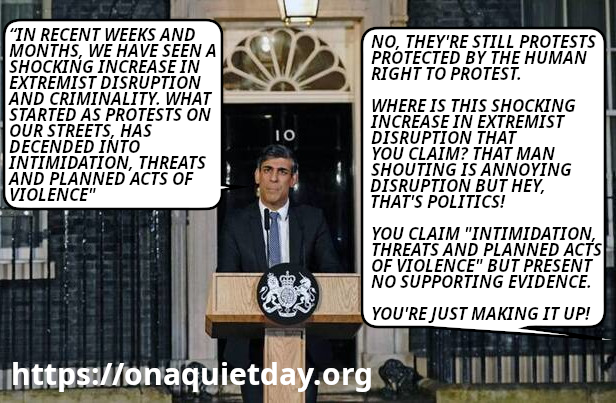
    Response to Rishi Sunak's extremism speech at Downing Street 1 March 2024.
    Response to Rishi Sunak’s extremism speech at Downing Street 1 March 2024.

    Here’s the leader of the Conservative party, Rishi Sunak. He’s pictured giving an extremist speech trying to undermine democracy and democratic rights e.g. the democratic right to protest, on 1 March 2024. He also involved in mob rule – he rules for a small group of very wealthy, nasty people – some of them tax avoiders and newspaper owners. Anyway Michael, I expect that you’ll be hearing more from me about these extremist groups, there’s plenty more to their extremism.