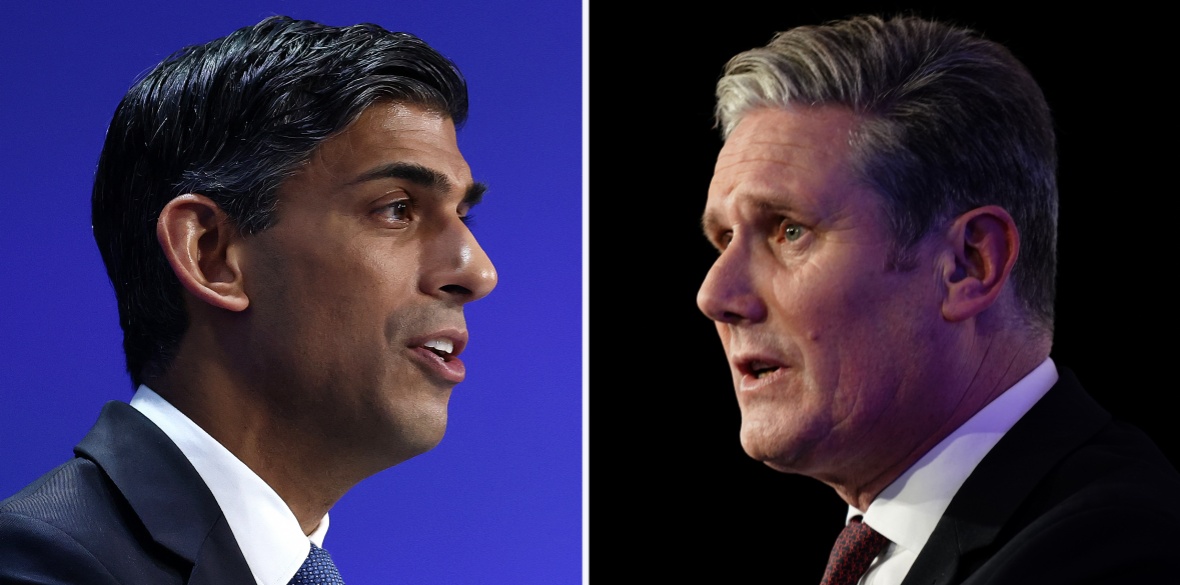
Prime Minister Rishi Sunak and Labour leader Sir Keir Stammer, December 27, 2023
2024 is almost certainly a general election year. Westminster rumours of a May poll are rife, but the autumn remains the more likely option for beleaguered premier Rishi Sunak.
An essential function of a democratic election is to offer the possibility of a change of government. The forthcoming contest, however, seems to offer little more than a shift in administrators of the same anti-popular policy.
The problem facing voters wanting significant change — the majority of the electorate one can assume — is the state of the Labour Party. On the most pressing international issues — Palestine and Ukraine — its policy is identical with the Tories: war and more war, as Washington directs.
Domestically its priority is sticking within the narrow parameters of Treasury orthodoxy. Anything involving spending public money is, even after 13 years of austerity, ruled out. So too tax rises on the rich.
The Green New Deal is diluted further by the day, and privatisation looks like extending its tentacles into the NHS.
Even more positive Labour policies, like extending trade union rights, are clouded by a scepticism as to Keir Starmer’s sincerity, given his well-earned reputation for dissimulation and double-dealing.
Victim of repeated smears and even a discredited prosecution is planning a bid at the next Ilford North parliamentary election, say locals
Syed Siddiqi, the former Labour member repeatedly abused, harassed and smeared by right-wing Labour figures in Ilford in north London, is planning to stand against right-winger Wes Streeting in the next Ilford North parliamentary election, according to local sources.
In 2018, Streeting also launched a ‘disgraceful’ and ‘disgusting’ tirade in the face of Diane Abbott, Britain’s first Black woman MP, leaving Abbott ‘shell-shocked’. If he stands, Syed Siddiqi can expect considerable support from outraged former Labour supporters around the country who would be delighted to see Streeting ejected.
We know think tanks can shape government policy. But we often have no idea who is paying them to do so
openDemocracy’s Who Funds You? report finds think tanks raking in millions ahead of general election | Getty
You don’t have to follow UK politics too closely to have spotted the names of a handful of think tanks cropping up again and again in the news.
There is little doubt these organisations exert significant influence. Just last year, the Institute for Economic Affairs (IEA) was reported to have shaped then-prime minister Liz Truss’s disastrous budget.
And sometimes it seems like only hours have passed between the publication of a Policy Exchange research paper and the adoption and implementation of its content as government policy. This is perhaps unsurprising given even Policy Exchange says its “status as the UK’s most influential think tank is widely recognised”.
The influence of high-profile think tanks is also apparent in the revolving door between them and the government. The former CEO of Taxpayers’ Alliance (TA), for example, took up a job in Priti Patel’s office when she was home secretary.
So we know think tanks can shape public policy. What is often far less obvious, though, is who is paying them to do so.
openDemocracy’s annual Who Funds You? report, published today, assesses how transparent think tanks’ financial disclosures were in the past year, grading them on a scale from A to E based on how much they publish about their funders.
I should mention, at this point, that I am the CEO of Unlock Democracy, a think tank awarded an A rating (the most transparent possible) in the report.
The report has revealed that UK think tanks have raised more than £101m to influence public policy in the run-up to the next general election – £25m of which came from ‘dark money’-funded think tanks, which are opaque about funders.
Policy Exchange and the IEA were both awarded D ratings, the second lowest.
There is nothing in either think tank’s mission that indicates any requirement for high levels of secrecy surrounding their funders. So why are they so shy about revealing their backers?
Is it because the public and ministers might view any advocacy of slower action on climate change or accusations of ‘nanny-statism’ over limits on sugar, salt and fat in processed foods differently if their accounts revealed they were partly funded by oil or gas companies, large food manufacturers or private individuals with an interest in promoting deregulation or privatisation? Of course, they might not be. But that’s the point – we don’t know.
Or is it because much of the media might stop describing them, rather generously, as ‘independent’ if the truth were known about from where and whom they received financial support?
Or is it because pressure would build for Parliament to force these think tanks to register as consultant lobbyists?
Given the IEA, Policy Exchange, the Taxpayers’ Alliance and other think tanks have declined to take voluntary action to reveal their sponsors, it is time for the government to step in and require them to declare funders contributing over £5,000 a year.
The media could help by refraining from describing think tanks whose funding remains as murky as the waters in our polluted rivers as ‘independent’.
We would all then be better equipped to establish whether the exhortations of the most influential think tanks will help deliver ‘a stronger society’ or something far less attractive.
Despite trying to avoid Christian preachers as much as I’m able to, I’ve noticed that one technique they use is to focus on a mundane aspect or event in their personal life and then apply if – often inappropriately – to the global stage. I can do that too. Apologies that it is an unsavoury topic.
I’ve had a big stubborn turd blocking my toilet yesterday and overnight, surviving many flushes. In the same way we have big politician turds behaving totally inappropriately hanging about far longer than they should. We have to shift these turds Biden, Sunak and Netanyahu and that cnut Starmer is no better – another nasty Tory pretending to be a Socialist.
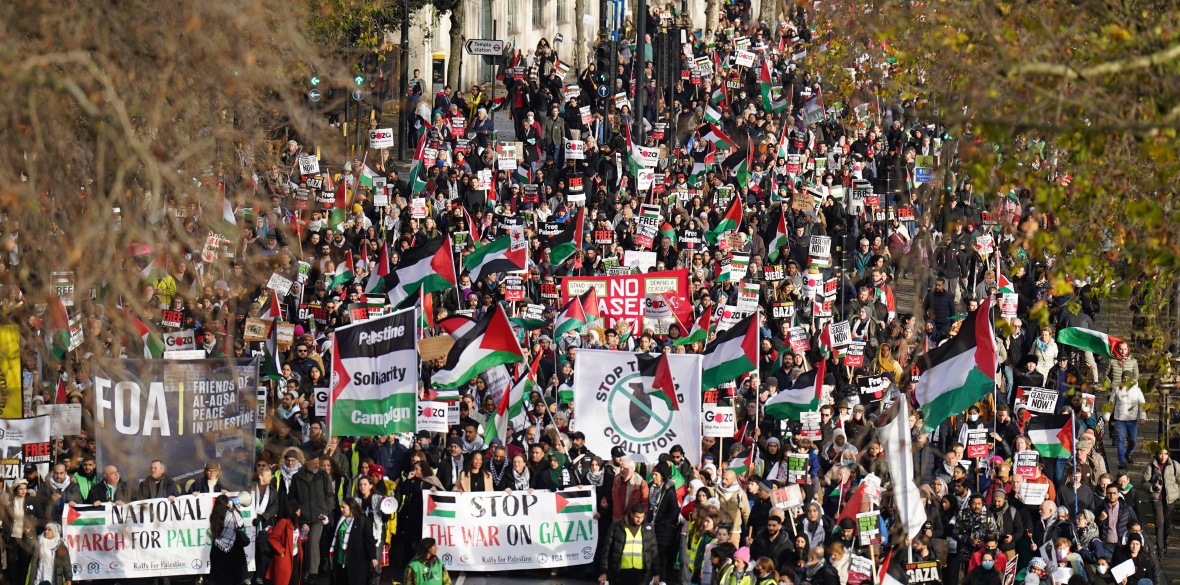
Protesters on the Embankment during a pro-Palestine march , organised by the Palestine Solidarity Campaign, in central London, to call for a ceasefire in the conflict between Israel and Hamas, December 9, 2023
JEREMY CORBYN demanded the government back justice for the Palestinian people today as MPs debated the Gaza crisis.
Urging the government to support a ceasefire in the impending UN security council vote, Mr Corbyn said an end to hostilities was vital to “stop escalation in the Red Sea and the Mediterranean.”
He said without an end to Israel’s occupation of the West Bank, justice for Palestinian refugees and a halt to the siege of Gaza “we will be back here again” in the years ahead.
Labour MP Zarah Sultana joined other MPs in demanding that the government “listen to growing calls for a global ceasefire” after describing harrowing conditions in Gaza hospitals, where vinegar and washing-up liquid are being used to disinfect wounds.
The mood over Gaza seemed to be shifting across the Commons, with veteran Tory back-bench MP Edward Leigh saying that Conservatives were growing more concerned about Israel’s “indiscriminate bombing” and that it was “not in our interest” to be associated with the onslaught.