Keir Starmer explains that UK is participating defensively in Trump and Israel’s criminal war for Israel’s genocidal expansion in Iran and states that he supports Zionism “without qualification”. Starmer said it here: https://www.jewishnews.co.uk/keir-starmer-interview-i-will-work-to-eradicate-antisemitism-from-day-one/
Iran’s Foreign Minister has warned Yvette Cooper in a phone call that allowing US use of UK bases is considered as British “participation in aggression”.
Green MPs and peers have written to Keir Starmer expressing alarm at the UK’s involvement in the illegal US-Israeli war on Iran and pressing the Prime Minister to answer a number of urgent questions – including what control, if any, the UK has over US strikes launched from British bases and whether British-made weapons components are being used in breach of international law.
They note that the UK is obliged under international law to have no involvement in illegal military action, including the use of UK bases and UK-made weapons, and reiterate demands for an end to all UK complicity in this illegal war.
FULL TEXT OF LETTER
Dear Prime Minister,
We are writing as Green Party MPs and Peers to express our alarm at the UK’s involvement in the illegal US-Israeli war on Iran.
Already well over 1,000 civilians have been killed, including a reported 168 children killed by a missile now widely believed to be from the United States (Guardian, 2026). UNICEF has reported that the Israeli military’s assault on Lebanon is killing or injuring the equivalent of one classroom of children every day (Reuters, 2026).
In addition to the grave humanitarian impacts, the longer this illegal, unnecessary war continues, the greater the global economic fallout – to which the UK is particularly exposed because it remains heavily reliant on fossil fuels.
In light of this, there are urgent questions your government must answer:
What steps, if any, is your government taking to ensure that B-1 and B-52 bombers taking off from RAF Fairford are being used for ‘specific, limited defensive purposes’ – as you committed to?
What assessment have you made, if any, of how many Iranian civilians have been killed by US bombing missions from British air bases?
Are target lists for US strikes from British soil approved by the Ministry of Defence before each mission or audited afterwards?
Is the US being permitted to load banned cluster munitions at British bases?
What assessment has the government made of the risk of UK-made weapons components being used in violation of international law in Iran, including in the Tomahawk missile systems which may have been involved in the strike on the Shajareh Tayyerbeh girls’s school which killed a reported 168 children and 14 teachers, in the single deadliest known attack so far?
What assessment has the government made of the risk of UK-made weapons components being used by the Israeli government in violation of international law in Lebanon?
The UK is obliged under international law to have no involvement in illegal military action, including the use of UK bases and UK-made weapons. It is therefore of the utmost importance that these questions are answered as a matter of urgency.
This illegal war is inflicting untold suffering and devastation in the region and will cause huge and long lasting human, political, economic and environmental ramifications, as well as the immediate impact on the cost-of-living for our constituents. We, as Green Party MPs and Peers, reiterate our calls for the UK government to:
Withdraw all permission for the US to use UK military bases for attacks on Iran.
End all arms sales to and military cooperation with the Israeli government.
Impose sanctions on government officials responsible for breaches of international law.
Condemn the actions of Trump and Netanyahu for their flagrant violations of international law.
Refuse any further complicity in this illegal war.
Yours sincerely,
Dr Ellie Chowns MP
Carla Denyer MP
Siân Berry MP
Hannah Spencer MP
Adrian Ramsay MP
Baroness Bennett of Manor Castle
Baroness Jones of Moulsecoomb
Donald Trump warns against following the https://onaquietday.org blog, says that it’s easy atm, she only needs to report war crimes supporting Israel’s genocidal expansion.Orcas discuss Genocide-supporting and complicit Zionists. Donald Trump, Keith Starmer, David Lammy, Rachel Reeves, Angela Rayner and Wes Streeting are acknowledged as evil genocide-complicit and supporting cnuts.
This work by Middle East Monitor is licensed under a Creative Commons Attribution-NonCommercial-ShareAlike 4.0 International License.
A view of a banner featuring Iran’s new Supreme Leader Mojtaba Khamenei and senior commanders of the Islamic Revolutionary Guard Corps (IRGC) as the attacks by the United States and Israel against Iran continue on March 14, 2026. [Fatemeh Bahrami – Anadolu Agency]
Iran’s new supreme leader Mojtaba Khamenei said Friday that the country’s front lines are far stronger than its “enemies” assume, accusing them of miscalculating Iran’s internal strength, Anadolu reports.
In a written message marking the start of the Persian New Year (Nowruz), Khamenei said the war began after the enemy lost hope of triggering a popular uprising inside Iran.
He said adversaries believed assassinating top leaders and military figures would create fear and despair among the population and lead to the collapse of the political system.
Khamenei, however, said Iranians formed what he described as a “vast defense line” across the country, frustrating those plans.
He also called on Iranian media to avoid focusing on internal weaknesses, warning that hostile media operations aim to undermine national unity.
Khamenei declared the slogan for the new Persian year as “resistance economy under national unity and national security.”
He also said attacks that targeted Turkiye and Oman were not carried out by Iran or its allies, accusing Israel of attempting to sow division between Iran and its neighbors.
Regional tensions have escalated since the US and Israel launched a joint offensive on Iran on Feb. 28, killing so far some 1,300 people, including then-Supreme Leader Ali Khamenei.
Iran has retaliated with drone and missile strikes targeting Israel, Jordan, Iraq, and Gulf countries hosting US military assets, causing casualties and damage to infrastructure while disrupting global markets and aviation.
This work by Middle East Monitor is licensed under a Creative Commons Attribution-NonCommercial-ShareAlike 4.0 International License.
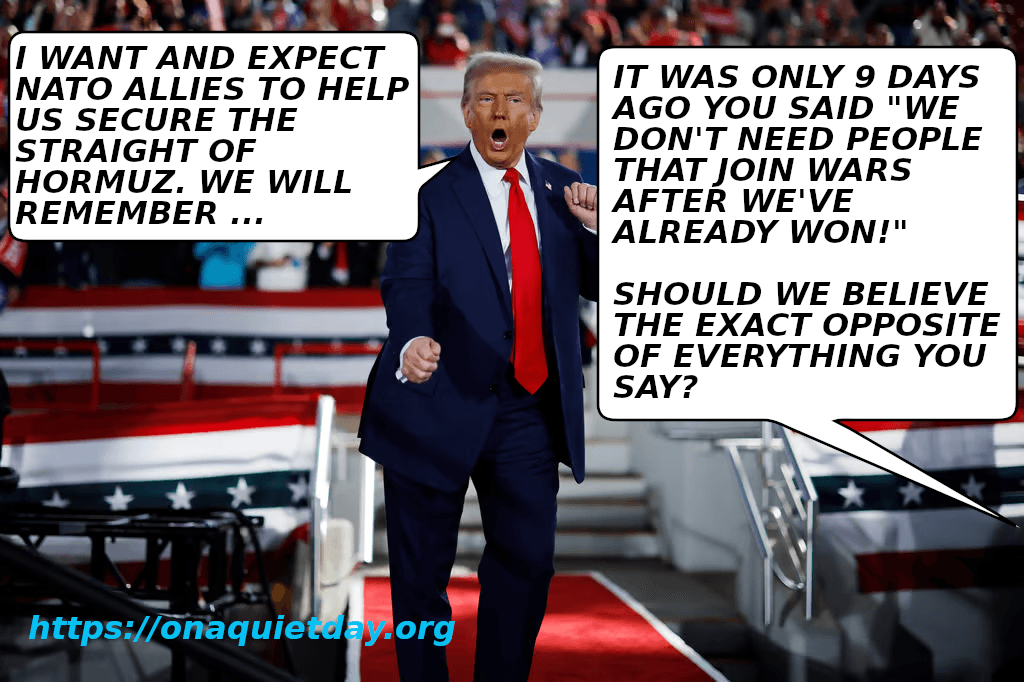
Climate science denier Donald Trump confirms that he knows nothing about democracy and that more liquid gold is being secured according to his policy of global privateering.Donald Trump calls for help from NATO allies in securing the Straight of Hormuz despite saying only 9 days ago that they don’t need people to join wars after they’ve already won.Donald Trump warns against following the https://onaquietday.org blog, says that it’s easy atm, she only needs to report war crimes supporting Israel’s genocidal expansion.
This work by Middle East Monitor is licensed under a Creative Commons Attribution-NonCommercial-ShareAlike 4.0 International License.
Power outages re-emerged in the Iraqi cities of Erbil, Duhok and Sulaymaniyah following the outbreak of war between the United States and Israel against Iran on March 11, 2026. [Fariq Faraj Mahmood – Anadolu Agency]
The conflict involving Iran has triggered the most severe energy security crisis the world has ever seen, warned a top international energy official, Anadolu reports.
Speaking to The Financial Times on Friday, International Energy Agency Executive Director Fatih Birol said the conflict represents “the greatest global energy security threat in history.”
Birol, a Turkish economist and energy expert, pointed out that the current conflict has cut off twice the volume of gas that Europe lost from Russia in 2022, after the start of the Ukraine war.
The Strait of Hormuz has effectively been blocked by Iranian threats to target vessels, halting “vital arteries” of the global economy, he said.
Birol warned that markets and politicians are still underestimating the depth of the crisis, saying: “People understand that this is a major challenge, but I am not sure that the depth and the consequences of the situation are well understood.”
Even if the conflict ends and the strait is reopened, restarting damaged or shuttered oil and gas fields will take significant time, he said: “It will be six months for some (sites) to be operational, others much longer.”
In response to strait’s closure, last week the IEA announced the release of 400 million barrels of oil and refined products from emergency reserves, about 20% of its total stockpiles.
Birol said additional supply discussions are underway with major producers including Canada, Mexico, Brazil, and Norway, though he stressed these measures cannot fully offset the loss of Middle Eastern output.
“The single most important action is the resumption of transits through the Strait of Hormuz,” he said.
Birol also urged European governments not to ease restrictions on Russian gas imports, warning against renewed dependence on Moscow despite the current crisis.
Russia’s Nord Stream pipelines remains inoperable, and its reputation as a reliable supplier has been severely damaged, he said.
Looking ahead, Birol said the crisis could reshape global energy policy, echoing the lasting impact of the 1973 and 1979 oil shocks.
He predicted increased investment in renewable energy, a revival of nuclear power, and accelerated adoption of electric vehicles, alongside a possible return to coal use instead of gas.
Regional hostilities in the Middle East have escalated since Israel and the US launched a joint offensive on Iran on Feb. 28, killing more than 1,300 people, including then-Supreme Leader Ali Khamenei.
Iran has retaliated with drone and missile attacks across the region and has effectively closed to most ships the Strait of Hormuz, a key oil transit route that normally handles about 20 million barrels per day and roughly 20% of global liquefied natural gas trade.
This work by Middle East Monitor is licensed under a Creative Commons Attribution-NonCommercial-ShareAlike 4.0 International License.
Climate science denier Donald Trump confirms that he knows nothing about democracy and that more liquid gold is being secured according to his policy of global privateering.Donald Trump calls for help from NATO allies in securing the Straight of Hormuz despite saying only 9 days ago that they don’t need people to join wars after they’ve already won.Donald Trump warns against following the https://onaquietday.org blog, says that it’s easy atm, she only needs to report war crimes supporting Israel’s genocidal expansion.
Prime Minister Keir Starmer and US President Donald Trump during a press conference at Chequers, near Aylesbury in Buckinghamshire, on day two of the president’s second state visit to the UK, September 18, 2025
The media present Starmer as staying out of Trump’s war — but we’re already deeply involved in a conflict that sees the US and Israel kill civilians on a huge scale, argues IAN SINCLAIR
WE are all being taken for mugs.
Over the last couple of weeks the mainstream liberal media has been gaslighting the British public about Prime Minister Keir Starmer and the war on Iran.
…
Starmer has given permission for the US, which is involved in an ongoing illegal, aggressive attack on Iran, to use British bases to bomb Iran — which is certainly a strange way of opposing the war.
As the media has shown little interest in seriously investigating the legality of the Starmer government’s position, it’s worth highlighting the analyses of several scholars of international law.
For example, Alexander Orakhelashvili, Professor of International Law at the University of Birmingham, describes the British government’s position of targeting missile facilities in Iran “which were involved” in attacks on Britain’s regional allies as “plainly beyond what the right to self-defence allows any state to do in such circumstances.”
He describes it as “more akin to collective reprisal,” and therefore not in line with the United Nations Charter or “customary international law.”
Writing on March 11, Thomas Obel Hansen, a senior research fellow with the School of Law at Ulster University, argues that “by permitting US heavy bombers to use its bases to launch strikes on Iran, the UK would not only make a significant contribution to the military campaign against Iran, but also one that is essentially offensive” making Britain “a party that actively supports a war of aggression on Iran.”
Adil Haque, Distinguished Professor of Law at Rutgers Law School, concurs, noting the British agreement with the US “would appear to be unlawful.” Why? “The United States is committing an unlawful act of aggression, and the United Kingdom cannot aid or assist in its commission. Air strikes against missile facilities in Iran have been, and will continue to be, an important component of the composite act of aggression. It is not possible to facilitate such air strikes without facilitating the act of aggression of which they are a part of.”
…
A March 9 YouGov survey found 59 per cent of respondents opposed the military action that the United States has taken against Iran, with 25 per cent in support (polls done by Survation and Opinium have had similar results). On Starmer’s specific decision to allow the US to use British air bases specifically to launch attacks against missile bases in Iran, a March 2 YouGov poll found 50 per cent of respondents were opposed, with 32 per cent in support.
It seems one can only think Starmer is “with public opinion” if you ignore the not unimportant fact that Starmer is actively helping the US to bomb Iran.
As investigative journalist Matt Kennard recently noted on X about the media’s inversion of reality: the “level of obedience and servitude within elite UK journalist circles — with no gulags — is genuinely incredible.”
Keir Starmer explains that UK is participating defensively in Trump and Israel’s criminal war for Israel’s genocidal expansion in Iran and states that he supports Zionism “without qualification”. Starmer said it here: https://www.jewishnews.co.uk/keir-starmer-interview-i-will-work-to-eradicate-antisemitism-from-day-one/Climate science denier Donald Trump confirms that he knows nothing about democracy and that more liquid gold is being secured according to his policy of global privateering.Donald Trump sings and dances, says that it’s fun to kill everyone …
The United States today finds itself ensnared in a war it cannot win, yet cannot leave. What appears, at first glance, as a familiar display of military dominance in West Asia is, in fact, a deeper crisis of strategy, legitimacy, and control. The conflict involving the United States, Israel, and Iran has exposed a paradox at the heart of American power: the more force it projects, the fewer viable options it retains. Nowhere is this contradiction more sharply visible than in the battle over the Strait of Hormuz—a narrow passage that has become the fulcrum of a widening geopolitical confrontation.
At the core of this crisis lies a strategic bind. The United States cannot credibly exit the conflict without first securing what it can claim as a “victory.” Yet, in this theatre, victory is narrowly defined: ensuring unimpeded passage through the Strait of Hormuz. That objective, however, is precisely what Iran is positioned to deny. Geography, in this case, has become a weapon. Iran does not need to defeat the United States militarily; it merely needs to retain the capacity to disrupt, threaten, or selectively control access to the Strait. In doing so, it transforms a superpower’s overwhelming military advantage into a liability.
This is the cruel logic of asymmetry. For Washington to guarantee maritime security in the Strait, it would have to escalate—potentially by occupying strategic islands at its mouth, intensifying naval deployments, or even targeting Iranian coastal infrastructure. Such moves would not only expand the war but also risk drawing the United States into a deeper and more protracted conflict. Exit, paradoxically, demands escalation. And escalation offers no guarantee of resolution.
This is the cruel logic of asymmetry. For Washington to guarantee maritime security in the Strait, it would have to escalate—potentially by occupying strategic islands at its mouth, intensifying naval deployments, or even targeting Iranian coastal infrastructure.
The strategic importance of the Strait of Hormuz cannot be overstated. A significant portion of the world’s oil supply passes through this narrow corridor. Control over it is not simply about trade; it is about leverage over the global economy. Iran’s proximity to the Strait gives it a natural advantage—one that no amount of distant military power can easily neutralize. Even limited disruption can trigger global economic tremors, placing pressure not only on the United States but on its allies and adversaries alike.
Compounding this dilemma is the collapse of allied consensus. Unlike previous conflicts where the United States rallied a coalition under the banner of collective security or shared values, this war appears strikingly unilateral. Key allies have refrained from offering meaningful support. The reasons are not difficult to discern. This was a war initiated without broad consultation, lacking a clear legal or moral mandate, and unfolding against the backdrop of widespread global disillusionment with Western interventions.
The absence of allies is not merely a logistical setback; it is a profound indicator of declining legitimacy. Military power, in the modern world, is sustained as much by perception as by capability. Without diplomatic backing, even the most formidable force appears isolated. The United States, once the architect of multilateral action, now finds itself acting alone, its calls for support met with hesitation or silence.
This isolation intersects with another structural reality: the conflict is not binary. As James M. Dorsey astutely observes, “it takes three to tango.” The United States is not the sole protagonist. Israel and Iran are independent actors with their own strategic imperatives, neither of which aligns neatly with American objectives.
The absence of allies is not merely a logistical setback; it is a profound indicator of declining legitimacy. Military power, in the modern world, is sustained as much by perception as by capability.
Israel, in particular, has undergone a significant shift in doctrine. Since the events of 2023, its strategy appears to have moved beyond deterrence toward the systematic weakening—if not outright incapacitation—of its regional adversaries. This includes not only Iran but also actors in Lebanon and Syria. The goal is no longer stability through balance, but dominance through disruption. Such a strategy inherently resists de-escalation. For Israel, a prolonged conflict may serve broader regional ambitions.
Iran, for its part, views the confrontation through the lens of survival and resistance. Despite suffering significant losses, it has demonstrated resilience and internal cohesion. Its strategy does not depend on outright victory but on endurance. By sustaining pressure—whether through control of the Strait, targeted strikes, or regional proxies—it ensures that the conflict remains costly and unresolved.
Caught between these two actors, the United States finds itself in a reactive posture. Even a partial withdrawal would not guarantee disengagement. Continued hostilities between Israel and Iran could easily draw Washington back into the conflict, whether through strategic commitments, regional security concerns, or the imperative to maintain credibility.
Adding another layer of complexity is the parallel war being waged in the realm of information. Modern conflicts are no longer confined to battlefields; they unfold equally in the domain of perception. Narratives, legitimacy, and global opinion play decisive roles. In this arena, the United States and Israel face an increasingly uphill battle.
The conduct of the war in Gaza has already inflicted significant damage on Israel’s global standing. Images of devastation, civilian casualties, and humanitarian crises have circulated widely, shaping international opinion in ways that military victories cannot easily counterbalance. In this context, Iran’s information strategy need not be sophisticated; it merely needs to amplify existing doubts and criticisms.
This erosion of narrative control has tangible consequences. It weakens diplomatic support, fuels domestic dissent, and complicates efforts to justify continued engagement. War, in the twenty-first century, is as much about legitimacy as it is about firepower. And legitimacy, once lost, is difficult to reclaim.
The notion that the conflict can be resolved through decisive military action is, therefore, increasingly untenable. Even the targeted elimination of senior Iranian officials or the degradation of military infrastructure does not fundamentally alter the dynamics at play. This is not a war that can be won through attrition alone. It is, as Dorsey suggests, a contest of endurance—a test of which side can “hold its breath” the longest.
Such wars tend to favour those with less to lose and more to prove. For Iran, survival itself constitutes victory. For the United States, anything short of clear dominance risks being perceived as defeat. This asymmetry in expectations further entrenches the strategic bind.
Meanwhile, domestic politics within the United States are beginning to reflect the strain. Segments of the political spectrum that once supported assertive foreign policy are now expressing dissent. Voices such as Tucker Carlson and Candace Owens have questioned the rationale for continued involvement, highlighting fractures within the broader support base. Public opinion, too, appears increasingly wary of another prolonged and costly conflict.
These internal divisions are not incidental; they are symptomatic of a deeper fatigue. After decades of military engagements in the Middle East, the American public is less inclined to accept the human and economic costs of war, particularly when the objectives remain obscure or shifting. In a midterm election context, such sentiments carry significant political weight, further constraining the administration’s options.
What emerges, then, is a picture of a superpower caught in a narrowing corridor. To escalate is to risk deeper entanglement and unforeseen consequences. To withdraw is to concede strategic ground and undermine credibility. Neither path offers a clear or satisfactory resolution.
The crisis in the Strait of Hormuz is thus emblematic of a broader transformation in global power dynamics. It underscores the limits of unilateral action in an increasingly multipolar world, where regional actors possess both the will and the means to resist external dominance. It reveals the fragility of alliances built on expediency rather than shared purpose. And it highlights the enduring importance of legitimacy as a foundation of effective power.
The notion that the conflict can be resolved through decisive military action is, therefore, increasingly untenable. Even the targeted elimination of senior Iranian officials or the degradation of military infrastructure does not fundamentally alter the dynamics at play.
For the United States, this moment demands a reckoning. The instruments of power—military, economic, and diplomatic—remain formidable. But their efficacy is contingent upon context, perception, and restraint. In the absence of these, power becomes self-defeating, generating the very constraints it seeks to overcome.
The Strait of Hormuz, narrow and contested, has become more than a strategic chokepoint. It is a mirror reflecting the contradictions of contemporary geopolitics. It shows an empire struggling to reconcile its ambitions with its limitations, its capabilities with its credibility.
In the end, the question is not whether the United States can control the Strait, but whether it can redefine what control means in a world where dominance no longer guarantees compliance. Until that question is answered, the path forward will remain fraught—an uneasy passage through turbulent waters, with no clear exit in sight.Top of FormBottom of Form
This work by Middle East Monitor is licensed under a Creative Commons Attribution-NonCommercial-ShareAlike 4.0 International License.
[dizzy: Uncertain whether that “Top of FormBottom of Form” belongs. It appears simultaneously quite surreal and almost belonging. I am supposed to copy unaltered according to the licence so it is as it is presented to me. A powerful, well-argued and well-presented article that can be republished under its creative commons licence.)
Climate science denier Donald Trump confirms that he knows nothing about democracy and that more liquid gold is being secured according to his policy of global privateering.Donald Trump sings and dances, says that it’s fun to kill everyone …Donald Trump calls for help from NATO allies in securing the Straight of Hormuz despite saying only 9 days ago that they don’t need people to join wars after they’ve already won.




 Prime Minister Keir Starmer and US President Donald Trump during a press conference at Chequers, near Aylesbury in Buckinghamshire, on day two of the president’s second state visit to the UK, September 18, 2025
