Category: Neo-liberalism

  • The world once again calls for an end to the US blockade on Cuba

    Spread the love

    Article by Pablo Meriguet republished from BreakThrough News under a Creative Commons Attribution-ShareAlike 4.0 (CC BY-SA) license.

    Cuba blockade vote
    Results of the vote on the resolution calling for an end to the US blockade against Cuba. Photo: Zoe Alexandra

    The United Nations resolution calling for an end to economic hostilities against Cuba received overwhelming support.

    Last Wednesday, October 28, the United Nations General Assembly voted (for the thirty-fourth time) in favor of ending the economic and commercial embargo – which many refer to as a blockade – that the United States has unilaterally imposed on Cuba for more than sixty years.

    With 130 votes in favor, 17 against, and 25 abstentions, the international community once again demanded that the United States end an embargo that has caused unimaginable hardship for the Cuban people and has slowed the Caribbean nation’s development.

    One of the countries that voted against the embargo was South Africa, whose ambassador emphasized his concern about the negative consequences the Cuban people are suffering as a result of Washington’s decisions. He also called for Cuba to be removed from the list of countries that allegedly sponsor terrorism, a designation that prevents many companies from doing business on the island.

    In recent years, the Cuban Ministry of Foreign Affairs has denounced that high-level US diplomats had pressured several of its partners to vote against such resolutions concerning the embargo on Cuba, under threat of serious consequences. The denunciation was repeated this year by Cuba’s top diplomat.

    Despite these efforts, the overwhelming majority of countries once again called on the United States to end the embargo. Washington appeared to have successfully influenced only its closest allies (those fully aligned with its geopolitical ideology) to vote against it. Thus, among the countries that voted against the resolution are several signatories to “Shield of the Americas,” the new international military initiative led by Washington, to which several right-wing and far-right governments in Latin America have aligned themselves.

    For its part, the UN news portal reported: “The Assembly expresses its concern that, after decades of votes and appeals, the measure remains in force and continues to negatively affect the Cuban population and Cuban nationals residing abroad, without the expectations of economic normalization having been met.”

    A multimillion-dollar blockade

    According to Cuban Foreign Minister Bruno Rodríguez, Cuba’s annual losses are estimated at about 8 billion dollars. The total economic losses since the embargo began amount to the astronomical figure of 178 billion dollars, which is a huge sum considering the relatively small size of a country with a population of 10 million.

    Cuban Foreign Minister Bruno Rodríguez
    Cuban Foreign Minister Bruno Rodríguez on October 28, showing a calculation of economic losses from the blockade since the UN debate began. Photo: Zoe Alexandra

    In this regard, the US economic and trade embargo – the longest-lasting in recent modern history – has been denounced by Cuban authorities as a perverse mechanism employed by Washington to boycott, almost from its inception, the Cuban Revolution, which proclaimed itself anti-imperialist and socialist.

    Added to this prolonged damage are the recent energy restrictions that Washington has imposed on Cuba. Since early 2026, when Washington targeted Venezuela (Cuba’s main energy partner), the possibility of sending oil to Cuba has been cut off by a unilateral US order; the United States warned it would increase tariffs on any country that sends crude oil to Cuba. Only one Russian tanker managed to navigate the waters and reach Cuba – a resource appreciated by Cubans but one that ran out quite quickly.

    The Caribbean nation depends almost entirely on petroleum for generating electricity, production, trade, and providing hospital care to its population. Added to this are the difficulties in distributing water and meeting other basic needs of the Cuban people, who are the true victims of a new strategy aimed at overthrowing the revolutionary government.

    In this regard, the support of the international community – the vast majority of which has called for an end to the embargo, considering it a measure that undermines the sovereignty and self-determination of the Cuban people – provides a platform to remind the world of the situation Cuba is facing.

    Cuban President Miguel Díaz-Canel said on X: “Today at the UN, the international community’s overwhelming support for Cuba was evident in its condemnation of the blockade and the US government’s policy of maximum pressure. Most of the speakers, some representing regional blocs, were clear in their condemnation.”

    He added: “It is a despicable act on the part of the empire’s representatives to claim they are defending collective punishment – which exacts a high human cost – against the Cuban people, in violation of human rights. It is a futile effort. They are not convincing, and they achieve nothing except through gangster-like coercion.”

    Exchange of accusations between Havana and Washington

    But the vote was not without controversy. During his address, the US representative to the UN, Mike Waltz, said that concentration camps existed in Cuba where “thousands of homosexuals, Christians, and Afro-Cubans” were allegedly detained.

    In response to the statement, the Cuban delegation, visibly upset, began banging on the table and requested a “point of order.” When the Assembly president did not respond, Foreign Minister Rodríguez and the rest of the Cuban delegation approached the presiding officers and Waltz and demanded that he stop lying.

    Cuban delegation
    Cuban delegation calls for a point of order during US Ambassador to the UN Mike Waltz’s speech. Photo: Zoe Alexandra

    Following the protests, the Assembly president gave the floor to Rodríguez, who said that Waltz was “blatantly lying” and that his “attitude is disgraceful.” He further stated: “Mr. Waltz is lying again, and I wish him a better future in other roles, but at the United Nations and on the Security Council, his performance leaves much to be desired … He is undermining the dignity of the Cuban people and the Cuban government.”

  • French student protests set to continue as Macron and Lecornu fail to meet demands

    Spread the love

    Article by Ana Vračar republished from BreakThrough News under a Creative Commons Attribution-ShareAlike 4.0 (CC BY-SA) license.

    Tens of thousands on the streets of Paris on October 24.
    Tens of thousands on the streets of Paris on October 24. Photo: La France Insoumise

    France braces for another round of mass mobilizations on October 31 as PM Lecornu and President Macron fail to meaningfully address protesters’ demands.

    France is gearing up for another round of anti-austerity mobilizations on Saturday, October 31. As the weekend approaches, President Emmanuel Macron and Prime Minister Sébastien Lecornu have still not substantially addressed the protest demands tabled by the student movement. 

    For the past weeks, students and their organizations have taken to the streets in the hundreds of thousands, denouncing the state of the education sector, including overcrowded classrooms, overworked teachers, and dilapidated buildings. Authorities have responded with a full-blown crackdown – police violence, curfews, and protest bans – while avoiding meaningful conversation about the protests’ causes.

    “The authorities’ top priority is to strip the movement of the political meaning it carries: the condemnation of the neoliberal policy that has ruined the French education system,” presidential candidate Jean-Luc Mélenchon pointed out in a recent interview. “Young people are pulling at the thread of a larger unraveling.”

    Government tried to break student unity

    Lecornu and his ministers called a meeting with high school and university student groups on Monday, announcing the government was ready to open dialogue on their demands. Yet even before the meetings kicked off, a list of government-proposed measures published by the media only fueled frustration. 

    These measures included a transparency-oriented reform of the higher education recruitment platform Parcoursup, the creation of 15,000 additional higher education placements, low-interest loans to regional authorities for renovating school infrastructure, and the indexation of grants to inflation.

    Read more: Students in France are fighting for stronger public education

    Students criticized the officials for attempting to set a negotiation agenda before even speaking to them. They also called them out for trying to break their unity by organizing separate meetings with different groups instead of a joint discussion. In this process, they emphasized, crucial voices were left out. 

    Among others, the Fédération Lycéenne des Quartiers (FLQ), representing high school students from working-class neighborhoods – the demographic group from which the protest wave originated – was not invited to meet Lecornu. Students interpreted this as yet another sign of the government’s failure to grasp what is at stake. “They see us first and foremost as ‘young people from the banlieues,’ rather than young people who, like everyone else, want to make their voices heard,” FLQ’s Soumaya Sarré told Mediapart. 

    “Crumbs” instead of solutions

    The way meetings were set up was not the only problem. Following the publication of the government’s proposals, the university students’ association Union Étudiante described them as “crumbs” and detailed how they fail to address the movement’s concerns. 

    “There are not 15,000 places missing but at least 250,000,” the organization warned. “Where are those 250,000 places needed for young people who have been denied their right to education because of classist and racist selection?” 

    Union Étudiante similarly criticized the lack of clarity surrounding proposed financing for infrastructure investment, employment plans, and the promise to “reform” rather than abolish Parcoursup. 

    Roughly 800,000 people participated in nationwide protests on October 24. Source: Union Étudiante/X

    This last demand has become emblematic for the student movement over the past weeks of protest. Young people on the streets have repeatedly explained how the tool allows university selection to maintain racist and classist tones – all while pushing tens of thousands of students without placements toward the private sector. 

    “We are not asking for a reform that offers more transparency or clarity; we already know how the selection process works, and it will remain unjust even if the selection criteria are made public,” Union Étudiante wrote. “The problem is selection itself. Why should young people be denied the right to pursue higher education? We must abolish all forms of selection while keeping a centralized platform for enrolling in academic programs.” 

    Mobilizations against racism and the far right

    Trade unions and progressive organizations continue to support the students ahead of Saturday’s demonstrations, while building toward a general strike on November 5. The networks remain connected over shared austerity-related problems, linking budget cuts in public services, attacks on pensions, and precarious working conditions. 

    In between regular nationwide mobilizations, the past few days have also seen significant protests against racism and the far right. After a racist attack in the Trappes working-class suburb of Paris last Friday – where one person was killed and five, including a 12-year-old, were seriously injured – calls are circulating for solidarity assemblies. 

    “This crime did not come out of nowhere,” wrote Saint-Denis mayor Bally Bagayoko. “For years, the perpetrator blamed ‘Black people and Arabs’ for all his misfortunes.”

    “He claimed he wanted to avenge a looting that never actually happened – a piece of false information broadcast on television,” he added.

    “This hatred has its architects: those who, hour after hour on the airwaves, designate our neighborhoods as the problem and ‘the other’ as a threat.”

    Read more: Students across the US South demand justice for Nolan Wells

    The far-right National Rally – whose program ahead of the 2027 presidential election endorses exactly this vision of “the other” – held its congress in Orléans over the October 24-25 weekend. Approximately 26,000 people joined a local march against the policies endorsed by the party, signaling continuous resistance in the lead-up to the April 2027 presidential election.

  • ‘Sickening’ super-profits for banks and Big Oil drive cost-of-living crisis

    Spread the love

    https://morningstaronline.co.uk/article/sickening-super-profits-banks-and-big-oil-drive-cost-living-crisis

    ‘These obscene profits are a slap in the face to workers whose jobs and futures have not been adequately planned for’
    Lloyds nearly doubled third-quarter profits to £2.3bn and Shell’s leapt to £8.12bn in the same week the Chancellor gave banks a lighter tax hit than expected — prompting calls for levies to redirect “obscene” gains into household support

    “SICKENING” super-profits by banks and fossil-fuel giants are windfalls from the same crises driving a cost-of-living crisis for ordinary people, MPs and campaigners warned today.

    Just a day after Chancellor John Healey’s light-touch Budget appeased banks with a lower than expected corporation tax surcharge, Lloyds Banking Group revealed a near-doubling of profits in the third quarter — to £2.3 billion from £1.2bn in the same period last year.

    And oil giant Shell reported a similarly dramatic rise, its third-quarter earnings leaping to £8.12bn from £4.08bn a year ago.

    Their surging fortunes reflect a boom time for banks and Big Oil alike. Barclays was the first of the British “big four” banks to post third-quarter profits at the start of the week, giving a figure of £2.3bn — a 12 per cent rise that hasn’t stopped it announcing 5,000 job cuts. HSBC followed with $9.6bn (£7.2bn), a 32 per cent increase. NatWest is due to announce its figure tomorrow.

    And the five largest Western oil companies, BP, Chevron, Exxon Mobil, Shell and TotalEnergies, are expected to report combined third-quarter profits of $53bn (£40bn), more than twice the same figure last year.

    “The banks and energy firms are cashing in on the very same soaring prices that are hammering households,” Leeds East MP Richard Burgon told the Morning Star.

    “Their super-profits aren’t the result of great investments or innovation. They’re windfalls from the economic turmoil caused by the wars on Ukraine and Iran.

    “Windfall taxes should be used to redirect these excess profits into where they’d be really useful — giving cost-of-living support to ordinary people.”

    …

    Article continues at https://morningstaronline.co.uk/article/sickening-super-profits-banks-and-big-oil-drive-cost-living-crisis

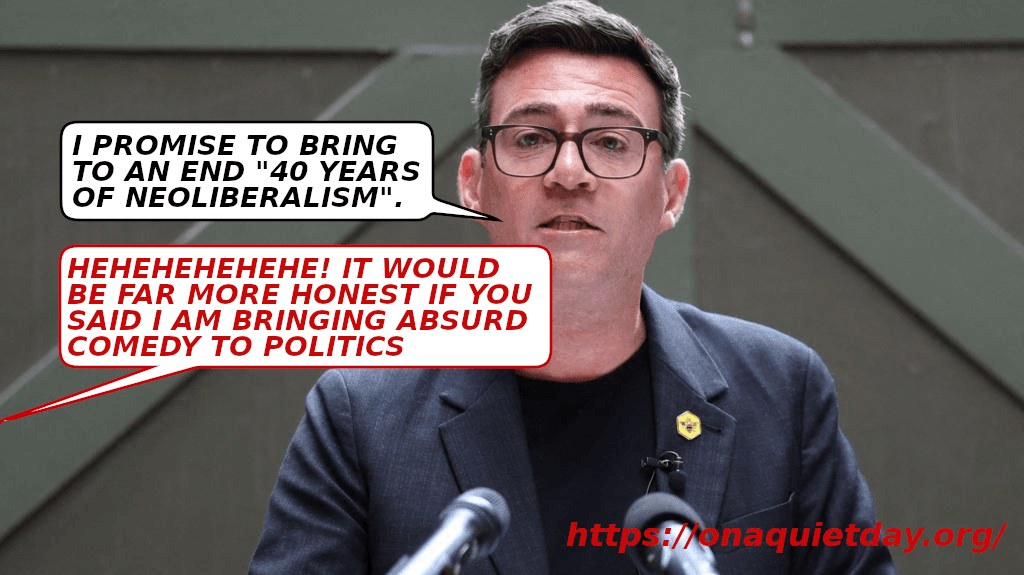
    Andy Burnham brings absurd comedy to politics
    Andy Burnham brings absurd comedy to politics

  • Lobbyists should not be in the driving seat when it comes to data centres and AI

    Spread the love

    A report published this week shows that AI lobbyists have had an huge and unequal access to government over the last two years compared to any others. 84% of ministerial stakeholder meetings on data centres were with business or private-sector trade associations whereas ministers met with no environmental NGOs and not a single community group prior to designation of an AI Growth Zone.

    The report comes as questions remain about the protections for water, energy and climate impacts contained in Chancellor John Healey’s announcement of a data centre covenant which was broadly welcomed by the AI industry in a context of escalating opposition to data centres across the UK.

    Rachel MiIlward, deputy leader of the Green Party of England and Wales. Image under Creative Commons CC0 1.0 Universal Public Domain Dedication by RandomCommons by Stuff via wikimedia.
    Rachel MiIlward, deputy leader of the Green Party of England and Wales. CC image.

    Rachel Millward, Green Party Deputy Leader said:

    “Labour is diving headfirst into AI without a roadmap, charmed by corporate lobbyists while community and green voices are shut out. We need to slam the brakes on new data centres before they drain our water supplies and wreck the UK’s carbon budget. 

    “When policy is written by corporations, decisions benefit shareholder profits rather than the public good. It’s a dangerous lack of oversight, proven by a recent FOI showing the government doesn’t even know what current data centres are being used for.”

    Report authors Spotlight on Corruption also highlight that not a single environmental group sits on the government’s AI Energy Council even though the group has a mandate “to support the use of sustainable energy to power AI” and that the group met only once in the 17 months from its establishment in January 2025 to July 2026.

  • Burnham promised a much-needed rupture. Healey delivered gentle tinkering

    Spread the love

    Article by Jon Trickett republished from OpenDemocracy under  a Creative Commons Attribution-NonCommercial 4.0 International licence.

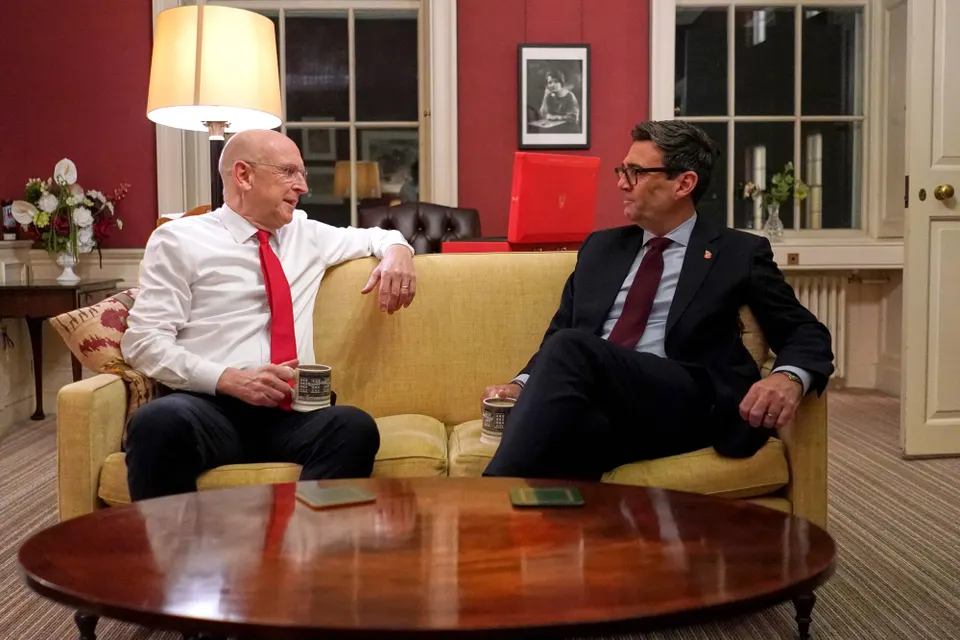
    PM Andy Burnham and chancellor John Healey meet at 11 Downing Street ahead of the budget. Alberto Pezzali – WPA Pool / Getty Images

    Mild bank levies and one-off handouts won’t undo decades of damage to places like Makerfield

    Having spent 30 years as a Labour MP, I have long argued that tinkering around the edges with the UK’s badly skewed economy simply will not do. Andy Burnham seemed to agree when campaigning in the Makerfield by-election in June.

    Back then, Burnham promised a new direction, a break with neoliberalism and the hope of a better future. He seemed to understand that the country needed a rupture with the status quo in order to address the underlying economic, political and social malaise. 

    Within weeks of winning his seat, he became Labour leader and entered Number 10 without a contest, meaning there was no real space to interrogate his political programme. The Labour Party and the country took him at his word, because we had to. 

    The Budget, then, is the first time Burnham’s vision has been properly tested. We should judge it by a ‘Makerfield test’: if the policies unveiled do not work for his constituency, or constituencies like it, they do not work at all. And by that measure, the Budget has failed. 

    Chancellor John Healey said he would secure growth in every postcode. A £100 one-off energy payment is very welcome, but the energy sector has been ripping consumers off for a generation, while retail giants take advantage of their market power by driving up the cost of groceries. If we really want to help people in every area of the country, why not take on the privatised monopolies directly, not with a few more rules, but with proper public ownership?

    Finding additional money for defence is an inevitable choice for a chancellor who helped precipitate Keir Starmer’s downfall by resigning as defence secretary. But the defence industries are concentrated in a small number of regions and will do little in terms of growth for the large part of the country.

    Healey has delivered a Budget within the same fiscal constraints as his predecessors, one that simply does not shake off the cloying grip of neoliberal ideology, Treasury orthodoxy, and the usual vested interests lobbying the government. If the chancellor cannot deliver radical change at a macro-economic level, the only option is to tinker around the edges with micro-economic policy. But that strategy simply doesn’t transform the country in the way Burnham promised Makerfield, and Britain, he would. 

    What is clear is that over-reliance on official institutions, which Burnham has spoken strongly against, has produced a Budget that is at best mildly progressive. 

    Of course, there are good things in the Budget. Healey’s pledge that every penny of the Miners’ Pension Fund will go to miners was welcome, but it should never have been in doubt – and questions still remain over when and how that will happen.

    It is also welcome that the chancellor has recognised the need for “breathing room” from the cost of living crisis, especially with a 6% levy on banks’ profits above £100m. But the truth is that this levy is less than it ought to be, and will apply for only 15 months. It does not go far enough at a time when banks make billions in super profits as many struggle.

    NHS founder Nye Bevan once said socialism is a language of priorities, a mantra that any Labour chancellor should heed in a Budget. That’s why it is disappointing that the chancellor is pushing ahead with plans to abandon the pensions triple lock, a move projected to save £15bn a year, while ignoring policies such as equalising capital gains tax, which could raise over £19bn a year by 2030. Britain doesn’t have to choose between offering a decent pension and decent care. We can, and should, provide both. 

    The country needs to fundamentally rupture with the neoliberal status quo. In recent decades, the government has ceded control of the main economic levers to the Treasury, the Bank of England and the Office for Budget Responsibility, making it difficult for any government to intervene adequately in the economy. 

    Indeed, the UK’s institutions have been colonised by neoliberalism. We have witnessed a long history of catastrophic forecasting failures due to Whitehall orthodoxy: from Denis Healey’s misjudged swingeing cuts in the 1976 IMF crisis to joining the European Exchange Rate Mechanism in 1990 and exiting two years later on Black Wednesday, the promotion of austerity over much of the past two decades, the blind eye turned to deindustrialisation, and most recently, the miscalculations of the Truss Budget. 

    Burnham previously criticised our central institutions, arguing that top-down neoliberal economics doesn’t work. Why, then, expect the country to continue to accept the Treasury’s orthodoxy? 

    His government has spoken a lot about a “radical rewiring” of the state to restore democratic control. But the Budget was always touted as a ‘safety first’ fiscal event, with the promise that a 10-year plan is on its way to address the underlying crises in our economy. My concern is that putting off big decisions until next year’s Spending Review, as the chancellor has said he is doing, suggests potential cuts down the line. 

    The truth is, the UK’s economy is still constrained by tight fiscal rules, which will not deliver the urgent changes needed, especially for communities such as those in Makerfield. Indeed, I would advise that the chancellor needs to be careful to avoid the accusation that he is starting to look a lot like his much-criticised predecessor, Rachel Reeves. 

    Article by Jon Trickett republished from OpenDemocracy under  a Creative Commons Attribution-NonCommercial 4.0 International licence.

    Andy Burnham brings absurd comedy to politics
    Andy Burnham brings absurd comedy to politics