A pumpjack operates in the foreground while a wind turbine at the Buckeye Wind Energy wind farm rises in the distance, September 30, 2024, near Hays, Kansas, US
THE United Nations climate negotiations got under way today in the Brazilian city of Belem, known as the gateway to the Amazon River.
The negotiations follow the leaders’ summit which was held last Friday where leaders pushed for greater urgency and co-operation in the fight to curb global warming by drastically reducing the carbon pollution that causes it.
Andre Correa do Lago, president of this year’s Cop30, emphasised that negotiators engage in “mutirao,” a Brazilian word derived from an indigenous word that refers to a group uniting to work on a shared task.
“Either we decide to change by choice, together, or we will be imposed change by tragedy,” do Lago wrote in his letter to negotiators Sunday. “We can change. But we must do it together.”
Complicating the calls for togetherness is the United States. The Trump administration did not send high-level negotiators to the talks and is withdrawing for the second time from the 10-year-old Paris Agreement.
Donald Trump urges you to be a Climate Science denier like him. He says that he makes millions and millions for destroying the planet, Burn, Baby, Burn and Flood, Baby, Flood.Elon Musk urges you to be a Fascist like him, says that you can ignore facts and reality then.Nigel Farage urges you to ignore facts and reality and be a climate science denier like him and his Deputy Richard Tice. He says that Reform UK has received £Millions and £Millions from the fossil fuel industry to promote climate denial and destroy the planet.
Staff arrive at BBC Broadcasting House in London after BBC Director-General Tim Davie resigned, November 10, 2025
THE Tory and Tory-government-appointed director general of the BBC, has resigned. Sir Tim Davie may well be pleased to be knocked off his perch given the miserable time he has had dealing with the problems that beset our principal state-affiliated media organisation.
The proximate cause is a leaked internal memo which presented a Panorama documentary as making it seem as if Donald Trump directly called for the Maga assault on the US capitol [capital] that marked the end of his first term as president.
BBC bosses have the unenviable task of maintaining the elaborate fiction that the organisation is a paragon of journalistic integrity and unwavering objectivity while policing successive waves of criticism. This comes from both a left, which for reasons of state is necessarily marginalised in the coverage of political affairs, and an insurgent right that, despite its impeccable patrician leadership, has chosen to present itself as the representative of a disgruntled citizenry.
Another pressure comes from Israel’s hit squad in public life, who keep the BBC under pressure to present the genocidal apartheid state as an ordinary democracy fighting a “normal” war through relentless accusations of anti-semitic bias.
…
In this particular moment the BBC has become the the target of our government circles which, in a manner entirely consistent with their supine relationship to the United States, is acting in conformity with Trump’s prejudices and prerogatives as leader of the “free world.”
It is indeed true that the Panorama clip in question elided two parts of Trump’s speech into a single framing of the Capitol riot he enabled. That it spoke to a wider truth that more accurately represented what Trump, thinks, schemed for and actually did is deemed unimportant if it is necessary to appease the US president.
No-one with an alert and critical mind will fail to make the comparison with the way the BBC represented and reported upon the efforts of Jeremy Corbyn when leader of the Labour Party, and subsequently. These too included the selective editing of his remarks to present them in a particular light.
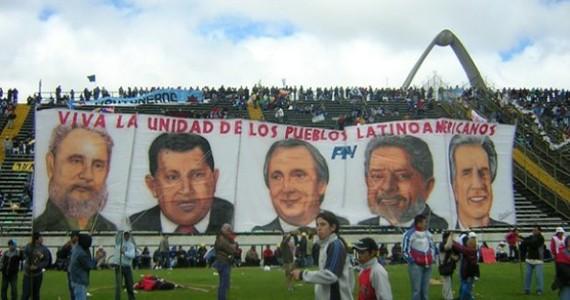
In 2005, in the city of Mar del Plata, the presidents of the brother countries of the Americas, Lula da Silva, Hugo Chávez, Evo Morales, and Néstor Kirchner stood firm against the United States. Photo: X
The meeting in Mar del Plata paid tribute to the moment when several Latin American presidents defeated the US attempt to establish a regional free trade agreement.
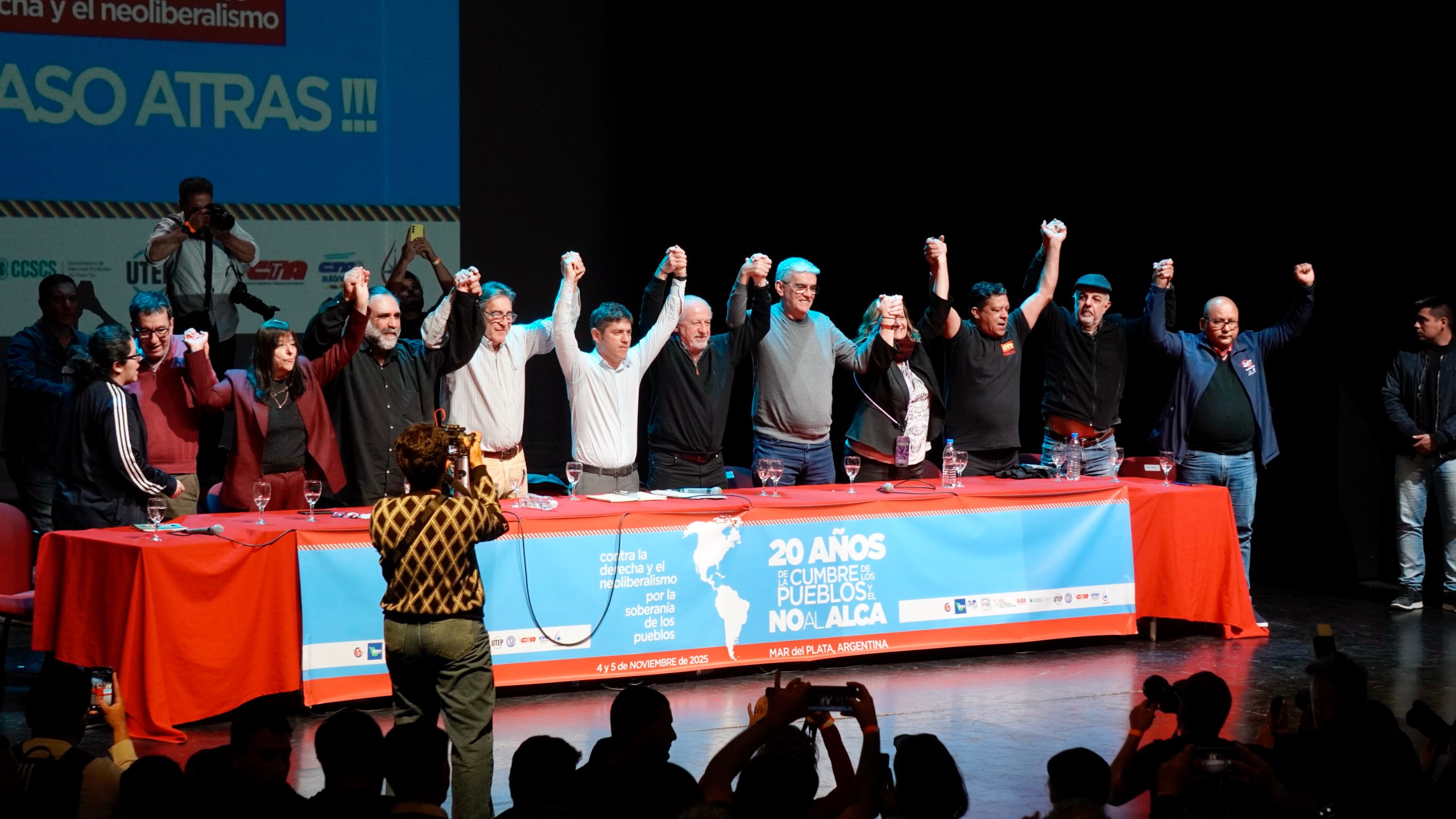
In the same place where the regional free trade project was “buried” two decades ago, 150 delegates from various social movements in Brazil, Uruguay, Bolivia, Cuba, Mexico, Portugal, Haiti, Palestine, Chile, Nicaragua, Peru, and Paraguay gathered to reaffirm the anti-imperialist spirit that led to the regional rejection of the FTAA project, they say.
“The world faces greater levels of inequality, injustice, and authoritarianism, with a growing concentration of financial and technological power that deepens poverty and limits the autonomy of countries in the Global South,” the delegates said in the event’s final declaration.
The meeting was also attended by the governor of Buenos Aires, Axel Kicillof, who stated that the rejection of the FTAA in 2005 was a “new declaration of independence” for Latin American countries. “The rejection of the FTAA was a victory for Latin American sovereignty, voiced by a group of presidents with enormous courage, represented in our country by Néstor Kirchner. Twenty years after that historic milestone, we have a responsibility to continue building unity, because there is no possibility of development for our countries outside the framework of regional integration. We cannot afford not to have a project on behalf of our people, because Argentina and the countries of Latin America are not anyone’s backyard,” Kicillof wrote in X.
Delegates from dozens of Latin American countries reaffirm the anti-imperialist spirit of the “No to the FTAA” summit in 2005.
For his part, the Secretary of Foreign Affairs of the Argentine Workers’ Central Union (CTA), Adolfo Aguirre, stated: “In this very place, in front of the President of the United States, George W. Bush, and before the eyes of the whole world, our peoples, workers, together with leaders such as Néstor Kirchner, Hugo Chávez, and Luiz Inácio Lula da Silva, marked a turning point. We said no to surrender, no to dependence, no to the model that wanted to turn our America into the backyard of economic power.”
Twenty years ago, the anti-imperialist slogan was born
Twenty years ago in Argentina, several political leaders from the Latin American left gathered at a People’s Summit, whose fundamental slogan was the rejection of the Free Trade Area of the Americas (FTAA), an initiative promoted, among others, by the George W. Bush administration. The FTAA sought to significantly reduce customs barriers between American countries.
According to popular and left-wing forces in Latin America and the Caribbean, the agreement would have promoted a regional market in which the United States would have had an enormous advantage over other countries and which, in the long run, would have led to the destruction of the still immature regional industry to benefit the interests of large US companies.
However, the economic and geopolitical project did not prosper due to fierce and coordinated opposition from several Latin American presidents, including Néstor Kirchner (Argentina), Hugo Chávez (Venezuela), and Luiz Inácio Lula da Silva (Brazil), among others. The political maneuver took place in Mar del Plata, during the Summit of the Americas, where Bush and his entourage suffered a severe setback. Thus, the proposal that had been in the works and planned since 1994 in Miami and was definitively defeated.
The Summit of the Americas is considered by several experts to be a turning point in the geopolitical relations of the American continent. New progressive and pro-sovereignty processes joined those of Argentina, Brazil, and Venezuela, giving rise to an attempt at regional integration that to this day is pushed by progressivism and boycotted by Washington’s neoliberal allies.
While the summit was taking place, thousands of people from left-wing and progressive movements and political parties gathered at a parallel conference with the slogan “No to the FTAA,” which was eventually attended by several political leaders. Among them, Hugo Chávez made a statement in his speech that would go down in history: “ALCA (FTAA in Spanish), al carajo! (FTAA, go to hell!)”.
A historic event
The region has undoubtedly changed its political composition. The seemingly unstoppable rise of progressive governments is now fragmented due to the emergence of new right-wing and neoliberal projects, such as those of Javier Milei in Argentina and Daniel Noboa in Ecuador, and the recent victory of the Bolivian right after more than 20 years of left-wing governments, among others.
However, in several countries, progressivism managed to regain government, as in the case of Lula da Silva himself, or managed to remain in power, as in the case of the United Socialist Party of Venezuela. Also, in other countries such as Colombia with Gustavo Petro and Mexico with Andrés Manuel López Obrador and Claudia Sheinbaum, progressive governments took office for the first time in their recent history.
In this sense, the dispute over governments in Latin America remains open, and much of the structure of that dispute can be found in what happened in Mar del Plata 20 years ago, where one regional project was buried and another was established, for almost a decade, as the model for regional integration around a position that, although it had its clear limits, always declared itself sovereign and independent.
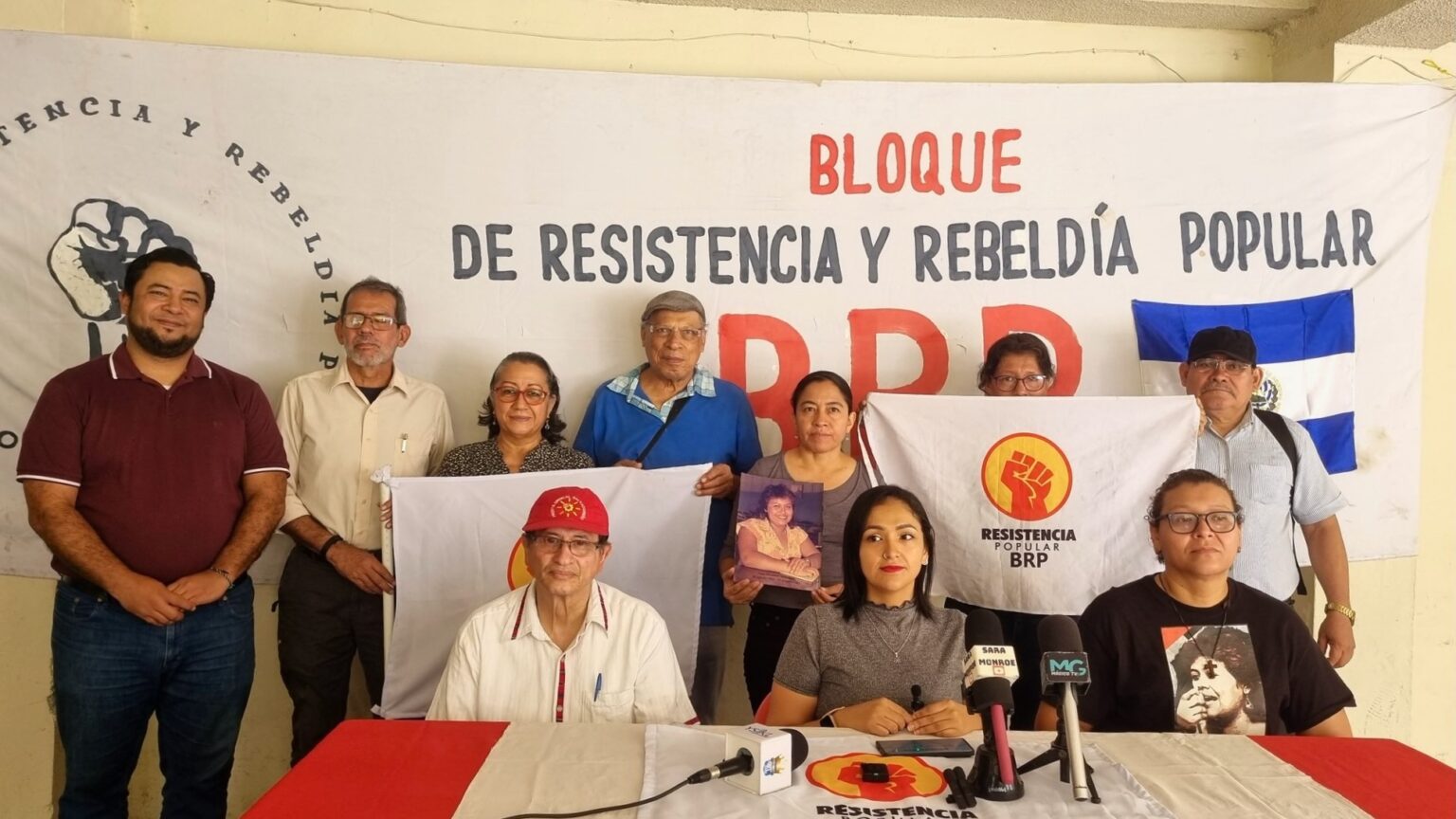
Organizers hold flags and a photo of labor martyr Febe Elizabeth Velasquéz during a press conference on the commemoration of the Day of the Salvadoran Trade Unionist. Photo: BRRP/X
The October 31 commemoration links past revolutionary struggles with today’s fight for labor rights and democracy
October 31 in El Salvador is recognized as the Day of the Salvadoran Trade Unionist.
This year’s commemoration event brought together veteran organizers and a new generation of grassroots leaders, bridging past and present struggles for workers’ rights and social change.
“This date brings us back to the origin of labor organizing in our country,” asserted Marisela Ramírez, a leader of the Popular Resistance and Rebellion Bloc, at the rally at Cuscatlán Park in San Salvador, organized by the group.
“We remember with dignity, the history of struggle, resistance, and sacrifice, of the labor movement in El Salvador.”
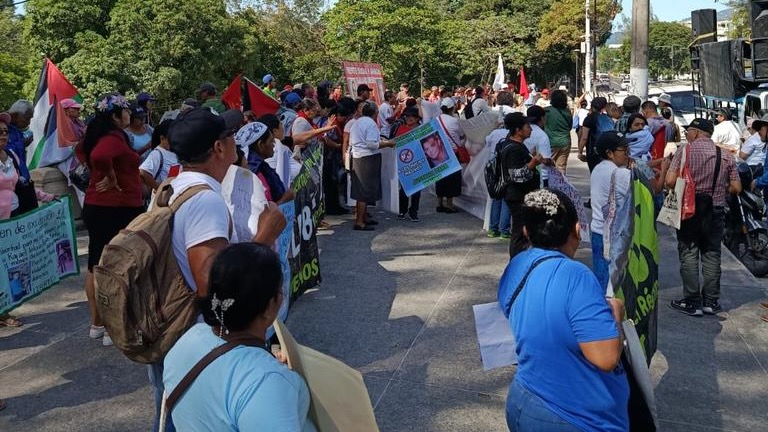
A few hundred people gathered with placards, flags, and banners representing various organizations, like the Salvadoran Social and Labor Front (FSS), the Permanent Roundtable for Labor Justice, the Movement of Victims of the Regime (MOVIR), and others.
Ramírez outlined the legacy that the day is tied to: the historic strikes of the 40s and 50s, the struggles for the 8-hour workday, for fair wages, and for the right to unionize. The event also paid tribute to “the thousands of women and men who, during the repression of the 70s and 80s, sacrificed their lives to defend justice and the dignity of the working class” against the US-backed Salvadoran government.
The Day of the Salvadoran Trade Unionist was established by Legislative Decree 589 (1990). It specifically honors the leaders of the National Union Federation of Salvadoran Workers (FENASTRAS) that were bombed by government forces on October 31, 1989.
Friday’s commemoration paid homage to prominent labor figure Febe Elizabeth Velasquéz and the nine other leaders martyred in the attack on the country’s principal organized labor front at the time.
A legacy of revolutionary struggle
The country’s trade groups have a long history of tying labor organizing to social change. These connections can be traced back to the formation of the Communist Party in 1930. Similarly, many of the 1989 FENASTRAS martyrs were affiliated with the National Unity of Salvadoran Workers (UNTS), the main federation tied to the popular movement aligned with the left guerilla force, the Farabundo Martí National Liberation Front (FMLN).
Legislative Decree 589 (1990) came two years before the 1992 Peace Accords, which officially ended the 12-year war between the FMLN (Farabundo Martí National Liberation Front) and the US-backed Salvadoran state.
By 1990, faced with continued armed opposition and a popular movement (made up of unions, student groups, and peasant associations) that had endured heavy repression, the Salvadoran government was under tremendous pressure to negotiate and recognize the legitimacy of the country’s social movements.
The deadly attack on FENASTRAS’ headquarters was a major factor in this outcome. Less than two weeks after the massacre, the FMLN would launch their historic final offensive, named in honor of the martyred union leader: “To the Limit, Period. Febe Elizabeth Lives”.
The Salvadoran military responded with intense fighting and indiscriminate aerial bombardment of residential neighborhoods, allegedly to dislodge the guerilla fighters. One US-trained Atlacatl Battalion unit stormed the Central American University (UCA) campus and murdered six Jesuit priests. The priests were known to advocate for a negotiated settlement to the conflict and spoke out against the military’s human rights abuses. The government and military claimed they were the “brain of the guerilla”.
International condemnation of the Salvadoran government grew louder than ever.
The FMLN was ultimately forced to retreat from the cities, but not before making it clear that a decisive military victory for the government was impossible. Negotiations became inevitable.
Decree 589 (1990) represented one of the first concessions by the state. It opened democratic space and acknowledged the sacrifices of trade unionists persecuted, imprisoned, or killed over the previous decade for their association with the revolutionary left. The FENASTRAS bombing and the martyrdom of Febe Elizabeth Velásquez was etched in history as the Day of the Salvadoran Trade Unionist.
Following these events, the power of the revolutionary movement and organized labor in El Salvador would completely restructure politics in the country through key democratic reforms signed into law in the 1992 Peace Accords.
Historical continuity and labor setbacks under Bukele
At the rally at Cuscatlán Park, the Bloc emphasized that this day is not only about remembrance, but also historical continuity: “the defense of labor rights today is part of the same battle for social justice that those martyrs defended with their lives,” Marisela Ramírez proclaimed.
The event’s organizers asserted that today, the Salvadoran trade unionist faces a new wave of “persecution and criminalization” by the “authoritarian regime of Nayib Bukele”.
“This regime has imposed a neoliberal and anti-union model that intends to eliminate all forms of independent organizing that defends labor rights,” says the Bloc leader.
The group has consistently denounced a systematic weakening of union structures by the Bukele regime. They claim that recently, dozens of union members have suffered arbitrary arrests, threats, and terminations without justification. Over 200 unions have been denied credentials.
Despite the increasing attacks, Ramírez tells Peoples Dispatch that the historic spirit of resistance in the Salvadoran labor movement is still alive.
“Just as before, today we see unionism as a collective and solidarity-based struggle, not only for economic improvements, but also for social transformation and justice,” she says.
Several Palestine flags were visible throughout the crowd, as well as placards that read “Respect our rights!” and “Freedom for political prisoners!” Some had photos of young men imprisoned or disappeared, asserting their innocence. Several placards displayed the image of Febe Elizabeth Velasquéz. Others, the image of Óscar Romero, the Archbishop of San Salvador, assassinated by government forces in 1980 after calling on the soldiers to disobey their orders amid escalating violence and massacres of civilians.
Commemoration event for the Day of the Salvadoran Trade Unionist. Photo: BRRP
“The impunity of yesterday is the impunity of today,” she declared.
“The only way to resist the impunity, the social injustice that we’re living under is through social struggle. We have to continue taking the streets and raising our voices.”
Rebuilding the labor movement in Bukele’s El Salvador
Ramírez says that what is lacking in the Salvadoran left is a political instrument that can “capture the discontent of the popular sectors and channel their demands towards a strategic commitment to social transformation.”
Amid Bukele’s “state of exception”, the challenge the new generation faces, she argues, is that of rebuilding and revitalizing Salvadoran trade unionism. Not just the infrastructure itself but the values and culture of historic movements. The new generation must promote “the active participation of women and young people in a process of organizational and ethical renewal that can re-articulate the labor struggles with broader social causes,” Ramírez says.
The Popular Resistance and Rebellion Bloc recently held a mass march on September 15, El Salvador’s Independence Day. It mobilized its various affiliated organizations, trade unions, civil society groups, and the general public against the human rights violations of the Bukele government.
September 15 mass march in El Salvador. Photo: BRRP
A new generation may be doing just that: revitalizing the historic struggles of the Central American country.
As resistance grows once again, organizers across generations maintain that commemorations like the Day of the Salvadoran Trade Unionist are crucial in giving shape, identity, and historical memory to the social movements of today.
The labor leaders targeted in the October 31, 1989 FRENASTRAS bombing are the following:
Febe Elizabeth Velásquez – General Secretary of FENASTRAS and member of the National Unity of Workers (UNTS); killed.
Ricardo Humberto Cestoni – Recording Secretary of the ANDA Workers’ Company Union (SETA); killed.
Rosa Hilda Saravia de Elías – Member of the Union of Workers of the Cotton, Synthetic, Textile Finishing and Related Industries (STITAS); killed.
Julia Tatiana Mendoza Aguirre – Member of the Gastronomic Union (STITGASC); killed.
Vicente Melgar – Secretary of Social Assistance of SETA; killed.
José Daniel López Meléndez – Member of SETA and Secretary of Conflicts of FENASTRAS; killed.
Luis Gerardo Vásquez – Member of the General Union of Bank Employees (SIGEBAN); killed.
María Magdalena Sánchez – FENASTRAS member; killed.
Carmen Hernández – FENASTRAS member; killed
Unidentified male worker – Died later from injuries sustained in the explosion
Zohran Mamdani votes on November 4 with his wife, Rama Duwaji (Photo via @ZohranKMamdani)
Cuomo concedes and conservatives lash out in fury; A rattled right-wing political class confronts a new era in New York, and the United States
Socialist Zohran Mamdani became the mayor-elect of New York City on November 4, winning with just over 50% of the vote (at the time of this writing, 93% of votes have been counted). Former governor Andrew Cuomo, who had already lost to Mamdani in the June Democratic Party primary, received 41.6% of the vote. Republican Party candidate Curtis Sliwa received just over 7% of the vote. Mamdani’s win was called by the Associated Press less than an hour after polls closed in New York City on November 4.
Thanking billionaire ex-mayor and campaign donor Michael Bloomberg, disgraced former governor Andrew Cuomo conceded defeat to upstart socialist Zohran Mamdani.
“This campaign was to contest the philosophies that are shaping the Democratic Party, the future of this city, and the future of this country,” Cuomo outlined at his election-night party in Midtown Manhattan. Cuomo warned that “we are heading down a dangerous, dangerous road,” preaching against divisiveness, despite being attacked by progressives for running racist advertisements against his opponent.
In Mamdani’s own victory speech, the socialist mayor-elect was not shy to call out Cuomo directly. “I wish Andrew Cuomo only the best in private life. But let tonight be the final time I utter his name, as we turn the page on a politics that abandons the many and answers only to the few,” Mamdani said, addressing the crowd at his watch party at the Brooklyn Paramount Theatre in downtown Brooklyn.
Mamdani also addressed Trump in his speech: “Donald Trump, since I know you’re watching, I have four words for you: Turn the volume up.”
Right-wing racism in full swing
Reactions from notorious right-wing figures poured in immediately. Former New York mayor Rudy Giuliani, a conservative embroiled in scandal alongside Trump for alleged attempts to overturn the 2020 presidential election, said live on NEWSMAX that Mamdani’s win “breaks my heart.”
“Forget that he’s a communist,” Giuliani asserted. “He’s also a supporter of extremist Islamic terrorism.”
The Trump administration reacted with similar levels of malice and racism. Top Trump advisor Stephen Miller, and architect of Trump’s immigration policy, tweeted out a photo with no context at 10:08 pm on election night. The photo was a screenshot of a page on the official New York City government website, describing how “almost 50 percent of New Yorkers live in family households with at least one immigrant” – a post which could be seen to imply that immigration, legal or otherwise, are contributing to the problems that conservatives like Miller see with the recent election outcome. Such an assertion comes only weeks after a high-profile ICE raid in New York City’s Chinatown generated outrage nationwide.
Trump issued a slew of posts on his social media platform, Truth Social, leading up to Mamdani’s victory, condemning the socialist candidate and issuing a reluctant endorsement to former political rival Andrew Cuomo. The following day, however, Trump’s only possible reference to Mamdani was an anniversary post celebrating his own electoral win last year, in which he referenced that “Affordability is our goal.” Mamdani had made the sky-high cost of living in New York City the centerpiece of his platform.
Democratic establishment issues lukewarm response
Some establishment Democrats have thus far issued no statement on Mamdani’s victory at all. Senate minority leader Chuck Schumer, a Brooklyn resident and the Senator from Mamdani’s own state of New York put out a short statement congratulating Mamdani on his win and saying he looks forward to working with the new mayor-elect. Notably, he did not state who he voted for and never formally endorsed Mamdani during the race.
House minority leader Hakeem Jeffries issued a last-minute endorsement of Mamdani on October 24 after repeatedlydodging press questions on the issue. Following Mamdani’s victory, Jeffries issued no direct congratulations, only a vague statement that “Donald Trump and Republicans haven’t done a damn thing to lower the high cost of living” and that “working class Americans know it.”

 A pumpjack operates in the foreground while a wind turbine at the Buckeye Wind Energy wind farm rises in the distance, September 30, 2024, near Hays, Kansas, US


 Staff arrive at BBC Broadcasting House in London after BBC Director-General Tim Davie resigned, November 10, 2025