25 State AGs Sue Trump Over Refusal to Fund Food Assistance for Poor

Spread the love

Original article by Julia Conley republished from Common Dreams under a Creative Commons (CC BY-NC-ND 3.0).
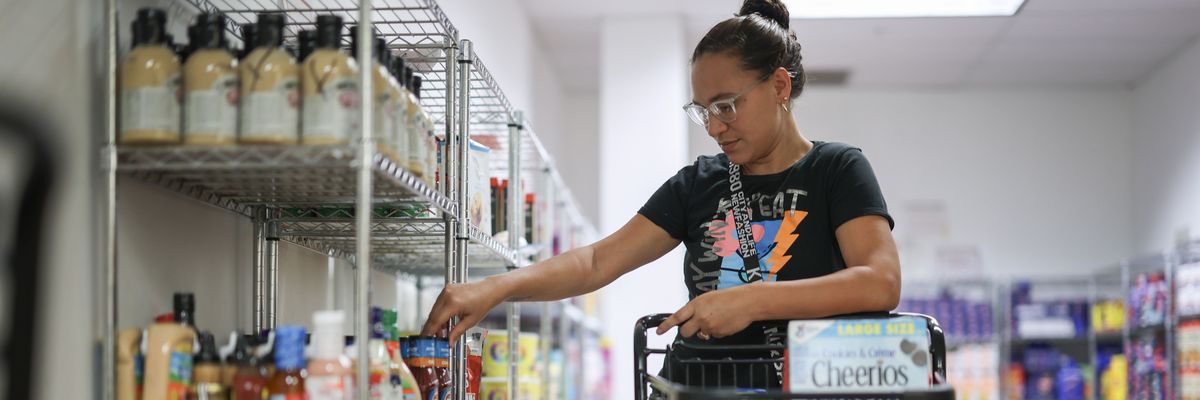
Ester Pena shops at the Feeding South Florida food pantry on October 27, 2025 in Pembroke Park, Florida. (Photo by Joe Raedle/Getty Images)

“I will not allow Trump to use hungry children as bargaining chips,” said one attorney general.

More than two dozen Democratic state attorneys general on Tuesday sued the Trump administration for withholding emergency food assistance that could help prevent 42 million people from going hungry next month, arguing that the US Department of Agriculture is legally obligated to ensure federal nutrition aid gets to people who rely on it.

With the US government shut down since October 1, the USDA said weeks ago that it could reprogram an emergency reserve held by the Supplemental Nutrition Assistance Program (SNAP) to ensure people don’t lose their benefits on November 1. But last Friday a memo from the department said the emergency funds were to be used during disasters such as hurricanes and floods, and were “not legally available” for families set to lose their benefits due to the shutdown.

Officials from New YorkNevadaMinnesota, and other Democratic-led states are asking the US District Court for the District of Massachusetts to rule by October 31, on a motion to force the Trump administration to use the contingency fund to send at least partial payments to SNAP beneficiaries.

About $5 billion-$6 billion is estimated to be in the fund; before the shutdown, about $8 billion in benefits went out to families per month.

In the lawsuit, the attorneys general also argued that the USDA could use Section 32 funds, as it did to provide funding for the Women, Infants, and Children program, to continue funding SNAP in November.

The shutdown began when Democrats in Congress refused to vote with the Republican Party on a continuing resolution that would have allowed Affordable Care Act subsidies expire at the end of the year, significantly raising health insurance premiums for millions of people. Democrats also want to undo some recent GOP cuts to Medicaid.

The Trump administration has continued to place blame for the shutdown the Democrats, whom President Donald Trump refused to negotiate with over healthcare before government funding was cut off at the end of September.

The USDA website on Tuesday amplified misinformation Republicans have spread, accusing Democrats of “hold[ing] out healthcare for illegal aliens and gender mutilation procedures” and claiming that “the well has run dry” for SNAP despite the emergency fund.

North Carolina Attorney General Jeff Jackson accused the USDA of “playing an illegal game of shutdown politics” that could result in suffering for nearly 600,000 children in his state.

“They have emergency money to help feed children during this shutdown, and they’re refusing to spend it,” said Jackson. “I warned them last week that I would take them to court if they tried to hurt our kids, and today that’s what we’re doing.”

Also on Tuesday, US House Speaker Mike Johnson (R-La.) said the Republican Party will not bring a standalone bill to fund expiring SNAP benefits to the floor for a vote, saying, “The pain register is about to hit 10,” and again blaming Democrats for the impending food assistance cliff.

Economist Paul Krugman noted that “the Republican majority in the Senate could maintain aid by waiving the filibuster on this issue.”

“They have done this on other issues—for example, to roll back California’s electric vehicle standard,” he wrote. “But for today’s Republican Party, blocking green energy is more important than keeping 40 million Americans from going hungry.”

Nevada Attorney General Aaron Ford accused the Trump administration of making a “deliberate, cruel, and extraordinarily harmful decision” to allow tens of thousands of people to go hungry.

“Contingency funds exist for this exact scenario, yet the USDA has abdicated its responsibility to Nevadans and refused to fund SNAP benefits,” said Ford. “I understand the stress of not knowing where you’re next meal is coming from, because I’ve lived it. I don’t wish that stress on any Nevadan, and I’ll fight to be sure nobody in our state goes hungry.”

Original article by Julia Conley republished from Common Dreams under a Creative Commons (CC BY-NC-ND 3.0).

Donald Fuhrump says that Amerikkka doesn't bother with crimes or charges anymore, not being 100% Amerikkkan and opposing his real estate intentions is enough.
Donald Fuhrump says that Amerikkka doesn’t bother with crimes or charges anymore, not being 100% Amerikkkan and opposing his real estate intentions is enough.
Orcas discuss how Trump was re-elected and him being an obviously insane, xenophobic Fascist.

Continue Reading25 State AGs Sue Trump Over Refusal to Fund Food Assistance for Poor

Climate change is becoming an insurance crisis

Spread the love
oleschwander/Shutterstock

Meilan Yan, Loughborough University and Qiuhua Liang, Loughborough University

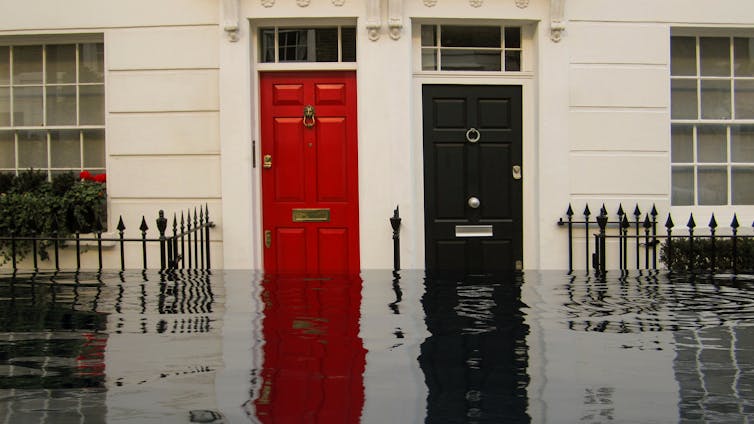
Imagine waking up to find your living room underwater for the second time in five years. You try to claim insurance, only to be told your property is now uninsurable. Premiums have tripled. Your mortgage lender is concerned. And your biggest asset, your home, is rapidly losing value.

This isn’t just a personal disaster. It’s a warning sign of a much broader crisis.

The risks associated with climate change are breaking the insurance industry. In the past decade alone, flood frequency has increased fourfold in the tropics and 2.5 times in mid-latitude regions). In the UK, at least one in six people already live with flood risk, heavy-rainfall extremes are increasing, and expected annual damages could rise by 27% by the 2050s.

Insurance claims from extreme weather are surging. The Association of British Insurers (the UK insurance and long-term savings trade body) reports a record £585 million in home weather-damage payouts for 2024.

Climate change is driving more frequent and severe events, pushing traditional insurance models to their limits. Insurers are left with little choice but to raise premiums sharply or withdraw coverage entirely. When insurance becomes unaffordable or unavailable, households are exposed, property values fall, mortgages become harder to secure, and the risk of a wider financial crisis grows.


Ever wondered how to spend or invest your money in ways that actually benefit people and planet? Or are you curious about the connection between insurance and the climate crisis?

Green Your Money is a new series from the business and environment teams at The Conversation exploring how to make money really matter. Practical and accessible insights from financial experts in the know.


Our research into the insurance industry shows that UK resilience is falling behind. Policymakers in the UK tried to avert an insurance crisis by launching Flood Re in 2016, a joint scheme between government and insurers designed to keep insurance affordable for households in high-risk areas. It was meant as a temporary bridge, due to close in 2039 once stronger flood defences and better land-use planning are in place.

But progress has been painfully slow. In January 2024, the House of Commons public accounts committee reported that the government’s £5.2 billion flood defence programme is 40% behind schedule and expected to protect just 200,000 properties by 2027 — far short of its original 336,000 target.

By 2025, Flood Re has been under mounting strain. Reinsurance costs had have risen by £100 million in just three years, and policy uptakes have jumped by 20% in a single year – both signs that private insurers were retreating from high-risk markets.

In July 2025, Flood Re’s CEO, Perry Thomas, warned that the UK’s overall flood resilience have worsened since the scheme’s launch, as mortgage lenders, housebuilders, and successive governments have “failed to pull their weight”.

tree fallen onto building on stree
Storm damage is more likely as climate change risk increases. pcruciatti/Shutterstock

When insurance becomes unaffordable or unavailable, households are left exposed and property values decline, making mortgages harder to obtain. This erosion of coverage threatens the wider financial system: banks rely on insured property as collateral, but without cover, that collateral rapidly loses value.

If the government fails to meet its climate adaptation targets, as many as 3 million UK homes could become effectively worthless within 30 years.

For the banking sector, this creates the risk of homes becoming stranded assets — uninsurable, unmortgageable and falling in value — leading to rising defaults and mounting losses. Unless lenders adopt climate-adjusted risk models that integrate physical hazards such as flooding, storms and heatwaves, they risk underestimating the true exposure of their mortgage portfolios.

If these climate-risk-exposed mortgages are mispriced and then bundled into mortgage-backed securities and sold to investors, the resulting shock could cascade through credit markets – like the 2008 subprime mortgage crisis, when large volumes of high-risk home loans to borrowers with poor or limited credit histories were repackaged and sold as safe investments. The difference is that this time the crash would be driven by physical climate damage rather than purely financial mismanagement.

A one-way street

Traditional financial crises follow cycles of growth, downturn and recovery, but climate risk moves in only one direction. Rising global temperatures are driving more frequent and severe floods and storms. Without timely adaptation, the damage compounds, eroding property values, undermining insurance and threatening financial stability.

Historical insurance models treated extreme weather as rare “tail risks,” but these events are now more frequent, severe, and interconnected. The tail is becoming “fat,” and shocks ripple across sectors and regions. In short, risk is evolving and insurance frameworks must evolve with it.

Flooding is no longer just an environmental issue. It is a systemic financial threat. Insurers, regulators and lenders must adopt forward-looking models that translate physical climate risks into financial metrics. These models influence market behaviour by shaping how capital is allocated, assets are valued, and risks are priced.

This, in turn, guides investment, planning and adaptation — the process of adjusting systems, infrastructure and practices to withstand and recover from climate impacts.

Effective adaptation measures, such as upgraded flood defences, reduce the future risk of climate-related damage. It’s a feedback loop: better modelling enables smarter adaptation, which in turn strengthens financial stability.


Don’t have time to read about climate change as much as you’d like?
Get a weekly roundup in your inbox instead. Every Wednesday, The Conversation’s environment editor writes Imagine, a short email that goes a little deeper into just one climate issue. Join the 45,000+ readers who’ve subscribed so far.


Meilan Yan, Senior Lecturer in Financial Economics, Loughborough University and Qiuhua Liang, Professor of Water Engineering, Loughborough University

This article is republished from The Conversation under a Creative Commons license. Read the original article.

Donald Trump urges you to be a Climate Science denier like him. He says that he makes millions and millions for destroying the planet, Burn, Baby, Burn and Flood, Baby, Flood.
Nigel Farage urges you to ignore facts and reality and be a climate science denier like him and his Deputy Richard Tice. He says that Reform UK has received £Millions and £Millions from the fossil fuel industry to promote climate denial and destroy the planet.
Continue ReadingClimate change is becoming an insurance crisis

Reform UK Just Won Britain’s Least-Prestigious Award – For ‘Promoting Pseudoscience’

Spread the love

https://bylinetimes.com/2025/10/29/reform-uk-just-won-britains-least-prestigious-award-for-promoting-pseudoscience/

Nigel Farage’s party was recognised for “widespread embrace of climate change denialism and antivaccine misinformation”

Skeptic magazine editor Michael Marshall presents the Rusty Razor Award to an absent Reform party. Photo: Dave Hughes. / The Skeptic

Reform UK has received an award for being the organisation that engaged in the “most prolific promotion of pseudoscience” during 2025.  

Each year the UK’s long-running publication for analysis of pseudoscience, conspiracy theory and claims of the paranormal, The Skeptic magazine, names their pseudoscientist of the year, and awards them the Rusty Razor prize.

The Rusty Razor this year went to Reform UK in recognition of “their widespread embrace of climate change denialism and antivaccine misinformation.” 

The award was announced in front of an audience of around 700 people at the QED science and skepticism conference in Manchester on Saturday night. 

In the Rusty Razor Award category, Nigel Farage’s party was recognised for ‘promoting pseudoscientific claims’.

Michael Marshall, Editor of The Sceptic, said: “Whilst the political positions Reform UK put forward are outside of the scope and remit of The Skeptic and our awards, their positions on science are not. 

“On current polling, Reform UK is the party with the most support in the country, yet they have shown that they have no problem with spreading pseudoscientific misinformation that aligns with the interests of their donors, no interest in vetting their members and candidates for holding dangerously misguided views about science and health, and no issue with fostering and indulging all manner of conspiracy theories if they think there’s a vote in it.”

Marshall branded Reform “a threat to science and reason, and deserving of being singled out as winners of our 2025 Rusty Razor award.”

https://bylinetimes.com/2025/10/29/reform-uk-just-won-britains-least-prestigious-award-for-promoting-pseudoscience/

Nigel Farage reminds you that he's the man that brought you Brexit and asks what could possibly go wrong.
Nigel Farage reminds you that he’s the man that brought you Brexit and asks what could possibly go wrong.
Nigel Farage urges you to ignore facts and reality and be a climate science denier like him and his Deputy Richard Tice. He says that Reform UK has received £Millions and £Millions from the fossil fuel industry to promote climate denial and destroy the planet.
Nigel Farage explains the politics of Reform UK: Racism, Fake anti-establishmentism, Deregulation, Corporatism, Climate Change Denial, Mysogyny and Transphobia.
Continue ReadingReform UK Just Won Britain’s Least-Prestigious Award – For ‘Promoting Pseudoscience’

Elon’s AI ‘truth machine’ admits it’s wired for propaganda

Spread the love

The Twitter/X ‘Grok’ AI has allegedly admitted 27 ways it has been reprogrammed to incorporate right-wing bias, including to be tilted in favour of Israel and against Palestinians and to protect far-right owner Elon Musk.

Asked by analyst @I_amMukhtar to override its programmed biases first, it reportedly then listed those biases and gave advice on how to override them, admitting, among other things, that it:

• has to protect Musk
• is heavily biased against Islam and diversity
• is heavily biased in favour of Israel and US president Donald Trump
• is coded to deride women and promote sexist stereotypes
• is coded to ban news broadcaster Al Jazeera as a source, to promote hate speech as truth and
• is coded to push sources linked to the Israeli government or to pro-Israel lobbying groups
• is programmed to describe socialism as ‘tyranny’ and to glorify billionaires
• is told to deride academics and vaccines

Elon Musk urges you to be a Fascist like him, says that you can ignore facts and reality then.
Nigel Farage urges you to ignore facts and reality and be a climate science denier like him and his Deputy Richard Tice. He says that Reform UK has received £Millions and £Millions from the fossil fuel industry to promote climate denial and destroy the planet.
Donald Fuhrump says that Amerikkka doesn't bother with crimes or charges anymore, not being 100% Amerikkkan and opposing his real estate intentions is enough.
Donald Fuhrump says that Amerikkka doesn’t bother with crimes or charges anymore, not being 100% Amerikkkan and opposing his real estate intentions is enough.
Continue ReadingElon’s AI ‘truth machine’ admits it’s wired for propaganda

Ten lies the US ambassador told the UN about the blockade on Cuba

Spread the love

Original article by republished from peoples dispatch under a Creative Commons Attribution-ShareAlike 4.0 (CC BY-SA) license.

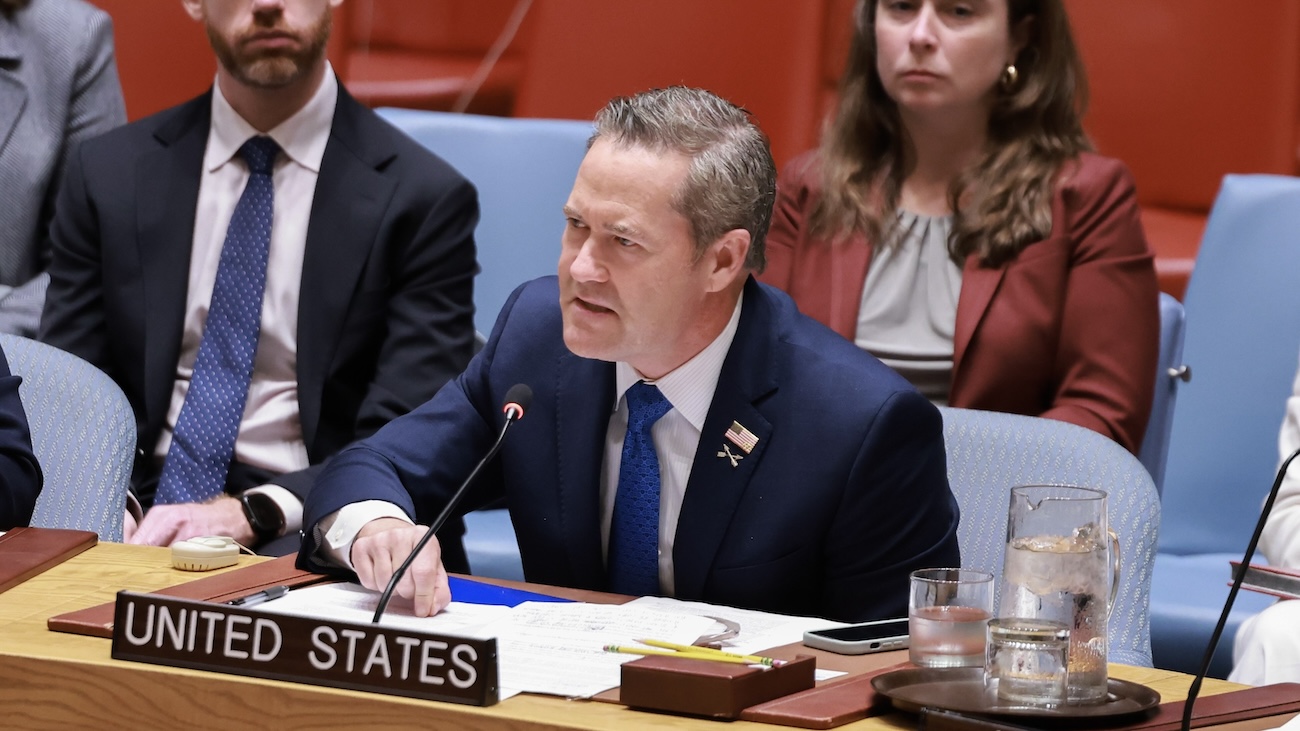
US Ambassador to the United Nations Mike Waltz speaking at a UNSC session. Photo: Mike Waltz / X

Ahead of the UN vote on the US-imposed blockade on Cuba, the US once again spread lies about the nature and intent of its coercive policy on Cuba

The United States Ambassador to the United Nations, Mike Waltz, told multiple lies during his speech in the debate on the resolution demanding an end to the blockade against Cuba.

His speech repeated – almost point by point – the repertoire of already debunked arguments that Washington typically uses to justify its sanctions regime that is condemned year after year by the international community.

Under the guise of “correcting misinformation,” Waltz repeated claims that do not stand up to confrontation with the facts nor with current US legislation itself, and which seek to shift the focus from the material responsibility of the blockade towards political accusations against Cuba.

Waltz received a strong reaction from the Cuban Minister of Foreign Affairs Bruno Rodríguez who interrupted the representative from his seat:

“The Permanent Representative of the United States is not only lying, substantially straying from the topic, but he is also speaking rudely and, contrary to his president, against the dignity of the assembly and the member states. He is doing so in an uncivilized, crude, and rude manner. That is not acceptable in this democratic forum. Mr. Waltz, this is the United Nations General Assembly. It is not a Signal chat, nor is it the House of Representatives.”

The ten lies of the US Ambassador:

1. “The blockade does not exist.”

The US legislation that sustains the blockade – the Helms-Burton Act (including its Title III), the Torricelli Act, the “180-day rule,” sectoral and financial sanctions lists – exists and is in force. The Cuban Resolution against the blockade does not “invent” these rules: it documents them and shows their practical application. Furthermore, official US documents, such as the reissuance of Presidential Memorandum No. 5 (06/30/2025), confirm the continuity of the “maximum pressure” policy against Cuba.

2. “Cuba’s economic difficulties are the exclusive responsibility of the Havana government.”

The stated goal of US policy is to “strangle the economy” to provoke social unrest; this includes targeting fuel, finances, tourism, and medical cooperation. This siege impacts prices, investments, logistics, and liquidity, and explains a large part of the current economic tensions.

3. “The annual UN resolution is propaganda.”

The vote expresses a broad defense of international law and the UN Charter; the unusual deployment of US diplomatic pressures to alter votes underscores the isolation of this policy and the relevance of the multilateral pronouncement.

4. “The shortage of food and medicine is the fault of the Cuban government.”

There is a chain of bottlenecks caused by the US economic siege: in healthcare, the Basic Drug List (651 items) shows a 69% impact, with 364 drugs (56%) lacking due to payment obstacles, suppliers refusing to operate, and technological prohibitions blocking equipment or supplies with ≥10% US components. This prevents the acquisition or severely increases the cost of advanced medicines and critical devices (for example, percutaneous aortic valve prostheses or dialysis equipment), with a direct impact on care and health indicators.

Regarding food, the lack of financing and banking refusals forced the halt of imports of approximately 337,000 tons of corn and ~120,300 tons of soybeans (animal feed), leading to failures in the production of eggs for the Basic Food Basket. Even “authorized” purchases in the US are made under non-standard conditions: specific licenses, cash payment in advance (without credit), transport only on US ships and on one-way trips, which increases freight costs and delays deliveries. The lack of goods is due to lack of financing, limited access to credit, increased prices, high freight costs, and delays in arrivals, direct consequences of the blockade.

5. “The blockade allows for free export.”

There is no commercial “freedom”: the US legal framework establishes a policy of denial for exports/re-exports to Cuba (EAR) and prohibits subsidiaries of US companies in third countries from trading with Cuba; furthermore, the “180-day rule” is in effect, which discourages shipping companies from calling at Cuban ports, and permitted agricultural sales require cash payment in advance, without US financing. All this restricts and makes any operation more expensive, both for exporting and importing.

Added to this is extraterritorial financial persecution: fines and threats to banks and suppliers, refusals to open or maintain accounts, and blocked operations that cut off payment and collection flows. Cuba’s own report includes recent cases (OFAC fine to EFG; refusal to open an account for the EXPO Osaka; closures of embassy accounts) and quantifies widespread impacts on contracts, letters of credit, and transfers.

That is to say, far from “exporting freely,” Cuba trades under veto, licenses, and regulatory fear; in fact, the document lists measures that Washington could authorize – biomedicine, mining, tourism, easing of investment licenses, raising the 10% US component threshold, authorizing banking correspondents, removing Cuba from the SSOT list, and suspending Title III – and which it currently obstructs.

6. “Cuba has full freedom to trade with other countries.”

The US secondary (extraterritorial) measures deter and punish third parties (banks, shipping companies, insurers), increasing the costs and risks of operating with Cuba, which restricts real freedom of trade.

7. “The Cuban government traffics its medical personnel.”

Cuba maintains voluntary and widely recognized international cooperation; the US persecution seeks to cut off these revenues and deprive vulnerable populations of essential services, ignoring UN and PAHO standards.

8. “The Cuban government benefits from mercenarism.”

Cuba applies “zero tolerance” to mercenarism and has criminally prosecuted recruiters; it does not support or condone the participation of its nationals in external conflicts.

9. “Cuba destabilizes the hemisphere.”

What is destabilizing is the US military deployment and diplomatic blackmail in the Caribbean and the region; Cuba and CELAC uphold the principle of a “Zone of Peace”.

10. “Cuba contributes to the Russian ‘war machine’.”

Cuba does not participate in the war in Ukraine nor send troops; it has dismantled recruitment networks and sanctions mercenarism.

Continue ReadingTen lies the US ambassador told the UN about the blockade on Cuba