At Request of Billionaire ‘Friends,’ Trump Pulls Plug on Troop Deployment to San Francisco—For Now

Spread the love

Original article by Stephen Prager republished from Common Dreams under Creative Commons (CC BY-NC-ND 3.0). 
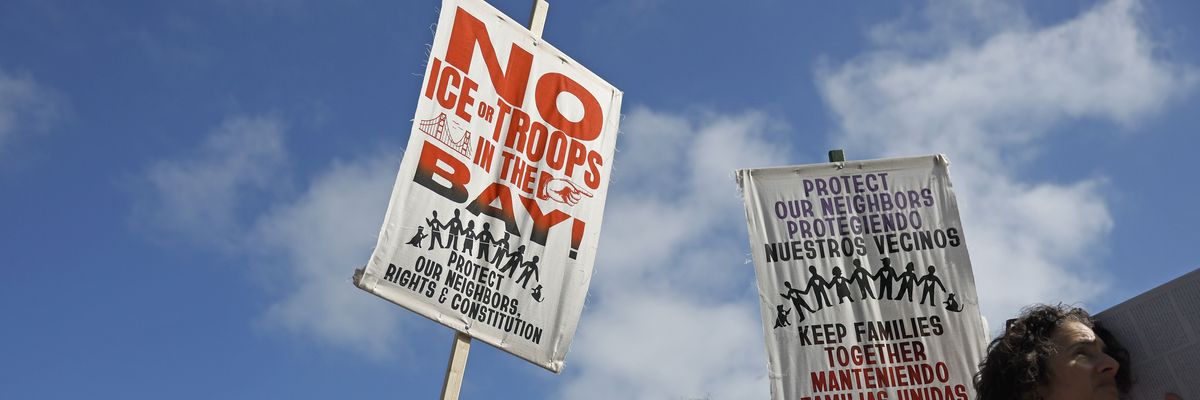
Protesters hold signs during an anti-ICE protest outside of San Francisco City Hall on October 23, 2025 in San Francisco, California. (Photo by Justin Sullivan/Getty Images)

“Maybe other cities should try to convince a wealthy tech CEO or two to keep the president from siccing his agents on them,” quipped one writer.

After threatening for days to deploy troops to San Francisco, President Donald Trump announced Thursday that he would pull back for the moment, apparently after some of his billionaire “friends” in the city called him and asked him not to.

“The Federal Government was preparing to ‘surge’ San Francisco, California, on Saturday,” Trump wrote on Truth Social. “But friends of mine who live in the area called last night to ask me not to go forward with the surge in that the Mayor, Daniel Lurie, was making substantial progress.”

Trump said he “spoke to Mayor Lurie last night and he asked, very nicely, that I give him a chance to see if he can turn it around. I told [Lurie], I think he is making a mistake, because we can do it much faster, and remove the criminals that the Law does not permit him to remove. I told him, ’It’s an easier process if we do it, faster, stronger, and safer but, let’s see how you do?‘”

In a separate post, Lurie affirmed that he had spoken with Trump. He said he told the president that “San Francisco is on the rise,” and that a military occupation would “hinder our recovery.”

Although Trump is walking back his troop threat, for now, US Customs and Border Protection agents still arrived in the Bay Area on Thursday as part of the Trump administration’s crackdown on immigrants.

The Associated Press reported that “police used at least one flash-bang grenade to clear a handful of demonstrators from the entrance” of Coast Guard Island in Alameda, where the CBP agents will be based.

In addition to threatening San Francisco in recent days, Trump has sent National Guard troops to Los Angeles, California; Washington, DC; Portland, Oregon; and Chicago, Illinois—where a judge has halted the deployment.

Like virtually all of the cities where Trump has either surged or threatened to surge federalized troops, San Francisco has no crime wave to “turn around.” In fact, crime has been falling precipitously in the city. Homicides dropped by 35% during 2024 and hit a 60-year low this year, contradicting Trump’s assertions that the city is a “mess” and that people there lived in constant fear of being “mugged, murdered, robbed, raped, assaulted, or shot.”

Lurie said he agreed to help Trump go to war on this imaginary crime wave, and said he would welcome “would welcome continued partnerships with the FBI, DEA, ATF, and US attorney.”

Trump said he was persuaded to hold off on the surge of troops after he was called by two Silicon Valley billionaires, Marc Benioff and Jensen Huang, whom he called “great people.”

Benioff, the CEO of Salesforce, was a longtime Democrat who quickly morphed into an outspoken Trump supporter after his victory in 2024. He was also an initial champion of Trump’s proposal to send troops to San Francisco, but later backed off and even apologized after facing criticism from local officials and former political allies.

Huang, the CEO of the computer tech company Nvidia, meanwhile, cut an unprecedented deal with Trump in August that allowed the company to sell computer chips in China if it handed 15% of the revenue from those sales to the federal government, which was described as a “shakedown” by one financial columnist.

Trump said that these two and some unspecified “others” called him, “saying that the future of San Francisco is great” and that “they want to give [Lurie’s efforts] a ’shot.‘”

“Therefore,” Trump said, “we will not surge San Francisco on Saturday.”

Hafiz Rashid, a writer for the New Republic, quipped that “maybe other cities should try to convince a wealthy tech CEO or two to keep the president from siccing his agents on them.”

Original article by Stephen Prager republished from Common Dreams under Creative Commons (CC BY-NC-ND 3.0). 

Orcas discuss how Trump was re-elected and him being an obviously insane, xenophobic Fascist.
Donald Trump urges you to be a Climate Science denier like him. He says that he makes millions and millions for destroying the planet, Burn, Baby, Burn and Flood, Baby, Flood.
Orcas discuss Donald Trump and the killer apes' concept of democracy. Front Orca warns that Trump is crashing his country's economy and that everything he does he does for the fantastically wealthy.
Orcas discuss Donald Trump and the killer apes’ concept of democracy. Front Orca warns that Trump is crashing his country’s economy and that everything he does he does for the fantastically wealthy.
Continue ReadingAt Request of Billionaire ‘Friends,’ Trump Pulls Plug on Troop Deployment to San Francisco—For Now

AOC Would Be Formidable 2028 Presidential Candidate, Sanders Says

Spread the love

Original article by Julia Conley republished from Common Dreams under Creative Commons (CC BY-NC-ND 3.0). 

Sen. Bernie Sanders (I-Vt.) speaks about Rep. Alexandria Ocasio-Cortez’s (D-NY) rise and political future on “The Axios Show” on October 23, 2023. (Photo: Axios/screenshot)

In addition to Rep. Alexandria Ocasio-Cortez, said the senator, “you’ve got a lot of great young people right now in the Progressive Caucus in the House… And that gives me a lot of optimism about our political future.”

Despite the Trump administration’s increasing assaults on immigrant communities, the political left, and the rule of law, US Sen. Bernie Sanders on Thursday said he is optimistic “about our political future” when he looks at progressive leaders including Rep. Alexandria Ocasio-Cortez.

In excerpts of the latest episode of “The Axios Show” by the news outlet Axios, which is set to be released in full on Friday, Sanders (I-Vt.) weighed in on the recent news that Ocasio-Cortez (D-NY) is considering a presidential run in 2028.

When host Alex Thompson asked him whether Ocasio-Cortez would be a “formidable” candidate, Sanders replied, “I think she would.”

He added that a number of other Democratic elected officials would also be good candidates, and said the congresswoman’s future political moves are “her decision to make.” Ocasio-Cortez has also been named as a potential challenger to Senate Minority Leader Chuck Schumer (D-NY) in 2026.

Sanders spoke about Ocasio-Cortez’s ability to connect with voters she meets in person.

“I’ve been out on the streets with her, people come up, and how she responds to people is so incredibly genuine and open,” he said. “It’s just something that’s a gift that she has. It’s a quality that she has, she’s a great speaker out there.”

While progressive electoral successes like Ocasio-Cortez’s have often been dismissed by centrist Democrats and Republicans who claim left-wing candidates don’t have appeal outside of deep-blue urban areas like New York City, the congresswoman—who’s often called by her nickname, AOC—has received warm receptions in conservative, rural parts of the country, including when speaking to crowds of thousands with Sanders on his Fighting Oligarchy Tour this year.

“She comes from the working class, she was a kid who was cleaning houses with her mother,” he said. “She knows what it’s like not to have any money and she’s going out, fighting for working families all over this country.”

Sanders emphasized that the Democratic Party has an increasingly deep bench of left-wing political leaders, naming Reps. Greg Casar (Texas), Pramila Jayapal (Wash.), Ilhan Omar (Minn.), and Maxwell Alejandro Frost (Fla.).

“I do want to say, it’s not just Alexandria,” he said. “You’ve got a lot of great young people right now in the Progressive Caucus in the House…I mean literally dozens… And that gives me a lot of optimism about our political future.”

Sanders also spoke about Maine Democratic Senate candidate Graham Platner, who is running a campaign focused on lifting up the working class in the primary against multiple candidates, including Gov. Janet Mills, as the party aims to unseat Sen. Susan Collins (R-Maine).

Platner has been the subject of controversy in recent days over deleted Reddit posts he wrote in the past and a tattoo that resembled a Nazi symbol—one that he got while serving in the military and that didn’t prevent him from being approved to reenlist. He announced Wednesday that he had gotten the tattoo covered with another image, before continuing his campaign with a town hall where he spoke to hundreds of Maine voters.

When Thompson asked Sanders about Platner’s controversies, he answered that he is “not overly impressed by a squad of media running around saying, ‘What do you think about the tattoo on Graham Platner’s chest?’”

“Between you and me, there might be one or two more important issues,” he said before speaking about the progressive oyster farmer’s impressive campaign rallies and the “dark period” he went through in the past.

“He went through some very difficult experiences in the military,” said Sanders. “Seeing his friends killed… He went to the VA and by the way, he says they rebuilt his life. He went into a dark period in his life. I suspect that Graham Platner is not the only American to have gone through a dark period.”

“The guy that I saw up on the stage in Portland, Maine, rather a brilliant guy,” said the senator. “Really a strong fighter for the working class, very articulate, very smart and what he said is, ‘Yeah, I went through a dark period and said stupid things. I am not the person that I was back then.’”

“And I think as a nation,” he added, “especially given the fact that we have a president who was convicted of 34 felonies, maybe we have to do a little bit of forgiveness.”

Original article by Julia Conley republished from Common Dreams under Creative Commons (CC BY-NC-ND 3.0). 

Front Orca supports AOC, urges her to kick some ass.
Orcas discuss how Trump was re-elected and him being an obviously insane, xenophobic Fascist.
Orcas discuss Donald Trump and the killer apes' concept of democracy. Front Orca warns that Trump is crashing his country's economy and that everything he does he does for the fantastically wealthy.
Orcas discuss Donald Trump and the killer apes’ concept of democracy. Front Orca warns that Trump is crashing his country’s economy and that everything he does he does for the fantastically wealthy.

Continue ReadingAOC Would Be Formidable 2028 Presidential Candidate, Sanders Says

‘No kings’: America’s oldest political slogan is drawing millions out onto the streets

Spread the love
Michael Nigro/Pacific Press via ZUMA Press Wire

Tom F. Wright, University of Sussex

Every few decades, Americans rediscover that their republic was built on a rejection – the rejection of being ruled by a monarch. Now, in one of the largest protest movements in many years, the phrase “No kings” is everywhere: on placards, online memes, and in chants aimed at a president who seems to want to rule rather than serve.

Yet the words are hardly new. They are the first note in the American political scale, the country’s founding slogan before it even had a flag.

Long before it echoed through the colonies, the slogan “No king but Jesus” rang out in the English civil war, where it was used to declare that divine authority, not royal prerogative, should rule the conscience.

When it crossed the Atlantic, colonial Americans inherited a phrase, a stance and an image that could turn theology into politics and rebellion into virtue.

As Thomas Paine put it in his 1776 pamphlet, Common Sense: “Of more worth is one honest man than all the crowned ruffians that ever lived.” Republican speech was invented by rejecting monarchy.

When independence was achieved, America’s experiment rested on a paradox: it needed strong leadership but feared the aura of command. “No kings” was a self-diagnosis of a nervous republic. A way of keeping the charisma of a leader on a leash.

That allergy to grandeur shaped the early republic. In the 1790s when John Adams proposed that the president be addressed as “His Highness”, he was swiftly mocked as “His Rotundity”. The laughter mattered. It expressed the conviction that democracy could not survive reverence.

By the 1830s, this suspicion of pomp had become visual. Critics of the seventh president, Andrew Jackson, issued a famous broadside “King Andrew the First” showing him crowned and trampling the constitution. It wasn’t just partisan art – it was an act of democratic hygiene.

Image from cover of 1864 pamphlet depicting Abraham Lincoln as a king.
Abraham LIncoln depicted as a king in 1864. Lincoln Financial Foundation Collection

A generation later, Abraham Lincoln faced the same charge. During the American civil war, a notorious 1864 pamphlet Abraham Africanus I accused him of seeking to become a “hereditary ruler of the United States”. His sweeping wartime powers fed old fears that emergency rule would harden into monarchy.

Sometimes, the charge is justified. When Puck magazine in 1904 depicted Theodore Roosevelt crowning himself Louis XIV (or perhaps Napoleon), it captured the public’s mixture of thrill and alarm at his trust-busting, canal-building, imperial swagger. Citizens wanted vitality in office, but not vanity.

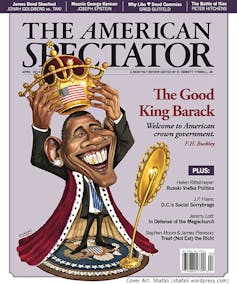
Image from cocver of American Spectgator 2014 showing a caricature of Barack Obama crowning himself king.
How the American Spectator depicted Barack Obama in 2014. American Spectator

Other times, the imagery seemed to speak more to American paternal longings. Take images of Dwight Eisenhower as “King Ike” in the 1950s, a genial ruler among smiling courtiers, soothing cold war nerves.

In our own century, the crown returns in sharper form. The American Spectator’s 2014 cover, “The Good King Barack” showed Obama beaming beneath a red velvet crown.

When Donald Trump triumphed in 2016, crown memes returned as America’s simplest moral shorthand for power that has gone too far.

It fell to his successor Joe Biden to officially declare, in response to the July 2024 Supreme Court ruling that Trump was not immune from prosecution: “This nation was founded on the principle that there are no kings in America.”

Why the crown keeps returning

The crown is both insult and safety valve at once. It’s an instantly legible piece of political folk art reminding citizens that authority is temporary, fallible and – like its wearer – mortal.

When protesters revive “No kings”, they aren’t just quoting the revolution. They’re translating an older language of civic republican virtue into an accent everyone can understand. No person above the law, no office above criticism, no citizen beneath respect.

The slogan reawakens the moral reflex that freedom depends on vigilance, and that dignity belongs to the governed as much as the governors.

And here’s the irony: both parties were founded on that same cry. Democrats and Republicans trace their roots to the anti-monarchical Democratic-Republicans of Thomas Jefferson and James Madison, who defined their movement against the spectre of kingly power. That party later fractured, giving rise to both modern traditions.

In that sense, “No kings” was the nation’s first party platform, the point of agreement from which every later disagreement grew.

Can it still work?

In today’s fractured America, “No kings” offers something rare: a language of protest that feels constitutional rather than ideological. It has the potential to speak to conservatives alarmed by executive overreach, to progressives wary of authoritarian drift, and to independents nostalgic for civic balance.

That gives it unusual rhetorical strength. Unlike most modern slogans – “Drill baby, drill”, “Make America great again” (Maga), or “Defund the police” – it doesn’t divide, it recalls a principle. “No kings” reminds Americans that what unites them is the rejection of tyranny.

The phrase also appeals to exhaustion as much as outrage. After years of political spectacle, “No kings” gestures toward humility, order and self-restraint: the virtues both parties claim to miss.

The movement may go nowhere. But if this moment does turn out to be an inflection point, it is a fitting way to frame it.

To chant “No kings” now is not nostalgia but muscle memory. That is how a republic tests its pulse: by mocking grandeur, refusing awe and rediscovering equality in the act of saying no.

Tom F. Wright, Reader in Rhetoric, University of Sussex

This article is republished from The Conversation under a Creative Commons license. Read the original article.

Orcas discuss how Trump was re-elected and him being an obviously insane, xenophobic Fascist.
Donald Trump urges you to be a Climate Science denier like him. He says that he makes millions and millions for destroying the planet, Burn, Baby, Burn and Flood, Baby, Flood.
Orcas discuss Donald Trump and the killer apes' concept of democracy. Front Orca warns that Trump is crashing his country's economy and that everything he does he does for the fantastically wealthy.
Orcas discuss Donald Trump and the killer apes’ concept of democracy. Front Orca warns that Trump is crashing his country’s economy and that everything he does he does for the fantastically wealthy.
Continue Reading‘No kings’: America’s oldest political slogan is drawing millions out onto the streets

Keir Starmer’s Labour is a lost cause. But there’s still hope for the left

Spread the love

Original article by Paul Rogers republished from openDemocracy under a Creative Commons Attribution-NonCommercial 4.0 International licence.

Zack Polanski, Zarah Sultana and Jeremy Corbyn offer hope for the British left
 | Ben Montgomery/Stringer / Leon Neal/Staff / Kristian Buus/Contributor / Getty Images / Composition by James Battershill

In choosing big business over ordinary people, the PM has sacrificed the heart of the Labour Party. So what next?

Labour’s political position is increasingly the reverse of the ‘for the many, not the few’ policy pursued under former leader Jeremy Corbyn. The party has embraced corporate capture and the main features of neoliberalism, albeit with incredibly poor timing, as the neoliberal economic model drives runaway wealth that increases dissent across much of the world.

It is no coincidence that, at the same time, when it should be coasting along on a huge parliamentary majority won less than 18 months ago, Labour has been plunged into political disarray and seen its lead disappear in the polls.

By cosying up to big business and failing to offer anything to substantially improve the lives of ordinary people up and down the country, Keir Starmer’s New-New Labour has seen a collapse in its general support and, more significantly, its membership.

The Labour Party has lost 300,000 of the 550,000 members it had in the Corbyn era. While it has been able to recoup the financial support offered by these ordinary members from a few big donors, it has in the process lost the heart of the party.

Many issues demonstrate this, but a few stand out. The government’s repeated refusal (now rumoured to be U-turned on at next month’s Budget) to lift the two-child benefit cap. Its flagship welfare bill (already U-turned on), which would have cut Universal Credit and Personal Independence Payments for millions of vulnerable people. The decision, announced in February of this year, to cut the foreign aid programme to increase military spending.

And then came perhaps the biggest problem of all for Starmer’s Labour: Gaza, where the UK government’s continuing support for Israel as it engages in genocide still beggars belief for many. There have been 32 mass demonstrations in London in the past two years, the most recent being one of the largest protests ever held in the UK. That level of political activity will continue, given Israeli prime minister Binyamin Netanyahu seems determined to avoid a peaceful outcome, and Starmer is unlikely to stand up to him or, by extension, the US.

Widespread dismay and depression on the backbenches may ebb and flow, but at this point, it feels like even a change of leadership may not be enough for a real change in fortune.

The government’s current predicament is the main reason why Westminster politics is so uncertain. Looking at the UK-wide parties, the far-right Reform UK is leading polls with vote shares that vary but are typically over 30%, having soaked up plenty of support as a substantial protest vote. If that persists through to the next general election in 2029, it will likely put Nigel Farage into Downing Street.

Labour’s support, meanwhile, is hovering at around 20%, the Tories more like 15% and the Liberal Democrats rather less.

And until three months ago, the Greens were still weak in polling terms – despite having made some progress since last year’s election – and millions on the left were still disenfranchised, having been disillusioned with Starmer’s Labour leadership.

Two things have changed; the first being Zack Polanski winning the Green Party leadership at the start of September. He has brought a more radical and left-wing perspective to the party, which has led to a jump in the polls and an 80% increase in new members. The Greens announced this week that its membership now stands at 126,000 – more than either the Conservatives or the Lib Dems.

The second change is in the fortunes of the new Your Party group, fronted by Corbyn and former Labour MP Zarah Sultana. While the party’s initial request for expressions of interest received a massive 800,000 responses – at which point it appeared likely to provide a serious challenge to Starmer’s Labour – it ran into internal disagreements six weeks ago that knocked it right back and led to a period of utter dismay and anger among supporters.

Those feelings have eased somewhat over the past two weeks, as Your Party has published draft versions of its constitution, standing orders and an organisational strategy, all of which are to be discussed and developed before being decided at a large national conference in Liverpool at the end of November. The documents, including a draft political statement, are open to all and will no doubt be subject to intense debate and plenty of disagreement, but they do appear to be a genuine attempt at accountability that is a very long way from the opacity of the Labour Party.

A typical meeting of supporters, of which there are hundreds around the country, still sees some of the anger of a few weeks ago, but now also more determination to see things through. If the new party can recapture the mood of three months ago – and particularly if it and the Greens are willing to work with one another – then there may be some hope for the disenfranchised left.

One of the most interesting aspects of these rapid political changes is the potential for the three figureheads of these two parties to have a substantial impact.

Zarah Sultana, with an often combative style, appeals particularly to younger and frustrated audiences, while Zack Polanski’s normal and measured approach is persistently disarming for Reform’s far-right politicians. Then there is Jeremy Corbyn, who is already a national figure known for a long-term commitment to a progressive agenda and a remarkable personal following.

These are very early days in a time of rapid political change. Reform is still on the up, but compared with just three months ago, there is now a lot more reason for hope on the left.

Sign up to openDemocracy’s free Daily Email

Keir Starmer explains that he feels no shame or guilt benefitting personally from gifts from the rich and powerful while insisting on policies of severe austerity causing suffering and death.
Keir Starmer says that the Labour Party under his leadership all feel a small part of Scunthorpe.
Keir Starmer objects to criticism of the IDF. He asks how could anyone object to them starving people to death, forced marches like the Nazis did, bombing Gaza's hospitals and universities, mass-murdering journalists, healthworkers and starving people queuing for food, killing and raping prisoners and murdering children. He calls for people to stop obstructing his genocide for Israel.
Keir Starmer objects to criticism of the IDF. He asks how could anyone object to them starving people to death, forced marches like the Nazis did, bombing Gaza’s hospitals and universities, mass-murdering journalists, healthworkers and starving people queuing for food, killing and raping prisoners and murdering children. He calls for people to stop obstructing his genocide for Israel.
Continue ReadingKeir Starmer’s Labour is a lost cause. But there’s still hope for the left

Welsh by-election shows far right isn’t the only alternative to establishment parties

Spread the love

Original article by Ana Vračar republished from peoples dispatch under a Creative Commons Attribution-ShareAlike 4.0 (CC BY-SA) license.

Plaid Cymru celebrates by-election results. Source: Rhun ap Iorwerth/X

Plaid Cymru’s by-election win in Wales shows that space still exists for progressive politics despite Nigel Farage’s claims.

Welsh party Plaid Cymru, an advocate for independence from the United Kingdom, delivered a major blow to both the Labour Party and Reform UK in a by-election for the devolved parliament, the Senedd. Plaid candidate Lindsay Whittle won 47% of the vote in Caerphilly, leaving Reform behind at 36% and Labour at just 11% – an astonishing 35-point drop compared to the previous election. The result marks Labour’s first loss of the seat in more than a century.

“This result shows that Plaid is no longer just an alternative, we are now the real choice for Wales, the only party able to stop billionaire-backed Reform,” party leader Rhun ap Iorwerth said after the result was announced. Ahead of the election, Reform had invested substantial resources into the campaign, with Nigel Farage apparently confident a win in Wales would prove his claim that the far right has become the only true alternative to Britain’s two establishment parties.

In reality, while the by-election confirmed that both Labour and the Conservatives remain in crisis after years of backing austerity, it actually showed that the far right can still be stopped by more progressive alternatives. “In every corner of Britain, people are calling out for an alternative to the misery faced by millions and candidates who will stand up against the hate and division sold by Reform and the shameful parroting of Farage’s rhetoric by Keir Starmer and his weakling Labour government,” the Peace and Justice Project wrote on social media.

Read more: 140,000 march in Brussels against austerity

Since the 2024 general election, Prime Minister Starmer’s shift to the right on everything from austerity to migration and Palestine solidarity has alienated much of Labour’s base and beyond. Many polls now predict the party could be shattered in upcoming elections. Although Reform UK has so far benefited the most from the widespread frustration and anger, positioning itself as the main alternative, progressive political forces have also gained significant ground.

The early announcement of a new left party by independent MPs Jeremy Corbyn and Zarah Sultana drew more than 600,000 expressions of support, while the Green Party has seen thousands of new members join in recent months. Following the election of a new leadership team headed by Zack Polanski, the Greens announced their membership had doubled to 140,000. Both the groups have rejected Reform’s hate-driven narrative and scapegoating of migrants, while also condemning Labour for failing to address people’s real concerns since taking office.

“This Senedd by-election result shows that people are sick of the Westminster establishment and its persistent scapegoating of marginalized communities instead of effectively dealing with the issues we all face,” the Peace and Justice Project stated. While Reform’s failed bid in Caerphilly suggests that not everyone has accepted the idea that the far right is the only alternative to business as usual in British politics, progressives still face the enormous challenge of mobilizing on a larger scale ahead of future elections – including the 2026 run for the Senedd – to counter far-right narratives and build a vision of hope for working-class communities across Britain.

Original article by Ana Vračar republished from peoples dispatch under a Creative Commons Attribution-ShareAlike 4.0 (CC BY-SA) license.

Nigel Farage explains the politics of Reform UK: Racism, Fake anti-establishmentism, Deregulation, Corporatism, Climate Change Denial, Mysogyny and Transphobia.
Keir Starmer justifies why he has to travel abroad so much
UK Conservative Party leader Kemi Badenoch explains her reality that the Earth is flat, the Moon is made of cheese and that she was born from Unicorn horn dust
UK Conservative Party leader Kemi ‘not a genocide’ Badenoch explains her reality that the Earth is flat, the Moon is made of cheese and that she was born from Unicorn horn dust
Continue ReadingWelsh by-election shows far right isn’t the only alternative to establishment parties