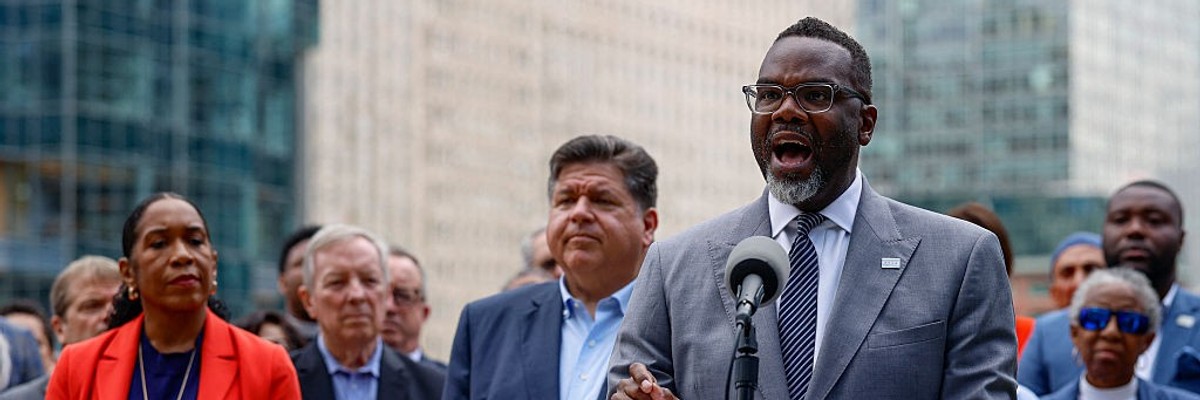
Chicago Mayor Brandon Johnson speaks during a press conference in Chicago, Illinois, on August 25, 2025. (Photo by Kamil Krzaczynski/AFP via Getty Images)
“This is not about fighting crime,” said Illinois Gov. JB Pritzker. “This is about Donald Trump searching for any justification to deploy the military in a blue city, in a blue state, to try and intimidate his political rivals.”
Progressive voices and Democratic leaders this week are letting it be known they will not take President Donald Trump’s threat to target the city of Chicago for his next federal takeover and deployment of federal troops lying down.
Chicago Mayor Brandon Johnson on Monday, alongside Illinois Gov. JB Pritzker and US Sens. Tammy Duckworth (D-Ill.) and Dick Durbin (D-Ill.), held a press conference to let Trump know that Chicago residents want no part of his plan to deploy the military into their city.
“The last thing that Chicagoans want is someone from the outside of our city, who doesn’t know our city, trying to dictate and tell us what our city needs,” said Johnson. “As the mayor of this city, I can tell you that Chicagoans are not calling for military occupation.”
Pritzker, meanwhile, bluntly warned Trump against sending troops to his state’s largest city.
“This is not about fighting crime,” Pritzker said of Trump’s plans to deploy the military in Chicago. “This is about Donald Trump searching for any justification to deploy the military in a blue city, in a blue state, to try and intimidate his political rivals.”
Illinois politicians weren’t the only ones who are vowing to resist Trump’s designs on Chicago, as Rep. Pramila Jayapal (D-Wash.) warned that the president had ambitions to deploy troops to all major American cities.
“First it was LA, then DC, and now Chicago,” she wrote in a social media post Tuesday. “None of us are safe from Trump’s authoritarian rule. We must fight back against this takeover of our cities.”
Progressive organization Our Revolution, has started circulating a petition demanding that Congress vote against any Trump request to extend his control over the Washington, DC Metropolitan Police Department beyond the legally allowed period of 30 days.
Progressives’ vows of defiance come as The Chicago Sun-Times is reporting new details about Trump’s designs on the Windy City. According to the paper, the administration is planning to use a suburban naval base just outside the city to house federal immigration officials and potentially National Guard troops starting in September.
An email sent this week by US Navy Cpt. Stephen Yargosz obtained by The Chicago Sun-Times claimed that the deployment will be focused on “downtown Chicago,” despite the fact that the downtown area is not where most violent crimes in the city occur.
Yargosz also said in his email that there are “not many details” right now about deploying the National Guard in Chicago, but “mainly a lot of concerns and questions.”
The Chicago Sun-Times report also noted that all of these plans are being done without any input from or consultation with local officials, who have said that they are completely in the dark about what the president is plotting.
Orcas discuss how Trump was re-elected and him being an insane, xenophobic Fascist.Elon Musk urges you to be a Fascist like him, says that you can ignore facts and reality then.
Original article by Brad Reed republished from Common Dreams under Creative Commons (CC BY-NC-ND 3.0).
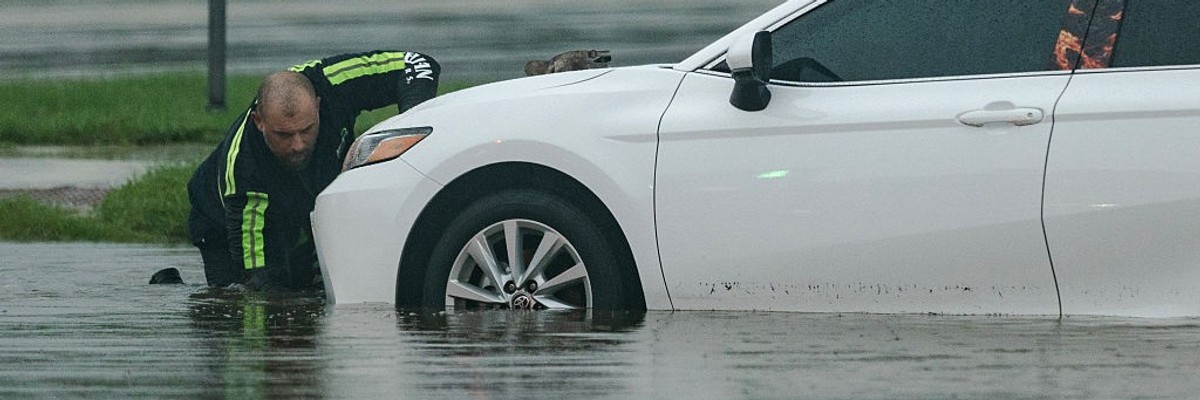
A tow truck driver tries to attach a cable to a car submerged in flood waters on the bank of the Guadalupe River during a search and recovery mission on July 13, 2025 in Ingram, Texas. (Photo by Jim Vondruska/Getty Images)
“Hurricane season has begun, yet FEMA continues to lack an appointed administrator with the mandated qualifications to fulfill this role,” the employees wrote in a letter to Congress.
More than 180 federal emergency relief workers have signed a letter warning that US President Donald Trump’s administration is severely harming their ability to respond to future disasters.
The letter, which was sent to members of Congress on Monday, painted a dire picture of the Federal Emergency Management Agency (FEMA) under Trump’s watch.
“Since January 2025, FEMA has been under the leadership of individuals lacking legal qualifications, Senate approval, and the demonstrated background required of a FEMA administrator,” the employees stated. “Decisions made by FEMA’s Senior Official Performing the Duties of the Administrator (SOPDA) David Richardson, former SOPDA Cameron Hamilton, and Secretary of Homeland Security Kristi Noem erode the capacity of FEMA… hinder the swift execution of our mission, and dismiss experienced staff whose institutional knowledge and relationships are vital to ensure effective emergency management.”
The employees then detailed several specific ways that the Trump administration has hamstrung the agency, which they said would be tantamount to “the effective dissolution of FEMA itself and the abandonment of the American people” if not corrected.
First, they faulted Noem for requiring personal review for all contracts, grants, and mission assignments costing more than $100,000, which they described as an improper impoundment of agency funds that “reduces FEMA’s authorities and capabilities to swiftly deliver our mission.”
They then took aim at Richardson, whom they lambasted as wholly unqualified for his position.
“Hurricane season has begun, yet FEMA continues to lack an appointed administrator with the mandated qualifications to fulfill this role,” they warned. “The dangers of unqualified leadership were a significant lesson learned from Hurricane Katrina.”
The FEMA workers noted that the Trump administration has flouted federal requirements demanding that FEMA administrators demonstrate “ability in and knowledge of emergency management.” According to The New York Times, Richardson told employees in June that he hadn’t been aware the US had a hurricane season.
“They’re breaking the law so they can hire mediocre people,” said US Rep. Sean Casten (D-Ill.). “And Americans will die as a result.”
The employees also slammed the administration for its “censorship of climate science, environmental protection, and efforts to ensure all communities have access to information, resources, and support.”
They also noted that the administration removed the Future Risk Index from FEMA’s website this past February, which they said would harm “the nation’s ability to properly prepare for and mitigate against the risks of tomorrow.”
Finally, the employees called attention to the massive workforce drain FEMA has experienced under Trump’s administration.
“FEMA’s current capacities have been significantly limited due to a loss of personnel through programs designed to incentivize our workforce to leave federal service, ongoing hiring freezes, and the cancellation of critical support contracts,” they wrote. “One-third of FEMA’s full-time staff have departed the agency this year, leading to the loss of irreplaceable institutional knowledge and long-built relationships.”
The employees also said that the damage done to FEMA was already visible this past summer during the agency’s response to deadly floods in central Texas that claimed the lives of more than 130 people.
“As that disaster unfolded, FEMA’s mission to provide critical support was obstructed by leadership who not only question the agency’s existence but place uninformed cost-cutting above serving the American people and the communities our oath compels us to serve,” they said.
A total of 181 FEMA employees signed the letter, although only 35 of them made their signatures a matter of public record.
Trump earlier this year said he’d like to see FEMA dismantled so that more responsibility for handling the aftermath of natural disasters would be pushed off to individual states. Meanwhile, the president has denied some states’ requests for disaster declarations, including Kentucky, Tennessee, and Oklahoma.
Original article by Brad Reed republished from Common Dreams under Creative Commons (CC BY-NC-ND 3.0).
FEMA, the Federal Emergency Management Agency, is a U.S. government agency under the Department of Homeland Security responsible for coordinating federal responses to disasters and emergencies.
Donald Trump urges you to be a Climate Science denier like him. He says that he makes millions and millions for destroying the planet, Burn, Baby, Burn and Flood, Baby, Flood.Elon Musk urges you to be a Fascist like him, says that you can ignore facts and reality then.Orcas discuss how Trump was re-elected and him being an insane, xenophobic Fascist.
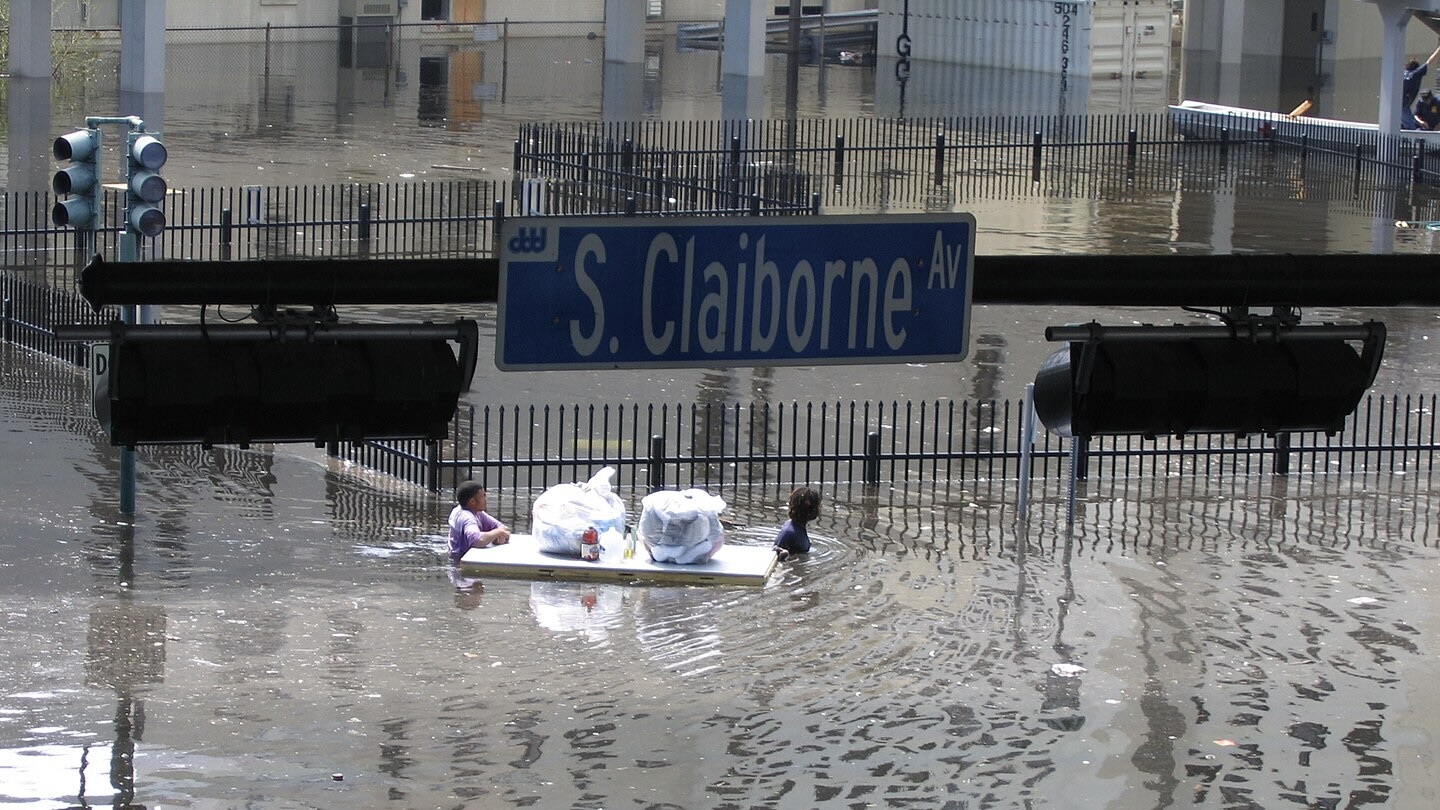
Flooding in downtown New Orleans after Hurricane Katrina on August 31, 2005. Photo: Wikimedia Commons
As the people of New Orleans suffered from mass devastation and state neglect following Hurricane Katrina, Cuba’s offer of solidarity was rejected
Two decades ago, Hurricane Katrina ripped through the Gulf Coast of the United States, a Category 5 monster that exposed the raw nerves of inequality, racism, and governmental neglect in the United States. While the storm itself was a force of nature, the true disaster was the response – or lack thereof – from the world’s wealthiest nation. Yet, amidst the chaos and despair, a beacon of international solidarity shone brightly, emanating from an unexpected place: Cuba.
The images are seared into collective memory: rooftops submerged, desperate cries for help echoing through flooded streets, and the Superdome stadium transforming into a squalid shelter. New Orleans, a city with a majority Black population and a vibrant hub of Black culture, bore the brunt. As the levees broke, so too did the illusion of American exceptionalism. Over 1,800 people died, and millions were displaced. The federal government’s response was not only slow but also virtually nonexistent in the crucial initial days. President George W. Bush, vacationing at the time, seemed detached, famously remarking to his FEMA director, “Brownie, you’re doing a heck of a job,” even as the crisis deepened.
Cuba’s hand of friendship
In New Orleans, as desperately overworked healthcare providers struggled with a critical lack of medicine, equipment, and personnel, the Cuban government made its formal offer on September 2. The Senate Majority Leader at the time, Bill Frist, a physician himself who was visiting the flooded city, acknowledged the crisis, stating, “The distribution of medical assistance continues to be a serious problem,” and confirmed reports that scores of people were dying as a result. As the US government faltered, a small island nation, blockaded and vilified by Washington for decades, extended an immediate and comprehensive offer of aid. Fidel Castro announced that Cuba was ready to send a medical brigade of 1,586 doctors, equipped with 36 tons of medical supplies, to assist the victims of Hurricane Katrina. This wasn’t a conditional offer, nor was it for profit. It was a gesture of unconditional solidarity, rooted in the values of the Cuban people, in offering help to those in need, whether suffering from natural disasters or colonialism.
“We would be honored to send our doctors,” Fidel declared. “We could move them by air in groups of 100, and they could arrive within 12 hours of permission being granted.” The doctors were prepared to work in the most challenging conditions, bringing not just medical expertise but field hospitals of their own and decades of experience in providing free and socialized healthcare to millions of people in Africa, Asia, and Latin America. They were even willing to brave the dangerous waters to reach those stranded. This was the nascent stage of what would soon become the Henry Reeve International Medical Brigade, a testament to Cuba’s unwavering commitment to global health.
The Henry Reeve Brigade
The Henry Reeve Brigade, named after a young American volunteer from Brooklyn, New York, who fought for Cuban independence in the 19th century, was officially formed shortly after Katrina. Its mission: to provide medical assistance in disaster situations and serious epidemics anywhere in the world. While the Bush administration ultimately rejected Cuba’s offer of aid for Katrina, citing “logistical challenges,” the reason given was a lack of full diplomatic relations with Cuba, a claim that rang hollow given the Bush administration had just accepted aid from Taiwan, with which the US also lacks full diplomatic relations. It was a thinly veiled excuse rooted in geopolitical animosity.
Still, the brigade went on to become a global force for good. From the devastating earthquake in Pakistan in 2005 to the cholera epidemic in Haiti, and most recently, the global COVID-19 pandemic, the Henry Reeve Brigade has been deployed to over 40 countries, treating millions and saving countless lives. These doctors often work in remote, dangerous, and impoverished areas, where most Western charities and aid organizations usually fear to stay. They embody the Cuban principle of prioritizing human well-being over profit or political gain. They are a living, breathing condemnation of the often generalized idea in the United States that healthcare is something to profit from.
The contrast between the US government’s response to Katrina and Cuba’s offer of aid couldn’t be starker. For decades, US foreign policy has been predicated on the idea that Cuba is a threat to US democracy, even landing on the US State Sponsors of Terrorism list. Yet, when its own citizens were drowning, Washington chose to maintain its Cold War attitude over the necessity of saving the lives of its own citizens. A Katrina survivor, recounting the harrowing days after the storm, once lamented, “Where was our government? We were left to die.” This sentiment encapsulates the raw betrayal felt by many of the city’s Black residents.
The rejection of Cuba’s aid wasn’t just a missed opportunity; it was a damning indictment of the US’s priorities. While ordinary Americans were suffering, the Bush administration was more concerned with maintaining its anti-Cuba stance than with saving lives. This is the inherent flaw of a system that prioritizes capital over human lives, that sees solidarity as a weakness rather than a strength.
From Katrina to today: the enduring relevance
Twenty years later, the lessons of Katrina and Cuba’s offer of aid remain profoundly relevant. In today’s political climate, the US continues its aggressive stance against Cuba, even attempting to discourage other countries in the Global South from accepting Cuban medical brigades. The Trump administration, for example, actively campaigned against countries receiving aid from Cuban doctors, labeling them as “human trafficking” – a cynical and baseless accusation designed to undermine Cuba’s international standing and maintain the brutal economic blockade.
Yet, despite these efforts, Cuba’s medical internationalism continues to inspire. In the midst of the COVID-19 pandemic, as wealthy nations hoarded vaccines and medical supplies, Cuba developed its own vaccines and continued to send its doctors to the most remote corners of the globe.
As people across the Gulf Coast commemorate the 20th Anniversary of Hurricane Katrina, may the example of the Henry Reeve Brigade be a powerful reminder of Cuba’s solidarity with the people of the United States.
Manolo De Los Santos is Executive Director of The People’s Forum and a researcher at Tricontinental: Institute for Social Research. His writing appears regularly in Monthly Review, Peoples Dispatch, CounterPunch, La Jornada, and other progressive media. He coedited, most recently, Viviremos: Venezuela vs. Hybrid War (LeftWord, 2020), Comrade of the Revolution: Selected Speeches of Fidel Castro (LeftWord, 2021), and Our Own Path to Socialism: Selected Speeches of Hugo Chávez (LeftWord, 2023).
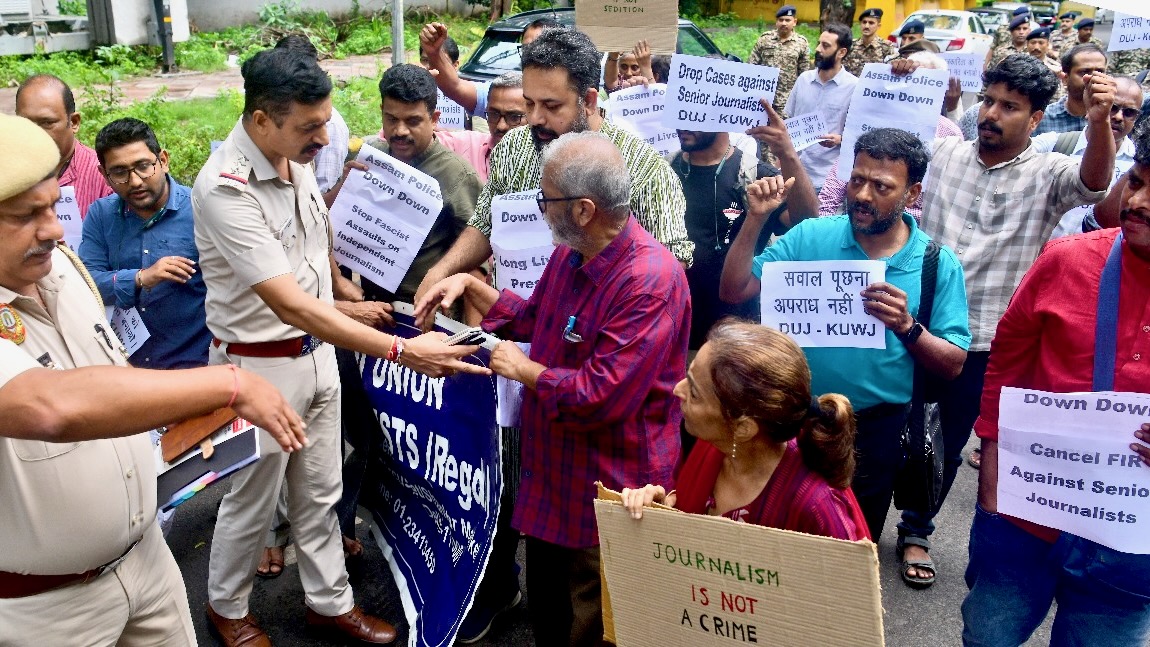
Journalists and activists protest in Delhi against the state’s attacks on press freedom. Photo: DUJ
The ultra-right-wing Bharatiya Janata Party (BJP) governments in various provinces in India have used sedition charges against journalists for their critical reporting on policies and actions.
Members of the Delhi Union of Journalists (DUJ) and the Kerala Union of Working Journalists (KUWJ) held a protest in India’s capital, New Delhi, on Wednesday, August 27, denouncing the rising cases of state-sponsored attacks on journalists in the country.
The protesters also demanded the immediate withdrawal of all the false charges against senior journalists Siddharth Varadarajan, Karan Thapar, and Abhisar Sharma, calling them blatant attacks on media and press freedom in the country.
The DUJ and KUWJ warned that if their cases are not withdrawn and such attacks on press freedom continue in the future, journalists in the country will take larger public action and flood the streets in protest.
Siddharth Varadarajan, founding editor-in-chief of the independent newsportal The Wire, Karan Thapar, senior editor with The Wire, and another senior journalist, Abhisar Sharma, were booked by the police in India’s north-eastern state of Assam and charged with sedition and other criminal activities.
The case against Abhisar is related to his reporting on his YouTube channel on the charges of corruption against the chief minister of Assam, Himanta Biswa Sarma. Abhisar also talks about the chief minister’s openly sectarian policies and provocative language against Muslim minorities in his video.
Varadarajan and Thapar were booked first in July and then again in August by the Assam police for their critical reporting on Operation Sindoor, India’s military operation against Pakistan in May which created a war-like situation between the two nuclear-powered neighbors.
Varadarajan and Thapar went to the court demanding the dismissal of the cases against them. While the matter was still under consideration by the court, the Assam police filed fresh charges against them. The Supreme Court of India (SCI) provided the journalists temporary protection from any action.
Abhisar Sharma also received interim relief from the SCI on Thursday. However, in both cases the SCI failed to quash the First Information Reports (FIRs), the official document in India that initiates criminal proceedings.
BJP’s attempts to silence critical voices
What the DUJ calls “attempts to browbeat and harass the media into submission”, has been a policy of the BJP government to silence critical voices in the country.
Assam is ruled by the same BJP which runs the union government in Delhi.
Several other journalists have faced false charges in the state in the last few years. In March of this year, Assam witnessed large-scale protests against the arrest of senior journalist Dilwar Hussain Mazumdar, who was arrested after he tried to expose corruption in a cooperative bank.
The union government has also used its agencies to raid and shut down independent newsportals, such as Newsclick, and has threatened others, including the Wire, to try to silence them.
Reflecting on the state of media in India earlier this year, Reporters without Borders (RSF) demanded that the state must “end media raids and arrests of journalists, often carried out under the guise of anti-terrorism laws or tax regulations.”
RSF had noted that “this judicial harassment has reached a critical level for independent news media”, with authorities repeatedly misusing the legal provisions.
Misuse of sedition
Apart from anti-terrorism laws and allegations of financial irregularities, the BJP government has also used sedition, a colonial era offense which remained a part of India’s legal codes even decades after independence. It has been frequently invoked against journalists questioning government policies.
Following massive public outcry and court interventions, the BJP government promised to scrap it in 2023, underlining its “colonial origin”. However, within months, the same government brought it back with a new name under the new set of legal codes called Bharatiya Nyaya Sanhita (BNS), promulgated in 2024.
The Wire has filed a fresh petition in the court to remove the sedition charges from the new code (section 156 of the BNS).
The DUJ hopes that the section “will be struck down so it can no longer be used to arrest, imprison, browbeat and harass those who dare to speak truth to power.”