Getting shorter and going hungrier: how children in the UK live today

Spread the love
Keir Starmer says pensioners can freeze to death and poor children can starve and be condemned to failure and misery all their lives.
Keir Starmer says pensioners can freeze to death and poor children can starve and be condemned to failure and misery all their lives. The child poverty and neglect discussed in this article occurred previously to Keir Starmer and the Labour Party being in office. They polices are however certainly continuing and reproducing child poverty and destitution.

Danny Dorling, University of Oxford

Children’s lives in the UK are changing.

They are becoming shorter in height. More of them are going hungry than they were a few years ago. Recently, more have died each year than they did a few years ago. Increased poverty, more destitution and the effects of ongoing austerity are the clear culprits.

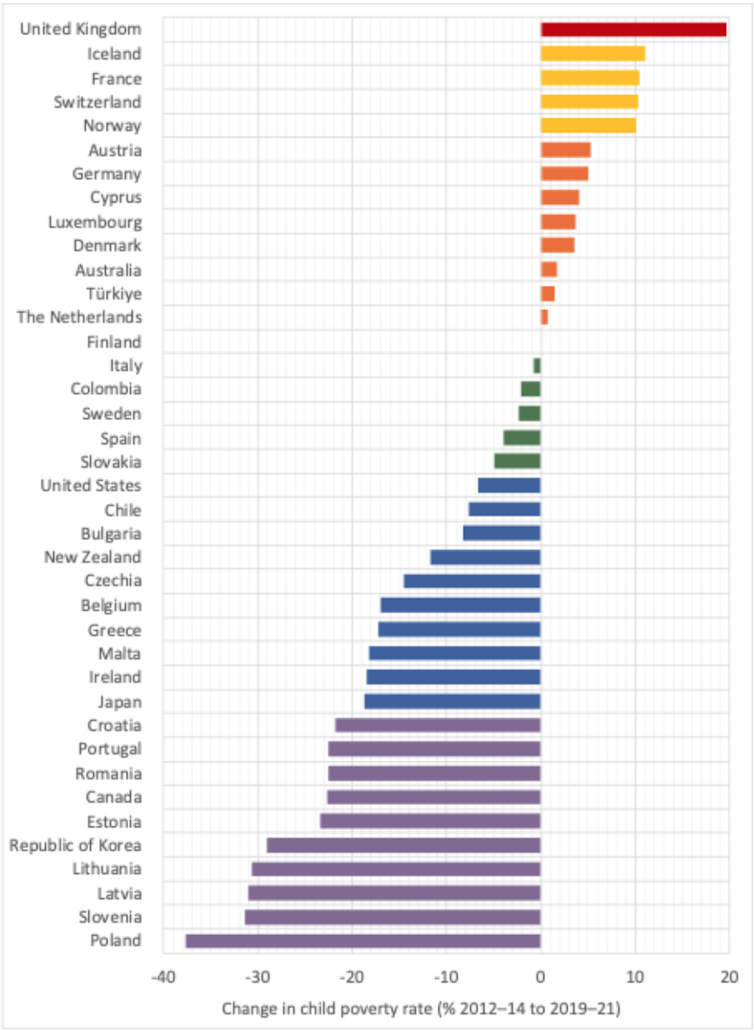
But why did this happen to our children? This rise in child poverty is a change that has not been found to have occurred to the same extent anywhere else in the world, among all the places that the United Nations measures in the same way.

Change in child poverty, 2012–14 to 2019–21
Bar chart
UNICEF Innocenti—Global Office of Research and Foresight (2023) ‘Innocenti Report Card 18: Child poverty in the midst of wealth’, CC BY-NC-ND


This graph tells a story of hope and success. In much of Eastern Europe, child poverty has fallen by between as much as a third – and often at least a quarter – in a mere seven years.

But it also shows that child poverty has risen the most in the UK. The poorest fifth of households in the UK are poorer than the poorest fifth in most of Eastern Europe. For many people in the UK, this will come as a surprise. Some will refuse to believe it can be this bad.

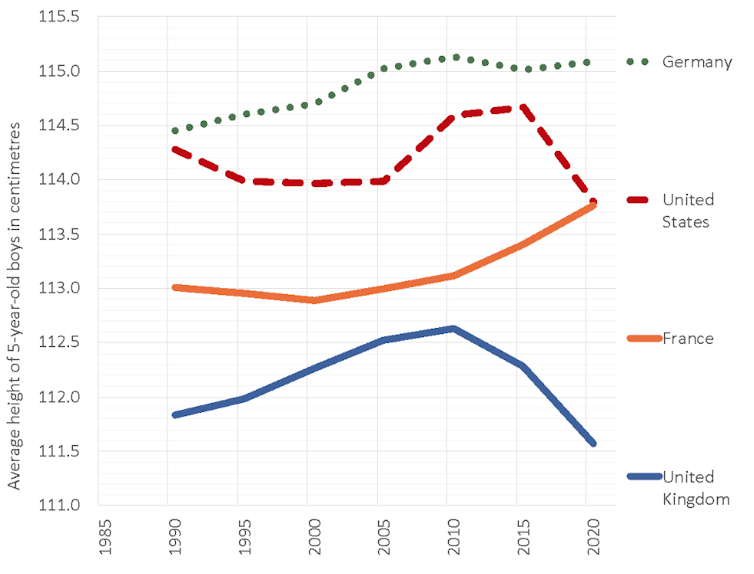
The evidence for this poverty is seen in the declining heights of five-year-olds since 2010.

Average height of five-year-old boys, 1985–2020
Line graph
Average height of 5-year-old boys, 1985–2020. Redrawn by the author from data in Press Association (2023) ‘British children shorter than other five-year-olds in Europe’, ITV News, 21 June., CC BY-NC-ND


A 5-year-old in 1990 would have been born in 1985 and their height influenced mostly by nutrition in the years 1985–1990. Those were hard years for the UK: mass poverty resulting from over three million people being out of work in the early 1980s. But the average height of children was still increasing.

It was not until 2010, for those children who had lived between 2005 and 2010, that we first saw heights plateau and then fall, coinciding with the post-2010 austerity years.

My forthcoming book attempts to make sense of what has happened to the UK: why, in 2024, it is not merely one of the countries in Europe with a high rate of child poverty, but the one country above all others that the UN has singled out as having had the greatest rises in child poverty among all those it surveyed.

Seven children

To try to understand more about children’s lives in the UK, I constructed seven typical children. I divided all 14 million children living in the UK into seven groups of 2 million, according to the income of their families in 2018 and 2019. I then chose the middle child of each 2 million. I next looked at what had happened to those families between 2018 and 2024.

The graph below shows the annual income of each of the seven households the children were drawn from.

Annual household incomes after tax, benefits and housing costs in the UK, families with children 2019/20
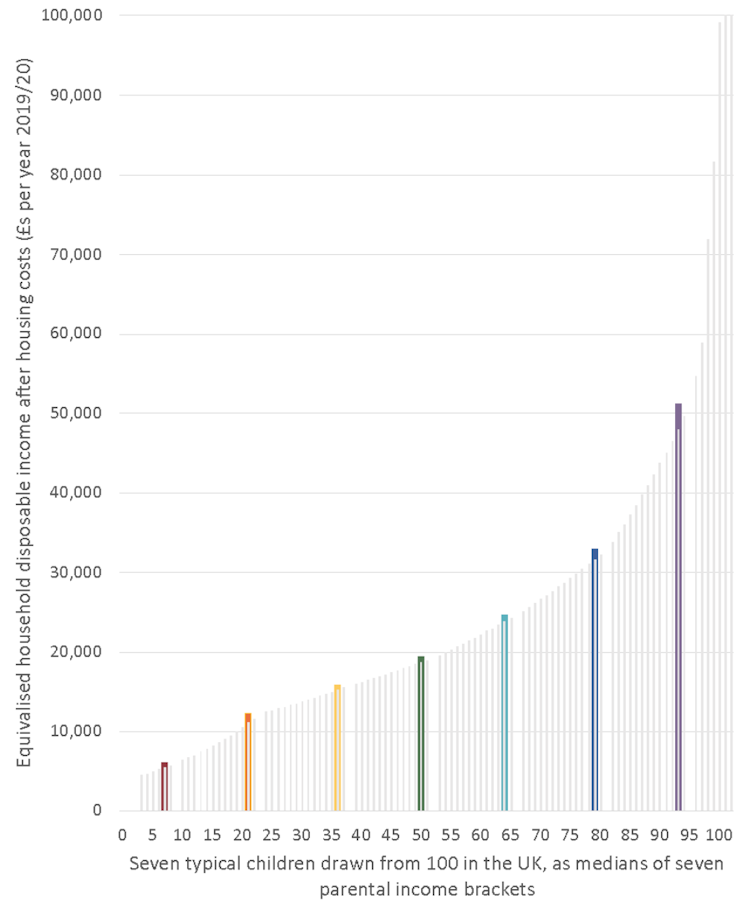
Annual household incomes after tax, benefits and housing costs in the UK, families with children 2019/20: seven typical children marked in colour. Danny Dorling, CC BY-NC-ND


The first thing to note is just how incredibly well-off the children are who are better-off than our seven typical children.

Some 6% of all children in the UK live in households richer than the best-off typical child in my analysis. Those 6% of children, the best-off children of all, live in families that each year receive and spend a third of all the income in the UK.


Want more politics coverage from academic experts? Every week, we bring you informed analysis of developments in government and fact check the claims being made.

Sign up for our weekly politics newsletter, delivered every Friday.


These 6% are not typical, and neither are the 6% poorest: those most destitute, those whose families are most likely to use food banks. If you pick seven typical children, equally spaced out across the income scale, then these extremes are not part of what you see.

But four of our typical seven children now live lives that most better-off people would consider to be in poverty. The other three are hardly well-off.

The least well-off are in families struggling to pay bills and making sacrifices others do not have to think about. For instance, whether to save £10 a month, or have insurance against the effects of flood, fire or theft. Increasingly often they cannot afford both.

But even the most well-off of our seven children lives in a family that worries about paying for an annual holiday. That is rare among the most affluent two million families, but possible.

The UK in 2024 demonstrates to the world what living with high inequality means in a once affluent country. It means a few using up far more resources than the vast majority of other children, such as having access to many more school teachers – per child – as compared to the rest, better food, better shelter, more warmth, more toys, better material everything; often more than you might think any child needed.

In future, almost all our children will tell their stories of growing up in the UK of the 2020s and – hopefully – what changed to make things better. It is hard to imagine them becoming much worse.

Danny Dorling, Halford Mackinder Professor of Geography, University of Oxford

This article is republished from The Conversation under a Creative Commons license. Read the original article.
Continue ReadingGetting shorter and going hungrier: how children in the UK live today

Morning Star Editorial: Change or die: Starmer must abandon Treasury orthodoxy or face oblivion

Spread the love

https://morningstaronline.co.uk/article/change-or-die-starmer-must-abandon-treasury-orthodoxy-or-face-oblivion

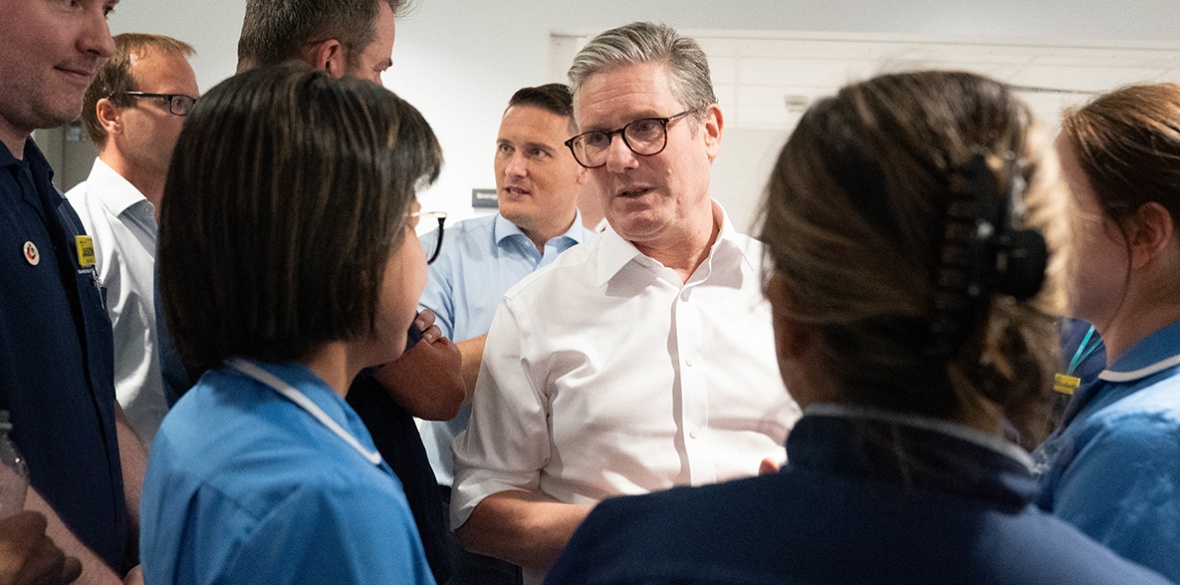
Prime Minister Sir Keir Starmer (left) and Health Secretary, Wes Streeting during a visit to the University College London Hospital (UCLH), September 11, 2024

“CHANGE or die” was Keir Starmer’s message to the National Health Service.

But it could as well apply to his own government, which already appears locked in a downward spiral.

Labour secured the election with the smallest share of the vote for a new government in history and on a low turnout to boot. Barely one eligible voter in five chose Labour on July 4.

Starmer himself, moreover, saw half of his 2019 vote — and that was not a good year for Labour — disappear in his north London constituency.

But the only conclusion he has apparently drawn is that more misery must be piled on the public.

First, he maintained the cruel two-child benefit cap, and suspended from the Parliamentary Labour Party those MPs who had the temerity to vote to lift children out of poverty.

Then he appeared in the Downing Street garden to announce that things were only going to get worse for the foreseeable future, preparing the way for that new round of austerity he had pledged to avoid during the election campaign.

His pretence is that “tough choices” are needed because of an unexpected “black hole” left behind in the public finances by the Tories.

But the choices made by Chancellor Rachel Reeves and Starmer are always “tough” at the expense of the poorest.

In 2017 Labour estimated that means-testing the winter fuel allowance would lead to nearly 4,000 extra fatalities. Today, following exactly that policy, the government conceals the possible consequences, having either not commissioned an assessment of the policy’s impact, or determined to hide it.

It is said that you only get one chance to make a first impression. The first impression of this government is now set in stone — it is of callous cost-consciousness compounded by concealment.

This is not “fixing the foundations” as Starmer claims. It is fracturing them, and many Labour MPs know it.

https://morningstaronline.co.uk/article/change-or-die-starmer-must-abandon-treasury-orthodoxy-or-face-oblivion

Keir Starmer says pensioners can freeze to death and poor children can starve and be condemned to failure and misery all their lives.
Continue ReadingMorning Star Editorial: Change or die: Starmer must abandon Treasury orthodoxy or face oblivion

Jeremy Corbyn: Austerity Is Labour’s Choice

Spread the love

https://tribunemag.co.uk/2024/09/jeremy-corbyn-austerity-is-labours-choice

After 14 years of billionaires doubling their wealth, the political elite’s choice of starving pensioners and children shows austerity as a complete con job.

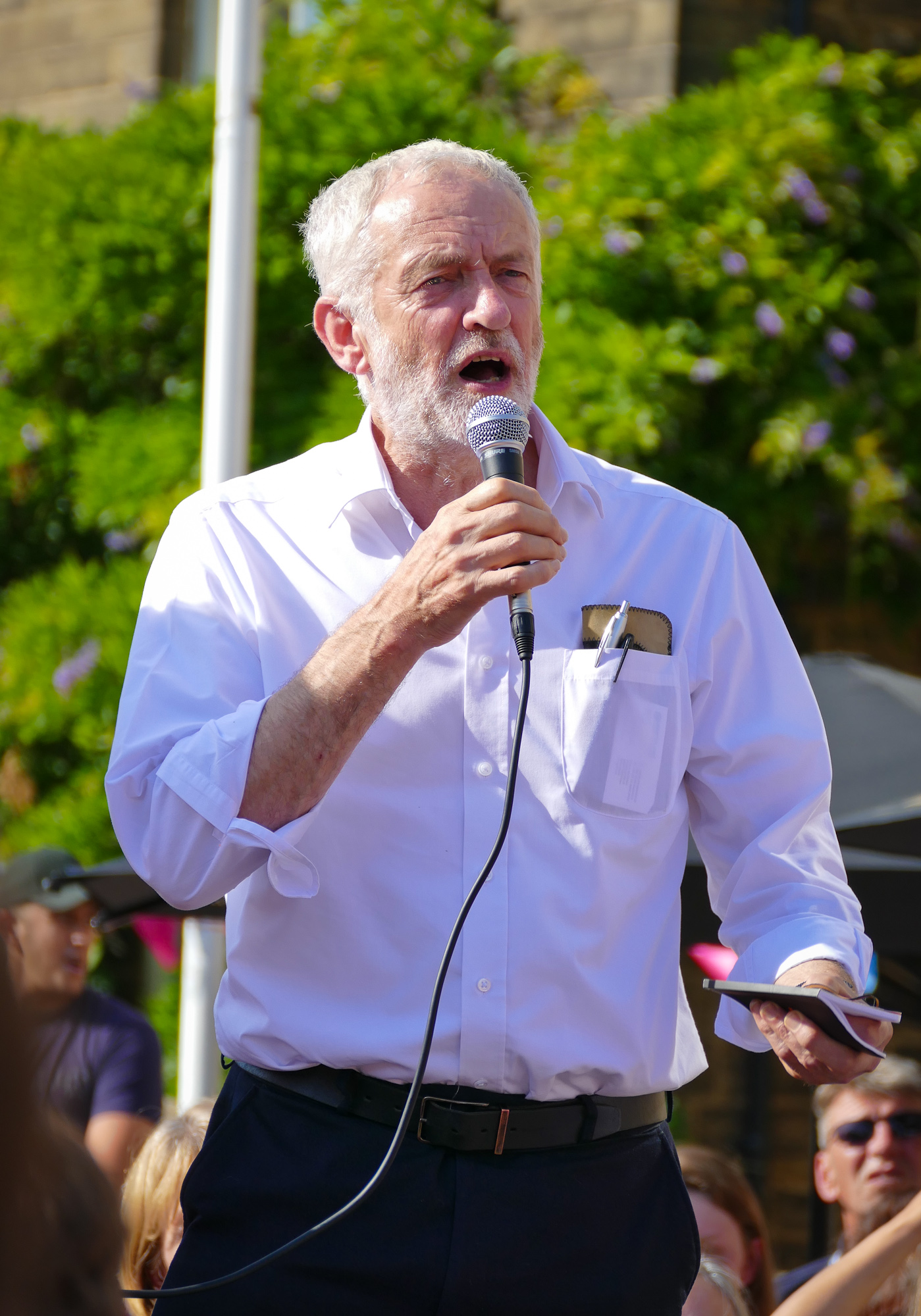
Image of Jeremy Corbyn MP, former leader of the Labour Party
Jeremy Corbyn MP, former leader of the Labour Party

Every day, my constituents make tough choices. Tough choices like deciding whether to heat their homes or put food on the table. Tough choices like taking out a loan to pay for this month’s rent. Tough choices like selling their home to pay for their family’s social care.

People are making tough choices because governments have made the wrong choices. We warned that Tory austerity would weaken our economy and decimate our public services. We were ignored, and the poorest in society paid the price. Austerity is not just a buzzword. It is the ongoing, brutal reality for millions of people who have been pushed into destitution. It is the face of desperation and anxiety of those forced into a spiral of debt. It is a freezing cold night for the record numbers of people sleeping rough on the streets. It is the graveyard for those left without vital support: more than 300,000 excess deaths have been attributed to austerity policies.

We often talk about austerity in terms of cuts to public spending, but that is just one side of the coin. By starving public services of resources, the government manufactured a convenient excuse for their privatisation. We saw this most acutely with the NHS: an underfunded public service does not just cause satisfaction to plummet, but the belief in the principle of public healthcare itself. Austerity was never about saving money (the UK’s debt pile increased every single year under the Tories). It was about transferring money from the poorest to the richest. Between 2010 and 2018, aggregate wealth in the UK grew by £5.68 trillion. 94% went to the richest 50% of households. 6% went to the poorest 50%. As child poverty was heading towards its highest levels since 2007, Britain’s billionaires more than doubled their wealth.

It was a political decision to defund, dismantle and auction off our public services. And it will be a political decision to repeat this failed economic experiment. ‘It’s going to be painful’, the Prime Minister told the nation last week, prepping the public for ‘difficult choices’ ahead. Did he get permission from the Tories to reuse their trademark slogans? Other ministers have gone one step further, indicating that they do not have any choice at all but to impoverish children and pensioners. Keeping children in poverty is unavoidable, apparently, if we want to restore the public finances. Scrapping the winter fuel allowance is a necessity, we were risibly told, if we want to stop a run on the pound.

It is astonishing to hear government ministers try to pull the wool over the public’s eyes. The government knows that there is a range of choices available to them. They could introduce wealth taxes to raise upwards of £10 billion. They could stop wasting public money on private contracts. They could launch a fundamental redistribution of power by bringing water and energy into full public ownership. Instead, they have opted to take resources away from people who were promised things would change. There is plenty of money, it’s just in the wrong hands — and we will not be fooled by ministers’ attempts to feign regret over cruel decisions they know they don’t have to take.

..

Article continues at https://tribunemag.co.uk/2024/09/jeremy-corbyn-austerity-is-labours-choice

Continue ReadingJeremy Corbyn: Austerity Is Labour’s Choice

Chancellor’s ‘black hole’ claim ‘unnecessary and unhelpful’, says ex Bank of England economist

Spread the love

https://news.sky.com/story/chancellors-black-hole-claim-unnecessary-and-unhelpful-says-ex-bank-of-england-economist-13213523

Andy Haldane

Former senior economist Andy Haldane told Sky News that Rachel Reeves’s comments earlier this summer had spooked consumers, businesses and investors.

The chancellor’s claim of a £22bn “black hole” in government finances was “unnecessary and probably unhelpful economically”, a former Bank of England chief economist has said.

Andy Haldane told Sky News’ Politics Hub with Sophy Ridge that Rachel Reeves’s statement in July was a “bad idea” because it generated a sense of “fear and foreboding” just when there was a new-found confidence in the UK.

Ms Reeves made the claim within weeks of taking office in what was widely seen as a warning that her first budget in October would be a painful mix of spending cuts and tax rises.

He said: “The black hole event was unnecessary and probably unhelpful economically.

“It’s one thing to reveal a black hole, if that indeed is what it is. But just leaving that to sit for three months I think was a bad idea.”

Asked what the government should have done, he said it was “much better to say nothing until you provide solutions”.

https://news.sky.com/story/chancellors-black-hole-claim-unnecessary-and-unhelpful-says-ex-bank-of-england-economist-13213523

Continue ReadingChancellor’s ‘black hole’ claim ‘unnecessary and unhelpful’, says ex Bank of England economist