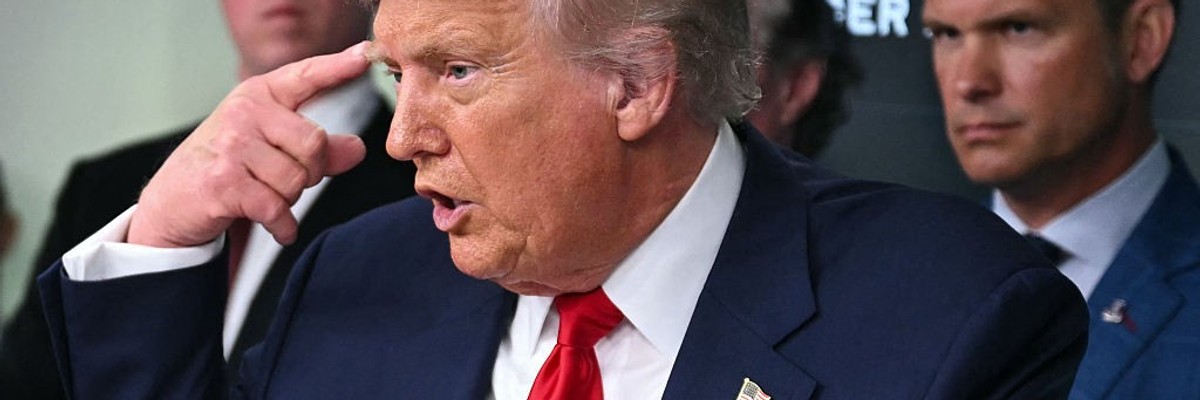
U.S. President Donald Trump gestures while speaking during a news conference to discuss crime in Washington, D.C. on August 11, 2025. (Photo: Jim Watson/AFP via Getty Images)
“The administration’s actions are unprecedented, unnecessary, and unlawful,” declared Washington, D.C. Attorney General Brian Schwalb.
U.S. President Donald Trump on Monday moved to deploy the National Guard on the streets of Washington, D.C., while also officially taking over the city’s police department.
What’s more, Trump suggested that this could be a model for other American cities.
As reported by NBC News, Trump said during his announcement on plans to deploy the National Guard in the nation’s capital that “other cities are hopefully watching this” and that he hoped it would make them “self-clean up, and maybe they’ll self-do this and get rid of the cashless bail thing and all of the things that caused the problem.”
Trump then named Baltimore, Oakland, New York, and Chicago as potential future targets for National Guard deployments and other measures.
Shortly after Trump made his announcement, Washington, D.C. Attorney General Brian Schwalb indicated that he was not taking the president’s attempt to take over his city’s police force lying down.
“The administration’s actions are unprecedented, unnecessary, and unlawful,” he declared in a post on X. “There is no crime emergency in the District of Columbia. Violent crime in D.C. reached historic 30-year lows last year, and is down another 26% so far this year. We are considering all of our options and will do what is necessary to protect the rights and safety of District residents.”
Rep. Mary Gay Scanlon (D-Pa.) was also quick to condemn the president’s takeover of D.C. law enforcement as an unnecessary power grab.
“The president’s attempt to federalize the D.C. Metropolitan Police Department and deploy the National Guard on the streets of our nation’s capital is an abuse of power,” she said. “It’s an egotistical, pathetic attempt to stoke fear and distract from his failures: America is less affordable, healthy, and safe under this administration.”
Minnesota Gov. Tim Walz, who last year served as the Democratic Party’s vice-presidential nominee, chided critics who had accused him in the past of exaggerating the authoritarian threat of a second Trump term.
“The road to authoritarianism is littered with people telling you you’re overreacting,” he wrote on X.
The NAACP, meanwhile, compared Trump’s enthusiasm for deploying the National Guard in Washington, D.C. to purportedly battle crime with the lackadaisical attitude he took toward deploying the National Guard when his supporters violently stormed the United States Capitol building on January 6, 2021.
“As a reminder: The same president who proclaims he wants to take back our capital during a historic 30-year low crime rate also couldn’t find the National Guard on Jan. 6,” the organization wrote.
Public Citizen co-presidents Lisa Gilbert and Robert Weissman issued a joint statement slamming Trump’s actions and outright labeling him a “despot.”
“As autocrats commonly do, Trump is seeking control over the national capital in order to intimidate and squelch dissent,” they said. “Like despots around the world and throughout history, Trump is also relying on the pretextual deployment of military force to intimidate and project power, to suppress protest and undercut democracy.”
As reported by Politico, Trump’s seizure of the D.C. police is on borrowed time from a legal perspective. While the Home Rule Act gives Trump the power to take control of the D.C. police force for emergencies, this power only lasts for 30 days, after which he must seek authorization from Congress to maintain control.
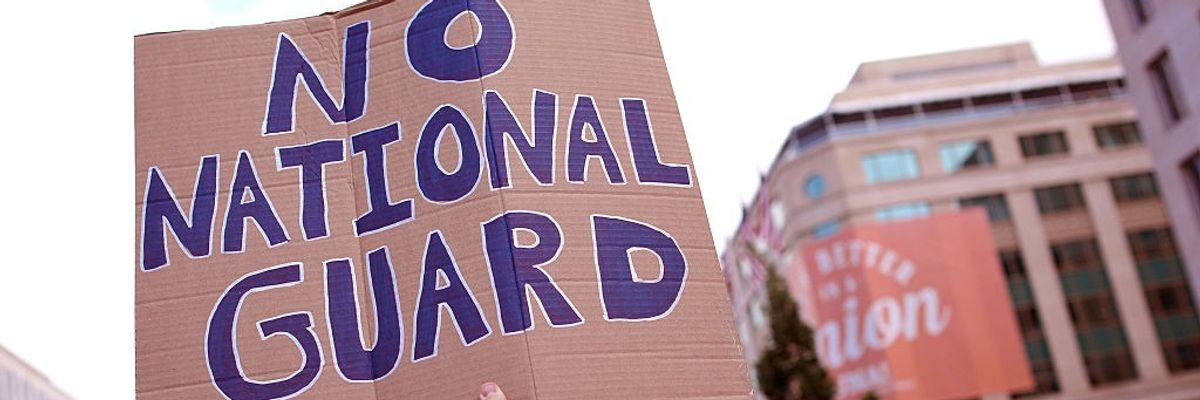
People participate in a rally against the Trump Administration’s federal takeover of the District of Columbia, outside of the AFL-CIO on August 11, 2025 in Washington, DC. President Trump announced he is placing the DC Metropolitan Police Department under federal control, and will deploy the National Guard to the District in order to assist in crime prevention in the nation’s capital. (Photo by Kevin Dietsch/Getty Images)
“If people aren’t allowed to peacefully protest and the elections are being rigged through gerrymandering and voter suppression, how are Americans supposed to respond when they figure out their lives are being actively destroyed by a corrupt, fascist government?”
Internal documents obtained by The Washington Post and reported on Tuesday reveal a secret Pentagon plan by the Trump administration to create a standing force of military personnel that could be rapidly deployed to U.S. cities or communities to quell public protests or any situation President Donald Trump deems “domestic civil unrest.”
The proposal to create what it dubs a “Domestic Civil Disturbance Quick Reaction Force”—which evidence shows has been under serious consideration by the administration over recent months—would utilize existing statute, including invocation of Title 32, to authorize the deployment of specialized National Guard units anywhere in the country within hours, according to the documents.
The plan calls for 600 troops to be on standby at all times so they can deploy in as little as one hour, the documents say. They would be split into two groups of 300 and stationed at military bases in Alabama and Arizona, with purview of regions east and west of the Mississippi River, respectively.
“This isn’t normal!!!” declared one social media user, a U.S. Navy veteran, in response to the reporting.
The leaked documents detailing the plan, which the Post noted “represents another potential expansion of [Trump’s] willingness to employ the armed forces on American soil,” comes just a day after the president sparked serious concerns (and local protests) by deploying National Guard troops in the city of Washington, D.C. and announcing a federal takeover of the D.C. police force.
Trump is a wannabe dictator, and his takeover of DC shows us exactly what he wants to do to cities across this country.
We must continue to stand up to protect our cities and our people.
Civil liberties advocates and critics of Trump’s growing authoritarianism warn the president is raising “a trial balloon” to see just how much he can get away with when it comes to deploying U.S. soldiers onto the nation’s streets.
Coupled with the D.C. takeover, Tuesday’s revelations about the Pentagon’s more expansive plan served to increase those fears, especially in the light of looming political battles regarding gerrymandered districts for next year’s congressional elections and growing disgust with the broader Trump policy agenda.
“If people aren’t allowed to peacefully protest and the elections are being rigged through gerrymandering and voter suppression, how are Americans supposed to respond when they figure out their lives are being actively destroyed by a corrupt, fascist government?” asked Wisconsin state Rep. Chris Larson, a Democrat.
“The U.S. military should never be used against peaceful civilians,” said Larson. “The criminal president who thinks it’s cool can f*ck all the way off.”
Joseph Nunn, an attorney at the Brennan Center for Justice specializing in the domestic use of the U.S. military, told the Post that the lawfulness of the proposal is far from clear and that the creation of such a force would be deeply troubling.
“You don’t want to normalize routine military participation in law enforcement,” Nunn warned. “You don’t want to normalize routine domestic deployment.”
“When you have this tool waiting at your fingertips, you’re going to want to use it,” he added. “It actually makes it more likely that you’re going to see domestic deployments—because why else have a task force?”
Nicolás Maduro greets thousands of supporters outside of MIraflores Palace on July 28, 2024. Photo: Zoe Alexandra
The reaction came after the US Attorney General increased the reward to USD 50 million for information leading to the arrest of the Venezuelan president.
The Venezuelan government has said that the increase in the reward for the arrest of President Nicolás Maduro by US Attorney General Pam Bondi is “ridiculous” and that it is part of a “propaganda operation” and a “desperate distraction” from the internal problems facing the United States.
Bondi published a video on August 7, announcing that the US Department of Justice and Department of State are offering USD 50 million for “information leading to the arrest of Nicolás Maduro”.
This is not the first time the US government has tried to pressure the Bolivarian government in this way. In 2020, the US Department of Justice offered USD 15 million for Maduro’s arrest. The accusations were based on alleged acts of “narco-terrorism” by the Venezuelan government.
According to the US government, Maduro allegedly collaborated with the Revolutionary Armed Forces of Colombia (FARC) “to use cocaine as a weapon to ‘flood’ the United States”.
During the Biden administration, this figure was increased to USD 25 million (the same amount offered for the capture of Osama Bin Laden after the attacks of September 11, 2011).
This time, Washington is doubling the “bet” to USD 50 million. According to the Trump administration, Maduro is one of the world’s most prominent drug traffickers, as he allegedly works closely with the criminal gangs the Sinaloa Cartel, the Tren de Aragua, and the Cartel de Los Soles.
“Under President Trump’s leadership, Maduro will not escape justice, and he will be held accountable for his despicable crimes,” said US Attorney General Pamela Bondi in a video. Bondi accused Maduro of using Foreign Terrorist Organizations (FTO) Tren de Aragua, Sinaloa Cartel, and the Cartel de Los Soles to “to bring deadly drugs and violence into our country”.
For his part, Venezuelan Foreign Minister Yván Gil said the accusations are nothing more than a media show aimed at satisfying Trump’s most extremist supporters.
“Pamela Bondi’s pathetic ‘reward’ is the most ridiculous smokescreen we have ever seen. While we dismantle the terrorist plots orchestrated from your country, this lady comes out with a media circus to please Venezuela’s defeated far right,” Gil affirmed in response to Bondi’s statements.
According to Caracas, the accusations have no real basis and are part of a smear campaign against the Venezuelan government, in addition to the sanctions and economic and trade blockades imposed by the United States on Venezuela.
Maduro also reacted to Bondi’s accusations, describing them as part of a “fascist conspiracy” to destabilize his government: “Colombian drug trafficking linked to [ex-President Álvaro] Uribe, criminal gangs and recycled criminals that still exist in the country, and the fascist conspiracy financed by the United States, are a disastrous equation against Venezuela.”
The Cuban government also rejected the decision to increase the reward for Maduro’s “head”. The country’s Foreign Minister, Bruno Rodríguez, posted on X: “We condemn the fraudulent reward announced by the US government against the legitimate President of Venezuela, Nicolás Maduro, which constitutes a new act of aggression against that sister nation. The US government lacks the legal and moral authority to take such a measure.”
Wildfires have scorched more than 40,000 hectares of land so far this year across the UK – an area more than twice the size of the Scottish city of Glasgow.
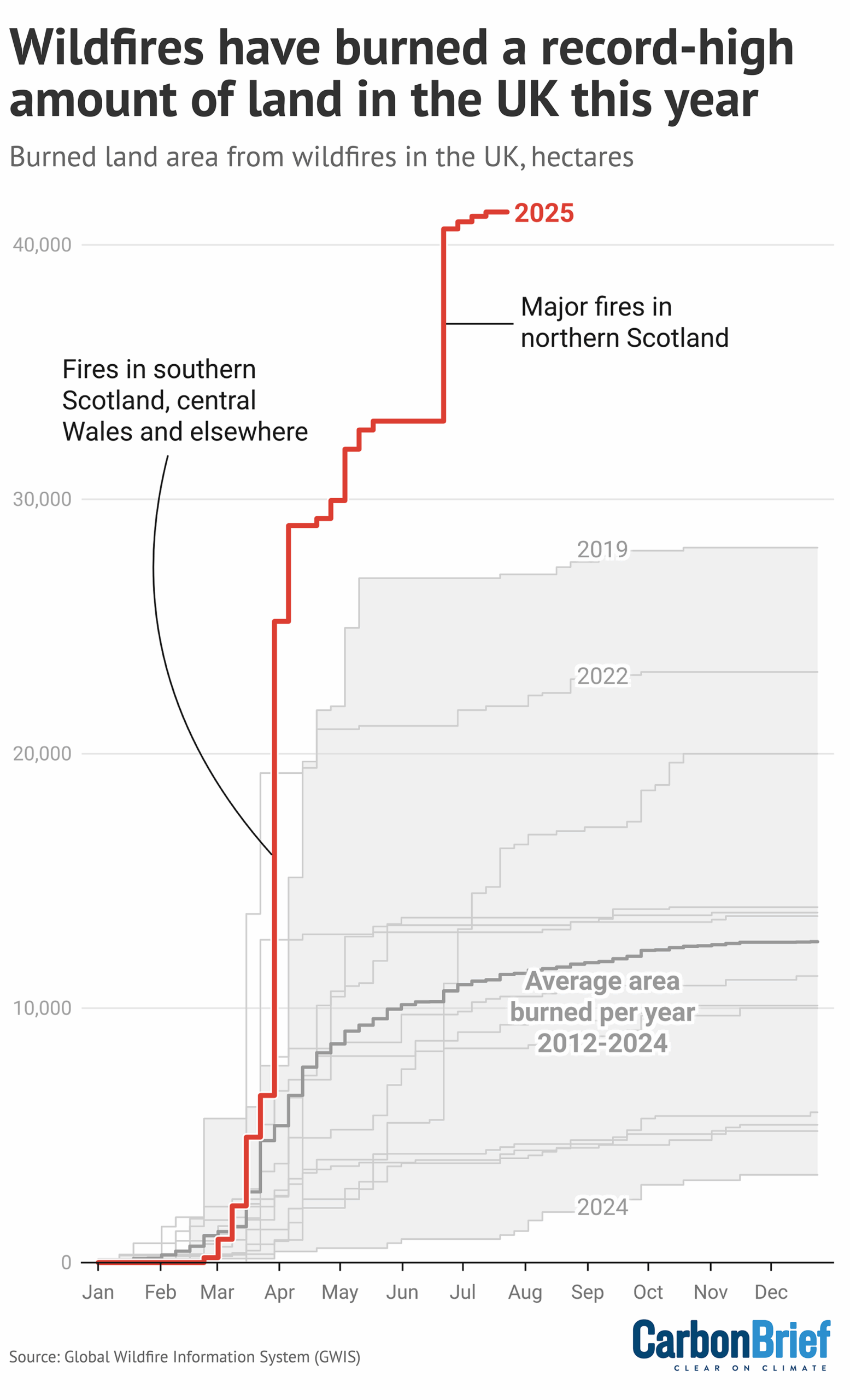
This is already a record amount of land burned in a single year, far exceeding the previous high, Global Wildfire Information System (GWIS) data shows.
It is also almost four times the average area burned in wildfires by this stage of the year over 2012-24 – and 50% higher than the previous record amount burned by this time in 2019.
The burned area overtook the previous annual record in April, BBC News reported at the time, and has continued to soar in the months since.
Major wildfires
The chart below shows that UK wildfires in 2025 so far have already burned by far the largest area of land over any calendar year since GWIS records began in 2012. The previous record year was 2019, followed by 2022, while 2024 saw the lowest area size burned.
Annual land area burned by wildfires across the UK from 2012 to 2025 (red), alongside the average area burned each year over 2012-24. Source: Global Wildfire Information System.
Climate change can increase the risk and impact of wildfires. Warmer temperatures and drought can leave land parched and dry out vegetation, which helps fires spread more rapidly. Climate change is making these types of extreme conditions more likely to occur, as well as more severe.
Fire services in England and Wales responded to 564 wildfires from January to June 2025 – an increase from 69 fires in the same period last year, the National Fire Chiefs Council (NFCC) said in a statement in June.
Most wildfires in the UK are caused by human activity, whether accidental or deliberate, according to the NFCC. Some common ignition sources are disposable barbecues, lit cigarettes and campfires.
Jessica Richter, a research analyst at Global Forest Watch, says that, while fires are also a key part of some ecosystems, climate change is the “major driver behind the increasing fire activity around the globe”. She tells Carbon Brief:
“As we see more fires, we’re going to see more carbon being emitted and that’s just going to be, for lack of a better phrasing, adding fuel to the fire.”
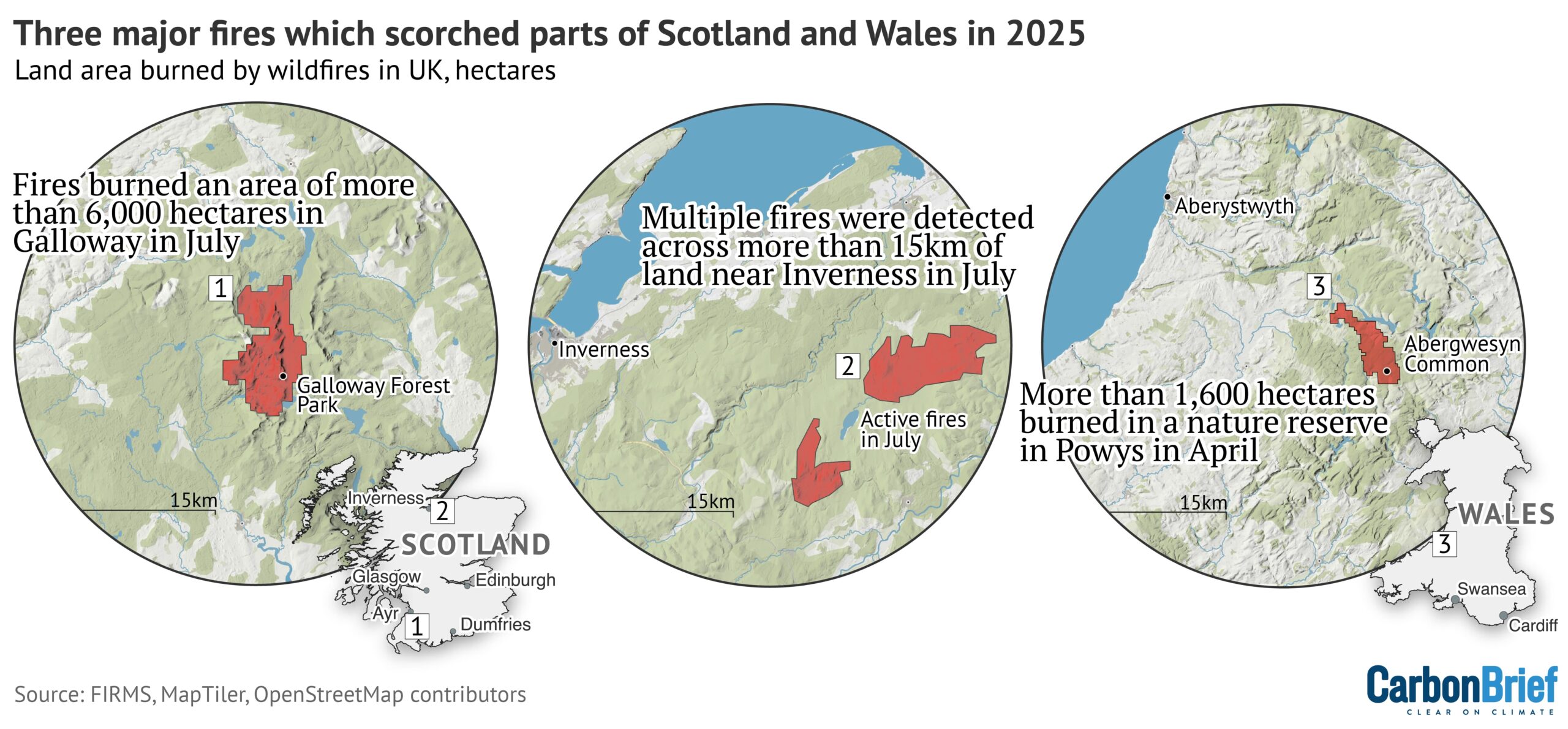
Examples of 2025 wildfires around Galloway (1) and Inverness (2) in Scotland, and a wildfire in Powys (3) in Wales. Source: FIRMS, MapTiler, OpenStreetMap contributors.
The UK has also recorded its highest-ever wildfire emissions this year, according to Copernicus, which was “primarily driven” by major wildfires in Scotland from late June to early July.
These were the largest wildfires ever recorded in the country, reported the Scotsman. They “ravaged” land in Moray and the Highlands in the north of the country, the newspaper added.
Scotland experienced an extreme wildfire in Galloway Forest Park in April, which was “so intense it could be seen from space”, the Financial Times said.
Elsewhere, in April, the Belfast News Letter reported that firefighters tackled almost 150 fires on the Mourne Mountains in Northern Ireland.
More recently, BBC News reported that firefighters in Dorset, England received “non-stop” wildfire calls in the first weekend of August, with one blaze “engulf[ing] an area the size of 30 football pitches”.
Wildfires have also caused devastation across many parts of Europe in recent weeks – including Albania, Cyprus, France, Greece, Spain and Turkey – as well as in the US and Canada.
Words by Orla Dwyer. Analysis by Ho Woo Nam. Charts by Tom Prater.
Nigel Farage urges you to ignore facts and reality and be a climate science denier like him. He says that Reform UK has received millions and millions from the fossil fuel industry to promote climate denial and destroy the planet.Donald Trump urges you to be a Climate Science denier like him. He says that he makes millions and millions for destroying the planet, Burn, Baby, Burn and Flood, Baby, Flood.
Original article by Alan Macleod republished from MPN under a Creative Commons Attribution-NonCommercial-ShareAlike 3.0 International License.
As we commemorate the 80th anniversary of the Hiroshima and Nagasaki atomic bombings, the world is drifting as close to another nuclear confrontation as it has been in decades.
With Israeli and American attacks on Iranian nuclear energy sites, India and Pakistan going to war in May, and escalating violence between Russia and NATO-backed forces in Ukraine, the shadow of another nuclear war looms large over daily life.
Eighty Years Of Lies
The United States remains the only nation to have dropped an atomic bomb in anger. While the dates of August 6 and August 9, 1945, are seared into the popular conscience of all Japanese people, those days hold far less salience in American society.
When discussed at all in the U.S., this dark chapter in human history is usually presented as a necessary evil, or even a day of liberation—an event that saved hundreds of thousands of lives, prevented the need for an invasion of Japan, and ended the Second World War early. This, however, could not be further from the truth.
American generals and war planners agreed that Japan was on the point of collapse, and had, for weeks, been attempting to negotiate a surrender. The decision, then, to incinerate hundreds of thousands of Japanese civilians was one taken to project American power across the world, and to stymie the rise of the Soviet Union.
“It always appeared to us that, atomic bomb or no atomic bomb, the Japanese were already on the verge of collapse,” General Henry Arnold, Commanding General of the U.S. Army Air Forces in 1945, wrote in his 1949 memoirs.
Arnold was far from alone in this assessment. Indeed, Fleet Admiral William Leahy, the Navy’s highest-ranking officer during World War II, bitterly condemned the United States for its decision and compared his own country to the most savage regimes in world history.
As he wrote in 1950:
It is my opinion that the use of this barbarous weapon at Hiroshima and Nagasaki was of no material assistance in our war against Japan. The Japanese were already defeated and ready to surrender. My own feeling was that in being the first to use it, we had adopted an ethical standard common to the barbarians of the Dark Ages.”
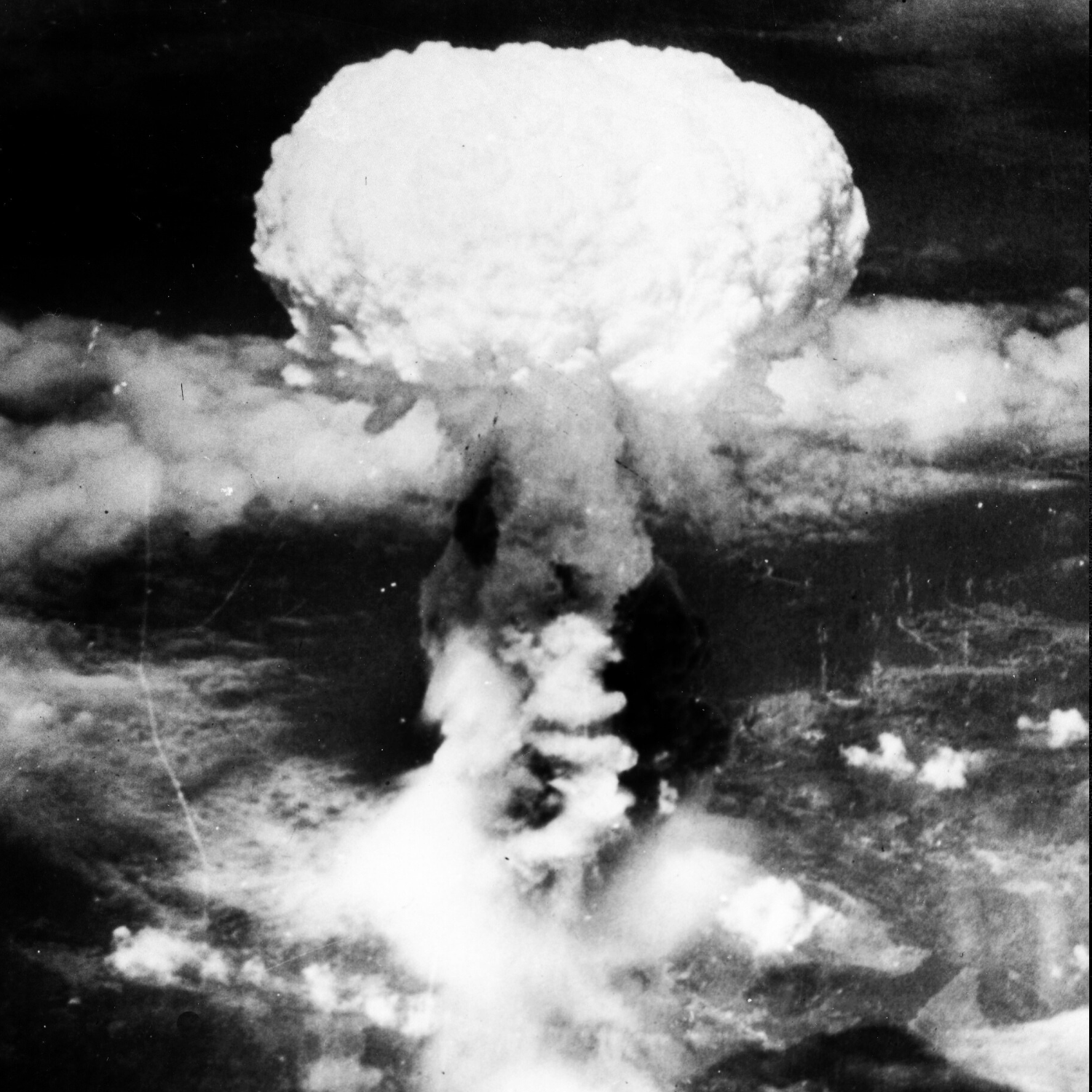
A column of smoke rises more than 60,000 feet into the air after the second atomic bomb ever used explodes over Nagasaki, Aug. 9, 1945. Photo | AP
By 1945, Japan had been militarily and economically exhausted. Losing key allies Italy in 1943 and Germany by May 1945, and facing the immediate prospect of an all-out Soviet invasion of Japan, the country’s leaders were frantically pursuing peace negotiations. Their only real condition appeared to be that they wished to keep as a figurehead the emperor—a position that, by some accounts, dates back more than 2,600 years.
“I am convinced,” former President Herbert Hoover wrote to his successor, Harry S. Truman, “if you, as President, will make a shortwave broadcast to the people of Japan—tell them they can have their emperor if they surrender, that it will not mean unconditional surrender except for the militarists—you’ll get a peace in Japan—you’ll have both wars over.”
Many of Truman’s closest advisors told him the same thing. “I am absolutely convinced that had we said they could keep the emperor, together with the threat of an atomic bomb, they would have accepted, and we would never have had to drop the bomb,” said John McCloy, Truman’s Assistant Secretary of War.
Nevertheless, Truman initially took an absolutist position, refusing to hear any Japanese negotiating caveats. This stance, according to General Douglas MacArthur, Commander of Allied Forces in the Pacific, actually lengthened the war. “The war might have ended weeks earlier,” he said, “If the United States had agreed, as it later did anyway, to the retention of the institution of the emperor.” Truman, however, dropped two bombs, then reversed his position on the emperor, in order to stop Japanese society from falling apart.
At that point in the war, however, the United States was emerging as the sole global superpower and enjoyed an unprecedented position of influence. The dropping of the atomic bomb on Japan underscored this; it was a power play, intended to strike fear into the hearts of world leaders, especially in the Soviet Union and China.
First Japan, Then The World
Hiroshima and Nagasaki drastically curbed the U.S.S.R.’s ambitions in Japan. Joseph Stalin’s forces had invaded and permanently annexed Sakhalin Island in 1945 and planned to occupy Hokkaido, Japan’s second-largest island. The move likely prevented the island nation from coming under the Soviet sphere of influence.
To this day, Japan remains deeply tied to the U.S., economically, politically, and militarily. There are around 60,000 U.S. troops in Japan, spread across 120 military bases.
Many in Truman’s administration wished to use the atom bomb against the Soviet Union as well. President Truman, however, worried that the destruction of Moscow would lead the Red Army to invade and destroy Western Europe as a response. As such, he decided to wait until the U.S. had enough warheads to completely destroy the U.S.S.R. and its military in one fell swoop.
War planners estimated this figure to be around 400. To that end, Truman ordered the immediate ramping up of production. Such a strike, we now know, would have caused a nuclear winter that would have permanently ended all organized life on Earth.
The decision to destroy Russia was met with stiff opposition among the American scientific community. It is now widely believed that Manhattan Project scientists, including Robert J. Oppenheimer himself, passed nuclear secrets to Moscow in an effort to speed up their nuclear project and develop a deterrent to halt this doomsday scenario. This part of history, however, was left out of the 2023 biopic movie.
By 1949, the U.S.S.R. was able to produce a credible nuclear deterrent before the U.S. had produced sufficient quantities for an all-out attack, thus ending the threat and bringing the world into the era of mutually assured destruction.
“Certainly prior to 31 December 1945, and in all probability prior to 1 November 1945, Japan would have surrendered even if the atomic bombs had not been dropped, even if Russia had not entered the war, and even if no invasion had been planned or contemplated,” concluded a 1946 report from the U.S. Strategic Bombing Survey.
Dwight D. Eisenhower, Supreme Allied Commander in Europe and future president, was of the same opinion, stating that:
Japan was already defeated and dropping the bomb was completely unnecessary…[it was] no longer mandatory as a measure to save American lives. It was my belief that Japan was, at this very moment, seeking a way to surrender with a minimum loss of face.”
Nevertheless, both Truman and Eisenhower publicly toyed with the idea of using nuclear weapons against China to stop the rise of Communism and to defend their client regime in Taiwan. It was only the development of a Chinese warhead in 1964 that led to the end of the danger, and, ultimately, the détente era of good relations between the two powers that lasted until President Obama’s Pivot to Asia.
Ultimately, then, the people of Japan were the collateral damage in a giant U.S. attempt to project its power worldwide. As Brigadier General Carer Clarke, head of U.S. intelligence on Japan wrote, “When we didn’t need to do it, and we knew we didn’t need to do it, and they knew that we knew we didn’t need to do it, we used them [Japanese citizens] as an experiment for two atomic bombs.”
Tiptoeing Closer To Armageddon
The danger of nuclear weapons is far from over. Today, Israel and the United States – two nations with atomic weaponry – attack Iranian nuclear facilities. Yet their continued, hyper-aggressive actions against their foes only suggest to other countries that, unless they too possess weapons of mass destruction, they will not be safe from attack. North Korea, a country with a conventional and nuclear deterrent, faces no such air strikes from the U.S. or its allies. These actions, therefore, will likely result in more nations pursuing nuclear ambitions.
Earlier this year, India and Pakistan (two more nuclear-armed states) came into open conflict thanks to disputes over terrorism and Jammu and Kashmir. Many influential individuals on both sides of the border were demanding their respective sides launch their nukes – a decision that could also spell the end of organized human life. Thankfully, cooler heads prevailed.
Meanwhile, the war in Ukraine continues, with NATO forces urging President Zelensky to up the ante. Earlier this month, President Trump himself reportedly encouraged the Ukrainian leader to use his Western-made weapons to strike Moscow.
It is precisely actions such as these that led the Bulletin of Atomic Scientists to move their famous Doomsday Clock to 89 seconds to midnight, the closest the world has ever been to catastrophe.
“The war in Ukraine, now in its third year, looms over the world; the conflict could become nuclear at any moment because of a rash decision or through accident or miscalculation,” they wrote in their explanation, adding that conflicts in Asia could spiral out of control into a wider war at any point, and that nuclear powers are updating and expanding their arsenals.
The Pentagon, too, is recruiting Elon Musk to help it build what it calls an American Iron Dome. While this move is couched in defensive language, such a system – if successful – would grant the U.S. the ability to launch nuclear attacks anywhere in the world without having to worry about the consequences of a similar response.
Thus, as we look back at the horrors of Hiroshima and Nagasaki 80 years ago, we must understand that not only were they entirely avoidable, but that we are now closer to a catastrophic nuclear confrontation than many people realize.
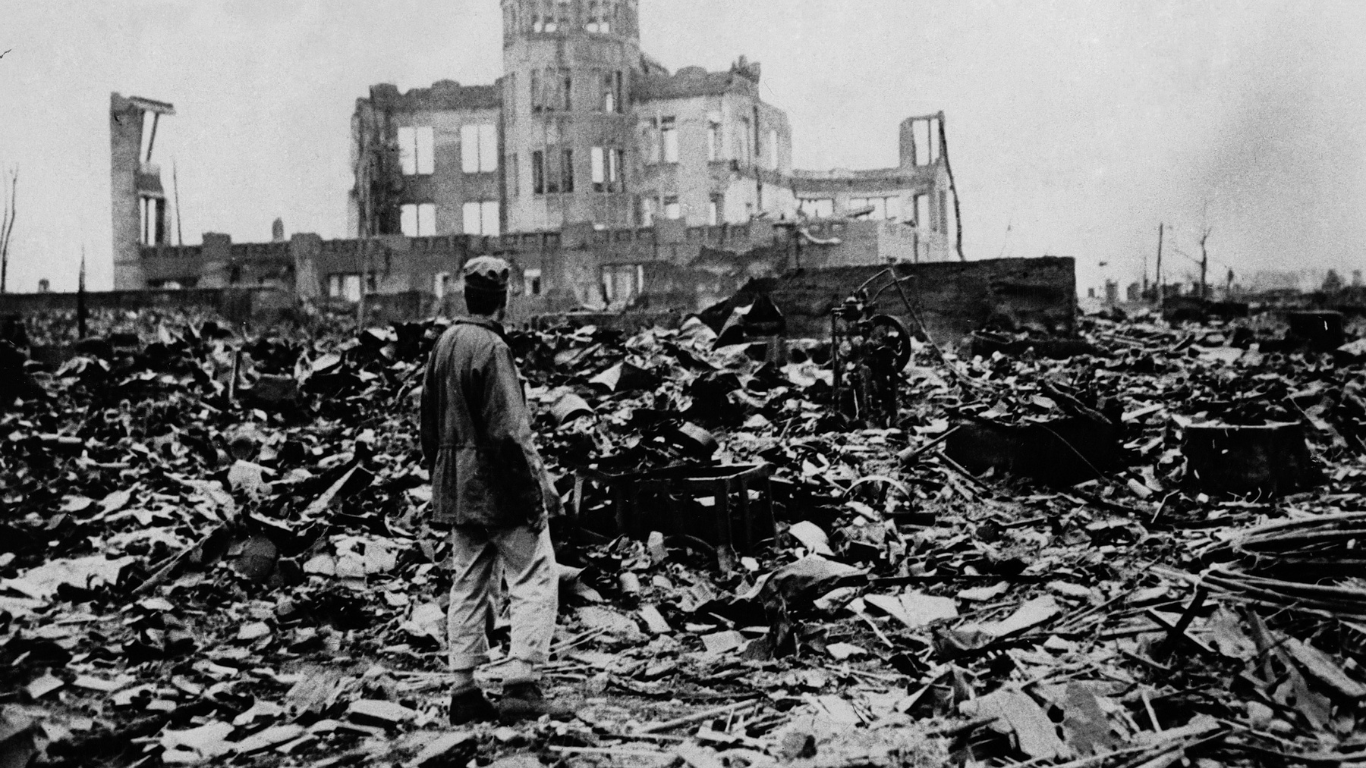
Feature photo | A man looks over the expanse of ruins left the explosion of the atomic bomb on August 6, 1945 in Hiroshima, Japan. Some 140,000 people died here immediately. Photo | AP