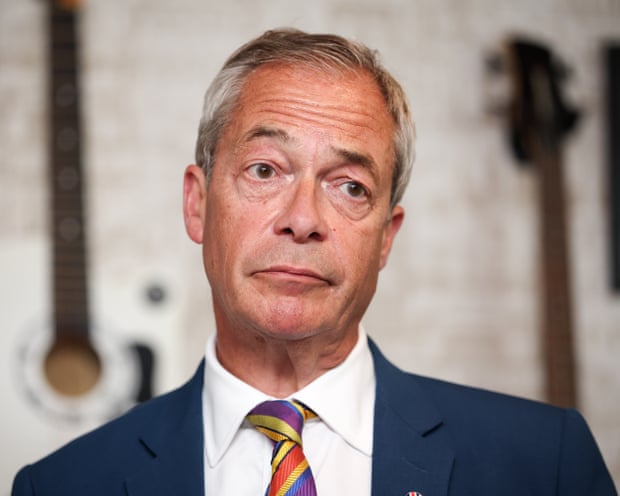
Nigel Farage has claimed that ‘foreign state actors’, most likely serving Moscow, accessed his phone. Photograph: Ryan Jenkinson/Getty Images
Anna Turley gives Reform leader 24 hours to report Russian hacking claim in ‘public and national interest’
The Labour chair has given Nigel Farage 24 hours to report to security services the claim that his phone was hacked by Russia-linked actors or the party will do it for him.
In a letter to the Reform UK leader, Anna Turley said it was “in the public and national interest” to ensure that a suspected overseas hack of a senior politician’s phone by a hostile state was properly investigated.
A Reform spokesperson said the incident had been reported to “the relevant authorities”, without saying who these were.
In her letter, Turley asked Farage, who has largely avoided media scrutiny in recent weeks, to set out why Harborne gave him the money, in the run-up to the 2024 general election. Farage initially said the sum was intended to pay for his security, but later characterised it as a reward for his campaigning on Brexit.
…
On Monday, Ciaran Martin, the former head of the National Cyber Security Centre, called Farage’s version of events “an entirely unsubstantiated claim and one without any merit”, saying it would be difficult to conclude the involvement of Russia based on the examination of a phone.
Martin said given the seriousness of the matter, Farage should formally report what happened to the authorities.
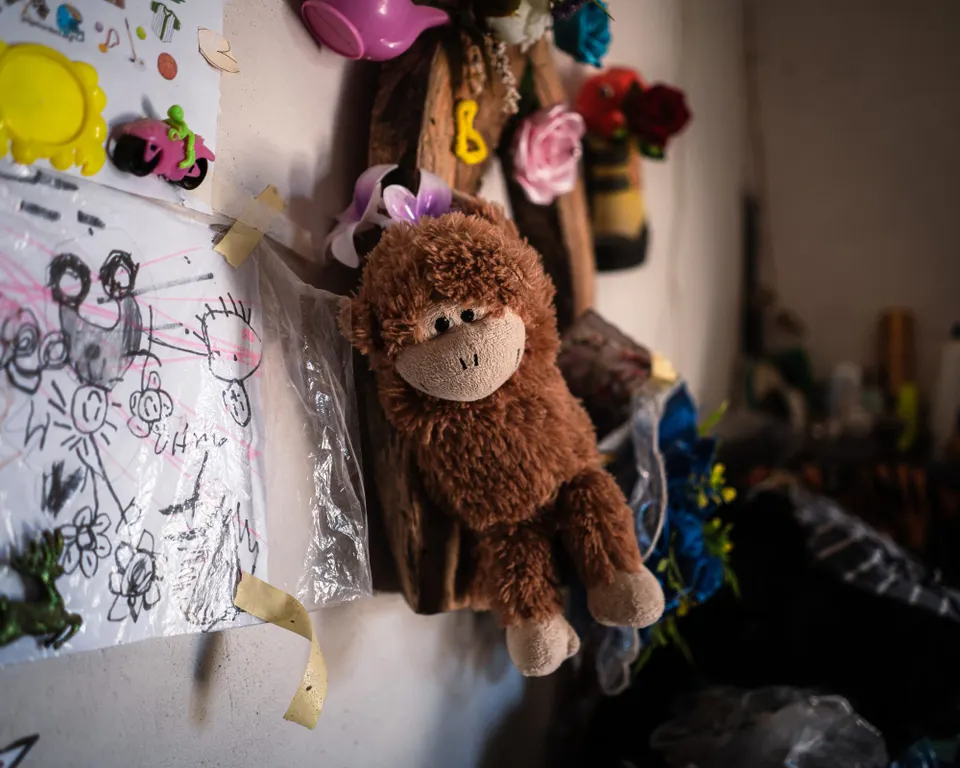
In the bedroom of Rosalina González’s youngest son, detained in February 2025, a toy monkey hangs next to a drawing made by his six-year-old daughter | Euan Wallace/openDemocracy
Pregnant women, babies and children are being swept up in the mass arrests ordered under Bukele’s ‘state of emergency’
Rosalina González’s granddaughter is nine months old. Every day of her short life has been spent in Izalco penitentiary in Sonsonate, the maximum-security prison in western El Salvador notorious for its documented history of torture and abuse.
The child was born in the prison after her already pregnant mother was detained on 19 February 2025, alongside her father and uncle, González’s sons. That night, González remembers being awoken at her home in Chilamates, in rural north-west El Salvador, by police who accused her family of unlawful association with gang members and took them away.
The charge is often used to imprison people under the state of emergency introduced in March 2022 by Salvadoran president Nayib Bukele, who once described himself as the “world’s coolest dictator”.
The state of emergency has suspended key constitutional rights in a purported effort to dismantle the criminal networks that wielded substantial power in El Salvador at the time. Human rights organisations say it has fuelled a startling democratic backslide, as well as arbitrary detentions and deaths in custody. Yet Bukele has an approval rating of 94%, which he attributes to the country’s falling homicide rate, which has gone from one of the highest in Latin America to the lowest in the region amid draconian policies and pacts his government has quietly made with gang leaders.
After more than a year in detention, González’s sons and daughter-in-law have still not been convicted of any crime. Yet like many of the more than 90,000 people who have been imprisoned under the state of emergency, they have been denied all contact with the outside world.
Today, González fiercely defends her family’s innocence. “My sons were working men,” the 59-year-old told openDemocracy. “My kids are honest… I could leave money here on this table and they would not touch it.”
Although she has reported their detention to the Public Prosecutor for Human Rights, no progress has been made on their case.
“I ask myself: what did the baby do?” says Sylvia Portillo, the mother-in-law of Gonzalez’s youngest son, the uncle of the child born in prison. “The babies have nothing to do with anything.”
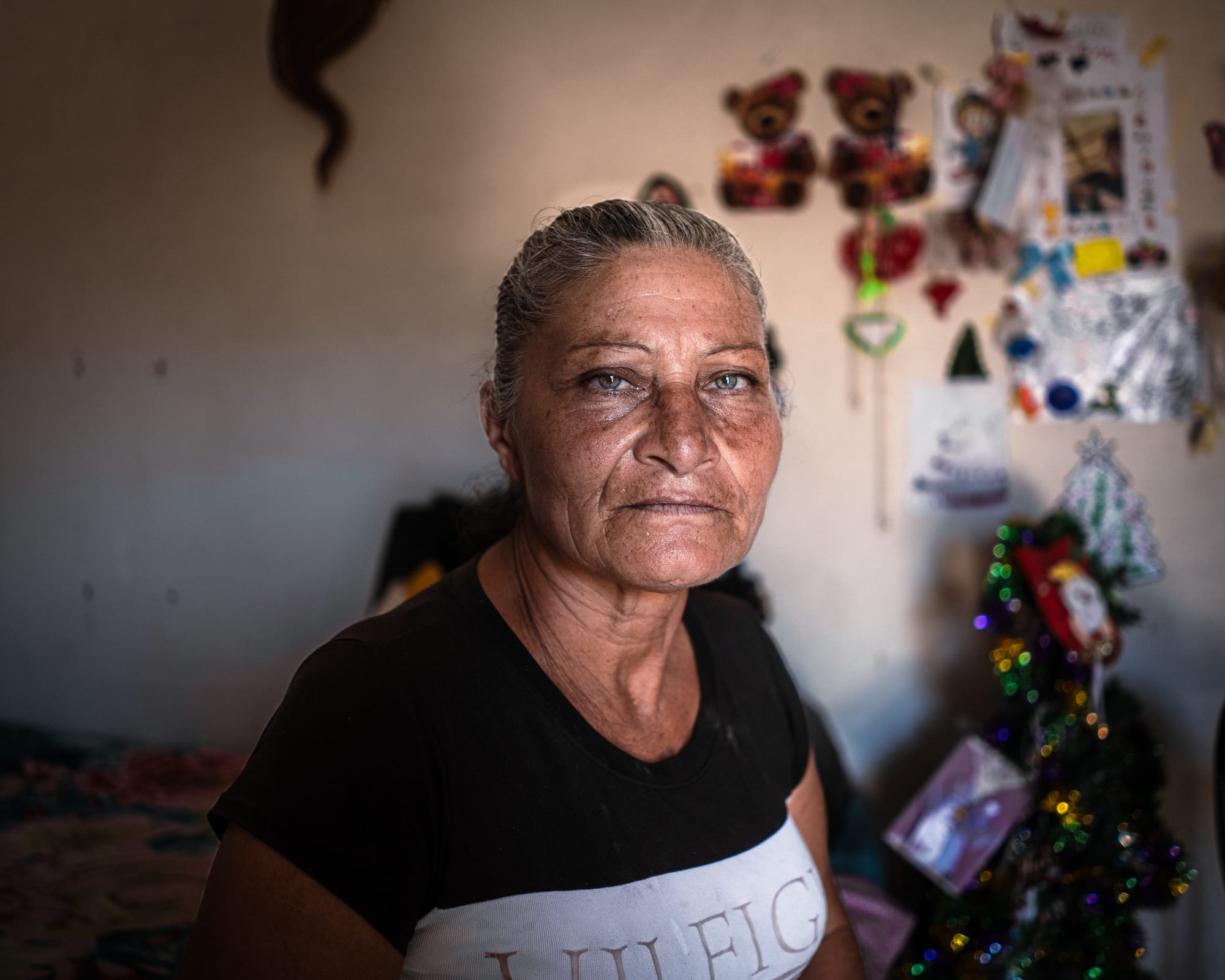
Rosalina González, 59, whose 9-month-old granddaughter was born in Izalco prison and remains in custody to this day. Her two sons and daughter-in-law (the baby’s mother) are also in prison | Euan Wallace/openDemocracy
Children with life sentences
It is not just those born behind bars who are growing up in El Salvador’s prisons.
More than 3,000 under-18s were detained between March 2022 and July 2024, according to a Human Rights Watch report. Some of those children have described being tortured and abused whilst in custody.
Last month, new reforms came into effect that give judges the power to hand out life sentences to children as young as 12 who are convicted of crimes including homicide, femicide, rape and gang membership. Gang association sentences were previously capped at ten years for children aged 15 and under, and 20 years for adolescents aged 16 to 18.
The reforms have sparked “deep concern” from UNICEF and the UN Committee on the Rights of the Child, which, in a joint statement, accused El Salvador of “a contradiction of the standards enshrined in the Convention on the Rights of the Child”.
Defence lawyer Lucrecia Landaverde believes many of the children being arrested were never involved with gangs. “It is very likely that innocent children will end up with life sentences,” she said, explaining that El Salvador’s judicial system is heavily stacked against defendants.
Many people are found guilty based only on the testimony of a police officer or “co-operating witness” – a convicted gang member offered a reduced sentence for testifying for the prosecution. “The reward consists of reducing their sentence or even pardoning their crimes in exchange for helping to testify and point the finger at everyone, regardless of whether they are making it all up,” Landaverde said. “The criminal protects himself and his own family, and starts accusing people he doesn’t even know.”
This testimony is rarely scrutinised adequately, she added, saying a judge once called for her arrest in open court for cross-examining a prosecution witness.
Landaverde vividly remembers the early days of the state of emergency, when “mass arrests were carried out without any oversight”, she said. “[Our office] looked like a health clinic, packed around the clock with people crying in the waiting room because their young children had been arrested.”
She told openDemocracy how a 13-year-old boy was detained after refusing to share his fried chicken with police officers. “They arrested him, took the chicken, put him in prison and charged him with unlawful association,” she said, “then they ate the chicken.”
Some in El Salvador view the reforms that hand life sentences to children as part of Bukele’s continued crackdown on freedom of expression. “This is a message to young people that no one can oppose the regime, that no one can speak out here,” Samuel Ramírez, the founder of Salvadoran human rights organisation MOVIR, told openDemocracy.
Meanwhile, it is not known how many infants and young children are living in prisons after being born there.
“We have cases of children who have been born in prison, whose mothers were arrested while pregnant. There are other children who have died from a lack of medical care in prison,” Ramírez said. “No matter how much the family or the grandmother asked for them to be returned, they were never returned.”
At least four babies who were born in prisons in the country were confirmed to have died due to poor conditions and limited medical care last year, with causes of death including pneumonia and liver failure. There are also “reports of additional deaths of pregnant women and newborns, including stillbirths resulting from the denial of care”, according to the UN Committee on the Elimination of Discrimination against Women.
In February, the committee expressed grave concern over the conditions for pregnant women in El Salvador’s prison system, highlighting a lack of adequate prenatal and postnatal care, as well as an environment unfit for detained children.
openDemocracy asked the Salvadoran presidency about abuses of rights under the state of emergency, criticism of the detention of babies and children, and the imposition of life imprisonment on children as young as 12. The government did not respond.
‘We’re dying inside’
Today, Rosalina González lives in the shell of the home that her sons were building for the family when they were arrested. With no one to continue construction, the front room is still without a roof.
Standing in the bedroom of her youngest son, she carefully removes a few of his belongings from a plastic bag and lines them up on the bed. His photograph is pinned on one wall, alongside a collection of children’s toys and drawings made by his six-year-old daughter, who lives with her other grandma, Sylvia Portillo, and has never met her baby cousin.
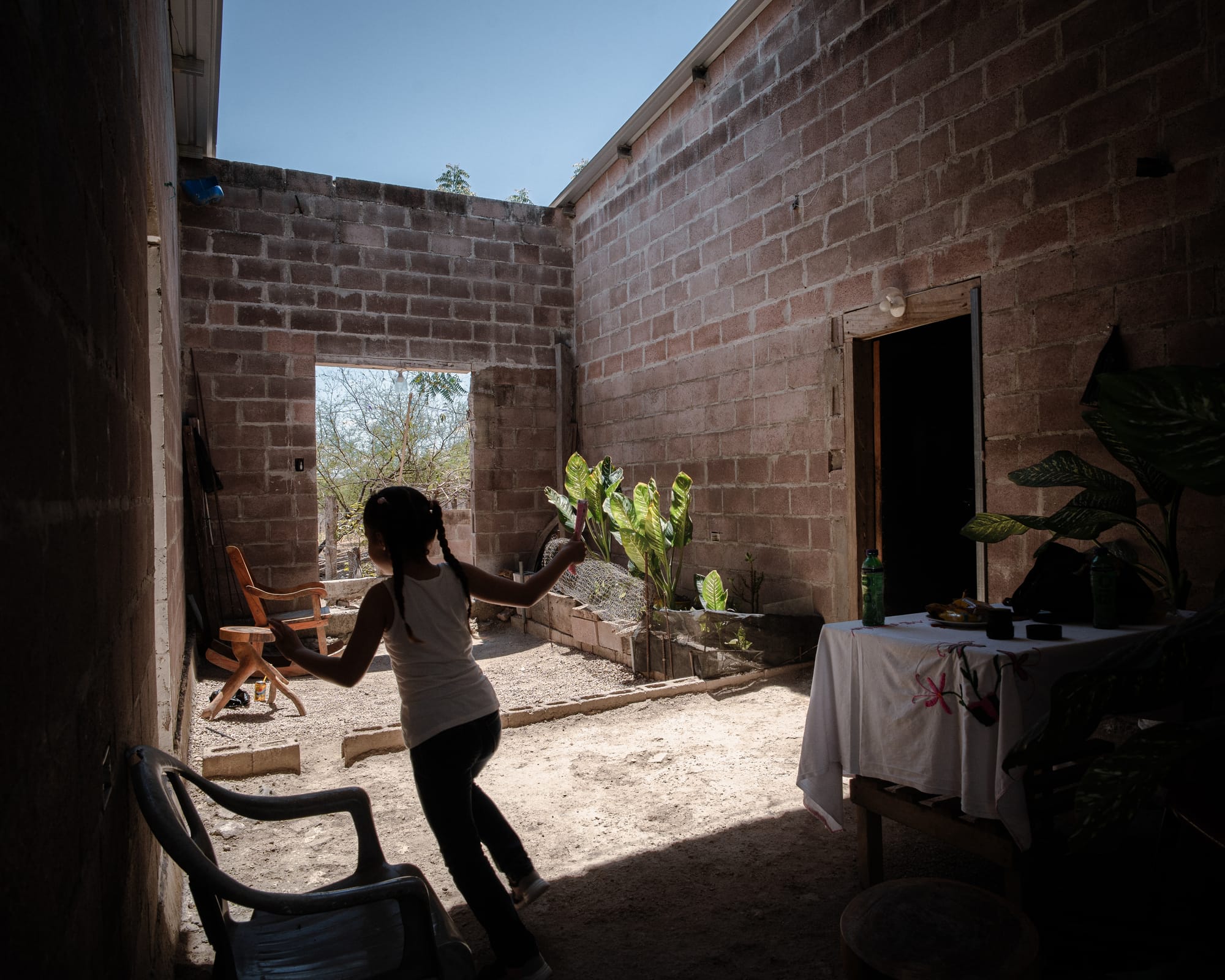
Rosalina’s 6-year-old granddaughter runs through her grandmother’s house. Her two sons were still building the house when they were arrested | Euan Wallace/openDemocracy
“Every time I’d put my hat on, he would take it off me again,” says the child, laughing as she remembers her father. “It was like a game.”
She skids across the dirt floor of the roofless main room, skipping giddily between stripes of shade and sunlight. A pink folding fan flashes in one hand. Dancing tip-toe across the dust, she uses it to conceal her face from an imagined audience.
Inside, her grandmother repacks her father’s belongings and places them out of sight. González spends much of her time alone these days, denied contact with her detained sons and daughter-in-law. “You feel like you’re dying inside,” she says. “They destroyed my life. They destroyed my children’s lives.”
Euan Wallace is a freelance journalist and photographer. His work focuses on human rights and the climate crisis across Latin America. He is currently based in Bogotá, Colombia.
Martina Mariano is a freelance journalist and aspiring anthropologist, based in Bogotá, Colombia. Her work focuses on human rights and migration.
This work by Middle East Monitor is licensed under a Creative Commons Attribution-NonCommercial-ShareAlike 4.0 International License.
Smoke rises after an Iranian drone attack struck fuel tanks at Kuwait International Airport in Kuwait City, Kuwait on April 01, 2026. [Stringer – Anadolu Agency]
Iran’s Islamic Revolutionary Guard Corps (IRGC) said early Thursday that it targeted a US airbase in Kuwait in response to an American aerial strike near Bandar Abbas Airport in southern Iran, Anadolu reports.
According to Iran’s semi-official Tasnim News Agency, the IRGC said the retaliatory strike came at 4.50 am (0120GMT), hours after what it described as a US assault on a point near the port city’s airport using aerial projectiles.
“This response is a serious warning so that the enemy knows that aggression will not go unanswered, and if repeated, our response will be more decisive,” it said.
Later, the US Central Command (CENTCOM) said Thursday through US social media company X that Iran launched “a ballistic missile toward Kuwait” at 10.17 pm ET (0217GMT) on Wednesday, and that the missile was “successfully intercepted by Kuwaiti forces.”
CENTCOM described the launch as an “egregious ceasefire violation by the Iranian regime.”
It also said Iranian forces earlier launched “five one-way attack drones that posed a clear threat in and near the Strait of Hormuz,” adding that all were intercepted by US forces.
The command further said US forces “prevented a sixth drone launch from an Iranian ground control site in Bandar Abbas.”
Earlier in the day, a US official told Anadolu that US forces shot down four Iranian drones that posed a threat near the Strait of Hormuz and struck an Iranian ground control station in Bandar Abbas that was preparing to launch a fifth drone.
“These actions were measured, purely defensive, and intended to maintain the ceasefire,” said the official, who spoke on condition of anonymity.
CENTCOM said US forces and regional partners “remain vigilant and measured” as they continue defending “forces and interests from unjustified Iranian aggression.”
The latest strikes came after CENTCOM earlier this week confirmed a previous round of strikes on southern Iran targeting missile launch sites and Iranian boats allegedly attempting to lay mines. Iran condemned those strikes as a “grave violation of the ceasefire.”
Earlier, commenting on the state of the negotiations to end the war on Iran, US President Donald Trump said he is “not satisfied with it, but we will be. Either that, or we’ll have to just finish the job.”
Regional tensions escalated on Feb. 28, when the US and Israel launched attacks on Iran, prompting Tehran to retaliate with barrages of drones and missiles that hit targets across the region and to close the Strait of Hormuz.
A ceasefire took effect on April 8 through Pakistani mediation, but talks in Islamabad failed to produce a lasting agreement.
Trump later extended the truce indefinitely while maintaining a blockade on vessels traveling to or from Iranian ports through the strategic waterway and periodically saying a peace deal was close.
This work by Middle East Monitor is licensed under a Creative Commons Attribution-NonCommercial-ShareAlike 4.0 International License.
Donald Trump sings and dances, says that it’s fun to kill everyone …Orcas discuss how Trump was re-elected and him being an obviously insane, xenophobic Fascist.
This work by Middle East Monitor is licensed under a Creative Commons Attribution-NonCommercial-ShareAlike 4.0 International License.
Pro-Palestinian Jewish American demonstrators rally outside the Manhattan headquarters of Pro-Israel lobbying group American Israel Public Affairs Committee (AIPAC) and the offices of Senators Chuck Schumer and Kirsten Gillibrand, who accept donations from the group on February 22, 2024 in New York City, United States. [Selcuk Acar/Anadolu via Getty Images]
Pro-Israel donors linked to the American Israel Public Affairs Committee (AIPAC) are reportedly using new, innocuous-sounding fundraising vehicles to direct money to favoured candidates in high-stakes Democratic primaries, as support for Israel becomes increasingly toxic in US politics.
According to details reviewed by The Lever, a newly formed joint fundraising committee, Better Blue Fund is one of the groups using weakened campaign finance rules to act as a “one-stop shop” for contributions from some of the pro-Israel lobby’s largest longtime donors. More than $250,000 has been raised by the fund in under two months for Democratic candidates who have faced scrutiny over their support for military aid to Israel or past links to pro-Israel groups.
The committee is currently supporting former Utah congressman Ben McAdams, New York representatives Adriano Espaillat and Dan Goldman and Missouri representative Wesley Bell, all of whom face contested primaries. It is also fundraising for representatives Bob Menendez of New Jersey, Grace Meng of New York, Steve Cohen of Tennessee and Jeremy Moss, a Democratic challenger in Michigan’s 11th District. All eight candidates are currently endorsed by pro-Israel groups or have been in the past.
The Better Blue Fund was formed in March as a joint fundraising committee, a structure which allows multiple candidates to raise funds collectively and attract larger contributions from wealthy donors. Critics say such vehicles can obscure the political interests behind the money, particularly when the committee’s name gives no indication of a pro-Israel agenda.
In one example cited in the report, pro-Israel contributions appear to have been routed through a more discreet channel. McAdams was publicly endorsed by Democratic Majority for Israel in 2020 and received $5,000 from its PAC, but this year the group has offered no public endorsement or direct financial support.
Instead, the Better Blue Fund is backing his campaign, as he faces criticism from progressive rival Nate Blouin over his past support for unrestricted US military aid to Israel. As a congressman, McAdams voted with pro-Israel groups on military funding, opposed boycotts of Israel and joined congressional delegations to the occupation state.
The fund’s donor list also highlights the depth of its links to the pro-Israel donor network. It has reportedly raised nearly $300,000 from pro-Israel donors, including $28,000 from financier Jonathan Jacobson, who gave $2.5 million in 2024 to AIPAC’s super PAC, United Democracy Project. Rob Stavis, a partner at Bessemer Venture Partners, contributed $24,500 to the Better Blue Fund after giving $50,000 to Democratic Majority for Israel in 2024. Its largest reported contribution so far is $31,500 from investor Erich Mindich, who gave $250,000 to Democratic Majority for Israel in the last cycle.
The report notes that once the Better Blue Fund distributes money to participating candidates, the donations will appear in campaign filings under the fund’s name, rather than clearly identifying the donors’ wider pro-Israel affiliations. This has raised concerns that the new model gives AIPAC-aligned donors a way to support pro-Israel candidates while shielding them from the backlash increasingly attached to the lobby’s brand.
A similar strategy is said to have appeared in Michigan’s Democratic Senate primary, where a new PAC called the Center for Democratic Priorities, with no prior campaign history, reportedly spent $5.3 million on ads supporting congresswoman Haley Stevens shortly after AIPAC promoted her to donors in a fundraising email. Registration documents reportedly showed that the PAC shared a treasurer with other pro-Israel groups and used the same strategy firm employed by such groups to place the ad buy.
The apparent shift comes as opinion polls show Israel losing support among the American public. A Pew Research Center survey in April found that 53 per cent of US adults held an unfavourable view of Israel, up from 42 per cent in 2022. Gallup reported in July that only 32 per cent of Americans approved of Israel’s military action in Gaza, while 60 per cent disapproved, the lowest level of support Gallup had recorded since it began asking the question in November 2023.
This work by Middle East Monitor is licensed under a Creative Commons Attribution-NonCommercial-ShareAlike 4.0 International License.
Donald Trump sings and dances, says that it’s fun to kill everyone …Orcas discuss how Trump was re-elected and him being an obviously insane, xenophobic Fascist.
This work by Middle East Monitor is licensed under a Creative Commons Attribution-NonCommercial-ShareAlike 4.0 International License.
An Israeli army soldier walks near a main battle tank deployed at a position along the border with the Gaza Strip and southern Israel on July 29, 2025. [Jack GUEZ / AFP/Getty Images]
Israel is planning, in coordination with the United States, to expand its occupation of the Gaza Strip.
According to Israel’s Channel 14, the plan includes a major expansion of the so-called Yellow Line in Gaza, alongside continued bombardment and targeted killings outside the area controlled by the Israeli army, which currently occupies more than 60 per cent of the territory.
As part of the new strategy, the Hebrew-language channel said Israel, in coordination with the United States, will work to significantly expand the Yellow Line area across the Gaza Strip over the coming months.
Donald Trump sings and dances, says that it’s fun to kill everyone …Orcas discuss how Trump was re-elected and him being an obviously insane, xenophobic Fascist.