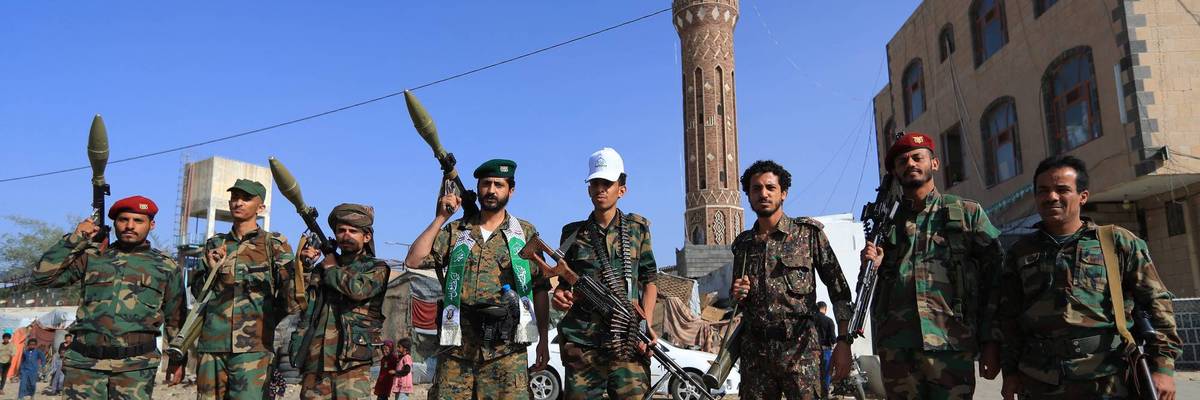
Fighters loyal to the Houthi authorities, gather during a rally to recruit more fighters, in Sanaa on September 10, 2026.(Photo by Mohammed Huwais/AFP via Getty Images)
The increased fighting is putting even more pressure on global energy markets, with the price of Brent crude topping $107 per barrel during Thursday trading
Houthi fighters on Thursday took control of a key port city on the west coast of Yemen, putting them in a stronger position to disrupt commercial shipping—and to potentially send oil prices rocketing even higher.
According to Reuters, the Houthis seized the city of Mocha from Saudi-backed forces before moving toward the Hanish Islands, located to the northeast.
Reuters further reported that Iran’s Islamic Revolutionary Guard Corps provided the Houthi fighters with weapons and guidance ahead of their successful assault.
The Houthis’ seizure of more territory along the Red Sea gives the militant group a greater ability to launch attacks on vessels trying to transport oil through the Bab el-Mandeb Strait.
Petroleum exporters in the region have had to rely more heavily on the Bab el-Mandeb Strait ever since Iran shut down shipping traffic in the Strait of Hormuz in retaliation for President Donald Trump’s illegal war of choice, which he launched in February without authorization from Congress.
Restricting shipments through both straits would put even greater pressure on global oil markets, which have already been under strain since the start of the Iran War.
A Thursday report from Bloomberg noted that Saudi Arabia, whose ships have been targets of Houthi attacks, revealed that its oil output has dropped to 6.24 million barrels per a day, its lowest level of oil production since 1990.
The price of Brent crude topped $107 during Thursday trading, a 6% increase from the day before. Data released Thursday by the American Automobile Association showed that the average price of gas in the US has reached $4.28 per gallon while the average price of diesel has reached a record high of $5.98 per gallon.
Fawaz Gerges, professor at the London School of Economics, said in an interview with The New York Times that the Houthis, despite receiving assistance from Iran, have their own distinct goals and see Trump’s illegal war as a “golden opportunity” to make advances against Yemen’s Saudi-backed government.
Additionally, said Gerges, “Iran directly and indirectly benefits from what the Houthis have been doing,” since “all-out war could have major implications for the global energy supply.”
Brett Erickson, managing partner at Obsidian Risk Advisors, wrote in a social media post that Iran and the Houthis have all the incentive in the world to keep the pressure on global petroleum shipping.
“Brent Crude just spiked over $107 per barrel,” Erickson wrote. “Just a mere month ago, it was trading at $85. That’s a 25.9% increase in a month. And with no off-ramp for Trump until at least the midterms are over, we’re looking at a long period of elevated oil prices now.”
The change in policy is a direct result of sustained pressure from activists and organisers across the Palestine movement. But what comes next?
…
We can certainly retain our anger at the government’s complicity. No sanction can offset the foreign policy decisions made by the former prime minister Keir Starmer and former foreign secretary David Lammy, the repression of domestic pro-Palestine advocacy, or the sheer loss of life. But we must balance this with cautious optimism that the political tide is turning.
…
The necessary next step is a full arms embargo and an end to cooperation with Israeli security forces – to truly have teeth, these sanctions must not take with one hand and then give with another. Miliband has said that “we’ve already suspended over 30 arms licences used by the IDF in Gaza. That suspension remains fully in place”, and that the government will “now also refuse all licence applications for arms and other exports that materially contribute to the occupation”. But components of F-35 jets continue to be exported to Israel and used for operations in Gaza, as are surveillance technologies such as drones and radar made in the UK by Elbit Systems. This is a total dereliction of duty by the British government.
Miliband’s announcements were a necessary reminder that a just political future is possible and, within it, a reckoning with past crimes. As a campaigner, I have borne witness to Israel’s most egregious human rights violations: I have documented Israeli settlers committing pogroms against the community of Al-Mufaqara, sat in Palestinian villages threatened with home demolitions and army raids, and witnessed the ongoing daily misery of Israel’s apartheid policies. This has all strengthened my motivation to see the end of the Israeli occupation.
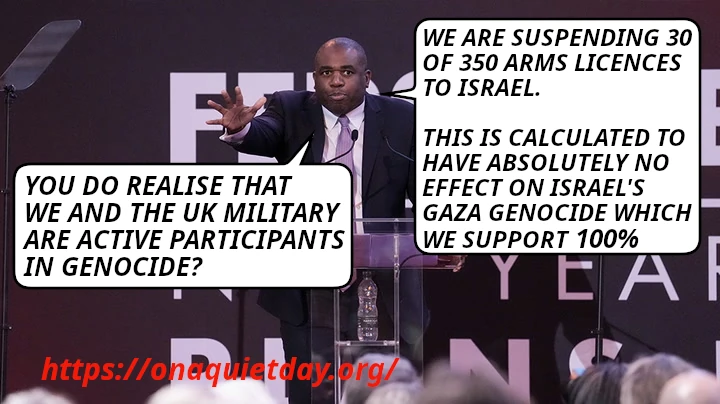
Genocide denier and Current UK Prime Minister Keir Starmer is quoted that he supports Zionism without qualification. He also confirms that UK air force support has been essential in Israel’s mass-murdering genocide. Includes URLs https://www.declassifieduk.org/keir-starmers-100-spy-flights-over-gaza-in-support-of-israel/ and https://youtu.be/O74hZCKKdpAKeir Starmer objects to criticism of the IDF. He asks how could anyone object to them starving people to death, forced marches like the Nazis did, bombing Gaza’s hospitals and universities, mass-murdering journalists, healthworkers and starving people queuing for food, killing and raping prisoners and murdering children. He calls for people to stop obstructing his genocide for Israel. New Labour UK Prime Minister Andy Burnham continues Labour party policy of active support and complicity in Israel’s genocide.Genocide denying UK Foreign Secretary David Lammy says that UK is suspending 30 of 350 arms licences to Israel. He also confirms the UK government’s support for Israel’s Gaza genocide and the UK government and military’s active participation in genocide.
10 September 2026 – Please find below a letter from Dr Natalie Roberts, Executive Director of Médecins Sans Frontières / Doctors Without Borders to the Prime Minister Andy Burnham and the Foreign Secretary Ed Miliband.
Dear Prime Minister and Foreign Secretary,
Congratulations on your appointments as Prime Minister and Foreign Secretary of the United Kingdom. I am writing to you as the Executive Director of Médecins Sans Frontières / Doctors Without Borders (MSF) in the United Kingdom to request an urgent meeting regarding the ongoing genocide and ethnic cleansing in the West Bank and in Gaza.
Since 1 November 2023, we have repeatedly written to your predecessors to provide evidence of atrocities directly witnessed and experienced by our 1,500 colleagues working in Gaza, to remind the UK of its power and its obligation to act, and to request an urgent high-level meeting. We have never received clear acknowledgement of the evidence that we have provided, nor have we ever been offered that meeting. In July last year we concluded that the UK Government just did not want to acknowledge what everybody else can see: that genocide is being committed in Gaza, and it is being committed with the military, diplomatic, and material support of the UK.
We therefore greatly welcome your decision to sanction illegal Israeli settlements in the West Bank, to recognise that what is happening in the West Bank is ethnic cleansing, and to align with the 2024 advisory opinion of the International Court of Justice that the Israeli occupation of Palestinian territory is unlawful. Thank you for finally taking some first tangible steps towards action, rather than claiming that the UK could only powerlessly stand by while a foreign government committed war crimes with complete impunity. But while the new UK sanctions are a welcome, and necessary, response to the illegal occupation and spiralling violence in the West Bank, it is difficult for us to understand how they will have any tangible impact on the catastrophic situation in Gaza.
On that subject, we urge you to hear directly from MSF. MSF is the UK’s largest medical humanitarian organisation still operating in Gaza. Since January 2026, we have been prevented by the Israeli authorities from bringing international staff and supplies into Palestine, yet we continue to work at scale across Gaza and the West Bank. Around 1,500 Palestinian MSF staff are providing surgical support, wound care, physiotherapy, maternity and paediatric care, general healthcare, vaccination, and mental health services as well as water production and distribution, under extraordinarily difficult conditions. My Palestinian colleagues see every day, in our hospitals and clinics, the human consequences of political decisions taken far from the Occupied Palestinian Territories.
Despite the October 2025 ceasefire, Palestinians in Gaza continue to face daily violence, repeated displacement, severe restrictions on humanitarian access, and appalling living conditions. The situation is characterised by the systematic erosion of Palestinians’ possibility to survive with dignity.
MSF teams witness catastrophic medical needs: traumatic injuries, malnutrition in infants and pregnant women, and rampant infectious disease. The Israeli military is now estimated to occupy at least 60 percent of the Strip, as Gaza has been divided by an unclearly marked and constantly shifting Israeli-military-controlled “yellow line”. MSF teams continue to treat patients suffering from blast injuries, fragment wounds, and blunt trauma caused by explosions and gunshot wounds, including people who are shot by Israeli forces when approaching the shifting boundary. Israeli forces continue to issue sudden displacement orders, forcing Palestinians to flee with almost no warning. Palestinians in Gaza are also dying from preventable diseases and untreated health conditions, as communicable diseases spread amid severe Israeli restrictions on essential supplies and a lack of access to basic services. Israeli authorities are leaving Palestinians to suffer and die through its illegal blockade, and Israel’s deliberate policies of violence, destruction, and denial of basic needs have created a deadly cycle of extreme deprivation, suffering, and death, fuelling its genocidal campaign and violating international humanitarian law. More than two and a half years of global inaction and complicity in the face of genocide have allowed this catastrophe to persist.
Israeli forces have arbitrarily detained hundreds of Palestinian healthcare workers from Gaza since October 2023, holding many without charge and routinely denying access to those imprisoned. They include our colleague, MSF orthopaedic surgeon Dr Mohammed Obeid, who was arrested during an Israeli military raid on Kamal Adwan Hospital in October 2024. Dr Obeid is still detained by Israel without charge, and we are very concerned for his safety and wellbeing.
Fifteen Palestinian colleagues have been killed in Gaza since October 2023, and many more injured. Yet the Israeli military has denied any criminal investigation into the killing or injury of MSF staff. Last month, the Israeli Military Advocate General decided to close without investigation the cases MSF submitted for review: the multiple attacks on an MSF convoy in Gaza City in November 2023 that killed two, and the February 2024 strike on an MSF shelter in Khan Younis that killed two and injured six. With this decision, the Israeli authorities made it clear that there is no prospect of accountability within the Israeli legal system for the killing of our staff, just as there has been no accountability for Israel’s ongoing genocide against Palestinians. Although we support the efforts of the International Courts in pursuing accountability for war crimes, our colleagues, their families, and the Palestinians living in Gaza cannot wait for the outcome of lengthy processes – processes which the Israeli government has anyway stated it considers invalid.
Over a year ago we asked that the UK Government:
Acknowledges and respects the rulings of the International Court of Justice (ICJ), and acts decisively to end the war crimes, crimes against humanity, and genocide committed by the Israeli government in Gaza
Ends all military cooperation with Israel and suspends all arms transfers to its government
Ends all material and diplomatic support to the Israeli government
Speaks out to acknowledge and condemn the genocide in Gaza
Pushes to end the siege and allow unfettered access of humanitarian aid, including medical supplies, into Gaza
Creates a pathway for the evacuation of medical patients from Gaza to the UK to be treated
While the recent shift in UK policy makes progress in responding to those asks, and we once again thank you for showing moral leadership, we would like to meet to discuss further steps the UK Government should take to uphold fully its obligations to act under International Humanitarian Law to protect all civilians in Gaza.
Yours sincerely,
Dr Natalie Roberts
Executive Director of Médecins Sans Frontières / Doctors Without Borders (MSF) UK
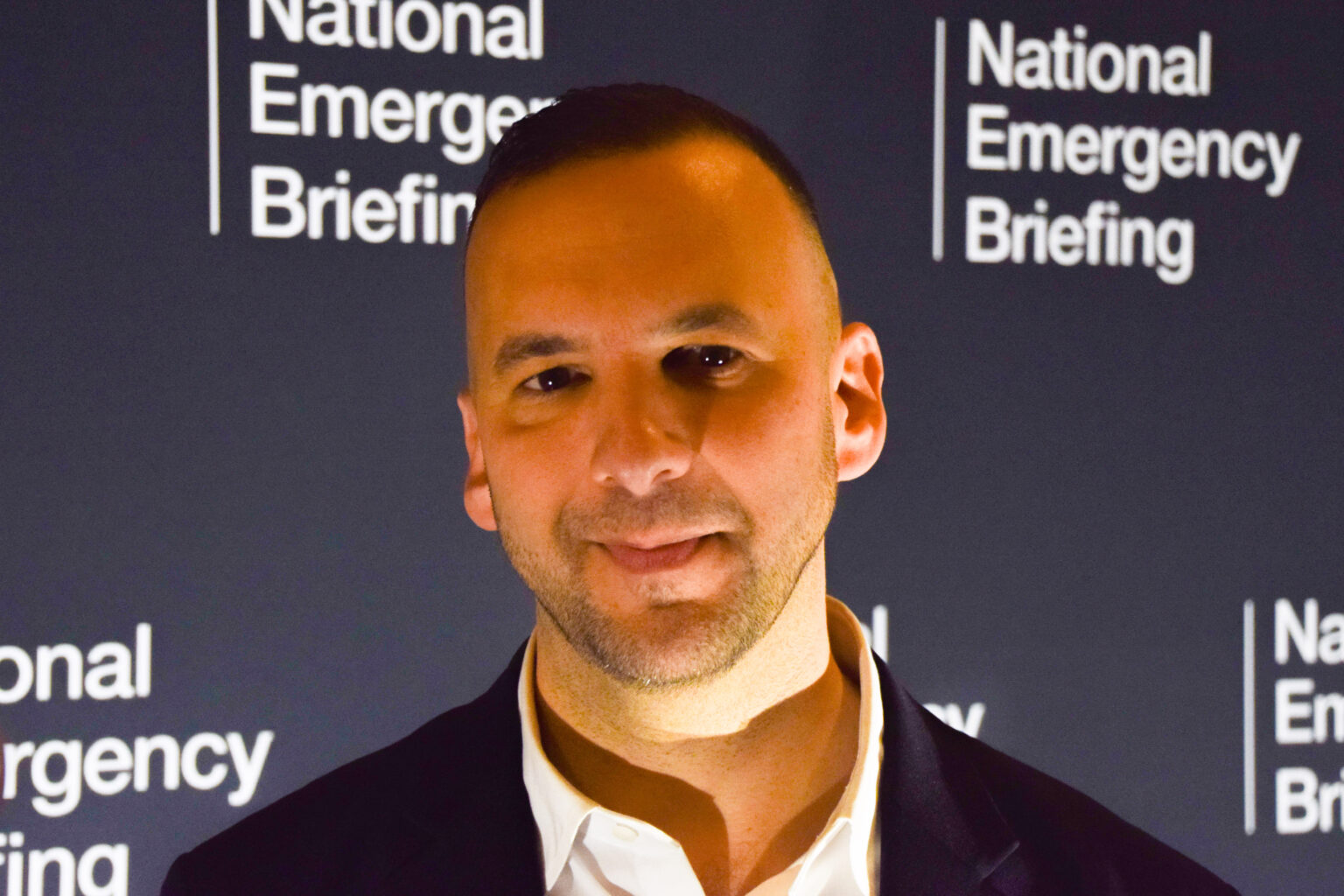
Green party leader Zack Polanski speaks to media following the National Emergency Briefing on climate and nature at the Central Hall Westminster, 27 November 2025, London, UK. Vuk Valcic/ZUMA Press Wire
It predicts a UK national security crisis with war, pandemics and food shortages.
Zack Polanski is calling on the government to publish the full, unredacted version of a report outlining how ecosystem collapse will plunge Britain into a national security crisis.
The report from UK intelligence chiefs warns that global ecosystem degradation and collapse will have devastating security consequences for Britain, including price rises, geopolitical instability, food and water shortages, greater pandemic risk, increased migration and conflict.
The Joint Intelligence Committee’s report was published in a redacted version in January and despite pressure from MPs and journalists, the Labour government has so far refused to release it in full.
Green party leader Polanski called on prime minister Andy Burnham to “tell the truth”, arguing that the public has a right to know the full scale of the threat.
Speaking at the Wild Summit in Bristol, Polanski said: “We’ve already seen how fragile our food systems are this year, with farmers warning that we could see empty shelves as a result of drought and flooding, and the government whispering that we should start stocking up on tinned food and bottled water.
“And these buried reports lay bare how unprepared we are for what is coming.”
Donald Trump urges you to be a Climate Science denier like him. He says that he makes millions and millions for destroying the planet, Burn, Baby, Burn and Flood, Baby, Flood.Nigel Farage urges you to ignore facts and reality and be a climate science denier like him and his Deputy Richard Tice. He says that Reform UK has received £Millions and £Millions from the fossil fuel industry to promote climate denial and destroy the planet.
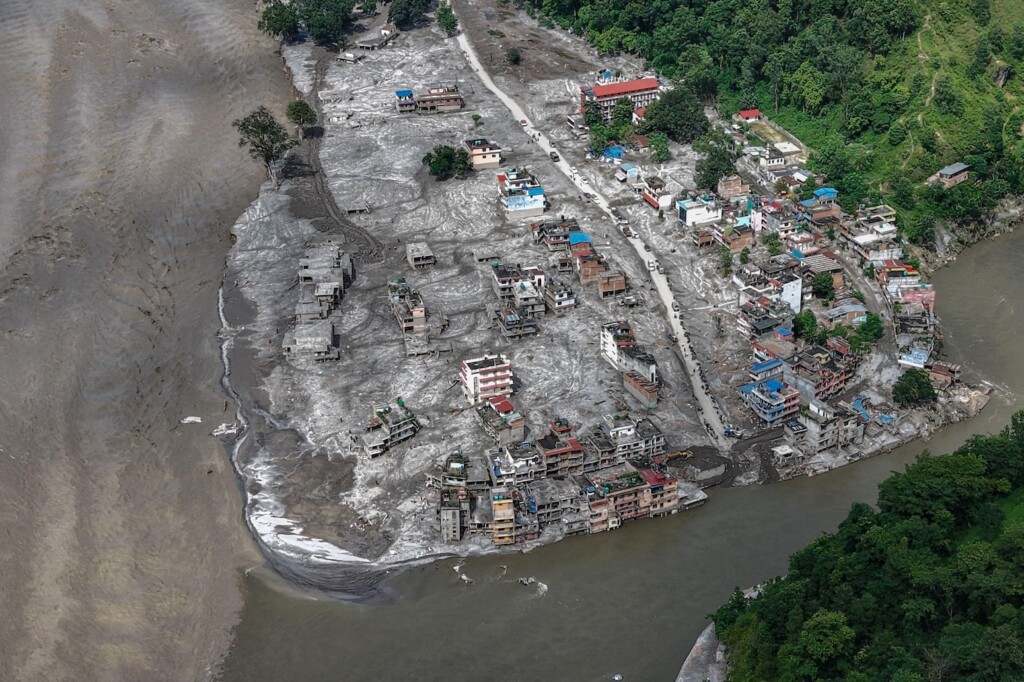
An aerial view of Devighat Bazaar in Nuwakot, Nepal, following the floods of 26 August 2026. Credit: ZUMA Press / Alamy Stock Photo
Can the event be attributed to climate change?
On the morning of 26 August, flash floods surged through a Himalayan border region of Nepal and the Chinese region of Tibet, killing more than 1,300 people, with thousands still missing.
In the days since the floods, scientists have examined satellite imagery, drone footage and seismic data in order to understand and explain the forces behind the event.
While initial theories pinned the flood on a glacial collapse, scientists now understand the event as a “multi-hazard cascade”, which began with a bedrock collapse.
Some climate sceptics have tried to use this to falsely claim that human-caused climate change had no impact on the event.
Yet, scientists havenoted that, while no formal attribution study has been carried out thus far, warming is making such ice-rock avalanches in the region more likely.
Researchers have highlighted how rapid warming is dramatically reshaping Asia’s high-mountain region – and identified rising temperatures, glacier retreat and permafrost thaw as factors that may have all contributed to the disaster.
Balendra Shah, Nepal’s prime minister, has called the floods a “serious signal that…the risks we must bear in the Himalayan region are increasing” due to climate change.
Here, Carbon Brief unpacks what scientists currently know about the causes of the catastrophic event and what they can – and cannot – say about the role of climate change.
A report published on 28 August by the HiRisk scientific consortium of high mountain experts detailed the events that led to the flash floods.
It said that events were set in motion on 26 August when a mass of bedrock, as well as the glacier ice on top of it, broke off a slope of Langtang-Lirung mountain in the Nepalese Himalaya, plunging from approximately 5,200 metres above sea level to the valley floor at 3,000 metres.
The landslide shook the ground hard enough that, at 8:37am Nepal local time, the US Geological Survey (USGS) initially reported a magnitude 4.4 earthquake. Later that day, it clarified the shaking was caused by glacier collapse and debris flow, equivalent to a magnitude 5.2 earthquake.
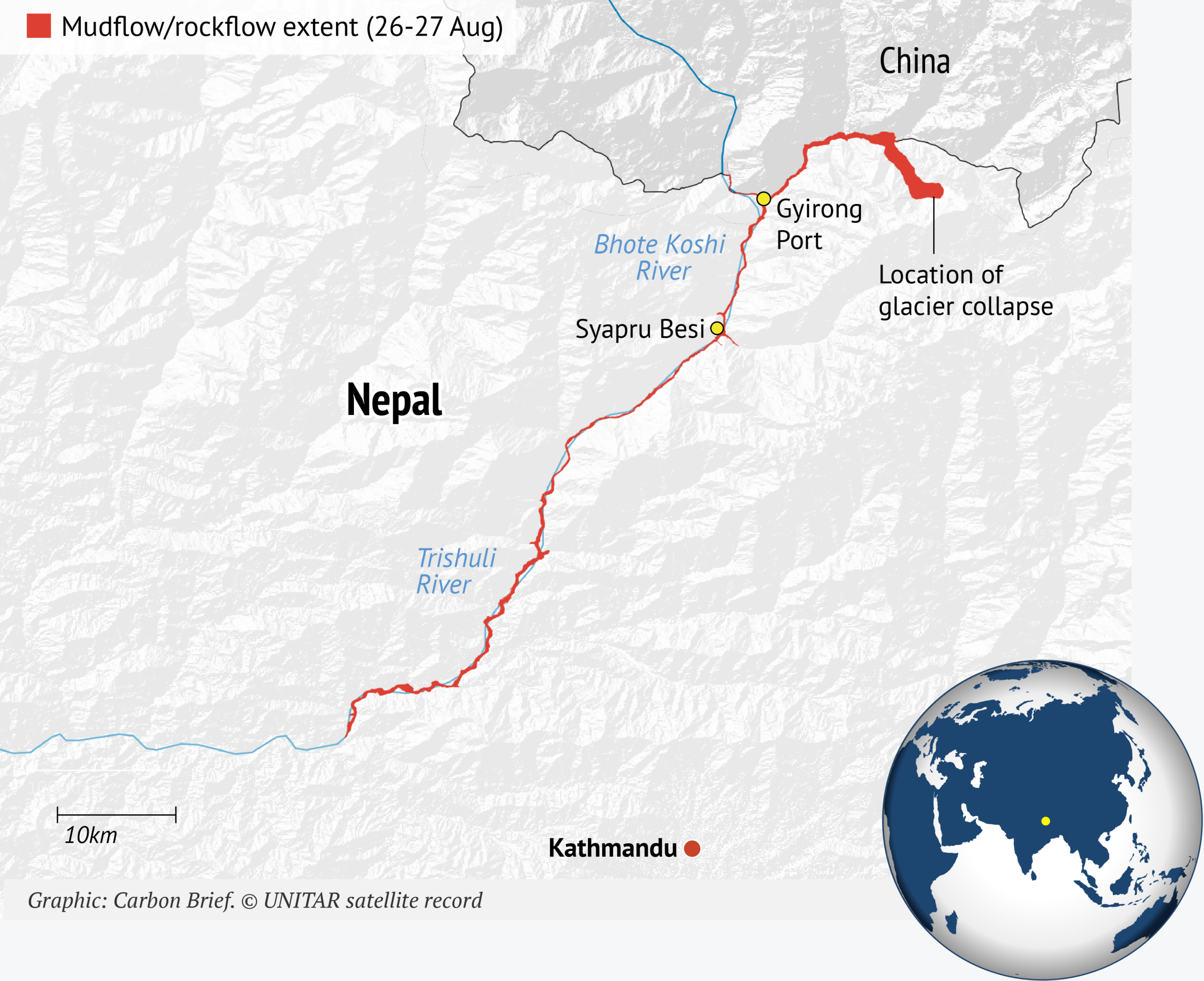
On the valley floor, the melting ice, water and debris slammed into the Lhende Khola river, a high-altitude river that runs along Nepal’s border with China.
Known downstream as the Bhote Koshi river in Nepal and the Poiqu or Poqu in China, the Lhende Khole feeds a network of rivers across Nepal and the Chinese region of Tibet, including the Trishuli river. (In China, the Lhende Khola is known as the Donglin Tsangpo.)
The designations employed and the presentation of the material on this map do not imply the expression of any opinion whatsoever on the part of Carbon Brief concerning the legal status of any country, territory, city or area or of its authorities, or concerning the delimitation of its frontiers or boundaries. Credit: Carbon Brief.
A large “debris” lake was briefly formed on the valley floor. When this lake burst, a wall of water and rock travelled downstream, killing more than a thousand people and destroying settlements, roads, bridges, hydropower plants and border posts across Nepal and Tibet.
HiRisk said that the floodwave travelled down rivers as fast as 30km an hour (around 19 miles per hour) and reached Mugling – a Nepalese town more than 130km downstream – at around 1pm local time.
A separate report from the Center for Land Surface Hazards in the US noted that the flood moved “exceptionally fast, was sediment-laden and extreme in scale”. For example, in the Nepalese municipality of Galchhi, the Trishuli river rose by nine metres in 30 minutes, it said.
He continued that a new “barrier lake” – estimated to hold a few million cubic metres of water – had developed in a location where two rivers meet in Tibet before crossing into Nepal. This lake burst on 28 August and the river rose again, he said.
On 4 September, the chief of Nepal’s National Disaster Risk Reduction and Management Authority, told Reuters that property and infrastructure worth “at least” $2.5bn (£1.9bn) had been lost. Dharma Raj Upreti estimated the cost to build roads and temporary shelters, provide drinking water and restore power would be around $53m (£39m).
How did bedrock collapse trigger the flash floods?
In the immediate aftermath of the floods, initial reports suggested that the trigger was a collapsing glacier or earthquake in the high mountains of Nepal.
After confirming that a seismic tremor was as a result of falling rock and ice, the USGS said the trigger was likely a “glacial collapse and debris flow”. This was widelypickedupby the media.
Subsequently, satellite imagery revealed that an “enormous chunk of the mountainous bedrock” beneath the glacier had also given way, reported the New York Times.
“It was not a glacier that collapsed. It was the mountain below the glacier that collapsed and the glacier had no other chance but to go with it because it was sitting on top of it.
“The trigger for that is something that we are not 100% certain about, but, in the end, it very much looks like simply a mechanical failure of the rock material because of stressors that have built up over a long period of time.”
Failures of “bedrock” – the hard, solid rock that sits below looser rocks and soil – are an “increasingly common occurrence”, says Prof Bethan Davies, a professor of glaciology at Newcastle University. She tells Carbon Brief:
“These massive landslides occur in mountain regions, commonly following rapid deglacierisation [the melting away of a glacier]. Similar events happened in the Chamoli event in 2021 [in the Indian Himalaya] and in the Blatten landslide last year in Switzerland. They’ve also occurredrecently in Alaska.”
With a shift in focus from the failure of a glacier to the bedrock underneath, some climatescepticsseized on the development to falsely claim that climate change had not played any role in the disaster.
However, scientists have highlighted the likely contribution of rapid warming in the region. These factors include the thawing of permafrost and glacier retreat. (For more, seesectionsbelow).
Fundamentally, “this would have been a much less significant tragedy if it had been just a rock-slope failure”, notes Davies.
The initial landslide took a mixture of rock and ice into a valley that “contains buried ice” as well, she says, providing the water that “resulted in the hyperconcentrated flow, which took so many lives”.
How have temperatures risen in the affected region?
Global temperatures have risen by roughly 1.4C since the pre-industrial period. However, this increase is not uniform across the planet, with some regions warming faster than others.
A study published in Global and Planetary Change in June 2026 investigated changes in the Langtang catchment – a river basin in central Nepal, in which the Langtang-Lirung mountain is located, which eventually drains into the Ganges. Around one-quarter of the area is made up of glaciers.
The paper found that glacial areas of the catchment – found at 4,000 metres above sea level – warmed at 0.31C per decade over 1960-2023. This was “more than three times” the rate observed at a lower elevation weather station, the authors said.
Looking in more detail at the site of the glacial collapse, Dr Robert Rohde, chief scientist for Berkeley Earth, used ERA5 reanalysis data to show how temperature has changed at the 5,200-metre elevation site where the mass of ice and rock broke loose.
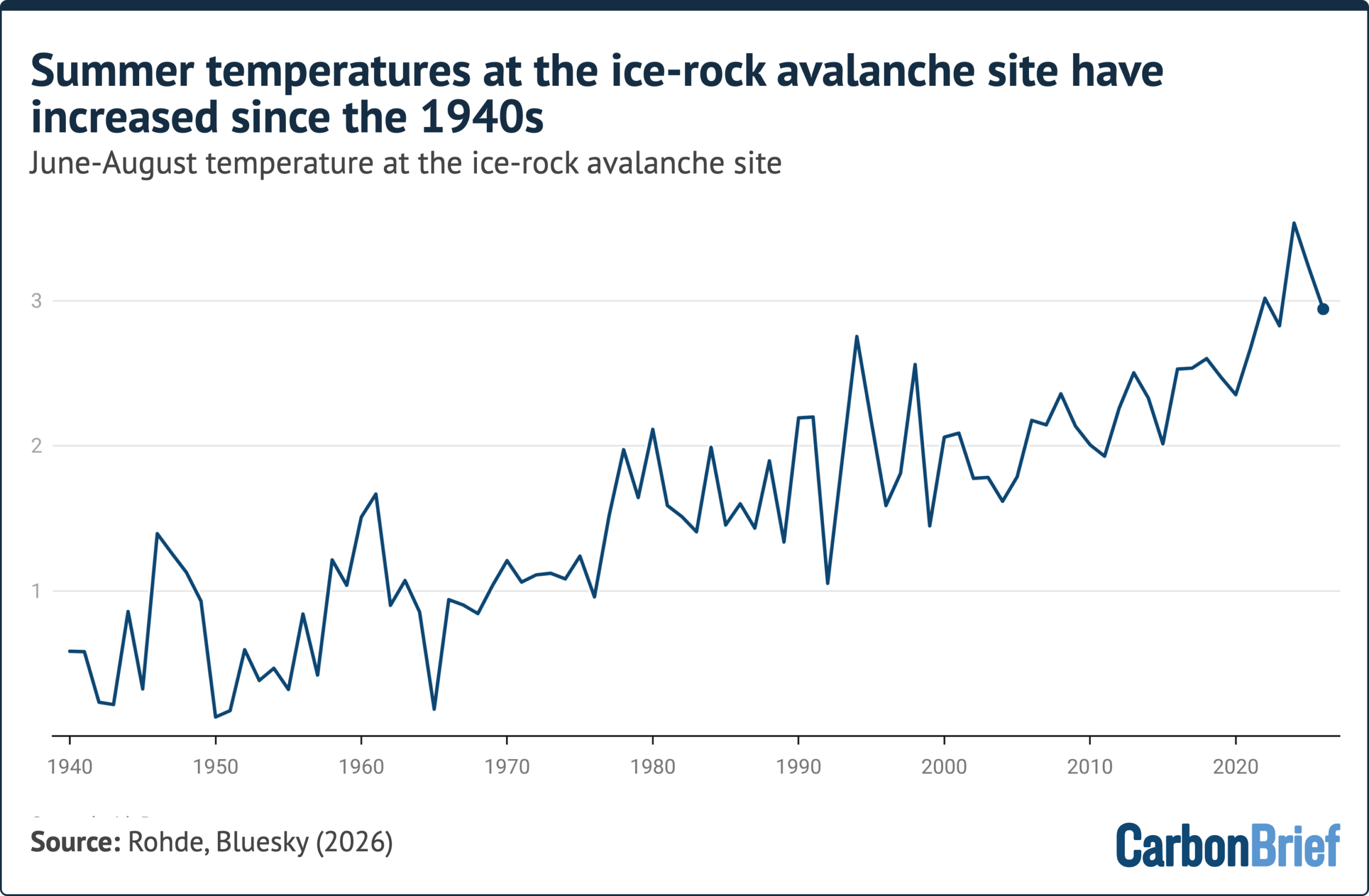
Rohde’s analysis found that June-to-August temperatures have been rising at the site of the glacier collapse since the year 1940, with 2026’s summer the fourth warmest on record, behind 2024, 2025 and 2022. This is shown in the graph below.
Average summer (June-August) temperature at the ice-rock avalanche site over 1940-2026. Data source: Rohde, Bluesky (2026)
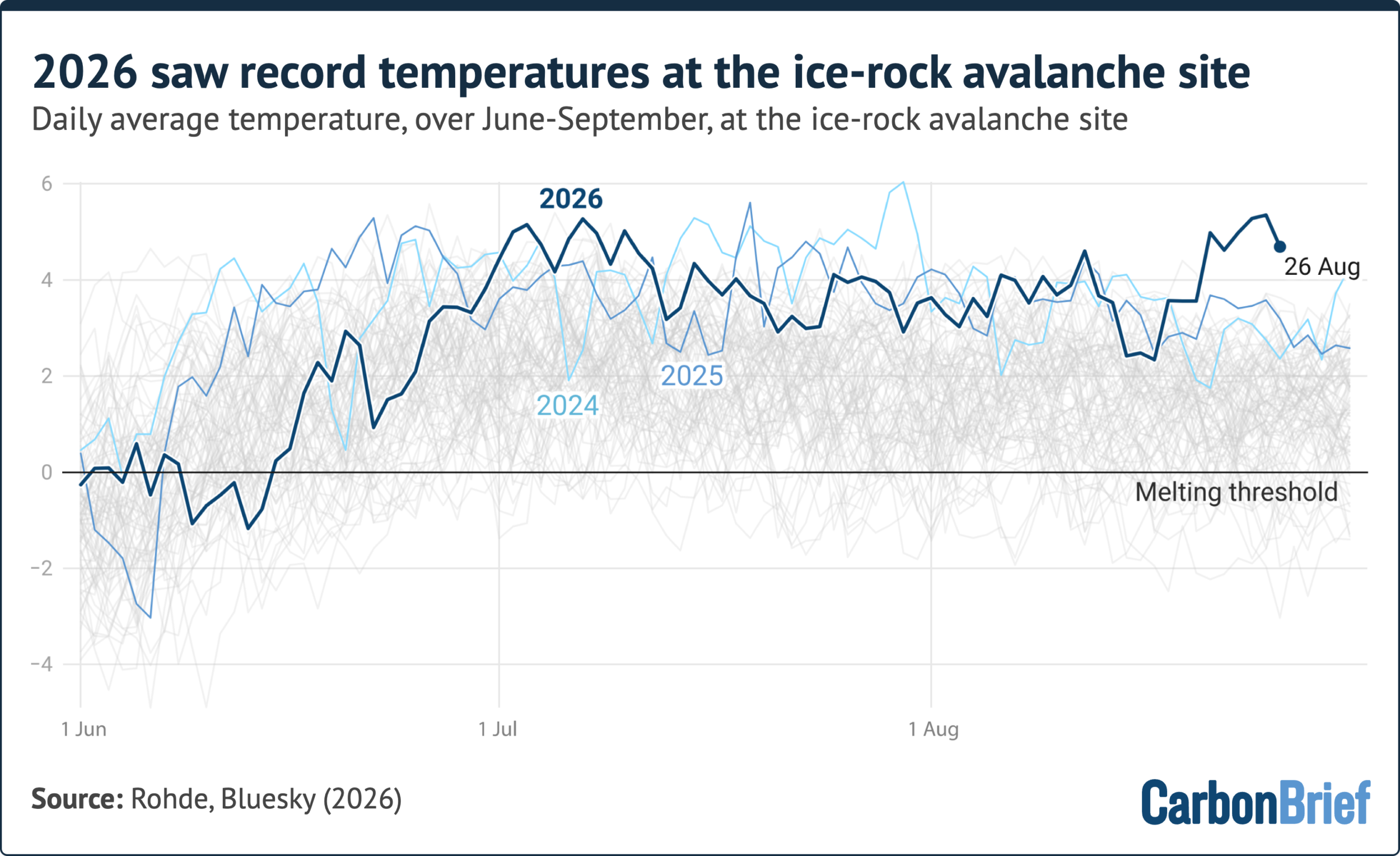
Rohde also found that the days leading up to the disaster recorded the hottest August temperatures ever experienced at the site. This is shown in the graph below.
Daily average temperature, from 1 June-1 September, at the ice-rock avalanche site. 2026, 2025 and 2024 are shown in dark, mid and light blue. All other years from 1940-2023 are shown in grey. Source: Rohde, Bluesky (2026)
“Given the warming trend, this Nepali glacier had probably been thinning and weakening for years, or even decades. But it ultimately failed during the warmest week in one of its warmest years on record. It would be a hell of a coincidence if global warming wasn’t at least partially to blame.”
How have rising temperatures affected mountain stability?
Many experts have linked warming temperatures in the region to thawing permafrost – ground that has been frozen for at least two consecutive years, whose thickness ranges from less than one metre to more than a kilometre.
Steiner is part of a research team that has been using sensors to monitor permafrost in the region since 2014. He tells Carbon Brief that it is “pretty clear” the permafrost has been thawing “very actively” at elevations as high as 5,200 metres above sea level “for many years”. He adds:
“This means that the ground has, over the last decades, moved from being in a solid state into – at least, periodically during the warm season – patchy ground where some is frozen and some isn’t…
“If you have frozen ground next to non-frozen ground, you have dynamics happening between that because there are different densities and there’s movement happening, which is conducive to interventional failure – and that we know from many other cases.”
Davies also points to the “degradation” of perennially frozen ground as a factor in the disaster:
“This permafrost acts as a glue to hold together the rocks and, as it melts, the rock can become weakened.”
Permafrost thaw can also result in saturated ground, says Davies, which adds “pressure in the joints” of rock and can “facilitate” failure. She continues:
“Sources of the water include melting permafrost and meltwater from the overlying glacier. We know that this event happened during a period of warmth, but in the absence of heavy precipitation, pointing to ice melt as the source of water.”
A 2025 study of rock and ice avalanches in High Mountain Asia found that more than two-thirds started in areas “where permafrost is probable”.
How have glaciers retreated in the affected region?
Glaciers – frozen rivers of ice holding three-quarters of the global freshwater supply – are extremely vulnerable to climate change.
In the Himalaya, the rate of glacier retreat has doubled since the late 20th century, according to a 2019 study in Science Advances.
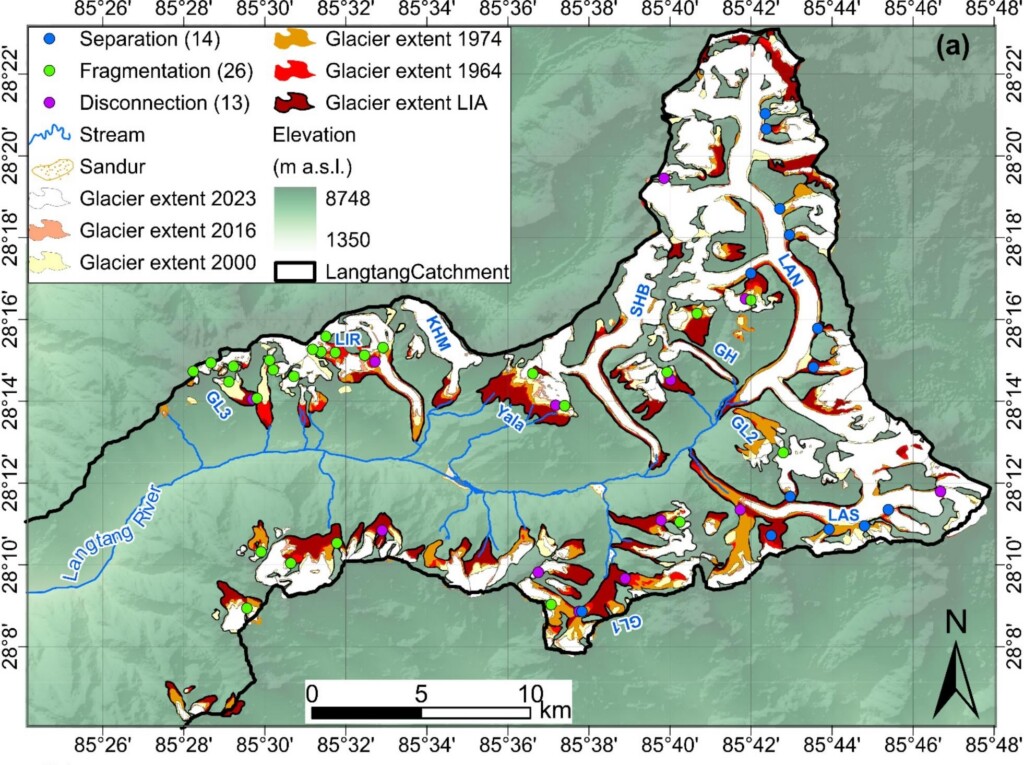
The Global and Planetary Change study found that glacier area loss rates in the Langtang catchment increased more than fourfold from 1964 to 2023 – with melting accelerating after 2000.
It added that glaciers in the region also experienced “fragmentation” and “widespread thinning” over this period.
The study noted that this loss “coincided with elevation dependent warming”.
The figure below provides an overview of glacier loss in the Langtang catchment over 1964-2023, with orange, red and dark red indicating areas of retreat.
In addition, green dots note points of glacier fragmentation, while blue dots show separation and pink show disconnection.
Glacier loss in the Langtang catchment over 1964-2023. Orange, red and dark red indicate areas of retreat. Green dots note points of glacier fragmentation, while blue dots show separation and pink show disconnection. Credit: Silwal et al. (2026)
In comments released by the University of Reading, Prof Maria Shahgedanova, a climate scientist researching climate impacts on mountain glaciers, said that the glacier involved in the floods had “retreated by approximately 450 metres between 1990 and 2020”.
She adds that this “potentially reduce[d] the mechanical support provided by the glacier to the underlying rock slope”.
Speaking to Carbon Brief, Davies reiterates that the retreat of the glacier is “potentially a contributing factor” to the bedrock collapse and subsequent disaster.
This is because the removal of the glacier from the lower slopes leaves the “upper rock slopes less stable”, she says.
The most recent assessment by the International Centre for Integrated Mountain Development said that glaciers in the Hindu Kush Himalaya region are “rapidly shrinking” as a result of climate change. (This region extends 3,500km over Afghanistan, Bangladesh, Bhutan, China, India, Myanmar, Nepal and Pakistan.)
It said this loss is threatening the safety of the nearly two billion people, including by increasing the risk of “glacial lake outburst floods” (GLOFs). A GLOF is a sudden and catastrophic release of meltwater from a glacial lake.
Although this disaster was not caused by a GLOF, it is known that climate change is making such events more likely.
However, many climate scientists have cautioned that it is too early to say precisely how climate change impacted the disaster.
Davies tells Carbon Brief:
“These events happen so quickly that the exact causes and drivers can take a little time to uncover, especially if the event was a surprise and there had been no monitoring system in place.”
When trying to determine the role human-caused climate change played in the intensity or likelihood of extreme weather, scientists turn to the field of “attribution science”.
To date, no formal rapid attribution study has been produced that attempts to quantify whether – and how – climate change contributed to the event.
Scientists have noted that climate attribution of ice-rock avalanches – which are typically driven by a variety of factors – remains limited, in part because of the lack of a long-term observational record of previous collapses in high mountain areas.
Meanwhile, the studies that do exist stop short of directly linking such disasters to climate change. For example, the authors of a 2021 study into the Chamoli ice-rock avalanche concluded that “we cannot attribute this individual disaster specifically to climate change”.
However, they added, the “possibly increasing frequency of high-mountain slope instabilities can likely be related to observed atmospheric warming and corresponding long-term changes in cryospheric conditions (glaciers and permafrost)”.
In the aftermath of the disaster, many researchers have similarly highlighted that climate change could not be singled out as the cause of the disaster, even if warming likely increased the probability of its occurrence.
On the Climate Brink substack, Carbon Brief’s climate science contributor Dr Zeke Hausfather noted that a “definitive single-event attribution” of the more recent disaster “may never be possible” due to the “messy causality of rock-ice avalanches”.
However, he added that both the existing scientific literature and “essentially every scientist working on these hazards point in the same direction” – namely, that warming is making such events more likely in the Himalaya.
Steiner tells Carbon Brief it might be possible to attribute different factors that played a role in the disasters to climate change – for instance, the recession of the glacier – but it would be more difficult to do so for the event as a whole.
Part of the reason for this, he says, is that rock failures in this region of the Himalaya have occurred for millennia, well before humans started altering the climate.
However, he continues:
“The physics of it is not something that has been made possible by climate change. This could have happened without it. But the chance of it happening – and the likelihood of it happening five years after a previous, similar event [in Chamoli] – we, as the scientific community, can be pretty confident about that [being increased because of a changing climate].
“This is because so many of the changes that we know are related to climate change can potentially drive the build-up to eventual failure.”
Ultimately, says Davies, a “careful attribution study is needed, but it is hard to argue that the rapidly warming climate is not having an effect in these regions”. She adds:
“A single event may have multiple drivers, but we are seeing an increase in these events and are likely to see more as the permafrost and glacier melt continues.”