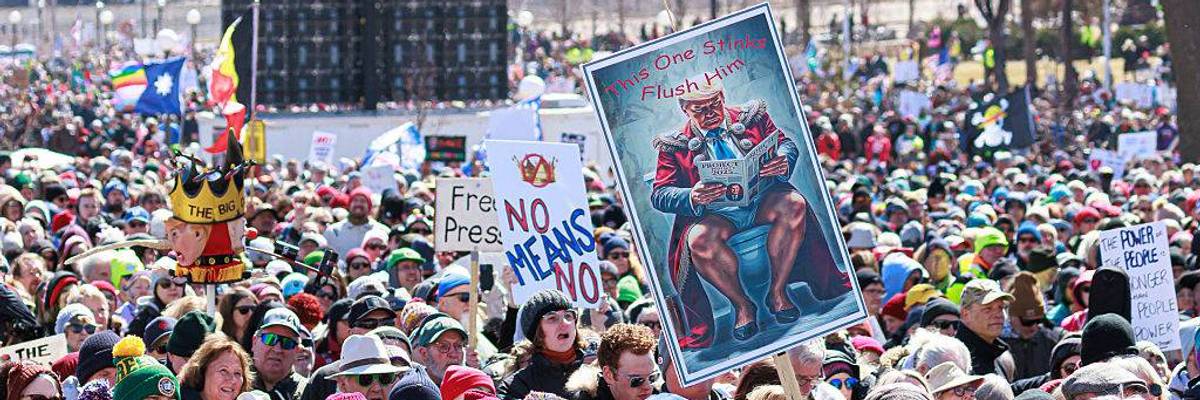
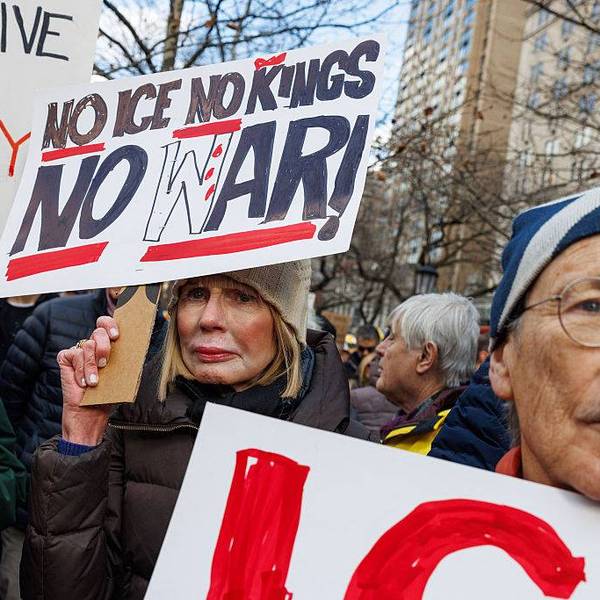
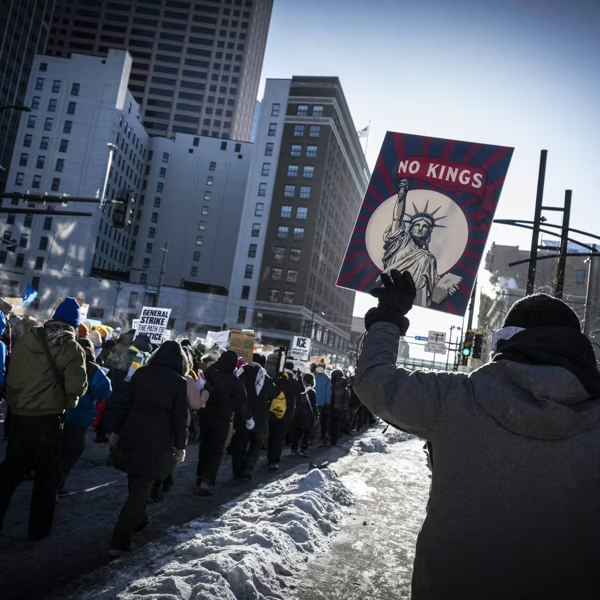
A large crowd of demonstrators gather outside the Minnesota State Capitol during the “No Kings” national day of protest in Saint Paul, Minnesota, on March 28, 2026. (Photo by Kerem Yucel / AFP via Getty Images)
“No work, no school, no shopping. We’re going to show up and say we’re putting workers over billionaires and kings.”
Ezra Levin, co-founder of Indivisible, said on Saturday that a nationwide general strike is being planned for May 1 that will be modeled on the day of action residents of Minnesota organized in January against the brutality carried out by federal immigration enforcement officials.
Appearing at the flagship No Kings rally in Minneapolis, Levin praised the strength shown by the Minnesota protesters in the face of the US Immigration and Customs Enforcement (ICE) siege of their city this year, and said his organization wanted to replicate it across the country.
“The next major national action of this movement is not just going to be another protest,” Levin said. “It is a tactical escalation… It is an economic show of force, inspired by Minnesota’s own day of truth and action.”
Levin then outlined what the event would entail.
“On May 1, on May Day, we are saying, ‘No business as usual,’” he said. “No work, no school, no shopping. We’re going to show up and say we’re putting workers over billionaires and kings.”
Levin: This is the largest protest in Minnesota history… The next major national action of this movement is not just gonna be another protest. On May 1st, across the country, we are saying no business as usual. No work, no school, no shopping. We're gonna show up and say we're… pic.twitter.com/bRPR7K5DuP
Levin added that “we are going to build on that courage, that sacrifice” that Minnesota residents showed during their day of action in January, and vowed “to demonstrate that regular people are the greatest threat to fascism in this country.”
In an interview with Payday Report published Saturday, Indivisible co-founder Leah Greenberg said that the goal of the nationwide strike action would be to send “a clear message: we demand a government that invests in our communities, not one that enriches billionaires, fuels endless war, or deploys masked agents to intimidate our neighbors.”
The No Kings protests against President Donald Trump’s authoritarian government, which Indivisible has been central in organizing, have brought millions of Americans into the streets.
Polling analyst G. Elliott Morris estimated that the previous No Kings event, held in October, drew at least 5 million people nationwide, making it likely “the largest single-day political protest ever.”
Climate science denier Donald Trump confirms that he knows nothing about democracy and that more liquid gold is being secured according to his policy of global privateering.Donald Trump sings and dances, says that it’s fun to kill everyone …Keir Starmer explains that UK is participating defensively in Trump and Israel’s criminal war for Israel’s genocidal expansion in Iran and states that he supports Zionism “without qualification”. Keir Starmer said “I said it loud and clear – and meant it – that I support Zionism without qualification.” here: https://www.jewishnews.co.uk/keir-starmer-interview-i-will-work-to-eradicate-antisemitism-from-day-one/
Huge “No Kings” protests throughout the United States and a huge anti-Fascist protest in London yesterday.
Climate science denier Donald Trump confirms that he knows nothing about democracy and that more liquid gold is being secured according to his policy of global privateering.Keir Starmer explains that UK is participating defensively in Trump and Israel’s criminal war for Israel’s genocidal expansion in Iran and states that he supports Zionism “without qualification”. Keir Starmer said “I said it loud and clear – and meant it – that I support Zionism without qualification.” here: https://www.jewishnews.co.uk/keir-starmer-interview-i-will-work-to-eradicate-antisemitism-from-day-one/
A view of the US aircraft carrier USS Gerald R. Ford at a US Navy base in Souda Bay, Crete, where it is set to undergo repairs on March 23, 2026. [Stefanos Rapanis – Anadolu Agency]
Americans have heard this script before. A president says he wants a deal, insists he does not want a wider war, and then quietly builds the military architecture for one anyway. That is where the United States now stands in its war with Iran. Even as Donald Trump talks about a possible settlement and claims there are “major points of agreement,” the Pentagon is preparing to send thousands more troops from the 82nd Airborne Division to the Middle East, adding to a military buildup that already looks less like leverage and more like preparation for a deeper phase of the war. A government serious about winding down a conflict does not keep expanding the force package behind it.
The gap between Washington’s words and Washington’s actions is no longer small enough to dismiss as ordinary diplomatic theater. Trump says contacts with Iran are promising. Tehran has publicly denied direct talks, and Reuters has reported that Iran’s negotiating position has hardened during the war, with demands for guarantees against future attacks and refusal to place new limits on its missile program. That does not look like a near-term diplomatic breakthrough. It looks like an administration using the language of negotiation to buy time while keeping military options open. The question is no longer whether Washington prefers a deal in the abstract. The question is whether “talks” are becoming political cover for continued escalation.
That matters because coalition reluctance does not usually restrain Washington. More often, it leaves Washington compensating with more American assets, more American risk, and eventually more American ownership of a war that was sold as limited.
There is another sign that this war is moving in a more dangerous direction: America is having trouble persuading others to own it. When Trump asked allies to help keep the Strait of Hormuz open, several of them declined to send ships. Japan and Australia publicly said they had no immediate plans to participate, and Reutersreported similar hesitation from other partners. That matters because coalition reluctance does not usually restrain Washington. More often, it leaves Washington compensating with more American assets, more American risk, and eventually more American ownership of a war that was sold as limited. A conflict that begins as a joint project can become an overwhelmingly American burden simply because nobody else wants to get pulled in deeper.
This is how mission creep actually happens. It rarely arrives with a formal declaration that the United States is entering a ground war. It comes in pieces: reinforcements to protect bases, troops to secure shipping lanes, special operations contingencies for sensitive sites, and a standing insistence that “all options remain on the table.” Reutersreported last week that U.S. officials were weighing reinforcements that could support operations connected to Hormuz and other possible next steps, while experts warned that securing Iran’s uranium stockpiles would be highly complex and risky even for special operations forces. That is not the language of a conflict staying neatly contained. It is the language of a war searching for its next rationale.
The American public, importantly, is not asking for this. A Reuters/Ipsos poll published last week found that 65 percent of Americans believe Trump will order troops into a large-scale ground war in Iran, but only 7 percent support such an idea. An AP-NORC poll published found that most Americans believe recent U.S. military action against Iran has gone too far, and about six in ten oppose deploying U.S. ground troops to fight there. Those numbers matter because they expose the fiction that a deeper war would rest on any real democratic consensus. Washington is not moving toward a broader conflict because the public has embraced one. It is moving there in spite of the public’s clear warning.
That should disturb Americans even if they have no sympathy at all for the Iranian government. One does not have to romanticise Tehran to see the danger of what Washington is doing. The United States and Israel may share the current war effort, but any ground phase would be paid for primarily by Americans, fought primarily by Americans, and politically owned in Washington long after today’s rhetoric about quick outcomes has faded. That is the part of “supporting an ally” that the White House prefers to leave vague. Air campaigns can be sold as controlled and temporary. Ground commitments are different. They create their own logic, their own momentum, and their own excuses for staying longer than promised.
Even now, after weeks of US-Israeli strikes, the Strait of Hormuz remains a live strategic problem, negotiations remain uncertain, and military planners are still talking in terms of options rather than outcomes.
Nor is there any reason to think a ground phase would solve the political problem that air power has failed to solve. Iran is not a target that can simply be bullied into strategic surrender by adding more American bodies to the region. Even now, after weeks of US-Israeli strikes, the Strait of Hormuz remains a live strategic problem, negotiations remain uncertain, and military planners are still talking in terms of options rather than outcomes. That is usually a sign that the advertised strategy has stalled. When that happens, Washington has a long habit of treating escalation not as proof of failure but as the remedy for failure. That is how bad wars become bigger wars.
What makes this moment especially dangerous is that the administration still wants the political benefits of sounding restrained while preparing for the military benefits of going further. It wants to say “deal” and move troops at the same time. It wants to claim this is not another open-ended American war while creating precisely the conditions from which open-ended American wars emerge. For Middle East Monitor readers, this should be understood clearly: Washington is not standing outside this conflict trying to calm it. It is deep inside it, helping shape the next phase while pretending the next phase may never come. If the White House truly wanted to prevent a ground war, it would stop building one. Until then, Americans should call this what it is—not prudence, not deterrence, but a familiar and dangerous drift toward a war the country has not chosen and does not want.
The views expressed in this article belong to the author and do not necessarily reflect the editorial policy of Middle East Monitor.
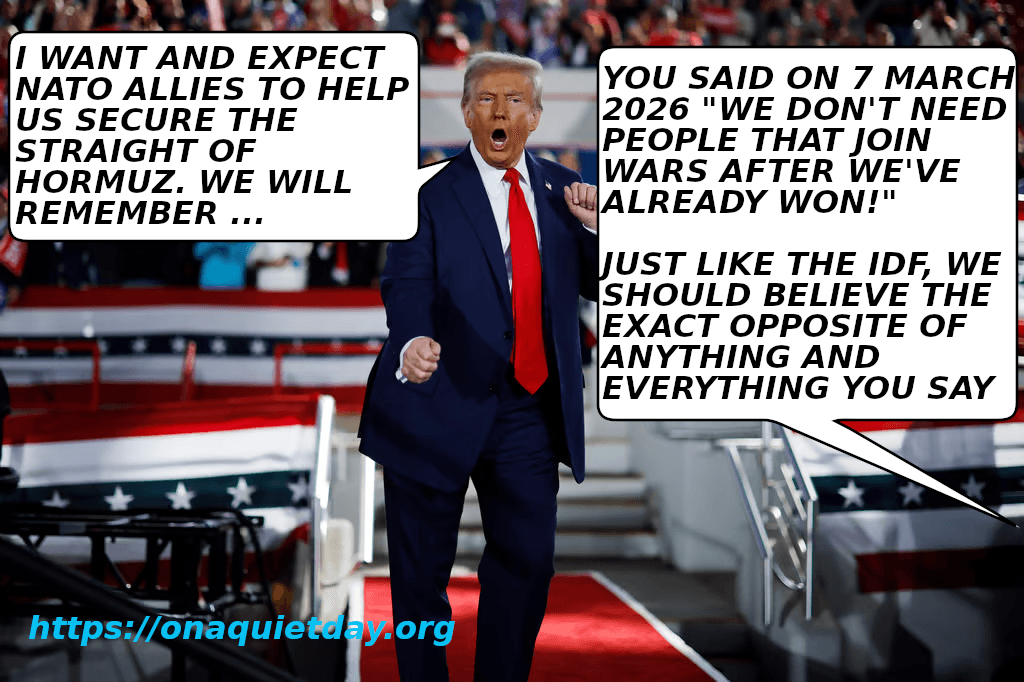
Donald Trump calls for help from NATO allies in securing the Straight of Hormuz despite saying on 7 March 2026 that they don’t need people to join wars after they’ve already won.Keir Starmer explains that UK is participating defensively in Trump and Israel’s criminal war for Israel’s genocidal expansion in Iran and states that he supports Zionism “without qualification”. Keir Starmer said “I said it loud and clear – and meant it – that I support Zionism without qualification.” here: https://www.jewishnews.co.uk/keir-starmer-interview-i-will-work-to-eradicate-antisemitism-from-day-one/Orcas discuss how Trump was re-elected and him being an obviously insane, xenophobic Fascist.
This work by Middle East Monitor is licensed under a Creative Commons Attribution-NonCommercial-ShareAlike 4.0 International License.
Burned press equipment and belongings are seen at the site of an Israeli airstrike in the Jezzine district of southern Lebanon, where three journalists, including Ali Shuaib of Al Manar TV, Fatima Fetuni of Al Mayadeen and photojournalist Mohammed Fetuni, were killed after their vehicle was targeted, on March 28, 2026. [Ahmed Kaddoura – Anadolu Agency]
Three journalists were killed on Saturday when an Israeli airstrike targeted a vehicle they were traveling in near the city of Jezzine in southern Lebanon, according to an Anadolu correspondent, Anadolu reports.
The deceased include Al-Manar TV correspondent Ali Shuaib, Al-Mayadeen correspondent Fatima Fatouni, and a cameraman.
In a statement, the Israeli army admitted the killing of Ali Shuaib, but did not comment on the death of the other two journalists.
Lebanese President Joseph Aoun said the attack constitutes a “blatant crime that violates all norms” and called on international bodies to take action.
Prime Minister Nawaf Salam also condemned the attack, urging respect for international law, according to the National News Agency.
Separately, the Syndicate of Workers in Visual and Audio Media in Lebanon said: “Targeting journalists in the field is a blatant attack on press freedom and a transparent attempt to silence free voices and obscure the serious human rights violations taking place.”
“This crime not only targets specific individuals but also the entire media community and all those who strive to reveal the truth to the public,” it added in a statement.
In a news conference, Information Minister Paul Morcos said that Lebanon is preparing to file a complaint with the UN Security Council over the attack.
Earlier, the National News Agency reported that an Israeli airstrike targeted a car on the Al-Barad road in Jezzine, without providing further details.
Since dawn on Saturday, Israel launched airstrikes and artillery attacks on 42 towns, cities, and areas in Lebanon, most of them in the south, according to the news agency.
The Israeli offensive against Lebanon, which began on March 2, has resulted in 1,142 deaths and 3,315 injuries, according to the latest figures from the Lebanese Health Ministry.
Donald Trump calls for help from NATO allies in securing the Straight of Hormuz despite saying on 7 March 2026 that they don’t need people to join wars after they’ve already won.Keir Starmer explains that UK is participating defensively in Trump and Israel’s criminal war for Israel’s genocidal expansion in Iran and states that he supports Zionism “without qualification”. Keir Starmer said “I said it loud and clear – and meant it – that I support Zionism without qualification.” here: https://www.jewishnews.co.uk/keir-starmer-interview-i-will-work-to-eradicate-antisemitism-from-day-one/Orcas discuss how Trump was re-elected and him being an obviously insane, xenophobic Fascist.
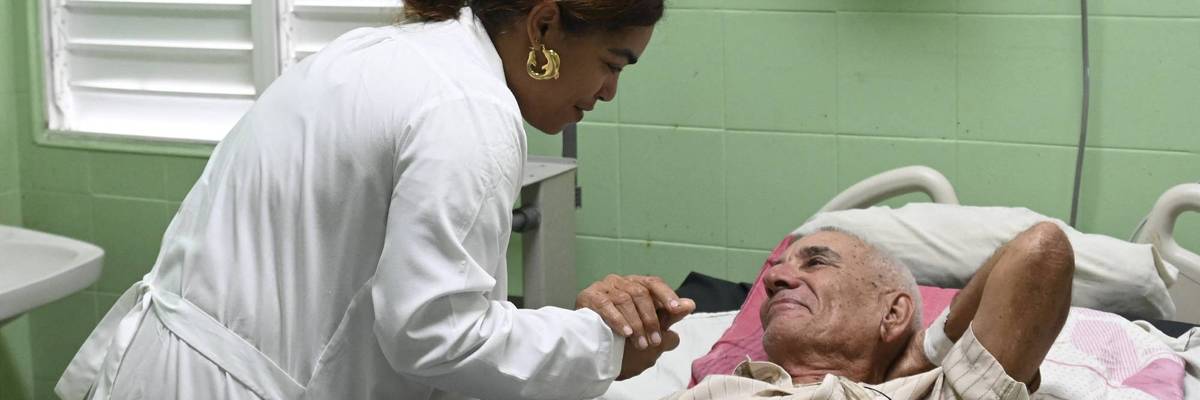
A doctor talks to a patient in the cardiology room of the Calixto Garcia Hospital in Havana on February 12, 2024. (Photo by Yamil Lage/AFP via Getty Images)
“We do everything with love to assist people, but the reality right now is that we don’t have enough resources,” said one Cuban doctor, who added that “the main cause of everything is the USA.”
The Trump administration’s oil blockade of Cuba—an escalation of the 65-year US stranglehold on the socialist island’s economy—is killing Cubans amid a severe shortage of electricity and critical basic medical supplies, doctors and nurses there told reporters this week.
“I can’t tell you how many deaths, but I’m sure there are more than in the same period last year,” Dr. Alioth Fernandez, chief anesthesiologist at William Soler Pediatric Hospital in Havana, told The New York Times in an article published Friday. “I see it in shift handovers, in colleagues’ comments, and in children I’ve operated on.”
Cuba’s universal healthcare system is internationally known. Its “Army of White Coats” has been deployed around the world, both to provide routine and specialized care, as well as during emergencies such as the Haiti earthquake, Sierra Leone Ebola outbreak, and Covid-19pandemic in Italy.
Despite decades of success under increasingly adverse conditions, Cuba’s vaunted health system is under tremendous strain, due in no small part to the cumulative effects of generations of US economic sanctions.
“Since I was born, this is the most difficult time, without any doubt,” José Carlos, a resident intern at Havana Cardiology Institute, told the Canadian Broadcasting Corporation on Thursday. “We do everything with love to assist people, but the reality right now is that we don’t have enough resources.”
The lack of fuel is limiting ambulance service and keeping many doctors and other medical professionals from commuting to hospitals that are canceling surgeries and discharging patients early. As Common Dreams reported earlier this week, more than 96,000 Cubans—including 11,000 children—are waiting for surgery due to the fuel shortage.
“Everything is hitting us—energy, resources, transportation,” Carlos told the CBC.
We met in Cuba with doctors and medical professionals to deliver desperately needed medicine. They explained many basic products like pain killers and antibiotics are hard to get and hospitals lack medical supplies while experiencing nationwide blackouts due to the US blockade. pic.twitter.com/DAgD3P3j7g
When the lights go out, neonatal nurses use hand-pumped ventilators to keep infants alive. Without power, hospitals and clinics can’t administer chemotherapy cycles or dialysis treatments.
“I don’t know how long we can keep going,” Xenia Álvarez, the mother of a 21-year-old man who suffers a rare genetic disease and requires full-time use of a ventilator, told The New York Times.
Shortages of basic medicines and supplies are forcing doctors to substitute medications, delay treatments, or even ask patients’ relatives to find supplies themselves. Antibiotics, painkillers, and medications to treat chronic diseases are scarce, as are gloves, syringes, and diagnostic equipment. Hospital staff also report difficulty maintaining sterile conditions.
While the US government claims that humanitarian goods like medicine are exempt from sanctions, critics counter that the fuel blockade, along with severe restrictions on banking and shipping, effectively block many medical supplies from reaching the island. The Trump administration has also been pressuring countries into expelling the lifesaving Cuban medical teams, sparking widespread outrage and condemnation.
🇨🇺🇯🇲 Jamaica to end five-decade healthcare relationship and lose over 300 Cuban doctors.
Social movements in Jamaica are protesting their government’s decision to end the medical cooperation between Cuba and Jamaica. This comes amid rising pressure from the United States… pic.twitter.com/iMVQiuwa5D
After the Fidel Castro-led revolution that ousted the US-backed dictatorship of Fulgencio Batista, the United States imposed an economic embargo on the island that has been perennially condemned by an overwhelming majority of United Nations member states for 33 years. Cubasays US sanctions have cost its economy more than $200 billion in inflation-adjusted losses.
US Secretary of State Marco Rubio recently admitted that the economic chokehold is meant to force political change in Cuba while simultaneously disparaging the Cuban economy as “dysfunctional.”
Rubio also said that although President Donald Trump is currently focused on the US-Israeli war of choice on Iran—one of seven nations attacked since the self-proclaimed “president of peace” returned to the White House—he would “be doing something with Cuba very soon.”
Trump said earlier this month that he believes he’ll “be having the honor of taking Cuba,” language echoing the 19th century US imperialists who conquered the island along with Puerto Rico and the Philippines from Spain.
In addition to patients, the crisis in Cuba is also taking a physical and psychological toll on Cuban doctors—who, even with a recent raise earn just 100 pesos, or about $2.40, per 12-hour shift. This, in a country in which a dozen eggs cost nearly $10. Many doctors rely upon side hustles to get by.
“Doctors’ pay is just for basic things,” said Carlos. “It doesn’t allow you to buy many things in the supermarket or go to a restaurant or a hotel, or things like that.”
Breakdowns and burnout are on the rise.
“I’ve seen doctors cry,” one physician, who wished to remain anonymous for fear of retaliation, told Reuters. “With this crisis, they cry. They’ve stopped working, they’ve become depressed. You can see it on their faces.”
Despite the worsening situation, Carlos told the CBC that he does not want to leave Cuba, and blamed the US for the crisis.
“The main cause of everything is the USA,” he said. “I have no doubt about that.”
Some do want to leave, blaming their own government as well the US embargo for Cuba’s suffering. Others are taking things one day at a time.
“We don’t know what will happen,” a nurse who gave only her first name, Rita, told the CBC, “so we just keep working.”
The mounting—and preventable—deaths in Cuba are prompting renewed calls for the US to lift sanctions on Cuba.
“No patient deserves this. Trump’s cruel Cuban blockade is killing people unnecessarily,” National Nurses United, the largest US nurses’ union, said on social media Friday. “Depriving Cubans of essential resources needed to sustain life and health is an unconscionable violation of human rights. Nurses say: End the blockade now!”
Congresswoman Ilhan Omar (D-Minn.) also weighed in during a Thursday floor speech in which she said that “Cuba poses no threat to us, yet we are strangling an entire nation with economic warfare.”
Trump's oil blockade is strangling an entire nation.
Families are going without food. Water systems are failing. Hospitals are struggling to stay open. This is economic warfare.
I'm calling for an immediate end to this cruel and indefensible blockade. Hands off Cuba. pic.twitter.com/MNybPNlBHn
“Families are going without food. Water systems are failing. Hospitals are struggling to stay open,” she continued. “These tactics are designed to suffocate an island into submission. Make no mistake: This unconscionable suffering is occurring because Trump is trying to force regime change.”
“Hands off Cuba,” Omar added. “End the blockade now.”
Donald Trump sings and dances, says that it’s fun to kill everyone …